Assessing and Improving Recommender
Systems to Deal with User Cold-Start Problem
Crícia Zilda Felício Paixão
Universidade Federal de Uberlândia
Faculdade de Computação
Program a de Pós-Graduação em Ciência da Computação
Crícia Zilda Felício Paixão
Assessing and Improving Recommender
Systems to Deal with User Cold-Start Problem
Tese de doutorado apresentada ao Programa de Pós-graduação da Faculdade de Computação da Universidade Federal de Uberlândia como parte dos requisitos para a obtenção do título de Doutor em Ciência da Computação.
Área de concentração: Ciência da Computação
Orientador: Celia Aparecida Zorzo Barcelos Coorientador: Philippe Preux
P149 2017
Orientadora: Célia Aparecida Zorzo Barcelos. Coorientador: Preux, Philippe.
Tese (doutorado) - Universidade Federal de Uberlândia, Pós- Graduação em Ciência da Computação.
Inclui bibliografia.
1. Computação - Teses. 2. Percepção visual - Teses. 3. Usuários da Internet - Teses. 4. Sistemas de Recomendação Social - Teses. I. Barcelos, Célia Aparecida Zorzo. II. Preux, Philippe. III. Universidade Federal de Uberlândia. Programa de Pós-Graduação em Ciência da Computação. IV. Título.
Paixão, Crícia Zilda Felício, 1977—
Assessing and improving recommender systems to deal with user cold-start problem / Crícia Zilda Felício Paixão. - 2017.
113 f. : il.
Agradecimentos
A Deus e a todo o apoio espiritual que recebi na minha jornada.
À professora Sandra de Amo, pela orientação de parte do meu trabalho e pelo exemplo de dedicação ao trabalho e competência como pesquisadora.
Ao professor Philippe Preux por ter me acolhido no grupo Sequel - INRIA, pela ori entação e por ter colaborado ativamente nas publicações.
À professora Celia Barcelos por ter assumido o compromisso da minha orientação na reta final do meu doutorado, me dando a segurança necessária para que eu pudesse concluí-lo.
Ao Instituto Federal do Triângulo Mineiro - Campus Uberlândia Centro pela licença de 1 ano e 10 meses para que pudesse me dedicar exclusivamente ao doutoramento.
Aos colegas do LSI pelo auxílio com os artigos e discussões sobre o trabalho.
Ao meu filho Pedro Paulo pela graça de ser mãe, pelo sorriso que me revigora, pelo abraço que me conforta; ingredientes que fizeram a diferença na execução do meu trabalho. Ao meu filho Mateus que veio me acompanhar nos últimos meses dessa jornada enchendo meu coração de alegria.
Resumo
Sistemas de recomendação fazem parte do nosso dia-a-dia. Os métodos usados nesses sistemas tem como objetivo principal predizer as preferências por novos itens baseado no perfil do usuário. As pesquisas relacionadas a esse tópico procuram entre outras coisas tratar o problema do cold-start do usuário, que é o desafio de recomendar itens para usuários que possuem poucos ou nenhum registro de preferências no sistema.
Uma forma de tratar o cold-start do usuário é buscar inferir as preferências dos usuários a partir de informações adicionais. Dessa forma, informações adicionais de diferentes tipos podem ser exploradas nas pesquisas. Alguns estudos usam informação social combinada com preferências dos usuários, outros se baseiam nos clicks ao navegar por sites Web, informação de localização geográfica, percepção visual, informação de contexto, etc. A abordagem típica desses sistemas é usar informação adicional para construir um modelo de predição para cada usuário. Além desse processo ser mais complexo, para usuários
full cold-start (sem preferências identificadas pelo sistema) em particular, a maioria dos sistemas de recomendação apresentam um baixo desempenho. O trabalho aqui apresen tado, por outro lado, propõe que novos usuários receberão recomendações mais acuradas de modelos de predição que já existem no sistema.
Nesta tese foram propostas 4 abordagens para lidar com o problema de cold-start
do usuário usando modelos existentes nos sistemas de recomendação. As abordagens apresentadas trataram os seguintes aspectos:
□ Inclusão de informação social em sistemas de recomendação tradicional: foram in vestigados os papéis de várias métricas sociais em um sistema de recomendação de preferências pairwise fornecendo subsidíos para a definição de um framework geral para incluir informação social em abordagens tradicionais.
formação adicional como uma rede de usuários, foi investigado como as redes de usuários podem ser incluídas nos sistemas de recomendação de maneira a beneficiar a recomendação para usuários cold-start.
□ Análise do impacto da seleção de modelos de predição para usuários cold-start: a última abordagem proposta considerou que sem a informação adicional o sis tema poderia recomendar para novos usuários fazendo a troca entre os modelos já existentes no sistema e procurando aprender qual seria o mais adequado para a recomendação.
As abordagens propostas foram avaliadas em termos da qualidade da predição e da qualidade do ranking em banco de dados reais e de diferentes domínios. Os resultados obtidos demonstraram que as abordagens propostas atingiram melhores resultados que os métodos do estado da arte.
Palavras-chave: Sistema de Recomendação; Preferências dos Usuários; Problema do
Crícia Zilda Felício Paixão
UFU
Universidade Federal de Uberlândia
Faculdade de Computação
Program a de Pós-Graduação em Ciência da Computação
U N IV E R SID A D E FE D E R A L D E U B E R L Â N D IA F A C U L D A D E DE C O M P U T A Ç Ã O
P R O G R A M A D E P Ó S -G R A D U A Ç Ã O E M CIÊN CIA D A C O M P U T A Ç Ã O
The undersigned hereby certify they have read and recommend to the PPGCO for acceptance the thesis entitled “
Assessing and Improving
Recommender Systems to Deal with User Cold-Start Problem
” submitted byCrícia Zilda Felício Paixão
as part o f requirements for obtain thePhD
degree in Computer Science.
Uberlândia,___d e __________de
Supervisor:____________________________________ Prof. Dra. Celia Aparecida Zorzo Barcelos
Universidade Federal de Uberlândia
CoSupervisor:
Prof. Dr. Philippe Preux University of Lille
Examining Committee Members:
Prof. Dra. Maria Camila Nardini Barioni Universidade Federal de Uberlândia
Prof. Dr. Bruno Augusto Nassif Travençolo Universidade Federal de Uberlândia
Prof. Dr. Joao Gama Universidade do Porto
Abstract
Recommender systems are in our everyday life. The recommendation methods have as main purpose to predict preferences for new items based on user’s past preferences. The research related to this topic seeks among other things to discuss user cold-start problem, which is the challenge of recommending to users with few or no preferences records.
One way to address cold-start issues is to infer the missing data relying on side in formation. Side information of different types has been explored in researches. Some studies use social information combined with users’ preferences, others user click behav ior, location-based information, user’s visual perception, contextual information, etc. The typical approach is to use side information to build one prediction model for each cold user. Due to the inherent complexity of this prediction process, for full cold-start user in particular, the performance of most recommender systems falls a great deal. We, rather, propose that cold users are best served by models already built in system.
In this thesis we propose 4 approaches to deal with user cold-start problem using existing models available for analysis in the recommender systems. We cover the follow aspects:
□ Embedding social information into traditional recommender systems: We investi gate the role of several social metrics on pairwise preference recommendations and provide the hrst steps towards a general framework to incorporate social information in traditional approaches.
□ Improving recommendation with visual perception similarities: We extract networks connecting users with similar visual perception and use them to come up with prediction models that maximize the information gained from cold users.
based on the switch of models already built in system.
We evaluated the proposed approaches in terms of prediction quality and ranking quality in real-world datasets under different recommendation domains. The experiments showed that our approaches achieve better results than the comparison methods.
List of Figures
Figure 1 - Matrix Factorization method illustration... 27
Figure 2 - Bayesian Preference Network PNeti over C1 preferences... 39
Figure 3 - Social PrefRec structure... 42
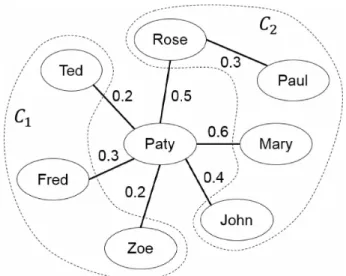
Figure 4 - Social network example... 42
Figure 5 - Social PrefRec Framework... 43
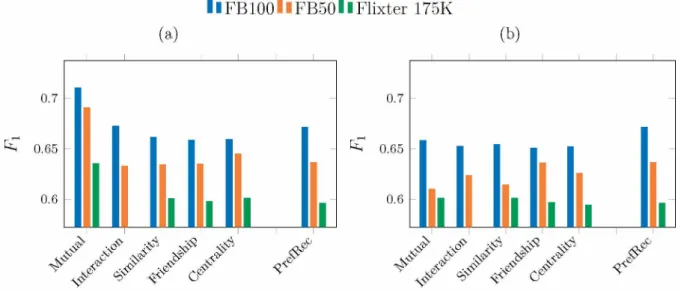
Figure 6 - F1 scores for Social PrefRec and PrefRecfor 2 model selection strategies: (a) Minimum threshold, (b) Average connection weight. . . . 50
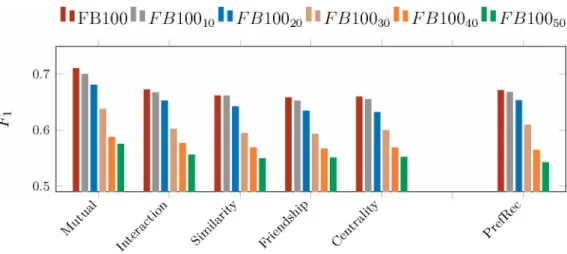
Figure 7 - Social PrefRec and PrefRec metrics across sparse scenarios with minimum threshold of 40%... 53
Figure 8 - Profile length factor effect (a, see Eq. 6) over F1 measure (PrefRec) in Figure 8a. Social degree effect variants (0, see Eq. 7) over F1 measure in Figure 8a - 8f... 54
Figure 9 - (a) F1 metric for Popular users and Unpopular users in FB100 and (b) FB50 with minimum threshold of 10%... 55
Figure 10 - Painting of a Dog and Cat. Some people might focus their attention to the cat, but others to the dog... 58
Figure 11 - 11a Gaze positions and fixation length captured. 11b Painting splits in sixteen equal parts. 11c Image parts with nonzero fixation length. . . . 59
Figure 12 - Visual perception clusters and users’ ratings (left), selection of visual perception cluster for ut> (cold start) and ut (right)... 61
Figure 13 - VP Framework general representation... 62
Figure 14 - Bayesian Preference Network PNet1 over V1 preferences... 64
Figure 16 - nDCG scores across Male-Clothing sparser subsets...68
Figure 17 - ToSocialRec selects a prediction model from a set of consensual ones previously built for other users... 72
leftmost blueish bars are algorithms we compare ToSocialRec to, while the pinkisk rightmost bars (over-braced) are variant of ToSocialRec. . 81 Figure 20 - PdMS relies on feedback to learn how to appropriately select a consen
List of Tables
Table 1 - Example of a user-item rating matrix. - means that the user has not
rate the ite m ... 26
Table 2 - Example of movies attributes... 26
Table 3 - Example of users demographic attributes... 26
Table 4 - Movie attributes... 37
Table 5 - User-item rating matrix... 38
Table 6 - Clusters of users with consensual preferences... 39
Table 7 - C\ pairwise relation... 39
Table 8 - Dataset features... 46
Table 9 - Resulting nDCG@5, @10, @15, and @20 against FB50. 50 Table 10 - Resulting nDCG@5, @10, @15, and @20 against FB100 51 Table 11 - Resulting nDCG@5, @10, @15, and @20 against Flixter 175K51 Table 12 - Resulting nDCG@5, @10, @15, and @20 against Flixter 811K51 Table 13 - FB100 sparse subsets... 52
Table 14 - Users’ visual perception over two images of paintings dataset...60
Table 15 - Relational schema of paintings images... 63
Table 16 - Users ratings over painting images... 63
Table 17 - Three Pref-clusters from user-item rating matrix in Table 16... 63
Table 18 - V\ pairwise preference re la tio n ... 63
Table 19 - Paintings and Clothing dataset features... 65
Table 20 - nDCG for cold-start scenario (0-rating) against our three datasets. . . 67
Table 21 - Male-Clothing sparser subsets... 68
Table 22 - nDCG for 5-fold-cross-validation protocol against our three datasets. . 69
Table 23 - Example of a user-item rating matrix. - means that the user has not rate the item. ... 75
Table 24 - Predicted rating matrix... 76
Table 25 - Consensual preference vectors... 76
Table 29 - nDCG for cold-start scenario (0-rating protocol) against Filmtrust dataset. 83 Table 30 - nDCG for cold-start scenario (0-rating protocol) against Epinions dataset. 83 Table 31 - nDCG for cold-start scenario (0-rating protocol) against Paintings dataset. 83 Table 32 - nDCG for cold-start scenario (0-rating protocol) against Clothing dataset. 83 Table 33 - (a) Example of a user-item rating matrix. “-” means that the user
Acronyms list
nDCG: Normalized Discounted Cumulative Gain
PdMS: Prediction Model Selection
RS: Recommender Systems
RMSE: Root Mean Squared Error
SRS: Social Recommender Systems
VP-Rec: Visual Perception recommender
Contents
1 IN T R O D U C T IO N ... 17 1.1 C ontext...17 1.2 Problem...18 1.3 Improving Recommender Systems with Existing Prediction
Models ...19 1.4 Our Approach in a N u tsh ell... 20 1.5 Contributions... 22 1.6 Structure of the T h e s is ... 22
2 FUNDAMENTALS ... 25 2.1 Introduction... 25 2.2 Traditional Recommender System s...25
2.2.1 Collaborative Filtering ... 26 2.2.2 Content-based... 28 2.2.3 H y b r id ... 28
2.3 Related W o r k ... 29
2.3.1 Social Recommender Systems... 29 2.3.2 Visual Perception Similarity ... 30 2.3.3 Model S election ... 31
2.4 Summary ... 33
3 PAIRWISE RECOMMENDERS W ITH SOCIAL INFORMA
TION ... 35 3.1 Introduction ... 35 3.2 Background ... 37 3.3 Social PrefRec ... 41
3.3.1 The Fram ew ork... 43
3.4.2 Comparison M e th o d s... 45 3.4.3 Experimental Protocol ... 46 3.4.4 Evaluation m eth od s... 48
3.5 Result and Discussion...49
3.5.1 How accurately social information help on pairwise preference recom
mendation? (Q1) 49
3.5.2 How relevant are the recommendations made by a social pairwise pref erence recommender? (Q2) ... 49
3.5.3 Which social metrics are more important for item recommendation? (Q3) 52
3.5.4 How effective is Social PrefRec to mitigate data sparsity problems?
(Q4) 52
3.5.5 Does social degree affect Social PrefRec as much as profile length affects PrefRec? ( Q 5 ) ... 52 3.5.6 Are there major differences between the quality of recommendations
considering popular and unpopular users? (Q6) ... 53
3.6 Sum m ary... 55
4 IMPROVING RECOMMENDATION W ITH VISUAL PER
CEPTION SIM ILARITIES... 57 4.1 Introduction... 57 4.2 Background ... 59 4.3 VP Framework ... 61 4.4 Experimental Settings ... 64
4.4.1 Dataset ... 64 4.4.2 Comparison Methods and Parameter Settings... 65 4.4.3 Evaluation Protocols ... 65
4.5 Result and Discussion ... 66
4.5.1 How effective is VP-Rec for cold-start user? (R Q 1 )... 66 4.5.2 How is the performance of VP-Rec under data sparsity? (R Q 2 )... 67
4.5.3 What is the performance comparison of matrix factorization approaches
on users with observed ratings versus V P -Rec? (R Q 3 )... 68
4.6 Summary ... 69
5 BENEFITS OF A GENERAL FRAM EW ORK TO INCOR
PORATE NETWORKED IN FO R M ATIO N ... 71 5.1 Introduction ... 71 5.2 Background ... 73
5.2.2 Preference-like Score... 73
5.3 ToSocialRec... 74
5.3.1 Construction and Update of the Prediction M odels... 75 5.3.2 Making Recommendations ... 77
5.4 Experiment Setting... 78
5.4.1 Datasets and Configuration... 78 5.4.2 Evaluation Metrics... 79 5.4.3 Other m ethods... 79 5.4.4 Parameter Settings ... 80
5.5 Result and Discussion... 80 5.6 Sum m ary... 84
6 LEARNING TO SELECT PREDICTION MODEL AT
COLD-START S T A G E ... 87 6.1 Introduction... 87 6.2 Background ... 89 6.3 PdMS Approach ... 90
6.3.1 Model Computing and U pdating... 90 6.3.2 Recommendation ... 92
6.4 Experiment Setting ... 93
6.4.1 Datasets ... 93 6.4.2 Evaluation Criteria ... 93 6.4.3 Comparison Methods ... 94
6.5 Result and Discussion ... 94 6.6 Summary ... 97
7 C O N C L U SIO N ... 99 7.1 As a Conclusion ... 99 7.2 Future W o rk ...101 7.3 Collaboration ...102
I hereby certify that I have obtained all legal permissions from the owner(s) of each third-party copyrighted matter included in my thesis, and that their permissions allow availability such as being deposited in public digital libraries.
17
C h a p t e r
1
Introduction
1.1 Context
Recommender systems popularization is direct related with the increasing amount of Web information. They can be seen as an information hltering mechanism, but different from search engines. Instead of having a user querying contents, recommender systems predict items/products users preferences. These systems try to predict which movies and songs people will enjoy, which clothes they should buy, which places they should visit, and even whom to date (RESNICK; VARIAN, 1997). The predictions are made based on user preferences information that can include items ratings or purchase histories.
Usually, recommender systems are classihed based on how recommendation are made (ADOMAVICIUS; TUZHILIN, 2005): content-based (PAZZANI; BILLSUS, 2007; LOPS; GEMMIS; SEMERARO, 2011), collaborative hltering (HERLOCKER; KONSTAN; RI EDL, 2000; SU; KHOSHGOFTAAR, 2009) and hybrid (BURKE, 2002; GUNAWAR- DANA; MEEK, 2009). Content-based systems recommend items with similar content to the ones the user preferred in the past. Collaborative hltering recommended items that people with similar preferences liked in the past; and hybrid systems combine collaborative and content-based methods features.
Many of the research challenges that arise in studying collaborative hltering recom- menders situate around data sparsity and cold-start problems (ADOMAVICIUS; TUZHI LIN, 2005). Sparsity is related to the fact that there are a lot of items available in the system and few ratings per user. So, there are few ratings in common among users and that imposes more difficulties to the process of user preferences prediction. Item cold- start problem occur when an item is not rated by a substantial number of users, while user cold-start problem happen when the system has not enough users ratings to learn their preferences and make accurate recommendations.
methods will recommend cold-start items based on its features that can be similar to others non-cold items.
However, to deal with user cold-start problem usually lies in two approaches: ask for user preference elicitation or use additional information to infer the preferences. We will not consider here the user preference elicitation to cope with the cold-start problem.
A user’s preferences can be inferred from many kinds of information, such as so cial information (ALAHMADI; ZENG, 2015), click behavior (LIU; DOLAN; PEDER SEN, 2010), location-based information (CHENG et al., 2012a), visual attention (MELO; NOGUEIRA; GULIATO, 2015), and, more broadly speaking, contextual information (ADOMAVICIUS; TUZHILIN, 2015). With such information, the dominant trend of cur rent studies has been towards designing new personalized prediction models for cold-start users. Henceforth, a recommender system cannot offer personalized recommendations to a user until it has collected enough preference information for that user.
Furthermore, Gomez-Uribe and Hunt show how it is important to provide recommen dations that ht a user’s needs (GOMEZ-URIBE; HUNT, 2015). They advocate that a higher level of personalization is fundamental to increase the chances of success when offering recommendations. According to them, Netflix, a major Internet TV enterprise, “saves up more than $1B per year” with the reduction of subscriber monthly churn, thanks to recommenders algorithms that better match users’ expectations.
This raises one natural question: how to improve recommender systems to better deal with a cold user? This question of dealing with cold users is the main issue addressed in this thesis.
Regarding the vocabulary, new users are also qualihed as “cold” users; dealing with them is the user “cold start” problem. Once enough information to provide accurate recommendations has been gathered, the user is said to be “warm” or “hot”.
In short, the recommendation task is naturally a complex task. This may be aggra vated at the beginning of a user experience when there is a lack of data to infer the users’ preferences. As evidence, bad hrst recommendations correlate with less active users as shown in an analysis of MovieLens system (CHANG; HARPER; TERVEEN, 2015). Thus, recommender systems have to carefully deal with cold users.
1.2 Problem
There are mainly two practical ways to deal with cold users: (i) cold users are asked to complete a preference elicitation process; (ii) cold users are admitted directly into a system with no requirements, leading to an initial experience that is non-personalized.
1.3. Improving Recommender Systems with Existing Prediction Models 19
contains less than 1% of density, which represents the percentage of cells in the full user item matrix that contain a known rating values. Alternative datasets also present similar behavior (DROR et al., 2012; MCAULEY; PANDEY; LESKOVEC, 2015; MCAULEY et al., 2015), showing that the cold user issue occurs very often.
Many problems may occur due to the little information given by users and the amount of cold users that we meet in real life. Below we list some concrete problems highlighted by the literature:
□ Researchers have found that compelling a user to go through a lengthy bootstrap process often leads the user to leave the system. Also, bad initial recommendations decrease the chance that a user remains active (RASHID; KARYPIS; RIEDL, 2008; DRENNER; SEN; TERVEEN, 2008; CHANG; HARPER; TERVEEN, 2015).
□ Recommendations from different algorithms have pros and cons no matter the user. On the one hand, a user can beneht from independent recommendation approaches. But on the other hand, users in general are not willing to switch algorithms by themselves (BELLOGiN; SAID; VRIES, 2014; EKSTRAND et al., 2015).
□ Multiple recommendation algorithms have the power to improve the user experi ence. However, keeping a large number of recommendation approaches is computa tionally not feasible (TOSCHER; JAHRER; BELL, 2009; DOOMS; PESSEMIER; MARTENS, 2015).
These problems show the difficulty of a user recommendation, specially to offer high quality initial recommendations. It is important to ensure that the hrst user experience is correctly performed.
1.3 Improving Recommender Systems with Existing
Prediction Models
To deal with user cold-start problems, approaches have been proposed to support recommender systems. One common approach consists in using side information (ZHOU et al., 2012; NING; KARYPIS, 2012). This information is provided (or crawled) to recommender systems, so that they can infer users’ preferences (MA et al., 2011). Overall, the literature concentrates on solutions that are specihc for each recommendation model. There is a lack for solutions that extend traditional recommender systems to consider side information, but take advantage of current recommendation algorithms, as described below.
PrefRec (AMO; OLIVEIRA, 2014), a model-based hybrid recommender system frame
can handle cold items, it cannot deal with cold users. Another example is CRESA (MELO; NOGUEIRA; GULIATO, 2015), an image recommender. It combines textual attributes, visual features, and human visual attention to enhance items’ prohle. However, a user without preferences will not get any recommendation from this system.
A primary inhibitor to adopt many proposed solutions is that they are based on specihc techniques. Therefore, a solution to provide personalized recommendation through side information can be a framework to extend recommender systems in such a way that leverages their own techniques and recommendation models.
A second common approach to alleviate cold user issues is based on switching mech anisms (BILLSUS; PAZZANI, 2000; ZANKER; JESSENITSCHNIG, 2009). Prior works draw on techniques to switch among recommenders (EKSTRAND; RIEDL, 2012; BRAUN HOFER; CODINA; RICCI, 2014; TANG et al., 2014). For instance, a cold user receives a recommendation from recommender that can perform without any ratings. Then, as more ratings become available, they switch to a collaborative recommender.
Apart from being costly, maintaining a stack of recommenders also requires a bigger range of side information. Moreover, some of this information may be noisy. In such cases, it can be risky to incorporate side-information into the recommendation process, because it can harm the efficacy of the process. Thus, a solution that better exploits the models generated by one recommender could mitigate such costs. We show an approach using sequential learning based on bandits’ algorithms (AUER; CESA-BIANCHI; FISCHER, 2002a; SUTTON; BARTO, 1998) for this task (Chapter 6).
In summary, existing approaches lack of: (i) a deep understanding of the benehts provided by a general framework to incorporate side-information, (ii) a better use of prediction models already built in the system, and (iii) an analysis of the impact of prediction model selection from one recommender to deal with cold users.
1.4 Our Approach in a Nutshell
In this thesis, we propose methods and techniques to improve recommender systems to offer better recommendations to cold users. Such methods may ensure, for example, better use of information already existent in the recommender systems. Based on this principle we dehned our hypothesis: Hypothesis: Cold users are best served by predic tion models already available in the system instead of building new models or use baseline recommenders.
1.4. Our Approach in a Nutshell 21
Embedding social information into traditional recommender systems. While it is not new that social network information increase recommendation effectiveness (LIU; LEE, 2010; TANG; HU; LIU, 2013), incorporating such information into recommender systems is not trivial. We investigate the role of several social metrics on pairwise prefer ence recommendations and provide the first step towards a general framework. The goal is to incorporate social information in traditional approaches to select between existent prediction models.
Improving recommendation with visual perception similarities. Current ap proaches related to image recommendation do not take advantage of visual attention to offer recommendation for cold users (MELO; NOGUEIRA; GULIATO, 2015). We pro pose two solutions, Matrix-factorization and Pairwise based methods, in order to benefit cold users. In both solutions, we extract networks of visual perceptions from users and use them to come up with prediction models that maximize the information gained from cold users. The matrix-factorization method made use of visual perception network to build new prediction models while pairwise method used visual perception to select a prediction model. Here we also analyze the benefits of select a prediction model instead of build a new one. However, we used visual perception similarities instead of online social network information.
Analyzing the benefits of general framework to incorporate networked in formation into recommender systems. Networked information proved to be valuable to many research fields (STROGATZ, 2001; BOCCALETTI et al., 2006). Many recom- mender systems are not able to handle such data structure or they are designed for specific tasks, for example, particular classes of social recommenders (GUY, 2015; SUN et al., 2015). We undergo an investigation on how to incorporate networked information into recommender systems. We wanted to understand whether such data structures are worthwhile enforcing, given the current state of the systems, in the context of cold user recommendation. Besides the use of a general user network information to select a pre diction model for a cold user, we also change the way the system generate the prediction models. These changes make this aspect be different from the two others one.
network,visual perception network and general user network. On the other hand, here the idea is switch between the different prediction models to learn the better one for a cold user recommendation. We based on user feedback and sequential learning to decide the better prediction model to use in a certain moment.
1.5 Contributions
The main contributions of this thesis are summarized as follows:
Contribution 1. We devised a method to incorporate social network information in pairwise recommender systems. We provide new experiments on a system that was not able to handle such data structures (FELICIO et al., 2015; FELICIO et al., 2016a).
Contribution 2. We provide two approaches to better support recommendation using visual perception similarities at user cold-start stage (FELICIO et al., 2016b; FELI CIO et al., 2016c).
Contribution 3. We generalize our prior works to understand how a framework to in corporate network information can impact in typical recommender systems and help it deal with cold start problem (FELICIO et al., 2016e).
Contribution 4. We devised a method to take advantage of the number of prediction models generated by a recommender to learn which one might match a cold user expectation (FELICIO et al., 2016d; FELICIO et al., 2017).
1.6 Structure of the Thesis
Chapter 2: Fundamentals
This chapter presents a background of traditional recommender systems and draws insight from other work in social recommender systems, image recommendation, and model selection in recommender systems. Note that we focus on user cold-start problem related works.
Chapter 3: Pairwise Recommenders with Social Information
1.6. Structure of the Thesis 23
Chapter 4: Improving Recommendation with Visual Perception
Similarities
This chapter describes our approach to analyze the benehts provided by visual per ception similarities under the specihc context of recommendation based on item/product image at user cold-start stage. We validate our approach against two real datasets.
Chapter 5: Benefits of a General Framework to Incorporate N et
worked Information
This chapter presents our analysis on the impact of a general framework to incorporate networked information into recommender systems. We include a large experimental results from 6 different datasets and show improvement in all experiments.
Chapter 6: Learning to Select Prediction M odel at Cold-Start
Stage
This chapter describes our envisioned mechanism to learn the preferences of a cold user, in which an agent explores and exploits a given set of prediction models alternatives in the course of a sequential decision process. Finally, we provide experiments and discuss their results.
Chapter 7: Conclusion
25
C h a p t e r
2
Fundamentals
2.1 Introduction
In this chapter, we present traditional recommender systems features and their current approaches. The focus is on the approaches that cope with cold user. Then, in related work section, we show that there are lacks in all approaches as to deal with cold users.
We argue that many related works are dedicated to propose new recommendation models and there is little focus on leveraging the available amount of existing prediction models already built in the recommender systems.
2.2 Traditional Recommender Systems
Generally, recommender systems information is composed by users attributes, items attributes and user feedback over items. User feedback represents preferences and is usually expressed as ratings (ratings range from 1 to 5, 1 to 10, etc.) or in a binary way (0 or 1) that will indicate if the user had purchase or not one product, like or dislike, etc.
According to Adomavicius and Tuzhilin (2005), the recommendation problem consists in predict the preferences for items not yet rated by a target user. A target user is whom the system will make recommendations. Once the predictions are done is possible to compute a ranking of items and recommend the ones with high score.
The recommendation problem formalism can be seen as: let U = {u\, be a set
of users and I = { R , i n} be a set of items, RU( AX ) Ar) be a relational scheme related to users, and RI ( AX ) At) be a relational scheme related to items. The user-item rating matrix in a system with m users and n items is represented by R = [ru>i]mxn, where each entry ru>i represents the rating given by user u on item i.
User Ù À Ù
Ted 5 - 4 -
-Mary 5 - 3 4
-Rose 4 - 3 4
-Zoe 5 - 4 - 3
Table 1 - Example of a user-item rating matrix. - means that the user has not rate the item
ID Title Genre Director Year Actor
ii Seven Suspense Fincher 1995 Brad Pitt
Î2 Babel Drama Inarritu 2006 Brad Pitt
h Titanic Romance Spielberg 1997 Di Caprio
Ù Lincoln Drama Spielberg 2012 Day-Lewis
Amistad Drama Spielberg 1997 Anthony Hopkins
Table 2 - Example of movies attributes.
Name Gender Location Birth date
Ted M Nova York 1978-10-18
Mary F Paris 1980-04-07
Rose F Paris 1987-02-12
Zoe F Los Angeles 1985-06-05
Table 3 - Example of users demographic attributes.
Traditional recommender systems will make use of a function predict(up, ij) to predict the rating for a item ij G I from a user up G U. The way that function predict will compute the predicted score is different for each recommender system approach. The traditional recommender systems are based on collaborative hltering, content-based or hybrid methods.
In our example, the recommender system will use the user-item rating matrix in Table 1 to make predictions for a target user. Next section describes how the prediction is computed per method.
2.2.1 Collaborative Filtering
2.2. Traditional Recommender Systems 27
using the neighborhood set and the similarity score between them.
The predict(uk,ij) equation computes the predict preference score of user uk on item
ij according to the Eq. (1). In Eq. (1) rUk represents the uk’s average rating score for items rated in common with users u, sim(uk,u) is the similarity between uk and u calculated using one of similarity measures (Pearson, Spearman, Cosseno, etc.), ru represents the w’s average rating score for items rated in common with user uk and rU)ij is the rating of user u for item ij.
predict(uk ,ij ) = rUk + X!ueu sirn(uk,u ) {rUj] vu)
’ Uk neu\sim(uk ,u)\ (1)
Example: In Table 1, consider a cold user Paty was added and she gave film Lincoln a rating of 5. Suppose that a memory-based system will compute the prediction to Paty for Seven, and the method will compute the similarity between users. The similarity calculus between Paty and others users who rate the movie Lincoln in the past will show a high similarity score between Paty and users that also gave high ratings to Seven. There are a tendency of the predicted rating for Seven has a similar value of rating gave by users with a high similarity score.
The memory-based method disadvantages include the fact that the recommendation is not possible to users that had rated nothing in common with the others users and users with no ratings. Additionally, items with no ratings will not be recommended too.
Latent factors methods revolutionized recommender systems. Mainly because they present better accuracy than memory-based methods. Regarding the techniques, matrix factorization is the most popular. The idea behind matrix factorization (KOREN; BELL; VOLINSKY, 2009) is to profile both users and items in a user-item rating matrix. Then, through latent factor models, transform both items and users to the same latent factor space. Thus, making them directly comparable. Intuitively, the latent space tries to explain ratings by characterizing items and users on factors inferred from user ratings.
Figure 1 shows an illustration of matrix factorization method. R is the user-item rating matrix, P is the users latent factors and Q the items latent factors. Intuitively, P
matrix and Q matrix are factorized from R. The product between P and Q contains the ratings predictions.
Figure 1 - Matrix Factorization method illustration
expressiveness, sentimentalism. The high correspondence between items factors and users factors indicates one recommendation (KOREN; BELL; VOLINSKY, 2009).
We use a matrix factorization technique to get a matrix of predicted ratings R' from the user-item rating matrix. R' is expressed as a product of latent factors, P and Q. The predicted rating of the item ik by user Uj is R'Uj ^ = predict(uj, ik, P, Q), the details of this function depending on the completion method being used. A simple method computes the prediction using the product of the user latent factor and item latent factor without any addition of terms or other latent factors. Then, using this type of method, the predicted rating of the item ik by user Uj is given by R'Uj ^ = PUj Qfk.
Netflix competition (Netflix Prize1) had contributed to latent factors methods popular ization. That company asked for solutions to improve its recommender system accuracy. The competition offer a million dollar prize, and motivate the increasing of collaborative hltering research. The winner group used matrix factorization technique. The proposed method obtained 10% of improvement over Netflix recommender system accuracy (see Netflix Prize website).
2.2.2 Content-based
Content-based methods compute predict(uk,ij) using the ratings of items that are similar to a given item ij. The items similarity can be dehned based on items attributes. Then, the higher predicted ratings will be associated to items that have the same at tributes contents from items that received high ratings from user uk in the past.
As example, consider the scenario in Section 2.2. Using content-based method, the selection of a hlm to recommend for user Mary is based on the movies attributes, see Table 2. Those attributes are used to compute the similarity among movies. Suppose we will consider similarity only by genre. A movie to recommend to Mary will be Babel, because it has the same genre as Lincoln, which received a rating of 4 from Mary.
Content-based methods are limited to recommend to target user only items that have similar attributes with items previous rated by the user. In our example, unless Mary give high ratings to movies from others genre, she will always receive recommendation of dramas. This drawback of content-based methods is called overspecialization (ADO- MAVICIUS; TUZHILIN, 2005). Another crucial limitation is that the system will not recommend to users without ratings (full cold start user). Furthermore, the similarity between users preferences is not taken in consideration in content-based methods.
2.2.3 Hybrid
2.3. Related Work 29
approaches and the hybrid systems are classihed in 4 types:
□ Methods that combine the predictions of a collaborative hltering method with a content based method (CLAYPOOL et al., 1999; PAZZANI, 1999);
□ Methods that incorporate content-based features in collaborative hltering approach (BALABANOVIC; SHOHAM, 1997; GOOD et al., 1999);
□ Methods that incorporate collaborative hltering features in content-based meth ods (SOBOROFF; NICHOLAS, 1999);
□ Unihed methods with collaborative hltering features and content-based features (BASU et al., 1998; POPESCUL; PENNOCK; LAWRENCE, 2001).
Incorporating content-based features in collaborative approaches generates a system that is able to predict ratings to items without ratings based on similar items. Also allows recommendation to users using users similarities. In this way, even cold items can be recommended by the prediction method of content-based through similarity calculus. Moreover, similarity between users enables the recommendation of items that were not rated for the target user and is not similar to items previously rated.
In our example, consider Peter as a cold user in the system. He gives a rating of 4 to the movie Titanic. Analyzing Peter’s preferences, Titanic is similar to Lincoln and Amistad if we take movies’ director as an attribute to similarity calculus (content-based method). Beside that, Peter’s preference for Titanic indicates the similarity with users that gave high rating to the hlm Seven (collaborative hltering method). Then, using a hybrid approach the three movies will be predicted as good recommendations to Peter.
One of the hybrid methods disadvantage is the need to rebuild the users prediction when a new item is add in the system.
2.3 Related Work
In this section we present the related work in social recommender systems, visual perception similarities and prediction model selection.
2.3.1 Social Recommender Systems
Social attachments proved to be a valuable source of information to alleviate data sparsity issues. Furthermore, several social-based recommender systems have recently been proposed (CARRER-NETO et al., 2012; LI; WU; MAMOULIS, 2014; ALAHMADI; ZENG, 2015; REAFEE; SALIM; KHAN, 2016; BARJASTEH et al., 2016).
Ma et al. (2008) and Ma et al. (2011) proposed social enhanced algorithms to improve matrix factorization based recommenders. For instance, SoRec (MA et al., 2008) relies on probabilistic matrix factorization, to better deal with data sparsity and accuracy prob lems. Later, SoReg (MA et al., 2011) also relies on a matrix factorization framework, but incorporates social constraints into its built models. TrustMF (YANG et al., 2013), is an adaptation of matrix factorization technique to map users in terms of their trust relationship; and SocialMF (JAMALI; ESTER, 2010), explores the propagation of trust among users. Both systems present high scores dealing with cold-start users, so that we consider them in our experimental studies for the sake of comparison with our approaches.
SocialMF was rebuilt in (YANG; STECK; LIU, 2012) to take into consideration category-specific friends. The intuition is that a user may trust different subsets of users regarding different domains. In terms of assuming that links among users in a social network reflects actual similarities among users there are some works (MA, 2014; MA, 2013). In location-based social networks such as Foursquare, users with social relations are likely to do check-ins at the same locations (YE; LIU; LEE, 2012). Delporte et al. (2013) developed an improved matrix factorization based recommender combining social information with implicit feedback.
Cheng, Liu and Yu (2016) propose an online social trust model that explores public trusted users, that is users who have a large number of fans in the social network. The items it recommends are more likely accepted and trusted by the public. The authors construct a Bayesian network to model the trust relationship among these public and other users. Their recommendations are based on the similarity between the trust users and the target user in terms of items or reviews and on the proximity of time of accesses by two users (CHENG; LIU; YU, 2016).
Summary
Regarding social recommenders, the major focus of this thesis has been on the use of social networks metrics to select a consensual prediction model, more details on Chapter 3 and 5. Our study differentiates itself from all these existing studies since we aim to provide a method to select a more appropriate prediction models to deal with cold users.
2.3.2 Visual Perception Similarity
2.3. Related Work 31
approach against Google and YouTube search queries results to recommend documents, images or videos.
Umemoto et al. (2012) proposed to relate users’ eye movements with information seeking. Then, they rank search results to emphasize relevant parts on a Web page. The work (XU; JIANG; LAU, 2010) also used gaze positions of a user in conjunction with facial expressions as two types of implicit user feedback within the context of personalized web page recommendation. Although relied on visual perceptions, they did not handle images or videos elements, but text content that comes along with those elements in search queries.
Human visual perception data was adopted to build a gaze-based classiher for the image preference mining (SUGANO et al., 2014). The authors have shown that their approach had a higher level of accuracy than metadata-based baseline methods. This work is close to ours in the sense that user visual perception and preference data have been taken as a knowledge source to recommend using images (more details in Chapter 4).
There are many new others applications of visual perception similarity in academic research (MUTLU; VEAS; TRATTNER, 2016; TEO et al., 2016; WROBLEWSKA; RACZKOWSKI, 2016; SUGANO; ZHANG; BULLING, 2016). Our main motivation is to complement the work of Melo, Nogueira and Guliato (2015). They proposed a content- based hltering enhanced by human visual attention applied to clothing recommendation. Their approach is specihc for the domain of clothes and relies on item visual perception similarity combined with the measures conventionally used in content-based image rec ommendation systems. However, their proposed method falls a great deal facing cold users.
Summary
Our work is innovative in the sense that we incorporate visual perception data as a contextual information for recommender systems. We use a clustering-based hltering approach that infers a visual perception network, mainly to tackle cold-start problem. The users visual perception similarities is represented by the way the users look at different images, such as eye hxation time and gaze position. Having the users with similar visual perception, we consider non-cold users preferences to provide recommendation to cold users.
2.3.3 M odel Selection
There are some common themes between our approach and the work of Billsus and Pazzani (2000) and Mary, Gaudel and Preux (2015). The hrst work proposed a news recommender system that leverages explicit feedback from the user to learn and update the user model based on classihcation methods. The second one combines matrix factorization approach and bandits algorithms to address online recommendation problem where at each item recommendation the system receive a feedback, update the user prediction model and select the best item for the next recommendation. We also rely on user’s feedback and bandits algorithms. However we use feedback to analyze which prediction model might be the best one to use in the next recommendation.
Our approach builds on the same understanding as Ekstrand and Riedl (2012): dif ferent prediction models unveil distinct results. While their focus is on switch hybrids systems, we proposed a solution to switch among consensual prediction models existing in the same system. Specially within cold-start stage, Braunhofer, Codina and Ricci (2014) also proposed a switching mechanism, but dependent on contextual information.
In Chapter 6, we aim to select prediction models without prior side information. Thus, we rely on special learning method called Multi-armed Bandits (AUER et al., 1995; AUER; CESA-BIANCHI; FISCHER, 2002b; CESA-BIANCHI, 2008; BUSA-FEKETE; HULLERMEIER, 2014). We believe that exploring a number of available existing models in a recommender system and we can better hnd which model might be the best one for a cold user.
Li et al. (2010) reported on personalized recommendation of news articles as a con textual bandit problem. They propose LinU C B, an extension to the UCB algorithm. It selects the news based on mean and standard deviation. It also has a factor a to control the exploration/exploitation trade-off.
Moreover, Caron and Bhagat (2013) incorporate social components into bandit algo rithms to tackle the cold-start problem. They designed an improved bandit strategy to model the user’s preference using multi-armed bandits.
Several works model the recommendation problem using a multi-armed bandits setting in which the items to be recommended are the arms (BOUNEFFOUF; BOUZEGHOUB; GANCARSKI, 2012; GIRGIN et al., 2012). In a different way, Lacerda, Veloso and Ziviani (2013) and Lacerda et al. (2015) model users as arms to recommend daily-deals. They consider strategies for splitting users into exploration and exploitation. Li, Karatzoglou and Gentile (2016) proposed to double cluster users and items using bandits. We also rely on clustering users, but to reach a prediction model (see Chapters 3 and 5) in that could be leverage by our model selection strategy.
Summary
2.4. Summary 33
since the arms are consensual prediction models, detail on Chapter 6. Besides that, our approach requires no prior effort from the user.
2.4 Summary
In this chapter we hrst presented the main concepts related with traditional recom- mender systems and then made a review of works related with our approach. We have shown that there are lacks in current approaches to support recommender systems, in particular to ensure better cold user recommendation. We considered three aspects: (i) social-based recommender systems, (ii) image recommendation, and (iii) prediction model selection.
We identihed the following problems. First, social information have not yet been used to select a model already built in the system. Second, image recommenders do not properly handle cold user. Third, the real impact of networked information on recom mendation at cold-start stage is not known. Finally, learning a model that hts a cold user without prior information is still challenging in recommender systems.
35
C h a p t e r
3
Pairwise Recommenders with Social
Information
13.1 Introduction
Social recommender systems (SRS) are important to help users to find relevant content. This is in part because of social media contents now account for the majority of content published on web. Typical social recommender systems assume a social network among users and makes recommendations based on the ratings of the users that have direct or indirect social relations with the target user (JAMALI; ESTER, 2010).
However, explicit user’s ratings suffer from two known drawbacks: (i) The problems of calibration (consistency), which consists in incompatible users ratings on same scale, for example, on 1 to 5 star ratings scale, a rating of 4 for user X might be comparable to a rating of 5 for user Y. (ii) Resolution (granularity), this problem states that any numeric scale for ratings, say 1 to 5 stars, may be insufficient to capture all the users interests without loss of information (BALAKRISHNAN; CHOPRA, 2012) (AMO; RAMOS, 2014).
Thus, building on PrefRec (AMO; OLIVEIRA, 2014), we propose Social PrefRec a social recommender that applies user preference mining and clustering techniques to incorporate social information on the pairwise preference recommender system. Besides the advantage of the pairwise preference model, our focus is mitigate the user cold-start problem and sparsity.
Researches related to collaborative social recommendation argue that social informa tion can easily deal with cold users and data sparsity, because instead of relying only in user’s preferences they use available ratings from users whose hold a relationship with the target user (MA et al., 2011; WANG et al., 2014). In this work, we propose an approach to incorporate social network to provide recommendations. To leverage social influence in our model, we exploit several well know social network metrics.
In addition, social recommender systems in general make use of social information to build prediction models (recommendation models). Thus, for each cold user a new model must be built. In comparison, our approach harnessing pre-existent models. Instead of building a new model from scratch for each cold user, we cluster existent users and generate prediction models for each group. Through social information we select among existent models the most appropriated for a cold user.
Different factors of social relationships have influence on cold users. Some of these factors contribute or even harm social recommender systems (YUAN et al., 2015). Un derstanding the extent to which these factors impact SR systems provides valuable insights for building recommenders. We investigated the role of several social metrics on pairwise preference recommendations. Given that user’s preference is similar to or influenced by their connected friends (TANG; HU; LIU, 2013), we also studied how to apply social similarities in a pairwise preference recommender. Social PrefRec is evaluated on two datasets, named Facebook and Flixster, to verify the integrity of our results. Focusing on social pairwise preference recommendation, our study addresses six questions:
Q1: How accurately does social information help on item recommendation?
We assessed the accurateness of Social PrefRec by comparing it to PrefRec. This is the key to determine whether a pairwise preference recommender can beneht from social information.
Q2: How relevant are the recommendations made by a social pairwise preference rec-ommender?
One of the main reasons for the relevance of Social PrefRec is to mitigate the cold start problem for users through social information. To further assess our model, we compare Social PrefRec to three state-of-art social recommenders.
Q3: Which social metrics are the most important for item recommendation?
The previous questions focus on understanding whether pairwise recommenders could beneht from contextual social information. Here, we want to evaluate the overall perfor mance of each social metric: friendship, mutual friends, similarity, centrality and interac tion.
Q4: How effective is Social PrefRec to mitigate data sparsity problems?
In social recommender systems there is a common assumption that contextual social information mitigates data sparsity problems. To assess our model in this context, we evaluate the effectiveness of Social PrefRec with regards to PrefRec against hve data sparsity levels.
Q5: Does social degree affect Social PrefRec as much as profile length affects Pre fRec ?
3.2. Background 37
our approach.
Q6: Are there major differences between recommendations quality of popular and un popular users?
Here we further investigate social popularity effects on recommender systems. This question complements Q5, offering valuable insights into when and which social metric impacts the predictions.
This chapter is organized as follows. Section 3.2 presents the background knowledge undertaking in this chapter. Section 3.3 describes our proposed framework the Social
PrefRe c, as well as the applied social metrics and recommender model selection strate gies. Section 3.4 describes our experimental settings and Section 3.5 presents the results. Finally, Section 3.6 concludes the chapter.
3.2 Background
In this section, we introduce the main concept underlying this chapter: pairwise pref erence recommender systems.
Pairwise Preference Recommender Systems
Let U = {u\, ...,um} be a set of users and I = {i\, ■■■, In} be a set of items, RU ( A \ , A r) be a relational scheme related to users, and R I(A \,..., At) be a relational scheme related to items. The user-item rating matrix in a system with m users and n items is represented by R = [ru>i]mxn, where each entry rug represents the rating given by user u on item i.
Table 4 shows a set of 8 items (movies) and their attributes. A user-item rating matrix with 7 users and movies ratings in the range [1, 5] is illustrated in Table 5.
Table 4 - Movie attributes.
Item Title Decade Director Star Genre
A Gangs of New York 2000 Scorsese Di Caprio Drama
*2 Catch me If You Can 2000 Spielberg Di Caprio Drama
*3 The Terminal 2000 Spielberg Tom Hanks Drama
U The Departed 2000 Scorsese Di Caprio Thriller
*5 Shutter Island 2010 Scorsese Di Caprio Thriller
A Saving Private Ryan 1990 Spielberg Tom Hanks Drama
A Artihcial Intelligence 2000 Spielberg Haley J. Osment Drama
is Bridge of Spies 2010 Spielberg Tom Hanks Drama
Table 5 - User-item rating matrix.
Û *2 u A U is
Ted 5 2 - 1 - 2 1
-Zoe 5 2 4 1 5 1 - 3
Fred 4 - 5 - 5 - 1
-Mary 2 5 3 5 - - - 5
Rose 1 - 2 - 2 - - 4
Paul - - 3 4 1 - - 5
John 2 - - 5 2 - -
-systems predicts the preference between a pair of items with missing values in the user item matrix. Both types of systems use the predictions to extract a ranking of items and recommend the top-k.
We focus on the PrefRec framework, a hybrid model-based approach to design pair wise preference recommender systems. Essentially, PrefRec works in two phases: (a) construction of the prediction models, and (b) recommendation.
A) Construction of the prediction models. The main activities of this phase are Pref erences Clustering, Consensus Calculus and Preference Mining.
Preferences Clustering: First, PrefRec clusters users according to their prefer ences. This process applies a distance function and a clustering algorithm C over the rows of the user-item rating matrix. A preference vector of user ux is dehned as 9Ux = RUx , where RUx is a row of matrix R. The output of the clustering algorithm is a set of clusters
C, where each cluster Cs has a set of users with the most similar preference vectors.
Consensus Calculus: For each cluster Cs, a consensus operator A is applied to compute 9S, the consensual preference vector of Cs. 9s,j is the average rating for item j
in cluster Cs. Please note that the 9s,j element is computed if and only if more than half of the users in Cs rated the item. Otherwise, this position will be empty.
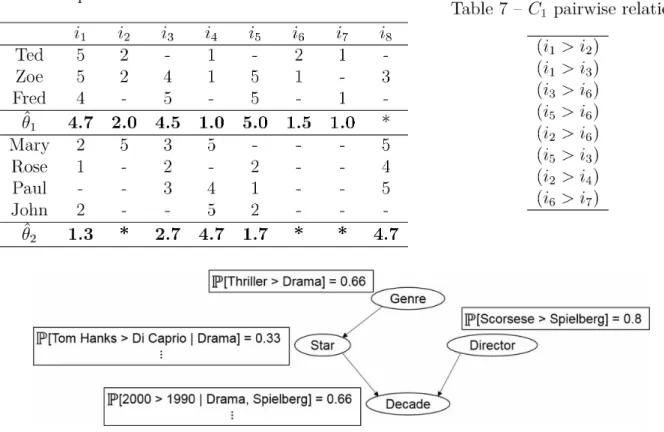
An example of clustering and consensus calculus can be seen in Table 6. The users from Table 5 were clustered in two groups according to their preference vectors, and a consensual preference vector for each cluster was computed using the group average rating per item.
In comparison with the original PrefRec proposed in (AMO; OLIVEIRA, 2014), one main enhancement done in these two activities, Preferences Clustering and Consensus Calculus, was the replacement of the preference matrix and the consensual matrix by vectors. This new representation not only reduces the algorithm complexity and execution time, but remarkably allows a clustering of a better quality.
Preferences Mining: Having the consensual preference vector from each cluster, the system could establish the preference relation between pairs of items. Formally, a
3.2. Background 39
Table 6 - Clusters of users with consensual preferences.
h k k k k %6 k k
Ted 5 2 - 1 - 2 1
-Zoe 5 2 4 1 5 1 - 3
Fred 4 - 5 - 5 - 1
-A
0i 4.7 2.0 4.5 1.0 5.0 1.5 1.0 *
Mary 2 5 3 5 - - - 5
Rose 1 - 2 - 2 - - 4
Paul - - 3 4 1 - - 5
John 2 - - 5 2 - -
-O2 1.3 * 2.7 4.7 1.7 * * 4.7
Table 7 - C\pairwise relation.
( k > ( k >
(k > k ) (k > k ) (k > k ) (k > {k > k ) {k > k )
Figure 2 - Bayesian Preference Network PNeti over C\ preferences.
transitive and not reflexive. We denote by i\ > the fact that i\ is preferred to According to the previous example, a preference relation over consensual preference vector
6\ is presented in Table 7.
A preference miner V builds a prediction model for each group using item’s features.
The set of prediction models is M — {M 0 — i, P i),.. ., Mk — (Ok, )}, where K is the
number of clusters, 6S is the consensual preference vector, and is the preference model
extracted from 0S, for 1 < s< K.
In this scenario, a prediction model is a contextual preference model. Thus, each model
Ps in M is designed as a Bayesian Preference Network (BPN) over a relational schema
R I(A i, ..., At). A BPN is a pair (G,(p) where is a directed acyclic graph in which each node is an attribute, and edges represent attribute dependency; ip is a mapping that associates to each node of G a set of conditional probabilities P[P2|-E’i] of the form of
probability’s rules: Ai = a\A ... A Av= av —>• B = b\ = where
two items i1 and i2, the model can predict which is preferred.
The construction of a BPN comprehends in: (1) the construction of a network struc ture represented by the graph G and (2) the computation of a set of parameters p rep resenting the conditional probabilities of the model. The preference miner used in this work, CPrefMiner (AMO et al., 2013; AMO et al., 2015), uses a genetic algorithm in
the hrst phase to discover dependencies among attributes and then, compute conditional probabilities using the Maximum Likelihood Principle (NIELSEN; JENSEN, 2009).
Example Overview. Considering the relational schema of movie attributes in Table 4 and the user-item rating matrix in Table 5 PrefRec clusters users, extracts preference
consensual vector from 91 (Table 6) and builds the pairwise preference relation (Table 7). Then, C PrefMiner can build the BPN depicted in Figure 2. P N et1 represents the
contextual preference model that is used to compare the set of pairs of items and make the predictions.
B) Recommendation. In its second phase, PrefRec aims at using a prediction model
Ms to recommend items for a cold user. It is executed online, in contrast to the hrst phase which is offline. The recommendation process is executed according to the following steps:
1. Given a target user ux and a (small) set of ratings provided by ux over some items of
I, the hrst task consists in obtaining the consensual preference vector 9S more similar to ux s preferences. We compute the similarity between 9U (the ux s preference vector) and each consensual preference vector. Let 9S be the consensual preference vector, related to cluster Cs, the most similar to 9U.
2. Consider the preference model Ps corresponding to 9S. Ps is used to infer the preference between pairs of items in I which have not been rated by the user ux in the past.
3. From the set of pairs of items (ij ,ik) indicating that user ux prefers item ij to item
ik, a ranking is built by applying a ranking algorithm adapted from the algorithm Order By Preferences (COHEN; SCHAPIRE; SINGER, 1999). Thus, the
output is a ranking (A, i2, ■ ■ ■ , in) where an item ij is preferred or indifferent to an item ik, for j < k and j,k G {1, ■■■, n}.
![Table 4 shows a set of 8 items (movies) and their attributes. A user-item rating matrix with 7 users and movies ratings in the range [1, 5] is illustrated in Table 5.](https://thumb-eu.123doks.com/thumbv2/123dok_br/16349621.721616/51.892.148.779.892.1092/table-movies-attributes-rating-matrix-movies-ratings-illustrated.webp)