Pulmonol.2020;26(6):353---362
www.journalpulmonology.org
ORIGINAL
ARTICLE
Host
factors
associated
to
false
negative
and
indeterminate
results
in
an
interferon-
␥
release
assay
in
patients
with
active
tuberculosis
J.A.
Santos
a,b,∗,
R.
Duarte
c,d,
C.
Nunes
aaNOVANationalSchoolofPublicHealth,PublicHealthResearchCentre,UniversidadeNOVAdeLisboa,PortugalAvenidaPadre Cruz,1600-560Lisboa,Portugal
bNationalHealthInstituteDr.RicardoJorge,PortugalAvenidaPadreCruz,1600-560Lisboa,Portugal
cChestDiseaseCenter,VilaNovadeGaia,PortugalRuaConselheiroVelosodaCruz,4400-092VilaNovadeGaia,Portugal dFaculdadedeMedicinadaUniversidadedoPorto,PortugalAlamedaProf.HernâniMonteiro,4200-319Porto,Portugal
Received19September2019;accepted11November2019 Availableonline13December2019
KEYWORDS Tuberculosis; Interferon-gamma releasetests; Tuberculintest; Publichealth; Latenttuberculosis; Preventivemedicine Abstract
Introduction:Informationonhostfactorsthatcontributetofalsenegativeandindeterminate resultsininterferon-␥releaseassays(IGRA)arecriticaltoimprovetheusefulnessofthesetests inthefightagainsttuberculosis(TB)epidemics.
TheaimofthisstudywastoestimateandcomparethesensitivityofanIGRAandthe tuber-culinskintest(TST),independently andasacombinedapproach,inpatientswithTBandto identifyriskfactorsassociatedwithfalsenegativeandindeterminateIGRAresults.
Methods:RetrospectivecohortstudyofallactiveTBnotificationswithanIGRAresult(n=1230), from2008to2015.68.0%(n=727)ofthesepatientshadaTSTresultinterpretedusinga5mm (TST-5mm)and10mm(TST-10mm)cutoff.Sensitivitywasdeterminedforbothtests.
Logisticregressionanalysis wasusedtoevaluatetheassociationofsociodemographicand clinicalfactorstotheriskoffalsenegativeorindeterminateIGRAresults.
Results:IGRA, TST-5mmand TST-10mm were positive in82.4%, 84.5% and78.4%ofthe patientsthatperformedbothtests.Whenusedcombined,IGRA/TST-5mmsensitivitywas91.7 %andIGRA/TST-10mmsensitivitywas90.6%.Age≥65years,alcoholabuseandpulmonaryTB were predictivefactorsfor indeterminate results.Inflammatorydiseasesandpulmonary TB werestatisticallyassociatedwithfalsenegativeIGRAresults.
∗Correspondingauthorat: Epidemiologyand StatisticsDepartment, EscolaNacionaldeSaúdePública,UniversidadeNOVAdeLisboa, AvenidaPadreCruz,1600-560Lisboa,Portugal.
E-mailaddresses:[email protected](J.A.Santos),[email protected](R.Duarte),[email protected](C.Nunes).
https://doi.org/10.1016/j.pulmoe.2019.11.001
2531-0437/©2019SociedadePortuguesadePneumologia.PublishedbyElsevierEspa˜na,S.L.U.ThisisanopenaccessarticleundertheCC BY-NC-NDlicense(http://creativecommons.org/licenses/by-nc-nd/4.0/).
Conclusion:InflammatorydiseasesandpulmonaryTBwereidentifiedasfactorsforfalse neg-ative IGRAresults.Our resultsindicatethatthe useofbothtestsinacombined approach, especiallyinspecificriskgroupsofthepopulation,couldincreasethesensitivityofthescreening processandacceleratetheachievementoftheWHOEndTBStrategygoals.
©2019SociedadePortuguesadePneumologia.PublishedbyElsevierEspa˜na,S.L.U.Thisisan openaccessarticleundertheCCBY-NC-NDlicense( http://creativecommons.org/licenses/by-nc-nd/4.0/).
Introduction
The timely identification of latent tuberculosis infection (LTBI) cases and implementation of preventive treatment can substantially decrease the risk of people developing tuberculosis(TB)diseasefromalatentinfectionand, conse-quently,reduceTB-relatedmorbidityandmortality,reduce transmission,andtheburdenofthedisease.1
The existing screening tests are indirect methods that onlyprovideimmunologicalevidenceofhostsensitizationto Mycobacteriumtuberculosisantigens,donotdifferentiate accuratelybetweenLTBIandactiveTBorprovideevidence regardingthestageandpotentialprogressionfrominfection todisease.2
WHO guidelines recommend the use of the tuberculin skin test (TST)and theinterferon-␥ releaseassays (IGRA) asscreeningtests.
IGRAsmeasureT-cellreleaseofinterferon-␥inresponse to stimulation by two strongly immunogenic but highly specificM.tuberculosiscomplexantigens(ESAT-6and CFP-10).TwoIGRAsarecommerciallyavailable,QuantiFERON-TB Gold assay (Qiagen) and the T-SPOT.TB assay (Oxford Immunotec),bothdetecting thereleaseofinterferon-␥ in responseto the specific M. tuberculosisantigens through differentmethods.
IGRAshavehigherspecificityforM.tuberculosisthanthe TST,astheantigensusedarenotencodedinthegenomes ofany ofthe BCGvaccinestrains ormost speciesof non-tuberculousmycobacteria.3Furthermore,thesetestshave
logisticadvantageswhencomparedtoTST(e.g.requireonly onevisit),havepositiveandnegativecontrols(e.g. identi-ficationofpotentialcasesof anergy),andnoboosteffect whenrepeated.2
However,theseassays aremore expensive andrequire laboratory infrastructure.Also,T-cell assays suchas IGRA aresusceptible to variabilityby differentfactors at mul-tiple levels, including assay manufacturing, preanalytical processing(e.g.bloodvolume,sample transport tempera-ture,incubationtime)oranalyticaltesting.3
IGRAshaveshownreducedsensitivityin immunocompro-misedpatients, especiallyin thosewith asevere immune depression,suchaspatientswithdiabetes4orHIVinfection.5
IGRAs have also presented a lower sensitivity in young (<5yearsofage)orimmunocompromisedchildren.6,7
Anotherdrawbackof IGRAtesting is theoccurrence of indeterminateresults,whichmayresultfromaninsufficient immuneresponsetothepositivecontrolorahighlevelof responseinthenegativecontrol,8withpreviousstudies
pre-sentingratesofindeterminateIGRAresultsrangingbetween 2%and11%.8
InordertoimprovetheusefulnessoftheIGRAsasa diag-nostic aid for detection of LTBI, it is essential to better understandwhichfactorsareassociatedwithfalsenegative andindeterminateIGRAresults.
SincethereisnodiagnosticgoldstandardforLTBItohelp evaluatetheIGRAs,sensitivitycanbeestimatedusing surro-gatereferencestandardssuchasIGRAresultsfrompatients witha definitive TB diagnosis and,through collected epi-demiologicaldata,determinefactorsthatmaybeassociated withfalsenegativeresults.
The objective of this study wasto analyse the perfor-manceofanIGRAtestinpatientswithactiveTB.Thespecific objectiveswereto:(i)determineandcomparethe sensitiv-ity ofIGRA andTST tests;(ii) searchfor risk factors that couldbe linkedwithindeterminate IGRAresults; and(iii) ascertain risk factors that could be associated with false negativeIGRAresults.
Material
and
methods
Studydesignanddatasource
Retrospective cohort study centered on data from active TB cases notified in the Portuguese National Tuberculosis SurveillanceSystem(SVIG-TB),from2008to2015.This offi-cialdatabaseisgeneratedbydirectcompulsoryreportingby healthcareprovidersandthedatafromthisofficialsystem ofnotificationiscomplementedandupdatedduringTBcases follow-up.Patientsnotified inthedatabase arediagnosed basedonlaboratoryconfirmedTB(throughidentificationof M. tuberculosis by microscopy, cultural and/or molecular methods)and/orbasedonclinicalandradiologicalfindings andafavorableTBtreatmentresponse.
For this study ethics committee approval or informed consent was not required, as all patient’s information retrievedfromtheSVIG-TBdatabasewasfullyanonymized.
Studydata
The study included all patients notified in the SVIG-TB database with an IGRAtest result.The IGRA test used in thepatientsenrolledinthestudywastheQuantiFERON-TB GoldIn-Tube(Qiagen).
The clinical and sociodemographic variables analyzed were sex, age group, comorbidities (chronic renal failure in dialysis,oncologicdiseases, inflammatory diseases,HIV infection,chronicobstructivepulmonarydisease[COPD]and diabetes), substance abuse (alcohol and drug abuse) and siteofdisease(pulmonaryorextrapulmonaryTB).IGRAand
Hostfactorsassociatedtofalsenegativeandindeterminateresultsininterferon-gammareleaseassays 355 TSTresults werethe dependent variable(event:negative
results).
IndeterminateIGRAresultswereassessedbydividingthe resultsintodeterminate(positiveandnegativeresults)and indeterminate(event).
Statisticalanalysis
TST induration measurementswere interpreted usingtwo cutoffpoints,≥5mm(TST-5mm)and≥10mm(TST-10mm),9
andconvertedtopositiveornegativeresults.
Results from patients that underwent both diagnostic testswereusedtocalculatethesensitivitywith95% confi-denceintervalforeachtestseparatelyandincombination (IGRA/TST-5mmorIGRA/TST-10mm).Sensitivityoutcomes werecomparedusingMcNemar’stest.10
Bivariate and multivariate logistic regression analysis10
wasusedtodetermine thevariables thatwere significan-tly associated with the occurrence of indeterminate and falsenegativeIGRAresults.Multivariatelogisticregression analysiswithforward stepwise(LikelihoodRatio) method, logitfunction(entry-0.05;removal-0.10),includedvariables thatweresignificantinbivariateanalyses.Oddsratiowere reportedwith95 %confidence intervals(95 %CI). Statisti-calanalyseswereperformedusingIBM®SPSS®Statisticsfor
Windows,version23(IBMCorp.,N.Y.,USA).
Results
Therewere1230patientsnotifiedwithactiveTBinthe SVIG-TB database (2008---2015) with an IGRAtest, 857patients (69.7%)hadapositivetestresult,212(17.2%)hada neg-ativeresultand161(13.1%)hadanindeterminateresult. Among the1069 patients witha determinateIGRAresult, 727(68.0%)alsohadaTSTresult.
The mean (±standard deviation) age of the patients withadeterminateIGRAresult(n=1069,86.9%)was47.9 (±20.0),rangingfromlessthan1to91years.Portugalwas the main country of origin (n=931; 87.1 %), followed by Angola (n=31, 2.9%),CaboVerde (n=23,2.2%), Guinea-Bissau(n=19,1.8%)andMozambique(n=12,1.1%).
Diabetesmellituswasthemostcommoncomorbidityand chronicrenalfailurewastheleastfrequent.
IGRAandTSTsensitivity
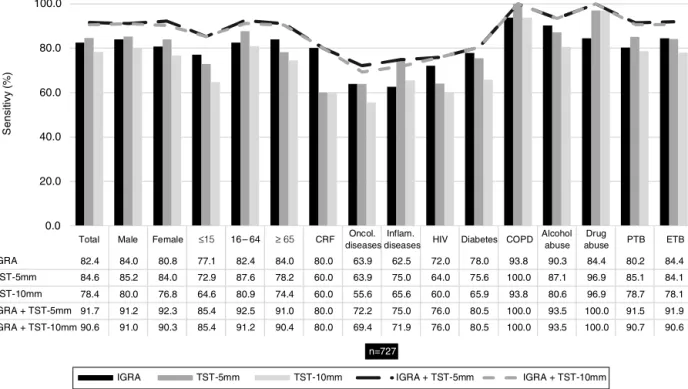
ConsideringthepatientswhoperformedIGRAandTSTassays (n=727),overallsensitivitywas82.4 %,84.6%and78.4 % forIGRA,TST-5mmandTST-10mm,correspondingly.These resultsindicatethat128(17.6%),112(15.4%)and157(21.6 %)patientswithadiagnosisofactiveTBhadafalsenegative result withIGRA, TST-5mm and TST-10mm tests, respec-tively.Table1presentsthesensitivityresultsforIGRAand TSTfortotalofpatientsandstratifiedbysociodemographic andclinicalvariables.
Comparing the sensitivity of the tests separately with thecombinedsensitivityofIGRA/TST-5mmand IGRA/TST-10mm (91.7 % and 90.6 %, respectively), the latter was consistentlyhigherandthisdifferencewasstatistically sig-nificant(p<0.001)---Fig.1.
RiskfactorsforIGRAindeterminateresults
Ofthe161patientswithanindeterminateresult,the major-ityweremale(67.7%)withameanageof56.0(±19.4)that rangedfrom5 to92 years,andmore than halfwere ≥50 yearsold(57.1%).
Theproportionofindeterminateresultsincreasesasthe age increases,withpatients over 80 yearsold presenting thehighestproportionofindeterminateresults(34.5%)and patientsunder20yearsoldpresentingthelowestproportion ofindeterminateresults(2.9%).
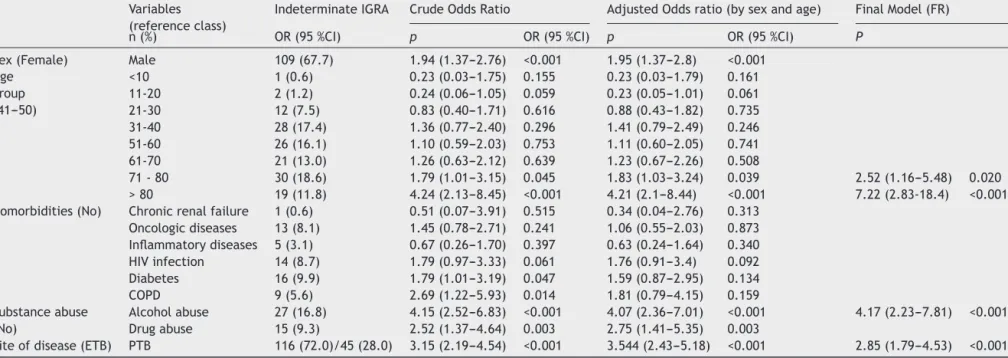
Beingolderthan70years,alcoholabuseandpulmonary TBwereindependentpredictivefactorswithastatistically significantassociationtohigherprobabilityofindeterminate IGRAresultsinTBpatients(Table2).
RiskfactorsforIGRAfalsenegativeresults
Amongtheriskfactorsanalyzedthroughlogisticregression (Table 3),twopresented astatisticallysignificant associa-tionwithanincreasedriskofobtainingfalsenegativeIGRA results-inflammatorydiseasesandpulmonaryTB.
Discussion
Theobjectiveofthisstudywastoanalysetheperformance ofan IGRAtest in patients withactiveTB which involved establishingandcomparingthesensitivityofIGRAandTST tests.
IGRAsensitivityresultsareheterogeneousacrossthe lit-erature,ranging from 60 %11 tonearly 100 %12 withmost
studies presenting an sensitivity above 70 %, as demon-strated by three different meta-analyzes that obtained a pooled sensitivity of 81.0 %,13 80.0 %14 and 84.2 %.15 In
ourstudy,IGRAoverallsensitivity(82.4%)wasclosetothe pooledsensitivityofthesemeta-analyzes.Nonetheless,17.6 % of the results were false negative, demonstrating that althoughthesetestscanfacilitatediagnosticdecisions, neg-ative results should not be used alone to exclude an M. tuberculosisinfectionbut interpretedin conjunction with otherclinicalfindingsanddiagnoses.
OurTSTsensitivitywashigherthanthepooled sensitiv-ityobtainedinthreedifferentmeta-analysis-66%,1570%13
and77%16 -butcomparabletoaUS TBsurveillancestudy
thatincludedalmost65000culture-confirmedTBpatients, inwhich84.2%of thepatientshadaTST≥5mmand81.6 % a TST≥10mm.17 Despite the differences in sensitivity
obtainedbetween IGRAandTST-5mm or TST-10mm, only thedifferencebetween IGRA andTST-10mm was statisti-callysignificant (p=0.021),whichindicates thatIGRAand TST-5mmhadan similarperformancein theidentification ofcases ofinfection andpresented a betterperformance thanTST-10mm.
Bycombiningtheresultsofthetwotests,thesensitivity increasedtomorethan90.0%,andthedifferencebetween theseresultsandthoseobtainedbythetestsseparatelywas statisticallysignificant(p<0.001).Choietal.presented sim-ilarsensitivityresults,obtaining85.3%(TST),70.3%(IGRA) and93.3%(IGRA/TST).4Thisincreaseinsensitivitysuggests
thatthecombineduseofthetwotestscouldpromotethe identificationofmorecasesofinfectionthanifused
sepa-J.A.
Santos
et
al.
Table1 IGRAandTSTsensitivity(5mmand10mmcut-offs)accordingtosex,agegroup,comorbidities(chronicrenalfailure,oncologicdisease,inflammatorydisease,HIV,
diabetesandCOPD),substanceabuse(alcoholordrugabuse)andsiteofdisease(pulmonaryorextrapulmonary)inpatientssubmittedtobothassays(n=727).
Variables Patients IGRA TST-5mm TST-10mm
n/N(%) Positive(n) Sensitivity%(IC95%)Positive(n) Sensitivity%(IC95%)Positive(n) Sensitivity%(IC95%)
Total 727 599 82.4(79.5---84.9)615 84.6(82.0---87.2)570 78.4(75.4---81.4) Sex Male 362/727(49.8)304 84.0(79.9---87.4)311 85.2(81.6---88.8)292 91.2(88.3---94.1) Female 365/727(50.2)295 80.8(76.5---84.5)304 84.0(80.2---87.8)278 92.3(89.5---95.0) Agegroup ≤15 48/727(6.6) 37 77.1(63.5---86.7)35 72.9(60.3---85.5)31 85.4(75.4---95.4) 16---64 523/727(71.9)431 82.4(78.9---85.4)458 87.6(84.7---90.4)423 92.5(90.3---95.0) ≥65 156/727(21.5)131 84.0(77.4---88.9)122 78.2(71.7---84.7)116 91.0(86.5---95.5) Comorbidities Chronicrenalfailure 5/727(0.7) 4 80.0(37.6---96.4)3 60.0(14.7---94.7)3 80.0(28.4---99.5) Oncologicdiseases 36/727(5.0) 23 63.9(47.6---77.5)23 63.9(48.2---79.6)20 72.2(57.6---86.9) Inflammatorydiseases32/727(4.4) 20 62.5(45.3---77.1)24 75.0(60.0---90.0)21 75.0(60.0---90.0) HIVinfection 25/632(3.4) 18 72.0(52.4---85.7)16 64.0(44.5---79.8)15 76.0(56.6---88.5) Diabetes 41/727(5.6) 32 78.0(63.3---88.0)31 75.6(62.5---88.8)27 80.5(68.4---92.6) COPD 16/727(2.2) 15 93.8(71.7---98.9)16 100(79.4---100) 15 100(79.4---100) Substanceabuse Alcoholabuse 31/706(4.3) 28 90.3(75.1---96.7)27 87.1(75.3---98.9)25 93.5(78.6---99.2)
Drugabuse 32/709(4.4) 27 84.4(68.3---93.1)31 96.9(83.8---99.9)31 100(89.1---100) Siteofdisease PTB 343/727(47.2)275 80.2(75.6---84.1)292 85.1(81.4---88.9)270 91.5(88.6---94.5)
ETB 384/727(52.8)324 84.4(80.4---87.7)323 84.1(80.5---87.8)300 91.9(89.2---94.7)
Hostfactorsassociatedtofalsenegativeandindeterminateresultsininterferon-gammareleaseassays 357 0.0 20.0 40.0 60.0 80.0 100.0
Total Male Female ≤15 16 –64 ≥ 65 CRF Oncol. diseases
Inflam.
diseases HIV Diabetes COPD Alcohol abuse Drug abuse PTB ETB IGRA 82.4 84.0 80.8 77.1 82.4 84.0 80.0 63.9 62.5 72.0 78.0 93.8 90.3 84.4 80.2 84.4 TST-5mm 84.6 85.2 84.0 72.9 87.6 78.2 60.0 63.9 75.0 64.0 75.6 100.0 87.1 96.9 85.1 84.1 TST-10mm 78.4 80.0 76.8 64.6 80.9 74.4 60.0 55.6 65.6 60.0 65.9 93.8 80.6 96.9 78.7 78.1 IGRA + TST-5mm 91.7 91.2 92.3 85.4 92.5 91.0 80.0 72.2 75.0 76.0 80.5 100.0 93.5 100.0 91.5 91.9 IGRA + TST-10mm 90.6 91.0 90.3 85.4 91.2 90.4 80.0 69.4 71.9 76.0 80.5 100.0 93.5 100.0 90.7 90.6 Se n s it ivy (% ) n=727
IGRA TST-5mm TST-10mm IGRA + TST-5mm IGRA + TST-10mm
Figure1 SensitivityofIGRAandTSTwhenusedseparatelyandwhenusedtogether(IGRA/TST-5mmandIGRA/TST-10mm)in patientswithbothtestresults(n=727).Sensitivitywasassessedaccordingtosex,agegroup(≤15,16-64,≥65years),comorbidities (chronicrenalfailure[CRF],oncologicdisease,inflammatorydisease,HIVinfection,diabetesandCOPD),substanceabuse(alcohol ordrugabuse)andsiteofdisease(pulmonaryTB[PTB]orextrapulmonaryTB[ETB]).
ratelyandinsubstitutionofoneanother.Thecombineduse couldenhancethedetectionofLTBIcasesamong vulnera-blepopulations,18 suchashomelesspeople,drugoralcohol
abusers,prisonersandpeoplelivingwithHIV.Thisapproach couldbeespeciallyhelpfulinlow-incidencecountries,asthe majorityofTBcasesoccurduetotheprogressionfromLTBI toTBdisease.19Furthermore,thesevulnerablepopulations
arefrequentlyassociatedwithindividualandcontextual fac-tors,aspresentedbyZãoetal,20thatcontributetopatient
andhealthcaresystemdelayinthediagnosisandtreatment of TB. A false negativeresult could contribute to longer delays,thusperpetuatingthespreadofthedisease.
Indeterminateresultsrepresentaconsiderableproblem forclinicalmanagement,sincetheyimplythelackofclear informationaboutthepatient’sTBinfectionstatus.
Unlikeotherstudies,21,22ourresultsdonotshowoldage
asariskfactorforfalsenegativeIGRAresults.However,we observed that older agewas apredictive factor for inde-terminateresults,whichwasconsistentwiththefindingsof otherstudies.21,23Several studiesanalyzedtheassociation
betweenageandindeterminateIGRAresultsandconcluded that indeterminateresults aresignificantly more common inchildren23---25andadolescents23andintheelderly.23,26Our
resultsconfirmpartoftheirconclusions,withpatientsaged >80yearsbeingseventimesmorelikelytohavean indeter-minateIGRAresult.Inaddition,whenwestratifiedpatients inten-yearagegroups,weobservedthattheproportionof indeterminateresultsincreasedastheageincreases,with patientsover80yearsoldpresentingthehighestproportion ofindeterminateresults,resultssharedwithKobashietal.26
Inourstudyyoungerpatientsdidnotpresentanyassociation withfalsenegativeorindeterminateIGRAresults.
Our study also found an association between alcohol abuseandindeterminateIGRAresultsinwhichpatientswith analcoholproblemwerefourtimesmorelikelytohavean indeterminateoutcome.Bothacuteandchronicalcoholuse haveprofoundregulatoryeffectsontheimmunesystem,27
whichpossiblyimpairsthepatient’sabilitytorespond cor-rectly to the IGRA, resulting in an indeterminate result. Becausealcohol dependencewasbasedonself-reportand daily alcohol intake was not determined, further studies withamore detailedinformation onalcohol consumption areneededtobetterunderstandthispotentialassociation. Fromthestudiesavailableinvolving IGRA,PTBpatients andETBpatients,thetestsensitivityremainssimilarinboth formsofTB,asshown byDietal.28 (89.7%vs 79.7%),Ji
etal.29(89.7%vs87.6%),Azghayetal.30(78.9%vs87.8%)
andinourstudy(80.2%vs84.4%).However,pulmonaryTB waspresentedasapredictivefactorforindeterminateand falsenegativeresults,inwhichthesepatientswerealmost threetimesmorelikelytohaveanindeterminateoutcome andnearly twice aslikelyto have a falsenegative result comparedtoextrapulmonaryTB(ETB)patients.
ClinicalmanifestationsofETBmayvaryfromanacuteor disseminateddisease,suchasmeningitisormiliaryTB,toa chroniclocalizedinfectionwithaninsidiousonsetandslow progression,suchaslymphnodeorosteoarticularTB.31,32In
twoanalysesofriskfactorsoffalse-negative IGRAresults, onlymeningitisTBfromtheeightformsofETBinonestudy and6forms intheother wassignificantlyassociated with falsenegativeresults,an acuteclinicalmanifestation.28,33
Thus,thefactthatmostETBmanifestationshaveaslower progressionto severe disease, possibly allowspatients to maintain a functional immune system and consequently
J.A.
Santos
et
al.
Table2 Sociodemographicandclinicalcharacteristicsof161patientswithindeterminateIGRAresultsandtheirassociationwiththeoccurrenceoftheindeterminatetest
resultsinpatientswithactiveTB. Variables (referenceclass)
IndeterminateIGRA CrudeOddsRatio AdjustedOddsratio(bysexandage) FinalModel(FR)
n(%) OR(95%CI) p OR(95%CI) p OR(95%CI) P
Sex(Female) Male 109(67.7) 1.94(1.37---2.76) <0.001 1.95(1.37---2.8) <0.001 Age group (41---50) <10 1(0.6) 0.23(0.03---1.75) 0.155 0.23(0.03---1.79) 0.161 11-20 2(1.2) 0.24(0.06---1.05) 0.059 0.23(0.05---1.01) 0.061 21-30 12(7.5) 0.83(0.40---1.71) 0.616 0.88(0.43---1.82) 0.735 31-40 28(17.4) 1.36(0.77---2.40) 0.296 1.41(0.79---2.49) 0.246 51-60 26(16.1) 1.10(0.59---2.03) 0.753 1.11(0.60---2.05) 0.741 61-70 21(13.0) 1.26(0.63---2.12) 0.639 1.23(0.67---2.26) 0.508 71-80 30(18.6) 1.79(1.01---3.15) 0.045 1.83(1.03---3.24) 0.039 2.52(1.16---5.48) 0.020 >80 19(11.8) 4.24(2.13---8.45) <0.001 4.21(2.1---8.44) <0.001 7.22(2.83-18.4) <0.001 Comorbidities(No) Chronicrenalfailure 1(0.6) 0.51(0.07---3.91) 0.515 0.34(0.04---2.76) 0.313
Oncologicdiseases 13(8.1) 1.45(0.78---2.71) 0.241 1.06(0.55---2.03) 0.873 Inflammatorydiseases 5(3.1) 0.67(0.26---1.70) 0.397 0.63(0.24---1.64) 0.340 HIVinfection 14(8.7) 1.79(0.97---3.33) 0.061 1.76(0.91---3.4) 0.092 Diabetes 16(9.9) 1.79(1.01---3.19) 0.047 1.59(0.87---2.95) 0.134 COPD 9(5.6) 2.69(1.22---5.93) 0.014 1.81(0.79---4.15) 0.159 Substanceabuse (No) Alcoholabuse 27(16.8) 4.15(2.52---6.83) <0.001 4.07(2.36---7.01) <0.001 4.17(2.23---7.81) <0.001 Drugabuse 15(9.3) 2.52(1.37---4.64) 0.003 2.75(1.41---5.35) 0.003
Siteofdisease(ETB) PTB 116(72.0)/45(28.0) 3.15(2.19---4.54) <0.001 3.544(2.43---5.18) <0.001 2.85(1.79---4.53) <0.001
Host factors associated to false negative and indeterminate results in interferon-gamma release assays 359
Table3 AssociationbetweenfalsenegativeIGRAresultsandsociodemographicandclinicalvariablesamongpatientswithnotifiedTB(n=1069).
Variables (referenceclass)
Patients CrudeOddsRatio AdjustedOddsratio(bysexandage) FinalModel(FR) n/N(%) OR(95%CI) p OR(95%CI) p OR(95%CI) p
Sex(Female) Male 555/1069(51.9) 0.87(0.64---1.17) 0.352 0.86(0.63---1.16) 0.325 Age group (41---50) <10 35/1069(3.3) 1.34(0.60---2.99) 0.472 1.34(0.60---2.98) 0.476 11-20 66/1069(6.2) 0.75(0.37---1.51) 0.413 0.75(0.37---1.52) 0.428 21-30 116/1069(10.9) 0.97(0.56---1.67) 0.909 0.96(0.55---1.65) 0.872 31-40 166/1069(15.5) 0.83(0.51---1.37) 0.471 0.82(0.49---1.36) 0.445 51-60 209/1069(19.6) 0.62(0.36---1.07) 0.088 0.62(0.36---1.07) 0.084 61-70 153/1069(14.3) 0.66(0.38---1.12) 0.122 0.65(0.38---1.11) 0.111 71-80 153/1069(14.3) 0.84(0.49---1.43) 0.516 0.83(0.49---1.41) 0.493 >80 135/1069(12.6) 0.81(0.33---1.96) 0.64 0.82(0.34---1.99) 0.66 Comorbidities(No) Chronicrenalfailure 13/1069(1.2) 0.73(0.16-3.33) 0.687 0.85(0.18-3.92) 0.835
Oncologicdiseases 61/1069(5.7) 1.611(0.90---2.88) 0.108 1.64(0.90---2.97) 0.105 Inflammatorydiseases 49/1069(4.6) 2.25(1.22---4.13) 0.009 2.40(1.29---4.46) 0.006 2.04(1.04---4.01) 0.039 HIVinfection 59/931(5.5) 1.22(0.66---2.28) 0.528 1.18(0.62---2.24) 0.62 Diabetes 62/1069(5.8) 0.77(0.38---1.53) 0.452 0.89(0.44---1.84) 0.767 COPD 23/1069(2.2) 0.85(0.29---2.52) 0.767 0.93(0.31---2.79) 0.892 Substanceabuse (No) Alcoholabuse 57/1029(5.3) 0.65(0.30-1.39) 0.263 0.69(0.32-1.53) 0.371 Drugabuse 47/1042(4.4) 0.96(0.46---2.01) 0.904 0.93(0.43---2.0) 0.85
Siteofdisease(ETB) PTB 481/1069(45.0) 1.71(1.26---2.31) 0.001 1.67(1.22---2.29) 0.001 1.69(1.22---2.35) 0.002
functionalT-cellswhich,whenpresentedwithTBantigens, willrespondwiththe production ofinterferon-␥. Another reasonfortheseresultsmaylieintheseverityofpulmonary TB cases. Different studies have shown that severe pul-monarydiseasecanbeassociatedwithimmunesuppression whichmayleadtoreducedinterferon-␥production.34,35
Dur-ingTBprogression,thenaturalcytokinebalanceisaltered while the bacterialload increases,potentially influencing the performance of IGRA tests resulting in a reduction in M. tuberculosis specific immune responses, especially interferon-␥production.36,37
Consideringtheexistence ofhighlyheterogeneous clin-icalmanifestationsassociatedtothefactthatmostforms ofETBdonotcontributetothetransmissionofTB,andalso consideringthatresearchinETBandtheirinfluenceinthe immuneresponseisscarce,itisimperativetodevelop fur-therstudiesinordertobetterunderstandtheperformance ofthetestinthedifferentclinicalmanifestationsofTB.
Weobserved thatinflammatory diseases werean inde-pendent predictive factor for negative IGRA results in patients with active TB. With the growing use of bio-logictherapiesforinflammatoryrheumaticdiseasesandthe increasedriskofTBassociated38 withtheiruse,ourresults
showthat theuse of IGRAalone maynot besufficient to eliminatethepossibilityofanM.tuberculosisinfection.In viewofthe highrisk of TBin thesepatients andthe pos-sibilityoffalsenegativeresults,adualtestingstrategyof IGRAandTSTcouldbemoreeffectiveforLTBIdiagnosis,as otherstudiesinvolvingpatientswithinflammatorydiseases concluded.39---41
Inour study,fiveof the 49patients withinflammatory diseasespresentedanindeterminateIGRAresultbutno sig-nificantassociationwasfound.Somestudieshaveidentified an association,39,42,43 with the corticosteroids used in the
treatmentof thesediseases beingthe commonpredictive factor for indeterminate results. No treatment data was availableinourstudy.
Ourstudyhaslimitations.T-cellassayslikeIGRAare sus-ceptibletovariabilitybydifferent factorsassociatedwith assaymanufacturing,pre-analyticalprocessingoranalytical testing.3However,despitetheirimportancewewereunable
todeterminetheimpactofthesefactorsontheIGRAresults usedinthestudy.Duetotheabsenceof healthy individu-alsinourstudypopulation,itwasnotpossibletoestimate thespecificity for both immunologictests,TST and IGRA. Thepresenceofvariablesbasedonpatientself-report(e.g. alcohol abuse, drug abuse) may have led to a less accu-rateestimateoftheimpactofthesevariables.Theuseof activeTBpatientsasaproxytoassessthesensitivityofIGRA andTSThasthedisadvantagethatpatientswithactiveTB maypresentimmunosuppressionduetothediseaseitself, thusobtainingadifferentresponsethanwithpatientswith alatentinfectionorrecentinfection.
Onthe other hand, ouranalysisof theperformance of theIGRA test was comprehensive. It involved a consider-ablenumberofpatients withdifferentrisk factors,which allowedobservationoftheperformanceofIGRAindifferent contexts,contributingtoabetterunderstandingofhowto usethistestinpopulationswithcertainriskfactors.In addi-tion,the comparisonwiththe otherscreening methodfor LTBIavailable(TST)providedadditionalinformationonhow
thesetestscanbeusedinordertoenhancethedetection ofcasesofinfection.
Conclusion
Inourstudyweidentifiedthreefactorsassociatedwiththe occurrenceofindeterminedIGRAresults-ageover70years, alcoholabuseandpulmonaryTB.
InflammatorydiseasesandpulmonaryTBwere indepen-dentriskfactorsforfalsenegativeIGRAresultsinpatients withactiveTB.
Given theimpact thattreatments ofinflammatory dis-eases have on the development of active TB, our results suggestacarefulinterpretationofanegativeresult,since thereisasignificantriskoffalsenegativeresults.
ThefactthattheIGRAappearstoperformwellinpatients withETB(lessindeterminateandfalsenegativeresultsthan in patientswithpulmonary TB), makesita valuable diag-nostictoolinthesecases.
Funding
Fundac¸ão para a Ciência e Tecnologia provided financial support to conduct this research [Grant: PTDC/SAU-PUB/31346/2017] but hadnoinvolvement in theresearch itself.
Declarations
of
interest
None.
Appendix
A.
Supplementary
data
Supplementarymaterialrelatedtothisarticlecanbefound, in the online version, at doi:https://doi.org/10.1016/j. pulmoe.2019.11.001.
References
1.GetahunH,MatteelliA,AbubakarI,AbdelAzizM,BaddeleyA, BarreiraD,etal.ManagementoflatentMycobacterium tuber-culosisinfection:WHOguidelinesforlowtuberculosisburden countries.EurRespirJ.2015;46(6):1563---76.
2.Matteelli A, Sulis G, Capone S, D’Ambrosio L, Migliori GB, GetahunH.Tuberculosiseliminationandthechallengeoflatent tuberculosis.PressMedicale.2017;46(2):e13---21.
3.Pai M,Denkinger C, KikSV, Rangaka M, Zwerling A, Oxlade O, et al. Gamma interferon release assays for detection of Mycobacterium tuberculosis infection. Clin Microbiol Rev. 2014;27(1):3---20.
4.ChoiJC, JarlsbergLG,Grinsdale JA,Osmond DH,Higashi J, HopewellPC,etal.ReducedsensitivityoftheQuantiFERON® testindiabeticpatientswithsmear-negativetuberculosis.Int JTubercLungDis.2015;19(5):582---8.
5.MetcalfeJZ,EverettCK,SteingartKR,CattamanchiA,Huang L,Hopewell PC,et al.Interferon-␥releaseassaysfor active pulmonarytuberculosisdiagnosisinadultsinlow-and middle-incomecountries:Systematicreviewandmeta-analysis.JInfect Dis.2011;204SUPPL.4.
6.SollaiS,GalliL,deMartinoM,ChiappiniE.Systematicreview andmeta-analysisontheutilityofInterferon-gammarelease
Hostfactorsassociatedtofalsenegativeandindeterminateresultsininterferon-gammareleaseassays 361
assaysfor thediagnosisofMycobacteriumtuberculosis infec-tioninchildren:a2013update.BMCInfectDis.2014;14Suppl 1(Suppl1):S6.
7.MandalakasAM,DetjenAK,HesselingAC,BenedettiA,Menzies D.Interferon-gammareleaseassaysandchildhood tuberculo-sis:Systematicreviewandmeta-analysis.IntJTubercLungDis. 2011;15(8):1018---32.
8.Sharninghausen JC, Shapiro AE, Koelle DM, Kim HN. Risk Factors for Indeterminate Outcome on Interferon Gamma Release Assay in Non-US-Born Persons Screened for Latent Tuberculosis Infection. Open Forum Infect Dis. 2018;5(8): 1---8.
9.American ThoracicSociety, CDC.Targeted tuberculin testing andtreatmentoflatenttuberculosisinfection.AmJRespirCrit CareMed.2000;161:221---47.
10.AltmanD.Practicalstatisticsfor medicalresearch. firstedit London:CRCPress;1991.
11.DewanPK, Grinsdale J, Kawamura LM. Low Sensitivity of a Whole-BloodInterferon-␥ReleaseAssayforDetectionofActive Tuberculosis.ClinInfectDis.2007;44(1):69---73.
12.TakasakiJ,ManabeT, MorinoE,Muto Y,HashimotoM,Iikura M,et al. Sensitivity and specificity ofQuantiFERON-TB Gold Plus compared with QuantiFERON-TB Gold In-Tube and T-SPOT.TBonactivetuberculosisinJapan.JInfectChemother. 2018;24(3):188---92.
13.DielR,LoddenkemperR,NienhausA.Evidence-Based Compar-isonofCommercialInterferon-␥ReleaseAssaysfor Detecting ActiveTB.Chest.2010;137(April(4)):952---68.
14.SesterM,SotgiuG,Lange C,GiehlC,GirardiE,MiglioriGB, etal. Interferon-␥releaseassaysfor the diagnosis ofactive tuberculosis:Asystematicreviewandmeta-analysis.EurRespir J.2011;37(1):100---11.
15.LuP,ChenX,ZhuL,YangH.Interferon-gammareleaseassays forthediagnosisoftuberculosis:asystematicreviewand meta-analysis.Lung.2016;194(June2(3)):447---58.
16.PaiM,ZwerlingA,MenziesD.SystematicReview:T-Cell---based Assaysfor theDiagnosisofLatentTuberculosisInfection:An Update.AnnInternMed.2008;149:177---84.
17.AuldSC, Click ES,Heilig CM, MiramontesR, Cain KP, Bisson GP,etal.AssociationBetweenTuberculinSkinTestResultand ClinicalPresentation ofTuberculosisDisease.BMC Infect Dis. 2013;13:460.
18.Heuvelings CC, Vries SG, Grobusch MP. Tackling TB in low-incidencecountries:improving diagnosisand management in vulnerablepopulations.IntJInfectDis.2017;56(March):77---80. 19.BlumbergHM,ErnstJD.TheChallengeofLatentTBInfection.
JAMA.2016;316(September6(9)):931.
20.ZãoI,RibeiroAI,ApolinárioD,DuarteR.Whydoesittakeso long?Thereasonsbehindtuberculosistreatmentdelayin Por-tugal.Pulmonology.2019;25(4):215---22.
21.Cho K, Cho E, Kwon S, Im S, Sohn I, Song S, et al. Fac-torsAssociatedwithIndeterminateandFalseNegativeResults ofQuantiFERON-TBGold In-TubeTest inActive Tuberculosis. TubercRespirDis(Seoul).2012;72(5):416.
22.Kwon Y-S, Kim YH, Jeon K, Jeong B-H, Ryu YJ, Choi JC, etal.FactorsthatPredictNegativeResultsofQuantiFERON-TB GoldIn-Tube Testin Patients with Culture-Confirmed Tuber-culosis:AMulticenterRetrospectiveCohortStudy. PLoSOne. 2015;10(6):e0129792.
23.TebrueggeM,DeGraafH,SukhtankarP,ElkingtonP,Marshall B,SchusterH,etal.Extremesofageareassociatedwith inde-terminateQuantiFERON-TBgoldassayresults.JClinMicrobiol. 2014;52(7):2694---7.
24.Bergamini BM, Losi M, Vaienti F, D’Amico R, Meccugni B, Meacci M, et al. Performance of Commercial Blood Tests for the Diagnosis of Latent Tuberculosis Infection in Chil-dren and Adolescents. Pediatrics. 2009;123(March 1 (3)): e419---24.
25.RoseMV,KimaroG,NissenTN,KroidlI,HoelscherM,Bygbjerg IC,etal.Quantiferon®-TBgoldin-tubeperformancefor diag-nosingactivetuberculosisinchildrenandadultsinahighburden setting.PLoSOne.2012;7(7):1---10.
26.KobashiY,SugiuT,MouriK,ObaseY,MiyashitaN,OkaM. Indeter-minateresultsofQuantiFERONTB-2Gtestperformedinroutine clinicalpractice.EurRespirJ.2009;33(4):812---5.
27.FriedmanH,ProssS,KleinTW.Addictivedrugsandtheir rela-tionshipwithinfectiousdiseases.FEMSImmunolMedMicrobiol. 2006;47(3):330---42.
28.DiL,LiY.Theriskfactoroffalse-negativeandfalse-positive for T-SPOT.TBin active tuberculosis. JClin Lab Anal. 2018; 32(2).
29.Ji L, Lou YL, Wu ZX, Jiang JQ, Fan XL, Wang LF, et al. Usefulness ofinterferon-␥ releaseassay for thediagnosis of sputum smear-negative pulmonary and extra-pulmonary TB in Zhejiang Province. China. Infect Dis Poverty. 2017;6(1): 1---5.
30.AzghayM,BouchaudO,MechaiF,NicaiseP,FainO,Stirnemann J.UtilityofQuantiFERON-TBGoldIn-Tubeassayinadult, pul-monaryandextrapulmonary,activetuberculosisdiagnosis.Int JInfectDis.2016;44:25---30.
31.HoustonA,MacallanDC.Extrapulmonarytuberculosis.Medicine (Baltimore).2014;42(January(1)):18---22.
32.Sanches I, Carvalho A, Duarte R. Who are the patients with extrapulmonary tuberculosis? Rev Port Pneumol. 2015;21(2):90---3.
33.KimYJ, KangJY, KimSIl, Chang MS,Kim YR,Park YJ. Pre-dictorsfor false-negativeQuantiFERON-TBGoldassay results inpatientswithextrapulmonarytuberculosis.BMCInfectDis. 2018;18(1):457.
34.Shams H, Wizel B, Weis SE, Samten B, Barnes PF. Contri-bution of CD8(+) T cells to gamma interferon production in human tuberculosis. Infect Immun. 2001;69(May (5)): 3497---501.
35.SodhiA,GongJ,SilvaC,QianD,BarnesPF.ClinicalCorrelatesof InterferonProductioninPatientswithTuberculosis.ClinInfect Dis.1997;25(3):617---20.
36.Vanham G, Toossi Z, Hirsch CS, Wallis RS, Schwander SK, Rich EA, et al. Examining a paradox in the patho-genesis of human pulmonary tuberculosis: Immune activa-tion and suppression/anergy. Tuber Lung Dis. 1997;78(3---4): 145---58.
37.deVisserV,SotgiuG,LangeC,AabyeMG,BakkerM,Bartalesi F, et al. False-negativeinterferon-␥ release assay resultsin activetuberculosis:aTBNETstudy.EurRespirJ. 2015;45(Jan-uary(1)):279---83.
38.Dixon WG, Hyrich KL, Watson KD, Lunt M, Galloway J, Ustianowski A, et al. Drug-specific risk of tuberculosis in patients with rheumatoid arthritis treated with anti-TNF therapy: results from the British Society for Rheumatol-ogy Biologics Register. Ann Rheum Dis. 2010;69(March (3)): 522---8.
39.VassilopoulosD,TsikrikaS,HatzaraC,PodiaV,KandiliA, Sta-moulisN,etal.Comparisonoftwogammainterferonrelease assays and tuberculin skin testing for tuberculosis screen-ing in a cohortof patientswith rheumatic diseases starting anti-tumor necrosis factor therapy. Clin Vaccine Immunol. 2011;18(12):2102---8.
40.SoH,YuenCS,YipRM.Comparisonofacommercial interferon-gammareleaseassayandtuberculinskintestforthedetection oflatenttuberculosisinfectioninHongKongarthritispatients who are candidates for biologic agents. Hong Kong Med J. 2017:1---5.
41.Song G, Bae S, Lee Y. Interferon-gamma release assays versus tuberculin skin testing in patients with rheumatoid arthritis (Provisional abstract). Int J Rheum Dis. 2013;16: 279---83.
42.ChoH, KimYW, SuhC-H,JungJ-Y, UmY-J,JungJ-H, etal. Concordancebetweenthetuberculinskintestandinterferon gamma releaseassay (IGRA)for diagnosing latent tuberculo-sisinfectioninpatientswithsystemiclupuserythematosusand patientcharacteristicsassociatedwithanindeterminateIGRA. Lupus.2016;25(Oct11(12)):1341---8.
43.KaurM,SingapuraP,Kalakota N,CruzG, ShuklaR,Ahsan S, etal.FactorsThatContributetoIndeterminateResults From theQuantiFERON-TBGoldIn-TubeTestinPatientsWith Inflam-matoryBowelDisease.ClinGastroenterolHepatol.2018;16(10), 1616-1621.e1.