CERNE
Historic:
Received 12/04/2018 Accepted 28/08/2018
Keywords:
Wood quality Genetic material Growth site
1 Federal University of Viçosa, Viçosa, Minas Gerais, Brazil
2 Federal University of Espirito Santo, Jerônimo Monteiro, Espirito Santo, Brazil +
Correspondence: [email protected]
DOI:
10.1590/01047760201824032558
Thaís Pereira Freitas1+, José Tarcísio da Silva Oliveira2, Graziela Baptista Vidaurre2, Brunela Pollastrelli Rodrigues2
ENVIRONMENTAL EFFECT ON CHEMICAL COMPOSITION OF EUCALYPTUS CLONES WOOD FOR PULP PRODUCTION
FREITAS, T. P.; OLIVEIRA, J. T. S.; VIDAURRE, G. B.; RODRIGUES, B. P. Environmental effect on chemical composition of eucalyptus clones wood for pulp production. CERNE, v. 24, n. 3, p. 219-224, 2018.
HIGHLIGHTS
The extractive content was the characteristic that suffered the highest site effect.
The S/G ratio was considered to be the most stable characteristic to environmental change.
There is a signifi cant variation between the values of S/G ratio among different clones.
The holocellulose (%) was the second characteristic lowest infl uenced by the environment.
ABSTRACT
This study aimed to evaluate the environmental effect on the wood chemical composi-tion of Eucalyptus grandis x Eucalyptus urophylla clones for pulp production. Seven clones of 6.5 years old were evaluated. The clones were planted in two growing sites, Nova Almeida – Espírito Santo and Posto da Mata – Bahia, established in 3 x 3 m spacing. Five
trees were selected from each clone and discs were removed from fi ve different positions
equidistant from the trunk and at diameter at breast height (DBH) height. Two wedge from opposite sides were obtained from the discs. A chemical analysis was performed with a sample composed of all the wedges of each tree in order to determine extractive contents, lignin, holocellulose, carbohydrates and the ratio among syringyl (S) and guaiacyl (G) lignin substructures (S/G) per tree. The S/G ratio was considered to be the most sta-ble characteristic to environmental change, followed by the holloceluloose content, which
was considered the second least characteristic infl uenced by the growth site. Most of the
studied clones presented a statistical difference between the growing site for the wood extractive content, in contrast to the total carbohydrates content that was highlighted by
presenting values which were little infl uenced by the genetic material and the growth site.
INTRODUCTION
Some Eucalyptus species have become increasingly important in pulp production in different parts of the world such as in southern Europe, South America, South Africa and Australia. The interbreeding between species is a reality in Brazil and has become more common since hybrids are being used in huge commercial plantation areas (Gominho et al., 2001). On a world scale, Eucalyptus plantations also stands out as it is estimated that 20 million hectares are planted and distributed in tropical, subtropical and temperate zones (Rejmánek and Richardson, 2011).
Nowadays, the Eucalyptus grandis x Eucalyptus urophylla hybrid provides most of the wood that is used for hardwood pulp companies in Brazil, since this
interspecific combination results in vigorous trees with
fast initial growth, resistance to cangrees caused by a type of fungus and high wood quality, being highly adapted to the pulp and paper industry, and presenting high yields and high pulp quality (Gonçalez et al., 2014).
Wood properties are a result of the interaction between the genetic tree potential and the environmental conditions where it grows, and the environment
influences on wood properties is being studied by many
authors (Brito, 1985). Some countries, such as Brazil, have a wide range edaphoclimatic conditions, therefore in order to guarantee a more homogenous feedstock production, it is important that the clones suffer the least
influence possible from their growth site on the wood
technological characteristics (Gouvea et al., 2012). The growing knowledge of the impact of raw-material properties on pulp quality has led to research on wood quality parameters and to their integration with selection traits in the improvement programs (Miranda and Pereira, 2002).
One of the wood characteristics that are used to determine wood quality in the pulping process are its chemical proprieties. The plant cell is constituted from macromolecular components, which are the primary or structural constituents of the cell wall formed by cellulose, hemicellulose, and lignin; and the secondary or non-structural constituents are the extractives and the inorganic compounds (Carvalho et al., 2009). The variations that occur in the cellulose pulp quality are mainly caused by the change in the chemical quantities and composition of the raw-material which result from different factors, including the site quality, harvest period, geographic location from the plant, climate, age and species/clones (Silvério et al., 2008; Bikovens et al., 2013).
The chemical composition of woods to be used in pulp production is crucial, because it has a direct relation
with the pulping process efficiency. Gomide et al. (2010)
showed the lignin and extractives content importance in wood such as the quality standards from the Eucalyptus to the cellulose production, since they have significant
effects on the kraft pulping process and with good correlations during the process, since the higher the lignin and extractive content in the wood, the higher the reagent consumption and the lower the pulping yield.
In this context, this work aims to evaluate the environmental effect on the wood chemical composition of different Eucalyptus grandis x Eucalyptus urophylla
hybrid clones for pulp production.
MATERIAL AND METHODS
Experimental material and local sample
The wood from the study came from seven
Eucalyptus grandis x Eucalyptus urophylla hybrid clones from clonal test plots established in 3 x 3 m spacing with an age 6.5 years in planting areas of the Fibria Celulose S.A. company in two locations. One location was in Nova Almeida/Espirito Santo, Brazil (20º3’7” S and 40º14’28” W) and the other at Posto da Mata/Bahia, Brazil (17º 53’ 44” S and 39º 34’ 2” W).
Information regarding rainfall and temperature were taken from the historical data from the years in which the planting occurred (2007-2014) and was obtained from the stations that compose the climate monitoring system of the Fibria Celulose S.A. company. Edaphoclimatic information is listed in Table 1.
The tree sampling of the seven clones was performed in the same stand in each region. Five trees were used for each clone and site, and one disk was taken from each tree from the diameter at breast height (DBH, i.e. diameter at 1.30m shoot extension) and another from the positions at 0, 25, 50, 75 and 100% of the tree’s commercial height.
Chemical characterization
One wedge was then removed from each disc of the different positions with a radial angle of 20º for the chemical analyses in order to obtain a composite sample with the amount of material of each disk proportional to its position, representing the whole tree.
The extractive analyses were performed according to TAPPI T204 om 97(1992). From the sawdust samples, 2.0 ± 0.001g were taken moisture-free and arranged in a glass crucible with porosity 2. The sawdust samples were submitted to acetone extraction for a period of 5h. A mix with solvent and the extractive solution from the extraction was put into a lab oven at 103 ± 2°C to evaporate the solvent. When dried, the samples were weighed and the extractive content was obtained by the weight difference.
The lignin content (Klason) was determined according to TAPPI T222 om-06 (1992), but with a few changes described by Coleman et al. (2008). After the extractive removal, ± 0.2g of the sample was put inside a glass bottle, their masses recorded, and then the samples were hydrolyzed with three mL of 72% sulfuric acid (H2SO4) for 2 hours. The solution was then manually homogenized with a glass stick every 10 minutes. Then, 112 mL of distilled water was added to each bottle, and they were sealed and autoclaved for 1 hour at 121°C.
The solution was filtered, and the insoluble lignin content
(Klason) was determined by weight difference.
The soluble lignin content was obtained from
the liquid remaining from filtering the insoluble lignin and
analyzed in a UV spectrophotometer, in which 0.1 ml of the liquid containing the soluble lignin was diluted in 1.5 mL of 4% sulfuric acid (H2SO4). The absorbance of the
filtrate was read at the wavelength of 205 nm. The soluble
lignin content was determined according to Equation 1, where SL is the Soluble lignin content (%) and A205 is the absorbance for the 205m wave.
from the insoluble lignin filtration. This was subsequently
analyzed by high-performance liquid chromatography (Dionex DX-500, Dionex, CA) equipped with an ionic change PA1 column (Dionex), an amperometric detector pulsed with a gold electrode, and a Dionex AS.
The sugars concentration (arabinose, galactose, glucose, xylose, mannose and rhamnose) were determined by the external standard method when using the commercial analytical standards. A differential refraction detector was used for the monosaccharides detection and a computer program determined the peak integrations.
The monolignol composition was performed in duplicate using the thioacidolysis method (2 mL of 0.25 mg.mL-1 of CH
2Cl2) by gas chromatography (GC) according to a method described by Robinson and Mansfield (2009).
Gas chromatography was performed on a
Thermo Scientific-TRACE GC 1310 equipped with an AI
1310 injector and a TG-5MS column. The GC method used an injection volume of 2 mL, one injector of initial temperature of 250°C, and detector temperature of 270°C. The initial temperature was 130°C (maintained for 3 minutes) and increased at a rate of 3°C per minute to 260°C, and maintained for 5 min.
The extractive content was determined in the Wood Science Laboratory of the Federal University of Espírito Santo, Brazil. Moreover, the carbohydrate, lignin, holocellulose and ratio among syringyl (S) and guaiacyl (G) lignin substructures (S/G) were determined in the laboratory of the Wood Science Department at the University of British Columbia, Vancouver, Canada.
Data analysis
The experiment was conducted in an entirely randomized design with a 2 x 7 factorial arrangement; the factors were the clones (seven levels) and the sites
(two levels), with five repetitions. When the interaction effect between the clone and the site were significant by the variance analysis on the F-test (p ≤ 0.05), it showed
the existence of dependency between the considered TABLE 1 Height (H), stem diameter (SD), leaf area (LA), shoot dry mass (SDM) and root system dry mass (RSDM) of Khaya ivorensis
clonal seedlings, 120 days after staking.
Location P (mm.year-1)
T
(°C) Soil type Soil texture OM1 OM2 AWC Altitude Relief
NA 1247.3 23.3 Typical Yellow Argisol Medium/
clayey 2.7 2.3 260 43.0
Smooth undulated
PM 1455.6 24.3
Dystrophic Yellow Argisol to prominent Sandy/ medium/ clayey
1.0 0.9 157 33.3 Flat
[1]
The total lignin content consisted of the soluble and insoluble fractions together, and the holocellulose was determined by the difference between the initial mass and amount of extractives from the total lignin.
The carbohydrates content in the wood was determined by taking 1 mL from the remaining liquid
SL A = ⋅ ⋅ 205 110 1840
factor (clone and site), therefore the interaction analysis and comparison between means by the Scott-Knott test
(p ≤ 0.05) were performed.
RESULTS AND DISCUSSION
The soluble lignin content was the only studied
variable that showed no significant clone x site interaction, but it showed a significant statistical difference at 5%
probability for the clone and local factors separately, and the comparison between the averages is presented in Table 2. It is observed that the highest values were obtained for this variable in Nova Almeida - ES.
obtained an S/G ratio of 2.9 for 7-year old clones from an implantation in Southern Bahia. Barbosa et al. (2008) found an average value of 2.5 ± 0.09 in studying the use of analytical pyrolysis combined with gas chromatography/ mass spectrometry (Py-GC/MS) to determine the syringyl/guaiacyl ratio (S/G) in 7-year old E. grandis x E. urophylla lignins.
Those results also corroborate the values obtained by Nunes et al. (2010) and Gouvêa et al. (2011) who found mean values between 2.78 - 2.86 and 2.59 - 3.03 for S/G ratio of 3-year old eucalyptus clones from four different regions.
According to Gomide et al. (2005), the
syringyl lignin had a less condensed structure due to it being more easily dissolved during the kraft pulping process, and as a consequence are more favorable to
delignification by cooking liquor. Nevertheless, this
relationship is still controversial, because while some researchers encounter good correlation in some species between the lower consumption of reagents (alkali) and increase in pulp yield, others dispute those results.
Thus, the clone selection for pulp production is important to not only look at the wood lignin content, but also its chemical structure that affects the process yield, since
the higher the S/G ratio, the more favorable the delignification
is, thereby allowing a lower alkali use in the kraft pulping and consequently increasing the yield. However, the ideal wood for kraft pulp production is one containing low lignin and a high S/G ratio (Gomes et al., 2008).
The chemical composition suffering more
environmental influence was the extractives content, presenting statistically significant difference for most
clones (1, 3, 4, 6 and 7). Mean values of 2.68 and 2.35% TABLE 2 Mean soluble lignin content values per clone and
site for the E. grandis x E. urophylla hybrid at 6.5 years of age.
Variable Site Clones
NA PM 1 2 3 4 5 6 7
SL 4.06 a 3.70 b 3.86 c 4.13 b 3.49 c 4.72 a 3.57 c 3.69 c 3.74 c
NA = Nova Almeida - ES; PM = Posto da Mata - BA; SL = soluble lignin (%). Means followed by the same letter do not differ from each other by the Scott-Knott test (p > 0.05).
The clone x site interaction was significant at 5%
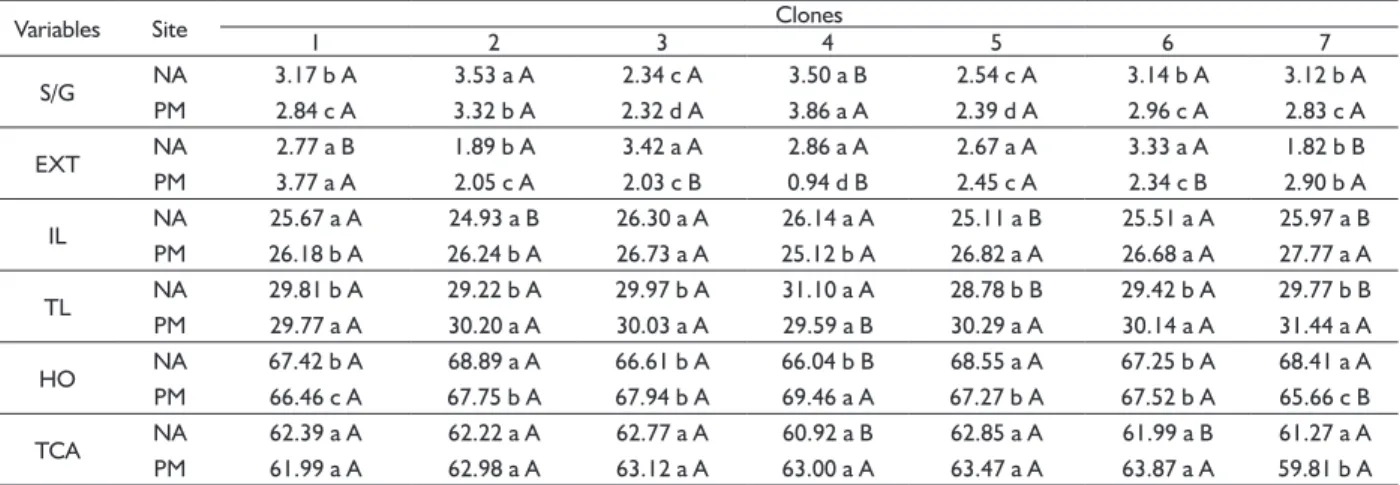
probability for all the other studied characteristics. Thus, an interaction analysis and a mean comparison were performed (Table 3).
The S/G ratio was the chemical composition that
had the lowest environmental influence, however, there is a significant variation between the values among the
different genetic materials, where the minimum relation was 2.32 for the clone 3 and the maximum 3.86 for the clone 4, both in Posto da Mata/BA.
Results inside this range were also obtained by Alves et al. (2011) for E. grandis x E. urophylla, which
TABLE 3 Mean values and multiple comparison test for the chemical composition of E. grandis x E. urophylla hybrid at 6.5 years of age at different growth sites.
Variables Site 1 2 3 Clones4 5 6 7
S/G NA 3.17 b A 3.53 a A 2.34 c A 3.50 a B 2.54 c A 3.14 b A 3.12 b A PM 2.84 c A 3.32 b A 2.32 d A 3.86 a A 2.39 d A 2.96 c A 2.83 c A
EXT NA 2.77 a B 1.89 b A 3.42 a A 2.86 a A 2.67 a A 3.33 a A 1.82 b B PM 3.77 a A 2.05 c A 2.03 c B 0.94 d B 2.45 c A 2.34 c B 2.90 b A
IL NA 25.67 a A 24.93 a B 26.30 a A 26.14 a A 25.11 a B 25.51 a A 25.97 a B PM 26.18 b A 26.24 b A 26.73 a A 25.12 b A 26.82 a A 26.68 a A 27.77 a A
TL NA 29.81 b A 29.22 b A 29.97 b A 31.10 a A 28.78 b B 29.42 b A 29.77 b B PM 29.77 a A 30.20 a A 30.03 a A 29.59 a B 30.29 a A 30.14 a A 31.44 a A
HO NA 67.42 b A 68.89 a A 66.61 b A 66.04 b B 68.55 a A 67.25 b A 68.41 a A PM 66.46 c A 67.75 b A 67.94 b A 69.46 a A 67.27 b A 67.52 b A 65.66 c B
TCA NA 62.39 a A 62.22 a A 62.77 a A 60.92 a B 62.85 a A 61.99 a B 61.27 a A PM 61.99 a A 62.98 a A 63.12 a A 63.00 a A 63.47 a A 63.87 a A 59.81 b A
were obtained in Nova Almeida - ES and Posto da Mata - BA, respectively. Approximate values were found by Zanuncio et al. (2013), who obtained averages ranging from 2.1 to 2.5% for different thinning regimes in eucalyptus clone forest plantations (Eucalyptus grandis x
Eucalyptus urophylla).
Miranda and Pereira (2002) studied the quality of 9-year old Eucalyptus globulus wood planted at three
sites, and also verified that extractive content was the
characteristic that had the highest variation among the studied properties. Nonetheless, Miranda et al. (2007) evaluated the core, the extractives and the pulp yield of
Eucalyptus globulus clones grown at two different sites,
and found no significant effect of the location or clones
on the extractive values.
The total lignin content was encountered at the range of 28.78 (clone 5, Nova Almeira/ES) to 31.44% (clone 7, Posto da Mata/BA). These results corroborate with Gouvea et al. (2012), who also studied the site effect on the technological characteristics of Eucalyptus
wood and found total lignin content from 27.2 to 30.9%. The holocellulose content was the second
lowest characteristic influenced by the environment, as a statistically significant difference between the sites
was only detected in two clones. The holocelullose term comprehends the total polysaccharides content in the wood and is represented by the cellulose fraction together with hemicellulose, which could be up to 80% of the total. It is mainly present in the cellular wall (Gullichsen and Paulapuro, 2000). High contents from these composts are favorable to pulp production; different from extractives and lignin.
The holocellulose content constituted on average 67.60 and 67.44% of the wood mass for the different clones and growth sites in Nova Almeida - ES and Posto da Mata - BA, respectively, ranging from 65.66 to 68.89%. This variation range corroborates with Gomide et al. (2005), who encountered holocellulose content between 64.5 and 70.2% for a eucaliptus clone.
The results from this current study are also in agreement with those obtained by Medeiros et al. (2016) and Segura et al. (2016) who found an average holocellulose content of 66.12 and 68.85% for E. grandis
x E. urophylla woodof 4 and 6 years old, respectively. The total carbohydrate content evidences a
significant statistical difference at 5% for the clone x site
interaction, therefore leading to an analsyis and mean comparison being performed (Table 2). In Nova Almeida/
ES, there was no significant influence on the average carbohydrate content. In relation to the site influence, only the clones 4 and 6 showed a significant difference
between the means. In general, it can be observed that
this characteristic was little influenced by the clone
and the site, presenting minimum percentage values of 61.27% and maximum of 63.47%.
CONCLUSIONS
The ratio among syringyl (S) and guaiacyl (G) lignin substructures (S/G) was considered the most stable property to environment changes, while the
holocelullose content was the second least influenced
by the growth site. The extractive content was the chemical composition that suffered the highest effect from the site. With the exception of the clones 4 and 7, in general, the genetic materials used in this study were
considered to be little influenced by the environment,
which is an advantage, since it is desired to obtain clones that are more stable to external variations and that can be indicated for different growth sites.
ACKNOWLEDGEMENTS
To Fibria Celulose S.A. that donated the material. To the Fundação de Amparo à Pesquisa do Espírito Santo –
FAPES, and the University of British Columbia that made
the accomplishment of the Scientific Technical Internship
abroad possible.
REFERENCES
ALVES I.C.N.; GOMIDE, J.L.; COLODETTE, J.L.; SILVA, H.D. Technological characterization of Eucalyptus benthamii
wood for kraft pulp production, Brazil. Ciência Florestal, Santa Maria, v.21, n.1, p.167-174, 2011.
BARBOSA L.C.A.; MALTHA C.R.A.; SILVA V.L. Determination of the siringyl/guaiacyl ratio in Eucalyptus wood by Pyrolysis-gas Chromatography/mass Spectrometry (PY-GC/MS), Brazil. Química Nova, v.31, n.8, p.2035-2041, 2008.
BIKOVENS O.; ROZE L.; PRANOVICH A.; REUNANEN M.; TELYSHEVA G. Chemical composition of lipophilic extractives from Grey Alder (Alnus incana), USA.
BioResources, v.8, n.1, p.350–357, 2013.
BRITO J.O. Influence of fertilizer application on the tree
rings characteristics of P. caribaea var. bahamensis. 1985. 113 p. PhD thesis Universidade de São Paulo, Escola Superior de Agricultura “Luiz de Queiroz”, Piracicaba, Brazil.
CARVALHO, W.; CANILHA, L.; FERRAZ, A.; MILAGRES, A.M.F. A vision of wood structure, composition and biodegradation, Brazil. Química Nova, v.32, n.8, p.2191-2195, 2009.
COLEMAN H.D.; PARK J.Y.; NAIR R.; CHAPPLE C.; MANSFIELD S.D. RNAi-mediated suppression of p-coumaroyl-CoA 3‘-hydroxylase in hybrid poplar impacts lignin deposition and soluble secondary metabolism, USA.
GOMES, F.J.B.; GOUVÊA, A.F.G.; COLODETTE, J.L.; GOMIDE, J.L.; CARVALHO, A.M.M.L.; TRUGILHO, P.F.; GOMES,
C.M.; ROSADO, A.M. Influence of content and S/G relation
of the wood lignin on kraft pulping performance, Brazil. O
papel, v.69, n.12, p.95-105, 2008.
GOMIDE J.L.; COLODETTE J.L.; OLIVEIRA R.C.; SILVA C.M. Technological characterization of the new generation of
Eucalyptus clones in Brazil for kraft pulp production, Brazil.
Revista Árvore, v.29, n.1, p.129-137, 2005.
GOMIDE J.L.; FANTUZZI NETO H.; REGAZZI A. Analysis of wood quality criteria of eucalyptus wood for kraft pulp production, Brazil. Revista Árvore, v.34, n.2, p.339-344, 2010.
GOMINHO J.; FIGUEIRA J.; RODRIGUES J.C.; PEREIRA H. Within-tree variation of heartwood, extractives and wood density in the eucalypt hybrid urograndis (Eucalyptus grandis
x E. urophylla), USA. Wood and Fiber Science, v.33, n.1, p.3-8, 2001.
GONÇALEZ J.C.; SANTOS, G.L.; SILVA JUNIOR, F.G.; MARTINS I.S.; COSTA J.A. Wood Fiber size and density relationship along the stem of Eucalyptus urograndis, Brazil.
Scientia Forestalis, v.42, n.101 p.81-89, 2014.
GOUVEA A.F.G.; TRUGILHO P.F.; COLODETTE J.L.; BIANCHI M.L.; SORAGI L.C.; OLIVEIRA A.C. Relationship among wood characteristics and Eucalyptus cellulose pulp with the non destructive methods in the living tree, Brazil. Scientia Forestalis, v.39, n.90, p.205-220, 2011.
GOUVEA A.F.G.; GOMES C.M.; MATOS L.M.; SOUZA T.A.; KUMABE F.J.B.; BENITES P.K.R.M. Effect of the site in technological characteristics of Eucalyptus wood for kraft pulp production, Brazil. Ciência da Madeira, v.3, n.2, p.102-115, 2012.
GULLICHSEN J.; PAULAPURO H.B. Papermaking science
and technology: forest products chemistry. Helsinki: FAPET, 2000. 300p.
MEDEIROS B.L.M.A; GUIMARÃES JUNIOR J.B.; RIBEIRO M.X.; LISBOA F.J.N.; GUIMARÃES I.L.; PROTÁSIO T.P. Evaluation of physical and chemical properties Corymbia citriodora and Eucalyptus urophylla x Eucalyptus grandis wood, cultured in Piauí, Brazil. Nativa, Sinop, v.4, n.6, p.403-407, 2016.
MIRANDA I.; GOMINHO J.; LOURENCO A.; PEREIRA H. Heartwood, Extractives and Pulp Yield of Three Eucalyptus globulus Clones Grown in Two Sites, Australian/New Zealand. Appita Journal: Journal of the Technical
Association of the Australian and New Zealand Pulp and Paper Industry v.60, n.6, p.485-500, 2007.
MIRANDA I.; PEREIRA H. Variation of pulpwood quality with provenances and site in Eucalyptus globulus, France. Annals
of Forest Science, v.59, n.3, p.283–291, 2002.
NUNES C.A.; LIMA C.F.; BARBOSA L.C.A.; COLODETTE J.L.; GOUVEIA A.F.G.; SILVÉRIO F.O. Determination of Eucalyptus
spp lignin S/G ratio: A comparison between methods.
Bioresource Technology, v.101, p.4056–4061, 2010.
REJMÁNEK M.; RICHARDSON D.M. Eucalypts. In:
Encyclopedia of biological invasions. Simberloff, D, Rejmánek M (Eds.). Berkeley, University of California Press, p. 203-209, 2011.
ROBINSON A.R.; MANSFIELD S.D. Rapid analysis of poplar lignin monomer composition by a streamlined thioacidolysis
procedure and near-infrared reflectance-based prediction
modeling, USA. The Plant Journal. v.58, n.4, p.706-706, 2009.
SEGURA, T. E. S.; SANTOS, J. R. S. ; SARTO, C. ; SILVA JR., F.
G. . Effect of Kappa Number Variation on Modified Pulping
of Eucalyptus. Bioresources, v.11, p.9842-9855, 2016.
SILVÉRIO F.O.; BARBOSA L.C.A.; MALTHA C.R.A.; FIDÊNCIO P.H.; CRUZ M.P.; VELOSO D.P.; MILANEZ A.F. Effect of storage time on the composition and content of wood extractives in Eucalyptus cultivated in Brazil. Bioresource
Technology. v.99, n.11, p.4878–4886, 2008.
TECHNICAL ASSOCIATION OF THE PULP AND PAPER INDUSTRY – TAPPI. Tappi test methods T 257 om-92:
sampling and preparing wood for analysis. Atlanta: Tappi Technology Park 1, 1992.
ZANUNCIO A.J.V.; COLODETTE J.L.; GOMES F.J.B.; CARNEIRO A.C.O.; VITAL B.R. Chemical composition of Eucalypt wood with different levels of thinning, Brazil.