http://vdi.sagepub.com/
Investigation
Journal of Veterinary Diagnostic
http://vdi.sagepub.com/content/20/2/215
The online version of this article can be found at:
DOI: 10.1177/104063870802000212
2008 20: 215
J VET Diagn Invest
José Gabriel Olveira, Florbela Soares, Sofia Engrola, Carlos P. Dopazo and Isabel Bandín
senegalensis
)
Solea
Antemortem versus postmortem methods for detection of betanodavirus in Senegalese sole (
Published by:
http://www.sagepublications.com
On behalf of:
Official Publication of the American Association of Veterinary Laboratory Diagnosticians, Inc.
can be found at:
Journal of Veterinary Diagnostic Investigation
Additional services and information for
http://vdi.sagepub.com/cgi/alerts Email Alerts: http://vdi.sagepub.com/subscriptions Subscriptions: http://www.sagepub.com/journalsReprints.nav Reprints: http://www.sagepub.com/journalsPermissions.nav Permissions:
What is This?
- Mar 1, 2008
Version of Record
>>
by guest on October 11, 2013 vdi.sagepub.comDownloaded from vdi.sagepub.com by guest on October 11, 2013 Downloaded from vdi.sagepub.com by guest on October 11, 2013 Downloaded from vdi.sagepub.com by guest on October 11, 2013 Downloaded from vdi.sagepub.com by guest on October 11, 2013 Downloaded from vdi.sagepub.com by guest on October 11, 2013 Downloaded from
Antemortem versus postmortem methods for detection of betanodavirus in Senegalese sole
(Solea senegalensis)
Jose´ Gabriel Olveira, Florbela Soares, Sofı´a Engrola, Carlos P. Dopazo, Isabel Bandı´n
1Abstract. The suitability of nested reverse transcription polymerase chain reaction (nRT-PCR) to detect betanodavirus in blood samples from naturally infected Senegalese sole (Solea senegalensis) was evaluated in comparison with other diagnostic methods. Results indicated that histologic examination of brain lesions could be regarded as the most consistent indicator of nodavirus infection in this species. The nRT-PCR showed low to moderate levels of detection; the best values were obtained in brain samples followed by blood samples. Inoculation of SSN-1 and SAF-1 cells with fish samples did not cause cytopathic effect, although virus was detected by reverse transcription polymerase chain reaction in approximately 25% of the SSN-1 inoculated wells. The efficiency of detection of the viral genome was dramatically increased by the use of nRT-PCR, reaching 90.6% of positives in brain samples and 84.4% in blood samples. The sensitivity and the negative predictive value of nRT-PCR in blood samples were slightly lower than those obtained using brain samples. Nevertheless, it is suggested that the advantage of being able to perform diagnosis on live fish adequately counterbalances the slightly lower sensitivity of nRT-PCR on blood samples. This technique is proposed as a useful tool, not only for the selection of nodavirus-free breeders but also to check the fish status during ongrowing.
Key words: Betanodavirus; blood; nested reverse transcription polymerase chain reaction.
<!?show "fnote_aff1"$^!"content-markup(./author-grp[1]/aff|./author-grp[1]/dept-list)>
Viral encephalopathy and retinopathy, or viral nervous necrosis (VNN), is considered to be one of the most serious viral diseases affecting not only larvae but also juvenile marine fish throughout the world.14The causative agents of
the disease are viruses belonging to the genus Betanodavirus (family Nodaviridae). Betanodaviruses are nonenveloped virions with icosahedral symmetry, about 25 nm in di-ameter, with a viral genome consisting of 2 single-stranded (ssRNA) segments. The main target organ of these viruses is the central nervous system, including brain, spinal cord, and retina. Clinical signs of the disease include lack of appetite, changes in pigmentation, and neurologic signs such as abnormal swimming. Both horizontal5,15 and
vertical transmission of nodavirus have been demonstrated in different fish species.3,9,15
In general, the diagnosis of VNN relies on histopatho-logic identification of necrosis and vacuolization in brain and retina, combined with positive immunohistochemical assessment. However, other diagnostic procedures, such as enzyme-linked immunosorbent assay (ELISA)4,14 and
re-verse transcription polymerase chain reaction (RT-PCR), have been developed in recent years.7,14,19
The use of PCR-based technology applied to blood samples has proven to be an excellent diagnostic tool for
other fish viruses6,8,13 and has been previously used to
detect betanodavirus in sea bream and sea bass.7 The
present study reports the suitability of nested RT-PCR (nRT-PCR) for detecting betanodavirus in blood samples of naturally infected Senegalese sole (Solea senegalensis) compared with RT-PCR using other tissue samples, isolation in cell culture, cell culture combined with RT-PCR, and histologic visualization of the lesions.
In November 2005, sole weighing 145.4 6 86.0 g and reared in a 4-m2 tank supplied with flow-through water (11.8 6 1.3uC) at the facilities of the CCMAR-Centro de Cieˆncias do Mar (University of Algarve, Portugal) started to show mildly chronic mortality, anorexia, spiral swim-ming, and ulceration in the skin. In a first sampling performed in December 2005, 3 moribund fish were individually processed for viral detection by RT-PCR using specific primers for betanodavirus, Infectious pancreatic necrosis virus (IPNV), Infectious hematopoietic necrosis virus (IHNV), and Viral hemorrhagic septicemia virus (VHSV) following the procedure described as follows. All fish were positive only for betanodavirus.
In February 2006, 32 fish were individually sampled both antemortem (blood samples) and postmortem (internal organs). Blood samples were obtained by puncturing the caudal vein (200–500ml from each fish); the samples were immediately heparinized. After immersion in ice, individual fish were necropsied, and kidney, spleen, and brain were aseptically collected from each fish. To evaluate the efficiency of the diagnostic techniques, 8 apparently healthy fish kept in a different tank were also sampled.
For histologic analysis, brain samples were fixed in Bouin’s fixative, dehydrated in graded ethanol, and embedded in paraffin. Next, 4-mm-thick sections were cut,
From the Unidad de Ictiopatologı´a-Patologı´a Viral, Instituto de Acuicultura, Dpto. Microbiologı´a y Parasitologı´a, Universidad de Santiago de Compostela, Spain (Olveira, Dopazo, Bandı´n), and the CCMAR-Centro de Cieˆncias do Mar, Universidade do Algarve, Faro, Portugal (Soares, Engrola).
1Corresponding Author: Isabel Bandı´n, Instituto de
Acuicul-tura, Campus Sur, Universidad de Santiago de Compostela, 15782 Santiago de Compostela, Spain. [email protected]
mounted on glass slides, and stained with hematoxylin and eosin. Bacterial isolation was accomplished by inoculating samples of kidney, spleen, and liver onto tryptone soy agar supplemented with 1% (wt/vol) NaCl (TSA-1)aand TCBS (thiosulfate-citrate-bile salts-sucrose) agara(Vibrio selective agar) and incubating the samples at 25uC for 24 hr. Pure cultures of the different colony types were subjected to taxonomic analysis by standard morphologic, physiologic, and biochemical tests. Two cell lines, SSN-1 (derived from striped snakehead, Channa striatus) and SAF-1 (derived from gilhead sea bream, Sparus aurata), and 2 tissue samples from each fish (brain and a mix of kidney and spleen) were used for viral isolation. Samples were processed as previously described,1and inoculated (diluted
up to 1021and 1022) in duplicate onto SSN-1 and SAF-1 cells grown on 24-well plates. Infected monolayers were incubated at 20uC and 25uC and examined daily for the presence of cytopathic effects (CPEs). Every 15 days one of the wells inoculated with each sample was subjected to blind passages (up to 2 passages) whereas the other well was maintained up to a maximum of 45 days.
To extract RNA from blood and other fish tissues, QIAamp RNA Blood Mini Kita and RNeasy Mini Kitb were used, respectively, following the manufacturer’s instructions. Primer pairs used for RT-PCR were BA4D
-BA4Ufor IPNV,6cm3a-cm3b for VHSV,13cm4a-cm4b for
IHNV (59AGATCGGGGCGGTGCTTAGA-39, 59-CCATCGCCATCGTACTTGAGGACA 39), and F2-R318 for nodavirus. Complementary DNA (cDNA)
syn-thesis and amplification rounds were carried out using SuperScript III Platinum One-Step Quantitative RT-PCR System Kitc as previously described.13 The nRT-PCR for
nodavirus detection was performed using 3ml from the RT-PCR reaction, the specific primers F21-R31 (59-GATTTCGTTCCATTCTCTTG-3, 59-AGTGTCTCCAG CTTTCTTCT-39) using the same protocol as described. The PCR products were analyzed by electrophoresis on a 2% agarose gel. All RT-PCR and nRT-PCR assays were repeated 2 or 3 (in the case of negative samples) times. The performance of PCR-based methods for nodavirus detection was evaluated by sensitivity (probability of a positive test result in a nodavirus-infected fish) and specificity (probability of a negative result in a noninfected fish) using results from histopathologic examination as the gold standard. In addition, positive and negative predictive values for each test were determined. Positive predictive values (PPV) are defined as the probability for a fish testing positive of actually having nodavirus infection and the negative predictive values (NPV) are defined as the probability for an individual testing negative of not being infected.
The results of the histopathologic observation showed VNN-specific histologic lesions, such as necrosis with vacuolization, in all brain samples (Fig. 1). Bacterial growth was detected in 15 of 32 fish analyzed (46.87%). Bacterial colonies were identified as Vibrio fisheri (5 fish), Vibrio splendidus (3 fish), Photobacterium damselae subsp. piscicida (2 fish), Pseudomonas aeruginosa (3 fish), and Vibrio sp. (1 fish). In addition, one mixed culture of V. fisheri and V. splendidus was obtained from one fish. No
bacteria were isolated from the control group. None of the samples produced CPE in first passage on SSN-1 or SAF-1 15 days after inoculation. After 2 blind passages, there was no evidence of CPE in both cell lines. All second blind passages in SSN-1 or SAF-1 cells were examined by RT-PCR to determine whether any of the samples harbored noncytopathic virus. Only SSN-1 cells yielded positive results by RT-PCR in 17 of the 32 monolayers inoculated with brain samples and 8 inoculated with kidney/spleen samples (Table 1). No virus was isolated and no RT-PCR product was obtained from the cells inoculated with samples from the control fish.
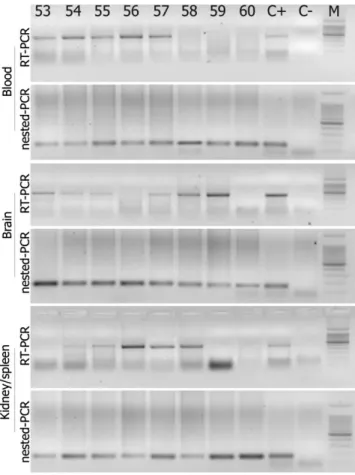
The results of betanodavirus detection by RT-PCR are summarized in Table 1. A specific RT-PCR amplification product of 420 base pair (bp; Fig. 2) was obtained from 18 fish, which represents 56.3% of the fish population. Brain was the most effective organ for viral detection (46.9% positive) followed by blood with 28.1% of positives, whereas only 15.6% of the kidney/spleen samples were positive. These percentages were slightly increased if RT-PCR was applied onto cell culture infected with the tissue homogenates: up to 53% from brain and 25% from kidney/spleen (blood samples were not subjected to cell culture isolation). No RT-PCR amplification was obtained from the fish used as negative control (data not shown). As expected, all the samples considered positive by RT-PCR were also found to be
Figure 1. Light micrograph showing vacuolation in the brain of Solea senegalensis. Hematoxylin and eosin. Bar 5 25mm.
positive by nRT-PCR, which detected considerably more positive samples (Table 1). In fact, the specific amplifica-tion product of 156 bp (Fig. 2) was obtained from all 32 fish, although using different types of samples. The highest level of detection, as occurred in the RT-PCR analysis, was achieved in the brain (90.6%), followed by blood and kidney/spleen, which had the same detection capacity (84.4%). Sixty-nine percent of the fish were regarded as positive for nodavirus using the 3 types of samples. All fish from the control group were negative (data not shown).
The results of the performance evaluation of the diagnostic tests assayed are shown in Table 2. All
RT-PCR and nRT-RT-PCR assays showed the maximum specific-ity values (100%), resulting from the absolute absence of false-positive results; PPV was also 100%. As expected, the highest sensitivity was obtained with nRT-PCR applied to brain samples with a value of 91%. The lowest level was yielded by RT-PCR applied to kidney/spleen samples (16%). The NPV ranged from 73% for nRT-PCR in brain tissues to 32% for RT-PCR applied to kidney/brain samples. Nested RT-PCR applied to blood and kidney/ spleen samples provided identical sensitivity and PPV values (84 and 62%, respectively).
Results obtained indicated that the observation of histologic lesions in brain could be regarded as the most
Table 1. Detection of betanodavirus by reverse transcription polymerase chain reaction (RT-PCR) and nested (n)RT-PCR in infected cell cultures and fish tissues.
Sample RT-PCR nRT-PCR* Positive fish{ Bacterial isolation Blood Brain S/K{ Blood Brain S/K RT-PCR nRT-PCR CC1 TSI CC TS 53–16 + + + 2 2 + + + + + 2 54–24 + + + + + + + + + + Vibrio fisheri 55–29 + + + + + + + + + + Vibrio splendidus 56–43 + + 2 + + + + + + + 2 57–44 + + + + + + + + + + V. fisheri 58–64 2 + + + + + + + + + V. fisheri 59–66 2 + + 2 2 + + + + + V. fisheri 60–71 2 2 2 2 2 + + + 2 + 2 61–73 2 + + 2 2 + + + + + 2 62–75 + + + 2 2 + + + + + 2 63–76 2 + + + 2 2 + 2 + + 2 64–79 2 + + 2 2 2 + + + + V. fisheri 65–81 2 + + 2 2 2 + + + + V. fisheri/V. splendidus 66–84 2 + + 2 2 + + + + + Photobacterium damselae subsp. piscicida 67–86 2 2 2 2 2 2 + 2 2 + 2 68–90 2 2 2 2 2 2 + 2 2 + Vibrio sp. 69–97 2 + + + 2 + + + + + 2 70–100 2 2 2 2 2 + + + 2 + 2 71–104 2 2 2 2 2 + 2 + 2 + 2 72–105 2 2 2 2 2 + + + 2 + 2 73–106 2 2 2 2 2 + + + 2 + 2 74–107 + + 2 2 2 + + + + + Pseudomonas aeruginosa 75–108 2 2 2 2 2 + + + 2 + P. damselae subsp. piscicida 76–110 2 + + + 2 + + + + + 2 77–111 + + + 2 2 + + + + + 2 78–114 2 2 2 2 2 + 2 + 2 + 2 79–117 2 2 2 2 2 + + 2 2 + V. splendidus 80–120 2 2 2 2 2 + + + 2 + Ps. aeruginosa 81–122 2 2 2 2 2 + + + 2 + Ps. aeruginosa 82–125 2 2 2 2 2 + + + 2 + 2 83–126 + 2 2 2 2 + 2 + + + 2 84–127 2 2 2 2 2 + + 2 2 + V. splendidus Positives 9 (28.1)" 17 (53.1) 15 (46.9) 8 (25) 5 (15.6) 27 (84.4) 29 (90.6) 27 (84.4) 18 (56.3) 32 (100) * Nested RT-PCR was performed only on tissue samples.
{Based on results obtained applying RT-PCR and nRT-PCR to tissue samples. {S/K 5 spleen/kidney.
1 CC 5 cell culture; RT-PCR performed with the RNA obtained from SSN-1 cells inoculated with tissue homogenates (not cytopathic effect was observed in any case).
ITS 5 tissue sample; RT-PCR performed with the RNA obtained from fish tissue samples. " Expressed as a percentage of the total fish analyzed.
consistent indicator of nodavirus infection in sole (100% detection). However, this procedure is time consuming and not available in all laboratories. Use of RT-PCR showed low to moderate levels of detection, but the highest percentage of positives was obtained also using brain samples. It has already been reported that samples positive for nodavirus by immunohistochemical observation can yield a negative result in RT-PCR.7,19Those false-negative
results have been attributed to the presence of inhibitory components for the PCR reaction in the tissue samples or to differences between the sequences of the primers and different viral strains. The efficiency nodavirus genome detection was dramatically increased by the use of nRT-PCR (90.6% of positives in brain samples, 84.4% in blood and kidney/spleen).
Inoculation of SSN-1 and SAF-1 cells with fish samples did not cause CPE. However, virus was detected by RT-PCR in some of the SSN-1–infected cells, especially those inoculated with brain samples, allowing the increase of the number of positive results obtained compared with plain
RT-PCR performed directly on tissue samples. Viral replication without CPE has already been reported for VNN10and other fish viruses.12It has been suggested that
the low number of nodavirus particles inoculated into cells is the cause of the absence or delay in the development of CPE, and the use of a combined procedure of cell culture and RT-PCR was proposed to detect samples with low virus levels.11 The results of the present study seem to
support the suitability of these combined procedures even though the authors tested second-blind passage cultures instead of the 72-hr cultures reported previously.11On the
other hand, although it could be expected that coinfection bacteria/nodavirus would act as a stressful factor facili-tating viral replication, no improvement was observed on the nodavirus detection by PCR and/or isolation in cell culture in the fish infected with bacteria. Only 9 of 15 fish showing bacterial growth were positive for nodavirus, and only 8 of the 17 fish positive by RT-PCR in cell culture showed bacterial infection, which suggests that no correlation exists between coinfection and viral detection
In recent years, there has been an increasing emphasis on the use of antemortem sampling methods that would allow determination of the presence/absence of nodavirus in fish stock, particularly in breeders, without killing the in-dividual fish. Different procedures have been used to analyze broodstock for nodavirus detection, including detection of serum antibodies in sea bass (Dicentrarchus labrax),2,4detection of the virus by RT-PCR in gonads and
eggs of stripped jack (Pseudocaranx dentex),16or detection
with both techniques in barfin flounder (Verasper moseri)20
and sea bass,3with contradictory results. It is important to
Figure 2. Detection of nodavirus in different tissue samples of Solea senegalensis by reverse transcription polymerase chain reaction (RT-PCR) and nested (n)RT-PCR. The results were obtained after visualization of amplification products in agarose gel under ultraviolet light. Lane numbers correspond to fish numbers: C+ 5 RT-PCR or nRT-PCR applied to RNA obtained from nodavirus strain 411/96/ERV (420 and 156 base pair [bp], respectively); C– 5 RNase-free water; M 5 100-bp DNA ladder: 11 fragments ranging from 100 to 1000 bp in 100-bp increments, with an additional band of 1,500 bp.
Table 2. Sensitivity, specificity, and predictive values of reverse transcription polymerase chain reaction (RT-PCR) and nested (n)RT-PCR procedures in different types of samples using the results of histopathologic examination as the gold standard (%).
Sensitivity* Specificity{ PPV{ NPV1 nRT-PCR brain 91 100 100 73 nRT-PCR blood 84 100 100 62 nRT-PCR K/SI 84 100 100 62 RT-PCR brain 47 100 100 32 RT-PCR blood 28 100 100 26 RT-PCR K/S 16 100 100 23 RT-PCR cells brain" 53 100 100 35 RT-PCR cells K/S# 23 100 100 32
* Probability of a positive test result in a fish infected with nodavirus.
{Probability of a negative test result in a noninfected fish. {Positive predictive value (PPV) is defined as the probability of a fish testing positive for having nodavirus infection.
1 Negative predictive value (NPV) is defined as the probability of a fish testing negative for not being infected.
IK/S 5 kidney/spleen samples.
# Indicates RT-PCR performed with the RNA extracted from SSN-1 cells inoculated with K/S homogenates (no cytopathic effect was observed in any case).
" Indicates RT-PCR performed with RNA extracted from SSN-1 cells inoculated with brain homogenates (no cytopathic effect was observed in any case).
realize that the viruses may not reside in the reproductive organs at all times17; thus, PCR procedures may not detect
infection in brood fish if the gonad has not been invaded.14
In those circumstances it has been suggested that the additional demonstration of specific antibodies in blood or body fluids can be a very useful complementary pro-cedure.3,14However, the development of nRT-PCR
proce-dures for detecting this virus in blood samples may represent a significant improvement in speed and sensitivity using minimum amounts of sample. In a previous study,7it
was concluded that blood samples could be appropriate for selecting nodavirus-free spawners of sea bass and sea bream only when nRT-PCR was used. The results of the present study indicate that nodavirus could be detected in blood samples using plain RT-PCR, albeit at moderate levels (28%), and that the use of nRT-PCR increases the detection to 84%. Although nRT-PCR on antemortem sampling (blood) is less sensitive than on postmortem sampling (brain), it is suggested that the advantage of keeping fish alive counterbalances the slightly lower sensitivity of the antemortem versus postmortem sampling.
Acknowledgements. This work was partly supported by grants PTR1995/0985/DP from the Ministerio de Educa-cio´n y Ciencia (Spain), PGIDIT04RMA261014PR and PGIDIT06RMA008E from Xunta de Galicia, and REDAQUA/SP5.E27/02 programme INTERREG III A, cofunded by FEDER (European Fund for Regional Development; European Commission). The authors wish to thank all members of Aquagroup who participated in the sampling process.
a. Oxoid Ltd., Basingstoke, Hampshire, UK. b. Qiagen Gmbh, Hilden, Germany. c. Invitrogen Corporation, Carlsbad, CA.
References
1. Bandı´n I, Olveira JG, Borrego JJ, et al.: 2006, Susceptibility of the fish cell line SAF-1 to betanodavirus. J Fish Dis 29:633–636. 2. Breuil G, Pepin JF, Castric J, et al.: 2000, Detection of serum antibodies in wild and farmed adult seabass: application to the screening of the broodstock in sea bass hatcheries. Bull Eur Ass Fish Pathol 20:95–100.
3. Breuil G, Pepin JFP, Boscher S, Thiery R: 2002, Experimental vertical transmission of nodavirus from brood-fish to eggs and larvae of the sea bass, Dicentrarchus labrax (L.). J Fish Dis 25:697–702.
4. Breuil G, Romstand B: 1999, A rapid ELISA method for detecting specific antibody level against nodavirus in the serum of the sea bass, Dicentrarchus labrax (L.): application to the screening of spawners in a sea bass hatchery. J Fish Dis 22:45–52.
5. Castric J, Thie´ry R, Jeffroy J, et al.: 2001, Sea bream Sparus aurata, an asymptomatic contagious fish host for nodavirus. Dis Aquat Org 47:33–38.
6. Cutrı´n JM, Lo´pez-Va´zquez C, Olveira JG, et al.: 2005, Isolation in cell culture and detection by RT-PCR of IPNV-like virus from leucocytes of carrier turbot (Scophthalmus maximus). J Fish Dis 28:713–722.
7. Dalla Valle L, Zanella L, Patarnello P, et al.: 2000, Development of a sensitive diagnostic assay for fish nervous necrosis virus based on RT-PCR plus nested PCR. J Fish Dis 23:321–327.
8. Giray C, Opitz HM, MacLean S, Bouchard D: 2005, Comparison of lethal versus non-lethal simple sources for the detection of infectious salmon anemia virus (ISAV). Dis Aquat Org 66:181–185.
9. Grotmol S, Bergh O, Totland GK: 1999, Transmission of viral encephalopathy and retinopathy (VER) to yolk sac larvae of the Atlantic halibut Hippoglossus hipppoglossus: occurrence of nodavirus in various organs and a possible route of infection. Dis Aquat Org 36:95–106.
10. Iwamoto T, Mori K, Arimoto M, Nakai T: 1999, High permissivity of the fish cell line SSN-1 for piscine nodaviruses. Dis Aquat Org 39:37–47.
11. Iwamoto T, Mori K, Arimoto M, Nakai T: 2001, A combined cell-culture and RT-PCR method for rapid detection of piscine nodaviruses. J Fish Dis 24:231–236.
12. Kibenge FSB, Lyaku JR, Rainnie D, Hammel KL: 2000, Growth of infectious salmon anaemia virus in CHSE-214 cells an evidence for phenotypic differences between virus strains. J Gen Virol 81:143–150.
13. Lo´pez-Va´zquez C, Dopazo CP, Olveira JG, et al.: 2006, Development of a rapid, sensitive and non-lethal diagnostic assay for the detection of viral haemorrhagic septicaemia virus. J Virol Methods 133:167–174.
14. Munday B, Kwang J, Moody N: 2002, Betanodavirus infections of teleost fish: a review. J Fish Dis 25:127–142. 15. Munday B, Nakai T: 1997, Special topic review: nodaviruses
as pathogens in larval and juvenile marine finfish. World J Microbiol Biotechnol 13:375–381.
16. Mushiake K, Nishizawa T, Nakai T, et al.: 1994, Control of VNN in striped jack: selection of spawners based on the detection of SJNNV gene by polymerase chain reaction (PCR). Fish Pathol 29:177–182.
17. Nguyen HD, Mushiake K, Nakai T, et al.: 1997, Tissue distribution of striped jack nervous necrosis virus (SJNNV) in adult striped jack. Dis Aquat Org 28:87–91.
18. Nishizawa T, Mori K, Nakai T, et al.: 1994, Polymerase chain reaction (PCR) amplification of RNA of striped jack nervous necrosis virus (SJNNV). Dis Aquat Org 18:103– 107.
19. Thie´ry R, Arnauld C, Delsert C: 1999, Two isolates of sea bass, Dicentrarchus labrax L, nervous necrosis virus with distinct genomes. J Fish Dis 22:201–207.
20. Watanabe K, Nishizawa T, Yoshimizu M: 2000, Selection of brood stock candidates of barfin flounder using an ELISA system with recombinant protein of barfin flounder nervous necrosis virus. Dis Aquat Org 41:219–223.