SOCIUS Working Papers
Regulating self-regulating
professional associations:
What changes in the Portuguese
context with the Law 6/2008?
Raquel Rego
Nº 01/2011
SOCIUS - Centro de Investigação em Sociologia Económica e das Organizações ISEG - Instituto Superior de Economia e Gestão
Universidade Técnica de Lisboa R. Miguel Lupi, 20 1249-078 Lisboa
Tel: 213951787 Fax: 213951783 E-mail: [email protected]
2
Regulating self-regulating professional associations:
What changes in the Portuguese context with the Law 6/2008?
1(PLEASE DO NOT QUOTE WITHOUT AUTHOR’S PERMISSION)
Author: Raquel Rego – Researcher fellow
Institution: Research Centre in Economic and Organizational Sociology (SOCIUS)
Address: SOCIUS-ISEG-Technical University of Lisbon Rua Miguel Lúpi, 20 1249-078 Lisboa Portugal
Email: [email protected]|[email protected] Phone: (351) 21 392 27 95
Abstract
Since there is a professionalization trend (Wilensky, 1964), professional associations are one of the few cases of associations which membership is not in decline, namely according to the World Values Survey data from 2000s. Most professions need to be organized as associations to be able to exert influence over the political power and this influence becomes more important when the State attributes autonomy to these associations in order to regulate the profession and defend the public interest. These professional groups thus acquire a privileged relation with the State (Halliday, 1987).
In Portugal, these professional associations are named professional public associations (PPAs), also known as professional Orders. These PPAs are entities of the indirect and autonomous administration of the State (Moreira, 2003). The system of professional regulation in Portugal belongs to the most common pattern of the European Continent, in which the professional associations have the monopoly of professional regulation (Moran and Wood, 2003).
The ambiguity of interests defended, private or public, is a characteristic of these associations (Candler, 2000; Moreira, 2003). Therefore, many times, when contributing towards the control of work, of the market, etc., these professional associations are responsible for the collision of public interest with professional interest. In this sense, in our country, some PPAs were involved in polemic situations when they obstructed the adhesion of professionals whose graduation course was not recognized by the PPA, but had been homologated by the Government (Lusa, 2005).
We can say that behind a professional association there is always a candidate to a PPA (Moreira, 2003). In this sense, some Portuguese associations entitle themselves association pro-Order, like the Pro-Order Association of Psychologists (Associação Pró-Ordem dos Psicólogos) and the Teachers Pro-Order Trade Union (Associação Sindical dos Professores Pró-ordem). Professional associations can, with effect, also be understood as a strategy of a group to strengthen its status (Selander in Burrage and Torstendahl, 1990).
Recently we have observed a substantial increase in the number of professional groups that obtain the status of a PPA following an apparently discretionary criterion by the legislator (Rego in Freire, 2004). For instance some professional groups succeeded to obtain the public status, like economists, while
1
3 others, even if acting in more public interest sensitive fields, took longer, like psychologists or nutritionists.
As a result of the proliferation of PPAs, Law 6/2008 was recently published to regulate its creation and action. The law has established a formal procedure for all PPAs creation but did not bring new features in terms of these associations power, namely on professional regulation. The only new requirement for the creation of a PPA is the making of a previous study, apparently an indicative of the importance of technical and scientific nature of the PPA creation. In short, we may expect that the material resources of professional groups will be important in order to support the legal initiative, besides the change of their lobbying focus, which will be centred on the parliamentary political parties instead of the government.
The aim of this paper is to present and analyse the before and after periods of recently developed Portuguese legislation designed to regulate professional associations, taking in account policy makers standpoints, namely parliamentary parties who have voted and enacted the Law 6/2008. This paper is the result of an ongoing project on professional associations’ creation and it intends to discuss the impact of the new legal framework on the future strategies of professional groups.
Keywords: Portugal, professional associations, professionalization, regulation, State.
Introduction
Ever since the classical work of Carr-Saunders and Wilson in 1933, on the sociology of professions, professional associations have been referred only in a secondary way. And despite literature making reference to the great power of professional associations (Halliday, 1987), research on them is scarce (Van Hoy, 1993; Greenwood et al., 2002), especially research on the process that leads to the creation of professional associations.
Most professions need to be organised as associations to be able to exert influence over the political power. This influence becomes more important when the State gives to these associations the autonomy to regulate the profession and defend the public interest. These professional groups thus acquire a privileged relation with the State (Halliday, 1987).
In this sense, professional associations have been considered as the most influent associations in Portugal (Freire, 2004). They are consulted on legislative issues and also take initiative to pronounce themselves on professional matters, which include the creation of other professional associations. This means that when a professional group intends to influence political decision-making in order to have self-regulation power, it must not only persuade decision-makers, but also deal with already existent professional associations that will be lobbying in the reverse direction.
4 There are three main parts in this paper:
i) first of all, we make a brief reference to the increase of power of professional associations and to the diversity of professional regulation systems in order to contextualise our research;
ii) secondly, we introduce the Portuguese case focusing on the recent discretionary trend to create professional associations and the consequent emergence of Law 6/2008 in order to control it, summarising its content;
iii) finally, we highlight current political positions, and present the effects of the new legal framework that are already evident.
1. Professional associations’ power increase and theEuropean Continent pattern of regulation
Since there is a professionalization of everyone (Wilensky, 1964), it is expected that the number of members of professional associations will increase. Robert D. Putnam (2000) has observed that professional associations’ membership was exceptionally growing in the United States, in a time of civic participation collapse. World Values Survey findings also showed that professional associations’ membership is growing in several countries, as we may see in Graph 1.
Graph 1: Evolution of professional associations’ membership (1990; 1999; 2006) - %
Source: World Values Survey
(Japan‘s data is from 2005 and not from 2006; there is no data available for Portugal in 2006).
Professional associations are increasing their power, not only because their representativeness is growing, but also because, as Julia Evetts (2002) stresses, professions are themselves internationalising, leading to the reinforcement of international professional associations.
In this sense, more professional groups show the ambition to have professional regulating power. And most of them need to be organised as associations to be able to exert influence over the political power, as Terence C. Halliday (1987) has sustained. This influence becomes more important when the State gives to these associations the autonomy to regulate the profession and defend the public interest. These professional groups thus acquire a privileged relation with the State (Halliday, 1987).
0 5 10 15 20 25 30
1990 1999 2006
USA
Argentina
Portugal
Poland
Japan
5 In Portugal, these professional associations are named professional public associations (PPAs), also known as professional Orders (Ordens profissionais). These PPAs are part of the autonomous branch of the State (Moreira, 2003). The system of professional regulation in Portugal belongs to the most common pattern of the European Continent, in which the professional associations have the monopoly of the professional regulation. Table 1 shows us the main regulation systems.
Table 1: Regulation system patterns and their agencies
REGULATION SYSTEMS REGULATORY AGENCIES DOMINANT REGION
Independent self-regulation (monopolist) Professional associations European continent State sanctioned self-regulation Professional associations Anglo-Saxon countries
Direct state regulation State --
Source: adapted fromMoran and Wood, 1993.
But, as Moran and Wood stress “There is no ‘model’ of regulation – and the pattern in any one country is certainly not the only model.” (1993: 19). In this sense, in Portugal, there are at the same time the administrative regulation system, namely for taxi drivers, hair dressers, etc., and a kind of independent system for journalists who count on a regulating council composed by experts, professionals and other members.
2. Portuguese professional associations discretionary increase and Law 6/2008
The type of professional associations with the monopoly of regulation of the profession are considered one of the most powerful associations in democracy, although we do not know much about the process of their creation, nor of their effective impact, namely in professionals.
The ambiguity of interests defended, private or public, is a characteristic of professional associations (Candler, 2000) and in particular of PPA (Moreira, 2003). Therefore, when contributing towards the control of work, of the market, etc., these professional associations are responsible for the collision of the public interest with the professional interest. In this sense, in Portugal, some PPAs, and architects in particular, were involved in polemic situations when they obstructed the adhesion of professionals whose graduation course was not recognized by the PPA, but had been homologated by the Government (Lusa, 2005).
We can say that behind a professional association there is always a candidate to a PPA (Moreira, 2003). In fact, some voluntary associations of private law pursue this goal and inscribe it in its own name. Some Portuguese associations entitle themselves association pro-Order, like the Pro-Order Association of Psychologists (Associação Pró-Ordem dos Psicólogos) and the Teachers Pro-Order Trade Union (Associação Sindical dos Professores Pró-ordem). Professional associations can, with effect, also be understood as a strategy of a group to strengthen its own status (Selander in Burrage and Torstendahl, 1990).
6 government. The proximity of social ties between the government and the professional group appears then to us as a plausible hypothesis to explain the PPA creation.
Table 2 shows us the creation of Portuguese PPAs in the democratic period. We observe that 10 out of 17 current PPAs (which also includes lawyers, physicians, solicitors, pharmacists, engineers, dispatchers, accounting auditors), were created after the 25th April 1974, and especially in the 1990s.
Table 2: PPAs creation in the democratic regime (1975-2009) 1 9 7 5 1 9 7 6 1 9 7 7 1 9 7 8 1 9 7 9 1 9 8 0 1 9 8 1 1 9 8 2 1 9 8 3 1 9 8 4 1 9 8 5 1 9 8 6 1 9 8 7 1 9 8 8 1 9 8 9 1 9 9 0 1 9 9 1 1 9 9 2 1 9 9 3 1 9 9 4 1 9 9 5 1 9 9 6 1 9 9 7 1 9 9 8 1 9 9 9 2 0 0 0 2 0 0 1 2 0 0 2 2 0 0 3 2 0 0 4 2 0 0 5 2 0 0 6 2 0 0 7 2 0 0 8 2 0 0 9
1 2 1 3 1 1 1
Source: Based on Rego in Freire, 2004.
As a result of the proliferation of PPAs, Law 6/2008 was published in February 2008 to regulate its creation. New PPAs must follow this legal framework and already existent PPAs may ask to be integrated in the new regime. All political parties represented in the Parliament have agreed with Law 6/2008 since it intends to clarify and increase transparency to the process of professional groups lobbying.
This Law institutionalise the traditional tacit criteria for PPAs creation, namely:
- its exceptional character, resulting of a special public interest need;
- the exclusive nomination of Ordem (or Câmara if concerning a not graduated profession) to these associations, and bastonário for their presidents - preventing appropriation from others as it has happened with Ordem dos Avaliadores (building auditors), which is in fact a private association;
- the defence of users and professionals interests at the same time;
- the equivalence of PPAs as public institutions concerning their legal regime (for example statutes must be created and changed by the Parliament) and its administrative and financial autonomy -which implies the interdiction of participation in trade union actions and issues; - the monopoly of representation and the control of individuals admitted to the profession; - the right to be consulted in legal issues regarding the profession;
- the existence of an autonomous disciplinary control.
The new legal framework has established a formal procedure for all PPAs creation but did not bring many new features concerning the professional regulation. The Law has determined that any rights attributed are restricted to its content. This avoids, for instance, that graduations homologated by the
Architects Dentists Veterinarians Economists Nurses Biologists Technical engineers
Clerks Psychologists
7 Government are not recognised by the respective PPA. Some other features were also clarified by the Law:
- the interdiction of numerus clausus on access to the profession;
- the settlement of the responsible ministry, besides an annual report to be sent to the Parliament and to the Government about the PPA performance;
- the right to impose at least a registration of all members, although the statutes can assume a different orientation;
- the determination of the right to create private associations;
- the limitation of social bodies to two mandates, and each one to four years at the maximum;
- the distinction between professionals and members sanctions, since the non payment of PPAs quota cannot justify a member exclusion, which is the hardest sanction;
- the initiative of a disciplinary process may be raised by PPAs social bodies but also by the users’ defender(provedor), always a non member, or by the public ministry;
- the regime of interest incompatibilities between social bodies members and also between social bodies members and public functions - although exceptions are accepted.
But probably the most important features are, on one side, the fact that the creation of a PPA is now especially a Parliament initiative, not a Government proposal. This changes the focus of professional groups lobbying into different parties, increasing the channels available to make pressure, but it also leads to a longer process. And, on the other side, the need of a prior study in order to demonstrate the special public interest need of self-regulation, which is a controversial feature.
The elaboration of a prior study apparently is an indicative of the importance of technical and scientific nature of the PPA creation. The study contents required are not precise, which means that the study may include whatever the authors consider relevant. It even allows that the study does not propose exactly the same thing the professional group does. Some studies seem to include a legal opinion, a draft of the PPA bylaw, besides a more or less sociological study on the professionals (number, training courses, certification,...). The payer of the study is also not mentioned. The lack of information on this has leaded at least one professional group to develop a fund campaign.
We may expect that, on one side, studies can be of diverse nature, risking the lack of adequate information to support the decision making, and surely not providing comparable data. On the other side, only groups with resources, or who succeed to get the money to pay an independent and prestigious institution, may initiate the process which is a contribution to inequity and not to the public interest.
8 Declaration implementation in which we find co-workers with different curricula: some recognised by
Bologna’s, others not.
3. Policy makers standpoints and the impact of the new legal framework on professional groups
As said before, professional associations can be understood as a strategy of a group to strengthen its status (Selander in Burrage and Torstendahl, 1990) and, in this sense, we can analyze professional groups as pressure groups.
We cannot speak of a general theory, nor even of a pattern per country (Thomas, 2001), but frequently, professional groups tend to follow a pattern of cooperation or pragmatic involvement (Thomas, 2001), for example with political parties who support them. Several factors constraint the relation established between a pressure group and a political party: the political and socio-economic development of the country; the normative and political framework (degree of centralisation of the government, strength of political parties, etc.); the characteristics of the pressure group (leadership, objectives, strategies, etc.) (Thomas, 2001). On the other hand, the group-party relation is expressed in different ways, as in overlapping membership, ideological affinities, among others (Thomas, 2001).
The question of why some pressure groups are more influent than others seems to be fundamental for the understanding of democracy; however, it remains unanswered (Binderkrantz, 2008). Some explanations have pointed to the resources available and the different strategies used (internal and external), or the diversity of used channels (Binderkrantz, 2008). However, these explanations have limitations in their empirical measurement and do not seem to explain, for instance, the choice of whom to influence.
Before the regulating law, it was expected that the influence would occur in a more fruitful way if professionals had access to Government members. With law 6/2008, the opportunities to influence are bigger since they must be addressed to parliamentary parties (although the minister in charge of the professional field is informally contacted by the Parliament to give his opinion as well) but success can take longer since it involves more actors.
If there is a Parliament majority, we could expect that the main focus of the influence would be the party in Government. But when there is not a majority, professional groups often request audiences to all parties with parliamentary representation and in particular to those represented in the parliamentary commission in charge of the PPAs creation - small parties do not have human resources to participate in all parliamentary commissions. In this sense, we have already seen different political parties taking the initiative to present a PPA proposal, such as in the case of psychologists.
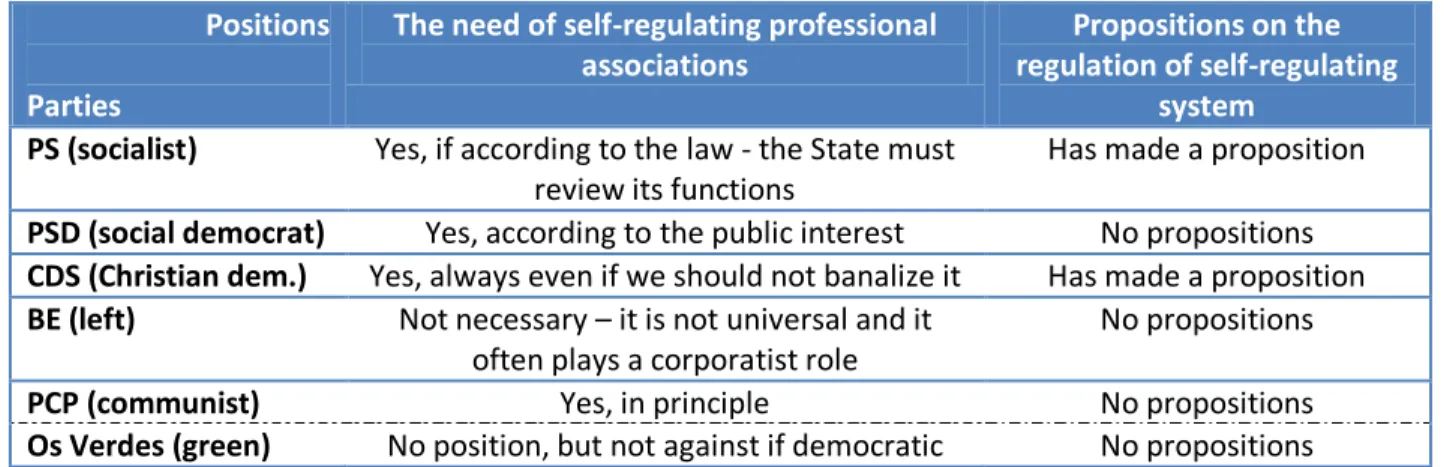
In the Portuguese spectrum there are two parties particularly active in this matter, the Socialist and the Christian Democratic parties. These proposals seem to be related with parties’ resources, but also with their priorities. In fact, left-wing parties consider that the agenda of the parliamentary commission must give more space for discussing the Labour Code or eventual redundancy cases, for example.
9
Table 3: Sum of political parties positions on professional self-regulation
Positions
Parties
The need of self-regulating professional associations
Propositions on the regulation of self-regulating
system
PS (socialist) Yes, if according to the law - the State must review its functions
Has made a proposition
PSD (social democrat) Yes, according to the public interest No propositions
CDS (Christian dem.) Yes, always even if we should not banalize it Has made a proposition
BE (left) Not necessary – it is not universal and it often plays a corporatist role
No propositions
PCP (communist) Yes, in principle No propositions
Os Verdes (green) No position, but not against if democratic No propositions
In the near future we expect to observe the expansion of professional groups lobbying. For now, based on the formal demands of audiences and considering the public expression of that goal (in newspapers, in websites), there are at least nine professional groups currently intending to become a PPA. The process has started more than 10 years ago in some cases. The next table identifies these groups.
Table 4: Professional groups intending to create a PPA (May 2010)
Professional groups Current situation
1 Archaeologists A platform of two associations leads the discussion process inside the professional group and has found receptivity from the supervising ministry
2 Designers Law projects are in discussion at the Parliament
3 Health technicians A platform of associations leads the influence process for a global self-regulation association
4 Landscape architects A study is being developed in order to fulfil the legal requirement
5 Nutrionists The professional PPA was approved in general by the Parliament and is now waiting for the specialised discussion – although dieticians are contesting, because they want to be included
6 Physiotherapists A petition presented at a parliamentary commission was rejected since there was no new data on the demand process
7 Teachers A study was made; the process seems to be currently lead by the national teacher associations but there is also a pro-Order association
8 Social Workers Auditions with members were made focusing on the legal proposition and on the study that will be presented to the Parliament
9 Urbanism professionals Audiences were asked during the previous legislature – similar organisations were contacted abroad – and the architects Order has created in 2004 the urbanism council which was implemented in 2008…
10 One important consequence of the political influence process is the scissions it causes inside the field:
(a) among professionals who disagree about the PPA creation or about the form it takes;
(b) among professionals with the same function but different backgrounds;
(c) among professionals with different functions but working together.
Besides, these divisions usually correspond to splits within and between professional associations:
A) between professionals from the same association,
B) between different associations of the professional field (Law 6/2008 establishes the obligation of their consultation during the PPA creation), and
C) among different professional fields, which can be particularly difficult if there is already a PPA since it can take advantage of its privileged position next to the state and use more important resources. This situation leads sometimes to lawsuits. The leading association will often not only intend that a PPA is created, but also to become itself that PPA. And this is clear in particular when the president becomes the PPA president, the bastonário.
But empirical data still needs to be gathered in order to demonstrate this and to continue our research.
Conclusion
In this paper an attempt is made to contribute to the knowledge of professional groups’ political influence on the creation of self-regulating professional associations. Professional associations are one of the most important associations in democracy and in particular in Portugal where they are apparently often present in mass media.
We have emphasised the recent discretionary creation of PPAs in Portugal and the consequent essay to stop it. Law 6/2008 came to coercively regulate self-regulating professional associations. It has made more explicit the set of traditionally tacit criteria, has clarified PPAs’ capacities in order to avoid new problems of legitimacy dispute between institutions, and has imposed a prior study to support the need to create a new PPA next to the parliamentary political parties.
In sum, there are three main changes in the legal framework. First of all, apparently more professional groups intend to reach the PPA status and have initiated the respective study request; the study requisite has generated different kinds of contents since they are not stipulated by law, which leads us to sustain the need for standard parameters, in order to assure a more rigorous and transparent decision-making; finally, this law has imposed a transfer of decision-making focus from the Government to the Parliament, and consequently the change of the professional groups target in the lobbying process. Apparently the access to the political decision-making is easier but the process may take longer and is limited to professional groups with resources instead of based in their relevance to the public interest.
11
References
Binderkrantz, Anne (2008), “Different groups, different strategies: how interest groups pursue their political ambitions”, Scandinavian Political Studies, 31(2), pp. 173-200.
Burrage, Michael and Torstendahl, Rolf (eds.) (1990), Professions in Theory and History – Rethinking the Study of the Professions, London: Sage.
Candler, Gaylord George (2000), “The professions and public policy: expanding the third sector”, International Political Science Review, 21(1), pp. 43-58.
Evetts, Julia (2002), “New directions in State and international professional occupations: discretionary decision-making and acquired regulation”, Work, Employment & Society, 16(2), pp.341-353.
Freire, João (coor.) (2004), Associações Profissionais em Portugal, Oeiras: Celta.
Greenwood, Royston, Suddaby, Roy and C. R. Hinings (2002), “Theorizing change: The role of professional associations in the transformation of institutionalized fields”, Academy of Management Journal, 45(1), pp.58-80.
Halliday, Terence C. (1987), Beyond Monopoly – Lawyers, State Crisis and Professional Empowerment, Chicago: The University Chicago Press.
Law 6/2008 – at http://www.dgpj.mj.pt/sections/leis-da-justica/pdf-ult2/lei-6-2008-de-13-de4297/downloadFile/file/Lei%206.2008.pdf?nocache=1204280397.17 (accessed 25 June 2010).
Lusa (2005), “Estudantes de arquitectura vão manifestar-se contra processo de admissão à Ordem, in Público, 12.10.2005 – at
http://www.publico.clix.pt/Educa%c3%a7%c3%a3o/estudantes-de-arquitectura-vao-manifestarse-contra-processo-de-admissao-a-ordem_1235419 (accessed 25 June 2010).
Moreira, Vital (2003), Administração Autónoma e Associações Públicas, Coimbra: Coimbra Editora.
Putnam, Robert D. (2000), Bowling Alone: The Collapse and Revival of American Community, New York: Simon & Schuster.
Thomas, Clive S. (2001), Political Parties and Interest Groups – Shaping Democratic Governance, Boulder/London: Lynne Rienner Publishers.
Van Hoy, Jerry (1993), “Intraprofessional politics and professional regulation: a case study of the ABA
commission on professionalism”, Work and Occupation, 20(1), pp.90-109.
Wilensky, Harold L. (1964), “The professionalization of everyone?”, American Journal of Sociology, 70(2), pp.137-158.