Accelerated Aging Tests combined with EIS as a
Tool for Investigating the Tinplate Cans
Degradation Process
Master Thesis
by
Luísa Mariana de Oliveira Carneiro
Developed for curricular Dissertation purposes
conducted at
Colep
Supervisor at FEUP: Prof. Adélio Mendes Supervisor at Colep: Eng. Rita Resende
Chemical Engineering Department
Agradecimentos
Foram muitas as pessoas que contribuíram para a realização desta tese, às quais deixo o meu mais sincero agradecimento.
Em primeiro lugar, e o maior agradecimento de todos, para os meus pais e irmão, por todo o apoio dado durante toda a minha vida e também pelo enorme orgulho que sempre demonstraram em mim.
Ao Professor Adélio Mendes, por toda a dedicação e apoio prestado no decorrer da tese, pois foram fundamentais para o desenvolvimento da dissertação.
À minha orientadora, a Engª Rita Resende, pela constante ajuda disponibilizada no decorrer da tese.
À Tânia Lopes, um agradecimento muito especial por toda a dedicação, paciência e disponibilidade ao longo destes 3 meses. Foi, sem dúvida alguma, um importante pilar desta dissertação.
À Ana e à Margarida pelo carinho demonstrado e por tão bem me terem recebido no laboratório.
Um enorme agradecimento à Susana, à Mariana e também à Cindy por me terem ajudado em momentos de aperto, pelos conselhos e pelas horas de conversa, foram um apoio importante nesta etapa da minha vida.
Ao Vitor, que durante os últimos 6 anos esteve sempre ao meu lado, nos bons e nos maus momentos, pelo carinho, pela preocupação e por toda a ajuda que sempre me prestou.
À Colep, pelo apoio financeiro e pela oportunidade concedida de realizar este projeto em ambiente empresarial.
E aos restantes que, de uma maneira ou de outra, estiveram presentes e aos quais também deixo o meu agradecimento.
Accelerated Aging Tests combined with EIS as a Tool for Investigating the Tinplate Cans Degradation Process
Resumo
As embalagens metálicas de folha-de-flandres são bastante suscetíveis à corrosão eletroquímica quando expostas a determinado tipo de produtos de enchimento. Para proteger a superfície metálica da embalagem estas são revestidas com materiais poliméricos.
Atualmente, o método mais utilizado na indústria para avaliar a compatibilidade entre a embalagem e o produto de enchimento é o chamado Teste de Armazenamento em Estufa. Neste método as embalagens são sujeitas a uma temperatura constante que pode variar dos 45 ºC aos 75 ºC durante extensos períodos de tempo. Periodicamente, as embalagens são abertas e o seu estado de degradação é analisado por inspeção visual; uma das grandes desvantagens deste método é o fornecer apenas dados qualitativos. O objetivo deste projeto é utilizar testes de envelhecimento acelerado combinados com a técnica de Espectroscopia de Impedância Eletroquímica (EIS - Electrochemical Impedance Spectroscopy) para analisar de forma quantitativa a evolução da degradação do sistema embalagem/produto. Concluiu-se que a avaliação da corrosão das embalagens pequenas poderia ser realizada ao fim de 2 semanas envelhecimento, em vez das 24 semanas atualmente consideradas.
Foram ainda comparados dois testes de envelhecimento acelerado: o tradicional Teste de Armazenamento em Estufa e um novo método eletroquímico, o método AC-DC-AC. Em ambos os testes, a caracterização quantitativa da degradação foi feita através da técnica de EIS. O método AC-DC-AC revelou-se promissor para a caracterização da evolução do processo de degradação nas embalagens metálicas. Contudo, é necessário um estudo mais aprofundado para que seja possível determinar a sua equivalência ao método de envelhecimento em estufa.
Palavras Chave: EIE; corrosão; folha-de-flandres; revestimentos;
Abstract
Tinplate cans are very susceptible to corrosive attack due the wide diversity of aggressive products packed. Anticorrosive coatings are used to prevent the direct contact between the packed product and the metal surface of the can, retarding the degradation of the system.
Currently, the most common test used in industry to evaluate the compatibility between coatings and packed products is the Storage Test. In this method, cans are stored in an oven at temperatures between 45 ºC and 75 ºC during extended periods of time. Periodically, the packages are opened and its degradation state is analysed. A disadvantage of this method is that it only provides qualitative data about the degradation of the system, and it is not possible to determine the degradation causes. The main purpose of this project is the use of accelerated aging tests combined with Electrochemical Impedance Spectroscopy (EIS) technique to analyse quantitatively the evolution of the degradation of the packed/product system over time.
Two different accelerated aging tests were compared: the Storage Test and a new electrochemical method, the AC-DC-AC. In both tests the quantitative characterization was performed with EIS technique. With Storage Test, after two weeks of aging, packaging degradation stabilizes. It was concluded that for Small Size Aerosols, the evaluation of the corrosion process could be determined after two weeks of storage. The AC-DC-AC method reveals promising to characterize the evolution of the degradation process in metal cans however, it is necessary further studies to determine if it is possible the use of this method instead of Storage Test.
Keywords: EIS; corrosion; tinplate; coatings; AC-DC-AC;
Accelerated Aging Tests combined with EIS as a Tool for Investigating the Tinplate Cans Degradation Process
Declaração
Declara, sob compromisso de honra, que este trabalho é original e que todas as contribuições não originais foram devidamente referenciadas com identificação da fonte.
Introduction 1
Table of Contents
Table of Contents ... 1
Figure Captions ... 3
Table Captions ... 5
Nomenclature ... 6
1
Introduction ... 7
1.1 Background and Project Presentation ... 10
1.2 Company Overview ... 10
1.3 Project Contributions ... 11
1.4 Organization of the Thesis ... 11
2
Context and State of the Art ... 13
3
Materials and methods ... 20
3.1 Electrochemical Impedance Spectroscopy ... 21
3.2 Storage Test ... 22
3.3 AC-DC-AC Method ... 22
4
Results and Discussion ... 23
4.1 Storage Test combined with EIS measurements ... 23
4.1.1 Big Size Aerosols (AB) ... 26
4.1.2 Medium Size Aerosols (AM) ... 33
4.1.3 Small Size Aerosols (AS) ... 37
4.2 AC-DC-AC test ... 43
4.2.1 Medium Size Aerosols (AM) ... 43
Accelerated Aging Tests combined with EIS as a Tool for Investigating the Tinplate Cans Degradation Process
Introduction 2
5
Conclusions ... 46
5.1 Purposes Achieved ... 47
5.2 Limitations and Future Works ... 47
5.3 Final Assessment ... 48
Referencies ... 49
Attachment 1 - Samples Pictures After Tests ... 51
Attachment 2 - Bode diagram ... 58
Introduction 3
Figure Captions
Figure 1 – Tinplate Structure. ...7
Figure 2 – Sinusoidal Current Response in a Linear System. Extracted from [20]. ... 14
Figure 3 – Ideal non-conductive coating on a metal substrate and corresponding equivalent electric circuit. ... 16
Figure 4 – Electrical equivalent circuit of a coating in contact with an electrolyte with pore formation. Rpo is the charge transport resistance in pores, Rc� is the charge-transfer resistance at metal/electrolyte interface and Cdl is the double-layer capacitance. ... 16
Figure 5 – AC-DC-AC steps in function of time. Extracted from [24]. ... 17
Figure 6 – Electrochemical station used in the project. ... 21
Figure 7 – Comparative results of impedance analysis with a two- and three-electrodes system, under the same conditions. ... 25
Figure 8 – Initial time impedance measurements of all types of cans used in this project. Two-electrodes system. ... 26
Figure 9 – Nyquist diagram for an AB sample with electrolyte aging. Two-electrodes system. ... 27
Figure 10 - Equivalent Electrical Circuit for the first and following weeks of storage. ... 27
Figure 11 - Nyquist diagram for an AB sample with product aging. Two-electrodes system. ... 29
Figure 12 – Comparative Nyquist diagram for an AB sample aged with product and analysed with product (P+P) and with fresh electrolyte (P+E). Two-electrodes system. ... 31
Figure 13 – Comparative Bode diagram for an AB sample aged with product and analysed with product (P+P) and with fresh electrolyte (P+E). Two-electrodes system... 31
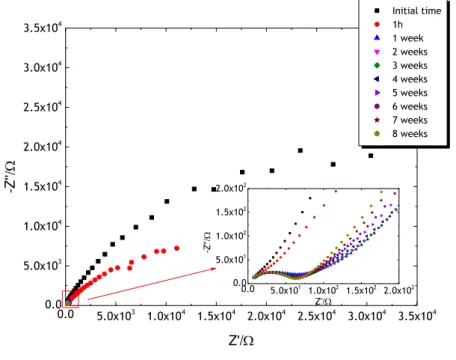
Figure 14 - Nyquist diagrama for an AM sample with electrolyte aging. Two-electrodes system. ... 33
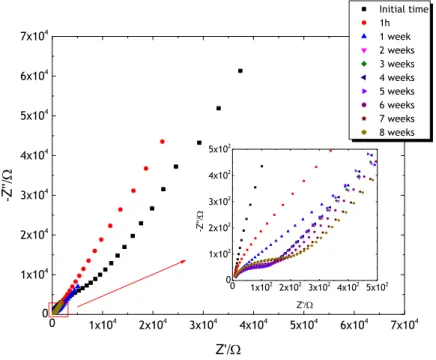
Figure 15 - Nyquist diagrama for an AM sample with product aging. Two-electrodes system... 35
Figure 16 – Comparative Nyquist diagram for an AM sample aged with product and analysed with product (P+P) and with fresh electrolyte (P+E). Two-electrodes system. ... 36
Figure 17 – Comparative Bode diagram for an AM sample aged with product and analysed with product (P+P) and with fresh electrolyte (P+E). Two-electrodes system... 36
Figure 18 - Nyquist diagrama for an AS sample with electrolyte aging. Two-electrodes system. ... 38
Figure 19 - Nyquist diagrama for an AS sample with product aging. Two-electrodes system. ... 39
Figure 20 – Comparative Nyquist diagram for an AS sample aged with product and analysed with product (P+P) and with fresh electrolyte (P+E). Two-electrodes system. ... 41
Accelerated Aging Tests combined with EIS as a Tool for Investigating the Tinplate Cans Degradation Process
Introduction 4
Figure 21 – Comparative Bode diagram for an AS sample aged with product and analysed with product
(P+P) and with fresh electrolyte (P+E). Two-electrodes system... 41 Figure 22 – Nyquist diagram of AM filled with electrolyte, at initial time and after 10 AC-DC-AC cycles.
... 43 Figure 23 – Open potential circuit evolution of AM filled with electrolyte, after 10 cycles of AC-DC-AC.
... 44 Figure 24 - Nyquist diagram of AS filled with electrolyte, at initial time and after 10 AC-DC-AC cycles 45
Figure 25 - Open potential circuit evolution of AS filled with electrolyte, after 10 cycles of AC-DC-AC.
Introduction 5
Table Captions
Table 1 – Specifications of the samples used in all tests. ... 20 Table 2 – Specifications of the products used. ... 21 Table 3 - Values of the setting parameters corresponding to a sample AB with electrolyte aging in a
two-electrodes system... 28 Table 4 - Values of the setting parameters corresponding to a sample AB with product aging in a
two-electrodes system. ... 30 Table 5 - Values of the setting parameters corresponding to a sample AB aged with product but
analysed with fresh electrolyte in a two-electrodes system. ... 32 Table 6 - Values of the setting parameters corresponding to a sample AB aged and analysed with
product in a two-electrodes system. ... 32 Table 7 - Values of the setting parameters corresponding to a sample AM with electrolyte aging in a
two-electrodes system... 34 Table 8 - Values of the setting parameters corresponding to a sample AM with product aging.
Two-electrodes system. ... 35 Table 9 - Values of the setting parameters corresponding to a sample AM aged with product but
analysed with fresh electrolyte in a two-electrodes system. ... 37 Table 10 - Values of the setting parameters corresponding to a sample AM aged with product but
analysed with product in a two-electrodes system. ... 37 Table 11 - Values of the setting parameters corresponding to a sample AS with electrolyte aging.
Two-electrodes system. ... 38 Table 12 - Values of the setting parameters corresponding to a sample AS with product aging.
Two-electrodes system. ... 40 Table 13 - Values of the setting parameters corresponding to a sample AS aged with product but
analysed with fresh electrolyte in a two-electrodes system. ... 42 Table 14 - Values of the setting parameters corresponding to a sample AS aged and analysed with
Accelerated Aging Tests combined with EIS as a Tool for Investigating the Tinplate Cans Degradation Process
Introduction 6
Nomenclature
Variables Definition Unit
A Coating Area exposed to the electrolyte cm2
Cco Coating Capacitance F
Cdl Double-layer Capacitance F
CPEc Constant Phase Element related to coating F
d Coating Thickness μm
E(t) Potential in function of time V
E0 Amplitude of the signal V
f Frequency Hz
l(t) Current in function of time A
l0 Current Signal Amplitude A
j Imaginary Unit
Rpo Pore Resistance Ω
Rct Resistance to charge-transfer Ω
Z’ Real Part of the Impedance Ω
Z’’ Imaginary Part of the Impedance Ω
Greek symbols
ɛ0 Vacuum Dielectric Constant F∙m-1
ɛr Coating Dielectric Constant
� Phase Angle °
ω Radial Frequency rad∙s-1
Abreviations
AB Big Size Aerossol
AM Medium Size Aerossol
AS Small Size Aerossol
Introduction 7
1 Introduction
Packaging is an ancient industry used to assist man in transporting, storing and protecting a variety of items.[1] According to some literature sources, packaging appeared 10 000 years ago when nomadic people needed to find a way to carry and preserve food during migrations for searching better places. The evolution of the materials used in packaging manufacture is directly related to the humanity evolution, since over time humans have been seeking for more durable and long lasting solutions for conserving cans’ content.[2]
In 1795 the French government, led by Napoleon Bonaparte, offered a prize to anyone who develop an effective method to preserve food for the army's and navy's use. Nicolas Appert, a French inventor, won this prize and in 1790 he started to commercialize food stored in glass bottles.[3]
In 1810, emerged the first metal packaging; Peter Durand disclosed this technology in a patent of preserving food using metal packaging. These packs were made of iron sheets coated with tin to prevent rust and corrosion, better known as tinplate.[4] The tinplate is a
cold rolled mild steel sheet of less than 0.50 mm thick, where both sides are coated with tin and a passivation layer of chromium - Figure 1.[5]
Figure 1 – Tinplate Structure.
With the market expansion and industrial development, there was an exponential increase of products to be stored in metal packaging and therefore it was necessary to adapt the packaging to the packaged products. In 1927 Erik Rotheim, a Norwegian engineer, patented a type of metal packaging that would be a huge success: the aerosol dispenser. These packages were mass-produced in the United States of America during the late forties to store insecticide. The aerosol dispenser is still used in our day-a-day in many different products, e.g. cleaning products, personal care or even with food.[6]
Accelerated Aging Tests combined with EIS as a Tool for Investigating the Tinplate Cans Degradation Process
Introduction 8
The tinplate packaging represents the biggest slice on the packaging sector, which includes the aerosol cans, three- or two-piece cans, rectangular cans and buckets. Tinplate packaging has many advantages such as hermeticity, thermal resistance, product protection and mechanical strength, among others. However, as drawback, some corrosion problems may occur in the inner and outer containers of these type.[7] For this reason, many studies are being conducted in an attempt to improve the lifetime of packaging; protecting it from corrosion over time. Currently, interior and exterior coatings are used as preventive method of this destructive phenomenon.
Corrosion
Corrosion is a natural process and it can be defined as the material degradation through chemical or electrochemical interaction with environment leading to a significant decrease of its duties.[8] This phenomenon exists in a wide range of materials, having a
greater impact on metallic materials. The corrosion process can be classified into chemical or electrochemical depending on the type of action of the corrosive medium on the material. In the case of metals, electrochemical corrosion is the most important.[9] Normally, metals are unstable when exposed to an aqueous environment. The basic process of metallic corrosion in aqueous solution consists of the anodic dissolution of the metal and the cathodic reduction of the oxidants present in the solution as follow[10]:
�� → ��++ �− anodic oxidation (1)
�� + �− → � − � � cathodic oxidation (2)
where �� represents the metal in the metallic bond state, ��+ is the hydrated metal ion in the aqueous solution, �− represents the electrons in the metal, �� is an oxidant agent, � − � � is a reducer agent and − � represents the redox electrons in the reductant.[10]
The overall corrosion reaction can then be written as:
��+ �� → ��++ � − � � (3)
The above-mentioned reactions are charge-transfer processes that occur in the metal/aqueous solution interface and therefore they are dependent on the interfacial potential that corresponds to the electrode potential of metals in electrochemistry terms. Electrode potential is the energy level of the electrons, also called the Fermi Level, when the electrode is immersed in an electrolyte solution.[10]
The use of coatings has long been used as a means of protection against corrosion, as it is very cheap and effective.
Introduction 9
Protective Coatings
Tinplate is prone to the attack of aggressive species and corrosion, which have a high economic impact in metal packaging industry. Assuring the compatibility between the product and its package is a critical step in the process of developing and introducing new products. For that reason, it has become increasingly important the development of protection mechanisms.
There are several corrosion protection mechanisms. The application of organic coatings to metal containers is the most used and has been applied for a long time. This method is cheaper and effective, presenting advantages as easy handing and application, and a good cost-effective ratio.[11, 12]
Coatings are solutions or dispersions of one or more resins or polymers in appropriate solvents, which may be organic or a mixture of water and organic. Generally, coatings are applied as liquid and require to be dried after application. These materials should be free from extractable toxic/harmful constituents and from substances that originate off-flavours and must present adequate resistance to scratching and steam processing.[12]
Container coatings provide a number of important basic functions such as protection of the metal from the content of the can and to avoid contamination of the product by metal ions from the package. In metal packaging industry, the most common resins are epoxy-phenolic, acrylic, polyesters and organosols.[13]
In this project aerosols coated with an epoxy-phenolic varnish were used. Although the coating acts as a barrier, avoiding the contact between metal surface and product, the residual oxygen in the can, derived from the atmosphere or the product itself, or absorbed on its surface, act as a de-polarizer and tinplate may start dissolving. Reaction rate depends on various factors as the storage temperature, the composition of the steel, the residual content of the can when closed or the presence of de-polarizers or corrosion accelerators. From those listed above, storage temperature has a substantial effect on corrosion, and it is known that corrosion rate almost doubles with a temperature increase of 10 ºC.[12]
Methodologies for metal packaging corrosion assessment
To evaluate how the tinplate package behaves in contact with the filling product, packaging industry normally uses accelerated aging tests, being the Storage Test the most common. The Storage Test consists of filling a set of cans with a specific product that are stored at higher temperature for a certain period of time. Over the storage time, some samples are opened and the package degradation is visually inspected – the corrosion state. Nevertheless, the obtained results with the storage tests are merely visual and they do not provide any additional information about the degradation cause.[14, 15]
Accelerated Aging Tests combined with EIS as a Tool for Investigating the Tinplate Cans Degradation Process
Introduction 10
In this sense, new tests were developed to analyze degradation processes, mainly the package corrosion, capable of providing quantitatively information in a short period of time. The latter can be achieved through the electrochemical techniques of electrochemical impedance spectroscopy (EIS) and AC-DC-AC.
1.1 Background and Project Presentation
The project main objective is to develop new methodologies that allow assessing the compatibility between coatings and packaged products in a shorter period of time than the Storage Test.
Protection systems used in metal containers are subject to a wide range of test procedures as a means of guaranteeing the quality of the cans. Metal packaging tests, like pack test, are nowadays used to analyse the compatibility between the coating and the packaged product in new and existing products and it represents a crucial part on the product development process in metal packaging industry.[16]
Nowadays, it is extremely necessary the development of new and quicker test procedures to study the corrosion behaviour in cans. Even when performed at high temperatures, the Storage Test is expensive and evolves great time consuming. Because of that, new accelerated aging tests are carried out to promote a faster analysis of the compatibility of package/product system and identification of corrosion causes.[16]
Storage Tests are done for approval of new package materials or new raw materials; for the long-term testing of the closure and of all aerosols products in metal and plastic containers; for new formulations; for new production process or site filling; for first productions confirmations and for other aging tests request by customers or Quality Department or other.
In this project three different types of aerosols were storage. Electrochemical Impedance Spectroscopy was used to evaluate the degradation level of cans in study, and AC-DC-AC measurements to assess the anticorrosive properties of coatings used. The tests were procedure with two different filling products: a fresh air deodorant and an electrolyte.
1.2 Company Overview
Colep was founded in 1965 by the engineer Ilídio Leite Pinto, being its original economic activity the manufacturing of metal packaging in Vale de Cambra, Portugal. Currently, Colep belongs to the RAR group and it is a leading global player in the consumer goods packaging and contract manufacturing industries. Colep carries on business in Portugal, Spain, Poland, Germany, United Kingdom, Brazil, Mexico and United Arab Emirates.[17]
Introduction 11
In Vale de Cambra industrial unit, the main business area is the production of metal packaging which can be divided into two distinct segments: aerosols and general line. The latter segment comprises both industrial and food packaging. Additionally, in this company site it is also performed the plastic and bottling types of packaging. A different activity is the contract manufacturing mainly dedicated to the formulation and filling of hygiene and beauty products, such as deodorants, hair mousse, shaving foams and etc.
This Project was developed in the lithography unit, in the production section of metal packaging.
1.3 Project Contributions
With this project was possible to evaluate the quality of the coatings applied in different types of cans produced in Colep.
Through accelerated aging tests combined with Electrochemical Impedance Spectroscopy (EIS), quantitative and qualitative information about the degradation process of the cans was obtained in shorts periods of time. The typical Storage Test currently used in industry was performed to accelerate the aging of the cans, and EIS measurements was conducted to characterize the degradation type occurring in the system. With this techniques combination it was possible to determine that after two weeks of storage in accelerated aging conditions, the major degradation phenomenon already occurs.
The AC-DC-AC method reveals a promising method to evaluate the quality of the coatings however, it is necessary a deeper study of the system to validate the use of this technique in substitution of Storage Test.
1.4 Organization of the Thesis
The first chapter is an introduction to the project. A brief history of the evolution of metal cans is described as well as the basics of electrochemical corrosion, and the protection mechanisms used against this phenomenon in industry.
In chapter 2 are introduced the techniques used in the project – EIS and AC-DC-AC. It is also portrayed the actual state of these methods and presented some similar studies performed in industry of metal cans.
The third chapter provides a description of the methods and materials used to characterize the corrosion behaviour of the coatings.
Chapter 4 presents the results obtained and the corresponding discussion about the degradation process in different cans, face to both accelerated aging methods used.
In the fifth chapter are presented the final conclusions of the thesis, as well as their limitations and suggestions for future work.
Context and State of the Art 13
2 Context and State of the Art
When a new product is released to the market, the first step to be taken is testing the compatibility between the product and the package. It is crucial that the product does not react with any of the package components, which should remain stable and unchanged from its original composition. This compatibility analysis is measured, in the industry, by performing accelerated aging tests and currently the main method used is the so-called Storage Test.[16, 18]
The storage test consists in a set of cans filled with a specific product and stored during a period of time at a certain temperature and it is performed by following two main standards: the Indian IS 9209-1979 and the FEA 603.[14, 15]
According to the Indian Standard IS 9209-1979, 16 cans samples are used where half of the samples are stored at room temperature (27 °C) and the other half is stored at high temperature of 45 °C. After 2, 4, 8 and 12 months testing, two cans from each storage condition are open and visually it is checked the presence of corro\|sion, blisters, coating degradation and etc. For the case of using the standard FEA 603, three different procedures with 12 cans samples are used consisting of: i) storage the cans at room temperature during a minimum time of one year, ii) storage the cans at 37 °C during 4 months and iii) storage the cans at 50°C during 2 months. In these two standards the main goals are: to determine the mass loss when stored at different temperatures and during a certain time and to determine, under the same conditions, the stability of the product.[14, 15]
Since this type of tests is merely visual they do not provide quantitative information about the degradation process of cans. Moreover, these tests are considerably time consuming, which delays the mass production of the product under qualification. Focused in the development of new methods for testing the compatibility between products and the metal package, industry is searching for alternative methods that gives not only qualitative information but also quantitative in a lower period of time. The latter can be achieved by using electrochemical techniques, as Electrochemical Impedance Spectroscopy techniques (EIS) and the AC-DC-AC method.
Electrochemical Impedance Spectroscopy (EIS)
Electrochemical Impedance Spectroscopy (EIS) is a non-destructive electrochemical method frequently used on the characterization of coatings, batteries, fuel cells, and corrosion phenomena. The fundamental approach of EIS consists of applying a small voltage sinusoidal perturbation and monitoring the resulting current response at a corresponding
Accelerated Aging Tests combined with EIS as a Tool for Investigating the Tinplate Cans Degradation Process
Context and State of the Art 14
frequency. The main advantage of EIS is the possibility of discriminating the different electrochemical processes since they answer at different frequencies.[19]
The excitation signal, expressed as a function of time, can be written as follow:[19]
� = � � (4) where, � is the potential at time , � is the amplitude of the signal, and � is the radial frequency. The relationship between radial frequency, �, expressed in radians/second, and frequency, , expressed in hertz is:[19]
� = � (5) The current response to the sinusoidal potential perturbation may be shifted in phase as:
� = � � + � (6) where, � is the current signal amplitude and � is the phase difference between both signals. A graphical representation is presented in Figure 2. System linearity is required for an easier impedance analysis; since the electrochemical systems are not linear it is important to use small-signal voltage perturbations in our impedance analysis.[19]
Figure 2 – Sinusoidal Current Response in a Linear System. Extracted from [20].
Impedance measures the ability of a system to “impede” electrical current to flow like resistance does. However, impedance deals with time or frequency-dependence phenomena. Recalling the Ohm’s law, which defines resistance as the ration between potential and current, impedance, can be expressed as follows:[19]
� =�� =�� � +�� = � � +�� (7)
Consequently, the impedance is expressed in terms of magnitude, � , and a phase shift, �.
Context and State of the Art 15
Using Euler’s relationship:
� � = � + � (8) it is possible to express the impedance as a complex function wherein the potential is described as:
� = � � � (9) represents the imaginary unit ( = √− , and the current response as:
� = � � � − � (10) Finally, the impedance can be represented as a complex number:
� � =�� = � � � = � � + � (11) Equation 11 can also be expressed in complex mathematics as a combination of real and imaginary parts. If both parts, the real and the imaginary parts, are plotted on the X-axis and on the Y-axis of a chart, respectively, we get a “Nyquist Plot”, where each point represents the impedance obtained for each applied frequency. Complementary information can be obtained by plotting impedance with log frequency on the X-axis and both the absolute values of the impedance (|Z|=Z0) and the phase-shift on the Y-axis, this represent is known as the
“Bode Plot”.[19]
To analyse the experimental EIS results, the most common method is fitting the data to an equivalent electrical circuit model. The circuit elements in the model are composed by common electrical elements such as resistors, capacitors and inductors can represent every electrochemical cell. However, the elements in the model are only useful if they have a physical meaning. In fact, they have to be associated with system’s physical properties that generate similar electric responses to the real experiments. In conclusion, the equivalent electrical circuit has to be as simple as possible, bearing in mind the two conditions above mentioned.[21]
In this project tinplate cans were used. As mentioned above, tinplate have a superficial layer composed by organic coatings to avoid the contact between metal surface and product, preventing corrosion. For the case of using EIS as a tool to characterize anticorrosive coatings, it is really important to know the behaviour of interface solution/coating and equivalent electrical circuit model can describe which corrosion mechanism is occurring during the degradation process.
In the ideal case, an intact coating, i.e., a coating free of pores, adheres perfectly to the metal substrate, with no surface imperfections. This situation can be described by the equivalent circuit from Figure 3,with the capacitance of the coating (� in series with the uncompensated resistance (��).[16, 22]
Accelerated Aging Tests combined with EIS as a Tool for Investigating the Tinplate Cans Degradation Process
Context and State of the Art 16
Figure 3 – Ideal non-conductive coating on a metal substrate and corresponding equivalent electric circuit.
Although the coating of a can, in an initial state, is pore free, it may present weaknesses at different locations. These weaknesses may not display as a pore at the beginning, but can involute to one with time. When the coating is in contact with an electrolyte, it starts to absorb water and the electrolyte enters the voidage of the coating. In terms of electrochemical analysis, the intact part of the coating act as a barrier for ions and electrical current and the pores act as a conductor. The pore is described as a resistance, in parallel with the capacitance, as shown in Figure 4.[16, 23]
Figure 4 – Electrical equivalent circuit of a coating in contact with an electrolyte with pore formation. � is the charge transport resistance in pores, � is the charge-transfer resistance at metal/electrolyte interface and � � is the double-layer capacitance.
Context and State of the Art 17
The use of equivalent circuits models to fit the data from EIS analysis cause some controversy in literature. The model presented in Figure 4 is the most commonly used to evaluate the coating quality. However, researchers do not agree on the physical processes that create the equivalent circuit elements. Because of that, there are several interpretations for this model.[19]
AC-DC-AC method
The AC-DC-AC method is a destructive electrochemical procedure to assess the anticorrosive properties of a coating; this method can promote the coating degradation in a short period of time –Figure 5. The method of AC-DC-AC is a combination of both cathodic polarization (DC) and EIS (AC) electrochemical techniques in a cyclic and automated process. For the case of using the AC-DC-AC method to study the cans coating properties, the cycles are continuously repeated until package degradation occurs. The process is initiated with an EIS measurement (AC) at open-circuit potential followed by the application of a constant cathodic potential (DC), here the sample is subject of a cathodic polarization at a certain applied potential during a certain amount of time. After the cathodic polarization the system potential is monitored until a new stationary state is reached. Finally, a new EIS measurement is performed to the system (AC). The EIS will allows us to compare the coating properties before and after applying the corrosive stress by means of cathodic polarization.[23]
Figure 5 – AC-DC-AC steps in function of time. Extracted from [24].
During the last few years, and bearing in mind the fast growing of new products coming to the cans market, new attempts to find alternative methods, to the well-known storage test, are being conducted.
Accelerated Aging Tests combined with EIS as a Tool for Investigating the Tinplate Cans Degradation Process
Context and State of the Art 18
In 1994, Zumelzu and Cabezas studied the influence of microstructure on electrolytic tinplate corrosion by means of alloy-tin couple, pickle-lag, anodic polarization tests, and scanning electron microscopy analyses. The results showed that electrochemical polarization provides significant information about the corrosion phenomena taking place in metal cans.[25]
In 1997, Hollander, following the electrochemical bases studied some years before, developed a new electrochemical test to analyse organic polymer laminates on aluminium food cans. To accelerate the corrosion process he resorted to Electrochemical Impedance Spectroscopy (EIS) combined with a short cathodic treatment, the AC-DC-AC method. The results of this study demonstrated that the cathodic reduction allows an assessment of the material quality level, and the impedance measure gives an early indication of interaction processes. [26]
One year later, Catala et al. studied the corrosion properties of lacquered tinplate cans in contact with tuna and mussels in pickled sauce using impedance analysis (EIS) and polarization. The cans, after filling, were closed and sterilized for 15 minutes at 115 ºC and cooled using a water shower and counter air-pressure and then stored at room temperature (18 - 22 ºC). After 50, 100 and 150 days of storage, two cans from each lot (tuna or mussels) were opened and subjected to EIS experiments and DC polarization studies. All methods yielded similar results.[27]
Kern et al. (1999) resorted to EIS to analyse the quality and performance of coated food cans, testing five types of PET food cans and two types of beverages cans. For each type of can, new cans as well as cans stored for 12 months with different products recipes, were examined. Three EIS routines were used to characterize the degradation process: 1) EIS measurements of new cans without any aging treatment (initial state test); 2) the AC-DC-AC test, which consists of two EIS measurement with polarization to a cathodic potential of -2V against the reference electrode for 120 s in between; and 3) the long term test. The authors concluded that, although all tests provided basic guidance as to the long term performance of the filled cans, the electrolyte aging test gave the best precision in performance prediction. They also observed that, due to the influence of corrosion products, the DC treatment was useful for new cans, but less appropriate for examining filled cans.[28]
Bernardo et al. (2005) used EIS to evaluate the influence of two different lacquer systems and two different sealant-compound systems on the shelf life of the steel beverage can. The cans were filled with a cola soft drink and stored at 37 ºC during 6 months. Five cans from each lot were open and subdued to an initial evaluation with electrochemical impedance measurements and after 6 months, again, 5 cans of each lot were opened to new EIS measure and analyse the iron migration to the soft drink. They concluded that the combination lacquer/compound can influence the shelf life of the can and the electrochemical impedance spectroscopy technique can be used to classify the lacquers
Context and State of the Art 19
applied internally in steel beverage cans fabricated through draw and wall ironing (DWI) process.[29]
Calderón and Buitrago (2007) studied the corrosion of lacquered tinplate cans in different solutions using electrochemical methods. They exposed samples with and without lacquer coating to different solutions and evaluated their susceptibility to corrosion using cyclic voltammetry, Tafel curves and electrochemical impedance spectroscopy. Cyclic polarization (CP) and electrochemical impedance spectroscopy (EIS) were carried out in a three electrode cylindrical cell. They concluded that the EIS and polarization measurements yielded concurring results and these techniques are useful tools for the evaluating the behaviour of lacquered tinplate cans with different canned products.[30]
Vooys et al. (2011) proposed a screening method for checking the suitability of a coated metal packaging can with a product that provides a pass/fail criterion in two weeks. The experiments consisted in filled aerosols with different products and stored at 45 °C for a period of two weeks. During the storage time, were measured the EIS spectra using a two-electrode cell, to follow the corrosion process of the cans. The proposed method differs from other methods in that the data is qualitatively analysed and compared to the four most likely degradation types: pore resistance, coating removal, blister formation and coating degradation. If the can degradation type falls in one of these categories an assessment of the mechanism can be given and a model is present to extrapolate the data to longer time periods. This method allows the study of the compatibility between different products and packages, providing details about cans degradation process.[16]
The study of the compatibility between organic coatings and tinplate cans is not much thorough in the literature. In fact, only a few authors studied the behaviour of the degradation process over time in this type of system and, as explained above, the EIS analysis cause some controversy in literature.
In this project was procedure not only the Storage Test but also the AC-DC-AC test, both combined with EIS measurements as a way to characterize the degradation process of the system in a short period of time.
Accelerated Aging Tests combined with EIS as a Tool for Investigating the Tinplate Cans Degradation Process
Materials and Methods 20
3 Materials and methods
In this project were used three different types of tinplate aerosol cans: Big Size Aerosol (AB), Medium Size Aerosol (AM) and Small Size Aerosol (AS). In total, a sampling of 57 cans was
tested: 45 in the Storage Test (15 samples for each type of aerosol) and 12 in the AC-DC-AC test (3 for each type of aerosol tested).
The specifications of the samples used are described in Table 1.
Table 1 – Specifications of the samples used in all tests.
As the main objective of this project is analyse the compatibility between coatings and packed products, each type of can was filled with a specific product, normally used in industry, a air freshener.
Although EIS is a good method to identify the degradation type occurring inside the cans, it presents some limitations. The impedance measurements are only possible if the products are electrolytes. Once most part of aerosol products does not present this feature, another purpose of this project is to overcome this barrier using, in parallel with product, an electrolyte. Thus, it is possible to determine if the response obtained with electrolyte resembles the response with the product. For all tests the electrolyte used was Na2SO4 with a
pH of 7.20 and a mass concentration of 20.4 g/L.
The products and electrolyte specifications are described in Table 2.
Package Body Coating Inside Seam protection Coating of the cans components
Type of can Dimensions (mm) Coating Nature Coating Supplier Number of Layers Coating thickness average (g.m-2) Coating Type Coating Supplier Coating Nature Coating Supplier Number of Layers Big Size Aerosols (AB) 52 x 105 Epoxy-Phenolic A 1 5 Electrostatic powder C Epoxy-Phenolic A 1 Medium Size Aerosol (AM) 49 x 119 Epoxy-Phenolic B 2 9.2 Electrostatic powder D Epoxy-Phenolic A 1 Small Size Aerosol (AS) 45 x 96 Epoxy-Phenolic B 1 5 Varnish E Epoxy-Phenolic A 1
Materials and Methods 21
Table 2 – Specifications of the products used.
Product pH (at 25 ºC) Electrical conductivity (mS/cm)
Deodorant 7.99 7.45 (at 25.8 ºC)
Electrolyte 7.20 11.20 (at 25.7 ºC)
Two different aging tests were used to carry out the degradation process: the storage test at a constant temperature of 45 ºC and the AC-DC-AC electrochemical method. To these tests were combined with the EIS method to make possible the characterization of the degradation process. The information obtained with this technique is not only quantitative but also qualitative.
3.1 Electrochemical Impedance Spectroscopy
The EIS tests were performed at open circuit potential and potentiostatic control in an Autolab PGSTAT302N Potentiostat. The impedance measurements were conducted over a frequency range of 1 Hz to 100 kHz, with signal amplitude of 10 mV.
To minimize the external interferences, all the tests were performed within a faraday cage.
The experimental setup used was two electrodes system for all tests and three electrodes for tests with electrolyte. The metal package corresponds to the working electrode; a steel cylinder was used as the counter electrode and, in a three-electrode configuration, where the reference electrode was of Ag/AgCl/Sat. KCl.
Accelerated Aging Tests combined with EIS as a Tool for Investigating the Tinplate Cans Degradation Process
Materials and Methods 22
3.2 Storage Test
The main purpose of storage test consists in observing the degradation of packaging in contact with the product over time. As stated above, a major problem associated with the use of the EIS is the fact that this method only works if the system presents electrical conductivity. As this feature promotes the occurrence of corrosion, the majority of products packaged in tinplate cans are non-conductive. Thereby, and to be possible to find a solution for any type of product, aging tests were carried out with some samples filled with product and others with electrolyte.
Thus, it is possible to make the comparison of results obtained in each situation and find out if the displayed behaviour is similar in the different cases.
Three different situations were studied:
1) P + P that correspond to cases where the package has been aged with the respective product and EIS analysis was also performed with the product;
2) P + E that correspond to cases in which aging was conducted with the product and the EIS measurements with the electrolyte;
3) E + E that correspond to cases where not only the packages were aged with the electrolyte but also the EIS measurements.
In each situation mentioned above, were tested five samples of each type of can.
All tests were performed in a Binder FD240 at 45 ºC during a maximum period of 8 weeks. In this test, the samples exposed were weekly opened and their EIS response measured. After the analysis, the samples were placed again in the oven.
3.3 AC-DC-AC Method
The AC-DC-AC tests were performed, as the EIS test, using an Autolab PGSTAT302N Potentiostat. The impedance measurements were conducted over a frequency range of 1 Hz to 100 kHz, with signal amplitude of 10 mV. The stabilization step was, for all tests, 120 s. Longer the cathodic polarization stage has different procedures for each type of can.
In Small Size Aerosols was applied, during 3 cycles, a -2 V potential during 200 s, followed by 7 cycles with -4 V potential applied during 200 s. The relaxation step was 300s.
In Medium Size Aerosols were applied, during 10 cycles, a -4 V potential during 200 s with a relaxation step of 300 s.
Results and Discussion 23
4 Results and Discussion
4.1 Storage Test combined with EIS measurements
One of the goals of the project is to assess the use of EIS technique to characterize the degradation evolution of metal packaging in contact with the packed product over time. This technique allows to obtain quantitative information about the degradation stage of the metal packing being more precise than the visual inspection after the accelerated storage test. As mentioned before, EIS measurements are only possible if the filling product presents electrical conductivity. However, most of the products packed in tinplate cans do not have this characteristic, thus, it becomes necessary to find alternatives to characterize the system’s aging even in these cases. To overcome such difficulty, three different tests where foreseen:
1. Aging the metal can with product and perform the EIS analysis with the same product (P+P);
2. Aging the metal can with product and perform the EIS analysis with fresh electrolyte (P+E);
3. Aging the metal can with electrolyte and perform the EIS analysis with the same electrolyte (E+E).
The experimental conditions concerning the first test are similar to the ones used in standard storage tests, wherein the package is aged in an oven at certain temperature filled with the product of interest being then the EIS measurements performed with the aged product. However, if the packed product has no charge transport ability, it is not an electrolyte, the second test is preferable. Here, the packaging aging is performed with the filling product, so that the system interactions correspond to the actual packaging situation. Lastly, the third test was conducted in order to validate the possibility of using electrolyte solution as filling product in packaging aging reducing the overall costs associated with storage tests conducted with the product to be packed.
The EIS technique was carried out in two- and three-electrodes configuration; being the three-electrode configuration only conducted when electrolyte solution was used as filling product to perform the EIS measurements (test 2).
The system response is different when using a two- or a three-electrode configuration. In fact, a three-electrode system is used when more detailed information about the working electrode (WE) is needed. Here, the reference electrode is not polarized, so the response verified is only referent to the working electrode. As mentioned, this configuration was not used when the EIS technique was performed with the product serving as electrolyte to
Accelerated Aging Tests combined with EIS as a Tool for Investigating the Tinplate Cans Degradation Process
Results and Discussion 24
prevent damaging the reference electrode diaphragm. Moreover, when the aging of cans was conducted with electrolyte the resulting corrosion products on the electrolyte made it impossible to measure the system impedance in three-electrode configuration.
In a two-electrode system the impedance results give information about the complete system between the working- and counter-electrodes, whereby more errors are introduced in the system due to the large amount of liquid used in the characterization system. One possible approach to overcome this problem, the surface area of the counter-electrode must be significantly higher than the working electrode. In a two electrode-configuration it is important to guarantee that the CE surface area is high enough to minimize in the interference of the CE impedance spectrum on the WE one. In fact, in a series circuit the total system capacitance, Ct, is the combination of the reciprocal capacitance of the WE and
CE:
��
=
���+
��� (12)where ��� is the working electrode capacitance and ��� the counter electrode capacitance. If ��� ≫ ���, then � will be approximately equal to ���. However, this only happens when the counter-electrode surface area is larger than the working-electrode. Moreover, having high surface areas of CE means that its resistance will be low and the overall resistances at high frequencies range will be domain by the working electrode resistance.
Comparing the EIS spectra obtained in a two- and three-electrode configuration in test 2 it is possible observe that some differences between both experiments are observed in the low-frequencies range – Figure 7. As previously mentioned the latter is related to the fact that in the low frequencies range different phenomena are observed when using a two- or a three-electrode configuration: in a three-electrode configuration the system response at low frequencies range is related to phenomena occurring in the metal/liquid interface whereas in a two-electrode system it is observed the electrolyte diffusion between the WE and CE. Thus different electrical circuit analogues would be necessary to represent these two distinct responses.
Results and Discussion 25
Figure 7 – Comparative results of impedance analysis with a two- and three-electrodes system, under the same conditions.
Since the main goal of this project is to study the tinplate cans degradation process, it is preferential to perform the EIS measurement in a three-electrode configuration system. However, due to the above mentioned reasons in the major part of the tests this was not possible; in this case the impedance spectra was only fitted in the high frequency range where information about the metal can (WE) is obtained.
Initial stage of the cans
In Figure 8 are presented the impedance values, measured with electrolyte, correspondent to the initial stage of each type of can studied. Big Size Aerosols (AB) exhibits
higher values of impedance, followed by Medium Size Aerosols (AM). Small Size Aerosols (AS)
presents lower values. From the analysis of Table 1 it would be expected that AM cans
presented better protection, as the they have two layers of body coating and one layer of an electrostatic powder in the seam. However, observing the Nyquist diagram (Figure 8) it is possible to see that AB has higher impedance responses, which means that even with one
layer of coating, the varnish used in AB provides a coating with a higher dielectric constant,
which normally means lower water incorporation (less swelling or less pores).
0 1x10² 2x10² 3x10² 4x10² 5x10² 6x10² 0 1x10² 2x10² 3x10² 4x10² 5x10² 6x10² 6 weeks - 2 electrodes 7 weeks - 2 electrodes 6 weeks - 3 electrodes 7 weeks - 3 electrodes
-Z
''/
Z'/
Accelerated Aging Tests combined with EIS as a Tool for Investigating the Tinplate Cans Degradation Process
Results and Discussion 26
0.0 5.0x10⁴ 1.0x10⁵ 1.5x10⁵ 2.0x10⁵ 2.5x10⁵ 3.0x10⁵ 3.5x10⁵ 4.0x10⁵ 0.0 5.0x10⁴ 1.0x10⁵ 1.5x10⁵ 2.0x10⁵ 2.5x10⁵ 3.0x10⁵ 3.5x10⁵ 4.0x10⁵
Medium Size Aerosols Big Size Aerosol Small Size Aerosol
-Z''
Z'
Figure 8 – Initial time impedance measurements of all types of cans used in this project. Two-electrodes system.
4.1.1 Big Size Aerosols (A
B)
In Table 1are described the characteristics of big size aerosols. These cans presents, in addition to one layer of body coating, an electrostatic powder applied in the seam. This powder provides an extra protection to the packaging, since it conceals the weld zone.
Aging the metal can with electrolyte and perform the EIS analysis with the same electrolyte (E+E)
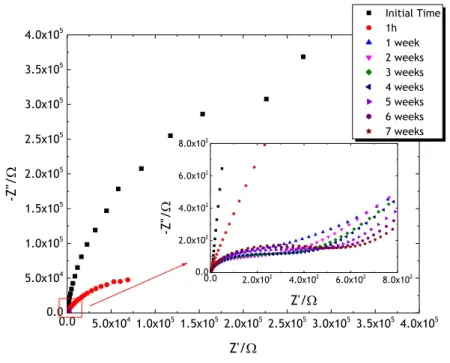
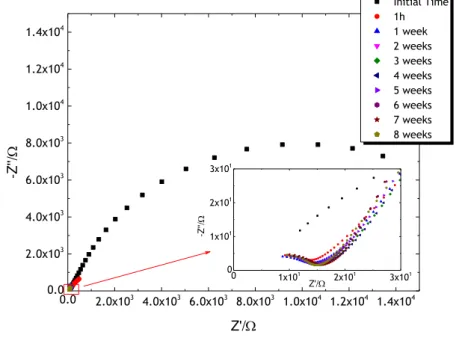
The test conducted in big size cans aged and characterized with a high conductive electrolyte solution shows that after only one hour under accelerated aging conditions it degrades from its initial condition – Figure 7 - demonstrating a high level of degradation with time. In fact, observing the inset plot on Figure 9 it is possible to observe that after one week testing, the Nyquist spectra tends to stabilize corroborating that the cans degradation occurred during the first week testing.
In the presence of oxygen, the electrolyte solution facilitates the charge transport and then the electrochemical oxidation of the cans. Due to this fact, and as mentioned above, measurements were performed only in a two-electrodes configuration.
Results and Discussion 27 0.0 5.0x10⁴ 1.0x10⁵ 1.5x10⁵ 2.0x10⁵ 2.5x10⁵ 3.0x10⁵ 3.5x10⁵ 4.0x10⁵ 0.0 5.0x10⁴ 1.0x10⁵ 1.5x10⁵ 2.0x10⁵ 2.5x10⁵ 3.0x10⁵ 3.5x10⁵ 4.0x10⁵ Initial Time 1h 1 week 2 weeks 3 weeks 4 weeks 5 weeks 6 weeks 7 weeks -Z'' / Z'/ 0.0 2.0x10² 4.0x10² 6.0x10² 8.0x10² 0.0 2.0x10² 4.0x10² 6.0x10² 8.0x10² -Z ''/ Z'/
Figure 9 – Nyquist diagram for an AB sample with electrolyte aging. Two-electrodes system.
After eight weeks testing the samples were opened to be subject of a visual inspection. From Figure A1.1 it is possible to observe the high level of corrosion obtained.
To quantitatively assess the degradation phenomena over the time the EIS experimental data obtained in a two-electrode configuration (Figure 9) was fitted to a suitable electrical. The EIS experimental high frequencies (3 kHz to 100 kHz) data was fitted to a resistance in series with a RC element – Figure 10. The low frequency data, related to the charge transport in the electrolyte, was disregarded since our interest was in the WE.
Figure 10 - Equivalent Electrical Circuit for the first and following weeks of storage.
All capacitances were modelled using a Constant Phase Element (� �) in place of a capacitor to compensate for non-homogeneity in the system. The � � is mathematically expressed by:[31]
���� =� ��� (13)
where � represents the � � time constant, is an imaginary unit, � is the angular frequency and is a constant related to the surface roughening and its value varies between 0 and 1
Rseries Rpo
Accelerated Aging Tests combined with EIS as a Tool for Investigating the Tinplate Cans Degradation Process
Results and Discussion 28
(where 1 represents a perfectly smooth surface).[32] Thus, if = , � � shows the response of a resistance, if = .5 the response is from a Warburg element and if = the � � presents a response of a capacitor.[32]
From the � � values obtained it is possible to determine the respective capacitance of the coating, � :[33]
� = � ×�� ⁄� (14)
The obtained fitted parameters are presented in Table 3.
Table 3 - Values of the setting parameters corresponding to a sample AB with electrolyte
aging in a two-electrodes system.
The obtained fitting results show that although the system present some pores (more accurately, smaller dielectric constant) initially (Figure 9) they have a huge resistance value. During the seven weeks testing it is possible to verify that in the first hour, most of the degradation occurred when electrolyte is used as filling product. After 1 week the � slight decreases stabilizing around 200 Ω. The light increase of pore resistance in the final weeks could be justified with the formation of corrosion products that blocks its growth, forming a barrier at the package seam, increasing the � .
The coating capacitance, � , is related to the coating thickness thereof, being its value inversely proportional to the thickness of the layer:[34]
� = ɛ ɛ � (15)
where ɛ is the vacuum dielectric constant, ɛ is the coating dielectric constant, � is the coating area exposed to the electrolyte and is the coating thickness. Concerning the coating
Time/weeks � � �� /٠� /٠�� /� 0 6.51 788330 1.58 x 10⁻⁷ 0.006 3.04 999 1.36 x 10⁻⁷ 1 1.02 302 1.80 x 10⁻⁷ 2 0.84 217 2.01 x 10⁻⁷ 3 0.75 233 1.97 x 10⁻⁷ 4 0.64 245 1.95 x 10⁻⁷ 5 0.70 284 1.96 x 10⁻⁷ 6 0.77 313 1.94 x 10⁻⁷ 7 1.82 340 1.93 x 10⁻⁷
Results and Discussion 29
capacitance it is observed a slight increase. In fact, with the package aging would be expected an increase in its capacitance, nevertheless, it can be conclude that it remains approximately constant. The latter can be explained by the fact that the unaffected coated area is higher than the area mainly affected by degradation (seam zone), so the response will not be only by the affected area, but throughout the coating.[35]
Aging the metal can with product and perform the EIS analysis with the same product (P+P)
These trials correspond to a more real situation of what is done in industry. For the reasons described above, it was not possible to perform the impedance analysis with a three-electrodes configuration.
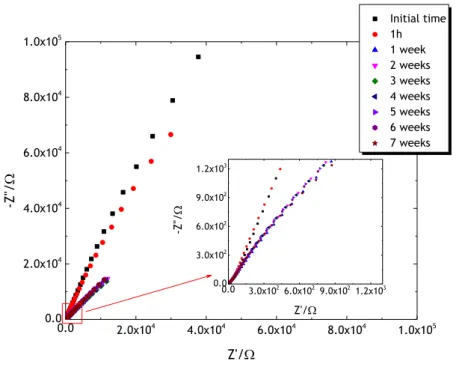
As it can be observed in Figure 11, the impedance drop was not as significant, after one hour of storage, as in assays with electrolyte, which means that the package degradation is also lower. After eight weeks of storage there was no visual degradation of the cans, as shown in Figure A1.2.
Similarly to the E+E trials, the data fitting was procedure with the analogue from Figure 10. 0.0 2.0x10⁴ 4.0x10⁴ 6.0x10⁴ 8.0x10⁴ 1.0x10⁵ 0.0 2.0x10⁴ 4.0x10⁴ 6.0x10⁴ 8.0x10⁴ 1.0x10⁵ Initial time 1h 1 week 2 weeks 3 weeks 4 weeks 5 weeks 6 weeks 7 weeks -Z'' / Z'/ 0.0 3.0x1026.0x1029.0x1021.2x103 0.0 3.0x10² 6.0x10² 9.0x10² 1.2x10³ Z'/ -Z' '/
Accelerated Aging Tests combined with EIS as a Tool for Investigating the Tinplate Cans Degradation Process
Results and Discussion 30
In Table 4 are presented the values of the setting parameters corresponding to the seven weeks of aging:
Table 4 - Values of the setting parameters corresponding to a sample AB with product aging
in a two-electrodes system.
The values were fitted only in the frequency range from 15 kHz to 100 kHz. As expected, � decrease over time. This decrease is related, as explained before, to the increase of the number of pores in coating or the increase of the existing pores area. After one week in the oven, the � maintains the same order of magnitude throughout the seven weeks, showing that the coating did not suffer many changes.
Aging the metal can with product and perform the EIS analysis with fresh electrolyte (P+E)
The P+E represents an important test for industry, as the objective is to validate the use of an electrolyte instead the product packed. The EIS measurements were performed in a two- and three electrodes system but, as these trials need to be compared with the P+P test, only the two-electrodes results will be used. The results from three-electrodes system were used to conclude that the response in the higher frequency range is the equivalent in both systems, as shown in Figure 7.
In Figure 12 is plotted the Nyquist diagram of two different AB, both aged with
product. In one case the EIS analysis was performed with the product serving as electrolyte and the other with the synthetic electrolyte. Figure 13 plots the Bode diagram for the same samples. Time/weeks � � �� /٠� /٠�� /� 0 12.2 698 3.03 x 10⁻⁷ 0.006 2.39 276 3.00 x 10⁻⁷ 1 4.15 203 3.40 x 10⁻⁷ 2 3.51 248 3.72 x 10⁻⁷ 3 3.43 241 4.04 x 10⁻⁷ 4 2.86 205 3.63 x 10⁻⁷ 5 2.78 184 3.43 x 10⁻⁷ 6 3.08 167 2.91 x 10⁻⁷ 7 2.93 184 2.67 x 10⁻⁷
Results and Discussion 31 0.0 5.0x10⁴ 1.0x10⁵ 1.5x10⁵ 2.0x10⁵ 2.5x10⁵ 3.0x10⁵ 3.5x10⁵ 0.0 5.0x10⁴ 1.0x10⁵ 1.5x10⁵ 2.0x10⁵ 2.5x10⁵ 3.0x10⁵ 3.5x10⁵ Initial Time_P+P Initial Time_P+E 1 weeks_P+P 1 weeks_P+E 4 weeks_P+P 4 weeks_P+E 7 weeks_P+P 7 weeks_P+E -Z''/ Z'/ 0 1x10² 2x10² 3x10² 0 1x10² 2x10² 3x10² -Z' '/ Z'/
Figure 12 – Comparative Nyquist diagram for an AB sample aged with product and analysed
with product (P+P) and with fresh electrolyte (P+E). Two-electrodes system.
100 101 102 103 104 105 -20 -30 -40 -50 -60 -70 -80 -90 Phas e Angl e/ º Frequency/Hz 100 101 102 103 104 105 101 102 103 104 105 106 |Z| Frequency/Hz Initial Time_P+P Initial Time_P+E 1 weeks_P+P 1 weeks_P+E 4 weeks_P+P 4 weeks_P+E 7 weeks_P+P 7 weeks_P+E
Figure 13 – Comparative Bode diagram for an AB sample aged with product and analysed with
Accelerated Aging Tests combined with EIS as a Tool for Investigating the Tinplate Cans Degradation Process
Results and Discussion 32
It is extremely important to refer that both cans can not be directly compared. In fact, each can have different initial stages, which means that the only term to be compared is the evolution of the degradation process in the coating. To overcome this problem, it is necessary to perform the test with the same sample, i.e., perform the aging test with product and measure the impedance response with both solutions, product and electrolyte, in the same can.
The data fitting was only conducted in the higher frequency range, between 20 kHz to 100 kHz, resorting to the analogue of the Figure 10. Observing the Nyquist and Bode diagrams (Figure 12 and Figure 13) it can be concluded that the degradation process is similar in P+P and P+E trials. Bode diagram shows, in the higher frequency range, one time constant related to the coating that evolves in the same terms in both cases. It can also be concluded that the analysis with the electrolyte shows responses more defined in the same frequencies.
In Table 5 are presented the values of the setting parameters of the P+E trial corresponding to weeks 1, 4 and 7 of aging and in Table 6 correspondent values of the P+P trial for the same times:
Table 5 - Values of the setting parameters corresponding to a sample AB aged with product
but analysed with fresh electrolyte in a two-electrodes system. Time/weeks �� �� /٠� /٠�� /�
1 2.97 151 2.69 x 10⁻⁷ 4 4.06 96 1.73 x 10⁻⁷
7 10.2 87 1.65 x 10⁻⁷
Table 6 - Values of the setting parameters corresponding to a sample AB aged and analysed
with product in a two-electrodes system.
Time/weeks �� �� /٠� /٠�� /�
1 4.37 181 3.12 x 10⁻⁷ 4 3.20 173 3.17 x 10⁻⁷
7 3.29 163 2.43 x 10⁻⁷
Comparing the fitting results it is possible confirm that the evolution of the degradation process in the coating is similar in both tests, as the � decrease with time and the � keeps the same magnitude order.