EVALUATING THE POTENTIAL BENEFITS AND
CHALLENGES OF LC ADOPTION IN THE
PORTUGUESE CONSTRUCTION INDUSTRY:A
SURVEY STUDY
João Matias1, Nuno Cachadinha2
ABSTRACT
As Lean Construction (LC) steadily grows all over the world, not much is heard about this new paradigm in the Portuguese Construction sector. Because LC has been embraced in other countries for its positive, cost-effective results, it is assumed that it can also greatly contribute to the Portuguese construction sector. This paper thus intends to analyze the ways in which LC can be beneficial in the Portuguese context.
This article first seeks to identify the causes of delays and material losses in the Portuguese construction sector by analyzing three main phases in the construction process: the contract phase (CP), the planning phase (PP) and the production phase (PrP). Secondly, this work intends to assess how to improve those areas of difficulties using Lean Construction solutions and how to bring out the full potential of these solutions in the Portuguese construction context.
Through these findings, this work seeks to foster the acceptance and use of Lean Construction and reveal its benefits to the Portuguese construction sector. The goal is to alert planners to the importance of ―stopping the line‖ according to LC principles, thereby stopping the small problems and wastes from becoming bigger and costly in the future.
KEY WORDS
Lean Construction, Waste, Material losses, Project control, Portugal.
INTRODUCTION
The construction industry has a considerable impact on the Portuguese economy; it is estimated to account for 12% of the total employment rate in Portugal alone through direct jobs, according to data from the National Statistics Institute (INE, 2008). It is responsible for 11,6% of the Portuguese GDP (BP, 2007). The Portuguese public opinion is also increasingly aware and unpleased with budget overruns and the successive delays that occurred in high profile public works (Court of Auditors, 2009).
These facts show the vast importance of the Portuguese construction sector to the Portuguese economy. Particularly in the present worldwide recession period it is of paramount importance to minimize waste in a sector that is somewhat reluctant to change.
1
Graduate student, Departamento de Engenharia Civil, Faculdade de Ciências e Tecnologia, FCT, Universidade Nova de Lisboa, 2829-516 Caparica, Portugal, Phone +351 968702958, [email protected]
2
The Portuguese Court of Audits, the high-court in Portugal responsible for reviewing the legal issues on public expenditure, in its recent audit on deadline fulfillment and budget control in Public Works, stated that the Portuguese State cannot accept the overrun of deadlines and budget by construction companies as a fatality (Court of Auditors, 2009). Hence the importance of finding ways to reduce waste, delays and the resulting chronic cost and budget overruns. Lean Construction (LC) features characteristics that indicate it can be a mean to achieve this important outcome.
This paper aims at assessing which forms of waste can be eliminated or reduced from the production process of Portuguese construction companies with the implementation of Lean Construction solutions. Hence, the hypothesis this paper addresses can be summarized as ―To what extent and in which areas does Lean Construction present solutions for waste, delays and cost overruns in Portuguese Construction?‖
This study is based on a set of 62 interviews with key figures of 10 of the largest and most innovative Portuguese construction companies. These interviews were carried out in the 3 main phases of the construction process from the contractor point of view, the Contract Phase (CP), the Planning Phase (PP) and the finally the Production Phase (PrP) itself. The interviews targeted the identification of occurrences of waste in each of the phases referred to above.
The findings seem to indicate that Lean Construction can help solve a number of the problems found, however the source of other problems is rooted in the Portuguese construction practices, namely in the fragmentation of the sector and competitive nature of business, so change to LC can be of the essence.
LITERATURE REVIEW
In order to understand what kinds of waste are common in the construction sector, the original definitions in the Toyota Company should be looked at. According to Taiichi Ohno (1988) there are seven kinds of waste, the first five refer to the flow of materials and the last two to human action:
Defects that must be corrected;
Overproduction;
Inventory;
Transportation of materials with no purpose;
Unnecessary processing steps;
Motion of employees with no purpose;
Waiting by employees.
Later Koskela (2004) added another type of waste to the list, making-do. This form of waste refers to the situation where a task is started without all the pre-conditions needed to execute or to the fact that the task is continued even if the pre-conditions are ceased.
Most of these waste forms are common in the current construction practices. These waste problems are likely to persist, since the current practice is founded on an ―obsolete conceptual and intellectual basis‖ (Koskela, 1992). The growing complexity and an even shorter time frame to complete construction projects can lead to an increase of waste problems. In this context it important to look for solutions and LC is clearly one to be taken into account.
much longer. Sapiens Project states that ‖The European consumers are increasingly demanding with the construction they want‖ (Teixeira et al., 2005). This mentality change is providing the incentive for Portuguese companies to look for ways to improve their methods, processes and procedures. Moura and Teixeira (2007) found that the Portuguese industry has a conservative behavior regarding innovation. One of the justifications for the lack of innovation and competitiveness in the sector given was the shortage of data relative to past case analysis and lessons learned according to the same authors.
According to Moura (2003) the source of delays can be of 3 different origins:
Construction Owner‘s responsibility;
Contractor responsibility;
A third party responsibility.
The first item contains payment delays, contract and design changes. The second item includes lack of technical or logistic expertise, deficiencies in management and problems with suppliers and subcontractors. The third item refers to acts of God, serious and unexpected accidents and unforeseen actions due to uprisings, terrorism, and vandalism.
Couto and Teixeira (2006), sustain that the most important causes for delays in Portuguese construction projects are:
Design faults (ambiguity, errors, omissions, lack of detail);
Low bid method used for public works awarding;
Low labor qualification;
Poor planning, management and control of activities/material/labor;
Time consuming process of obtaining permits and public approvals.
The audit by the Portuguese Court of Audits (2009) was a strong indicator that status quo needs to change. This document analyzed 5 major Public Works that had large budget overruns. They included tunnels, an airport, a bridge and a prestigious building. The conclusions were strong and aimed at every direction, reaching the owner, the design team and the contractor.
Therefore, Portuguese companies need to be looking at ways to improve their effectiveness and hopefully have better results in budget and time control.
Polat and Ballard (2004) investigated the causes of waste in Turkey, specifically focusing on material waste and delays. This study found that the causes for material waste with the highest frequency of occurrence were:
Ordering of materials that do not fulfill project requirements defined on design documents;
Imperfect planning of construction;
Workers‘ mistakes.
In addition to these findings, the causes for delays were (Polat and Ballard, 2004):
Delay in material supply;
Receiving materials that do not fulfill project requirements defined on design documents and waiting for replacement;
Irregular cash flow.
Garas et al. (2001) analyze the causes of waste in the Egyptian Construction Industry. Those were found to be as follows:
Late information;
Uncompleted design;
Poor control;
Unnecessary people moves;
Untrained labor;
Work not done;
Poor technology of equipment;
Changes to design;
Damage during transportation.
Studies by Gallaher et al. (2004) and Leong and Tilley (2008) analyze the RFI process in the USA to shed light upon causes of waste and delays in. The RFI‘s analysis gives out important indications concerning the flow of information throughout the whole construction process and help to identify areas and magnitude of those issues. The Leong and Tilley (2008) study had an average response time to an RFI of 18 days.
Comparing the studies of the Portuguese reality with those of other countries portrayed in the studies referred in this section, it becomes clear that a number of causes of waste and delays are similar, in particular those regarding design problems, poor planning and labor related issues.
Given these similarities it can be argued that results obtained in the Portuguese Construction Industry can be relevant to future studies in different realities.
RESEARCH METHOD
Since this work aims at studying the implementation of Lean Construction in Portugal. The universe of this study consists of the ten most innovative, Portuguese construction companies, according to COTEC, Business Association for Innovation and GPEARI, which is a the representative of the government for Planning, Strategy, Evaluation and International Relations.
The Civil Construction sector is represented in COTEC by 13 companies. The companies that started this association in 2002 contributed with about 18% of the Portuguese GDP.
The GPEARI cabinet conducted a survey in 2007 that analyzed the investment in Innovation and Development (I&D) made by the construction sector‘s companies. Out of the Portuguese companies that participated in this study, only 11 admitted investment in I&D.
Adding to the first requirement, the second criteria was the commitment evidenced by the companies to Quality Management, Environmental Management and Health and Safety standards by having achieved ISO 9001, ISO 14001 and OHSAS 18001 certification. Out of the 22 companies fulfilling the first requirement, only 12 have met the second requirement.
The third and final criteria was the maximum class construction permit (unrestricted bid value), because uncertain, short duration and complex projects are better fit for Lean Construction (Howell, 1999) and this type of construction is awarded to the companies with the maximum class construction permit in Portugal. Therefore only 10 of the 12 companies had maximum class construction permit in the categories of Structure and Concrete, Metallic Structures, Wooden Structures and Masonry, Plaster and Stonework.
Thus, the companies involved in this study were:
Construções Gabriel A. S. Couto, SA;
Edifer SGPS, SA;
Ensul-Meci – Gestão de Projectos de Engenharia, SA;
Grupo Soares da Costa SGPS, SA;
Mota-Engil SGPS, SA;
MSF SGPS, SA;
Opway SGPS, SA;
Somague SGPS, SA;
Teixeira Duarte – Engenharia e Construções, SA.
The criteria for the definition of the studied universe leaves out small companies. This is a limitation of this study, since small companies can be considered more flexible and faster in adopting new procedures and technology. However, this would cause a logistics problem, as a survey with statistically representative conclusions involving the Portuguese small construction companies would require an assessment based on a sample whose size would be incompatible with the resources available for the completion of this study. Hence a trend-setter approach as described above was followed.
The questionnaire was divided in 3 different sections, namely the CP, PP and PrP. In each of these sections the interviewed were requested to classify the relevance of a set of causes for delays in construction procedures at the phase within their responsibility. In addition, to this the PrP the inquired were also requested to classify the relevance of a set of causes that would lead to material waste. Finally, the interviewed were asked to provide an average number of Requests For Information (RFI) and their average satisfactory response time in the different phases studied.
The objective of the questionnaire was to identify different forms of waste in diverse areas of the Portuguese construction companies. This study used some open-ended questions but mostly closed questions, in particular using a Likert scale to allow for an easier answer and analysis. A subsequent objective was to assess whether LC could solve or minimize the causes of waste found.
DATA ANALYSIS
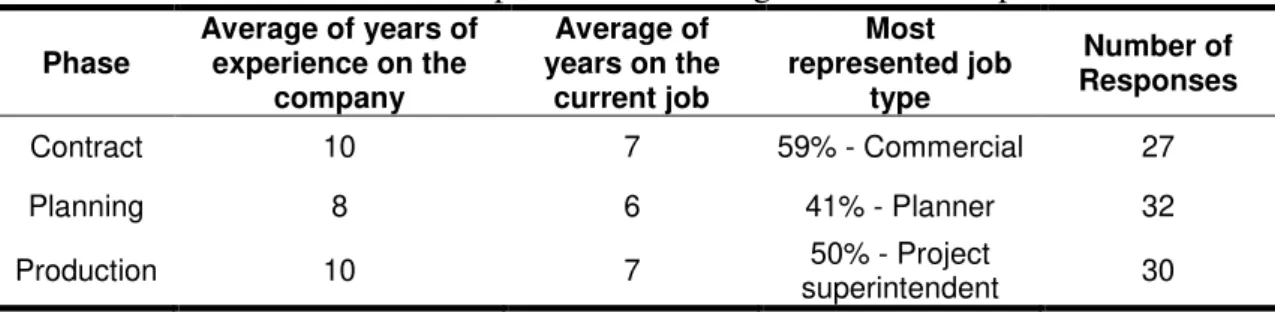
Table 1 below characterizes the respondents‘ profile, according to average years of experience on the company, current job and job type.
Table 1: Professional experience and background of the respondents
Phase
Average of years of experience on the
company
Average of years on the
current job
Most represented job
type
Number of Responses
Contract 10 7 59% - Commercial 27
Planning 8 6 41% - Planner 32
Production 10 7 50% - Project
superintendent 30
CONTRACT PHASE
In the CP the interviewed argued that the causes for waste were mainly two. The first one referred to a change in the Portuguese Public Contract Law that imposes that the main contractor will be deemed liable for every undetected error in the bid documents and specifications beyond the CP. The second problem is that, according to the interviewed, the project specifications available at this phase lack the necessary level of detail to enable accurate bidding.
In this phase the respondents argued that the number of RFI where less than 10, for 70% of the people interviewed. The average response time for an RFI was 1 week for 52% of the people surveyed.
Adoption of Lean Construction in the Contract Phase
The collaborative relation that LC advocates can possibly minimize the lack of project specifications cause discussed above, in the way that it brings together the architect/designer and the contractor. However, in Portugal this would be ratter difficult to implement in public projects because legally there must be a separation between the contractor and the architect/designer. The other important conclusion was that the Portuguese Contractor/Construction Owner/ Designers is too inflexible to respond to the RFI demands in the short CP schedule, so a multidisciplinary team of designers with construction/production background may be helpful with this problem.
PLANNING PHASE
There were a number of relevant causes for delays in the PP. These issues can be divided into two distinct categories. The first has its origin in the project, therefore included in this category are:
design changes and revisions;
lack of information related to types and specifications of materials;
existence of contradictions between documents;
Incompatibilities between specialties design.
The second category is related to the lack of a truly cooperative relation in the Portuguese construction sector. The issue of the lack of interaction between stakeholders involved is regarded by the respondents as problematic.
The number of RFI‘s in the PP has a significant increase, when compared to the CP, with 53% of the respondents saying that they have more than 75 RFI per construction project. This result is even more expressive when compared with the CP, where respondents answered that they had 10 or less RFI‘s. There are two main conclusions to be drawn from this fact. Firstly the time frame of the PP is longer than CP, thus a higher number of RFI‘s is to be expected; secondly, based on the interviews there are reasons to believe that the CP isn‘t getting the answers needed to complete the project according to what was designed. This may be because of a lack of information delivered to the contractor or because the latter only scratches the surface of the design and specifications, not analyzing them in the detail necessary to successfully and thoroughly undertake the project. An average response time to a RFI in this phase was, for 56% of the interviewed, a week.
Adoption of Lean Construction in the Planning Phase
highly competitive Portuguese construction sector. However, the authors find it is a most needed one. In addition to the solution presented above, the project related causes, should have a culture of responsibility towards quality, exemplified by ―do it right the first time‖. The Portuguese Court of Audits found that some changes and revisions to the project resulted, in some cases, in added costs, because unplanned tasks would be added to the project (Court of Auditors, 2009). LC can help with this problem because it advocates decision making at the last responsible moment, according to pull techniques, which leads to a great flexibility in terms of managing supplies and activities‘ scheduling.
PRODUCTION PHASE
In the PrP the emphasis was on material and time waste forms in the Portuguese Companies‘ operations.
In this phase the study identified the relevant causes for the interviewed of material waste that seem to be aligned with conclusion from Polat and Ballard (2004). The most important are:
design changes and revisions;
errors in materials‘ specifications;
excessive orders due to quantity assessment errors.
Subsequently, the causes considered relevant by the respondents for delays in the PrP were determined and are presented below, some are also found in Alarcón et al. (2008):
the lack of interaction between stakeholders;
rework due to design changes and revisions;
existence of contradictions between documents;
lack of workers;
unrealistic global schedule;
bad weather conditions;
unforeseen local conditions.
The number of RFI‘s also increases in this phase, with 76% of the interviewed answering that they had, on average, more than 150 RFI in the PrP of their projects. This number is more than double that of the PP. This vast increase would be expected during the PP, where a careful analysis of the project is carried out and also the compatibility of the different specialties‘ design is finished. However, according to the interviewed most of the times this compatibility check is not done by the designers. Thus, these increase shows that the current practice is more reactive to problems than proactive. LC encourages a proactive attitude by all stakeholders, hence providing a potential solution for this mindset problem.
The response time to a RFI also increases in this phase. 70% of the respondents answered that it takes an average of 2 weeks or more to get a satisfactory answer. Some of the interviewed said that in some cases responses to the RFI would never come. Consequently they had to find a solution themselves and submit it to the Construction Owner for approval.
Adoption of Lean Construction in the Production Phase
be needed in the following weeks, therefore these materials can be ordered from the supplier with a shorter agenda. That would eventually allow for a lower material waste when faced with a project revision. In addition to WIP, the delayed commitment solution can be helpful to the project superintendant, as this solution allows him to decide in possession of highest possible amount of information and in the last conscious moment. These two solutions will hopefully allow a greater flexibility in the response to project changes.
Another problem detected by the Portuguese Court of Audits, while analyzing the biggest budget overruns in the Portuguese Construction, was the increasingly higher costs with the construction site. It‘s fair to say that a big part of the construction site is used as storage room for materials and equipments. This could be greatly reduced with the use of LC, namely just in time (JIT) system. In fact, LC can be helpful in other construction site problems, since it requires overall less resources, be it equipment, manpower or the already mentioned materials. LC planning solutions allow resources the elements stated above to be ordered only when needed, therefore reducing storage costs and the cash flow needed in daily operations. Another LC solution that can be helpful for the reduction of material waste and the construction site standardization is the 5S technique, which enables a better standardization and safety in the construction site.
Regarding the delays in the PrP that were considered important by the interviewed, LC offers a series of solutions that could help minimize or, in some cases, eliminate the problems found. The cause ‗rework due to project change and revision‘ can be dealt with using the Delayed Commitment solution. The lack of interactions between stakeholders would be addressed by adopting a collaboration strategy instead of the competitive one. The delays in material supply will find a solution with the use of JIT and WIP. The lack of workers problem can be dealt with by using the Last Planner System (Ballard, 2000) and the predictable task times. This will allow a more reliable master schedule in terms of the duration of activities and, perhaps even more important, the correct sequence that they can be resolved by. Thus the amount of manpower needed will be reduced, since only the tasks that CAN be taken addressed WILL be addressed, which corresponds to the utilization of pull techniques.
Other key advantage towards the reduction of waste in the Portuguese construction sector is the 5 Why‘s technique, which would facilitate the discovery and, therefore, the later resolution of the occurring problems, often recurring and undetected.
Table 2: Causes for time waste and respective corrective Lean Construction Solutions
Phase Causes for Time Waste found Lean Construction Solutions
Contract
New Laws -
Lack of Project Details
Multidisciplinary teams, collaborative environment; Conception and Realization
Projects
Planning
Design revisions and changes Collaborative environment,
Lack of information related to types and specifications of
materials
Collaborative environment
Existence of contradictions
between documents Pull techniques, delayed commitment
Incompatibilities between
specialties projects Collaborative environment
Lack of interaction between
stakeholders Collaborative environment
Production
Lack of interactions between
stakeholder Kanban, collaborative environment.
Rework due to the project
changes and revisions WIP, LPS, pull techniques.
Existence of contradictions
between documents JIT, WIP.
Lack of workers LPS, multidisciplinary teams.
Unrealistic global schedule LPS
Table 3: Causes for Material Waste and Corrective Lean Construction Solutions
Phase Cause for Material Waste found Lean Construction
Solutions
Production
Design changes and revision JIT, WIP.
Errors in information‟s and its specifications of
materials
Collaborative environment
Excessive orders due to quantity assessment errors
5S, WIP.
CONCLUSIONS
This study identified the most significant waste and delay sources found in the Portuguese construction companies, which have proven to be in line with existing previous studies of the Portuguese Construction‘s reality, while complementing them in previously unstudied aspects. It was found that the information in the construction process seems to be poorly managed, as the RFI level keeps increasing throughout the duration of the project.
This study further concluded that LC solutions indicate improvement potential for the waste and delay sources obtained.
These findings are important to the Portuguese construction sector because they add important aspects to previous characterizations of forms of waste and delays in its activities.
The results of this study are also relevant to the LC community because they discuss and indicate LC solutions to widespread problems in the Portuguese Construction sector. The problems obtained have shown to be in line with several previous studies of different realities worldwide, thus expanding what we know about the potential of LC as a global solution to minimize or, in some cases, eliminate widespread forms of waste and delays in the global Construction market.
FUTURE FIELDS OF RESEARCH
This study addressed issues that are present throughout all the stages of the construction process, from its inception to its delivery. Future research should broaden this study, expanding it to all the stakeholders in the process, and should analyze the interfaces and collaboration between them.
This study is now being complemented by enlarging the universe studied to major designers and owners in the Portuguese Construction Business, and further results are expected to deepen the results and conclusions of the work portrayed in this paper.
REFERENCES
Alarcón, L. F., Diethelm, S., Rojo, O., and Calderón, R. (2008). ―Assessing the impacts of implementing lean construction.‖ Revista Ingeniería de Construcción, 23, 26-33.
Bank Of Portugal. (2007). ―Yearly Report of the Administration Council.‖ <http://www.bportugal.pt> (May 5, 2010).
Ballard, G. (2000). ―The Last planner System of Production Control‖. Ph.D. Thesis, School of Civil Engineering, University of Birmingham, Birmingham, UK.
Court of Auditors. (2009). ―Audit to public funded projects managed by the owner.‖ <http://www.tcontas.pt/> (April 29, 2010).
Couto, J., Teixeira, J. (2006). ―Design Quality: a component towards competitiveness in the Portuguese construction sector‖ NUTAU 2006. São Paulo, Brazil.
Gallaher, M., O‘Connor, A., Dettbarn, J. and Gilday, L. (2004), ―Cost Analysis of Inadequate Interoperability in the US Capital Facilities Industry‖, National Institute of Standards and Technology, Gaithersburg, MD, USA.
Howell, G. (1999). ―What is Lean Construction.‖ Proc. 7th Ann. Conf. Intl. Group for Lean Constr., University of California, Berkeley, CA, USA.
INE – National Institute of Statistics. (2008). ―Statistical Yearbook 2007‖. <http://www.ine.pt> (May 4, 2010).
Koskela, L. (1992). ―Application of the new production philosophy to construction.‖ Tech. Report No. 72, CIFE, Stanford University, California.
Moura, H. (2003), ―Claims in Construction Public Works‖, MS Thesis, Univ. of Minho, Guimarães, Portugal.
Moura, H., and Teixeira, J. (2007). ―Competitiveness and non-compliance in construction management functions.‖ In Construction Congress 2007- 3rd National Congress (pp. 1-13). Coimbra.
Ohno, T. (1988). Toyota production system, Productivity, Cambridge, Mass.
Polat, G. and Ballard, G. (2004). ―Waste in Turkish Construction: Need for Lean Construction Techniques.‖ Proc. Twelfth Annual Conference of the International Groupfor Lean Construction (IGLC-12), Elsinore, Denmark.