ISSN 0100-2945 http://dx.doi.org/10.1590/0100-29452017129
1(Paper 126-15). Received May 11, 2015. Accepted April 07, 2016.
2Agronomist, M.Sc., University of São Paulo - USP, Luiz de Queiroz College of Agriculture, Department of Biological Sciences, Caixa
Postal 09, 13418-900, Piracicaba-SP. Brasil. Email: [email protected]
3Agronomist, PhD. Sc., Federal University of Pampa. CEP 96450-000 - Dom Pedrito, RS, Brazil; Email: [email protected] 4Agronomist, M.Sc., University of São Paulo - USP, Luiz de Queiroz College of Agriculture, Department of Biological Sciences, Caixa
Postal 09, 13418-900, Piracicaba-SP. Brasil. E-mail: [email protected]
5Agronomist, PhD, University of São Paulo - USP, Luiz de Queiroz College of Agriculture, Department of Biological Sciences, Caixa
Postal 09, 13418-900, Piracicaba-SP, Brasil. E-mail: [email protected]
SCIENTIFIC
COMMUNICATION
VACUUM PACKAGING IS EFFICIENT TO REMOVE
ASTRINGENCY AND TO MAINTAIN THE FIRMNESS
OF ‘GIOMBO’ PERSIMMON
1
MARIANA FERRAZ MONTEIRO2, JUAN SAAVEDRA DEL AGUILA3,
CLEUCIONE DE OLIVEIRA PESSOA4, RICARDO ALFREDO KLUGE5
ABSTRACT- The aim of this study was to develop a simple technique to remove astringency and maintain the
pulp firmness of ‘Giombo’ persimmons. Fruit were packaged in three different plastic packages: low-density
polyethylene (LDPE), polypropylene (PP) and polyethylene-polyamide (PE-PA). Packages with dimensions
of 30 cm x 50 cm and 20 µm thickness were sealed under vacuum. Fruit uncovered in plastic film were used as control samples. After packaging, fruits were stored at ambient conditions (22°C and 70% RH) for five
days. After this period, fruits were removed from the package and kept at the same previous conditions for six days and evaluated every two days. All plastic packages showed effectiveness in removing astringency,
but only PE-PA maintained pulp firmness during the six days after package removal. LDPE and PP films also caused reduction of astringency while pulp firmness was properly maintained until the fourth day. These two films did not succeed in obtaining vacuum, which was only achieved by PE-PA. PE-PA reduces astringency faster and maintains fruit firmness for a longer time at room temperature.
Index terms: Diospyrus kaki L., modified atmosphere, tannin.
EMBALAGEM A VÁCUO É EFICIENTE PARA REMOVER A
ADSTRINGÊNCIA E MANTER A FIRMEZA DE CAQUI ‘GIOMBO’
RESUMO- O objetivo deste estudo foi desenvolver uma técnica simples para a remoção da adstringência,
além de manter a firmeza de polpa de caqui ‘Giombo’. Os frutos foram colocados em diferentes tipos de
embalagens plásticas: polietileno de baixa densidade (PEBD), polipropileno (PP) e polietileno-poliamida (PE-PA). As embalagens foram seladas a vácuo e tiveram dimensão de 30 cm x 50 cm e 20 micrômetros de espessura. Frutos não acondicionados em embalagens plásticas foram usados como controle. Após o embalamento, os frutos foram armazenados em condição ambiente (22oC e 70% UR) durante cinco dias. Após esse período, os frutos foram removidos da embalagem e colocados na mesma condição anterior por seis dias e avaliados a cada dois dias. Todas as embalagens plásticas demonstraram efetividade na remoção
da adstringência, mas apenas o PE-PA manteve a firmeza durante os seis dias após a remoção dos frutos da embalagem. As embalagens com PEPD e PP causaram redução na adstringência enquanto a firmeza
foi adequadamente mantida até o quarto dia em temperatura ambiente. Não foi possível obter vácuo nestes dois tipos de embalagem, apenas no PE-PA. O PE-PA reduz a adstringência mais rapidamente e mantém a
firmeza por mais tempo em condição ambiente.
‘Giombo’ persimmon (pollination-variant,
astringent - PVA) is one of the most cultivated in Brazil, mainly in São Paulo, and its preferred
form of consumption is fresh, i.e. firm and without
astringency. Thus, this cultivar needs to be submitted to astringency removal treatment (EDAGI; KLUGE, 2009). Several simple methods have been used to remove the astringency of persimmons, such as the use of ethanol, acetic acid (vinegar), ethylene and calcium carbide. These methods stimulate the accumulation of acetaldehyde in tissues, which react with soluble tannins, making them polymerized and insoluble, drastically reducing the astringency
sensation. Although these methods are efficient to
remove the astringency of persimmon, they bring the
inconvenience of drastically reducing pulp firmness, which is not desirable for ‘Giombo’ persimmon.
The use of high levels of carbon dioxide (CO2) is a strategy to remove the astringency of persimmon because it produces effects similar to one of the simplest methods, which is the accumulation of acetaldehyde in tissues (VIDRIH et al., 1994). However, its application demands the use of sealed chambers with strict control of temperature and CO2 levels inside them, or the use of active packages, in which optimal CO2 levels can be achieved. Another method that can be used to remove the astringency
of persimmon is the use of modified atmosphere. By
using packages, it is possible to obtain an anaerobic condition with higher carbon dioxide concentrations and low amounts of oxygen. This condition promotes the formation and accumulation of acetaldehyde, which polymerizes tannin molecules, removing the astringency of fruits (PESIS et al., 1986).
By using modified atmosphere, through plastic packaging, it is possible to restrict the amount of oxygen available for respiration and to accumulate carbon dioxide originated by this metabolic process, inducing anaerobiosis. Studies by Pesis et al. (1986) and Ben-Arie et al. (1991) found satisfactory results about the use of plastic packages
for astringency removal in ‘Triumph’ persimmon. Antoniolli et al. (2001) studied the use of modified atmosphere in ‘Giombo’ persimmon and also found
satisfactory results in removing the astringency of
fruits. However, a drastic reduction on firmness was
observed (ANTONIOLLI et al., 2003), and this is one of the major parameters considered in the selection of fruits by consumers. Vacuum storage is another way to modify the atmosphere by using plastic
films. The removal of air from the package induces
anaerobic respiration. Pesis et al. (1988) showed that
‘Triumph’ persimmon stored at 20°C and packaged in polyethylene films had faster astringency reduction
when CO2 was present inside the package. However,
quality was lost in the first week of storage, whereas fruit quality and firmness were maintained for two
weeks in vacuum packaged fruits. The permeability
of plastic films used also influences the amount of
gases inside the package. It can vary according to material, thickness, and internal pressure of gases released by respiration. Permeability should be lower than the carbon dioxide rate produced by fruits and their oxygen consumption due to aerobic respiration (EDAGI; KLUGE, 2009) keeping CO2 concentration appropriate to the physiological changes required without interfering in fruit quality. In this context, this
work aimed to remove the astringency of ‘Giombo’
persimmon by using vacuum packaging with three
different types of plastic films.
Persimmon fruits Giombo cultivar were harvested in Mogi das Cruzes (São Paulo, Brazil) in accordance with Classification Standards, Standardization and Identity of Persimmon (Brazilian Horticulture Modernization Program, 2000) and transported to the Laboratory of Post-harvest Physiology and Biochemistry of ESALQ/USP, Piracicaba-SP (Brazil). The fruit used in the experiment had mass of 152 g (+ 5 g), height of 91 mm (+ 3 mm) and diameter of 55 mm (+ 2 mm). After selecting, fruits were packed in different
plastic films (6 fruits per package). Vacuum sealer
(Selovac 200s sealing machine) was used to obtain
the modified atmosphere. The plastic films used were:
low density polyethylene (LDPE), polypropylene (PP) and polyamide polyethylene (PA-PE), all with the same size and thickness (30 cm x 50 cm in size and 20 mm thickness). Fruits uncovered with plastic
film were used as control. After packaging, fruits
were stored at 22° C ± 1°C and 70% ± 5% RH for 5 days. After this period, fruits were removed from packages, kept at the same previous conditions for six days and evaluated every two days.
All treatments were submitted to firmness
and astringency evaluation. The fruit received a transverse incision on the equatorial region, splitting it in half. For the astringency index evaluation, one
of the halves was placed in contact with filter paper
previously washed in a ferric chloride solution
(CAMPO-DALL’ORTO et al., 1996). Tannin, in its
soluble form, reacts with ferric chloride, becoming
dark. The evaluation of filter papers was made by
visual analysis, where grades from 1 to 5 were given to each stamped fruit, namely: 1 = not astringent; 2 = slightly astringent; 3 = moderate astringent;
4 = astringent; 5 = very astringent. Pulp firmness
Two readings were made on opposite sides of the fruit equatorial region after the removal of a small portion of peel. The results were expressed in Newton (N) and a commercialization acceptance limit of 15 N
was established for ‘Giombo’ persimmon (Brazilian
Horticulture Modernization Program, 2000). The soluble tannin content was determined according to adaptations of methodology of Agostini-Costa et al. (1999), using Folin-Ciocauteau (50%) and absorbance of 725nm (Biochrom spectrophotometer, model Libra S22) was used for readings. The results were expressed in grams of gallic acid per 100 grams of pulp (g 100 g-1).
The experimental design was completely randomized, with 4 treatments and 4 replicates of 6 fruits. Data were submitted to analysis of variance (F test) and averages were compared by the Tukey test (p <0.05).
Only PE-PA maintained the vacuum condition
in the package. In the other films (LDPE and PP),
even though they have sealed fruits normally, vacuum could not be obtained after sealing due to their greater permeability to gases compared to PE-PA. According to ROGERS (1994), polyamide, the
main constituent of PE-PA film, shows permeability
rate 140 times lower than LDPE and 50 times lower than PP, when measured at 25°C. Furthermore, polyethylene present in PE-PA acts as an additional
sealant layer in the film, providing resistance to gas permeability. Fruit storage in packages for five days
reduced the astringency index (Fig. 1). The removal of packages revealed that fruits packaged with PE-PA presented moderate astringency, whereas control samples were still very astringent. From the fourth day after the removal of packages, treatment fruits were considered non-astringent, while control ones remained moderately astringent until the end of the storage period at room temperature.
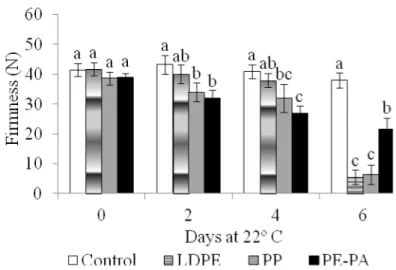
Pulp firmness reduced during storage for all films evaluated (Fig. 2). Fruits packaged in LDPE and PP films maintained appropriate commercialization firmness until the fourth day, and showed firmness
lower than 10N on the sixth day at 22oC. In fruits
packaged in PE-PA, a lower decrease in firmness
was observed, reaching values next to 20N on the last day of evaluation, maintaining acceptable levels for commercialization. The maintenance of
‘Giombo’ persimmon fruit firmness by the PE-PA packaging vacuum system was also found in ‘Fuyu’
persimmon (BEN-ARIE; ZUTKHI, 1992; CIA et
al., 2006). Atmosphere modified with low O2 and high CO 2 levels generally reduces respiration and other processes associated with ripening and loss of
firmness. In this sense, the use of PE-PA, in addition
to reducing astringency, maintained fruit firmness at
appropriate values for commercialization.
Considering the best results for astringency
index and firmness, fruits from treatment with PE-PA film were submitted to tannin content analysis. There was a significant reduction in the soluble
tannin content in fruits previously packaged with PE-PA. During storage at room temperature, the values observed in this treatment were below 0.5 mg 100 g-1 (Fig. 3). Control samples remained with high levels of soluble tannins, characterized by high astringency. According to Vidrih et al. (1994), fruits are edible when the soluble tannins content is equal to or lower than 0.1 g 100 g-1. The reduction of soluble tannin can be explained by the accumulation of acetaldehyde in consequence of
the modified atmosphere caused by PE-PA. Its low
permeability caused an anaerobic atmosphere, with low O2 and high CO2 levels. This alteration leads to the accumulation of malate, reduces pyruvate dehydrogenase activity and increases the activity of malic and pyruvate decarboxylase enzymes, thus increasing the formation of acetaldehyde. The activity of the alcohol dehydrogenase enzyme, responsible for the conversion of acetaldehyde
into ethanol, was also increased, which justifies
the accumulation of this compound (PESIS; BEN-AIRE, 1986; YAMADA et al., 2002). This study evaluated the use of plastic films such as low-density polyethylene, polypropylene,
polyethylene-polyamide to obtain modified atmosphere to reduce astringency and maintain the quality of ‘Giombo’
persimmon. Only polyethylene-polyamide (PE-PA) was able to maintain the vacuum condition, needed
for the treatment success. In addition, this plastic film
provided loss of astringency and kept the fruit with
FIGURE 1- Astringency index of ‘Giombo’ persimmon submitted to different packaging for 5 days at
22°C (+ 6 days at 22°C). LDPE = low-density polyethylene; PP = polypropylene; PE-PA = polyethylene-polyamide. 1 = not astringent; 2 = slightly astringent; 3 = moderate astringent; 4 = astringent; 5 = very astringent. Day 0 = evaluation shortly after the removal of fruit packaging. Days 2 to 6 = storage at 22°C. Averages followed by the same letter in each period do not differ by the Tukey test (p <0.05). Initial value = 5 (very astringent).
FIGURE 2- Firmness of ‘Giombo’ persimmon submitted to different packaging for 5 days at 22°C (+ 6 days
FIGURE 3 - Soluble tannins of ‘Giombo’ persimmon submitted to different packaging for 5 days at 22°C
(+ 6 days at 22°C). PE-PA = polyethylene-polyamide. Day 0 = evaluation shortly after removal of fruit packaging. Days 2 to 6 = storage at 22°C. Averages followed by the same letter in each period do not differ by the Tukey test (p <0.05). Initial value = 4.90 mg 100g-1.
REFERENCES
AGOSTINI-COSTA, T.S.; GARRUTI, D.S.; LIMA, L.; FREIRE, S.; ABREU, F.A.P.; FEITOSA, T. Evaluation of methodologies for the determination of tannins in cashew apple juice. Boletim do CEPPA, Curitiba, v.17, n.2, p.167-178, 1999.
ANTONIOLLI, L.R.; CASTRO, P.R.C.; KLUGE, R.A.; SCARPARE FILHO, J.A. Influence of polyethylene bags on astringency removal and quality of persimmons fruits (Diospyrus kaki L.), cv. Giombo, stored under cold conditions. Revista Brasileira de Fruticultura, Jaboticabal, v.23, n.2, p.293-297, 2001.
ANTONIOLLI, L.R.; CASTRO, P.R.C.; KLUGE, R.A.; SCARPARE FILHO, J.A. Use of polyethylene
bags on conservation of ‘Giombo’ persimmons during
cold storage. Revista Brasileira de Fruticultura, Jaboticabal, v.25, n.1, p.77-80, 2003.
BEN-ARIE, R.; ZUTKHI, Y.; SONEGO, L.; KLEIN,
J. Modified atmosphere packaging for long-term
storage of astringent persimmons. Postharvest Biology and Technology, Wageningen, v.1, n.2, p.169-179, 1991.
BRAZILIAN PROGRAM FOR HORTICULTURE MODERNIZATION. Classification standards of persimmon. São Paulo: CEAGESP, Center for Quality of Horticulture, 2000. 4 p. (Documents, 22).
CAMPO-DALL’ORTO, F.A.; OJIMA, M.;
BARBOSA, W.; ZULLO, M.A.T. New analytic process for persimmon astringency determination.
Bragantia, Campinas, v.55, n.2, p.237-243, 1996.
CIA, P., BENATO, E. A., SIGRIST, J. M. M., SARANTOPOULOS, C., OLIVEIRA, L. M.,
PADULA, M. Modified atmosphere packaging for extending the storage life of ‘Fuyu’ persimmon.
Postharvest Biology and Technology, Wageningen, v.42, n.3, p.228-234, 2006.
EDAGI, F. K.; KLUGE, R. A. Removal of astringency in persimmon fruits: a biochemical, physiological and technological view. Ciência Rural, Santa Maria, v.39, n.2, p.585-594, 2009.
PESIS, E.; LEVI, A.; BEN-AIRE, R. Deastringency of
persimmon fruits by creating a modified atmosphere
in polyethylene bags. Journal of Food Science, London, v.51, n.4, p.1014-1016,1986.
PESIS, E.; LEVI, A.; BEN-AIRE, R. Role of acetaldehyde production in the removal of astringency from persimmon fruits under various modified atmospheres. Journal of Food Science, London, v.53, n.1, p.153-156. 1988.
ROGERS, C.E. Permeation of gases and vapours in polymers. In: COMYN, J. (Ed.). Polymer permeability. New York: Elsevier Applied Science, 1985. p.11-73.
V I D R I H , R . ; S I M C I C , M . ; H R I B A R , J . ; PLESTENJAK, A. Astringency removal by high CO2 treatment in persimmon fruit (Diospyros kaki). Acta Horticulturae, Amsterdam, n.368, p.652-656, 1994.