ORIGINAL ARTICLE
CITE AS: Souza, C.P.F.; Souza, E.H. de; Ledo, C.A. da S.; Souza, F.V.D. 2018. Evaluation of the micropropagation potential of curauá pineapple hybrids for fiber production. Acta Amazonica 48: 290-297.
Evaluation of the micropropagation potential of
curauá pineapple hybrids for fiber production
Cintia Paula Feitosa SOUZA1,3, Everton Hilo de SOUZA1,3, Carlos Alberto da Silva LEDO1,2,
Fernanda Vidigal Duarte SOUZA1,2*
1 Universidade Federal do Recôncavo da Bahia (UFRB), Cruz das Almas, Bahia, Brazil 2 Embrapa Mandioca e Fruticultura (CNPMF), Cruz das Almas, Bahia, Brazil
3 Coordenação de Aperfeiçoamento de Pessoal de Nível Superior (CAPES), Programa CAPES-EMBRAPA, Brasília - DF, Brazil
* Corresponding author: [email protected]
ABSTRACT
Plant fiber is a renewable and biodegradable material that can be used effectively to reinforce various composites. Pineapple hybrids selected for their fiber quality are in the phase of agronomic validation in Brazil by the Embrapa Cassava and Fruits research unit. The selection of a hybrid for large-scale fiber production depends on obtaining a large number of seedlings. This study evaluated the morphogenetic response and propagation potential of eight hybrids of Ananas comosus var. erectifolius, for the purpose of producing high-quality seedlings on a large scale. Stem and crown buds were reduced and placed in MS nutritive medium supplemented with BAP at 0.5 mg L-1, NAA at 0.01 mg L-1 and Phytagel® at 2.5 g L-1. After 45 days, the number of oxidized, contaminated and surviving buds was determined. Swollen buds and plantlets were transferred to a multiplication medium containing MS sucrose, salts and vitamins. The propagation potential was evaluated based on the geometric growth rate among sub-cultures. The FIB-NEG hybrid presented the best results for the establishment phase (40.28%). The best propagative potential was obtained from crown buds with the highest values for EST (3.93), MIN (3.91) and FIB-BOY (3.91) hybrids.
KEYWORDS: Ananas comosus (L.) Merr.; in vitro propagation; lignocellulosic fibers; Poisson log-linear model; geometric growth rates
Avaliação do potencial de micropropagação de híbridos do abacaxi curauá
para a produção de fibras
RESUMO
A fibra vegetal é uma fonte renovável, biodegradável e de excelente desempenho como reforço em compósitos variados. Híbridos selecionados pela qualidade de suas fibras estão em fase de validação agronômica na Embrapa Mandioca e Fruticultura e sua adoção para produção de fibra em larga escala depende de um elevado número de mudas. Este trabalho teve como objetivo avaliar a resposta morfogenética e o potencial propagativo de oito híbridos de Ananas comosus var. erectifolius, com a finalidade de produzir mudas de qualidade em larga escala. Gemas do caule e coroa foram reduzidas, introduzidas em meio nutritivo MS suplementado com BAP a 0,5 mg L-1, ANA a 0,01 mg L-1 e Phytagel® a 2,5 g L-1. Aos 45 dias foram avaliados o número de gemas oxidadas, contaminadas e sobreviventes. Gemas intumescidas e plantas formadas foram transferidas para o meio de multiplicação contendo sacarose, sais e vitaminas MS. Avaliou-se o potencial propagativo a partir de uma taxa de crescimento geométrico entre subcultivos. O híbrido FIB-NEG (40.28%) apresentou os melhores resultados em porcentagem para a fase de estabelecimento. O melhor potencial propagativo foi obtido a partir de gemas de coroa, com os valores mais elevados registrados para os híbridos FIB-EST (3.93), FIB-MIN (3.91) e FIB-BOY (3.91).
INTRODUCTION
Fiber from curauá, Ananas comosus (L.) Merr. var. erectifolius
(L.B.Sm.) Coppens & F. Leal, a pineapple variety native to the Amazon region, is already produced in large scale due to its excellent mechanical strength, besides being biodegradable (Leão et al. 2009). This fiber is used to produce articles for the automotive industry (Zah et al. 2007), the production of polymeric composites (Marinelli et al. 2008; Sena Neto et al. 2013; 2015; 2017; Asim et al. 2015; Souza et al. 2017), and civil engineering products (Rocha et al. 2013). However, the industrial use of curauá was only made possible by the development of a micropropagation protocol to enable production of thousands of seedlings for replanting in large fields (Pereira et al. 2006; 2007).
Curauá hybrids have been selected by genetic improvement as a result of crosses ofcurauá (Ananas comosus var. erectifolius)
with Ananas comosus var. microstachys or Ananas comosus var.
bracteatus (Souza et al. 2014), and have already been evaluated regarding suitability of their fibers for industrial use (Sena Neto et al. 2013; 2015; 2017; Souza et al. 2017). The hybrid fibers are a consolidated selection in industrial applications, due to their excellent properties for the development of polymer composites (Sena Neto et al. 2013; 2015; 2017; Souza
et al. 2017). For the commercial launch of these materials to
meet demand, agronomic validation is necessary, along with the development of processes for large-scale production of seedlings, as has already been established for curauá. However, as the parents forming the curauá hybrids are wild varieties, little is known about the propagation potential of these materials and how they will respond to micropropagation.
Since the genotypic responses to in vitro cultivation
conditions are highly variable, different protocols of pineapple micropropagation have been reported (Pasqual et al. 2008; Souza et al. 2012a; 2012b; 2013; Alves et al. 2014; Santos et al. 2015). The Brazilian Agricultural Research Corporation research unit for cassava and fruit (Embrapa Mandioca e Fruticultura) has developed one basic protocol, which produced satisfactory results for various genotypes from its pineapple germplasm bank (AGB-Pineapple) (Souza et al. 2013).
The objective of this study was to assess the morphogenetic response and the propagation potential of curauá hybrids using the standard Embrapa protocol, to enable the production of material for large-scale planting. Considering that these hybrids have wild parents, we evaluated the propagation potential of buds from different regions of the plant.
MATERIAL AND METHODS
The experiment was conducted with axillary buds, the starting explants in the multiplication process. Buds were removed from the stem and crown of eight curauá hybrids: FIB-NEG (Figure 1a) and FIB-BOY (Figure 1b) (Ananas comosus (L.)
Merr.var. microstachys L.B.Sm.x A. comosus var. erectifolius), FIB-POT (Figure 1c), FIB-MIN (Figure 1d), FIB-EST (Figure 1e), FIB-ROX (Figure 1f) and FIB-CER (Figure 1g) (A. comosus var. erectifolius x Ananas comosus (L.) Merr. var.
bracteatus (Lindl.) Coppens & F.Leal), and FIB-SAI (Figure
1h) (A. comosus var. bracteatus x A. comosus var. erectifolius). Leaves were removed from the stem plants and crown to expose the buds. Stems and crowns were washed with water and neutral detergent. The stem of each plant was divided into three regions: i) upper, ii) middle and iii) lower (Figure 1i). Buds located between the first visible bud in contact with the roots and the position of the last root were considered to be from the lower region; those visible between the last root and the point of inflection of the stem were considered to be from the middle region; and the buds from that point to the tip were classified as from the upper region. The crown was not divided into regions due to the short length of its axis (Figure 1i). The buds were excised separately and transferred to laminar flow chambers in autoclaved jars. The asepsis process consisted of immersion of the buds in 70% alcohol for 5 minutes, to break the surface tension, followed by immersion in a solution of 2.5% NaCl in autoclaved distilled water plus three droplets of Tween 20® for 25 minutes. After this procedure, they were washed three times in autoclaved distilled water. After disinfestation, the excess tissue was removed from each bud before placement in test tubes (one bud per tube) with MS nutritive medium (Murashige and Skoog 1962) supplemented with BAP (6-benzylaminopurine) at 0.5 mg L-1, NAA (naphthaleneacetic acid) at 0.01 mg L-1 and Phytagel® at 2.5 g L-1 previously autoclaved at 120 ºC for 20 minutes. The tubes were then distributed randomly in a growth room under incubation conditions of 27 ± 1 ºC, photoperiod of 16 hours and light intensity of 30 µmol m-2 s-1, supplied by white fluorescent lamps, where they remained for 45 days (establishment phase).
For the in vitro establishment phase, we used a completely
The swollen buds and plants formed were grouped by treatment and transferred to jars with multiplication medium containing MS salts and vitamins (Murashige and Skoog 1962) supplemented with BAP 0.5 mg L-1, NAA 0.2 mg L-1 and Phytagel® 2.5 g L-1, a protocol adapted from Souza et al. (2013). The plants had their leaves cut off at the top to induce new shoots. The jars containing the plants were kept in the same incubation conditions as in the establishment phase. Four cultures were performed at intervals of 45 days. Each sub-culture involved cleaning the roots, removal of the oldest leaves and sectioning of the stem to break the apical dominance and thus favor the formation of new adventitious shoots.
The results of the multiplication phase were also analyzed by fitting a Poisson log-linear model. For this purpose, four hybrids were selected (FIB-NEG, FIB-EST, FIB-MIN and
FIB-ROX) that showed high propagation potential for stem buds, and six hybrids (NEG, SAI, MIN, FIB-BOY, FIB-EST and FIB-ROX) that had the best results for crown buds. In this phase we did not distinguish the different regions of the stem due to the high losses from the middle and lower parts. The model used the number of shoots as independent variable (linear and quadratic effects) and the shoot multiplication data as dependent variable, for each of the selected hybrids.
To calculate the propagation potential we used the geometric growth rate (r) between two consecutive sub-cultures, given by the expression: r = (t√Vf/Vi - 1) x 100, where: Vf – number of shoots in the subsequent sub-culture; Vi – number of shoots in the previous sub-culture; and t – interval of 45 days between each of the four sub-cultures.
RESULTS
Establishment phase
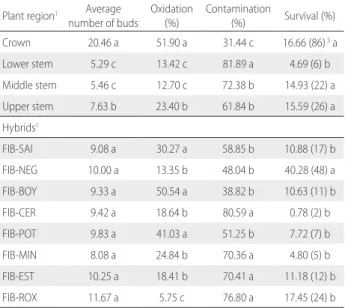
ANOVA resulted in no significant interaction between the factors (hybrids and plant regions), but there was significant variance within the factors (p < 0.01) (Table 1). The average number of buds varied significantly among the plant regions (5.29 to 20.46), with the number for the crown buds exceeding the sum of the buds of the three stem regions (Table 2). However, the crown buds also suffered the highest percentage of oxidation (over 50%), followed by the buds from the upper stem (23%). In turn, the buds from the lower stem had the highest contamination percentage, probably because of the proximity with the soil, resulting in a very low survival rate (Table 2). Considering oxidation and contamination, there was a significant loss of buds from all the regions, since the highest survival percentages (buds from the crown and upper stem region) were lower than 20% (Table 2).
There were no significant differences among the hybrids regarding average number of buds. With respect to oxidation, the highest percentages were observed for SAI, FIB-BOY and FIB-POT, while the highest contamination rates occurred for FIB-CER, FIB-MIN, FIB-EST and FIB-ROX. The survival rates varied from 0.78% (2 buds) for FIB-CER to 40.28% (48 buds) for FIB-NEG, and except for FIB-ROX, the survival rates of the other hybrids were below 12% (Table 2).
Multiplication phase
The response to the employed protocol differed among hybrids and between types of starting explants (Table 3). The greatest number of shoots was obtained from the crown buds for all the hybrids except FIB-NEG, and the highest values were recorded for FIB-MIN, FIB-EST and FIB-BOY in the fourth sub-culture. For the stem buds, the hybrids FIB-NEG and FIB-MIN produced the largest average number of shoots. It was not possible to complete all the sub-cultures for the hybrid
Table 2. Average number of buds and percentages of oxidized, contaminated
and surviving buds obtained from different regions of the plant after in vitro establishment of pineapple hybrids bred for fiber content [FIB-SAI (A. comosus var. bracteatusx A. comosus var. erectifolius), FIB-NEG and FIB-BOY (Ananas comosus. var. microstachysx A. comosus var. erectifolius), FIB-CER, FIB-POT, FIB-MIN, FIB-EST and FIB-ROX (A. comosus var. erectifolius x Ananas comosus var. bracteatus)].
Plant region1 Average
number of buds
Oxidation (%)
Contamination
(%) Survival (%) Crown 20.46 a 51.90 a 31.44 c 16.66 (86) 3 a
Lower stem 5.29 c 13.42 c 81.89 a 4.69 (6) b Middle stem 5.46 c 12.70 c 72.38 b 14.93 (22) a Upper stem 7.63 b 23.40 b 61.84 b 15.59 (26) a Hybrids1
FIB-SAI 9.08 a 30.27 a 58.85 b 10.88 (17) b FIB-NEG 10.00 a 13.35 b 48.04 b 40.28 (48) a FIB-BOY 9.33 a 50.54 a 38.82 b 10.63 (11) b FIB-CER 9.42 a 18.64 b 80.59 a 0.78 (2) b FIB-POT 9.83 a 41.03 a 51.25 b 7.72 (7) b FIB-MIN 8.08 a 24.84 b 70.36 a 4.80 (5) b FIB-EST 10.25 a 18.41 b 70.41 a 11.18 (12) b FIB-ROX 11.67 a 5.75 c 76.80 a 17.45 (24) b
1Means followed by the same letters in the column do not differ statistically by the Tukey test at 5% significancy level; 2 Means followed by the same letters in the column belong to the same group by the Scott-Knott test at 5% significancy level; 3 Values in parentheses represent the absolute numbers of survivors by region and hybrid.
Table 1. Summary of the analysis of variance, general averages and coefficients of variation for number of buds and percentages of oxidized, contaminated and surviving buds obtained from different regions of the plant after in vitro establishment of curuá pineapple hybrids.
Source of variation
Degrees of freedom
Mean square Average
number of budsOxidation Contamination Survival Plant region 3 24.68** 23.36** 0.91ns 4.01**
Hybrids 7 0.34ns 1.67** 1.66** 1.74**
Plant reg. x
Hyb. 21 0.31
ns 0.41ns 0.87** 0.59**
Error 64 0.25 0.34 0.35 0.19
General
average 9.71 3.20 4.97 1.46
CV (%) 16.50 35.84 26.78 36.56
** F-test significant at p < 0.01; ns non-significant
Table 3. Average number of shoots and geometric growth rate in four
sub-cultures of pineapple hybrids from stem and crown buds [FIB-SAI (A. comosus var. bracteatus x A. comosus var. erectifolius), FIB-NEG and FIB-BOY (Ananas comosus. var. microstachys x A. comosus var. erectifolius), FIB-CER, FIB-POT, FIB-MIN, FIB-EST and FIB-ROX (A. comosus var. erectifolius x Ananas comosus var. bracteatus)].
Hybrid Average number of shoots Geometric growth rate S1 S2 S3 S4 S1-S2 S2-S3 S3-S4 S1-S4 Stem
FIB-NEG 2.00 4.15 10.94 32.53 1.64 2.18 2.45 2.09
FIB-POT 1.75 0.00 0.00 0.00 - - -
-FIB-MIN 1.67 3.92 9.25 33.08 1.92 1.93 2.87 2.24 FIB-EST 1.00 1.50 3.00 14.50 0.91 1.55 3.56 2.00 FIB-ROX 1.78 2.00 3.33 7.89 0.26 1.14 1.93 1.11 Crown
FIB-SAI 2.00 2.67 7.83 26.67 0.64 2.42 2.76 1.94 FIB-NEG 1.45 1.98 5.48 15.87 0.70 2.29 2.39 1.79 FIB-BOY 2.00 2.00 6.17 34.67 0.00 2.53 3.91 2.14 FIB-CER 1.00 1.00 1.00 2.00 0.00 0.00 1.55 0.51
FIB-POT 1.00 0.00 0.00 0.00 - - -
FIB-POT, mainly because of the losses due to oxidation of the buds from the two explant sources (stem and crown).
The geometric growth rate tended to increase until the third sub-culture and then showed a substantial reduction in the propagation potential in the fourth sub-culture for all the hybrids except FIB-EST from crown buds (Table 3). This behavior can be described by a quadratic function, generally better adapted for biological processes. Therefore, although the number of shoots increased as the number of sub-cultures progressed, there was a clear reduction of the propagation potential of the hybrids.
The regression model of average number of shoots among sub-cultures showed the effect of genotype on the number of shoots over time. The Poisson log-linear model provided
the best fit for the data to represent the multiplication rate of the hybrids for the two explant sources (stem and crown) (Figure 2). The regression showed that the hybrids attained different shoot production peaks over time. The crown buds produced a greater number of shoots from the third subculture for almost all the hybrids, especially FIB-MIN, which had an exponential behavior (Figure 2).
DISCUSSION
Establishment phase
The evaluation of explant origin by plant regions (crown and three stem regions) allowed us to evaluate the behavior of buds in the initial phase, and estimate the quantity of viable
buds that can be obtained from the hybrids. The total number of buds produced by a plant can be an indication of its in
vivo propagation potential (Silva et al. 2016), even though
in laboratory conditions (in vitro), various factors can affect the development of the buds during the culture phase, such as contamination, oxidation and the response to the culture medium (Souza et al. 2013).
Higher oxidation rates in the crown buds during the establishment phase can be attributed to the small size of these buds, which makes manipulation more difficult and may increase the possibility of causing lesions to the tissues during the excision process, causing greater release of polyphenols (Sedighi et al. 2014). The high concentration of phenolic
compounds in the site of the lesion may lead to alteration of the medium culture and interfere with the absorption of nutrients by the explants (Andrade et al. 2000; Sedighi
et al. 2014). The phenolic compounds are oxidized by the
polyphenol enzymes, producing toxic substances that inhibit the growth of the explants, possibly causing their death (Sato
et al. 2001; Ozyigit et al. 2007).
In general, stem buds were more susceptible to contamination than crown buds. Under field conditions, the stem is near the soil, in direct contact with microorganisms that can be difficult to remove and/or be resistant to the disinfestation process in the laboratory (Souza et al. 2013).
The control of contamination during the in vitro establishment
depends on the protocol used. Our results revealed the need to improve the disinfestation procedure in the Embrapa protocol, not only for the buds from the lower part of the stem, but for those from all regions. In addition, the high losses to contamination in the parts closer to the soil may also be related to the fact that the lower tissue was old and hardened, making removal of microorganisms more difficult due to the lesser penetration of disinfectant agents.
The in vitro response of a plant depends on various factors,
such as species, genotype and initial explant. Also, the adjustment of the culture medium is one of the most relevant factors to obtain high multiplication rates and healthy plants (Souza et al. 2012b). Although the protocol used in here was successfully used with several pineapple varieties, our results revealed the need for adjustments in procedures in the establishment phase, which may be improved with more efficient decontamination treatments, such as higher concentrations of the disinfecting agents or longer treatment time.
Multiplication phase
The marked differences observed in both crown and stem bud production among the hybrids during the multiplication phase indicated a great influence from genotype and the origin of explants on the response to the tested protocol. The effect of genotype has been reported in various studies of micropropagation (Souza et al. 2012b; Alves et al. 2014)
and explains the need for constant adjustments of protocols.
Several studies have investigated the in vitro multiplication of different pineapple cultivars, using MS culture medium with different hormonal balances, or in cultivars for food use (Escalona et al. 1999; Piza et al. 2001; Dal Vesco et al. 2001; Macêdo et al. 2003; Carvalho et al. 2005; Silva
et al. 2007; Moraes et al. 2010; Souza et al. 2013; Alves et
al. 2014) and for ornamental purposes (Borges et al. 2003; Carvalho et al. 2005; 2009; Pasqual et al. 2008, Souza et al.
2013; Alves et al. 2014). BAP, a synthetic cytokinin, is the most used growth regulator for pineapple. For example, in a protocol for the Smooth Cayenne cultivar, the best BAP concentration for the successful multiplication of shoots in the multiplication phase (eight shoots per explant) was of 2 mg L-1 (Piza et al. (2001). Equilibrated in vitro growth and multiplication rates, i.e., a sufficient number of shoots (2 − 5 shoots after 90 days cultivation), and easy individualization of buds were obtained for the Pérola pineapple cultivar with intermediate concentrations of 0.5 mg L-1 BAP + 0.25 mg L-1 of NAA and 0.25 mg L-1 BAP + 0.12 mg L-1 of NAA in MS culture medium (Macêdo et al. 2003). Highest shoot multiplication rates (average of up to 10.4 shoots per explant) for the EMEPA pineapple cultivar were obtained in MS medium supplemented with 2.0 mg L-1 BAP + 0.5 mg L-1 of NAA during three successive sub-cultures (Moraes et al.
2010). In a study of multiplication of ornamental pineapple, the highest shoot production rate was obtained for A. comosus
var. bracteatus (average 12.30 shoots per explant) at a BAP concentration of 3 mg L-1, while A. comosus var. erectifolius only yielded 4.60 shoots per explant (Alves et al. 2014).
The culture system used in this this work involved a solid medium (2.5 g L-1 of Phytagel®) with concentrations of 0.5 mg L-1 of BAP and 0.2 mg L-1 of NAA. Under these conditions, after 90 days, the hybrid FIB-NEG produced the largest average number of shoots, considering the starting explant from the stem, and the hybrid FIB-MIN produced an average of 5 shoots when the starting explant was from the crown. These numbers are low if compared with the results described above with the varieties of Ananas comosus
var. comosus, but are similar to those obtained with Ananas
comosus var. erectifolius, which is one of the parents of the
hybrids evaluated in this work. Increasing the multiplication rates and the propagation potential of the hybrids evaluated can be obtained through more radical adjustments to the Embrapa protocol. Bud production can be improved by testing new hormonal balances, or increasing the intervals of subcultures. The subculture interval appears to have an influence on multiplication rates (Hamad and Taha 2008).
similar result was reported by Silva et al. (2016) for different wild pineapple accessions, with most materials peaking production in the fourth sub-culture, followed by decline in the fifth sub-culture. The causes of this decrease are varied and need to be studied more thoroughly, but the interval determined for subculture might have a strong influence on the result (Hamad and Taha 2008).
A relevant contribution of this study is the adequacy of the statistical tools used for in vitro biological models. As
already established by Silva et al. (2016), the use of geometric
growth rates in this case resulted in the estimation of more realistic multiplication rates for plants grown in vitro, which
should allow for better projections of propagation potential and behavior patterns during successive sub-cultures. Other studies have demonstrated that the in vitro multiplication
behavior of plants tends to follow a quadratic model, with decline of the multiplication rates after attaining a peak at a determined number of sub-cultures (Mendes et al. 1999;
Hamad and Taha 2008).
CONCLUSIONS
The curuá pineapple hybrid FIB-NEG presented the best result in the initial establishment phase using the protocol developed by Embrapa Mandioca e Fruticultura, attaining the highest survival percentages among eight hybrids tested. The best multiplication rates were obtained from crown buds, with the highest values being recorded for FIB-EST, FIB-MIN and FIB-BOY, and in the fourth sub-culture. Our results demonstrate that it is possible to obtain shoots of curauá pineapple hybrids by micropropagation applying the standard protocol used at Embrapa. In general, all the hybrids presented low multiplication rates in comaprison with other varieties, which indicates that further studies are needed to adjust the protocol to the specific requirements of these hybrids.
ACKNOWLEDGMENTS
The authors acknowledge the support of Fundação de Amparo à Pesquisa do Estado da Bahia, Conselho Nacional de Desenvolvimento Científico e Tecnológico - CNPq, and Coordenação de Aperfeiçoamento de Pessoal de Nível Superior - CAPES (Edital CAPES-EMBRAPA 15/2014 and PROCAD 2013) for the scholarships granted.
REFERENCES
Alves, K.A.; Londe, L.N.; Melo, E.F.; Rodrigues, G.B. 2014. Multiplicação de abacaxizeiros ornamentais em diferentes concentrações de BAP e períodos de avaliação do desenvolvimento
in vitro. Bioscience Journal, 30: 188-198.
Andrade, M.W.; Luz, J.M.Q.; Lacerda, A.S.; Melo, P.R.A. 2000.
Micropropagation of urunday (Myracrodruon urundeuva Fr. All).
Ciência e Agrotecnologia, 24: 174-180.
Asim, M.; Abdan, K.; Jawaid, M.; Nasir, M.; Dashtizadeh, Z.; Ishak, M.R.; Hoque, M.E. 2015. A review on pineapple leaves fibre
and its composites. International Journal of Polymer Science,
Article ID 950567.
Borges, N.S.S.; Correia, D.; Rossetti, A.G. 2003. Influência do meio bifásico na multiplicação de gemas e no alongamento de brotos
in vitro de Ananas lucidus Miller. Revista Brasileira de Horticultura
Ornamental, 9: 37-44.
Carvalho, A.C.P.P.; Braga, E.P.; Santos, M.R.A.; Morais, J.P.S. 2005.
Micropropagação de abacaxi ornamental (Ananas comosus var.
bracteatus) por meio da indução ao estiolamento e regeneração
de plântulas. Revista Brasileira de Horticultura Ornamental, 11:
121-126.
Carvalho, A.C.P.P.; Pinheiro, M.V.M.; Dias, G.M.G.; Morais,
J.P.S. 2009. Multiplicação in vitro de abacaxi ornamental por
estiolamento e regeneração de brotações. Horticultura Brasileira,
27: 103-108.
Dal Vesco, L.L.; Pinto, A.A.; Zaffari, G.R.; Nodaria, R.O.; Reis, M.A.; GUERRA, M.P. 2001. Improving pineapple micropropagation protocol through explant size and medium
composition manipulation. Fruits, 56: 143-154.
Escalona, M.; Lorenzo, J.C.; González, B.; Daquinta, M.; González,
J.L.; Desjardins, Y.; Borroto, C.G. 1999. Pineapple (Ananas
comosus L. Merr) micropropagation in temporary immersion
systems. Plant Cell Reports, 18: 743-748.
Hamad, A.M.; Taha, R.M. 2008. Effect of sequential subcultures on
in vitro proliferation capacity and shoot formations pattern of
pineapple (Ananascomosus L. Merr.) over different incubation
periods.Scientia Horticulturae, 117: 329-334.
Leão, A.L.; Machado, I.S.; Souza, S.F.; Soriano, L. 2009. Production
of curauá (Ananas erectifolius L.B. Smith) fibers for industrial
applications: characterization and micropropagation.Acta
Horticulturae, 822: 227-238.
Macêdo, C.E.C.; Silva, M.G.; Nóbrega, F.S.; Martins, C.P.; Barroso, P.A.V.; Alloufa, M. A. I. 2003. Concentrações de ANA e BAP
na micropropagação de abacaxizeiro l. Merrill (Ananas comosus)
e no cultivo hidropônico das plântulas obtidas invitro. Revista
Brasileira de Fruticultura, 25: 501-504.
Marinelli, A.L.; Monteiro, M.R.; Ambrósio, J.D.; Branciforti, M.C.; Kobayashi, M.; Nobre, A.D. 2008. Desenvolvimento de compósitos poliméricos com fibras vegetais naturais da biodiversidade: uma contribuição para a sustentabilidade
amazônica. Polímeros: Ciência e Tecnologia, 18: 92-99.
Mendes, B.M.J.; Filippi, S.B.; Demétrio, C.G.B.; Rodriguez, A.P.M. 1999. A statistical approach to study the dynamics of
micropropagation rates, using banana (Musa spp.) as an example.
Plant Cell Reports, 18: 967–971.
Moraes, A.M.; Almeida, F.A.C.; Bruno, R.L.A.; Cazé Filho, J.; Nunes, S.T.; Gomes, J.P. 2010. Micropropagação de abacaxizeiro
cv. Emepa 1. Revista Brasileira de Engenheria Agrícola Ambiental,
14: 932-936.
Murashige, T.; Skoog, F. 1962. A revised medium for rapid growth
and bioassays with tobacco tissue cultures. Physiologia Plantarum,
15: 473-497.
cultured cotton (Gossypium hirsutum L). African Journal of
Biotechnology. 6: 3–8.
Pasqual, M.; Santos, F.C.; Figueiredo, M.A.; Junqueira, K.P.; Rezende, J.C.; Ferreira, E.A. 2008. Micropropagação do
abacaxizeiro ornamental. Horticultura Brasileira, 26: 45-49.
Pereira, F.D.; Pinto, J.E.B.P.; Rodrigues, H.C.A.; Rosado, L.D.S.;
Beijo, L.A.; Lameira, O.A. 2006. Proliferação in vitro de brotos
de curauá utilizando diferentes volumes de meio de cultura. Plant
Cell Culture & Micropropagation, 2: 102-106.
Pereira, F.D.; Pinto, J.E.B.P.; Rodrigues, H.C.A.; Rosado, L.D.S.; Beijo, L.A.; Lameira, O. 2007. Caracteres anatômicos de
fibras foliares de brotações de curauá propagadas in vitro.Acta
Scientiarum - Biological Sciences,29: 23-28.
Piza, I.M.T.; Lima, G.P.P.; Brasil, O.G. 2001. Reguladores vegetais
na micropropagação do abacaxizeiro. Revista Ceres, 48: 681-690.
R Development Core Team. 2017. R: A Language and Environment for Statistical Computing. R Foundation for Statistical Computing, Vienna, Austria. (https://www.r-project.org/). Accessed on 18/09/2017.
Rocha, J.S.; Pontes, C.L.F.; Câmara, V.M.O; Ramos, K.B.L.; Bessa, T.M.F. 2013. Aproveitamento de fibras vegetais para a construção
sustentável. Inclusão Social, 6: 42-47.
Santos, P.B.; Barbosa, F.S.; Vieira, C.F.; Carvalho, A.C.P.P. 2015. Número de explantes, meio de cultura e fotoperíodo na
micropropagação de abacaxizeiro ornamental. Revista Ciência
Agronômica, 46: 749-754.
SAS Institute Inc. 2010. SAS/STAT® 9.22 User’s Guide. Cary,
NC: SAS Institute Inc. 8460p. (http://support.sas.com/ documentation/cdl/en/7/PDF/default/). Accessed on 15/11/2010.
Sato, A.Y.; Dias, H.C.T.; Andrade, L.A.; Souza, V.C. 2001.
Micropropagação de Celtis sp.: controle da contaminação e
oxidação. Cerne, 7: 117-123.
Sedighi, A.; Sedighi-dehkordi, F.; Gholami, M.; Rafieian-kopaei, M. 2014. Study of the effect of plant growth regulators, size, and cultivar of the grape inflorescence explant on production of
phenolic compounds in an in vitro condition. Journal of HerbMed
Farmacology, 3: 35-40.
Sena Neto, A.R.S.; Claro, P.I.C.; Souza, F.V.D.; Mattoso, L.H.C. ; Marconcini, J.M. 2017. Poly (lactic acid) composites reinforced with leaf fibers from ornamental variety of hybrid pineapple
(Potyra). Polymer Composites, 38: 1228-1235.
Sena Neto, A.R.; Araujo, M.A.M.; Barboza, R.M.P.; Fonseca, A.S.; Tonoli, G.H.D.; Souza, F.V.D.; Mattoso, L.H.C.; Marconcini,
J.M. 2015. Comparative study of 12 pineapple leaf fiber varieties
for use as mechanical reinforcement in polymer composites.
Industrial Crops and Products, 64: 68-78.
Sena Neto, A.R.; Araujo, M.A.; Souza, F.V.; Mattoso, L.H.; Marconcini, J.M. 2013. Characterization and comparative evaluation of termal, structural, chemical, mechanical and morphological properties of six pineapple leaf fiber varieties for
use in composites. Industrial Crops and Products, 43: 529-537.
Silva, A.B.; Pasqual, M.; Teixeira, J.B.; Araújo, A.G. 2007. Métodos
de micropropagação de abacaxizeiro. Pesquisa Agropecuária
Brasileira,42: 1257-1260.
Silva, R.L.; Ferreira, C.F.; Ledo, C.A.S.; Silva, P.H.; Souza, E.H.; Costa, M.A.P.C.; Souza, F.V.D. 2016. Viability and genetic
stability of pineapple germplasm after ten years of in vitro
conservation. Plant Cell, Tissue and Organ Culture,127: 123-133.
Souza, C.P.F.; Ferreira, C.F.; Souza, E.H.; Sena Neto, A.R.; Marconcini, J.M.; Ledo, C. A.S.; Souza, F.V.D. 2017. Genetic diversity and ISSR marker association with the quality of
pineapple fiber for use in industry. Industrial Crops and Products,
104: 263-268.
Souza, E.H.; Costa, M.A.P.C.; Santos-Serejo, J.A.; Souza, F.V.D. 2014. Selection and use recommendation in hybrids of
ornamental pineapple. Revista Ciência Agronômica, 45: 409-416.
Souza, E.H.; Souza, F.V.D.; Costa, M.A.P.C.; Costa Junior, D.S.; Santos-Serejo, J.A.; Amorim, E.P.; Ledo, C.A.S. 2012a. Genetic
variation of the Ananas genus with ornamental potential. Genetic
Resources and Crop Evolution, 59: 1357-1376.
Souza, E.H.; Souza, F.V.D.; Silva, M.J.; Souza, A.S.; Costa, M.A.P.C. 2012b. Growth regulators and physical state of culture media in
the micropropagation of ornamental pineapple hybrids. Plant
Cell Culture and Micropropagation, 8: 10-17.
Souza, F.V.D.; Souza, A.S.; Santos-Serejo, J.A.; Souza, E.H.; Junghans, T.G.; Silva, M.J. 2013. Micropropagação do Abacaxizeiro e Outras Bromeliáceas. In: Junghans, T.G.; Souza,
A.S. (Org.). Aspectos Práticos da Micropropagação de Plantas. 2nd
ed. Embrapa Mandioca e Fruticultura Tropical, Brasília, Distrito Federal, p.189-218.
Zah, R.; Hischier, R.; Leão, A.L.; Braun, I. 2007. Curauá fibers in
the automobile industry e a sustainability assessment. Journal of
Cleaner Production 15: 1032-1040.
RECEIVED: 01/02/2018 ACCEPTED: 18/07/2018
ASSOCIATE EDITOR: Rosy Mary Isaias