The contribution of heavy metal pollution derived from highway runoff to
Guanabara Bay sediments – Rio de Janeiro / Brazil
EDISIO PEREIRA1, JOSÉ A. BAPTISTA-NETO1,2, BERNARD J. SMITH3 and JOHN J. McALLISTER3
1Departamento de Geologia/LAGEMAR, Universidade Federal Fluminense
Av. Litorânea, s/n, Gragoatá, 24210-340 Niterói, RJ, Brasil
2Departamento de Geografia/FFP, Universidade do Estado do Rio de Janeiro
Rua Francisco Portela, 794, Paraiso, 24416-300 São Gonçalo, RJ, Brasil
3School of Geography, Queen’s University Belfast Belfast, Northern Ireland, United Kingdom, BT7 1NN
Manuscript received on August 21, 2007; accepted for publication on July 30, 2007;
presented byALCIDESN. SIAL
ABSTRACT
In this study, geochemical and particle size analyses of thirty-four street sediment samples collected from an urban environment around Guanabara Bay, shows highway run-off to be a potential source of heavy metals for the pollution of near-shore sedimentary deposits. Concentrations of Fe, Mn, Zn, Cu, Pb, Cr and Ni were found to be higher in these sediments when compared to concentrations found in samples from the natural environment, where an Enrichment Factor (EF) index was used to distinguish between natural and anthropogenic sources. Particle size analysis shows these sediments to be predominantly composed of sand and no distribution pattern was observed between the sand, silt and clay fractions. High levels of organic matter and heavy metals would indicate that these street run-off materials are a potential source of pollution for the near-shore sediments of Guanabara Bay.
Key words:heavy metals, urban runoff, Guanabara Bay.
INTRODUCTION
Established research has shown that sediments and dusts transported and stored in the urban environment have the potential to provide considerable loadings of heavy metals to receiving waters and water bodies, particularly with changing environmental conditions. Street sedi-ments that accumulate along pavesedi-ments in urban envi-ronments originate mainly from atmospheric deposition and human activities such as quarrying, cultivation and construction. These deposits have become an important medium for the study of anthropogenic pollutants and their possible sources (Ferguson and Kim 1991, Watts and Smith 1994, De Miquel et al. 1997, Naqerotte and Day 1998, Baptista Neto et al. 1999, McAllister et al.
Correspondence to: José Antônio Baptista Neto E-mail: [email protected]
sedi-ments and limited research in this field makes direct com-parisons difficult (Sutherland and Tolosa 2000, Pagotto et al. 2001, Sutherland 2003). Along with sewage, ur-ban street runoff has been identified as one of the main sources of heavy metals to coastal and estuarine systems (e.g. Odun and Drifmeyer 1978, Ellis 1979, Pope 1980, Lacerda et al. 1987, Smith and Orford 1989, Watts and Smith 1994, Chon et al. 1995, Baptista Neto et al. 1999, McAllister et al. 2000, 2005).
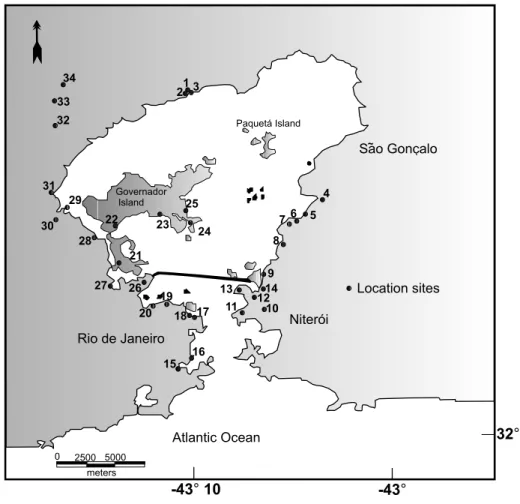
Guanabara Bay, Rio de Janeiro, Southeast Brazil (Fig. 1), is considered to be one of the most polluted environments on the Brazilian coastline, where the main direct sources originate from domestic and industrial ef-fluents (Rebello et al. 1986, Vandenberg and Rebello 1986, Leal and Wagener 1993, Baptista Neto et al. 2000). However, there is a lack of information concerning in-direct sources of pollution such as the urban street sedi-ments and to study this premise geochemical and parti-cle size analyses was carried out on sediments collected from highways located in the littoral of Guanabara Bay.
BACKGROUND TO THE STUDY AREA
Guanabara Bay is one of the largest on the Brazilian coastline, located in Rio de Janeiro State (Fig. 1). The bay has an area of approximately 384 km2including its several islands and presents a coastline of 131 km long and a mean water volume of 1.87×10⁹ m3 (Kjerfve
et al. 1997, Amador 1980). It lies within the tropics of southeastern Brazil and due to its coastal location, a humid sub-tropical climate prevails between December and April with 2,500 mm (high altitudes) and 1,500 mm (low land) of rainfall with a mean annual temperature of 20-25◦C (Nimer 1989). The drainage basin of Guana-bara Bay has an area of 4080 km2 and this consists of 32 separate sub-watersheds with 91 rivers and channels (Kjerfve et al. 1997). However, only six rivers are re-sponsible for 85% of the total mean fresh water input, in the order of 100 m3s–1(JICA 1994).
Approximately 11 million inhabitants live in the greater Rio de Janeiro metropolitan area and as a result of rapid urbanization and population growth; untreated sewage is discharged directly into the bay. This area is the second largest industrial region in Brazil and has over 12,000 industries operating along the Guanabara Bay drainage basin and these account for 25% of the
organic pollution released to the Bay (FEEMA 1990). Two oil refineries process 7% of the national oil and ap-proximately 2,000 commercial ships dock in the port of Rio de Janeiro every year, making it the second largest harbor in Brazil. The bay is also the homeport to two naval bases, a shipyard, and a large number of ferries, fishing boats and yachts (Kjerfve et al. 1997).
Over the past 100 years catchments areas around Guanabara Bay have been greatly modified by deforesta-tion and uncontrolled settlement. These activities have increased river flow velocities and transport of sediment load has increased by 1 to 2 cm year–1 (Godoy et al. 1998).
MATERIALS AND METHODS
SAMPLECOLLECTION ANDANALYSES
Thirty-four samples were collected from the main high-ways that experience intense traffic conditions around Guanabara Bay using a clean plastic dustpan and brush from a 1 m2 area which was measured using a quadrat (Charlesworth and Lees 1999) (Fig. 1), The samples were collected during the rainy season, three days af-ter the rain, stored in sealed polythene bags and trans-ported to the laboratory for analysis. They were then air dried at 30-35◦C and separated into two sub-samples using a riffle box and one portion was used for chemical and the other for physical analyses. Samples for chem-ical analyses were oven dried at 105◦C overnight and the<63µm fractions separated by passing them through
Fig. 1 – Location map of study area.
Forstner 1984, Turekian and Wedepohl 1961). Grain size analysis was carried out using a standard sieve tech-nique (for 2 mm-63µm) Wentworth scale and pipette (<63µm)after removal of organic matter by digesting
in 30% H2O2. Oxidazable organic carbon was deter-mined using the Walkley and Black (1934) technique.
RESULTS AND DISCUSSION
PARTICLESIZE
Results presented in Figure 2 shows the amount of coarse sand, fine sand, silt and clay in the samples. It must be emphasized that the particle size distribution for urban street sediments does not obey the laws of the hydro-dynamics like materials found in natural environments such as beaches and rivers. For example, in urban envi-ronments particulate matter can be deposited in different ways and these include moving parts of vehicles, loads
spilling from trucks, accidents, erosion of gardens and atmospheric deposition.
0 10 20 30 40 50 60 70 80 90 100
2
1,4 1 0,71 0,5 0,35
5
0,25 0,17 7
0,12 5
0,08 8
0,06 3
< 0, 063
1 2 3 4 5 6 7 8 9 10 11 12 13 14 15 16 17 18 19 20 21 22 23 24 25 26 27 28 29 30 31 32 33 34
Fig. 2 – Particle size of the urban street sediments around Guanabara Bay.
Particle size analysis of urban runoff sediments in this study and in the study carried out by Baptista Neto et al. (1999) showed finer size fractions when compared to the other studies mentioned and this may be due to the different weathering processes that take place in temper-ate and tropical regions.
In urbanized areas, mechanical methods of high-way cleaning collect larger size fractions and this results in the finer fractions being concentrated along highway surfaces (Ellis and Revitt 1982, Gromaire et al. 2000). Silt and clay fractions (mud) in the sediments tend to be low with an average of 5.3%, with the lower value of 0.29% being found at station 8 (Niterói-Manilha high-way) These values have also been reported in other stud-ies (Ellis and Revitt 1982, Roberts et al. 1988, Baptista Neto et al. 1999).
Organic matter concentrations (Fig. 3) show a sim-ilar pattern to the particle size, with a number of samples having an average value of 6.5%. However, a minimum value of 0.6% was found at station 3 and a maximum value of 18.22% was found at station 33.
GEOCHEMISTRY
Mineral dissolution, precipitation and complex reactions are controlled by hydrogen ion activity (pH) and redox potential (Eh). Metal cations are more soluble under acidic conditions (Richards et al. 2000). Mobility can also increase at high pH values when organo-metallic complexes are formed, since organic matter becomes more soluble as pH increases (McBride 1998).
Research has indicated that the metals in street sed-iments are predominantly associated with the fine par-ticulate phase (Ellis 1988, Weeks 1981, Wilkinson 1956, Cordery 1976). This is a crucial point, considering the environmental mobility of the sediments and the bio-availability of the metals, which depends of their con-centration in solution plus pH and Eh conditions.
Elements are divided into two groups (a) those that occur naturally (e.g. Fe and Mn), in modest abundances in most environments, and (b) those that occur in nature but are also products of anthropogenic activities (Zn, Cu, Ni, Pb and Cr) (Bricker 1993). Concentration enrich-ment of eleenrich-ments such as Zn, Cr, Cu, Pb and Ni in street sediments is generally an indication of urban and indus-trial pollution and their presence in these samples pro-vides evidence to demonstrate the importance of urban street sediments as a medium for transport of pollution to the coastal environment, and for metal accumulation in the urban environment.
Distribution patterns showing the concentrations of Zn, Cu, Ni, Pb and Cr in the urban street sediments around Guanabara Bay is presented in Figure 3 and these show higher concentrations when compared to the average levels found in shale and sandstone materials (Turekian and Wedepohl 1961) (Table I), and also com-pared with other environments, impacted or not by an-thropogenic activities (Table I). Highest concentrations of these elements are found in the areas that experience intense traffic conditions and especially in Rio de Janeiro and Niterói city centers. In general, the highest concen-trations for all the metals were recorded at stations 14 (closed to one of the main shipyard in Niterói), 19 (one of the oldest site in Rio de Janeiro downtown) and 26 (Rio de Janeiro Harbor). Automobiles are very impor-tant sources of heavy metal contamination in urban en-vironments (Ellis 1988, Baptista Neto et al. 1999), with lead being one of the most significant pollutants. Met-als are mobilized in an urban environment as a result of
human activities, however, vehicular traffic accounts for a significant proportion of the pollution load. Metals are released from vehicles in numerous ways, for example, nickel is present in several moving parts and it is also added to gasoline, copper is a component of brake cable devices and zinc is present in lubricants, tiers and galva-nized components. Sewers are another important source of metals to street sediment runoff, especially in these study areas where sewage overflow is very common, especially during the rainy season.
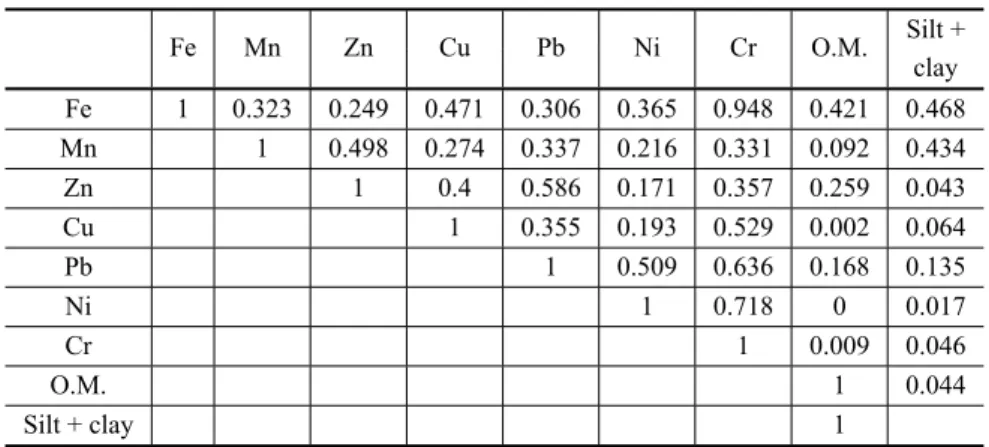
The degree of correlation between trace metals and other major constituents such as organic matter and size distribution is often used to study the origin of many metals (Windom et al. 1989). To verify this relationship correlations between all the metals and the parameters mentioned were carried out for (a) all the stations and (b) after dividing them into their various regions. Corre-lation coefficients for the metals, sand, silt and clay plus organic matter were low for all the stations (Table II).
These results were unexpected, since heavy metals have a high affinity for organic and silt and clay frac-tions (Bodur and Ergin 1994, Zonta et al. 1994). How-ever, this low correlation can be indicative of distinctive sources for these metals in these urban areas. Despite this low correlation between the samples, Cr shows a high correlation with Fe and Ni. According to Feely et al. (1983) trace element enrichments have been linked to scavenging reactions involving hydrous oxides. Sev-eral studies carried out in aquatic or “natural” environ-ments had linked the enrichment of heavy metals to scav-enging by hydrous Mn and Fe oxides.
In an attempt to evaluate the influence of the source areas for the various metals, sample stations were di-vided into 6 areas, all with a similar type of land-use, but however, correlation coefficients were still very low. The most significant correlations were found between Fe/Mn, Fe/Zn, Fe/Cu, Fe/Pb, Fe/Cr, Mn/Zn, Mn/Pb, Mn/Cr, Zn/Cu, Zn/Pb, Zn/Cr, Cu/Pb, Cu/Cr and Pb/Cr (Table III), at stations 26-34.
build-(ppm) (ppm) (ppm) (ppm) (ppm) 180.3 657.8 225.1 169.3 84.6 This study (55-450) (125-1750) (55-900) (72.5-222.5) (47.5-137)
91.6 428 233 70,5 24.3
Guanabara Bay1 100.5 237.5 60.8 64.8 (18.2-556) (8.6-940) (0-242) (0.2-322) Sediments from
Guapimirim 26 26.7 28.3 12.0
mangrove2 Sediments from
Duque de Caxias 86.7 53.3 46.7 10.3
mangrove2 Sediments from the
NE region of the 69 290 119 1
Guanabara Bay3
Jurujuba Sound, 61 158 51 89 48
Niterói4 (5-123) (15-337) (5-213) (10-223) (15-79) São João de Meriti
132 560
River and estuary
(11.6-212) (169-1059) Guanabara Bay5
Average shale6 20 95 45 90 68
Average sandstone6 7 16 10 35 2
1Perin et al. (1997);2Machado et al. (2002);3Faria and Sanchez (2001);4Baptista Neto et al. (1999); 5Barrocas et al. (1995);6Turekian and Wedepohl (1961).
ings, and covered with artificial materials such as as-phalt, concrete, metals, tiles, glass panels, and wood (with or without paint). Surfaces composed of these ma-terials exhibit remarkably different metal sorption prop-erties as compared to natural environment e.g. soil and plants. Even trough artificial materials with a porous surface may display the capacity to retain metals, where their micro-structure can potentially serve as reservoir for metal pollutants, these materials may be inferior to soil in terms of their metal adsorption capacity and could even become a source of pollutants (Van der Sloot et al. 1996, Tossavainen and Forssberg 1999, Andersson et al. 2004). As a result, metal-enriched particulates and dust deposited in the urban environment often remain relatively mobile and tend to disperse, due to the urban environment often remain relatively mobile and tend to
disperse, due to the lack of means of physical entrap-ment and adhesion to substrates (Charlesworth and Lees 1999).
Several authors suggested that the dispersion and deposition of metal-enriched particulates and dust in the urban environment are governed by physical and micro-environmental factors, including topography, wind direc-tion, and urban runoff (Cordery 1976, Charlesworth and Lees 1999, Andersson et al. 2004, Wong et al. 2006).
wa-TABLE II
Pearson correlation coefficient matrix for heavy metals in the urban street sediments (<63mm) from the road around Guanabara Bay.
Fe Mn Zn Cu Pb Ni Cr O.M. Silt + clay Fe 1 0.323 0.249 0.471 0.306 0.365 0.948 0.421 0.468 Mn 1 0.498 0.274 0.337 0.216 0.331 0.092 0.434 Zn 1 0.4 0.586 0.171 0.357 0.259 0.043
Cu 1 0.355 0.193 0.529 0.002 0.064
Pb 1 0.509 0.636 0.168 0.135
Ni 1 0.718 0 0.017
Cr 1 0.009 0.046
O.M. 1 0.044
Silt + clay 1
ter bodies and biota (Check 1997, Mason et al. 1999, Turer et al. 2001, Duzgoren-Aydin et al. 2004).
ENRICHMENTFACTORS(EF)
According to Selvaraj et al. (2004) differentiation be-tween metals originating from human activity and those from natural weathering is essential in this type of geo-chemical study. One such technique commonly applied is “normalization” of a textural or compositional charac-teristic, where for example conservative elements such as Al (Huang and Lin 2003), Li (Soto-Jiménez and Páez-Ozuna 2001), Cs (Ackeman 1980), Sc (Grousset et al. 1995) and Fe (Baptista Neto et al. 1999) have been used to indicate metal enrichment factors (EF). Iron has been used in several studies (Rule 1986, Ergin et al. 1991, Baptista Neto et al. 1999) and since it is a better proxy for the fine fraction and for its covariance with sewage signals in sediments (Bothner et al. 1998), this element and standard shale reference material are used in this study to calculate the enrichment factors (EFs). En-richment factors of approximately 1.0 indicate that the element originated predominantly from lithogenous ma-terial, whereas EFs greater than 1.0 indicate an anthro-pogenic origin (Szefer et al. 1995).
Enrichment factors for elements analyzed show the majority to have values greater than 1, highlighting their anthropogenic origin (Table III). Stations 1-3 situated in an area with lower urbanization and less traffic also show high enrichment factors for all the elements, especially Zn and Pb.
Highest EF values were found at stations 15-20 (Ta-ble III), all located in Rio de Janeiro City. It was impossi-ble to normalize the samples from Niterói, but a previous study carried out by Baptista Neto et al. (1999) in this area, indicated the importance of an anthropogenic con-tribution to the street sediments.
CONCLUSION
This study shows the concentration of heavy metals in urban streets sediments in highways around Guanabara Bay to be very high and is therefore an important source of pollution to the receiving rivers and to Bay. Levels of heavy metals found, in practically all the stations are very high, especially when compared to other environments that experience anthropogenic activities.
Relationship between the levels of heavy metals, type of occupation and land-use, verified that the most polluted sites are located in the center of Rio de Janeiro and Niterói. These results were expected; since these areas experience intense traffic conditions and sewage overflows cause heavy metal pollution of the sediments. Results would indicate that these types of sediments are potentially one of the main sources of heavy metal pollution since they are discarded directly into Guana-bara Bay during precipitation, by pluvial water galleries and by the fluvial systems.
and Wedepohl 1961).
Sample Zn/Fe Cu/Fe Pb/Fe Ni/Fe Cr/Fe 1 2.45 8.17 5.22 1.20 3.39 2 5.26 5.16 8.33 2.19 5.61 3 3.81 5.14 7.95 2.13 6.4 4 12.14 4.65 5.83 1.26 5.49 5 9.38 4.64 5.84 0.99 5.53 6 11.96 4.23 10.44 1.31 5.44 7 10.26 4.27 9.46 1.51 4.68 8 9.0 2.85 4.52 1.66 5.82 9 6.85 4.39 6.03 1.10 5.10 15 19.72 8.76 15.11 1.79 6.29 16 15.03 9.28 16.19 1.74 5.07 17 15.46 10.15 12.08 1.87 6.34 18 24.56 18.52 12.00 1.47 5.52 19 16.20 21.99 17.86 1.62 5.97 20 16.98 4.94 25.03 1.35 5.72 21 8.85 2.14 8.87 1.42 4.09 22 17.30 2.19 8.22 1.55 4.88 23 15.00 4.37 8.67 1.64 5.17 24 7.07 4.00 14.67 1.25 5.65 25 8.01 2.28 10.09 1.80 4.82 26 6.33 8.98 7.05 0.76 5.10 27 12.28 4.54 15.23 1.33 5.37 28 14.53 4.31 12.0 1.35 5.63 29 4.05 2.09 5.13 1.19 4.52 30 8.79 4.19 8.50 0.86 5.12 31 11.52 3.77 10.52 1.45 5.46 32 5.42 2.81 6.55 1.13 4.94 33 11.22 3.52 10.66 1.04 5.31 34 4.06 1.87 5.44 2.99 4.41
only characterize these sediments, but also to quantify the amount of pollutant which is introduced to the bay, and compare this source in relation to others such as domestic sewers and the industrial pollution.
ACKNOWLEDGMENTS
Funding for this project was provided through a coopera-tion program funded by the British Council and Coorde-nação de Aperfeiçoamento de Pessoal de Nível Superior
indebted to Dr. Maria Augusta Martins da Silva and Dr. Soraya Maia Pachtneelan for the comments on the first draft of this paper; to the Departamento de Geolo-gia/Universidade Federal Fluminense and to the School of Geography/Queen´s University of Belfast for support-ing this project.
RESUMO
Neste estudo, análises geoquímica e de granulometria de trinta e quatro amostras de sedimentos coletados ao longo de rodovias em um ambiente urbano ao redor da Baía de Guanabara, mos-tram que o escoamento superficial das rodovias pode ser fonte potencial de metais pesados para a poluição de depósitos sedi-mentares costeiros. Concentrações de Fe, Mn, Zn, Cu, Pb, Cr e Ni são bem altas quando comparadas com os valores encon-trados em ambientes naturais, onde o Fator de Enriquecimento (FE), que é índice de normalização, foi utilizado para a dis-tinção entre fontes naturais e antropogênicas de metais pesados. As análises granulométricas mostram que estes sedimentos são compostos predominantemente de areia e nenhum padrão de distribuição foi observado entre as frações areia, silte e argila. Os altos níveis de matéria orgânica e metais pesados indicam que estes materiais depositados sobre as rodovias são fontes potenciais de poluição para os sedimentos costeiros da Baía de Guanabara.
Palavras-chave:metais pesados, escoamento urbano, Baía de Guanabara.
REFERENCES
ACKEMANF. 1980. A procedure for correcting grain size
ef-fect in heavy metal analysis of estuarine and coastal sedi-ments. Environ Technol Letters 1: 518–527.
AMADORES. 1980. Assoreamento da Baía de Guanabara – taxas de sedimentação. An Acad Bras Cienc 52: 723–742. ANDERSSON M, OTTESEN RT AND VOLDEN T. 2004. Building materials as a source of PCB pollution in Ber-gen, Norway. Sci Total Environ 325: 139–144.
BAPTISTA NETO JA, SMITH BJ AND MCALLISTER JJ.
BAPTISTA NETO JA, SMITH BJ AND MCALLISTER JJ.
2000. Heavy metal concentrations in surface sediments in a nearshore environment, Jurujuba Sound, SE Brazil. Environ Pol 109: 1–9.
BARROCAS PRG, SILVA FILHO EV, WASSERMAN FPA ANDSANTOSSRA. 1995. Níveis de metais pesados nos sedimentos do Rio São João de Meriti e estuário da Baía da Guanabara, V Congresso Brasileiro de Geoquímica e III Congresso de Geoquímica dos Países de Língua Por-tuguesa, Niterói, RJ, Brasil, 12 p.
BODUR MN AND ERGIN M. 1994. Geochemical charac-teristic of the recent sediment from the Sea of Marmara. Chem Geol 115: 73–101.
BOTHNER MH, BUCHHOLTZ TEN BRINK M AND MAN -HEIM FT. 1998. Metal concentrations in surface
sedi-ments of Boston harbor changes with time. Mar Environ Res 45: 127–155.
BRICKERSB. 1993. The history of Cu, Pb and Zn inputs of Narragansett Bay, Rhode Island as recorded by salt-marsh sediments. Estua 16: 589–606.
CHARLESWORTHSMANDLEESJA. 1999. The transport of particulate-associated heavy metals from source to deposit in the urban environment, Coventry, UK. Sci Total Environ 235: 351–353.
CHECK LM. 1997. Drainage planning and control in the urban environment – the Singapore experience. Environ Monit Asses 44: 183–197.
CHONH, KIMKANDKIMJ. 1995. Metal contamination of
soils and dusts in Seoul metropolitan city, Korea. Environ Geoch Heal 17: 139–146.
CORDERY I. 1976. Potential value and treatment of urban
stormwater. Civil Eng Trans Inst Eng Australia 18: 60– 63.
DEMIQUELE, LLAMASJF, CHACONE, BERGT, LARSEN
S, ROYSETOANDVADSENM. 1997. Origin and pat-terns of distribution of trace elements in street dusts: un-leaded petrol and urban lead. Atmos Environ 31: 2733– 2740.
DUZGOREN-AYDINNS, LIXDANDWONGSC. 2004. Lead contamination and isotope signaturas in the urban environ-ment of Hong Kong. Environ Internat 30: 209–217. ELLISJB. 1979. The nature and sources of urban sediments
and their relations to water quality: a case study from northwest London. In: HOLLISGE (Ed), Man’s impact on the hydrological cycle in the United Kingdom, Nor-wich: Geoabstracts, p. 199–216.
ELLISJB. 1985. Sediment-water quality interactions in urban
rivers, Paper presented at the 1st International
Geomor-phological Conference, Manchester, 18 p.
ELLISJB. 1986. The management and control of urban runoff
quality. Jour Inst Wat Environ Manag 32: 116–124. ELLISJB. 1988. The quality of urban discharges. In: ELLIS
JB (Ed), Urban discharges and receiving water quality impacts. Pergamon Press, p. 1–8.
ELLISJBANDREVITTDM. 1982. Incidence of heavy met-als in street surface sediments: solubility and grain size studies. Wat Air So Pol 17: 87–100.
ERGINM, SAYDAMC, BASTÜRKÖ, ERDEMEANDYÖRÜK
R. 1991. Heavy metal concentrations in surface sedi-ments from the two coastal inlets (Golden Horne Estu-ary and Izmit Bay) of the north-eastern Sea of Marmara. Chem Geol 91: 269–285.
FARIAMMANDSANCHEZB. 2001. Geochemistry and
min-eralogy of recent sediments of Guanabara Bay (NE sector) and its major rivers – Rio de Janeiro State – Brazil. An Acad Bras Cienc 73: 121–133.
FEELY RA, MASSOTH GJ, PAULSON AJANDGENDRON
GF. 1983. Possible evidence for the enrichment of trace elements in the hydrous manganese oxide phases of sus-pended matter from urbanized embayment. Estuar Coast Shelf Sci 17: 693–780.
FEEMA. 1990. Projeto de recuperação gradual da Baía de Guanabara, Vol. 1. Fundação Estadual de Engenharia do Meio Ambiente, Rio de Janeiro, RJ, Brasil, 203 p. FERGUSONJEANDKIMN. 1991. Trace elements in street
and house dusts source and speciation. Sci Total Environ. 100: 125–150.
GODOY JM, MOREIRA I, BRAGANÇA MJ, WANDERLEY
CANDMENDESLB. 1998. A study of Guanabara Bay
sedimentation rates. Jour Radioanal Nucl Chem 227: 157–160.
GROMAIREMC, GARNAUDS, AHYERREMANDCHEBBO
G. 2000. The quality of street cleaning waters: compari-son with dry and wet weather flows in a Parisian combined sewer system. Urb Wat 2: 39–46.
GROUSSETFE, QUETELCR, THOMASB, DONARDOFX, LAMBERT CE, QUILLARD F ANDMONACOA. 1995. Anthropogenic vs. lithogenic origins of trace elements (As, Cd, Pb, Rb, Sb, Sc, Sn, Zn) in water column particles: northwestern Mediterranean Sea. Mar Chem 48: 291– 310.
HUANGKANDLINS. 2003. Consequences and implication
JICA. 1994. The study on recuperation of the Guanabara Bay ecosystem, 8 volumes. Japan International Cooperation Agency. Kokusai Kogyo Co. Ltd., Tokyo.
KACKSTAETTERURANDHEINRICHSG. 1997. Validity of low cost laboratory geochemistry for environmental appli-cations. Wat Air Soil Pol 95: 119–131.
KJERFVE B, RIBEIROCA, DIAS GTM, FILIPPOA AND
QUARESMA VS. 1997. Oceanographic characteristics of an impacted coastal bay: Baía de Guanabara, Rio de Janeiro, Brazil. Cont Shelf Res 17: 1609–1643.
LACERDA LD, PFEIFFER WC AND FISZMAN M. 1987.
Heavy metal distribution, availability and fate in Sepetiba Bay, SE Brazil. Sci Total Environ 65: 163–173.
LEAL MAND WAGENER A. 1993: Remobilization of
an-thropogenic copper deposited in sediments of a tropical estuary. Chem speciat bioavail 24: 31–39.
MACHADOW, SILVA-FILHOEV, OLIVEIRARRANDLA
-CERDALD. 2002. Trace metal retention in mangrove ecosystems in Guanabara Bay, SE Brazil. Mar Pol Bul 44: 1277–1280.
MASON Y, AMMANNAA, ULRICHAANDSIGG L 1999. Behavior of heavy metals, nutrients and major compo-nents during roof runoff infiltration. Environ Sci Tech 33: 1588–1597.
MCALLISTERJJ, SMITHBJANDSANCHEZB. 1998.
For-est clearance: impact of landuse change on fertility status of soils from the São Francisco area of Niterói, Brazil. Land Degrad Develop 9: 425–440.
MCALLISTER JJ, SMITH BJ AND BAPTISTA NETO JA. 2000. The presence of calcium oxalate dihydrate (wed-dellite) in street dusts from Niterói, Brazil and its health implications. Environ Geoch Heal 22: 195–210. MCALLISTER JJ, SMITH BJ, BAPTISTA NETO JA AND
SIMPSONJK. 2005. Geochemical distribution and bio-availability of heavy metals and oxalate in street sediments from Rio de Janeiro, Brazil: a preliminary investigation. Environ Geoch Heal 27: 429–441.
MCBRIDEMB. 1998. Soluble trace metals in alkaline
stabi-lized sludge products. J Environ Qual 27: 578–584. NAQEROTTESM ANDDAYJP. 1998. Lead concentrations
and isotope ratios in street dust determined by electrother-mal atomic absorption spectrometry and inductively cou-pled plasma mass spectrometry. Anal 123: 59–62.
133–137.
PAGOTTO C, RÈMY N, LEGRET MLE ANDCLOIREC P.
2001. Heavy metal pollution of road dust and roadside soil near a major rural highway. Environ Tech 22: 307– 319.
PERING, FABRISR, MANETES, WAGENERAR, HAMA
-CHERCANDSCOTTOS. 1997. A five-year study on the heavy-metal pollution of Guanabara bay sediments (Rio de Janeiro, Brazil) and evaluation of the metal bioavail-ability by means of geochemical speciation. Wat Res 31: 3017–3028.
POPEW. 1980. Impact of man in catchments. In: GOWER
AM (Ed), Water quality in Catchment Ecosystems. J Wiley & Sons, New York, p. 73–112.
REBELLO A, HAEKELW, MOREIRAI, SANTELLI RAND
SCHROEDER F. 1986. The fate of heavy metals in an estuarine tropical system. Mar Chem 18: 215–225. RICHARDSBK, STEENHUISTS, PEVERLYJHAND MC
-BRIDE MB. 2000. Effect of sludge-processing mode, soil texture and soil pH on metal mobility in undisturbed soil columns under accelerated loading. Environ Pol 109: 327–346.
ROBERTSAH, ELLISJBANDWHALLEYWB. 1988. The progressive alteration of fine sediment along an urban storm drain. Wat Res 22: 775–781.
RULEJH. 1986. Assessment of trace element geochemistry
of Hampton Roads harbour and lower Chesapeake Bay area sediments. Environ Geol Wat Sci 8: 209–219. SALOMONS W AND FÖRSTNER U. 1984. Metals in the
hydrocycle. Springer-Verlag, Berlin, 349 p.
SARTORJDANDBOYDGB. 1972. Water pollution aspects of street surface contaminants. Environ. Protection Tech. Series EPA R2-72-081. Office of Research Monitoring U.S. EPA, Nor.
SELVARAJK, RAMMOHANVANDSZEFERP. 2004. Evalu-ation of metal contaminEvalu-ation in coastal sediments of the Bay of Bengal, India: geochemical and statistical ap-proaches. Mar Pol Bul 49: 174–185.
SHAHEENDG. 1975. Contributions of urban roadway usage
to water pollution. U.S. EPA Report No. EPA 600/2-75-00, Washington D.C.
SWEENEY JC (Ed), The Irish Sea, A resource at risk.
Geograp Soc Ireland Spec Public 3: 107–116.
SOTO-JIMÉNEZMFANDPÁEZ-OZUNAE. 2001.
Distribu-tion and NormalizaDistribu-tion of Heavy metal concentraDistribu-tions in Mangrove and Lagoonal sediments from Mazatlán Harbor (SE Gulf of California). Est Coast Shelf Sci 53: 259–274. SUTHERLANDRA. 2003. Lead in grain size fractions of
road-deposited sediment. Environ Pol 121: 229–237. SUTHERLANDRAANDTOLOSACA. 2000. Multi-element
analysis of road-deposited sediment in an urban drainage basin, Honolulu, Hawaii. Environ Pol 110: 483–495. SZEFERP, GLASBYGP, PEMPKOWIAK JANDKALISZAN
R. 1995. Extraction studies of heavy-metal pollutants in surficial sediments from the southern Baltic Sea off Poland. Chem Geol 120: 111–126.
TOSSAVAINENMANDFORSSBERGE. 1999. The potential
leachability from natural road construction materials. Sci Total Environ 239: 31–47.
TUREKIANKKANDWEDEPOHLKH. 1961. Distribution of
elements in some major units of the earth’s crust. Geol Soc Amer Bul 72: 175–192.
TURERD, MAYNARDJBANDSANSALONEJJ. 2001. Heavy metal contamination in soils of urban highways: compar-ison between runoff and soil concentration at Cincinnati, Ohio. Wat Air Soil Pol 132: 293–314.
VAN DER SLOOT HA, COMANS RNJ ANDHJELMAR O. 1996. Similarities in leaching behaviors of trace contami-nants from waste, stabilized waste, constraction materials and soils. Sci Total Environ 178: 111–126.
VANDENBERGCANDREBELLOAL. 1986. Organic-copper
interactions in Guanabara Bay, Brazil – an electrochem-ical study of copper complexation by dissolved organic material in a tropical bay. Sci Total Environ 58: 37–45. WALKLEY A ANDBLACK IA. 1934. An examination of
the Degtjareff method for determining soil organic matter and proposed modification of the chromic acid titration method. Soil Sci 37: 29–38.
WATTSS ANDSMITH BJ. 1994. The contribution of high-way run-off to river sediments and implications for the impounding of urban estuaries: a case study of Belfast. Sci Total Environ 146/147: 507–514.
WEEKSCR. 1981. Pollution in urban stormwater runoff. Sec-ond International Conference on urban Storm Drainage, Urbana, Illinois, p. 39–48.
WILKINSON R. 1956. Quality of rainfall runoff from a
housing estate. J Inst Pub Health Eng 55: 70–84. WINDOMHL, SCHROPPSJ, CALDERFD, RYANJD, SMITH
RG, BURNEYLC, LEWIS FGAND RAWLINSON CH. 1989. Natural trace metal concentrations in estuarine and coastal marine sediments of the southeastern United States. Environ Sci Techn 23: 314–320.
WONG CSC, LI XAND THORNTON I. 2006. Urban en-vironmental geochemistry of trace metals. Environ Pol 142: 1–16.