www.scielo.br/aabc
Benthic foraminifera distribution in high polluted sediments
from Niterói Harbor (Guanabara Bay), Rio de Janeiro, Brazil
CLAUDIA G. VILELA1, DANIELE S. BATISTA1, JOSÉ A. BAPTISTA-NETO2 MIRIAN CRAPEZ3 and JOHN J. MCALLISTER4
1Departamento de Geologia/IGEO/CCMN – Universidade Federal do Rio de Janeiro, 21949-900 Rio de Janeiro, Brasil 2Departamento de Geografia – FFP/UERJ, Departamento de Geologia – Lagemar/UFF 24210-340 Brasil
3Laboratório de Microbiologia Marinha – PPGBM/UFF 24001-970 Brasil 4School of Geography – The Queen’s University of Belfast, BT7 1NN Ireland
Manuscript received on July 7, 2003; accepted for publication on October 15, 2003;
presented byNorma Costa Cruz
ABSTRACT
Dockyards and harbors are recognized as being important locations where sediment-associated pollutants can accumulate, which constitutes an environmental risk to aquatic life due to potential uptake and accumulation of heavy metals in the biota. The aim of this paper is to assess the concentrations and the effects of some heavy metals in the benthic foraminifera assemblage in Niterói Harbor. Low concentrations in the benthic foraminifera as well as the dominance of indicative species such asAmmonia tepida,Buliminella elegantissima andBolivina lowmanican be associated with an environment under stress. In addition, the occurrence of test abnormalities among foraminifera may represent a useful biomarker for evaluating long-term environmental impacts in a coastal region.
Key words:benthic foraminifera, Guanabara Bay, pollution, heavy-metals.
INTRODUCTION
Coastal areas, particularly docklands and harbors have been described in the international literature as typical locations where sediment-associated pol-lutants can accumulate due to anthropogenic activi-ties. Ecological and environmental consequences of contamination produce complex problems and these need to be resolved in order that exposed habitats may be protected. Guanabara Bay, Rio de Janeiro, Southeast Brazil, is considered to be one of the most polluted environments of the Brazilian coastline. Heavy metal contamination accounts for a high per-centage of this pollution (Rebello et al. 1986,
Van-Correspondence to: Profa. Dra. Claudia Gutterres Vilela E-mail: [email protected]
denberg and Rebello 1986, Leal and Wagener 1993, Baptista Neto et al. 2000). Metal toxicity is com-plicated when compared to, for example, hydrocar-bon pollution since the mode of toxicity in the lat-ter is similar. However, when studying metal pol-lution, toxicity varies among and within individual elements, depending on their speciation within the sample matrix. Metals are non-bioavailable and can bioaccumulate through various mechanisms (Bru-land et al. 1991, Bryan and Langston 1992). It is very important to access their impacts on the micro-fauna found in the surface sediment.
range of marine environments, from brackish estu-aries to deep ocean basins at all latitudes. These species are very sensitive to environmental changes and have well defined salinity and temperature pref-erences, making them very useful indicators of past environmental events (Ellison and Nichols 1976). One method of studying the effects of pollutants is to determine the taxonomic diversity of these or-ganisms by generating diversity index values from mathematical formulas. Diversity is a measure of order (or disorder) within a particular system and by applying the numbers to the Shannon-Wiener equa-tion, as described in Gibson and Buzas (1973), the degree of uncertainty can be determined. Benthic foraminifera have been used as ‘‘indicator organ-isms’’ to monitor human pollution in coastal regions (Alve 1991, 1995, Yanko et al. 1994, Yanko 1997). Knowledge of the microfaunistic assemblage con-tributes for the evaluation of the bottom sediments close to highly polluted areas. The response of ben-thic foraminiferal assemblages to heavy metals and high input of organic matter may be a useful tool when evaluating the impact of these substances in the studied area. Heavy metals and organic matter cause deformities and atrophy in the foraminifera tests, as well as a decrease in diversity and den-sity (Boltovskoy 1956, McCrone and Schafer 1966, Seiglie 1968, Alve 1991, Casamajor and Debenay 1995, Bonetti et al. 1997, Yanko et al. 1998, 1999, Samir 2000). It must be emphasized that heavy met-als influence natural bacteria in various ways in that they may enhance, suppress or have no effect on bac-terial growth (Ehrlich 1997). Potential toxicity of heavy metals to bacteria depends greatly on factors such as pH, Eh, sulfide, other inorganic elements, organic matter, hydrous metal oxides and clay min-erals (Somerfield et al. 1994). Metal speciation and bioavailability are greatly influenced by aerobic and anaerobic conditions. Many metals, for example, Cu and Cr exist as dissolved ions under aerobic con-ditions and as metal-sulfide complexes under anaer-obic conditions which reduces their bioavailability (Hare et al. 1994).
MATERIALS AND METHODS
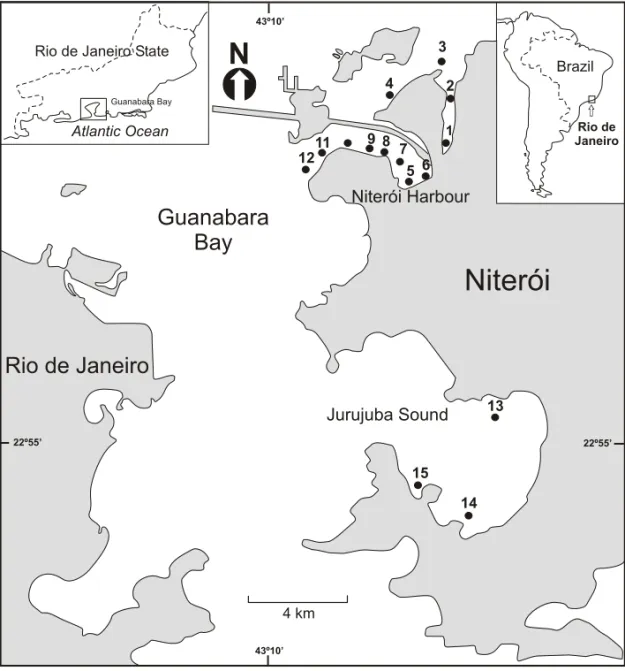
Fifteen samples were collected in June 2000, using a Van-Veen Grab sampler, from Guanabara Bay, Niterói, R.J. Brazil, located between 22˚70’ to 23˚00’S and 043˚00’ and 043˚30’W (Figure 1). The study area includes the Niterói Harbor, Conceição Island and the Jurujuba Sound. This municipality is marked by intensive naval activities and holds one of the main naval estates in the country.
Samples were stored in sealed polythene bags, transported to the laboratory, air-dried at 30-35˚C in a fan-assisted oven, and separated into three sub-samples. Each sediment sample was separated im-mediately after collection (80 ml) for foraminifera analyses, stored in polythene flasks and stained with Rose Bengal. In the laboratory samples were wash-ed and sievwash-ed through 0.062 and 0.50-mm-mesh sieves and oven dried at 50˚C. The 0.062 mm frac-tions were examined under a binocular microscope and a minimum count of 100 specimens of benthic foraminifera for each sample was observed, follow-ing the usual methodology for confined or stressed environments. Where necessary, samples were pre-viously divided according to the methodology de-scribed by Boltovskoy and Wright (1976). Stan-dard microscope studies and the use of a Scanning Electron Microscopic Zeiss – DSM 940A were car-ried out to identify the most significant specimens, normal or deformed. Benthic foraminifera were classified at species level and quantitative analy-ses included relative and total abundances, diversity and deformity of tests. The live and dead speci-mens were estimated by counting the stained and unstained specimens immediately after collection.
anal-N
Guanabara
Bay
Niterói
Niterói Harbour
Jurujuba Sound 13
12
5 6 7 8 9
4 3
2
1
11
15
14
4 km
Rio de Janeiro
Brazil
Rio de Janeiro
ñ Rio de Janeiro State
Guanabara Bay
Atlantic Ocean
22º55’ 22º55’
43º10’ 43º10’
Fig. 1 – Location of the study area and sample stations collected in Niterói, Guanabara Bay, in June 2000.
ysis (<63µm)techniques (Van Doesburg 1996). Elemental analysis was carried out using a Perkin Elmer Model 3100 atomic absorption spectropho-tometer.
RESULTS
Particle Size
In coastal bays, sediments form a textural contin-uum ranging from a sand-silt-clay mix on one side to well-sorted sand on the other, which represents the final product from the reworking of the sediments by wave and tidal action. The wave and tidal
anthro-pogenic sediments derived from the industrial and naval activities (Figure 2).
Geochemistry of the Sediments
Heavy metal distribution in the marine sediments is influenced by texture, clay-minerals, organic matter, oxides, oxyhydroxides of iron and manganese and calcium carbonate (Salomons and Förstner 1984). Harbors, marinas and dockyards are normally re-stricted areas and consequently have a low circu-lation of sediment, which makes them preferential sites for the deposition of pollution. Table I shows the concentration values for Cu, Pb, Zn, Ni and Cr in surface sediments from Niterói coast, where Zn, Cr and Ni show similar patterns. Higher con-centrations were found in sample 6, which is lo-cated close to the dockyard and ship painting ac-tivities that are carried out in the harbor. These elements have also been found in the paints used by the naval industry (Bellinger and Benham 1978). Table I shows higher metal concentrations in sam-ples located close to Niterói harbor and the dockyard than for those recorded in the international literature from other harbor locations (Förstner and Wittmann 1983, Smith and Orford 1989, Subramanian et al. 1988).
Benthic Foraminifera Analyses
Results showed microfauna to be of low abundance, with many small and abraded tests, and some of them deformed. Table I presents absolute values of abundance for the total fauna, stained specimens (alive immediately after collection) and deformed tests. The less abundant samples were located in Niterói Harbor, (Samples 5, 6 and 7 respectively). Sample 11, located close to the main channel of Gua-nabara Bay was the most abundant and contained many stained but no deformed specimens.
The Shannon-Wiener (H) function was used to estimate the species diversity in each sample, given by the formula:
H(S)= −pi ln pi, where
S: number of species
pi: proportion of species in the sample
The diversity values (Table I) can be considered low, compared with values for continental shelves (Sen Gupta and Kilbourne 1974, Gibson and Buzas 1973). Comparing these data with the pattern of diversity from other areas in Guanabara Bay, they are similar to data found in other restricted regions, such as the north of the Bay (Vilela et al. 2002), which is considered one of the most polluted areas, close to the main oil refineries in Rio de Janeiro (Rebello et al. 1986, Vandenberg and Rebello 1986, Leal and Wagener 1993).
Quantification of the total fauna (alive and dead) as well as their abundance, diversity and dom-inance trends was carried out. The abundance pat-terns related below were used for about 100 speci-mens or splitter fraction, using a volume of 80 ml of total sample: simple – 1; rare – 2 to 3; com-mon – 4 to 6; frequent – 7 to 12; abundant – 13 or above. Dominance is the tendency of one species to represent a great part of the assemblage, defined by the occurrence of the species in that assemblage (Boltovskoy and Totah 1985). Frequent or abun-dant species present in all samples were considered dominant (Figure 3).
DISCUSSION
Figure 4 illustrates the main benthic foraminifera species present in Niterói samples. Occurrence of the dominant species Buliminella elegantissima,
0% 20% 40% 60% 80% 100%
4,00 2,00 1,00 0,50 0,25 0,125 0,062 0,015 0,004 0,001 0,00025
mm
Sample1 Sample2 Sample3 Sample4 Sample5 Sample6 Sample7 Sample8 Sample9 Sample10 Sample11 Sample12 Sample13 Sample14 Sample15
Fig. 2 – Particle size of the bottom sediments from Niterói, Guanabara Bay.
TABLE I
Total abundance of benthic foraminifera per sample, stained and deformed specimens, Shannon-Wiener H(S) diversity, and heavy metal results (ppm).
Samples Tot. abund. Stained Deform. H(S) Ni Pb Cu Zn Cr
1 1304 – – 2,51 80 110 125 360 105
2 3584 7 – 2,51 60 45 35 115 85
3 7360 – – 2,46 70 70 75 205 105
4 4224 6 – 2,49 70 70 340 310 160
5 460 – 1 2,63 90 120 155 325 105
6 720 3 2 2,54 110 115 1450 850 230
7 466 9 6 2,93 50 95 105 270 100
8 4288 2 3 2,83 60 135 155 370 120
9 11936 10 – 2,79 60 80 105 220 95
10 7936 5 – 2,59 60 115 125 225 135
11 62720 18 – 2,99 60 90 350 385 95
12 1952 31 3 3,61 80 55 415 320 165
13 7200 16 11 2,38 30 45 45 160 75
14 2584 35 – 2,21 30 50 55 170 85
Sa m p le s A m m o n ia te p id a A . par k ins oniana B igener ina t ex tular ioidea B o liv in a l o w m a n i B o liv ina s p 1 . B . s phat ulat a B . s u b e x c a v a ta B riz alina aenar iens is B u lim in a c o s ta ta B . m a rg in a ta B u lim ina s p 1 . B u lim inella elegant is s im a Cas s idulina s p p . C o rn u s p ir a b y ra m e n s is E . d is c o id a le E . gunt er i E . e x c a v a tu m E . poey anum E ponides c ribr or epanda Fi s s u ri n a m a rg in a ta M iliolinella labios a Nonion depr es s u lum N o n io n e lla o p im a Pa ra ro ta lia s p 1 . P s eudoeponides s p . i n d e t. P s eudononion at lant ic um P . c uev anens is Q. c f. st a lke ri Q. s e m in u lu m Q u inqueloc ulina s p . i n d e t. Rem aneic a helgolandic a Ros alina f lor idana T e x tular ia ear landi T . oblonga T. cf . T . br az iliens is Uv iger ina s p 1 . 01 02 03 04 05 06 07 08 09 10 11 12 13 14 15
Simple: 1 specimen Rare: 2-3 specimens Common: 4-6 specimens Freqüent: 7-12 specimens Abundant: 13 or more
Fig. 3 – Benthic foraminifera relative abundance in samples from Niterói, Guanabara Bay. Species with Rare occurrence in 3 samples or less were not considered.
the occurrence ofB. elegantissima to the most re-stricted and polluted studied areas.
Stained specimens were scattered and more nu-merous among the dominant species such asB. el-egantissima,A. tepidaandB. lowmani, in samples located near the main channel of the bay and in Ju-rujuba Sound (Table I; Figure 6). Various types of deformities were observed in a few tests and these were mainly inB. lowmaniandA. tepida, recovered from samples collected close to the harbor and inside Jurujuba Sound (Table I; Figure 6). Morphological variations in the benthic foraminifera tests have been related to a combination of several parameters: tem-perature, salinity, carbonate solubility, depth, nutri-ents, bottom type, oxygen dissolution, lighting, pol-lution, currents, trace elements and rapid changes in the environment (Boltovskoy et al. 1991).A. tepida
can live in restricted environments under stress, and can acquire deformities due to various reasons, one of these being the presence of heavy metals (Yanko et al. 1998, Samir 2000, Sharifi et al. 1991). Several authors have concluded that the evaluation of
defor-mities in the foraminifera tests could be used as a bioindicator of heavy metal pollution (Alve 1991, Yanko et al. 1994, 1998, Geslin et al. 1998).
Fig. 4 – SEM photomicrographs of specimens from Niterói, Guanabara Bay: (1)Bolivina lowmani– Sample 15, collected in June 2000; (2)B. lowmani, deformed – Sample 14, collected in June 2000; (3)Ammonia tepida(Cushman) – Sample 40, collected in November 1999; (4)Buliminella elegantíssima(Orbigny) – Sample 15, collected in June 2000; (5)Elphidium gunteriCole – Sample 14, collected in June 2000; (6)E. gunteri, deformed – Sample 14, collected in June 2000; (7)E. discoidale(Orbigny), deformed and broken – Sample 15, collected in June 2000; (8)Quinqueloculina seminulum(Linné) – Sample 14, collected in June 2000; (9)
0 10 20 30 40 50 60 70 80
1 2 3 4 5 6 7 8 9 10 11 12 13 14 15
Samples
Num
ber
of specim
ens
Ammonia tepida Bolivina lowmani Buliminella elegantissima
Niterói Harbor Main Channel Jurujuba Sound
Fig. 5 – Benthic foraminifera relative abundance (for 100 specimens) of the dominant species in samples from Niterói, Guanabara Bay.
of abundance were found at samples 5, 6 and 7, in Niterói Harbor, which contain the highest levels of heavy metals (Table I).
Microfauna results when compared with other regions inside the bay indicated a very restricted and confined environment under high pollution stress. These results correlate with those from other areas that are also under environmental stress, such as the Rio de Janeiro Harbor and the northern area of the Bay (Vilela et al. 2002).
CONCLUSIONS
The benthic foraminifera assemblage found in the study area is poor and is represented mainly by small specimens with weak and fragile tests. This is char-acteristic of a restricted or confined environment un-der stress caused by high levels of industrial and do-mestic pollution. High levels of heavy metals and
Sa m p le s A m m onia t epida B o liv ina lowm ani B. su b e xca va ta B . s phat ulat a B . s tr iat ula B o liv ina sp .1 B u lim ina m a rg inat a B u lim ina sp .1 B u lim inella elegant is s im a B riz alina aenar iens is C a s s id u lin a c ra s s a Cor nus pir a by ra m ens is E lphidium ex c a v a tu m E . dis c o idale Ros alina f lor idana P s eudononion c uev anens is Q u inqueloc ulina sp . T o tal st ai n ed Sa m p le s A m m onia t epida B o liv ina lowm ani B o liv ina sp .1 B u lim ina sp .1 B u lim inella elegant is s im a E lphidium dis c o idale Ros alina f lor idana Tot a l de fo rm e d 1 1
2 7 2
3 3
4 6 4
5 5 1
6 3 6 2
7 9 7 6
8 2 8 3
9 10 9
10 5 10
11 18 11
12 31 12 3
13 16 13 11
14 35 14
15 2 15 1
Simple: 1 specimen Rare: 2-3 specimens Common: 4-6 specimens Freqüent: 7-12 specimens Abundant: 13 or more
Fig. 6 – Frequence of stained and deformed foraminiferal tests in samples from Niterói, Guanabara Bay.
ACKNOWLEDGMENTS
This research was supported by FAPERJ (Rio de Janeiro State Science Foundation), the Department of Geology from Universidade Federal do Rio de Janeiro, Departments of Geology and Biology from Universidade Federal Fluminense/Niterói, Depart-ment of Geography/FFP from Universidade do Es-tado do Rio de Janeiro, and The School of Geogra-phy from Queen’s University of Belfast/UK.
Thanks are given to Dr. Norma Maria da Costa Cruz, from CPRM (Mineral Resources Company), and the anonymous reviewers of the manuscript.
RESUMO
Estaleiros e portos são locais reconhecidamente
impor-tantes onde poluentes associados a sedimentos podem
acumular, constituindo um risco ambiental para a vida
aquática devido ao potencial de captação e acumulação
de metais pesados na biota. O propósito deste trabalho
é avaliar as concentrações e os efeitos de alguns metais
pesados na assembléia de foraminíferos bentônicos no
Porto de Niterói. Baixas concentrações de foraminíferos
bentônicos bem como a dominância de espécies
indica-tivas comoAmmonia tepida, Buliminella elegantissima eBolivina lowmani podem ser associadas a um ambi-ente sob estresse. A ocorrência de anormalidades entre
os foraminíferos pode representar um útil biomarcador
para avaliação de impactos ambientais de longo termo em
uma região costeira.
Palavras-chave:foraminíferos bentônicos, Baía de
Gua-nabara, poluição, metais pesados.
REFERENCES
Alve E.1991. Benthic foraminifera in sediment cores reflecting heavy metal pollution in Sorfjord, Western Norway. J For Res 21: 1-19.
Amador ES.1997. Baia de Guanabara e ecossistemas periféricos – Homem e Natureza. Rio de Janeiro, Reproarte Gráfica e Editora, 529 p.
Baptista Neto JA, Smith BJ and MCalister JJ.2000. Heavy metal concentrations in surface sediments in a nearshore environment, Jurujuba Sound, SE Brazil. Envir Poll 109: 1-9.
Bellinger EG and Benham BR.1978. The levels of metals in dockyard sediments with particular refer-ence to the contributions from ship-bottom paints. Envir Poll 15: 71-81.
Boltovskoy E.1956. Applications of chemical ecology in the study of foraminifera. Micropaleontology 2: 321-325.
Boltovskoy E and Totah V.1985. Diversity, similarity and dominance in benthic foraminiferal fauna along one transect of the Argentine shelf. Rev Micropale-ont 28: 23-31.
Boltovskoy E and Wright R. 1976. Recent Fora-minifera. Dr. W. Junk Publs, The Hague, 515p.
Boltovskoy E, Scott DB and Medioli FS.1991. Mor-phological variations of benthic foraminiferal tests in response to changes in ecological parameters: a re-view. J Paleont 65: 175-185.
Bonetti C, Debenay JP and Eichler BB.1997. De-formation in benthic foraminifer tests from a polluted Brazilian coastal system. In: The First Interna-tional Conference Application of Micropale-ontology in Environmental Sciences, Tel Aviv. Program & Abstracts, Herzlia: Anamet Ltd., 1997, p. 41-42.
Bruland KW, Donat J and Hutchins DA.1991. Inter-active influences of bioInter-active trace metals on biolog-ical production in oceanic waters. Limnol Oceanogr 36: 1555-1577.
Bryan GW and Langston WJ.1992. Bioavailability, accumulatin and effects of heavy metals in sediments with special reference to United Kingdom estuaries: a review. Environ Poll 76: 89-131.
Casamajor MN and Debenay JP.1995. Les Foramini-fères, bio-indicateurs des environnements paraliques: réaction à divers types de pollution dans l’estuaire de l’Adour. In: ANPP Colloque Internacional: Marqueurs Biologiques de Pollution, Chinon, 1995, p. 371-378.
Culver SJ and Buzas MA.1995. The effects of an-thropogenic habitat disturbance, habitat destruction, and global warming on shallow marine benthic foraminifera. J For Res 25: 204-211.
Debenay JP, Guillou JJ, Redois F and Geslin E.2000. Distribution trends of foraminiferal assemblages in paralic environments: a base for using foraminifera as bioindicators. In: Martin RE (Ed.), Environ-mental Micropaleontology, Topics in Geobiology 15, New York: Kluwer Acad. & Plenum Publ., p. 39-67.
Ehrlich HL.1997. Microbes and metals. Appl Micro-biol Biotechnol 48: 687-692.
Ellison RL and Nichols MM. 1976. Modern and Holocene foraminifera in the Chesapeake Bay region. In:Schafer CT and Pelletier BR(Eds.) First in-ternational symposium on benthic foraminifera of the continental margins, Part A: Ecol Biol Mar Sed Sp Publ, 1976, p. 131-151.
Förstner U and Wittmann GTW.1983. Metal pollu-tion in the aquatic Environment, Heidelberg: Sprin-ger, 486 p.
Geslin E, Debenay JP and Lesourd M.1998. Abnor-mal wall textures and test deformations inAmmonia (hyaline foraminifer). J For Res 28: 148-156.
Gibson TG and Buzas MA.1973. Species Diversity: Pattern in modern and Miocene foraminifera of the eastern margin of North America. Geol Soc Amer Bull 84: 217-238.
Hare L, Carignan R and Huerta-Diaz MA.1994. A field study of toxicity and accumulation by benthic in-vertebrates, implications of the acid-volatile sulphide (AVS) model. Limnol Oceanogr 39: 1653-1668.
Leal M and Wagener A.1993. Remobilization of an-thropogenic copper deposited in sediments of a trop-ical estuary. Chem Spec Bioav 24: 31-39.
McCrone AW and Schafer CT.1966. Geochemical and sedimentary environments of foraminifera in the Hudson River estuary, New York. Micropaleontol-ogy 12: 505-509.
Rebello A, Haekel W, Moreira I, Santelli R and Schroeder F.1986. The fate of heavy metals in an estuarine tropical system. Mar Chem 18: 215-225.
Samir AM.2000. The response of benthic foraminifera and ostracods to various pollution sources: a study from two lagoons in Egypt. J For Res 30: 83-98.
Seiglie GA.1968. Foraminiferal assemblages as indi-cators of high organic carbon contents in sediments and of polluted waters. AAPG Bull 52: 2231-2241.
Sen Gupta BK and Kilbourne RT.1974. Diversity of benthic foraminifera on the Georgia continental shelf. Geol Soc Amer Bull 85: 969-972.
Sharifi AR, Croudace IW and Austin RL.1991. Ben-thic foraminiferids as pollution indicators in Southampton Water, southern England, UK. J Mi-cropal 10: 109-113.
Smith BJ and Orford JD.1989. Scales of pollution in estuarine sediment around the North Irish Sea. In: Sweeney, JC(Ed.) The Irish Sea, a resource at risk: Geogr Soc Irel Spec Publ 3, p. 107-116.
Somerfield PJ, Gee JM and Warwick RM.1994. Soft sediment meiofaunal community structure in relation to a long-term heavy metal gradient in the Fal Estuary system. Mar Ecol Prog Ser 105: 79-88.
Sousa SHM, Duleba W, Kfouri P, Eichler BB and Furtado VV.1997. Response of foraminiferal as-semblages to environmental changes in the São Se-bastião Channel, northern coast of São Paulo State, Brazil. In: The First International Confer-ence Application of Micropaleontology in En-vironmental Sciences, Tel Aviv. Program & Ab-stracts, Herzlia: Anamet Ltd., 1997, p. 109-110.
Subramanian V, Itta PK and Griekan RV. 1988. Heavy metals in the Ganges Estuary. Mar Poll Bull 19: 289-293.
Vandenberg C and Rebello AL. 1986. Organic-copper interactions in Guanabara Bay, Brazil – an electrochemical study of copper complexation by dis-solved organic material in a tropical bay. The Sci Total Envir 58: 37-45.
Van der Zwann GJ.2000. Variation in natural vs. an-thropogenic eutrophication of shelf areas in front of major rivers. In: Martin RE(Ed.), Environmental Micropaleontology, Topics in Geobiology 15, New York: Kluwer Acad. & Plenum Publ., p. 385-404.
Van Doesburg JDJ.1996. Particle size analysis and min-eralogical analysis. In: Buurman P et al. (Eds.), Manual for Soil and Water Analysis, Leiden: Back-huys Publ., p. 251-267.
Vilela CG, Baptista Neto JA, Mendonça Filho JG, Sanjinés AES, Batista DS and Barbosa CF.2002. Benthic foraminifera occurrence in subenvironments on Guanabara Bay, Rio de Janeiro, southeast Brasil. In:FORAMS2002International Symposium on Foraminifera, Perth. Vol. Abstr., Perth, 2002, p. 70.
Walkley A and Black IA.1934. An examination of the Degtjareff method for determing soil organic matter and proposed modification of the chronic acid titra-tion method. Soil Sci 37: 29-38.
Yanko V. 1997. Benthic foraminifera as bioindica-tors of stress environment: anthropogenic problems – foraminiferal solution. In: The First Interna-tional Conference Application of Micropale-ontology in Environmental Sciences, Tel Aviv. Program & Abstracts, Herzlia: Anamet Ltd., 1997, p. 117-119.
Yanko V, Kronfeld J and Flexer A.1994. Response of benthic foraminifera to various pollution sources: implications for pollution monitoring. J For Res 24: 1-17.
Yanko V, Ahmad M and Kaminsky M.1998. Morpho-logical deformities of benthic foraminiferal tests in response to pollution by heavy metals: implications for pollution monitoring. J For Res 28: 177-200.