High Risk Bladder Cancer: Current Management and Survival
Anna M. Leliveld, Esther Bastiaannet, Benjamin H.J. Doornweerd, Michael Schaapveld, Igle
J. de Jong
Department of Urology (AML, BHJD, IJJ), University Medical Center Groningen, Groningen, The
Netherlands, Department of Epidemiology (EB), Leiden University Medical Center, and Comprehensive
Cancer Center North-Netherlands (MS), The Netherlands
ABSTRACT
Purpose: To evaluate the pattern of care in patients with high risk non muscle invasive bladder cancer (NMIBC) in the Comprehensive Cancer Center North-Netherlands (CCCN) and to assess factors associated with the choice of treatment, recurrence and progression free survival rates.
Materials and Methods: Retrospective analysis of 412 patients with newly diagnosed high risk NMIBC. Clini-cal, demographic and follow-up data were obtained from the CCCN Cancer Registry and a detailed medical record review. Uni and multivariate analysis was performed to identify factors related to choice of treatment and 5 year recurrence and progression free survival.
Results: 74/412 (18%) patients with high risk NMIBC underwent a transurethral resection (TUR) as single treatment. Adjuvant treatment after TUR was performed in 90.7% of the patients treated in teaching hospitals versus 71.8 % in non-teaching hospitals (p < 0.001). In multivariate analysis, age (60-79 years OR 0.40 and > 80 years OR 0.1 p = 0.001) and treatment in non-teaching hospitals (OR 0.25; p < 0.001) were associated with less adjuvant treatment after TUR. Tumor recurrence occurred in 191/392 (49%) and progression in 84 /392 (21.4%) patients. The mean 5-years progression free survival was 71.6% (95% CI 65.5-76.8).
Conclusion: In this pattern of care study in high risk NMIBC, 18% of the patients were treated with TUR as single treatment. Age and treatment in non-teaching hospitals were associated with less adjuvant treatment after TUR. None of the variables sex, age, comorbidity, hospital type, stage and year of treatment was associated with 5 year recurrence or progression rates.
Key words: urinary bladder neoplasms; treatment; outcomes Int Braz J Urol. 2011; 37: 203-12
INTRODUCTION
Bladder cancer is the second most common urological cancer. Non muscle invasive forms include carcinoma in situ (CIS) and Ta/T1 carcinomas and accounts for more than half of the incidence. These tumors frequently recur, particularly in multi focal disease. Progression to muscle invasive disease is
doi: 10.1590/S1677-55382011000200007
related to risk groups. The high risk group consists of patients with a high grade tumor (Grade 3) with/with-out concurrent CIS or CIS alone. Progression rates in this group of patients show a wide range (12 - 52%) (1-3).
tumors (4,5). However, these instillations do not prevent progression. In high grade tumors Bacillus Calmette Guerin (BCG) instillations are superior to intravesical chemotherapy to prevent or delay progres-sion. For optimal eficacy BCG maintenance therapy is necessary (1,3,6). If conservative treatment fails patients present with a recurrence of high risk bladder cancer with or without progression, the most common therapy is radical cystectomy. The exact timing of this cystectomy is still unclear and the subject of many studies.
Despite the presence of guidelines towards management of bladder cancer of the American and European Urological Associations, the actual manage-ment shows quite large variation. A great majority of surveyed urologists in the USA in 2003 were still re-luctant to perform a cystectomy in patients with a high grade tumor who failed intravesical immunotherapy although this was described in the guidelines and a cystectomy in this group of patients gives a tumor-speciic survival of 80 - 90 % (7).
In the Netherlands a national guideline for diagnosis and treatment of bladder cancer has been available since 2009. Until that moment regional consensus based guidelines are available within the regional comprehensive cancer centers. The current clinical practice roughly matches the European As-sociation of Urology guidelines (8,9).
Pattern of care studies are used to identify disparities in patient treatment. These studies can also evaluate which tumor related, patient related or other factors determine the treatment decisions and how this could inluence the course and development of the treatment outcome (7,10,11).
The aim of the study was to evaluate the actual pattern of care in patients with newly diagnosed high risk NMIBC and to assess factors associated with the choice of treatment, 5 year recurrence and progression free survival rates.
MATERIAL AND METHODS
Selection
From the cancer registry of the CCCN a total of 535 patients were identiied with a irst
manifestation of NMIBC in the period 1997-2002. We selected all cases with a non muscle invasive urothelial cell carcinoma stage Ta/1 G3 with/without CIS or isolated CIS of the bladder. Patients with metastatic disease (n = 5) and TxG3 (n = 8) were excluded. From 110 patients the medical records were not available for data collection on follow-up and recurrence. The data of these 110 patients in the CCCN registry showed identical characteristics and similar distribution regarding stage and grade of the tumor compared to the studied cohort. The inal analytic cohort included 412 patients with high risk NMIBC of the bladder.
Data Collection by the Cancer Registries
Statistics
To assess the factors associated with choice of treatment we used a logistic regression analysis. Age was studied as a continuous factor and grouped using decades. Time to local recurrence is deined as the time from diagnosis to the registered histological proven recurrence in the bladder after prior treat-ment. Progression time was deined as time from diagnosis to any registered recurrent tumor with progression in T-stage, arising concomitant CIS or progression to lymph node or distant metastases. Dif-ferences in 5 year Recurrence-Free Survival (RFS) and Progression-Free Survival (PFS) were assessed using the log-rank test. The effect of several factors on 5 year RFS and PFS were studied using a multi-variable Cox regression analysis. As cause of death was unknown in 19.8% of the patients we choose to use relative survival. The relative survival has been shown to be a good estimator of the disease speciic survival in absence of information on the cause of death or in case information on the cause of death is inaccurate (12). The relative survival estimates the net bladder cancer survival, survival in the hypotheti-cal situation that bladder cancer is the only possible cause of death. Maximum follow-up was curtailed at 8 years. Relative excess risks of death were estimated using a multivariate generalized linear model with a Poisson error structure, based on collapsed relative survival data, using exact survival times (13).
RESULTS
Treatment
Overall, 18% of the 412 patients with a high risk NMIBC underwent a TUR as single treatment (Table-1). Seventy-seven percent of the patients received adjuvant treatment with a single immediate Mitomycin (MMC)-instillation, MMC-instillations or BCG-instillations with or without a prior single MMC-instillation (3.3%, 39% and 34%, respectively). For the assessment of associating factors in the choice for TUR with adjuvant therapy 20 patients were ex-cluded because of any other treatment (radiotherapy, cystectomy).
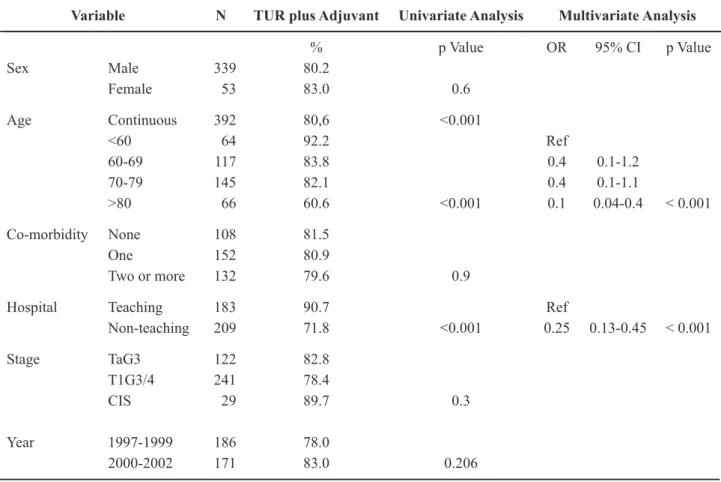
As shown in Table-2, age was related to re-ceiving adjuvant therapy (OR 0.94-95% CI 0.91-0.97) in univariate analysis. Patients younger than 60 years received adjuvant therapy in 92.2% of the cases and only 71.3% of the elderly patients (≥ 70 years) did receive adjuvant therapy. Patients treated in teaching hospitals received adjuvant treatment after the TUR Table 1 – Patient characteristics, hospital type, tumor and treatment.
N %
Sex
Male 354 85.9
Female 58 14.1
Age
<60 68 16.5
60-69 121 29.4
70-79 155 37.6
>80 68 16.5
Year
1997-1999 197 47.8 2000-2002 215 52.2 Comorbidity
None 115 27.9
One 159 38.6
Two or more 138 33.5 Hospital
Non-teaching 220 53.4 Teaching 192 46.6 Stage
TaG3 125 30.3
T1G3/4 258 62.6
CIS 29 7.7
Treatment
TUR 76 18.4
TUR with single instillation 14 3.4 TUR with chemotherapy 160 38.8 TUR and BCG 142 34.5 Cystectomy 16 3.9 Radiotherapy 4 1.0
in 90.7% compared to 71.8% in patients treated in non-teaching hospitals (p < 0.001). In multivariate analysis, age (60-79 years OR 0.40 and > 80 years OR 0.1 p = 0.001) and treatment in non-teaching hospitals (OR 0.25; p < 0.001) were associated with less adjuvant treatment after TUR.
Progression-Free Survival
Local recurrence was observed in 191 of the 392 patients (48.2%) with their bladder in situ dur-ing a mean follow up of 2,7 years (range 0.1 - 9.2). Of the 76 patients treated with TUR alone 44 (58%) showed recurrent disease versus 147 (49%) of the 316 patients treated with adjuvant chemo or BCG therapy showed recurrent disease (hazard ratio (HR)
0.66 (95% CI 0.47-0.93); p = 0.02). Median time to local recurrence was 2.6 years (range 0.10 - 9.20). None of the other variables sex, age, co morbidity, teaching/non-teaching hospitals, stage, year of treat-ment was associated with local recurrence (data not shown).
Tumor progression occurred in 84 of the 392 patients (21.4%). The mean 5-years progres-sion free survival was 71.6% (95% CI 65.5-76.8). In multivariate analysis disease progression showed a trend towards signiicance with stage (adjusted for age and type of growth) with a HR of 0.97(95% CI 0.60-1.56) for T1G3/4 (as opposed to TaG3) and a HR of 0.13 (95% CI 0.02-0.97) for CIS with a p-value of 0.1. None of the other registered factors was statisti-cally signiicant associated with progression-free survival.
Table 2 – Transurethral resection.
Variable N TUR plus Adjuvant Univariate Analysis Multivariate Analysis
% p Value OR 95% CI p Value Sex Male 339 80.2
Female 53 83.0 0.6 Age Continuous 392 80,6 <0.001
<60 64 92.2 Ref
60-69 117 83.8 0.4 0.1-1.2
70-79 145 82.1 0.4 0.1-1.1
>80 66 60.6 <0.001 0.1 0.04-0.4 < 0.001 Co-morbidity None 108 81.5
One 152 80.9
Two or more 132 79.6 0.9
Hospital Teaching 183 90.7 Ref
Non-teaching 209 71.8 <0.001 0.25 0.13-0.45 < 0.001 Stage TaG3 122 82.8
T1G3/4 241 78.4
CIS 29 89.7 0.3
Year 1997-1999 186 78.0
2000-2002 171 83.0 0.206
Relative Survival
During a median follow-up period of 4.5 years (range 0.1 - 8.0), 164 of the 412 patients (39.8%) died. The 5-years relative survival was 81.9% (95% CI 75.2-88.0). Patients with one or more co-morbidi-ties appeared to have a lower survival (5-years relative survival 70.8%) than patients with no co morbidity (95.2%; p = 0.084). None of the other registered fac-tors was signiicantly associated with relative survival in either univariate or multivariate analysis.
BCG Failure
Of the 142 patients initially treated with BCG 76 patients (54%) failed after irst course of BCG. Patients with CIS alone (42.9%) treated with BCG failed somewhat less often than patients with TaG3 (52.9%) or T1G3 (55.8%) with or without CIS (p = 0.4). BCG failure appeared to occur more often in patients with two or more co-morbidities (HR 1.38 p = 0.2). Histology was not associated with BCG failure. Two thirds of the failures were still non muscle inva-sive tumors (53/76). Nine of the patients were treated with a cystectomy (17%), while 26 were treated with a second course of BCG (34%).
COMMENTS
In this pattern of care study for high risk NMIBC in the CCCN region more than 80% of patients were treated according to international stan-dards. Only 18% of the patients were treated with a single TUR. We found hospital type and age to be associated with the choice for less adjuvant treatment. Both age and co morbidity appeared to inluence progression-free and relative survival, but no other clinical factors were associated with progression, survival or BCG failure.
In 1999 the AUA (American Urological As-sociation) Bladder Cancer Guidelines Panel recom-mended intravesical chemotherapy as a treatment option after endoscopic removal of low-grade Ta bladder cancer and intravesical BCG or MMC for CIS and after endoscopic removal of T1 and high grade Ta
tumors (14). Later in 2004, Sylvester et al showed a lower rate of recurrence in patients who received in-travesical therapy within 24 hours postoperatively.
Worldwide the preference for TUR as single treatment for high risk NMIBC decreased throughout the last decade. In a pattern of care study by Snyder et al. 40% of the patients who were diagnosed in 1995 with a high risk bladder tumor underwent resection only (11). In our cohort, a few years later, 18% did not receive adjuvant therapy.
Remarkably in a pattern of care project of the 2003 SEER program, data suggest still an underuse of intravesical therapy in patients with high risk NMIBC in the USA. Only 42 % of the 350 patients with high risk NMIBC received intravesical therapy. Stage, grade, race/ethnicity and geographic region were independently associated with intravesical therapy in this subcohort (10). Interestingly in this comparable study the use of adjuvant intravesical therapy was lower in academic hospitals (31%) as mentioned in the Editorial Comment on this study. In our study this was the opposite with adjuvant intravesical treatment in 90.7% of the patients treated in teaching hospitals versus 71.8% in non teaching hospitals.
The proportion of patients receiving adjuvant therapy in our study is still low compared to opinions expressed by urologists in survey studies conducted in 2003-2004. Witjes et al. (2006) observed that 94.6% of the Flemish and Dutch urologists would offer high risk patients at least an instillation course, predomi-nantly BCG (15). In a survey in 2003 in the US 18% of the urologists stated to prefer TUR only for Ta-T1 high grade tumors and 8% and 1% for concurrent CIS and CIS only respectively (7). This difference in results between a survey study and a pattern of care study might be explained by self-selection of urologists that respond to questionnaires (around 50%) while the actual practice of all urologists was evaluated in a pattern of care study.
Bohle et al. demonstrated in a meta-analysis of com-parative studies for BCG versus MMC a signiicant superiority for BCG for the prevention of tumor progression only if BCG maintenance therapy was provided (1). In a sub-analysis Sylvester et al. also showed superiority of BCG maintenance to MMC for patients with Tis (3). A clear overview of meta-analyses of studies comparing intravesical therapies and differences was published by Hall et al. in 2007 in an update of the guideline for the management of NMIBC (Stages Ta, T1 and Tis) (14). The individual patient data meta-analysis by Malmström in 2009 showed again the superiority of BCG in the prevention of recurrences (21). Prior intravesical chemotherapy was not a confounder. Differences in outcome may be explained by heterogeneity of stage and grade of the included patients, different chemotherapeutical agents which are used and different durations of therapy.
Because of concurrent CIS in the papillary tumor groups it is very dificult to draw any conclu -sion about the separate effect of stage. Also there is limited inter- and intra-observer agreement in histo-logical examination which affects the appropriateness of the staging. In a review pathology study the overall conformity in stage was only 50-60%, largely due to non-agreement for the low-stage tumors. Stage T1 and CIS appear to be the most dificult entities to determine while the differentiation of these tumors is important in the decision regarding conservative or more aggressive therapy (22).
The 5-year relative survival is 81% whereas almost 40% of the patients died during follow-up. Many patients probably died of other causes than their disease. It is obvious that multiple co-morbidi-ties are associated with a worse relative survival. A retrospective study in 2002 on T1G3 tumor patients also did not ind signiicant differences in survival between patients treated with BCG and transurethral resection alone (23).
Many recent studies on T1G3 bladder tumor treated with BCG showed recurrences of 23 to 52% (1,6,16,17,19,20). The number of patients treated in those studies did not exceed 81, but the median fol-low-up was longer than in our retrospective study. No difference was observed between groups of patients treated with or without the maintenance protocol after the induction therapy with BCG. Our study showed
similar results with a recurrence rate of 54 % and a progression rate of 16% in 142 patients who were treated with BCG.
Nowadays there is a tendency towards early cystectomy for recurrent T1 disease during or follow-ing intravesical BCG therapy. This may be associated with better disease speciic survival. Some investiga -tors promote immediate cystectomy for T1G3 tumors (24). Differences in racial or ethnic background can also be an associating factor for tumor stage at the time of cystectomy (25). In our series 5.0% of the T1G3 tumors were treated with radical cystectomy after the diagnostic TUR. This is in concordance with the results of Joudi et al. which were 7% high risk patients who underwent radical cystectomy. Finally promising salvage therapies for patients with BCG failure, unsuitable for radical cystectomy, are awaited in the near future. Yates et al. recently published an update of the application of thermo-chemotherapy, intravesical interferon-alfa and electromotive drug administration (26).
This study has limitations due to the retro-spective design. We were not able to assess socio-eco-nomic factors like educational level, income, social and martial status which are not recorded in the cancer registry and could not be obtained from the medical records. Any effects of race could not be assessed as the CCNN region consists of founder populations with > 95% of the inhabitants being Caucasians. Also speciic determining factors in individual patients or in individual hospitals were not clariied. Finally any comparison of results between treatment groups like TUR versus TUR plus adjuvant treatment can be confounded by an indication bias.
CONCLUSION
CONFLICT OF INTEREST
None declared.
REFERENCES
1. Bohle A, Bock PR: Intravesical bacille
Calmette-Guérin versus mitomycin C in supericial bladder
cancer: formal meta-analysis of comparative studies on tumor progression. Urology. 2004; 63: 682-6; dis-cussion 686-7.
2. Herr HW: Tumor progression and survival of patients with high grade, noninvasive papillary (TaG3) bladder tumors: 15-year outcome. J Urol. 2000; 163: 60-1; discussion 61-2.
3. Sylvester RJ, van der Meijden AP, Witjes JA, Kurth K: Bacillus calmette-guerin versus chemotherapy for the intravesical treatment of patients with carcinoma in situ of the bladder: a meta-analysis of the published results of randomized clinical trials. J Urol. 2005; 174: 86-91; discussion 91-2.
4. Kaasinen E, Rintala E, Hellström P, Viitanen J, Juusela H, Rajala P, et al.: Factors explaining recurrence in patients undergoing chemoimmunotherapy regimens
for frequently recurring supericial bladder carcinoma.
Eur Urol. 2002; 42: 167-74.
5. Sylvester RJ, Oosterlinck W, van der Meijden AP: A single immediate postoperative instillation of chemo-therapy decreases the risk of recurrence in patients with stage Ta T1 bladder cancer: a meta-analysis of published results of randomized clinical trials. J Urol. 2004; 171: 2186-90.
6. Sylvester RJ, van der MEIJDEN AP, Lamm DL: In-travesical bacillus Calmette-Guerin reduces the risk
of progression in patients with supericial bladder
cancer: a meta-analysis of the published results of randomized clinical trials. J Urol. 2002; 168: 1964-70.
7. Joudi FN, Smith BJ, O’Donnell MA, Konety BR:
Contemporary management of supericial bladder
cancer in the United States: a pattern of care analysis. Urology. 2003; 62: 1083-8.
8. Oosterlinck W, Lobel B, Jakse G, Malmström PU, Stöckle M, Sternberg C, et al.: Guidelines on bladder cancer. Eur Urol. 2002; 41: 105-12.
9. van der Meijden AP, Sylvester R, Oosterlinck W, Sol-sona E, Boehle A, Lobel B, et al.: EAU guidelines on the diagnosis and treatment of urothelial carcinoma in situ. Eur Urol. 2005; 48: 363-71.
10. Huang GJ, Hamilton AS, Lo M, Stein JP, Penson DF: Predictors of intravesical therapy for nonmuscle invasive bladder cancer: results from the surveillance, epidemiol-ogy and end results program 2003 patterns of care project. J Urol. 2008; 180: 520-4; discussion 524.
11. Snyder C, Harlan L, Knopf K, Potosky A, Kaplan R: Patterns of care for the treatment of bladder cancer. J Urol. 2003; 169: 1697-701.
12. Sarfati D, Blakely T, Pearce N: Measuring cancer
sur-vival in populations: relative sursur-vival vs cancer-speciic
survival. Int J Epidemiol. 2010; 39: 598-610. 13. Dickman PW, Sloggett A, Hills M, Hakulinen T:
Re-gression models for relative survival. Stat Med. 2004; 23: 51-64.
14. Hall MC, Chang SS, Dalbagni G, Pruthi RS, Seigne JD, Skinner EC, et al.: Guideline for the management of nonmuscle invasive bladder cancer (stages Ta, T1, and Tis): 2007 update. J Urol. 2007; 178: 2314-30. 15. Witjes JA, Melissen DO, Kiemeney LA: Current
prac-tice in the management of supericial bladder cancer
in the Netherlands and Belgian Flanders: a survey. Eur Urol. 2006; 49: 478-84.
16. Gardmark T, Jahnson S, Wahlquist R, Wijkström H, Malmström PU: Analysis of progression and survival after 10 years of a randomized prospective study com-paring mitomycin-C and bacillus Calmette-Guérin in patients with high-risk bladder cancer. BJU Int. 2007; 99: 817-20.
17. Gunlusoy B, Değirmenci T, Arslan M, Nergiz N,
Minareci S, Ayder AR: Recurrence and progression of T1G3 transitional cell carcinoma of the bladder treated with intravesical bacillus Calmette-Guérin. Urol Int. 2005; 75: 107-13.
18. Huncharek M, Kupelnick B: The inluence of intravesi
-cal therapy on progression of supericial transitional
cell carcinoma of the bladder: a metaanalytic compari-son of chemotherapy versus bacilli Calmette-Guerin immunotherapy. Am J Clin Oncol. 2004; 27: 522-8. 19. Margel D, Tal R, Golan S, Kedar D, Engelstein D,
Baniel J: Long-term follow-up of patients with Stage T1 high-grade transitional cell carcinoma managed by Bacille Calmette-Guérin immunotherapy. Urology. 2007; 69: 78-82.
20. Shelley MD, Wilt TJ, Court J, Coles B, Kynaston H, Mason MD: Intravesical bacillus Calmette-Guérin is superior to mitomycin C in reducing tumour recurrence
in high-risk supericial bladder cancer: a meta-analysis
of randomized trials. BJU Int. 2004; 93: 485-90. 21. Malmström PU, Sylvester RJ, Crawford DE, Friedrich
EDITORIAL COMMENT
The authors examined 412 patients (diag-nosed between 1997-2002) within the North-Nether-lands Cancer Registry for variation in the use of ad-juvant therapy in patients with high risk supericial bladder cancer (deined as high grade Ta/T1 or CIS). 82% of patients received some form of adjuvant in-travesical therapy. Of patients receiving adjuvant therapy, 4% received only a single peri-operative installation, while induction BCG or chemotherapy was given in 45% and 51% of patients, respectively. It is unclear from the presented data what proportion of patients receiving induction therapy also received
a peri-operative dose. Overall, these results suggest a much higher rate of compliance with published treat-ment guidelines than that found in similar studies in the Unites States (ref. 10 and 11 in article). Surpris-ingly, increasing age, but not co-morbidity, was sig-niicantly associated with lower odds of intravesical therapy use. Contrary to the indings of Huang et al. (ref. 10), the use of adjuvant intravesical therapy was greater in teaching versus non-teaching hospitals in the Netherlands.
Because the irst AUA guidelines were pub -lished in 1999 (1), and the irst EAU guidelines in
studies comparing intravesical mitomycin C versus bacillus Calmette-Guérin for non-muscle-invasive bladder cancer. Eur Urol. 2009; 56: 247-56.
22. Witjes JA, Moonen PM, van der Heijden AG: Review pathology in a diagnostic bladder cancer trial: effect of patient risk category. Urology. 2006; 67: 751-5. 23. Shahin O, Thalmann GN, Rentsch C, Mazzucchelli
L, Studer UE: A retrospective analysis of 153 patients treated with or without intravesical bacillus Calmette-Guerin for primary stage T1 grade 3 bladder cancer: recurrence, progression and survival. J Urol. 2003; 169: 96-100; discussion 100.
24. Skinner EC: The best treatment for high-grade T1 bladder cancer is cystectomy. Urol Oncol. 2007; 25: 523-5.
25. Manoharan M, Ayyathurai R, de Los Santos R, Nieder AM, Soloway MS: Presentation and outcome fol-lowing radical cystectomy in Hispanics with bladder cancer. Int Braz J Urol. 2008; 34: 691-8; discussion 698.
26. Yates DR, Rouprêt M: Failure of bacille Calmette-Guérin in patients with high risk non-muscle-invasive bladder cancer unsuitable for radical cystectomy: an update of available treatment options. BJU Int. 2010; 106: 162-7.
Accepted after revision: August 31, 2010
Correspondence address: Dr. A.M. Leliveld
Department of Urology
University Medical Center Groningen Hanzeplein 1, P.O. box 30.001
Groningen, 9700 RB, The Netherlands Fax: + 31 503 619-607
2002 (ref. 8), it will be interesting going forward to re-examine these indings as further dissemination has hopefully occurred. In addition, newer guide-lines by the AUA (ref. 14) and EAU (2) emphasize re-resection of high grade T1 lesions (even with muscle in the initial specimen) as well as the use of maintenance therapy. It will also be important to examine compliance with these newer guidelines. Finally, while the identiication of factors associ -ated with decreased intravesical therapy use -- age, ethnicity, or type of practice -- gives clues as to the barriers preventing implementation, the main under-lying issues may be failure to disseminate existing literature, patient burden (perceived or real), and lo-gistical issues which affect provider work-low.
REFERENCES
1. Smith JA Jr, Labasky RF, Cockett AT, Fracchia JA, Montie JE, Rowland RG: Bladder cancer clinical guidelines panel summary report on the management of nonmuscle invasive bladder cancer (stages Ta, T1 and TIS). The American Urological Association. J Urol. 1999; 162: 1697-701.
2. Babjuk M, Oosterlinck W, Sylvester R, Kaasinen E, Böhle A, Palou-Redorta J, et al.: EAU guidelines on non-muscle-invasive urothelial carcinoma of the bladder. Eur Urol. 2008; 54: 303-14.
Dr. Jared Whitson
Urologic Oncology Fellow Department of Urology University of California San Francisco E-mail: [email protected]
EDITORIAL COMMENT
From a distance, it may look as if there is nothing new under the sun regarding management of non-muscle invasive transitional cell bladder can-cer. We use urine cytology, transurethral resection, intravesical doxorubicin or mitomycin and BCG for more than 35 years and they remain our main weap-ons for ighting not only costly (due to innumerous recurrences), but unpredictive and if progressive of-ten fatal disease.
At a closer look, the ield of this disease has changed quite signiicantly in recent years. With -out considering new markers, drugs and techniques which are already available it may look promising in the future (studies evaluating screening with combi-nations of new markers like FISH analysis of exfo-liated cells in urine, proteomics, luorescence blue light cystoscopy and resection, gentamycin, micro-wave heated or electromotive intravesical drug ap-plication). Main change has been in standardization and systematization of our approach to patients with this disease. Those changes took place in recent
years and guidelines (AUA, NCCN and EAU) are all freely available from their respective web-sites. AUA guidelines are quite narrative and give reason-ing behind suggestions, NCCN produces and every few months updates short and up to a point graphic algorithms - decision trees and EAU may has pro-duced (in their last, 2009 update) most precise and straightforward set of rules for dealing with non-muscle invasive bladder cancer.
guidelines, should have received. Although the au-thors in discussion address this issue and cite one, 8 year old study, which claims no survival advantage for immunotherapy group and this may be debatable, the fact still remains solid: majority of patients were at the time of study not treated according to pres-ent guidelines. Some patipres-ents may be unsuitable (too old etc.) for treatment according to guidelines and guidelines have room for improvement with spe-ciically addressing those marginal groups. Perhaps some patients may be in a registered clinical trial (this is not reported). But otherwise - current man-agement of high risk bladder cancer should not be as was mentioned in this study. If not for other reasons, guidelines take a lot of hesitation out of our mind and help us a lot in ultimate question with high risk patients – i.e. to proceed with cystectomy or contin-ue conservative treatment? Decision for cystectomy
is a dificult one and it is universally accepted it is often made too late (1). Relatively rigid guidelines offer a highway towards this decision, if and when needed. Although guidelines can and will change with time, obeying them is a irst step towards im -proving outcomes, which for bladder cancer seem to remain the same for decades with no improvement. Only years after we have standardized our approach and try to follow guidelines with each individual pa-tient, SEER and other cancer statistics may and will relect improvements.
REFERENCES
1. Soloway MS, Hepps D, Katkoori D, Ayyathurai R, Manoharan M: Radical cystectomy for BCG failure: has the timing improved in recent years? BJU Int. 2010; 10. doi: 10.1111/j.1464-410X.2010.09830.x.