Focal Therapy with High-Intensity Focused Ultrasound for
Prostate Cancer in the Elderly. A Feasibility Study with 10 Years
Follow-Up
Amine B. El Fegoun, Eric Barret, Dominique Prapotnich, Shawn Soon, Xavier Cathelineau,
François Rozet, Marc Galiano, Rafael Sanchez-Salas, Guy Vallancien
Department of Urology, Institute Montsouris, University Paris Descartes, Paris, France
ABSTRACT
Purpose: To evaluate the long-term eficacy of prostate cancer control and complication rates, in the elderly, after focal therapy with high-intensity focused ultrasound (HIFU).
Materials and Methods: Between June 1997 and March 2000, patients with localized prostate cancer were included into a focal therapy protocol. Inclusion criteria were: PSA ≤ 10 ng/mL, ≤ 3 positive biopsies with only 1 lobe involved, clini
-cal stage ≤ T2a, Gleason score ≤ 7 (3+4), negative CT scan and bone scan. Hemi-ablation of the prostate was performed with the Ablatherm(R) device. Survival, complication rates and urinary continence were evaluated. Control biopsies were
performed at 1 year. Treatment failure was deined as a positive biopsy or need for salvage therapy.
Results: Twelve patients with a mean age 70 years were included. Median follow-up was 10 years. Control prostate biop
-sies were negative in 11/12 (91%) patients. Overall survival was 83% (10/12) and cancer speciic survival was 100% at 10 years. Two patients died from other causes. Recurrence free survival was 90% (95% CI; 0.71-1) at 5 years, and 38% (95% CI; 0.04-0.73) at 10 years. Five patients had salvage therapy with repeat HIFU (n = 1) or hormonal therapy (n = 4) and all salvage patients were alive at 10 years. No patients developed lymph node or bone metastasis. No patients suffered from urinary incontinence. International Prostate Symptom Score was stable at 1 year. Complications included two urinary tract infections and one episode of acute urinary retention.
Conclusions: Hemi-prostate ablation with HIFU can be safely performed in selected elderly patients with adequate long-term cancer control and low complication rates. Results from larger prospective studies using improved imaging techniques and extensive biopsy protocols are awaited.
Key words: prostate neoplasms; ultrasound; high-intensity focused; transrectal
Int Braz J Urol. 2011; 37: 213-22
INTRODUCTION
Radical treatments such as radical pros -tatectomy (RP) or radiation therapy (RT) offer an excellent cancer cure rate around 85 to 90%, but post-treatment side-effects on urinary control and sexual function are common (1-3). In the elderly, the use of such radical treatments that reduce quality of life is questionable (3). Recently, there has been a demand
doi: 10.1590/S1677-55382011000200008
-ited morbidity when applied to the whole gland (6,7). We hypothesize that applying HIFU on focal lesions could control disease with minimal harm to adjacent tissues, thus limiting post-treatment side effects of more radical therapy. We retrospectively reviewed our population and describe the long-term results of focal therapy with HIFU.
MATERIALS AND METHODS
Patients
Between June 1997 and March 2000, patients with localized prostate cancer were included in a focal therapy protocol. Inclusion criteria were: prostate spe -ciic antigen (PSA) ≤ 10 ng/mL, ≤ 3 positive biopsies with only 1 lobe involved, clinical stage ≤ T2a, Gleason score ≤ 7 with no predominant pattern 4, and negative staging (absence of lymphadenopathy on CT scan and a negative bone scan). All patients provided written informed consent before entering the study. Patients with a previous history of any deinitive treatment for prostate cancer or hormonal therapy were excluded.
Technique
Patients underwent HIFU with the irst-genera -tion Ablatherm(R) device (EDAP-TMS, Vaux-en-Velin France) using a 2.5 and 3 MHz transducer under general anesthesia. At the very beginning of our experience, even positive apical biopsies where considered suitable for HIFU treatment. Nevertheless, in the operative protocol, the sphincter was always avoided. Initially transurethral resection of the prostate (TURP) was offered prior to HIFU in patients with large prostate volumes. It was subsequently done routinely since TURP reduces post-op -erative bladder outlet obstruction (8). Overall, 5 patients underwent TURP before HIFU.
Endpoints
Cancer control: treatment failure was deined as any positive control biopsy (irrespective of the side) and/or salvage therapy. Prostate biopsies were
performed at 1 year after treatment and if there was a rising PSA. Salvage therapy was introduced on treat -ment failure, that is, when a control biopsy was positive or when PSA increased to above pre-treatment levels. In case of treatment failure, patients were offered HIFU if the recurrence was considered local (one positive biopsy in the same lobe); if more diffuse, they were offered androgen deprivation therapy. Adverse events, death and cause of death were recorded. Overall sur -vival was calculated at the time of death, regardless of cause. Prostate cancer speciic survival was calculated at the time of death from prostate cancer.
Quality of Life
Treatment related morbidity was recorded. Continence was evaluated as the number of pads used per day at 1, 6 and 12 months. Lower urinary tract symptoms (LUTS) were assessed with the In -ternational Prostate Symptom Score (IPSS), before treatment, and at 1, 6, and 12 months. Sexual function was not assessed in this study because 7/12 patients were not interested in sexual activity or had pre-exist -ing erectile dysfunction. The International Index of Erectile Function-5 questionnaires were unavailable for the remaining patients. Subjective information related to sexual function was available in the charts, but because of the lack of objective data, sexual func -tion was not assessed in this analysis.
Follow-up
PSA measurements were performed in all patients at 3 months from initial HIFU treatment, and then every 6 months thereafter. Clinical assessment was performed every 6 months during the irst 5 years and then annually thereafter. A six-core control biopsy involving both prostatic lobes was performed 1 year after treatment and/or in case of rising PSA. The data was analyzed retrospectively.
RESULTS
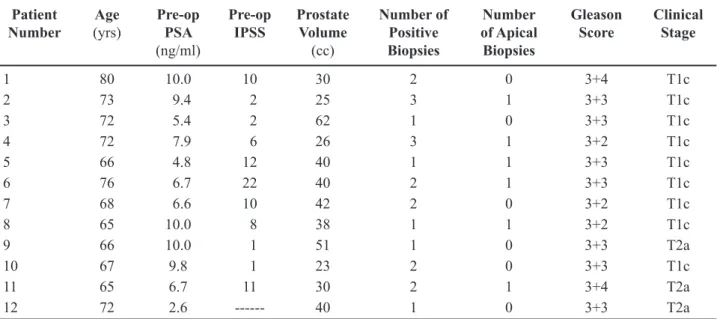
-ment patient characteristics are shown in Table-1. Long-term oncologic and functional outcomes are shown in Table-2. Data on patients with recurrence
is shown in Table-3. The mean age was 70 years (± 4.8) and median procedure time was 69 minutes. Median number of shots was 374 (161-533), median
Table 1 – Patient demographics.
Patient Number
Age
(yrs) Pre-op PSA (ng/ml)
Pre-op IPSS
Prostate Volume
(cc)
Number of Positive Biopsies
Number of Apical Biopsies
Gleason Score
Clinical Stage
1 80 10.0 10 30 2 0 3+4 T1c
2 73 9.4 2 25 3 1 3+3 T1c
3 72 5.4 2 62 1 0 3+3 T1c
4 72 7.9 6 26 3 1 3+2 T1c
5 66 4.8 12 40 1 1 3+3 T1c
6 76 6.7 22 40 2 1 3+3 T1c
7 68 6.6 10 42 2 0 3+2 T1c
8 65 10.0 8 38 1 1 3+2 T1c
9 66 10.0 1 51 1 0 3+3 T2a
10 67 9.8 1 23 2 0 3+3 T1c
11 65 6.7 11 30 2 1 3+4 T2a
12 72 2.6 --- 40 1 0 3+3 T2a
PSA = prostate-speciic antigen; IPSS = International prostate symptom score.
Table 2 – Focal therapy with HIFU: oncological and functional results.
Patient Number
Post-op IPSS
Nadir PSA (ng/mL)
PSA value at the Time
of Salvage Therapy
(ng/mL)
Time to Introduction
of Salvage Therapy
(years)
Type of Sal-vage Therapy
Last PSA (ng/mL)
Total Follow-up
(years)
1 12 2.4 8.6 9.0 ADT 1.3 11.0
2 1 2.0 14.5 10.0 ADT 0.1 11.1
3 7 2.8 26.0 10.0 ADT 1.0 10.5
4 4 1.9 9.9 9.0 ADT 3.2 10.6
5 8 2.2 NST NST NST 6.8 10.8
6 12 2.3 NST NST NST 3.8 10.5
7 12 1.1 NST NST NST 1.5 10.6
8 6 1.1 NST NST NST 1.2 Dead
9 4 1.1 NST NST NST 1.5 7.5
10 5 0.4 NST NST NST 0.4 Dead
11 6 0.3 1.6 5.0 HIFU 4.6 9.5
12 -- 1.0 NST NST NST 1.7 8.0
catheterization time was 2.5 days (range, 2-13). Mean prostate volume was 37 g (23-62), mean pre-operative PSA level was 7.3 ng/mL (2.6-10), mean number of positive biopsies was 2 (1-3) and median follow-up was 10.6 years (7.5-11.1). Six of the twelve patients had an initial apical positive biopsy. For two of these patients, this biopsy was the only positive biopsy. Control biopsies at one year were negative in 11/12 patients (91%). One of twelve patients harbored a residual Gleason 4 (2+2) cancer. This one patient with low grade, low volume disease was monitored with serial PSA, and was treated 4 years later with a second HIFU procedure on PSA increase. Treatment failure was observed in 5 patients. These patients had a salvage therapy with either HIFU (n = 1) or androgen deprivation therapy (ADT) (n = 4) and survival rate for recurrent patients was 100% at 9.5 to 11 years of follow-up. Three of the six patients with an initial api -cal positive biopsy recurred. None of the recurrences had subsequent lymphadenopathy or bone metastasis on staging. The last median PSA in the recurrence-free group was 1.63 ng/mL (range, 0.42-6.82). The patient re-treated with HIFU had a stable PSA at 4.6 ng/mL, 4.5 years after salvage HIFU treatment alone. The group treated with salvage ADT has a stable median PSA at 1.15 ng/mL (range, 0.13-3.2).
Two patients died during the follow-up pe -riod from non-cancer related causes (both from heart failure), they were free of disease when they died 2 and 3 years, respectively, with a PSA at 1.18 ng/mL
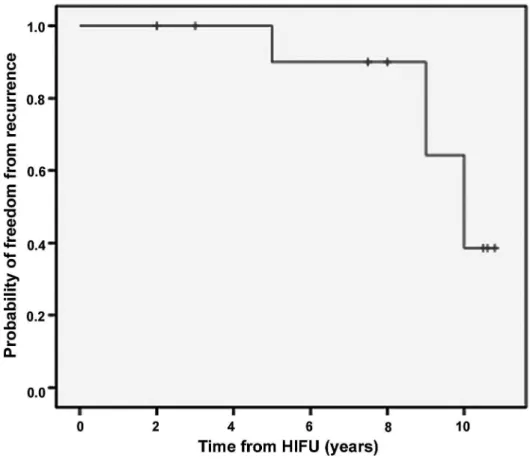
and 0.42 ng/mL on the last follow-up. Each also had a negative control biopsy. Recurrence free survival was 90% (95% CI; 0.71-1) at 5 years, and 38% (95% CI; 0.04-0.73) at 10 years (Figure-1). Overall survival was 83% (10/12 still alive) and cancer speciic survival was 100%. No urinary incontinence was observed. Two of twelve patients experienced urinary tract infection post-operatively: one episode of epididimo-orchitis, and one asymptomatic urinary tract infection. One patient experienced acute urinary retention post-operatively and had a supra-pubic catheter placed for 13 days. No urethral strictures were recorded. One patient did not have an IPSS score recorded. Eight of eleven patients (75%) had a similar IPSS 1 year after treatment. Two of eleven patients had a lower IPSS and one of eleven patients had a higher IPSS. Of the two patients with lower IPSS scores one year after HIFU treatment; one did not receive further therapy for lower urinary tract symptoms, while the other patient underwent a TURP before HIFU to prevent post-treatment urinary retention.
COMMENTS
In the PSA era, low-risk disease represents a growing proportion of newly diagnosed prostate cancer. Recent data from Cancer of the Prostate Stra -tegic Urological Research Endeavor demonstrates the number of patients with low-risk tumor characteristics
Table 3 – Status of recurrent patients.
Patient Initial PSA
Initial Positive
Biopsy Location
Nadir PSA
(ng/ mL)
PSA Value at the Time of
Sal-vage Therapy (ng/mL)
Post-op Positive
Biopsy Location
Time to Introduction
of Salvage Therapy (yrs)
Type of Salvage Therapy
Last PSA (ng/mL)
1 10.0 Lb,Lm 2.4 8.6 Lb, Lm 9.0 ADT 1.3
2 9.4 Lb,Lm,La 2.0 14.5 Lb,Lm,La
Rb,Rm,Ra 10.0 ADT 0.1
3 5.4 Rb 2.8 26.0 10.0 ADT 1.0
4 7.9 1.9 9.9 Rb,Ra,
Lb,La 9.0 ADT 3.2
11 6.7 Rb,Ra 0.3 1.6 Ra 5.0 HIFU 4.6
(deined as serum PSA ≤ 10 ng/mL, Gleason score ≤ 6 and clinical stage ≤ T2a) rose from 27.5% from 1990 to 1994, to 46.4% from 2000 to 2001 (5). Focal therapy has been suggested as an alternative to radical treatment (4).
In our study, focal therapy with HIFU pro -vided a 5 and 10 years recurrence free survival of 90% and 38%, an overall survival of 83% (10/12), and a cancer speciic survival of 100% (12/12). Besides the very large 95% CI resulting from the small sample size, these results are comparable to HIFU treatment of the whole gland. In a multicenter analysis including 140 patients treated with HIFU for the whole gland (7), the overall survival was 90% at 5 years and 83% at 8 years. Prostate cancer speciic-survival rate was 98%. Treatment failure was deined as presence of at least one positive biopsy, PSA > nadir PSA + 2 ng/mL or salvage therapy. In this analysis, disease free survival was 66% at 5 years, and 59% at 7 years.
When stratiied for risk-group, disease free survival at 5 years was 68% for low risk patients and 58% for the intermediate risk patients (p = 0.021).
a relatively safe option since there is no cumulative effect of ultrasound. In a cohort of 223 patients with a retreatment rate of 22%, Blana et al. reported there was no signiicant difference in urinary infection, outlet obstruction, and chronic pelvic pain after one or several HIFU sessions. However, they observed a signiicant increase in urinary incontinence and im -potence rates in this retreatment group (11). Salvage radiotherapy (RT) has recently been described as an option after HIFU failure with reasonable results (12). Even if most of our patients were treated with ADT, focal therapy with HIFU allows many options for salvage therapy such as repeat HIFU (9,11,13), RT (12), and radical prostatectomy (RP) (14) in case of recurrence.
Although radical treatment offers excellent cancer cure rates, post treatment side effects on uri -nary, sexual and bowel function are common (15). In the low-risk patient, RP offers a probability of free -dom from progression of 79% to 91% and a cancer speciic survival rate of 97% and 89% at 10 and 15 years (1,2). RT provides a 10-year progression-free survival rate for low risk patients treated with 75.6 Gy of 85% (16). For RP, urinary incontinence and impaired sexual function rates were 14% and 79%, respectively, 5 years after treatment. For RT, these values were 4% and 64%, respectively, 5 years after treatment (17). Gastrointestinal problems occur in 59% of patients undergoing RT compared to 14% of age-matched controls (18). Compared with radical treatment, focal therapy could provide a way to con -trol low-risk cancers with minimal morbidity. In our population, the only side-effects were urinary tract infection in 2 cases and acute urinary retention in 1 case. With the routine use of pre-operative TURP, the rate of urinary retention can be reduced (8). Neverthe -less, we do not perform pre-HIFU TURPs for our focal therapy patients, since this is not in agreement with our deinition of focal therapy. Furthermore, LUTS were not signiicantly changed by HIFU 12 months af -ter treatment and no urethral strictures were recorded. As expected, our data demonstrates focal therapy with HIFU minimizes side-effects. Our indings are also better than the results for the whole gland HIFU protocols reported in the literature. In a multicenter trial conducted on 402 patients, urinary retention was present in 9% of patients, urethral strictures developed
in 4%, and epididymitis in 6% (9). In another study 94% of patients recovered normal urinary continence, 14% had urinary obstruction associated with stric -tures, 6% complained of pelvic pain for less than 6 months and 26% previously potent patients developed severe erectile dysfunction (7). In a phase II trial as -sessing feasibility, safety and early eficacy of hemi prostate ablation with HIFU, Emberton et al. found that the probability of men being free of signiicant genito-urinary toxicity was 95% at 3 months. Patients were 100% pad-free immediately following treatment. Erectile function suficient for intercourse occurred in 70% by 2 weeks, and at 3 months, 95% had erec -tions suficient for penetration (19). In a prospective study, comparing whole gland and focal therapy with HIFU, these two options where equivalent for short-term cancer control. No signiicant differences were observed in the 2 year biochemical disease free survival for patients in the low and intermediate risk groups. Complications tended to be lower in the focal therapy group (20).
Despite reasonable short-term evidence sup -porting the safety and feasibility of AS in men with low-risk prostate cancer (21), few patients accept this approach. Active surveillance among patients older than 75 years has fallen by half in the PSA era, with less than one-quarter of low-risk patients electing initial observation (22). Moreover, due to anxiety, 50% of these patients usually exit the surveillance protocols during follow-up (21). Compared with AS, focal therapy offers a method to treat the index foci of cancer, relieving anxiety associated with waiting for the disease to progress. Focal HIFU is an attrac -tive option with the advantage of delaying deini-tive therapy and minimizing its associated adverse effects on patients’ quality of life (23).
techniques such as image guidance with color Dop -pler ultrasonography or MRI, transrectal saturation biopsies and perineal mapping biopsies are under evaluation (24-27). Sextant biopsy protocols are insuficient to correctly characterize the cancer and some tumors may have been underestimated (28). It is not clear to what extent this under sampling can explain the recurrence rate observed in our study. One can argue that prostate cancer multifocality explains the high level of recurrence when the whole gland is not treated, and that focal therapy may be of limited eficacy. More than 80% of the patients have mul -tifocal prostate cancer (29) with 80% of secondary tumor foci < 0.5 cm3 (30). Volume distribution of the secondary cancers, however, is almost identical to the cancers found incidentally in men undergoing cystoprostatectomy for bladder cancer (29). There is a growing body of evidence to support that the prog -nosis of the disease is driven by the index tumor foci. Our results are concordant with this assertion and it is encouraging to observe that the 10 year cancer speciic and disease free survival of this small sample feasibility study are comparable to the whole gland treatment with HIFU.
Prostate cancer treatments have dramati -cally evolved towards a more selective approach in order to reduce treatment burden whilst retaining cancer control. Over 10 years ago, our team has embraced HIFU for the treatment of prostate cancer and for the irst time we have described the long-term eficacy of focal therapy with HIFU and the limited morbidity of this procedure. Our results are encouraging and we plan to include more patients and eventually younger patients with very strict selection criteria. The main limitation of this non-randomized retrospective study is the small sample size, which precludes statistical analysis; thus, our indings must be interpreted according to this limi -tation. The ongoing evolution of imaging is also an exciting and important variable in the development of focal therapy (31). As previously deined for open radical prostatectomy, the trifecta remains the essential group of variables to evaluate for any focal therapy approach (1,32). At the beginning of the HIFU experience, we neither had a deinition of risk of recurrence, nor a deinition for focal therapy. The deinition of focal therapy for prostate cancer
describes the treatment of men with organ-conined, low to moderate risk prostate cancer. In these cases, the patient undergoes ablation of only the malignant tumor foci in order to provide acceptable freedom from disease progression and also a high probability of preserving genitourinary and bowel function.
According to the literature, HIFU is a treat -ment of proven eficacy for localized prostate cancer with limited side-effects. It offers the opportunity to treat elderly patients with a minimally invasive technique that can be repeated and in our initial series could be combined with TURP to offer better urinary outcome (33-36).
A focal approach for prostate cancer per -formed ten years ago and based on a sextant biopsy diagnosis allowed patients to have similar outcomes as patients treated in the same period with a whole gland approach. This cohort should further expand the discussion on focal therapy, because selected elderly patients were offered ablation of only a half of their prostates and were conferred an acceptable freedom from disease progression and cancer-speciic survival.
CONCLUSIONS
This retrospective feasibility study shows that hemi-prostate ablation with HIFU is a reasonable treatment strategy for a selected population of low or intermediate risk prostate cancer in elderly men. The long-term cancer control rate is adequate, recur -rences can be treated with a second HIFU session or other techniques. In the elderly, the concept of cancer control instead of cancer cure with HIFU has to be discussed, as it seems to provide an effective long-term disease control with minimal treatment-related morbidity. More extensive biopsy protocols and more accurate imaging techniques will certainly improve patients’ selection. Larger prospective studies with a long follow-up are awaited to conirm our small size preliminary results.
CONFLICT OF INTEREST
REFERENCES
1. Bianco FJ Jr, Scardino PT, Eastham JA: Radical pros
-tatectomy: long-term cancer control and recovery of sexual and urinary function (“trifecta”). Urology. 2005; 66(5 Suppl): 83-94.
2. Roehl KA, Han M, Ramos CG, Antenor JA, Catalona WJ: Cancer progression and survival rates following anatomical radical retropubic prostatectomy in 3,478 consecutive patients: long-term results. J Urol. 2004; 172: 910-4.
3. Alibhai SM, Naglie G, Nam R, Trachtenberg J, Krahn MD: Do older men beneit from curative therapy of localized prostate cancer? J Clin Oncol. 2003; 21: 3318-27.
4. Scardino PT, Abenhaim LL: Focal therapy for prostate cancer: analysis by an international panel. Urology. 2008; 72(6 Suppl): S1-2.
5. Cooperberg MR, Broering JM, Kantoff PW, Carroll PR: Contemporary trends in low risk prostate cancer: risk assessment and treatment. J Urol. 2007; 178: S14-9. 6. Gelet A, Chapelon JY, Bouvier R, Souchon R, Pangaud
C, Abdelrahim AF, et al.: Treatment of prostate cancer with transrectal focused ultrasound: early clinical experience. Eur Urol. 1996; 29: 174-83.
7. Blana A, Murat FJ, Walter B, Thuroff S, Wieland WF, Chaussy C, et al.: First analysis of the long-term results with transrectal HIFU in patients with localised prostate cancer. Eur Urol. 2008; 53: 1194-201. 8. Vallancien G, Prapotnich D, Cathelineau X, Baumert
H, Rozet F: Transrectal focused ultrasound combined with transurethral resection of the prostate for the treat
-ment of localized prostate cancer: feasibility study. J Urol. 2004; 171: 2265-7.
9. Thüroff S, Chaussy C, Vallancien G, Wieland W, Kiel HJ, Le Duc A, et al.: High-intensity focused ultrasound and localized prostate cancer: eficacy results from the European multicentric study. J Endourol. 2003; 17: 673-7.
10. de Senneville BD, Mougenot C, Moonen CT: Real-time adaptive methods for treatment of mobile organs by MRI-controlled high-intensity focused ultrasound. Magn Reson Med. 2007; 57: 319-30.
11. Blana A, Rogenhofer S, Ganzer R, Wild PJ, Wieland WF, Walter B: Morbidity associated with repeated transrectal high-intensity focused ultrasound treatment of localized prostate cancer. World J Urol. 2006; 24: 585-90.
12. Pasticier G, Chapet O, Badet L, Ardiet JM, Poisson
-nier L, Murat FJ, et al.: Salvage radiotherapy after high-intensity focused ultrasound for localized pros
-tate cancer: early clinical results. Urology. 2008; 72: 1305-9.
13. Poissonnier L, Chapelon JY, Rouvière O, Curiel L, Bouvier R, Martin X, et al.: Control of prostate cancer by transrectal HIFU in 227 patients. Eur Urol. 2007; 51: 381-7.
14. Liatsikos E, Bynens B, Rabenalt R, Kallidonis P, Do M, Stolzenburg JU: Treatment of patients after failed high intensity focused ultrasound and radiotherapy for localized prostate cancer: salvage laparoscopic extraperitoneal radical prostatectomy. J Endourol. 2008; 22: 2295-8.
15. Korfage IJ, Essink-Bot ML, Borsboom GJ, Madalinska JB, Kirkels WJ, Habbema JD, et al.: Five-year fol
-low-up of health-related quality of life after primary treatment of localized prostate cancer. Int J Cancer. 2005; 116: 291-6.
16. Dearnaley DP, Sydes MR, Graham JD, Aird EG, Bottomley D, Cowan RA, et al.: Escalated-dose versus standard-dose conformal radiotherapy in prostate cancer: first results from the MRC RT01 randomised controlled trial. Lancet Oncol. 2007; 8: 475-87.
17. Potosky AL, Davis WW, Hoffman RM, Stanford JL, Stephenson RA, Penson DF, et al.: Five-year outcomes after prostatectomy or radiotherapy for prostate cancer: the prostate cancer outcomes study. J Natl Cancer Inst. 2004; 96: 1358-67.
18. Widmark A, Fransson P, Tavelin B: Self-assessment questionnaire for evaluating urinary and intestinal late side effects after pelvic radiotherapy in patients with prostate cancer compared with an age-matched control population. Cancer. 1994; 74: 2520-32.
19. Ahmed HU, Zacharakis E, Dudderidge T, Armitage JN, Scott R, Calleary J, et al.: High-intensity-focused ultrasound in the treatment of primary prostate cancer: the irst UK series. Br J Cancer. 2009; 101: 19-26. 20. Muto S, Yoshii T, Saito K, Kamiyama Y, Ide H, Horie
S: Focal therapy with high-intensity-focused ultra
-sound in the treatment of localized prostate cancer. Jpn J Clin Oncol. 2008; 38: 192-9.
21. Klotz L: Active surveillance with selective delayed intervention: using natural history to guide treatment in good risk prostate cancer. J Urol. 2004; 172: S48-50; discussion S50-1.
22. Cooperberg MR, Lubeck DP, Meng MV, Mehta SS, Carroll PR: The changing face of low-risk prostate cancer: trends in clinical presentation and primary management. J Clin Oncol. 2004; 22: 2141-9. 23. Eggener SE, Scardino PT, Carroll PR, Zelefsky MJ,
prostate cancer: a critical appraisal of rationale and modalities. J Urol. 2007; 178: 2260-7.
24. Pelzer A, Bektic J, Berger AP, Pallwein L, Halpern EJ, Horninger W, et al.: Prostate cancer detection in men with prostate speciic antigen 4 to 10 ng/mL using a combined approach of contrast enhanced color Dop
-pler targeted and systematic biopsy. J Urol. 2005; 173: 1926-9.
25. Puech P, Huglo D, Petyt G, Lemaitre L, Villers A: Imaging of organ-conined prostate cancer: functional ultrasound, MRI and PET/computed tomography. Curr Opin Urol. 2009; 19: 168-76.
26. Chon CH, Lai FC, McNeal JE, Presti JC Jr: Use of extended systematic sampling in patients with a prior negative prostate needle biopsy. J Urol. 2002; 167: 2457-60.
27. Moran BJ, Braccioforte MH, Conterato DJ: Re-biopsy of the prostate using a stereotactic transperineal tech
-nique. J Urol. 2006; 176: 1376-81; discussion 1381. 28. Tareen B, Godoy G, Sankin A, Temkin S, Lepor H,
Taneja SS: Can contemporary transrectal prostate biopsy accurately select candidates for hemi-ablative focal therapy of prostate cancer? BJU Int. 2009; 104: 195-9.
29. Wise AM, Stamey TA, McNeal JE, Clayton JL: Morphologic and clinical signiicance of multifocal prostate cancers in radical prostatectomy specimens. Urology. 2002; 60: 264-9.
30. Villers A, McNeal JE, Freiha FS, Stamey TA: Mul
-tiple cancers in the prostate. Morphologic features of
clinically recognized versus incidental tumors. Cancer. 1992; 70: 2313-8.
31. Prando A: Clinical stage T1c prostate cancer: evalu
-ation with endorectal MR imaging and MR spectro
-scopic imaging. Int Braz J Urol. 2010; 36: 100-1. 32. DiBlasio CJ, Derweesh IH, Malcolm JB, Maddox MM,
Aleman MA, Wake RW: Contemporary analysis of erectile, voiding, and oncologic outcomes following primary targeted cryoablation of the prostate for clini
-cally localized prostate cancer. Int Braz J Urol. 2008; 34: 443-50.
33. Barua J, Campbell I I, Cole O, Harris D, Kaisary A, Larner T, et al.: High-intensity focused ultrasound for localized prostate cancer: initial experience with a 2-year follow-up. BJU Int. 2009; 104: 1794; authors reply 1794-5.
34. Abdel-Wahab M, Pollack A: Prostate cancer: Deining biochemical failure in patients treated with HIFU. Nat Rev Urol. 2010; 7: 186-7.
35. Berge V, Baco E, Karlsen SJ: A prospective study of salvage high-intensity focused ultrasound for locally radiorecurrent prostate cancer: Early results. Scand J Urol Nephrol. 2010; 44: 223-7.
36. Uchida T, Shoji S, Nakano M, Hongo S, Nitta M, Murota A, et al.: Transrectal high-intensity focused ultrasound for the treatment of localized prostate cancer: eight-year experience. Int J Urol. 2009; 16: 881-6.
Accepted after revision: July 30, 2010
Correspondence address:
Dr. Eric Barret
EDITORIAL COMMENT
During the last decade developments showed that in most oncologic therapies invasiveness has been reduced. Instead of removing the entire organ radically and surgically the focus is now on the treat -ment of cancer affected areas only.
Focal therapy in prostate cancer had irst been introduced for “male lumpectomy” in 2004 by G. Onic using Cryotherapy.
Statistics show that all local therapies have a high cancer-speciic long-term survival rate.
Therefore, the time seems to be right for “NOTES” (Natural Oriice Therapeutic Endoscopic Surgery) - as it is provided by HIFU (High Intensity Focused Ultrasound).
The Montsouris group has used transrectal
pulsed focused HIFU since 1996 when it was in
-troduced into clinical practice. They participated in
multicenter studies and registered their data in a da
-tabase ready to be stratiied according to speciic pa
-tient or indication groups. In past years “focal” HIFU has been restricted to few speciic cases based on individual medical decision. Thirteen patients have been treated based on current focal HIFU criteria in 12 years (unilateral, low risk PCa treated by hemi-ablation only). Their results have been collected and
retrospectively analyzed. The data underline the fea
-sibility of the focal HIFU concept as a realistic bal
-ance between low invasiveness, suficient radicality and low side-effect rate. Even though recurrence free
survival of 90% after 5 years decreased to 38% af
-ter 10 years, cancer-speciic survival still remained 100%.
However, it proves, that this collection of individual indications conirms the feasibility of the
focal concept and the validity of “focal HIFU ther
-apy” as well as the rationality of using the NOTES approach for this indication.
It is not possible to draw more statements from a study with such a small number of patients treated by different devices, with different technical settings and a changing application mode.
Other minimal invasive therapies such as
Brachy-, Cryo- or Photodynamic therapy are tech
-nically able to perform partial treatments as well, but the disadvantage of perineal, tissue and cancer perforating approaches cannot compete with the non invasive NOTES approach by transrectal HIFU.
Patients who decide for focal therapy want to avoid side-effects without major loss of cancer treatment eficacy. Even though this publication is just a feasibility study with 13 patients it proves that this desire of the patient can be met by the focal
treatment of PCa with High Intensity Focused Ultra
-sound.
Focal HIFU may be the irst step to postpone more invasive therapies, to preserve functional and sexual prostatic integrity without the psychological
burden of “watchful waiting” in prostate cancer ther
-apy.
Once better diagnostic technologies visual
-ize PCa affected areas, focal HIFU with its NOTES approach will have an even higher acceptance within the urological armentarium to treat prostate cancer.