Efficacy of Tamsulosin, Oxybutynin, and their combination
in the control of double-j stent-related lower urinary tract
symptoms
_______________________________________________
Miguel Maldonado-Avila
1, Leopoldo Garduño-Arteaga
1, Rene Jungfermann-Guzman
1, Hugo A.
Manzanilla-Garcia
1, Emmanuel Rosas-Nava
1, Nestor Procuna-Hernandez
1, Alejandro Vela-Mollinedo
1,
Luis Almazan-Treviño
1, Jose Guzman-Esquivel
21 Departamento de Urologia, Hospital Geral de Mexico, Ciudad de Mexico, 2 Instituto Mexicano del Seguro
Social Colima, no México
ABSTRACT
ARTICLE
INFO
______________________________________________________________ ______________________
Introduction and objective: Indwelling double J ureteral stents are used routinely in the resolution of ureteral obstruction caused by different etiologies. Evaluation of urinary symptoms related to double-J stent, indicate that these affect 73-90% of patients.
We conducted a prospective, randomized study, to evaluate the efficacy of tamsulo-sin, oxybutinin and combination therapy in improving the urinary symptoms.
Methods: Patients who underwent ureteral stent placement after ureterolithotripsy (total 51), were randomized into three groups: Group I: Tamsulosin 0.4 mg. once per day(17 patients), Group II: Oxybutinin 5 mg. once per day (17 patients), Group III: Tamsulosin+ oxybutynin once per day (17 patients). All the groups received the drugs for three weeks and completed a Spanish validated Ureteral Stent Symptom Questionnaire (USSQ) at day 7 and 21.
Results: Repeated measures ANOVA showed mean urinary symptom index score was 22.3 vs. 15.5 in group three (p<0.001) at day 7 and 21 respectively. The mean work performance index was 6.6 vs 8.1 (p=0.049) favoring tamsulosin group, the mean sexual score was 0.5 vs 1.5 (p=0.03). Among additional problems the mean was 7.2 vs 6.2 (p=0.03). No significant difference was noted among pain and general health index. No side effects were reported.
Conclusions: Combination therapy with tamsulosin and oxybutynin improved irri-tative symptoms and work performance as well as sexual matters. Combination the-rapy should be considered for patients who complained of stent related symptoms.
Keywords:
tamsulosin [Supplementary Concept]; oxybutynin
[Supplementary Concept]; Lower Urinary Tract Symptoms
Int Braz J Urol. 2016; 42: 487-93
_____________________
Submitted for publication: March 31, 2015
_____________________
Accepted after revision: August 11, 2015
INTRODUCTION
The placement of ureteral double-J stents has become routine clinical practice for resolving ureteral obstruction caused by different etiolo-gies (1-4). The estimated incidence of
stent-rela-ted symptoms varies from 19-76% and includes frequency, urgency, dysuria, incomplete voiding, flank pain, suprapubic pain, urinary incontinence, and hematuria (5-10).
and the International Prostate Symptom Score (IPSS) is complex and nonspecific (11-13). Joshi et al. developed the ureteral stent symptoms ques-tionnaire (USSQ), which is a validated and safe psychometric instrument for evaluating the im-pact of ureteral stents on symptoms and quality of life. This questionnaire explores 6 areas that include urinary symptoms, body pain, general he-alth status, work performance, sexual matters, and other additional problems (14). It has been utilized in numerous clinical trials and translated into di-fferent languages, including Spanish (15).
The efficacy of pharmacologic manage-ment of these symptoms related to the double-J stent, with alpha-1 adrenergic blockers, tamsu-losin and alfuzosin (16, 12, 17-19) and the an-timuscarinic agents, oxybutynin and tolterodine, has been demonstrated (20). In fact, there is a me-ta-analysis that evaluates the efficacy of alpha--blockers and concludes that they are associated with improvement in ureteral stent symptoms and supports their use in routine clinical practice (21). Nevertheless, at present there is no study directly comparing tamsulosin and oxybutynin. Therefore, the aim of this study was to evaluate the efficacy and safety of these two drugs for the control of lower urinary tract symptoms and their impact on quality of life.
MATERIALS AND METHODS
Patient selection
From November 2012 to October 2013, pa-tients of both sexes were included in the study; they were above 18 years of age and had unila-teral double-J stent placement after ureteroscopy that was performed at the Hospital General de Mé-xico.
Inclusion criteria were patients of either sex above the age of 18 years that had undergone ureteroscopy for lithiasis in the lower third of the ureteral tract, with stones under 15mm, and that required unilateral double-J stent placement.
The exclusion criteria were patients with a previous diagnosis of benign prostatic
hyper-plasia (IPSS≥7), a previous diagnosis of
overac-tive bladder, a history of interstitial cystitis or chronic cystitis, a history of chronic prostatitis or
chronic pelvic pain, chronic medication with al-pha blockers, anticholinergic agents and analge-sics, ureteral obstruction caused by malignancy, pregnant patients, patients unable to understand or sign an informed consent, patients with a his-tory of postural hypotension (decrease in blood pressure>20mmHg of the systolic or diastolic me-asurements) or syncope, patients with severe or unstable heart failure, severe renal failure, severe liver failure, or patients with a history of urinary retention, gastric retention, or uncontrolled wide--angle glaucoma.
A single-blind, randomized, prospective, comparative, and experimental clinical trial was conducted that included 51 patients (26 women, 25 men).
They were assigned to one of the following three groups by means of a randomization Table:
Group 1 - Tamsulosin 0.4mg PO before food every 24h for 21 days
Group 2 - Extended release Oxybutynin 5mg PO every 24h for 21 days
Group 3 - Tamsulosin 0.4mg PO before food every 24h for 21 days+oxybutynin 5mg PO every 24h for 21 days.
The sample size was calculated with the formula for comparing independent means, based on previous studies on the efficacy of alpha blo-ckers versus placebo (20). A power of 90% and a significance level of 0.05% were used in accor-dance with a finite population of 60 cases (the number of ureteroscopies per year at our hospital).
Methods
Once the diagnosis of ureteral lithiasis was established and it was confirmed that the patients met the protocol selection criteria, the characteristics of the study were explained to them. Upon accepting to participate in the study, the patients signed statements of informed con-sent, following the principles of the Declaration of Helsinki.
This study was approved by the institutio-nal ethics and research committees in accordan-ce with good clinical practiaccordan-ces, with registration number DI/12/105/04/081.
demographic data, clinical history, and complete physical examination results.
Each patient underwent ureterolithotrip-sy and a polyurethane 24 or 22cm X 6Fr double--J stent (Cook, USA) was placed after endoscopic extraction of the stone. Adequate ureteral double-J stent placement was verified through a plain abdo-minal film in the immediate postoperative period.
The ureteral stent symptoms questionnai-re (USSQ) was applied to all patients on posto-perative days 7 and 21, registering the scores of each of the 6 topics evaluated with the assessment tool. Each section has a total score; the higher the number, the worse the general health status of the patient.
Antibiotic was administered for 7 days (Ci-profloxacin 500mg PO bid), followed by urinary antiseptic (Nitrofurantoin 100mg PO every 24h) until removal of the stent, three weeks later. Keto-rolac PO 10mg was administered as needed by the patient, with a maximum of 4 tablets in 24 hours. Each patient kept a personalized register of the daily analgesic intake.
Statistical analysis
Values were expressed as means±standard deviation (SD) and the statistical analysis was car-ried out using the repeated measures ANOVA test for comparing the independent means of the 3 tre-atment groups.
Results were considered statistically signi-ficant with a value set at p<0.05. The IBM SPSS
Statistics 20.0 for Windows (SPSS, Chicago, IL, USA) statistical package was used.
RESULTS
A total of 56 patients were enrolled in the study. Five were eliminated; four due to spon-taneous stone expulsion and one for having an IPSS score above 21 points.
The remaining 51 patients (26 women and 25 men) were randomly distributed as follows:
Group 1 - Tamsulosin (17 patients)
Group 2 - Extended release oxybutynin (17 patients)
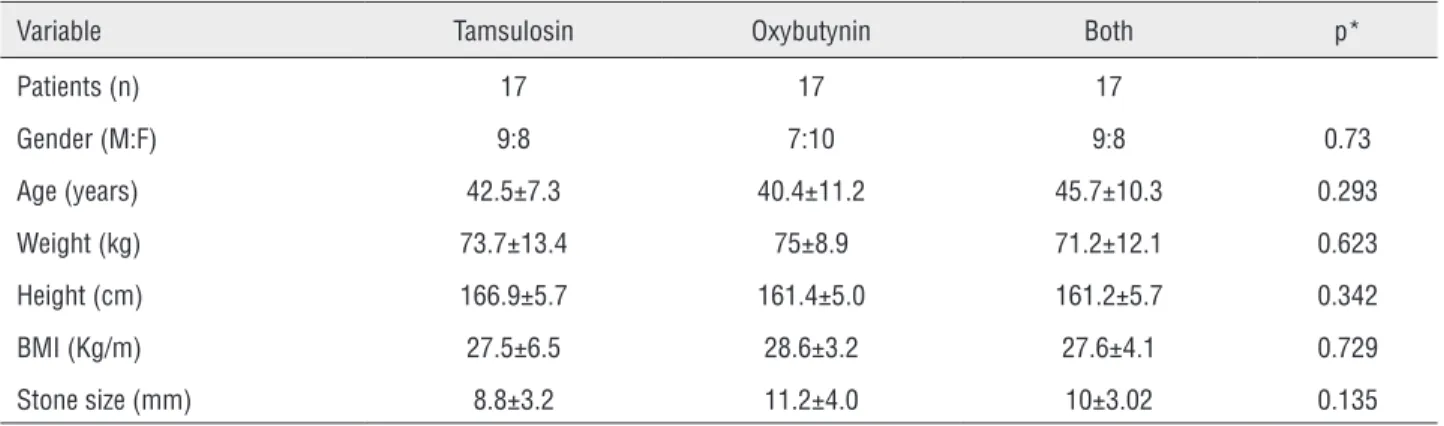
Group 3 - Combination therapy (17 patients) Table-1 shows the demographic charac-teristics of the study population. There were no statistically significant differences per group with respect to age, sex, weight, height, BMI, or stone size (p>0.05).
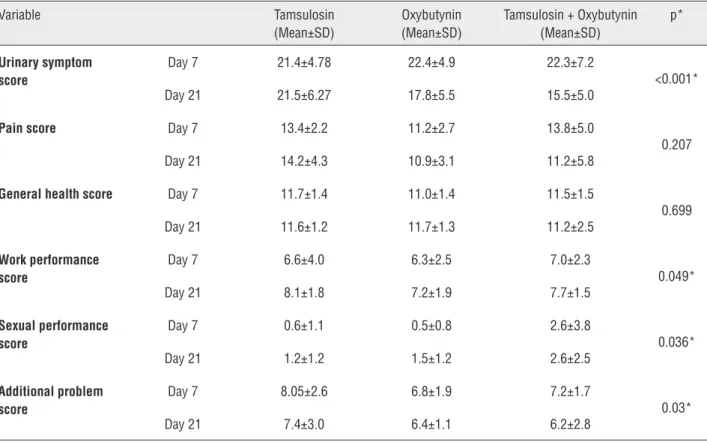
Repeated measures ANOVA showed a mean urinary symptom score of 22.3 versus 15.5 in Group 3 (p<0.001) at days 7 and 21, res-pectively (Figure-1). The mean work performan-ce score was 6.6 versus 8.1 (p=0.049), favoring the tamsulosin group, and the mean sexual per-formance score was 0.5 versus 1.5 (p=0.03). For the additional problems, the mean was 7.2 ver-sus 6.2 (p=0.03). No significant difference was noted between pain and general health scores (Table-2). No side effects were reported and the-re wethe-re no diffethe-rences in analgesic consumption between groups.
Table 1 - Demographic characteristics of the study patients.
Variable Tamsulosin Oxybutynin Both p*
Patients (n) 17 17 17
Gender (M:F) 9:8 7:10 9:8 0.73
Age (years) 42.5±7.3 40.4±11.2 45.7±10.3 0.293
Weight (kg) 73.7±13.4 75±8.9 71.2±12.1 0.623
Height (cm) 166.9±5.7 161.4±5.0 161.2±5.7 0.342
BMI (Kg/m) 27.5±6.5 28.6±3.2 27.6±4.1 0.729
Stone size (mm) 8.8±3.2 11.2±4.0 10±3.02 0.135
Figure 1 - Mean urinary symptoms score.
Table 2 - USSQ score comparison among the 3 groups on postoperative days 7 and 21.
Variable Tamsulosin (Mean±SD)
Oxybutynin (Mean±SD)
Tamsulosin + Oxybutynin (Mean±SD)
p*
Urinary symptom score
Day 7 21.4±4.78 22.4±4.9 22.3±7.2
<0.001* Day 21 21.5±6.27 17.8±5.5 15.5±5.0
Pain score Day 7 13.4±2.2 11.2±2.7 13.8±5.0
0.207 Day 21 14.2±4.3 10.9±3.1 11.2±5.8
General health score Day 7 11.7±1.4 11.0±1.4 11.5±1.5
0.699 Day 21 11.6±1.2 11.7±1.3 11.2±2.5
Work performance score
Day 7 6.6±4.0 6.3±2.5 7.0±2.3
0.049* Day 21 8.1±1.8 7.2±1.9 7.7±1.5
Sexual performance score
Day 7 0.6±1.1 0.5±0.8 2.6±3.8
0.036* Day 21 1.2±1.2 1.5±1.2 2.6±2.5
Additional problem score
Day 7 8.05±2.6 6.8±1.9 7.2±1.7
0.03* Day 21 7.4±3.0 6.4±1.1 6.2±2.8
*Repeated measures ANOVA.
Urinar
y symptoms (USSQ)
Tamsulosin Oxybutinin Group
Tamsulosin + Oxybutinin p<0.001 35
30
25
20
15
10
5
0
DISCUSSION
Ureteral stent placement for upper urinary tract diversion has been employed for more than four decades (22) and has become routine pro-cedure in various urologic surgeries performed for different indications. Ureteral stents prevent urinary flow obstruction caused by edema of the mucosa; they aid in the mucosal healing process after a complicated procedure and they passively dilate the ureter, and facilitate the passage of re-sidual stones (1).
Nevertheless, up to 76% of the patients will have symptoms associated with the presence of the stent, on occasion requiring its early re-moval (8). New stent designs, coatings, and bio-materials have been developed for the purpose of reducing these problems, but the ideal stent has yet to be produced (23).
Even though the exact pathophysiology of the symptoms related to the double-J stent is not known, it has been suggested that the me-chanism involved could be an increase in the pressure transmitted toward the renal pelvis du-ring micturition and bladder irritation due to the intravesical portion of the stent (24).
Both anticholinergic drugs and alpha--adrenergic blocking agents have been used to improve symptoms related to the double-J stent with good results in the majority of cases (20 21).
Our study showed that tamsulosin and oxybutynin combination therapy improved irri-tative urinary symptoms, as well as work perfor-mance and sexual aspects.
The combination of tamsulosin and oxy-butynin was clearly superior in improving uri-nary symptoms. This is a very relevant clinical situation, given that symptomatology is present in 73 to 90% of patients with double-J stent. The same was true for the area of additional problems.
In our study, the group with tamsulosin, alone, had a higher work performance score, compared with the other two groups.
Even though there were statistically sig-nificant differences in relation to the sexual sphere, we felt that the USSQ was not very use-ful, especially during the first postoperative days, because the patients were more concerned about
the result of the surgery and their general health than their sexual performance. In fact, the ma-jority of patients stated that they had made no attempt at having sexual activity.
There are few controlled clinical trials that evaluate the pharmacologic agents used in the treatment of double-J stent-related symp-toms, and to the best of our knowledge this is the first head-to-head study comparing long-acting tamsulosin and oxybutynin. It is well known that stent-related symptoms are similar to those of benign prostatic hyperplasia caused by urethral resistance and bladder instability. Damiano et al. reported that tamsulosin administration impro-ved urinary symptoms and pain when evaluated through the visual analog scale, as well as qua-lity of life (13).
Wang et al. stated that the selective al-pha-1 blocker, tamsulosin, improved urinary symptoms, flank pain, and pain during micturi-tion (19). Beddingfield et al. reported that patients treated with 10mg daily of alfuzosin showed im-provement with respect to micturition frequency, lumbar pain, and sleep disorders (25). Deliveliotis et al. had similar study results of improved stent--related symptoms in patients treated with alfu-zosin, especially in reference to pain, as well as sexual function, and general health (26).
Symptoms associated with double-J ure-teral stent are similar to those of overactive bladder caused by involuntary bladder contrac-tions, and antimuscarinic agents have been used with good results (27). Norris et al. reported that there were no statistically significant differen-ces between patients treated with oxybutynin compared with placebo or phenazopyridine (28). Agarwal et al. demonstrated that patients that had received oxybutynin or tolterodine prior to surgery showed greater relief in regard to bla-dder discomfort compared with patients in the placebo group (29).
CONCLUSIONS
The administration of tamsulosin and oxy-butynin markedly reduced the irritative symptoms commonly associated with a double-J stent. The-se drugs were also effective in the improvement of sexual performance and work performance, as well as other related problems. There was no di-fference with respect to pain and general health.
CONFLICT OF INTEREST
None declared.
REFERENCES
1. Chew BH, Knudsen BE, Denstedt JD. The use of stents in contemporary urology. Curr Opin Urol. 2004;14:111-5. 2. Saltzman B. Ureteral stents. Indications, variations, and
complications. Urol Clin North Am. 1988;15:481-91. 3. Denstedt JD, Wollin TA, Reid G. Biomaterials used in
urology: current issues of biocompatibility, infection, and encrustation. J Endourol. 1998;12:493-500.
4. Cormio L, Talja M, Koivusalo A, Mäkisalo H, Wolff H, Ruutu M. Biocompatibility of various indwelling double-J stents. J Urol. 1995;153:494-6.
5. Vega Vega A, García Alonso D, García Alonso CJ. [Characterization of urinary tract symptoms and quality of life in patients with double-pig-tailed ureteral stents]. Actas Urol Esp. 2007;31:738-42.
6. Miyaoka R, Monga M. Ureteral stent discomfort: Etiology and management. Indian J Urol. 2009;25:455-60.
7. Dellis A, Joshi HB, Timoney AG, Keeley FX Jr. Relief of stent related symptoms: review of engineering and pharmacological solutions. J Urol. 2010;184:1267-72. 8. Joshi HB, Okeke A, Newns N, Keeley FX Jr, Timoney AG.
Characterization of urinary symptoms in patients with ureteral stents. Urology. 2002;59:511-6.
9. Borboroglu PG, Amling CL, Schenkman NS, Monga M, Ward JF, Piper NY, et al. Ureteral stenting after ureteroscopy for distal ureteral calculi: a multi-institutional prospective randomized controlled study assessing pain, outcomes and complications. J Urol. 2001;166:1651-7.
10. Richter S, Ringel A, Shalev M, Nissenkorn I. The indwelling ureteric stent: a ‘friendly’ procedure with unfriendly high morbidity. BJU Int. 2000;85:408-11.
11. Erturk E, Sessions A, Joseph JV. Impact of ureteral stent diameter on symptoms and tolerability. J Endourol. 2003;17:59-62.
12. Lee SJ, Yoo C, Oh CY, Lee YS, Cho ST, Lee SH, et al. Stent Position Is More Important than α-Blockers or Anticholinergics for Stent-Related Lower Urinary Tract Symptoms after Ureteroscopic Ureterolithotomy: A Prospective Randomized Study. Korean J Urol. 2010;51:636-41.
13. Damiano R, Autorino R, De Sio M, Giacobbe A, Palumbo IM, D’Armiento M. Effect of tamsulosin in preventing ureteral stent-related morbidity: a prospective study. J Endourol. 2008;22:651-6.
14. Joshi HB, Stainthorpe A, MacDonagh RP, Keeley FX Jr, Timoney AG, Barry MJ. Indwelling ureteral stents: evaluation of symptoms, quality of life and utility. J Urol. 2003;169:1065-9.
15. Olvera-Posada D, Suárez-Santos M, Castillejos-Molina R, Gabilondo-Navarro F, Méndez-Probst CE. Validation of the Spanish version of Ureteral Stent Symptom Questionnaire: prevalence of symptoms in a tertiary care center in Mexico. J Endourol. 2014;28:377-82.
16. Buzelin JM, Fonteyne E, Kontturi M, Witjes WP, Khan A. Comparison of tamsulosin with alfuzosin in the treatment of patients with lower urinary tract symptoms suggestive of bladder outlet obstruction (symptomatic benign prostatic hyperplasia). The European Tamsulosin Study Group. Br J Urol. 1997;80:597-605. Erratum in: Br J Urol 1998;81:510. 17. Wang CJ, Huang SW, Chang CH. Effects of specific
alpha-1A/1D blocker on lower urinary tract symptoms due to double-J stent: a prospectively randomized study. Urol Res. 2009;37:147-52.
18. Navanimitkul N, Lojanapiwat B. Efficacy of tamsulosin 0.4 mg/ day in relieving double-J stent-related symptoms: a randomized controlled study. J Int Med Res. 2010;38:1436-41.
19. Wang CJ, Huang SW, Chang CH. Effects of tamsulosin on lower urinary tract symptoms due to double-J stent: a prospective study. Urol Int. 2009;83:66-9.
20. Lim KT, Kim YT, Lee TY, Park SY. Effects of tamsulosin, solifenacin, and combination therapy for the treatment of ureteral stent related discomforts. Korean J Urol. 2011;52:485-8.
21. Yakoubi R, Lemdani M, Monga M, Villers A, Koenig P. Is there a role for α-blockers in ureteral stent related symptoms? A systematic review and meta-analysis. J Urol. 2011;186:928-34. 22. Zimskind PD, Fetter TR, Wilkerson JL. Clinical use of long-term indwelling silicone rubber ureteral splints inserted cystoscopically. J Urol. 1967;97:840-4.
23. Lange D, Chew BH. Update on ureteral stent technology. Ther Adv Urol. 2009;1:143-8.
24. Thomas R. Indwelling ureteral stents: impact of material and shape on patient comfort. J Endourol. 1993;7:137-40. 25. Beddingfield R, Pedro RN, Hinck B, Kreidberg C, Feia K,
26. Deliveliotis C, Chrisofos M, Gougousis E, Papatsoris A, Dellis A, Varkarakis IM. Is there a role for alpha1-blockers in treating double-J stent-related symptoms? Urology. 2006;67:35-9.
27. Park SC, Jung SW, Lee JW, Rim JS. The effects of tolterodine extended release and alfuzosin for the treatment of double-j stent-related symptoms. J Endourol. 2009;23:1913-7. 28. Norris RD, Sur RL, Springhart WP, Marguet CG, Mathias
BJ, Pietrow PK, et al. A prospective, randomized, double-blinded placebo-controlled comparison of extended release oxybutynin versus phenazopyridine for the management of postoperative ureteral stent discomfort. Urology. 2008;71:792-5.
29. Agarwal A, Dhiraaj S, Singhal V, Kapoor R, Tandon M. Comparison of efficacy of oxybutynin and tolterodine for prevention of catheter related bladder discomfort: a prospective, randomized, placebo-controlled, double-blind study. Br J Anaesth. 2006;96:377-80.