The “Pelvic Harness”: a skeletonized mesh implant for safe
pelvic floor reconstruction
_______________________________________________
Sumerova Natalia
1, Neuman Menahem
2, 3, Krissi Haim
4, Pushkar Dmitri
51 European Medical Center, Moscow, Russia; 2 Urogynecology Unit, Departaments of Obstetrics and
Gynecology, Galilee Hospital, Nahariya; 3 Bar-Ilan University, Faculty of Medicine, Safed, Israel; 4 Helen Schneider Hospital for Women, Rabin Medical Center, Petach Tikva, and Sackler Faculty of
Medicine, Tel Aviv University, Tel Aviv, Israel; 5 Department of Urology, Moscow Medical Stomatological University, Russia
ABSTRACT
ARTICLE
INFO
______________________________________________________________ ______________________
Objectives: To evaluate the feasibility, safety and surgical results of skeletonized mesh implants to form a pelvic harness for pelvic floor reconstruction surgery.
Study design: Patients with advanced pelvic floor prolapse were enrolled to this study. Study model was a kit mesh, reduced to 75% of the original surface area by cutting out mesh material from the central mesh body. Patients were evaluated at the end of the 1st
and 6th post-operative months and interviewed at the study conclusion.
Results: Ninety-five women with advanced pelvic floor prolapse had this implant. Mean follow-up duration was 9 months (6-12 months). The POP-Q point’s measure-ments showed marked and statistically significant improvemeasure-ments. Bladder over-activity symptoms, fecal incontinence, pelvic pain and constipation rates were all reduced as well. No adverse effects related to the dissection or mesh implantation were marked. The first and sixth post-operative month follow-up records as well as the study con-clusion interview findings were satisfactory in terms of subjective and objective cure and adverse effects occurrence.
Conclusion: This study data proposes that skeletonizing meshes might be safely and successfully implanted for potentially improved pelvic floor reconstruction.
Keywords:
Reconstructive Surgical Procedures; General Surgery; Pelvic Floor Disorders
Int Braz J Urol. 2016; 42: 507-13
_____________________
Submitted for publication: March 28, 2015
_____________________
Accepted after revision: May 06, 2015
INTRODUCTION
Pelvic organ prolapse (POP) is a common condition negatively affecting the quality of life of millions of women worldwide, with a lifetime prevalence of 11% (1). Women with advanced symptomatic POP experience daily discomfort, as well body image dissatisfaction and impaired sexual function (2). Treatment for POP requires significant health care resources (3), with an ever-growing impact in parallel with the growing elderly population (4,5).
In an attempt to reduce these high fai-lure rates, synthetic meshes were designed and implanted. They provided reinforcement and better support for vaginal surgical repair of prolapse. This led to a significant reduction in anatomical failure and reoperation rates (10, 11). However, mesh implant-related compli-cations ranged from mild issues of transient pain and small mesh erosions to severe adverse effects such as large vaginal mesh exposures or extrusions, perforations into the bladder or bo-wel, and chronic pain. Mild mesh complications can be managed conservatively, but bladder or bowel injuries, fistulae, abscess formation, and debilitating pain may require repeat surgery and are not always curable (12).
One of the recent implant modifications aimed at reducing adverse effects is the par-tial absorbable mesh (13-15). It is assumed that significant reduction of the implant mass may lead to reduction of the adverse effects and complications of the graft that are thought to be directly related to the mesh mass.
The current pelvic floor implant meshes are designed to cover the whole pelvic floor area, even though the native pelvic floor ar-chitecture is more ligamentary rather than a sheath-like. This leads to creation of large sur-face area of the mesh implants and to poten-tially increased rate of mesh related post-ope-rative complications. The most significant mesh complications are erosions and post-operative pelvic pain which probably are directly related to the implant total mass and surface area. As mesh surgery is an important surgical tool for pelvic floor reconstruction, it is important to look for new ways to reduce the mesh compli-cation rates.
In this study we suggest skeletonization of the common used pelvic floor mesh implants and making that structure more ligamentary than fascial by a significant reduction of the total implant mass, to create a pelvic harness rather than sheath-like implant (Figure-1).
The aim of this study was to evaluate the feasibility, safety and short-term surgical results of skeletonized mesh implants for pelvic floor reconstruction surgery.
MATERIALS AND METHODS
We conducted a prospective observational study following women, scheduled to undergo re-constructive pelvic surgery for symptomatic and advanced anterior or posterior pelvic floor com-partment prolapse, using trans-vaginal mesh im-plants, during January 2012 to March 2013. The local IRB approved the study protocol.
All women experiencing symptomatic sta-ge 3 vaginal wall prolapse, and being at increased risk for prolapse recurrence, who have been sche-duled for POP vaginal reconstruction with a mesh implant were included in the study, after having a meticulous explanation regarding the potential benefits and adverse effects of having a small mesh implant. Risk factors for prolapse recurrence included previous POP reconstructive surgery and clinical assessment of poor pelvic floor tissue. Ex-clusion criteria were pelvic inflammatory disease and chronic pelvic pain.
compartment (apical, anterior and posterior) was separately evaluated for detection of defects in pelvic support.
Patients underwent trans-vaginal mesh placement using the partially absorbable mesh Gynecare Prolift+M (Ethicon, Summerville, USA), minimized by mesh body cutting down of 75% of the mesh surface, giving it a skeletonized li-gamentary harness appearance. Anti-incontinen-ce surgery was performed when indicated using sub-mid-ureteral synthetic tape, according to the surgeon’s preference.
All patients were administered first gene-ration Cephalosporin 1g intravenously, half an hour before surgery. An iodine antiseptic wash was applied to the area prior to the onset of sur-gery. All procedures were performed under gene-ral anesthesia. The detailed surgical technique was as published before (17). This included 50 millili-ter saline hydro-dissection at the mid-line of the affected compartment vaginal wall, longitudinal incision, sub fascial lateral dissection towards the pelvic side wall up to the iliac spine and then to the mid-portion of the sacro-spinous ligament, through pass of the needle guide and the mesh arm thereafter. The other pair of arms was passed through the obturator plate for the anterior com-partment or through the para-anal area for the posterior compartment reconstruction. The redu-ced mesh was plaredu-ced and flattened, and the vagi-nal wall was re-sutured by two layers: first fascia and then mucosa with running absorbable sutures.
At the end of the 1st and 6th postoperative
months, all patients were asked to complete the same questionnaire they had been given before surgery, and patients were re-evaluated with site--specific vaginal pelvic examination. Postopera-tive pain was assessed with the visual analogue scale (0-10) where 10 indicate maximal pain.
At the study conclusion, patients were interviewed by telephone for possible mesh-re-lated complications and pelvic floor symptoms. The primary outcome measure was the mesh im-plant adverse effects, and the secondary outco-me outco-measure was the subjective cure rate, among the patient group.
Statistical analysis was performed with Vassar Stats Statistical Computation. The
Wilco-xon signed-ranks test was used to evaluate quanti-tative parameters data distribution among groups. Point bi-serial correlation coefficient was used to calculate P values for changes from base-line to postoperative parameters. Significance has been set for a value of P<05.
RESULTS
Of the 100 women enrolled in this study, 5 refused participation after having a thorough in-formed consent presentation, while 95 (95.0%) ac-cepted participation and underwent surgery using the skeletonized non-absorbable mesh implants from January 2012 through March 2013 (Figure-2). The mean age was 64.5±9.0 year (range 43-83); all patients had advanced anterior or posterior wall prolapse, and all were admitted for correc-tive surgery with the skeletonized mesh implants. The mean follow-up duration was 9.5±3.8 months (6-12 months). Patient’s characteristics are shown in Table-1. Only 17 women (17.9%) had previous POP surgery and 16 (16.84%) had previous hyster-ectomy. All patients had anterior mesh, 46 women (48.4%) had also posterior pelvic floor reconstruc-tion (21 with mesh implants) and 33 (34.7%) had a concomitant anti-incontinence procedure.
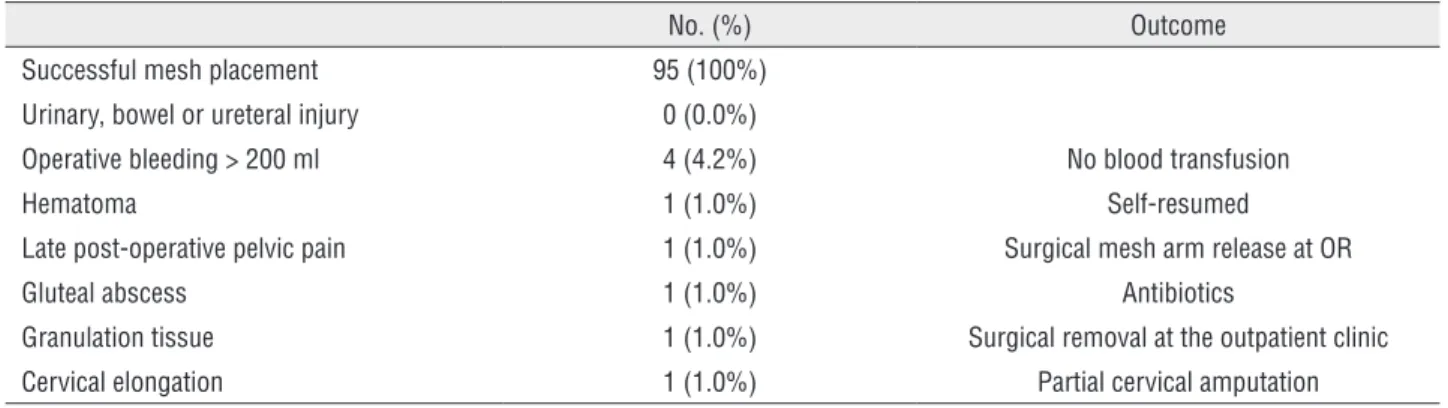
Mesh implementation and placement was feasible in all cases. Regarding the primary outco-me outco-measure, there was not a negative effect of the skeletonization or any difference in insertion than the original mesh procedure. The perioperative complications are summarized in Table-2. No ma-jor complications were noticed, viscera were not injured, blood transfusion was not indicated, pain and infection rate and severity were modest. No adverse effects related to the dissection or mesh implantation were marked.
Figure 2 - Patient flow-chart
Table 1 - Patients characteristics (N = 95).
Variable Mean±SD
Age 64.5±9.0 (Rang:43-83 Year)
Parity (no.) 2.6±1.6
BMI 24.8±2.4
Previous hysterectomy 16 (16.8%)
Previous POP surgery 17 (17. 9%)
Background chronic illness 35 (36.8%)
Follow-up duration 9.5±3.8 (6-12 Mnt)
Concomitant posterior compartment mesh* 25 (26.3%)
Concomitant posterior compartment colporrhaphy 21 (22.1%)
Concomitant anti USI operation** 33 (34.7%)
POP = Pelvic organ prolapse; USI = Urinary stress incontinence; Mnt = Month * 12 skeletonized Prolift +M, 12-Prosima, 1-Elevate
** 22-TVTA, 9-TVTS, TVTO-2
Table 2 - Operative details.
No. (%) Outcome
Successful mesh placement 95 (100%)
Urinary, bowel or ureteral injury 0 (0.0%)
Operative bleeding > 200 ml 4 (4.2%) No blood transfusion
Hematoma 1 (1.0%) Self-resumed
Late post-operative pelvic pain 1 (1.0%) Surgical mesh arm release at OR
Gluteal abscess 1 (1.0%) Antibiotics
Granulation tissue 1 (1.0%) Surgical removal at the outpatient clinic
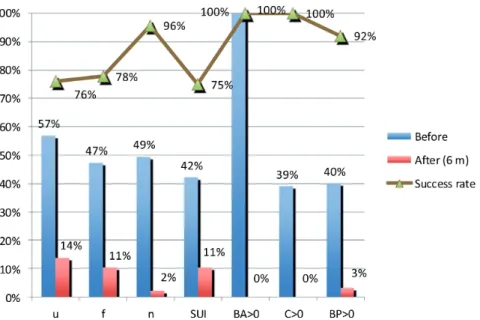
significantly. Faecal incontinence, pelvic pain and constipation rates were reduced as well. The first and sixth post-operative month’s follow-up re-cords as well as the study conclusion interview findings were satisfactory in terms of subjective and objective cure and adverse effects occur-rence. There was a statistically significant im-provement in bladder over-activity symptoms and stress urinary incontinence. There were only two cases (2.1%) of dyspareunia not significan-tly different from preoperative rate. The overall subjective and objective outcome results of this study are promising (Figure-3).
DISCUSSION
Petros previously suggested ligamentary sling rather than large mesh implants for rein-forcement for pelvic floor reconstruction (18). This is the first study looking at the possibility to minimize an in-use mesh implants surface area by skeletonization to a ligamentary har-ness rather than a large sheath mesh support, for potential reduction of mesh related com-plications, mainly erosion and pain, attributed significantly to the left over mesh mass.
The main findings of this study are that minimizing this mesh to a skeletonized ligamen-tary harness model for primarily reinforcement of the pelvic floor ligaments is feasible, effecti-ve and safe as the original mesh implant. These findings are attributed probably to the fact that a substantial fraction of the implant, affecting the pelvic soft tissue negatively and causing pel-vic pain, might be not necessary for pelpel-vic floor reconstruction reinforcement. The native pelvic floor supportive tissue architecture is basically li-gamentary rather than a flattened fascial sheath, thus the mesh reinforcing implants should have the form of a “ligamentary pelvic harness” rather than a sheath. Most of the mesh implants adver-se effects are likely related to excessive implanted mesh mass, thus shifting from large and high sur-face area implants (17, 19) to small sursur-face area sling framework might very well reduce unwanted adverse effects.
Pain reduction is crucial when considering mesh implantation. It is especially important in the sexually active patient who might have dys-pareunia after POP reconstruction.
We found no inferiority with the outcome among women who underwent vaginal Table 3 - Patients outcome.
Variable Prior to surgery First Post-Op Mnt Sixth Post-Op Mnt P value
Urgency 54 (56.8) 10 (10.5) 13 (13.7) <0.001*
Frequency 45 (47.4) 6 (6.3) 10 (10.5) <0.001*
Nocturia 47 (49.6) 7 (7.4) 2 (2.1)
SUI 40 (42.1) 9 (9.5) 10 (10.5) <0.001*
Dyspareunia 1 (1.1) 1 (1.1) 2 (2.1) NA
Anatomical objective outcome POP-Q points (Cm)
Ba 4.7±1.1 -2.9±0.4 -2.9±0.4 <0.001*
Bp 0.3±2.5 -2.5±1.2 -2.5±1.2 <0.001*
C 0.6±3.3 -6.3±0.9 -6.3±0.9 <0.001*
* All p values were statistically significant for the difference between status prior to surgery and 1 month following surgery. No significant differences were found between 1 and 6 months following surgery.
reconstructive surgery with skeletonized partially absorbable mesh implants for the pelvic floor, regarding other intra-and post-operative adverse effects or pelvic floor dysfunction symptoms. The postoperative anatomical and subjective findings were similar as well.
This technique is not more complicated, neither more hazardous to perform than the com-mon one.
This study strength is limited by being sin-gle armed and by having rather short-term follow--up. Further larger randomized controlled long--term studies should be carried out to shed more light on this important issue of minimizing the augmented mesh surface area and adapting the concept of ligamentary rather than a fascial she-ath correction of pelvic organs prolapse. Althou-gh the particular mesh used in the present study is no longer available, the principal benefits and drawbacks of the skeletonized, ligamentary mesh implant harness are valuable and meaningful.
CONCLUSIONS
Given that POP is a herniation process, one must acknowledge the importance of replacing the
weakened fascia that caused the hernia defect with an implant to reinforce the reconstructive proce-dure, for assuring long-term cure. Yet, the surgeon must endeavor to reduce the mesh-related compli-cations. This current study offers a new way for mesh implant adverse effects reduction, by adop-ting the skeletonized mesh concept.
CONFLICT OF INTEREST
None declared.
REFERENCES
1. Olsen AL, Smith VJ, Bergstrom JO, Colling JC, Clark AL. Epidemiology of surgically managed pelvic organ prolapse and urinary incontinence. Obstet Gynecol. 1997;89:501-6. 2. Nygaard I, Barber MD, Burgio KL, Kenton K, Meikle S,
Schaffer J, et al. Prevalence of symptomatic pelvic floor disorders in US women. JAMA. 2008;300:1311-6.
3. Subak LL, Waetjen LE, van den Eeden S, Thom DH, Vittinghoff E, Brown JS. Cost of pelvic organ prolapse surgery in the United States. Obstet Gynecol. 2001;98:646-51.
4. Boyles SH, Weber AM, Meyn L. Procedures for urinary incontinence in the United States, 1979-1997. Am J Obstet Gynecol. 2003;189:70-5.
Figure 3 - Objective and subjective success rate
5. Luber KM, Boero S, Choe JY. The demographics of pelvic floor disorders: current observations and future projections. Am J Obstet Gynecol. 2001;184:1496-501; discussion 1501-3.
6. Smith FJ, Holman CD, Moorin RE, Tsokos N. Lifetime risk of undergoing surgery for pelvic organ prolapse. Obstet Gynecol. 2010;116:1096-100.
7. Denman MA, Gregory WT, Boyles SH, Smith V, Edwards SR, Clark AL. Reoperation 10 years after surgically managed pelvic organ prolapse and urinary incontinence. Am J Obstet Gynecol. 2008;198:555.e1-5.
8. Chen Y, DeSautel M, Anderson A, Badlani G, Kushner L. Collagen synthesis is not altered in women with stress urinary incontinence. Neurourol Urodyn. 2004;23:367-73. 9. Deprest J, Zheng F, Konstantinovic M, Spelzini F, Claerhout
F, Steensma A, et al. The biology behind fascial defects and the use of implants in pelvic organ prolapse repair. Int Urogynecol J Pelvic Floor Dysfunct. 2006;17:S16-25. 10. Withagen MI, Milani AL, den Boon J, Vervest HA, Vierhout
ME. Trocar-guided mesh compared with conventional vaginal repair in recurrent prolapse: a randomized controlled trial. Obstet Gynecol. 2011;117:242-50. 11. Nguyen JN, Burchette RJ. Outcome after anterior vaginal
prolapse repair: a randomized controlled trial. Obstet Gynecol. 2008;111:891-8.
12. Jakus SM, Shapiro A, Hall CD. Biologic and synthetic graft use in pelvicn surgery: a review. Obstet Gynecol Surv. 2008;63:253-66.
13. Cobb WS, Burns JM, Peindl RD, Carbonell AM, Matthews BD, Kercher KW, et al. Textile analysis of heavy weight, mid-weight, and light weight polypropylene mesh in a porcine ventral hernia model. J Surg Res. 2006;136:1-7.
14. Schug-Pass C, Tamme C, Sommerer F, Tannapfel A, Lippert H, Köckerling F. A lightweight, partially absorbable mesh (Ultrapro) for endoscopic hernia repair: experimental biocompatibility results obtained with a porcine model. Surg Endosc. 2008;22:1100-6.
15. Ozog Y, Mazza E, De Ridder D, Deprest J. Biomechanical effects of polyglecaprone fibers in a polypropylene mesh after abdominal and rectovaginal implantation in a rabbit. Int Urogynecol J. 2012;23:1397-402.
16. Bump RC, Mattiasson A, Bø K, Brubaker LP, DeLancey JO, Klarskov P, et al. The standardization of terminology of female pelvic organ prolapse and pelvic floor dysfunction. Am J Obstet Gynecol. 1996;175:10-7.
17. Jacquetin B, Fatton B, Rosenthal C, Clavé H, Debodinance P, Hinoul P, et al. Total transvaginal mesh (TVM) technique for treatment of pelvic organ prolapse: a 3-year prospective follow-up study. Int Urogynecol J. 2010;21:1455-62.
18. Petros PE, Richardson PA. The TFS mini-sling for uterine/vault prolapse repair: a three-year follow-up review. Aust N Z J Obstet Gynaecol. 2009;49:439-40.
19. Rogowski A, Bienkowski P, Tosiak A, Jerzak M, Mierzejewski P, Baranowski W. Mesh retraction correlates with vaginal pain and overactive bladder symptoms after anterior vaginal mesh repair. Int Urogynecol J. 2013;24:2087-92.