Licenciado sob uma Licença Creative Commons DO): http://dx.doi.org. . / - . . .AO
[T]
Elaboration and assessment of clinical protocols to
support the evaluation of stand-to-sit activity
[)]
Elaboração e Avaliação dos Protocolos para auxílio
na avaliação da atividade de sentar
[A]
Maíra Junkes Cunha[a], Carolina Mendes do Carmo[b], Cássio Marinho Siqueira[b], Kelly Takara[c], Clarice Tanaka[d]
[a] PhD candidate, specialist, Universidade de São Paulo, )nstituto Central do (ospital das Clinicas )C(C , São Paulo, SP - Brazil, e-mail: [email protected]
[b] MSc, Physiotherapist, professor, Universidade de São Paulo, )nstituto Central do (ospital das Clinicas )C(C , São Paulo, SP - Brazil, e-mails: [email protected]; [email protected]
[c] MSc candidate, Universidade de São Paulo, )nstituto Central do (ospital das Clinicas )C(C , São Paulo, SP - Brazil, e-mail: [email protected]
[d] PhD, professor, Universidade de São Paulo, )nstituto Central do (ospital das Clinicas )C(C , São Paulo, SP - Brazil, e-mail: [email protected]
[R] Abstract
Introduction: Evaluation of sit-to-stand and stand-to-sit activities is used by physical therapists in patients
with neurological and musculoskeletal disorders. Sit-to-stand activity presents different descriptions of phases and movements; however the phases of stand-to-sit activity have not been established yet. Objectives:
To describe the movements during stand-to-sit activity and create an evaluation protocol. Materials and methods: Stand-to-sit activity was described on anterior and lateral views based on the observation of
healthy subjects. The body segments chosen to analyze were feet, ankles, knees, hips, pelvis, trunk, spine, upper limbs, head and cervical spine. The movements of body segments were described as adduction and abduction, eversion and inversion, valgus and varus, neutral position and asymmetry. The protocol was assessed with questionnaires answered by physiotherapists experts in the area. Results: Stand-to-sit
of each body segment. These protocols allow physiotherapists to identify unusual movements of body seg-ments during the stand-to-sit activity.
[P]
Keywords: Physiotherapy. Biomechanics. Musculoskeletal abnormalities. Activities of daily living.
Disability evaluation.
[B] Resumo
Introdução: Levantar e sentar são movimentos comuns da vida diária, e sua avaliação é utilizada frequen-temente por fisioterapeutas em pacientes com disfunções neurológicas e musculoesqueléticas. A atividade de levantar apresenta diferentes descrições quanto às fases e movimentos, enquanto a atividade de sentar ainda não apresenta suas fases estabelecidas. Objetivos: Descrever os movimentos durante a atividade de sentar e elaborar protocolos de auxílio à avaliação. Materiais e métodos: Esta atividade foi descrita nas vistas anterior e lateral com base nos achados de um levantamento bibliográfico e na observação das filmagens de 27 indiví-duos funcionalmente independentes. Os segmentos corporais analisados foram pés, tornozelos, joelhos, quadris, pelve, tronco, coluna lombar, membros superiores, coluna cervical e cabeça. Seus movimentos e condições foram descritos: adução e abdução, eversão e inversão, valgismo e varismo, posição neutra e assimetria. Os protocolos foram avaliados por meio de questionários de avaliação, respondidos por 12 fisioterapeutas especialistas na área. Resultados: A atividade de sentar foi descrita de acordo com o estabelecimento de 4 fases. 1- “Posição ini-cial”, 2- “Pré-agachamento”, 3- “Agachamento” e 4- “Estabilização”. Foram elaborados 2 modelos de protocolos, sendo considerados 5 segmentos corporais para a vista anterior e 7 segmentos para a vista lateral. Conclusão: A atividade de sentar foi descrita em 4 fases, e em cada uma ocorrem movimentos sequenciais de cada segmento corporal. Estes protocolos permitem identificar as alterações de segmentos corporais durante a atividade de sentar por meio da comparação dos movimentos descritos. A classificação do grau de inadequação corresponde ao número de segmentos corporais com movimentos alterados. [K]
Palavras-chave: Fisioterapia. Biomecânica. Anormalidades musculoesqueléticas. Atividades cotidianas. Avaliação da deficiência.
Introduction
Sit-to-stand and stand-to-sit are activities required for functional independence , , . Physiotherapists usually perform the evaluation of these movements in patients with neurological and musculoskeletal disorders . Movements of daily activities are difficult to describe because of different possibilities that each individual performs the same movement . Activities such as gait have full description of movements, and despite the con-ceptual differences described in the literature, the evaluation and phases of gait are already established . Sit-to-stand activity shows different descrip-tions of phases and movements and is considered to be a preceding phase of gait , .
Previous studies have been focus on analyzing the factors that influence the performance of stand-to-sit movement , , , such as height and type of
chair, the presence of back, feet position, positioning of upper limbs , and balance condition . The different purposes and methodologies of the studies make them difficult to become useful for clinical prac-tice kinematic analysis, electromyography to analyze the muscular activation pattern , ; movement analysis through observation of videos ; force platform for measuring the center of mass during the phases of activities .
Citation )ndex Expanded of the )nstitute for Scientific )nformation - )si Web of Knowledge. The keywords used were Daily Living Activities ; Functional as-sessment ; Abnormal Movements ; Biomechanics ;
Analysis ; Joints in the period between and . Participants were recruited in attendance of Unit of Physical Therapy, Speech Therapy and Occupational Therapy - (igh Complexity in Central )nstitute of (C-FMUSP with prior appointment by telephone or personally.
Participants stood barefoot and wore gym clothes during the acquisition of the videos. An acrylic go-niometer Carci®, São Paulo was used to proper position the hips and knees. Subjects were asked to perform the stand-to-sit activity from the upright pos-ture. The initial position was upright with feet parallel and spaced at cm apart, and the final posture was sitting. A backless carbon chair )SP Electromedical, A , Sao Paulo with no support for the up-per limbs and with a height of centimeters was positioned behind the participant.
The upper limbs position was due the study which was identified % reduction of the load on the ver-tebrae when there is support from upper limbs on thighs compared to the positioning of the upper limb parallel along the body .
There were two videos taken simultaneously: on the anterior view and on the left lateral view. The left side view was chosen to standardize the acqui-sition of videos during the evaluation. The videos were registered through two digital cameras Sony® DSC-W , . mega pixel arranged on two tripods
Weifeng®, Wt . Each camera was positioned at the same distance cm for the anterior tripod and . for the lateral tripod and height cm for the anterior tripod and cm lateral for all subjects. The video recorded for seconds with the participants on the standing position, and they were instructed to perform the activity after a sound signal. The re-cording was completed after seconds of the end of the activity. The videos were analyzed by physio-therapists of this study. The body segments chosen to analyze were feet, ankles, knees, hips, pelvis, trunk, lumbar spine, upper limbs, cervical spine and head.
Two protocols of stand-to-sit activity anterior view and lateral view were developed based on in-formation obtained from activity in the anterior and lateral views.
The protocols are based on the sequence body segments movements in each phase. To calculate the vertical displacement of the body phase )) , angular
displacement of knee phase ))) and stabilization of posture phase )V . The analyze of functional activi-ties requires knowledge of patterns of movement to identify kinesiological problems , .
The lack of a gold standard method to identify the positions of body segments during the execution of stand-to-sit activity makes it difficult to evaluate them in clinical practice. The appropriate description of this activity allows physiotherapists to identify different movements of body segments according to each phase of stand-to-sit activity. (owever there is no consensus among the authors about the phases of stand-to-sit activities, and this highlights the im-portance of describing the stand-to-sit activity . Based on this context, the objective of this study was to describe the movements of stand-to-sit activ-ity and to create observational protocols.
Materials and methods
The study included subjects age = . ± . years , women age . ± . years, height of . ± . cm, weight of . ± . kg, and body mass index BM) of . ± . kg/ m² and men age . ± . years, height of
. ± . cm, weight of . ± . kg and BM) of . ± . kg/m² . These participants attended the Physiotherapy Service of Central )nstitute of (C-FMUSP, and they were teachers, physiotherapists, graduate students, employees or participants in the quality of life group in the elderly.
Participants were included if they had proper height to maintain the hips and knees at ° and ° of flexion, respectively, while sitting on a bank of cm of height . The exclusion criteria were: pres-ence of musculoskeletal pathologies; current pain; functional dependence to execute sit-to-stand and stand-to-sit activities; dizziness or vertigo in the last months. All participants signed a consent form to par-ticipate in the study. The study was approved by the Ethics Committee for Analysis of Research Projects of the )nstitution / .
Procedures
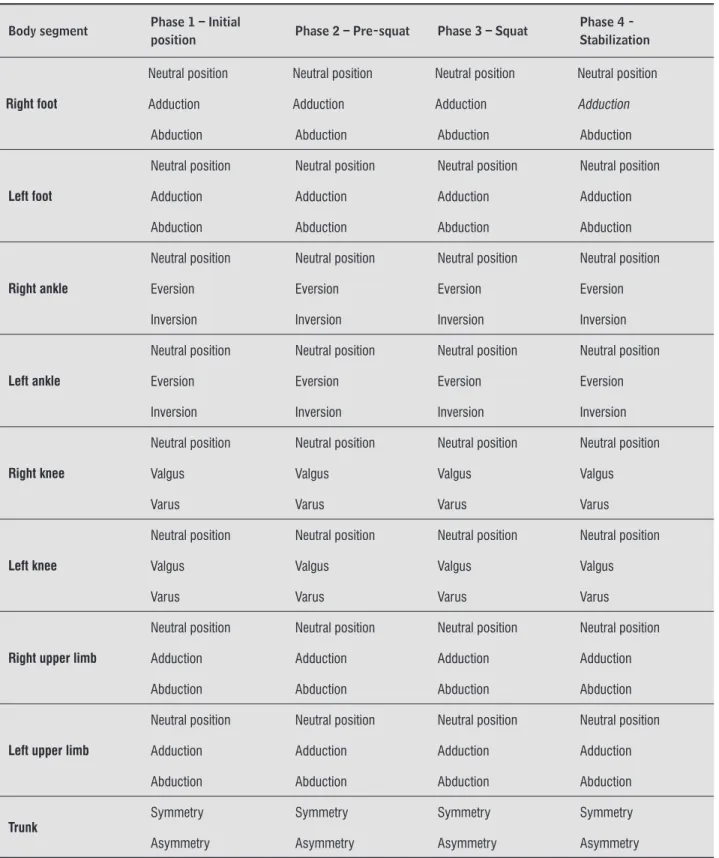
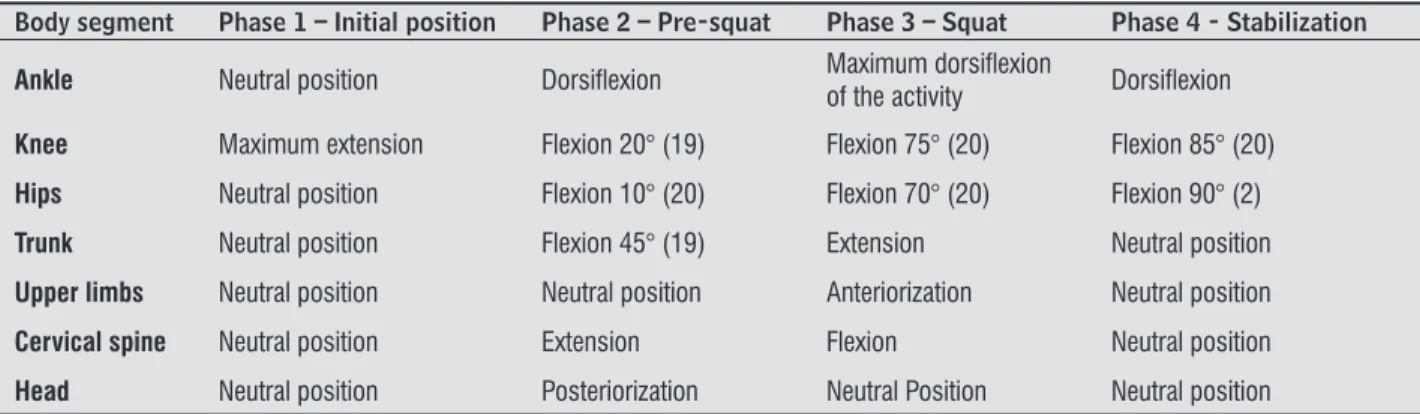
LV . The body segments chosen to analyze in the AV were "feet", "ankles", "knees", "uppe limbs" and "trunk" Table ; and the LV were "ankle", "knee", "hip", "trunk", "upper limb", "cervical spine" and "head" Table . Each protocol was based on the adequacy of movements of each phase of stand-to-sit activity according to the information obtained in the videos and in the literature review. The classifica-tion of condiclassifica-tions for each body segment with their respective values is disposed in Table .
Assessment of protocols
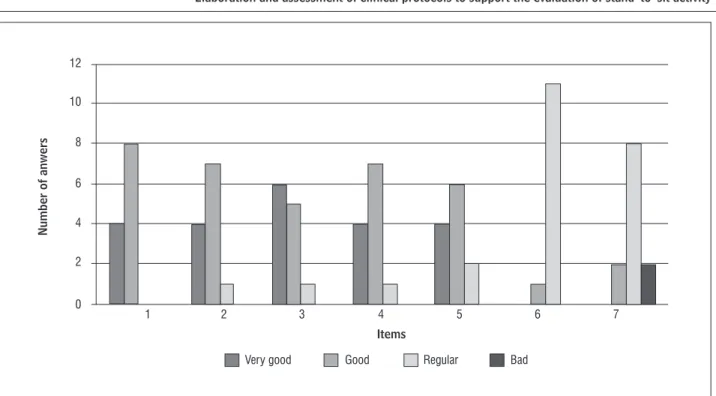
The number of each answers made by the phys-iotherapists was represented in graph form for both protocols. The number of answers regarding the items about the system for the evaluation of stand-to-sit activity on the AV is presented in Figure .
The answers of evaluators for the system to evalu-ate the stand-to-sit activity in LV are represented in Figure .
)n protocol on LV, the results for clarity of instruc-tions were % Good and % Very good . For the
number of body segments considered the majority of evaluators % considered Good % Very good and % considered Regular . The definition and se-quence of phases was considered Good for % of the evaluators Very good for % and Regular for % of them. On the interpretation of the segmental evalu-ation , % answered Regular for % of the evalua-tors, and % considered it Good . The general conclu-sion of the results was an item considered Regular by the majority % of physiotherapists, % of them responded Bad and % considered Good .
)n the evaluation of protocol on AV, to the clarity of instructions , % of the evaluators answered Good and % answered Very good . On the number of body segments considered , % of the evaluators answered Good , % answered Very good and % answered Regular . For the definition and sequence of phases , the evalua-tors answered predominantly Good % , fol-lowed by Very good % and % considered
Regular . For the interpretation of the segmental evaluation , the majority of evaluators answered Regular % and % considered Good . For the general conclusion of the results , % of evalu-ators considered Regular , % considered Good and % answered Bad .
individual condition it was elaborated a classification of inadequacy about movements. The professional may give point for each movement out of what is expected. )n the end of its evaluation it has to sum what was punctuated on each body segment. The sum of situations are made based on the inadequacy level of the movement for each phase, whereas the result is higher when the movement is more out of what is expected. After this stage, we were able to identify the condition of each segment according to the legend of the points. The degree of inadequacy is the number of phases in which the segment showed a different position from what is described in the protocol based on literature.
Assessment of protocols
The assessment of the protocols was performed through questionnaire answered by physiothera-pists. The questionnaire was compound by items that includes characteristics of movements of the joints. The questionnaire consisted of items for each pro-tocol such as "clear instructions to use the propro-tocol", "questions formulation," "order of body segments evaluation," "number of body segments used for each evaluation"; "definition and sequence of phases ; "in-terpretation of the segmental evaluation ; "general conclusion of the results . These responses were pre-sented according to the following classification: "Very good," "Good," "Regular", "Bad."
Data analysis
The stand-to-sit activity was described from the observation of the videos and they were matched to the literature review. The answers about the assess-ment of the protocols were calculated through simple equations in Microsoft Office Excel program.
Results
Table 1 - Description of stand-to-sit activity on anterior view
Body segment Phase 1 – Initial
position Phase 2 – Pre-squat Phase 3 – Squat
Phase 4 - Stabilization
Right foot
Neutral position Neutral position Neutral position Neutral position
Adduction Adduction Adduction Adduction
Abduction Abduction Abduction Abduction
Left foot
Neutral position Neutral position Neutral position Neutral position
Adduction Adduction Adduction Adduction
Abduction Abduction Abduction Abduction
Right ankle
Neutral position Neutral position Neutral position Neutral position
Eversion Eversion Eversion Eversion
Inversion Inversion Inversion Inversion
Left ankle
Neutral position Neutral position Neutral position Neutral position
Eversion Eversion Eversion Eversion
Inversion Inversion Inversion Inversion
Right knee
Neutral position Neutral position Neutral position Neutral position
Valgus Valgus Valgus Valgus
Varus Varus Varus Varus
Left knee
Neutral position Neutral position Neutral position Neutral position
Valgus Valgus Valgus Valgus
Varus Varus Varus Varus
Right upper limb
Neutral position Neutral position Neutral position Neutral position
Adduction Adduction Adduction Adduction
Abduction Abduction Abduction Abduction
Left upper limb
Neutral position Neutral position Neutral position Neutral position
Adduction Adduction Adduction Adduction
Abduction Abduction Abduction Abduction
Trunk
Symmetry Symmetry Symmetry Symmetry
Asymmetry Asymmetry Asymmetry Asymmetry
Source: Research data.
)n both protocols, the order of evaluation of body segments , % considered Very good , % Good and % Regular .
Table 2 - Description of stand-to-sit activity on lateral view
Body segment Phase 1 – Initial position Phase 2 – Pre-squat Phase 3 – Squat Phase 4 - Stabilization
Ankle Neutral position Dorsifl exion Maximum dorsifl exion
of the activity Dorsifl exion
Knee Maximum extension Flexion 20° (19) Flexion 75° (20) Flexion 85° (20)
Hips Neutral position Flexion 10° (20) Flexion 70° (20) Flexion 90° (2)
Trunk Neutral position Flexion 45° (19) Extension Neutral position
Upper limbs Neutral position Neutral position Anteriorization Neutral position
Cervical spine Neutral position Extension Flexion Neutral position
Head Neutral position Posteriorization Neutral Position Neutral position
Source: Research data.
Table 3 - Conclusion of the results about the segments during the activity
General Conclusion of Body Segments in the Activity
Adequate Condition (0 points):
Inadequate Condition Level I (1 point): Inadequate Condition Level II (2 points): Inadequate Condition Level III (3 points): Inadequate Condition Level IV (4 points):
Source: Research data.
Number of anwers
Items
12
10
8
6
4
2
0
1 2 3 4 5 6 7
Very good Good Regular Bad
Figure 1 - Number of answers about the items in evaluation questionnaire for the assessment of protocol to support the
evaluation of stand-to-sit activity in AV
Number of anwers
Items
12
10
8
6
4
2
0
1 2 3 4 5 6 7
Very good Good Regular Bad
Figure 2 - Number of answers about the items on the questionnaire for the assessment of protocol to support the observation
of stand-to-sit activity in LV
Note: 1) clear instructions to use the protocol; 2) questions formulation; 3) order of body segments evaluation; 4) number of body segments used for each evaluation; 5) defi nition and sequence of phases; 6) interpretation of the segmental evaluation; 7) general conclusion of the results. Source: Research data.
Discussion
The purpose of this study was to elaborate a pro-tocol and provide proper evaluation of stand-to-sit activity. )t is necessary to establish the movement that is considered normal to identify possible ab-normalities in clinical applications . The proto-cols in this study were developed in order to allow the physiotherapists to have a standard reference of evaluation.
Two protocols were elaborated in this study. On AV a neutral position was identified in each body seg-ment, which represents the adequate position during the execution of the activity. On LV different descrip-tions were used to represent the correct position and the differences were considered inadequate.
The stand-to-sit activity was divided into phases: ")nitial Position", "Pre-squat", "Squat" and "Stabilization". This segmental visualization of activ-ity facilitates the identification of inadequacy and show in which exactly phase the inadequacy occurs. On the first phase it´s expected an anterior tilt of trunk; then occurs a vertical displacement of body which represents the second phase; on the third
phase the weight is transferred to the chair and on fourth phase the trunk balance is adjusted and the body is stabilized.
Rising from a chair is an important prerequisite to the physiological and functional activity gait, being an important indicator of functional independence. The stand-to-sit activity is also performed several times per day and the movement perform of weight transference from stand to sit might display muscu-loskeletal abnormalities.
References
. Faria CDCM, Saliba VA, Teixeira-Salmela LF. Musculo-skeletal biomechanics in sit-to-stand and stand-to-sit activities with stroke subjects: a systematic review. Fisioter Mov. ; : - .
. Roorda LD, Roebroeck ME, Lankhorst GJ, van Tilburg T, Bouter LM. Measuring functional limitations in ris-ing and sittris-ing down: development of a questionnaire. Arch Phys Med Rehabil. ; : - .
. Dall PM, Kerr A. Frequency of the sit to stand task: an observational study of free-living adults. Appl Ergon.
; : - .
. Jeng SF, Schenkman M, Riley PO, Lin SJ. Reliability of a clinical kinematic assessment of the sit-to-stand movement. Phys Ther. ; : - .
. Etnyr B, Thomas DQ. Event standardization of sit-to-stand movements. Phys Ther. ; : - .
. Janssen WGM, Bussmann (BJ, Stam (J. Determinants of the sit-to-stand movement: a review. Phys Ther.
; : - .
. Nuzik S, Lamb R, VanSant A, (irt S. Sit-to-stand movement pattern. A kinematic study. Phys Ther.
; : - .
. Dreischarf M, Bergmann G, Wilke (J, Rohlmann A. Different arm positions and the shape of the thoracic spine can explain contradictory results in the litera-ture about spinal loads for sitting and standing. Spine.
; : - .
. Mourey F, Pozzo T, Rouhier-Marcer ), Didier JP. A kine-matic comparison between elderly and young subjects standing up from and sitting down in a chair. Age Age-ing. ; : - .
. Reisman DS, Scholz JP, Schöner G. Differential joint coordination in the tasks of standing up and sitting down. J Electromyogr Kinesiol. ; : - . . Goulart FRDP, Valls-Solé J. Patterned electromyo-graphic activity in the sit-to-stand movement. Clin Neurophysiol. ; : - .
. Kim M(, Yi C(, Yoo WG, Choi BR. EMG and kinematics analysis of the trunk and lower extremity during the sit-to-stand task while wearing shoes with different heel heights in healthy young women. (um Mov Sci.
; : - .
There are different factors that influence the ex-ecution of stand-to-sit activity due its complexity re-lated to the demands of adapting the motor system in the transfer of postures . Aging must implies on the activity performance, which seems to be directly related to physiological changes in the central ner-vous system , . Dubost et al. compared the movements of the body segments of stand-to-sit ac-tivity between young adults mean age = . years and elderly mean age = . . The study showed that elderly people display lower center of mass dis-placement ~ ° . The authors suggest that elderly people have different strategy of decreasing ante-rior displacement of mass, and this strategy might be an early indicator of loss of proper postural control caused by age advance.
Reisman et al. compared stand-to-sit and sit-to-stand activities, and found that stand-to-sit activity showed displacement of the center of mass further away from the base of support at the beginning and end of activity to provide greater body stability.
)n addition, specific features of movements dur-ing the stand-to-sit activity may vary in different populations. Obese individuals have this activity compromised by overweight, which makes their performance worse . )ndividuals with low back pain present compensatory movements through the activation of other muscles, resulting in altered dis-tribution of load and inadequate movements dur-ing stand-to-sit activity . )n contrast, the sit-to-stand activity is enough described in the literature and is considered an indicator for the risk of falls in the elderly.
The protocols developed in this study can be used for the population to identify possible patterns of inadequate movements of certain body segments in different groups with specific characteristics.
Conclusion
. Dubost V, Beauchet O, Manckoundia P, (errmann F, Mourey F. Decreased trunk angular displacement dur-ing sittdur-ing down: an early feature of agdur-ing. Phys Ther.
; : - .
. Kerr KM, White JA, Barr DA, Mollan RAB. Analysis of the sit-stand-sit movement cycle in normal subjects. Clin Biomech Bristol, Avon . ; : - . . Ricardo DR, Araújo CGS. Teste de sentar-levantar:
in-fluência do excesso de peso corporal em adultos. Rev Bras Med Esporte. ; : - .
. Shum GLK, Crosbie J, Lee RYW. Three-dimensional kinetics of the lumbar spine and hips in low back pain patients during sit-to-stand and stand-to-sit. Spine.
; : - .
Received: / / Recebido: / /
Approved: / / Aprovado: / /
. Fotoohabadi MR, Tully EA, Galea MP. Kinematics of ris-ing from a chair: image-based analysis of the sagittal hip-spine movement pattern in elderly people who are healthy. Phys Ther. ; : - .
. Kerr A, Durward B, Kerr KM. Defining phases for the sit-to-walk movement. Clin Biomech Bristol, Avon .
; : - .
. Kralj A, Jaeger RJ, Munih M. Analysis of stand-ing up and sittstand-ing down in humans: definitions and normative data presentation. J Biomechanic.
; : - .
. Perracini MR, Fló CM. Funcionalidade e envelheci-mento. Rio de Janeiro: Guanabara Koogan; . . (ukuda ME, Escorcio R, Fernandes LAY, Carvalho EV,
Caromano FA. Caracterização e tempo da atividade funcional de sentar e levantar da cadeira por meninos saudáveis. ConScientiae Saúde. ; : - . . Ashford S, De Souza L. A comparison of the timing
of muscle activity during sitting down compared to standing up. Physiother Res )nt. ; : - . . Durward BR, Baer GD, Rowe PJ. Movimento
fun-cional humano: mensuração e análise. São Paulo: