Fisioter. Mov., Curitiba, v. , n. , p. - , jul./set. Licenciado sob uma Licença Creative Commons DO): http://dx.doi.org. . / - . . .AO
[T]
Prevalence of postural alterations in students of Basic
Education in the city of Vila Velha, Espírito Santo state, Brazil
[)]Prevalência de alterações posturais em escolares
de Ensino Fundamental de Vila Velha (ES)
[A]
Paula Lopes Rodrigues[a], Eloá Ferreira Yamada[b]
[a] PhD candidate, Universidade Federal do Espírito Santo UFES , Vitória, ES - Brazil, e-mail: [email protected] [b] MSc, professor, Universidade Federal do Pampa Unipampa , Uruguaiana, RS - Brazil, e-mail:
[R]
Abstract
Introduction: (uman posture goes through a series of changes in the course of body growth and
develop-ment, i.e., in childhood and adolescence. Moreover, during these phases, individuals are subject to risk behaviors for spinal problems, especially those related to the use of backpacks and to poor sitting posture. Objective:
This study aimed to detect the prevalence of postural alterations in school children enrolled in the UMEF Vila Olímpica, Vila Velha, Espírito Santo. Methods: We evaluated schoolchildren in the orthostatic position and
in the anterior, posterior and side view. The following structures were analyzed: head, shoulder, the cervical, thoracic and lumbar spine, pelvis and lower limbs. Results: There was a high prevalence of postural deviations:
rotated or tilted head, elevated shoulder and pelvis, valgus or varus knee, head protraction, alterations of the thoracic spine, anteriorized shoulders, pelvis in anteversion, knees semiflexion or hyperextension and cavus or planus feet. Conclusion: Our results suggest that there is a high prevalence of postural alterations in students in
the school network of Vila Velha ES . This could be detected through public health policies, such as the federal government´s (ealth at School Program PSE .
[P]
Keywords: Postural Alterations. Schoolchildren. Physical Therapy.
438
Resumo
Introdução: A postura do ser humano apresenta uma série de mudanças no decorrer do crescimento e de-senvolvimento corporais, ou seja, na infância e na adolescência. Além disso, durante essas fases, os indivíduos estão sujeitos a comportamentos de risco para a coluna, principalmente aqueles relacionados à utilização de mochilas e à postura sentada. Objetivo: A finalidade desse trabalho foi verificar a prevalência de alterações posturais em escolares da UMEF Vila Olímpica, Vila Velha, Espírito Santo. Métodos: Foram avaliados 513 esco-lares na posição ortostática, em vista anterior, posterior e perfil, no qual foram analisadas as seguintes estrutu-ras: cabeça, ombro, colunas cervical, torácica e lombar, pelve e membros inferiores. Resultados: Os resultados apresentaram uma grande prevalência de desvios posturais: cabeça rodada ou inclinada, elevação do ombro e da pelve, joelho valgo ou varo, além de cabeça em prostração, alterações da coluna torácica, ombros ante-riorizados, pelve em anteroversão, joelhos em semiflexão ou hiperextensão, e pés cavos ou planos. Conclusão: Os resultados sugerem que há uma alta prevalência de alterações posturais em escolares na rede de ensino do município, o que poderia ser identificado através de políticas públicas de saúde, como o Programa Saúde na Escola (PSE) do governo federal. [K]
Palavras-chave: Alterações Posturais. Escolares. Fisioterapia.
Introduction
Posture can be defined as a relative disposition of body parts in which there is a state of muscular and skeletal balance, since it allows the individual to meet the mechanical requirements of the locomotor sys-tem, maintaining the upright position with minimal muscular effort . Good posture is maintained by a balance between strength and muscle stretching, by a proper functioning of the joints, gravity line balance and good postural habits, contributing to the health of the individual , .
(uman posture goes through a series of chang-es in the course of body growth and development, i.e., in childhood and adolescence , . Moreover, during these phases, individuals are subject to risk behaviors for spinal problems, especially those re-lated to the use of backpacks and to poor sitting
posture .
The Law of Guidelines and Bases of Education states that all children must be enrolled in basic edu-cation. Thus, during at least eight years, every child of school age will remain in the seated position for about four to five hours a day. These children will adopt different postural patterns while sitting and carrying backpacks, and may develop an improper gait, which may result in postural alterations, fatigue and chronic
back pain . Studies show that children attending
traditional school spend more than % of the time at school sitting in a static position , , and spend
an average of . hours a day playing video games and using computers .
These behaviors at school and/or during leisure time may cause both lateral and antero-posterior
pos-tural alterations , , increasing total stress on
body elements and putting higher loads on structures that are less able to bear them. This causes discom-fort, pain or disability .
Postural alterations may occur at the level of the head, neck, shoulder, pelvis, knees and feet. Spinal disorders can be found by observing an increase in the physiological curvature or the appearance of
lateral curvature of the spine . The most
com-mon deviations are found: in the shoulder elevation, depression, protrusion and retraction , the scapula abduction and adduction , the pelvis tilt, rotation, anteversion and retraction , knees valgus, varus, hyperextension and flexion and feet valgus, varus,
abduct, adduct, calcaneus and equinus .
According to Burns and MacDonald , children
may experience increased tension in certain muscle groups during school time. This is caused by the rapid bone growth that occurs between ages and years, and can be relieved by stretching the affected muscu-lature. (owever, postural habits adopted in childhood may influence poor posture in adulthood.
439
the posture of the head and shoulders. )n the right and left side views, we observed the posture of the head, shoulders, pelvis, knee, feet, and the spine curvatures.
Postural alterations were analyzed according to
the school grades of the students: th to th grade.
The sample was grouped according to school grades in order to compare the prevalence of deviations by age group.
Results
The results were obtained through assessments conducted on - graders of both sexes aged be-tween and years and enrolled in the UMEF Vila Olímpica, Vila Velha, Espírito Santo. Two hundred
fifty-eight children were male and were female.
The results were presented in tables for easy appre-ciation. The alignment of the head, shoulders, pelvis, knees, feet and spine were described.
We found alterations in the positioning of the head and shoulder in the anterior and posterior views, as shown in Table . Children presented tilted head
. % , rotated head . % , and rotated and
tilted head . % . Only . % showed head
balance. Prevalence of alterations in the shoulders was . %, which reveals the presence of imbal-anced shoulders.
should be avoided, particularly through measures that promote the awareness about attitudes that lead to a better quality of life during growth, development
and adulthood .
)n the last years, the incidence of scoliosis in school children has been widely monitored in the United States. The American Academy of Orthopaedics rec-ommends such monitoring for girls between and
years of age and boys between and years
of age .
Recently, the mayor of São Paulo city sanctioned
law number , establishing the Permanent
Campaign for Postural Education in Basic Education Schools. Physical therapists carry out a preventive program, making children aware of the importance
of adopting correct postures in everyday life .
)n Vila Velha, Espírito Santo, there are about
, students enrolled in Municipal Units of
Primary Education . (owever, to this date, there
are no current projects for the detection and preven-tion of postural alterapreven-tions, despite the importance of early intervention. Many vertebral disorders are amenable to correction when detected early.
Thus, this study aimed to detect the prevalence of postural alterations in school children enrolled in the Municipal Unit of Primary Education UMEF Deputy Mikeil Chequer – Vila Olímpica, Vila Velha, Espírito Santo.
Methods
This is a cross-sectional descriptive study. )t was approved by the Ethics and Research Committee
of the Universidade de Vila Velha No. / . The
sample was composed of children enrolled in
the th- th grades of the UMEF Vila Olímpica, Vila Velha, Espírito Santo.
Before the assessment, the purpose of this study was explained to the school board and to the chil-dren's parents and legal guardians. The latter signed an informed consent form authorizing the children´s participation in this study.
Postural assessment was performed using a proto-col based on techniques and benchmarks determined
by Liposcki, Rosa Neto and Savall . Postural
analy-sis was performed in the orthostatic position. )n the anterior view, we analyzed the posture of the head, shoulders, right and left anterior-superior iliac spine AS)S and knees. )n the posterior view, we analyzed
Table 1 - Prevalence of alterations in the positioning of the head and shoulder in the anterior and posterior views
Postural alterations
Number of
students %
Tilted head 152 29.63
Rotated head 118 23.00
Rotated and tilted
head 120 23.39
Elevated shoulders 342 77.78
Source: Research data.
440
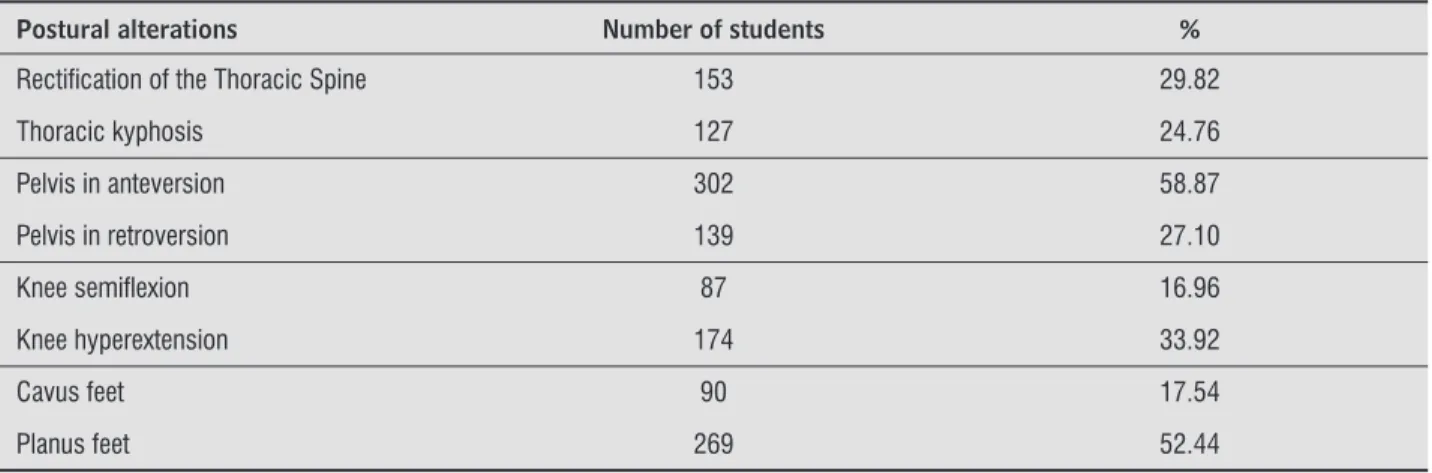
. % of the children had pelvis in anteversion and . % in retroversion. )n relation to alterations in the knee, children had knee semiflexion and had knee hyperextension. As for the alterations found in the feet, . % of subjects had cavus feet and . % had planus feet Table .
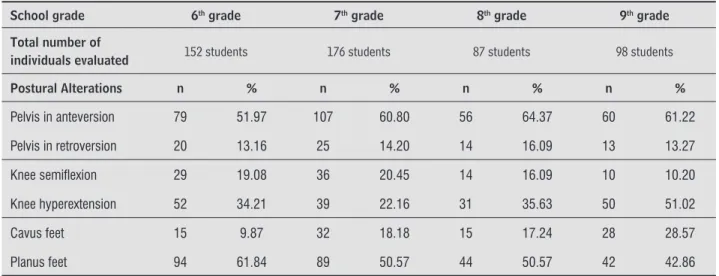
The analysis of the frequency of postural
altera-tions per school grade is presented next. For th
graders, there was a predominance of tilted head
. % , elevated shoulders . % , imbalanced
AS)S . % , valgus knee . % , protracted
head . % and shoulders . % ,
rectifica-tion of the thoracic spine . % , pelvis in
ante-version . % , knee hyperextension . %
and planus feet . % . For th graders, there was
a prevalence of rotated and tilted head . % ,
elevated shoulders . % , imbalanced AS)S
. % , and valgus knee . % ; in the side
view, there was a higher frequency of protracted
head . % and shoulders . % , pelvis in
an-teversion . % , knee hyperextension . %
and planus feet . % . th graders had rotated
head . % , elevated shoulders . % and
imbalanced AS)S . % and varus knee . % ;
in side view, we observed protracted head . %
and shoulders . % , rectification of the cervical
. % and thoracic . % spines, pelvis in
an-teversion . % , knee hyperextension . %
and planus feet . % . th graders had tilted head
. % , elevated shoulders . % , imbalanced
AS)S . % , and varus knee . % ; in the side
view, we found protracted head . % and
shoul-ders . % , rectification of the cervical . %
and thoracic . % spines, pelvis in anteversion
. % , knee hyperextension . % and planus
feet . % Table .
of lumbar scoliosis or different-sized lower limbs. . % of the students had imbalanced AS)S: . % had elevation of the left AS)S and . % of the right. With regard to alterations in the knee, they were
ob-served in students. Of these, . % had
valgus knees and . % had varus knees.
Table 2 - Prevalence of alterations in the ASIS and knees in the anterior view
Postural alterations
Number of
students %
ASIS elevation 342 66.67
Valgus knee 236 46.00
Varus knee 175 34.11
Source: Research data.
Regarding the assessment in the side view, subjects had head protraction and had head re-traction. We could observe a . % prevalence of shoulder protrusion among the subjects, which may indicate an improper posture of students with kyphotic positioning of the thoracic spine. )n addi-tion, . % of students had posteriorized shoulders, which may indicate a rectification of the thoracic spine. Associated with head protraction, this char-acterizes and reflects the adoption of a poor posture, with flexion of the head and shoulders.
Moreover, we found that . % of the children had cervical rectification and . % had increased
cervical lordosis. One hundred fifty-three . %
subjects had thoracic rectification and . %
had thoracic kyphosis Table .
Table 3 - Alterations in the positioning of the head, shoulders, neck, cervical and thoracic spines, pelvis, knees and feet in the side view
Postural alterations Number of students %
Head protraction 290 56.53
Head retraction 23 4.48
Protruded shoulder 316 61.60
Posteriorized shoulder 26 5.07
Rectifi cation of the Cervical Spine 144 28.07
Cervical lordosis 79 15.40
441 Table 3 - Alterations in the positioning of the head, shoulders, neck, cervical and thoracic spines, pelvis, knees and feet
in the side view
Postural alterations Number of students %
Rectifi cation of the Thoracic Spine 153 29.82
Thoracic kyphosis 127 24.76
Pelvis in anteversion 302 58.87
Pelvis in retroversion 139 27.10
Knee semifl exion 87 16.96
Knee hyperextension 174 33.92
Cavus feet 90 17.54
Planus feet 269 52.44
Source: Research data.
(Conclusion)
Table 4 - Frequency of postural alterations per school grade
School grade 6th grade 7th grade 8th grade 9th grade
Total number of
individuals evaluated 152 students 176 students 87 students 98 students
Postural Alterations n % n % n % n %
Tilted head 53 34.87 40 22.73 17 19.54 28 28.57
Rotated head 31 20.39 32 18.18 27 31.03 23 23.47
Rotated and tilted head 38 25.00 57 32.39 23 26.44 18 18.37
Elevated shoulders 108 71.05 127 72.16 59 67.82 65 66.33
ASIS elevation 116 76.32 113 64.20 57 65.52 56 57.14
Valgus knee 81 53.29 86 48.86 34 39.08 35 35.71
Varus knee 42 27.63 55 31.25 35 40.23 43 43.88
Head protraction 89 58.55 101 57.39 55 63.22 45 45.92
Head retraction 6 3.95 6 3.41 3 3.45 8 8.16
Protruded shoulder 96 63.16 110 62.50 55 63.22 55 56.12
Posteriorized shoulder 8 5.26 10 5.68 5 5.75 3 3.06
Rectifi cation of the
Cervical Spine 36 23.68 44 25.00 29 33.33 35 35.71
Cervical lordosis 36 23.68 23 13.07 9 10.34 11 11.22
Rectifi cation of the
Thoracic Spine 51 33.55 43 24.43 26 29.89 33 33.67
Thoracic kyphosis 41 26.97 48 27.27 23 26.44 15 15.31
442
Table 4 - Frequency of postural alterations per school grade
School grade 6th grade 7th grade 8th grade 9th grade
Total number of
individuals evaluated 152 students 176 students 87 students 98 students
Postural Alterations n % n % n % n %
Pelvis in anteversion 79 51.97 107 60.80 56 64.37 60 61.22
Pelvis in retroversion 20 13.16 25 14.20 14 16.09 13 13.27
Knee semifl exion 29 19.08 36 20.45 14 16.09 10 10.20
Knee hyperextension 52 34.21 39 22.16 31 35.63 50 51.02
Cavus feet 15 9.87 32 18.18 15 17.24 28 28.57
Planus feet 94 61.84 89 50.57 44 50.57 42 42.86
Note: n = number of students. Source: Research data.
(Conclusion)
Discussion
Most postural problems, especially those related to the spine, have their origin in childhood. These alterations can be observed particularly after the in-dividuals start school life. This is due to the amount of time spent in the sitting position. The condition worsens considerably if the chair and the table are
not adjustable . , which is often the case in
everyday school life. Thus, many alterations arise and become established due to muscular action, resulting in exaggeration of spinal curvatures and lateral displacements of the spine, and leading to degenerative processes and misalignment of other body structures.
The main differences observed in this study were found in the following segments: head tilt and pro-traction , shoulder elevation and protrusion , pelvis
elevation and anteversion , knee hyperextension and valgus and feet planus , confirming the findings in the literature.
A study by Penha et al. assessed female
subjects aged - years and found the following deviations: valgus knee, medial hip rotation, ante-pulsion, pelvis in anteversion, knee hyperextension, lumbar hyperlordosis, valgus ankle, imbalanced shoulders, lateral pelvic inclination, scoliosis, trunk rotation, thoracic hyperkyphosis, winged scapula, shoulder protraction, abducted scapula, medial rota-tion of shoulders and head tilt.
Correia et al. conducted a study with male
school children aged - years in the city of João Pessoa PB . They detected the following deviations
and pathologies: head tilt . % , elevated
shoul-ders % , adducted scapula . % scoliosis
. % , pelvic unleveling . % , knee
hyperex-tension . % , varus knee . % , adducted feet
. % , cervical hyperlordosis . % , dorsal
hy-perkyphosis . % , lumbar hyperlordosis . %
Resende and Sanches evaluated school
children of both sexes aged - years and enrolled in state and private schools of Maringá PR . They found that, as single deviations: . % of the
chil-dren had kyphosis . % of boys and . % of
girls ; . % had lordosis . % of girls and
. % of boys , and . % of the children had scoliosis. Among the double deviations, they found:
kyphosis-lordosis in . % of the children . %
of girls and . % of boys and kyphosis-scoliosis in
. % of the children . % of boys and . % of
girls . A very small number of children . %. had three deviations kyphosis, lordosis and scoliosis .
The most frequently found alteration in our study was elevated shoulders, observed in . % of subjects. This corroborates the results of Santos
et al. , which found this alteration in . % of
the st to th graders assessed boys and
girls in a public school in the city of Jaguariuna
SP . According to Penha et al. , the presence of
443
of age on, increased lumbar lordosis is considered an abnormal postural alteration which should receive therapeutic intervention in order to minimize the
extent of the problem , .
Correa, Pereira and Silva conducted a study
on good and bad posture with schoolchildren aged - years in Barra Mansa RJ and found . % of alterations, including hyperkyphosis, lordosis, scoliosis, valgus knees and valgus feet. They also observed scoliotic posture in . % of girls and
. % of boys.
)n a study by Rego and Scartoni th and th
graders were evaluated. They identified the preva-lence of back pain, scoliosis and the imbalance of the anterior-superior iliac spine in % of the children; varus and valgus knees in %, shoulder protrusion in %, head anteriorization in % and varus and valgus feet in %.
According Bienfait , the "physiological valgus
knee" is characterized by an outwardly opened side angle, in order to compensate for the width of the hips
and to turn the feet inward. Sacco et al. studied a
-year-old population and reported that knee align-ment is directly related to the distribution of weight during gait and weight discharge on the feet.
The evaluation of the children's plantar arch re-vealed an increase in the prevalence of cavus feet
from . % in the th graders to . % in th
grad-ers. Azevedo and Nascimento perceived a
pro-gressive decrease in the degree of planus feet with increasing age, associating it to child development height, weight, ligamentous laxity and the perfor-mance or no perforperfor-mance of physical activity.
Furthermore, we identified the following accentu-ated postural alterations in children of all the grades studied: head and shoulders protraction, imbalanced shoulders and pelvis, pelvis in anteversion, knees hy-perextension and planus feet. )t is important to high-light that the frequency of shoulders protrusion, uni-lateral elevation of the pelvis and planus feet was high in children of all school grades. (owever, the preva-lence of these alterations decreased with increasing
school grades from the th to the th grade : from
. % to . % in the shoulders; from . % to . % in the AS)S; and from . % to . % in the feet. Conversely, the frequency of rectification of the cervical spine and of cavus feet increased with increasing school grades: from . % to . % in the cervical spine, and from . % to . % in the feet .
the individual, usually occurring on the lower
shoul-der. Lemes and Pacagnan observed increased
frequency of elevated shoulders . % on the
left side, and the right side was the dominant side in
% of individuals. Schmidt studied the body
posture of schoolchildren and found deviations in the upper segment, mainly in the shoulders and scapu-las. Scapular deviations were highly related with the weight of the children.
Moreover, children usually carry backpack loads that are disproportionate to their body weight. This causes depression of one of the shoulders and may have consequences for the local muscles. The depres-sion of the shoulders lengthens the muscles, such as the levator scapulae, the upper fibers of the trapezius and the rhomboids, and tend to work towards modu-lating such depression in order to protect the joints of the shoulder girdle through muscle contraction, i.e., a tendency to elevate the shoulder during exces-sive muscle contraction caused by prolonged use of school backpacks with excessive weights. Such mus-cles would be performing an eccentric work during depression, and later an isometric work to stabilize
the shoulder .
With regard to the alterations found in the shoulder, we highlight protrusion in . % of the children. This is due to the prevailing action of the serratus anterior and pectoralis major muscles on the rhomboid, and middle and superior trapezius, producing a medial rotation of the humerus and a
an-terior traction of the shoulder complex . This
cor-roborates a study conducted by Xavier et al. with
-year-old primary schoolchildren of both sexes from Ji-Paraná RO . They observed that . % of children had head protrusion.
The population of this study presented, in the sagittal plane, head anteriorization and shoulder protrusion, rectified kyphotic curvature and cervical curvature within normal range. This differs from the
study reported by Verdéri , in which the increase
in the kyphotic curvature produced alterations such as forward projection of the shoulder girdle and head
cervical hyperlordosis .
444
. Zapater RZ, Duane MS, Vitta A, Padovani CR, Silva JCP. Postura sentada: a eficácia de um programa de educação para escolares. Cienc Saude Coletiva. ;
: - .
. Cardon G, De-Clercq D, De-Bourdeaudhuij ), Breithecker D. Sitting habits in elementary schoolchildren: a tra-ditional versus a "Moving school".Patient Educ Couns.
; : - .
. Murphy S, Buckle P, Stubbs D. Classroom posture and selfreported back and neck pain in schoolchildren. Appl Ergon. ; : - .
. Marshall SJ, Gorely T, Biddle SJ. A descriptive epide-miology of screen-based media use in youth: a review and critique. J Adolesc. ; : - .
. Detsch C, Candotti CT. A incidência de desvios postu-rais em meninas de a anos da cidade de Novo (amburgo. Movimento. ; : - .
. Detsch C, Luz AM(, Candotti CT, Oliveira DS, Lazaron F, Guimarães LK. Prevalência de alterações posturais em escolares do ensino médio em uma cidade no Sul do Brasil. Rev Panam Salud Publica. ; : - . . Schiaffino AN. Avaliação de desvios posturais em
crianças entre e anos do Porto dissertação . Por-to: Faculdade de Medicina e )nstituto de Ciências Bio-médicas de Abel Salazar, Universidade do Porto; . . Correa AL, Pereira JS, Silva MAG. Avaliação dos desvios
posturais em escolares: estudo preliminar. Fisioter Bras. ; : - .
. Burns YR, MacDonald J. Fisioterapia e crescimento na infância. São Paulo: Santos; .
. Fornazari LP. Prevalência de postura escoliótica em escolares do ensino fundamental de duas escolas do município de Guarapuava – PR, dissertação . Ribeirão Preto: Escola de Enfermagem, Universidade de São Paulo; .
. Reamy BV, Slakey JB. Adolescent idiopathic scoliosis: re-view and current concepts. Am Fam Physician. ;
: - .
. Altheman F. Lição de casa: cuidar de você!. Revista Crefito SP. ; : - .
. Prefeitura Municipal de Vila Velha website . Unidades de Ensino Fundamental. cited July . Avail-able from: http://www.vilavelha.es.gov.br/paginas/ educacao-unidades-de-ensino-fundamental.
Conclusion
)n this work, we analyzed the postural alterations found in schoolchildren enrolled in a primary school in Vila Velha ES . We evaluated the positioning of the head, shoulder, pelvis, lower limbs and cervical, thoracic and lumbar spines. The most frequent al-terations found in the anterior and posterior views
were: rotated or tilted head % , elevated shoulder
% , elevated pelvis % , valgus or varus knee
% . )n the side view, we found: head protraction
% , alterations of the thoracic spine % ,
anteri-orized shoulders % , pelvis in anteversion % ;
knees semiflexion % or hyperextension % ;
and cavus or planus feet % .
These results suggest that there is a high preva-lence of postural alterations in students in the school network of Vila Velha ES . This could be modified through public health policies, such as the federal government's (ealth at School Program PSE , which aims at the integration of health and education for the development of citizenship.
Acknowledgments
The authors are grateful to the FUNADESP — National Foundation for the Development of Private (igher Education — for its aid and the financial sup-port of this study.
References
. Kendall FP, McCreary EK, Provance PG, Rodgers MM, Romani WA. Músculos: provas e funções. São Paulo: Manole; .
. Gross J, Fetto J, Rosen E. Exame musculoesquelético. Porto Alegre: Artmed; .
. Nissinen MJ, (eliövaara MM, Seitsamo JT, Könönen M(, (urmerinta KA, Poussa MS. Development of trunk asymmetry in a cohort of children ages to years. Spine. ; : - .
. Bunnell WP. Selective screening for scoliosis. Clin Orthop Relat Res. ; : - .
445 . Xavier CA, Bianchi DM, Lima AP, Silva )L, Cardoso F,
Beresford (. Uma avaliação acerca da incidência de desvios poturais em escolares. Revista Meta. ;
: - .
. Verdéri E. Programa de educação postural. São Paulo: Phorte; .
. Rego ARON, Scartoni FR. Alterações posturais de alunos de ª e ª séries do Ensino Fundamental. Fit Perform. J. ; : - .
. Bienfait M. Os desequilíbrios estáticos: fisiologia, patologia e tratamento fisioterápico. São Paulo: Summus; .
. Sacco )CN, Trombini-Souza F, Ribeiro AP, Gomes AA, Roveri M), Silva DRMV, et al. Alinhamento frontal es-tático do joelho e cargas plantares durante a marcha de adultos jovens assintomáticos. Fisioter Pesqui.
; : - .
. Azevedo LAP, Nascimento, LFC. A distribuição da força plantar está associada aos diferentes tipos de pés?. Rev Paul Pediatr. ; : - .
Received: / /
Recebido: / /
Aprovado: / /
Approved: / /
. Liposcki DB, Rosa Neto F, Savall AC. Validação do con-teúdo do )nstrumento de Avaliação Postural - )AP. Re-vista Digital. ; : - .
. Penha PJ, João SMA, Casarotto RA, Amino CJ, Penteado DC. Postural assessment of girls between and years of age. Clinics. ; : - .
. Correia PPB, Silva GCC, Nascimento JF, Lima NMM, Sousa MSC. Prevalência de desvios posturais em es-colares da rede municipal de ensino da cidade de João Pessoa - PB. [cited Jan ] Available from: http://www.luzimarteixeira.com.br/wp-content/ uploads/ / /prevalencia-de-desvios-postur- ais-em-escolares-da-rede-municipal-de-ensino-da-cidade-de-joao-pessoa-e -pb.pdf
. Resende JA, Sanches D. Avaliação dos desvios postu-rais em crianças com idade escolar de a anos. Rev Educ Fis UEM. ; : - .
. Santos C)S, Cunha ABN, Braga VP, Saad )AB, Ribeiro MAGO, Conti PBM, et al. Ocorrência de desvios post-urais em escolares do ensino público fundamental de Jaguariúna, São Paulo. Rev Paul Pediatr. ; :
- .
. Lemes A, Pacagnan AM. Análise das alterações pos-turais encontradas em estudantes de ª a ª série de escolas públicas de Foz do )guaçu - PR. )n: Anais do . Seminário de Fisioterapia Uniamérica: )niciação Científica, - maio cited Aug , Foz do )guaçu, Brasil. Available from: http://www.unia-merica.br/site/pdf/geral/ ff .pdf