CASE REPORT
J Vasc Bras. 2012;11(4):317-319. Introduction
Erectile dysfunction (ED) is deined as a persistent failure to initiate and suiciently maintain an erection for a satisfactory sexual performance. It has multiple pathophysiology and etiology, making it a complex disorder and of diicult clinical management.
he prevalence of ED in general population varies between 22 and 52%1-3, with a diferent distribution among
age groups. ED has a proportionally greater predominance in older men4, becoming a common entity that can adversely
afect interpersonal relationships and quality of life of men and women.
Vasculogenic erectile dysfunction presents itself as one of the main representatives of this scenario, with well-deined risk factors, such as hypertension, dyslipidemia, obesity, smoking and cardiovascular disease5,6. It may be
caused by the obstruction of arterial blood low due to venous incompetence (varicocele) or obstruction of the venous system (veno-occlusive disease).
Penile arteriovenous istulas have trauma as its main etiology and represent a rare cause of erectile dysfunction. he spongy body, which surrounds the urethra, is irrigated by the bulbar artery, which is not directly related to the process of erection but to penile tumescence. In cases of arteriospongious istula, an arteriovenous shunt occurs Abstract
Erectile dysfunction (ED) is a common multifactorial disorder. he authors report a case of perineal trauma, evolving with ED for bulbar penile artery istula to the spongy body, promoting an arteriovenous shunt and culminating with erectile deicit, penile congestion and pain. Patient underwent an endovascular embolization and is now at the 6th month of ambulatorial follow-up. He returns to sexual activities, without complaints of penile rigidity
and pain.
Keywords: erectile dysfunction (ED); istula; therapeutic embolization. Resumo
A disfunção erétil (DE) representa um distúrbio comum de caráter multifatorial. Os autores relatam um caso de paciente vítima de trauma perineal evoluindo com DE por fístula da artéria bulbar para o corpo esponjoso peniano, promovendo um shuntarteriovenoso culminando com déicit de ereção, congestão peniana e dor. O mesmo foi submetido ao tratamento endovascular por embolização com sucesso e encontra-se no sexto mês de acompanhamento ambulatorial, com retorno às suas atividades sexuais e sem queixas de rigidez peniana e dor.
Palavras-chave: disfunção erétil (DE); fístula; embolização terapêutica.
Endovascular treatment of erectile dysfunction by traumatic
arteriospongious fistula: case report
Tratamento endovascular da disfunção erétil por fístula arterioesponjosa traumática:
relato de caso
Fábio Augusto Cypreste Oliveira1, Carlos Eduardo de Sousa Amorelli1, Fábio Lemos Campedelli1, Hugo Walter Frota Filho2,
Juliana Caetano Barreto3, Fernanda Lauar Sampaio Meirelles3, Mariana Caetano Barreto4, Philippe Moreira da Silva5
Study carried out at the Serviço de Angiologia, Cirurgia Vascular, Endovascular e Laserterapia. Hospital São Francisco de Assis – Goiânia (GO), Brazil.
1 Especialista em Cirurgia Vascular na área de Angiorradiologia e Cirurgia Endovascular pela Sociedade Brasileira de Angiologia e Cirurgia Vascular(SBACV), Colégio Brasileiro de
Radiologia(CBR) e Associação Médica Brasileira (AMB). – Goiânia(GO) Brazil.
2 Médico Cirurgião Geral e Diretor do Hospital São Francisco de Assis. – Goiânia(GO) Brazil. 3 Médica Clínica Geral. Instituição (SIGLA) – Goiânia(GO) Brazil.
4 Médica Cirurgiã Geral do Hospital de Urgências de Goiânia (HUGO) – Goiânia (GO), Brazil. 5 Técnico de Enfermagem e Instrumentador da Angiogyn. – Goiânia(GO) Brazil.
Financial support: None.
Endovascular treatment of erectile dysfunction - Oliveira FAC et al. J Vasc Bras 2012, Vol. 11, Nº 4
318
presence of bulbospongious istula. In cases of prolonged priapism, dysfunction may be ischemic or nonischemic. he ischemic form is most commonly associated with veno-occlusive disease, with a deicit of venous drainage, and its treatment includes pharmacotherapy, needle aspiration, proximal shunt or distal shunt. In nonischemic cases, arteriocavernous istula represents its main etiology, directly to the spongy body, so the input arterial blood low
is equal to the output venous blood low, with maintenance of penile tumescence, manifested by pain and erectile deicit. In cases of traumatic arteriocavernous istula, the erectile dysfunction occurs mostly in the form of high-low priapism, which may requires embolization of the istula for its resolution.
Case report
Case I
Male patient, 56 years old, a rural worker, presenting erectile dysfunction and painful maintenance of penile semi-rigidness about 2 months ater perineal blunt trauma. No comorbidities and previous surgeries.
He underwent urologic evaluation, with physical examination showing maintenance of penile tumescence, but without characterizing priapism. he remainder of physical, urological and vascular examination was normal. Among complementary exams, he had a negative urine culture, prostatic ultrasound within the standard of normality, penile Doppler ultrasound showing no detectable changes, and pelvic arteriography showing arteriospongious istula. he patient was referred to speciic treatment.
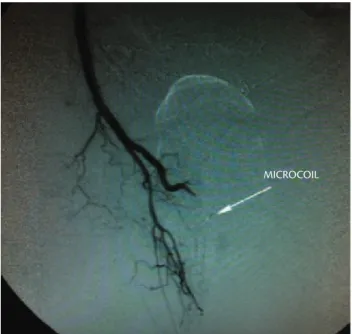
A pelvic and selective arteriography conirmed the diagnosis of bulbar artery istula to the spongy body with arterial blood supply only to the right side (Figure 1). Under local anesthesia and sedation, we performed superselective catheterism using Echelon14® microcatheter (ev3, MA, USA)
in coaxial system and embolization using controlled-release
microcoils of 2 mm × 2 cm Micrus® (MicrusEndovascular
Corporation. CA/EUA), with complete occlusion of the anomalous communication, without complications (Figure 2). Patient had an uneventful postoperative, with signiicant improvement in penile tumescence and pain, and was discharged ater 12 hours of hospitalization, without speciic medication.
He is now at the 6th month of ambulatorial
follow-up, presenting remission of penile tumescence and pain. Penile Doppler ultrasound in the 1st, 3rd and 6th month
postoperatively showed no changes. He returned to sexual activities ater 30 days postoperatively, without complaints.
Discussion
Perineal trauma may be related to erectile dysfunction due to penile fracture sequel, prolonged priapism sequel or
Figure 1. Selective arteriography with catheterization of the right
in-ternal pudendal artery, conirming the diagnosis of right bulbar artery istula to the penile spongy body.
Figure 2. Successful embolization of the istula with the implantation of
Endovascular treatment of erectile dysfunction - Oliveira FAC et al. J Vasc Bras 2012, Vol. 11, Nº 4 319
2. Bai Q, Xu QQ, Jiang H, Zhang WL, Wang XH, Zhu JC. Prevalence and risk factors of erectile dysfunction in three cities of China: a community-based study. Asian J Androl. 2004;6:343-8. PMid:15546027.
3. Wespes E, Wildschutz T, Roumeguere T, Schulman CC. he
place of surgery for vascular impotence in the third millennium. J Urol. 2003;170:1284-6. PMid:14501742.
4. Bertolotto M, Quata E, Mucelli FP, Ciampalini S, Forgacs B, Gattuccio I. Color doppler imaging of posttraumatic priapism before and after selective embolization. Radiographics. 2003;23:495-503. PMid:12640162.
5. Moreira Junior ED, Abdo CHN, Santos DB, Wroclawski E, Fittipaldi JAS. Epidemiologia da disfunção erétil no Brasil: resultados da pesquisa national do projeto Avaliar. Rev Bras Med. 2004;61:613-9.
6. Kendirci M, Nowfar S, Hellstrom WJ. he impact of vascular risk factors on erectile function. Drugs Today (Barc). 2005;41:65-74. PMid:15753970.
7. Montorsi P, Ravagnani PM, Galli S, et al. Common grounds for erectile dysfunction and coronary artery disease. Curr Opin Urol. 2004;14:361-5. PMid:15626880.
8. Eland IA, Van Der Lei J, Stricker BH, et al. Incidence of priapism in the general population. Urology. 2001;57:970. PMid:11337305.
9. Glodny B, Petersen J, Bendix N, et al. Microcoil embolization of an arteriovenous istula from the arteriabulbi penis to the corpus spongiosum penis in the treatment of erectile dysfunction: normal function regained immediately after intervention. Br. J. Radiol. 2007;80:265-7. PMid:17989324.
Correspondence Fábio Augusto Cypreste Oliveira Av. Alphaville Flamboyant, 3900, casa 283 CEP 74884-527 – Goiânia (GO), Brazil Fone: +55 (62) 81475111 E-mail: [email protected]
Authors contributions Conception and design: FACO Analysis and interpretation: FACO, CESA e FLC Data collection: FACO, HWFF, JCB, MCB, FLSM e PMS Writing the article: FACO, JCB, MCB e FLSM Critical revision of the article: FACO, CESA e FLC Final approval of the article*: FACO, CESA, FLC, HWFF, JCB, MCB, FLSM e PMS Statistical analysis: FACO, CESA e FLC Overall responsibility: FACO, CESA e FLC *All authors have read and approved the inal version submitted to J Vasc Bras. determining increased input arterial blood low with
normal venous return. It can be self-limited7, otherwise
therapeutic embolization8 may be needed.
In this case report, we presented a rare case of post-traumatic bulbospongious istula, which evolved to erectile dysfunction and painful maintenance of penile tumescence. he diagnosis was based on arteriography study, since Doppler ultrasound was not able to identify the decreased resistance and the increase of arterial diastolic blood low, as is characteristic in cases of arteriospongious istula. We chose to perform embolization using eletrodetachable microcoils by solder electrolysis made of platinum with PGA absorbable multiilament suture due to its greater accuracy and to avoid inadvertent embolization of the bulbar artery origin and promote permanent occlusion.
he only similar description found in literature was a
case of traumatic arteriospongious istulacausing erectile
dysfunction, described by Glodnyet al.9 Endovascular
treatment was performed with technical success and return of normal erectile function one week ater embolization.
Because it has a multifactorial character, erectile dysfunction should be addressed by a multidisciplinary team, in order to identify risk and etiologic factors of this disorder, and to deine the best diagnostic and therapeutic approach for each individual case.
Conclusion
Endovascular approach with embolization of the arteriospongious istula for treatment of erectile dysfunction showed itself feasible, with low complication rates and good initial results, but it is necessary a greater number of cases and long-term studies to deine treatment of choice.
References