3D conformal external beam radiation therapy
for prostate carcinoma: an experiment of Instituto
do Radium de Campinas with 285 patients*
Radioterapia externa conformada 3D para o carcinoma de próstata: experiência do Instituto do Radium de Campinas com 285 pacientes
Ricardo Akiyoshi Nakamura1, Carlos Roberto Monti2, Felipe Amstalden Trevisan3, Alexandre Arthur Jacinto4
OBJECTIVE: To report the outcomes of 3D conformal radiation therapy for prostate cancer in a single institution. MATERIALS AND METHODS: From July 1997 to January 2002, 285 consecutive patients with prostate cancer were submitted to 3D conformal radiation therapy receiving a median dose of 7920 cGy to the prostate, and were retrospectively evaluated. The patients distribution according to the level of risk was the following: low risk – 95 (33.7%); intermediate risk – 66 (23.4%); high risk – 121 (42.9%) patients. RESULTS: Median follow-up of 53.6 months (3.6–95.3 months) demonstrated 85.1% actuarial five-year overall survival, 97.0% specific cause survival, 94.2% five-year distant metastasis-free survival, and 75.8% five-year biochemical recurrence-free survival. Rates of five-year actuarial survival free from late rectal and urinary toxicity were 96.4% and 91.1% respectively. Pre-3D conformal radiation therapy transurethral resection of the prostate and doses > 70 Gy in 30% of the bladder volume implied a higher grade 2-3 late urinary toxicity in five years (p = 0.0002 and p = 0.0264, respectively). CONCLUSION: The first experiment with 3D conformal
radiation therapy reported in Brazil allowed high radiation doses with acceptable levels of urinary and rectal toxicity. Pre-3D conformal radiation therapy transurethral resection of prostate may determine a higher risk for post-irradiation grade 2-3 late urinary toxicity. At the tomography planning, the reduction of the radiation dose to ≤≤≤≤≤ 70 Gy in 30% of the bladder volume may reduce the risk for late urinary complications.
Keywords: Prostate; Cancer; Radiotherapy; Toxicity; Prognostic factors.
OBJETIVO: Reportar resultados de tratamentos do câncer de próstata com radioterapia conformada 3D reali-zados em uma única instituição. MATERIAIS E MÉTODOS: De julho de 1997 a janeiro de 2002, 285 pacientes consecutivos com câncer de próstata foram submetidos a radioterapia conformada 3D com dose mediana de 7.920 cGy na próstata e analisados retrospectivamente. A distribuição segundo o grupo de risco foi a seguinte: baixo risco — 95 (33,7%); risco intermediário — 66 (23,4%); alto risco — 121 (42,9%) pacien-tes. RESULTADOS: Em seguimento mediano de 53,6 meses (3,6–95,3 meses), sobrevidas atuariais global, causa específica, livre de metástases a distância e livre de recidiva bioquímica em cinco anos foram de 85,1%, 97,0%, 94,2% e 75,8%, respectivamente. Sobrevidas atuariais livre de toxicidade retal e urinária tardias em cinco anos foram de 96,4% e 91,1%, respectivamente. Ressecção transuretral pré-radioterapia conformada 3D e doses > 70 Gy em 30% do volume da bexiga implicaram maior toxicidade urinária tardia grau 2-3 em cinco anos (p = 0,0002 e p = 0,0264, respectivamente). CONCLUSÃO: A primeira experiência relatada de
radioterapia conformada 3D no Brasil permitiu altas doses de radiação, com toxicidades retal e urinária acei-táveis. A existência de ressecção transuretral de próstata pré-radioterapia conformada 3D pode sinalizar maior risco de toxicidade urinária tardia grau 2-3 após irradiação. Restrição da dose ≤≤≤≤≤ 70 Gy em 30% do volume da bexiga à tomografia de planejamento pode reduzir complicações urinárias tardias.
Unitermos: Próstata; Câncer; Radioterapia; Toxicidade; Fatores prognósticos.
Abstract
Resumo
* Study developed at Instituto do Radium de Campinas (IRC), Campinas, SP, Brazil.
1. MD, Radiotherapist at Hospital de Caridade Dr. Astrogildo de Azevedo and Universidade Federal de Santa Maria (UFSM), Santa Maria, RS, Brazil.
2. PhD, Radiotherapist and Director for Instituto do Radium de Campinas (IRC), Campinas, SP, Brazil.
3. Master, Radiotherapist at Instituto do Radium de Campi-nas (IRC), CampiCampi-nas, SP, Brazil.
4. MD, Radiotherapist at Hospital de Câncer de Barretos – Fundação Pio XII, Barretos, SP, Brazil.
melanoma skin cancer, with estimation of 49,530 new cases in 2008 in Brazil, corre-sponding to 52 new cases/100,000 men(1). The disease can be approached in a num-ber of ways such as surgery, external beam radiation therapy, brachytherapy with io-dine seeds, high-dose rate brachytherapy(2), androgen suppression therapy, prostate-specific antigen (PSA) monitoring alone, Nakamura RA, Monti CR, Trevisan FA, Jacinto AA. 3D conformal external beam radiation therapy for prostate carcinoma: an experiment of Instituto do Radium de Campinas with 285 patients. Radiol Bras. 2009;42(2):75–82.
Mailing address: Dr. Ricardo Akiyoshi Nakamura. Avenida Heitor Penteado, 1780, Taquaral. Campinas, SP, Brazil, 13075-460. E-mail: [email protected]
Received November 11, 2007. Accepted after revision Feb-ruary 26, 2009.
INTRODUCTION
non-and cryotherapy. However, only surgery, external beam radiotherapy, brachytherapy and cryotherapy, or an association of these therapeutic modalities can provide a cure for these patients.
Three-dimensional conformal radiation therapy (3DCRT), a technique of external beam radiotherapy, utilizes high technol-ogy with powerful computers and complex softwares, allowing a more accurate local-ization of the radiotherapy target and or-gans at risk, with the delivery of high doses to the target volume and better control over the radiation dose in healthy structures. The high radiation dose for prostate cancer has allowed a better biochemical control in prospective randomized studies although without resulting in increased overall sur-vival(3,4) and with an increase in toxicity(5). However the high doses released with 3DCRT generate lower toxicity as com-pared with conventional radiotherapy with conventional radiation doses(6).
The present study was aimed at report-ing the outcomes of the treatment for local-ized prostate cancer with 3DCRT per-formed in an institution were more than 1,000 patients have already been treated up to the present moment, and evaluating prognostic factors for the management of the disease and toxicity of the therapy.
MATERIALS AND METHODS
In the period between July 1997 and January 2002, 285 consecutive patients with localized prostate adenocarcinoma di-agnosed by means of transrectal biopsy were submitted to 3DCRT for curative pur-poses in a single institution, and were ret-rospectively evaluated. The median follow-up was of 53.6 months (3.6–95.3 months). All the patients were staged in compliance with the staging system of the American Joint Committee on Cancer (2002). Infor-mation on the testosterone levels at the beginning of the treatment was not avail-able. All the patients signed a term of free and informed consent before being submit-ted to the treatment. Other characteristics of the patients are shown on Table 1.
Treatment characteristics
Concomitant and/or adjuvant, neoadju-vant androgen suppression and type of
sup-pressor drug were defined by decision of the urologist and/or radiotherapist. Simu-lation was performed with the patient in dorsal decubitus in a helical CT equipment with venous and urethral contrast-enhance-ment and 5 mm-thick slices. The Med-Crane software was utilized for images ac-quisition.
The therapy targets were delineated on the tomographic slices as follows: a) pros-tate – whole volume delineation (gross tu-mor volume – GTV); b) seminal vesicles – whole extent delineation (GTV, when af-fected; clinical target volume – CTV in subclinical disease); c) drainage – lymph nodes of internal and external iliac vessels from the caudal region of the sacroiliac joint, and lymph nodes of the obturator vessels, excluding the lateral perirectal lymph nodes (CTV in high-risk patients). Margins for target displacement and posi-tioning errors measured 10 mm for all the dimensions and 3 mm posteriorly (PTV). Organs at risk were delineated as follows: a) bladder – whole volume by the outer muscular layer; b) rectum – whole volume and contents by the outer layer, from the rectoanal transition to the rectosigmoid transition. Energies of 6 or 15 MV and five radiation fields were utilized.
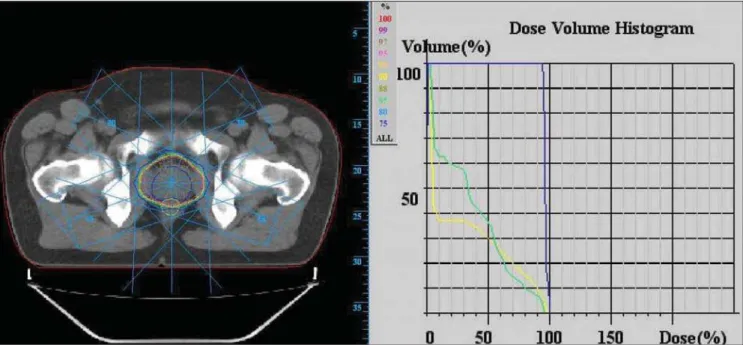
The radiotherapy treatment was divided into phases, as follows: in the first phase, pelvis, seminal vesicles and prostate were irradiated (PTV1); following, the treatment volume was restricted to the seminal vesicles and prostate (PTV2); and, finally, the treatment field covered only the pros-tate with respective margins (PTV3). In the absence of pelvic irradiation, the treatment was comprised of two phases, irradiation of seminal vesicles and prostate (PTV1), and following, only the prostate (PTV2). Restriction of doses in healthy tissues cor-responded to: a) rectum: 50% < 50 Gy, 25% < 70 Gy; b) bladder: 50% < 50 Gy, 30% < 70 Gy; c) femoral heads: < 55Gy; the pre-scription dose corresponded to 95%. Fig-ure 1 represents the dose and volume his-togram, and an axial CT view in a 3DCRT planning for prostate cancer. Transference of the planning data to the linear accelera-tor was the next step, the treatment being performed with a dose of 180 cGy/day five times a week. The patients were evaluated on a weekly basis or more frequently as
necessary. Weekly check-films were uti-lized for quality control. Other treatment characteristics are shown on Table 1.
Patients follow-up
After the 3DCRT, the patients were fol-lowed-up with serial total PSA between three and six months, and image studies were requested in case of specific com-plaints. By the time of the analysis, data on the management of the disease and toxic-ity of the treatment were updated through phone conversations with the patients.
Toxicity
Late toxicity was evaluated for the rec-tum and bladder and rated according to the Common Terminology Criteria for Adverse Effects version 3(7).
Biochemical failure
The presence of biochemical failure was considered after three consecutive in-creases in total PSA levels(8) or introduction of therapy with androgen suppression for any reason.
Statistical analysis
The patients were evaluated as a single group for management of the disease and late toxicity, and as three different groups for management of the disease according to the initial total PSA levels, Gleason score and clinical T-stage, as follows: low-risk group including patients with initial total PSA < 10 ng/ml, Gleason score ≤ 6 and stage ≥ T2a; intermediate risk group with initial total PSA ≥ 10 and < 20 ng/ml or Gleason score = 7 or stage T2b-T2c; and the high-risk group with initial total PSA
≥ 20 and/or Gleason score ≥ 8 and/or stage T3, or two or more characteristics of the intermediate risk group.
The patients with late urinary or rectal toxicity may have had one or more types of toxicity, and the data and degree considered for the survival calculation were respec-tively the most recent and the highest.
Fisher test was adopted. The significance level of 5% was considered for all the tests. Overall survival was defined as the in-terval between date of the treatment begin-ning and the date of death or last informa-tion for censured observainforma-tions. The period of disease recurrence of biochemical fail-ure was measfail-ured from the beginning of the 3DCRT to the date of recurrence.
Overall survival and recurrence-free survival were estimated by the Kaplan-Meyer test, and the logrank test was applied to compare survival curves with 95% con-fidence interval. The gross and adjusted relative risk of death was estimated by the Cox regression model. The whole statisti-cal analysis was performed with the Stata 7 software package (StataCorp.; Texas, USA).
RESULTS
Actuarial overall survival
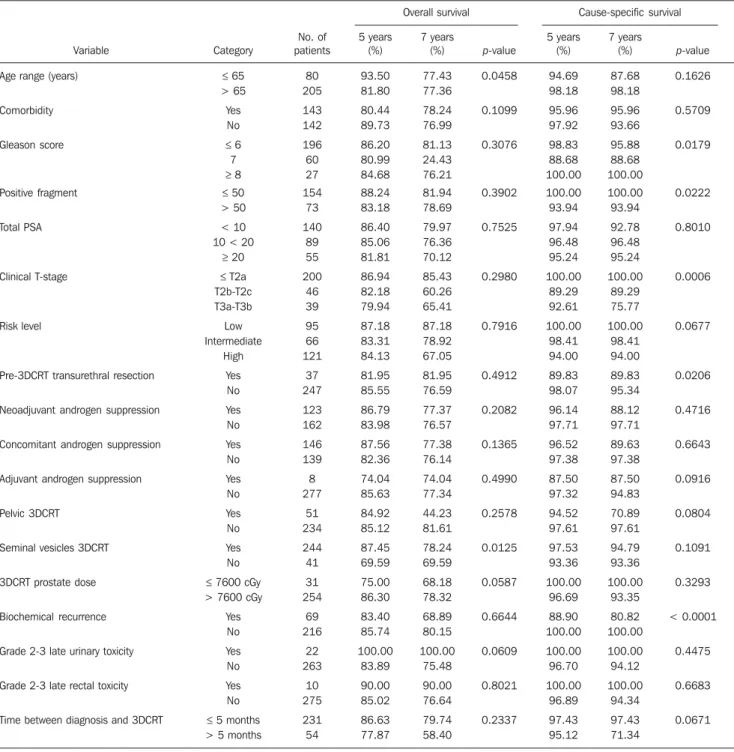
Actuarial overall five-year and seven-year survival rates were, respectively, 85.1% and 77.0%. Age > 65 years (p =
0.0458) and absence of seminal vesicles ir-radiation (p = 0.0125) resulted in lower
rates of overall survival (Table 2). Associa-tion between radiaAssocia-tion dose in seminal vesicles and increase in overall survival could not be observed. Other variables
Table 1 Patients and treatment characteristics.
Variable
Age
Prostate weight (g)
Gleason score
Positive fragment
Total PSA level
Clinical T-stage
Risk level
Neoadjuvant androgen suppression
Concomitant androgen suppression
Adjuvant androgen suppression
Comorbidity
Radiotherapy time
Pelvic 3DCRT
Seminal vesicles 3DCRT
3DCRT prostate dose
Category
≤ 6 7 ≥ 7 ≤ 50% > 50%
< 10 10 < 20
≥ 20 ≤ T2a T2b-T2c T3a-T3b
Low Intermediate
High
Yes No
Yes No
Yes No
Yes No
Days
Yes No
Yes No
No. of patients (%)
285
212
196 (69.26) 60 (21.20)
27 (9.54)
154 73
140 (49.30) 89 (31.34) 55 (19.37)
200 (70.18) 46 (16.14) 39 (13.68)
95 (33.69) 66 (23.40) 121 (42.91)
123 (43.16) 162 (56.84)
146 (51.23) 139 (48.77)
8 (2.81) 277 (97.19)
143 (50.18) 142 (49.82)
51 (17.89) 234 (82.11)
244 (85.61) 41 (14.39)
285
Median (variation)
70 (47–86)
35.3 (11–123)
2 (1–11)
10 (1.4–304)
71 (40–205)
5040 cGy (4500–7740)
7920 cGy (7020–8460)
Figure 1. Axial CT view for 3DCRT planning for prostate cancer with respective dose-volume histogram showing the dose rate in prostate (blue), bladder (green)
analyzed (see Table 2) did not influence the actuarial overall survival.
Actuarial cause-specific survival
The five-year and seven-year actuarial cause-specific survival rates were respec-tively 97% and 94.5%. Gleason score (p =
0.0179), percentage of positive fragments (p = 0.0222), clinical T-stage (p = 0.0006),
biochemical recurrence (p < 0.0001) and
pre-3DCRT transurethral resection (p =
0.0206) constituted prognostic factors for death for prostate cancer. The analysis of risk groups demonstrated a tendency to-wards statistical significance (p = 0.0677).
However, as the risk groups were sepa-rately analyzed, a same p value was found
for risk groups 1 and 2 (p = 0.2403) and the
group 1 demonstrated longer cause-spe-cific survival than group 3 (p = 0.0327).
Other characteristics analyzed are shown on Table 2.
Actuarial metastasis-free survival
The five-year and seven-year actuarial metastasis-free survival rates were respec-tively 94.2% and 93.1%. Seventeen pa-tients presented distant metastasis. Age ≤ 65 years (p = 0.0220), Gleason score (p =
0.0005), clinical T-stage (p = 0.0041), risk
group (p = 0.0033), biochemical recurrence
(p < 0.0001), pré-3DCRT transurethral
re-section (p = 0.0039) and a period > 5 months
Table 2 Characteristics related to the patient, to the tumor, and to the 3DRCT in terms of actuarial overall and cause-specific survival.
Variable
Age range (years)
Comorbidity Gleason score Positive fragment Total PSA Clinical T-stage Risk level
Pre-3DCRT transurethral resection
Neoadjuvant androgen suppression
Concomitant androgen suppression
Adjuvant androgen suppression
Pelvic 3DCRT
Seminal vesicles 3DCRT
3DCRT prostate dose
Biochemical recurrence
Grade 2-3 late urinary toxicity
Grade 2-3 late rectal toxicity
Time between diagnosis and 3DCRT
Category
≤ 65 > 65
Yes No ≤ 6 7 ≥ 8 ≤ 50 > 50
< 10 10 < 20
≥ 20 ≤ T2a T2b-T2c T3a-T3b Low Intermediate High Yes No Yes No Yes No Yes No Yes No Yes No ≤ 7600 cGy > 7600 cGy
Yes No Yes No Yes No ≤ 5 months > 5 months
between diagnosis and introduction of 3DCRT (p = 0.0016) constituted
prognos-tic factors for the development of distant metastasis (Table 3).
Actuarial biochemical recurrence-free survival
Actuarial five-year and seven-year bio-chemical recurrence-free survival rates were respectively75.8% and 64.0%. Sixty-nine patients presented biochemical
recur-rence (24.21%). Gleason score (p = 0.0004),
percentage of positive fragments > 50% (p
= 0.0211), initial total PSA (p < 0.0001),
clinical T-stage (p = 0.0204) and risk group
(p < 0.0001) implied higher rates of
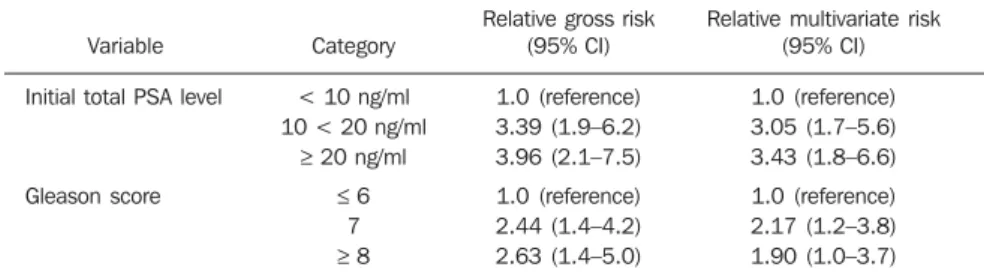
bio-chemical failure in the univariate analysis (Table 3). In the multivariate analysis, pre-3DCRT initial total PSA and Gleason scores constituted independent prognostic factors (p < 0.0001 and p = 0.0011,
respec-tively) (Table 4).
Pelvic 3DCRT
Patients submitted to pelvic radio-therapy presented lower actuarial bio-chemical recurrence-free and metastasis-free survivals. However, these patients had more aggressive tumors, allowing a sam-pling error in the statistical analysis.
Low-risk group
Actuarial seven-year overall and bio-chemical recurrence-free survival rates for
Table 3 Characteristics related to the patient, to the tumor, and to the 3DRCT in terms of actuarial metastasis-free and biochemical recurrence-free survival.
Variable
Age range (years)
Comorbidity Gleason score Positive fragment Total PSA Clinical T-stage Risk
Pre-3DCRT transurethral resection
Neoadjuvant androgen suppression
Concomitant androgen suppression
Adjuvant androgen suppression
Pelvic 3DCRT
Seminal vesicles 3DCRT
3DCRT prostate dose
Biochemical recurrence
Grade 2-3 late urinary toxicity
Grade 2-3 late rectal toxicity
Time between diagnosis and 3DCRT
Category
≤ 65 > 65
Yes No ≤ 6 7 ≥ 8 ≤ 50 > 50
< 10 10 < 20
≥ 20 ≤ T2a T2b-T2c T3a-T3b Low Intermediate High Yes No Yes No Yes No Yes No Yes No Yes No ≤ 7600 cGy > 7600 cGy
Yes No Yes No Yes No ≤ 5 months > 5 months
No. of patients 80 205 143 142 196 60 27 154 73 140 89 55 200 46 39 95 66 121 37 247 123 162 146 139 8 277 51 234 244 41 31 254 69 216 22 263 10 275 231 54 5 years (%) 74.08 76.20 72.37 79.16 81.47 62.95 59.54 82.05 67.87 87.91 66.17 61.20 79.35 61.47 74.83 91.21 73.56 64.59 61.71 77.85 72.61 78.21 73.96 77.89 62.50 76.14 62.92 78.66 76.88 67.71 84.22 74.86 — — 59.53 77.15 57.27 76.33 77.50 68.28
Biochemical recurrence-free survival
patients in the low-risk group were, respec-tively, 87.2% and 87.8%. Prognostic fac-tors implying lower survival rates for this group of patients were not identified. Only a tendency to longer actuarial overall sur-vival with doses > 76 Gy in the prostate (p = 0.0524) was observed. In account of
the low incidence of deaths for prostate cancer and distant metastasis, actuarial cause-specific and distant metastasis-free survival rates could not be evaluated for this group.
Intermediate-risk group
Actuarial seven-year overall and bio-chemical recurrence-free survival rates were, respectively 78.9% and 59.2%. Irra-diation of seminal vesicles resulted in longer actuarial overall and biochemical recurrence-free survival (p = 0.0034 and p
= 0.0301, respectively). No association was found between the other variables. Because of the low incidence of deaths for prostate cancer and distant metastasis, actuarial cause-specific and distant metastasis-free survival rates could not be evaluated for this group.
High-risk group
Actuarial seven-year overall and bio-chemical recurrence-free survival rates were respectively 67.1% and 49.0%. Neo-adjuvant and concomitant androgen sup-pression resulted in higher actuarial over-all survival rates (p = 0.0217 and p =
0.0238, respectively), and irradiation of seminal vesicles resulted in higher actuarial biochemical recurrence-free survival rates (p = 0.0040). Other variables were not
sta-tistically significant. Because of the low incidence of deaths for prostate cancer and distant metastasis, actuarial cause-specific and distant metastasis-free survival rates could not be evaluated for this group.
Late rectal toxicity
The rate of actuarial seven-year survival free of late rectal toxicity (grade 2-3) was 96.38%. Three patients presented late rec-tal toxicity grade 2 and seven, grade 3 (Table 5). Associated prognostic factors could not be identified because of the low number of patients with late rectal toxicity.
Late urinary toxicity
The rate of actuarial seven-year survival free of late urinary toxicity (grade 2-3) was 89.97%. Seven patients presented late uri-nary toxicity grade 2, and 15 grade 3 (Table 5). Pre-3DCRT transurethral resection and doses > 70 Gy in 30% of the bladder vol-ume implied a higher late urinary toxicity grade 2 and 3 (respectively (p = 0.0002 and p = 0.0264). Other variables were not
sta-tistically significant.
DISCUSSION
Treatment characteristics associated with the therapy results
In low-risk patients with clinical T1 and T2a stages, long term outcome from con-ventional external beam radiotherapy have been similar to the ones from radical
pros-tatectomy(9,10). However, in patients with locally advanced disease, the local manage-ment of the primary tumor with conven-tional external beam radiotherapy is unsat-isfactory, with 30% to 40% local recurrence in ten years and, after 10 and 15 years, only 35% to 45% and 18% to 27% respectively are alive(10).
Retrospective studies have associated local management with radiation dose in prostate adenocarcinoma(10,11). However, the delivery of doses > 70 Gy with the tech-nique of conventional radiotherapy has implied severe complications (grades 3 and 4) in 3.5% to 6.9% of cases(12).
With the technological development, the association of computed tomography with linear accelerator became feasible by means of complex software packages. This association has allowed an extremely reli-able visualization of the therapeutic target as well as of adjacent healthy structures, and the estimation of the radiation dose in the target volume and structures at risk. As a result, since the beginning of the nineties, dose scaling protocols have been devel-oped and, in cases of prostate cancer, a higher biochemical control with acceptable late toxicity has been achieved(3,4). In the present series, the actuarial five-year bio-chemical recurrence-free survival for low, intermediate and high-risk patients was, respectively, 91.40%, 73.29% and 64.25%, similarly to the results from 3D radiother-apy(13) and radical prostatectomy(8).
Already published series with dose scal-ing(3,4,13) report a higher biochemical con-trol with higher radiation doses, although without increasing the overall survival. However, the follow-up of these patients is still relatively short, and a longer follow-up may demonstrate benefits in terms of overall survival. In the meantime a decrease in biochemical failure may result in mea-surable benefits to the patients, with longer actuarial cause-specific and metastasis-free survival as reported by the present series, besides reducing the necessity of androgen suppression in the biochemical failure.
Gleason score, clinical T-stage and ini-tial total PSA level can predict the risk for seminal vesicles involvement(14) that, de-pending on the risk level, must be treated. However, irradiation of seminal vesicles may drastically increase the volume of
Table 4 Independent prognostic factors for biochemical failure in the multivariate analysis.
Variable
Initial total PSA level
Gleason score
Category
< 10 ng/ml 10 < 20 ng/ml
≥ 20 ng/ml ≤ 6
7 ≥ 8
Relative gross risk (95% CI)
1.0 (reference) 3.39 (1.9–6.2) 3.96 (2.1–7.5)
1.0 (reference) 2.44 (1.4–4.2) 2.63 (1.4–5.0)
Relative multivariate risk (95% CI)
1.0 (reference) 3.05 (1.7–5.6) 3.43 (1.8–6.6)
1.0 (reference) 2.17 (1.2–3.8) 1.90 (1.0–3.7)
CI, confidence interval.
Table 5 Late urinary and rectal toxicity.
Complication
Cystitis
Urinary retention
Hematuria
Urinary incontinence
Rectal bleeding
Rectal pain
Intestinal obstruction Grid
2 3
2 3
3
2
2 3
3
3
No. of patients
2 3
1 8
7
4
3 5
1
healthy tissues irradiated and, consequently increase the risk for late toxicity. In the present study, irradiation of seminal vesi-cles resulted in longer actuarial overall and biochemical recurrence-free survival in pa-tients of the intermediate risk group, and increased the biochemical recurrence-free survival in patients of the high-risk group, without increasing the toxicity.
Several prospective randomized studies associating androgen suppression with ra-diotherapy have been developed, demon-strating benefits in terms of overall sur-vival, disease-free sursur-vival, cause-specific survival, biochemical recurrence-free sur-vival, distant metastasis-free sursur-vival, and local management(15,16). In the present se-ries, the utilization of neoadjuvant and concomitant androgen suppression resulted in longer overall survival in high-risk pa-tients. Patients at intermediate and low risks did not benefit from the procedure. The number of patients submitted to adju-vant androgen suppression was small and did not allow statistical analysis.
In the present study, patients submitted to pelvic radiotherapy presented shorter ac-tuarial biochemical recurrence-free and distant metastasis-free survival. However, patients submitted to this treatment pre-sented more aggressive tumor characteris-tics, causing distortion in findings con-firmed in the cases where statistically sig-nificant was not observed among patients of a same risk group submitted or not to pelvic radiotherapy.
Patients’ characteristics associated with treatment results
The relevance of several tumor-related prognostic factors, particularly Gleason score, clinical T-stage and initial total PSA level, has been identified in the litera-ture(14). In the present series, Gleason score, clinical T-stage and initial total PSA level constituted prognostic factor for cause-spe-cific and biochemical recurrence-free sur-vival. For metastasis-free survival, Gleason score and clinical T-stage were significant; initial total PSA level was marginally sig-nificant (p = 0.0545). The division into risk
groups associating initial total PSA level, Gleason score and clinical T-stage in the present series was significant for biochemi-cal recurrence-free and distant
metastasis-free survival, and marginally positive for cause-specific survival. However, as the risk groups are separately evaluated, a same
p value was found for risk groups 1 and 2
and the group 1 demonstrated longer cause-specific survival than group 3.
In the literature, the role of pre-3DCRT transurethral resection in the management of prostate cancer is controversial(17,18). In the present series, pre-3DCRT transurethral resection resulted in shorter cause-specific and metastasis-free survival, suggesting that the procedure may reduce the 3DCRT effectiveness.
After the diagnosis of prostate cancer, patients who had to wait for more than three months to have the 3DCRT started presented a tendency to a shorter metasta-sis-free survival (p = 0.0763). However,
when the wait was extended for more than five months from the diagnosis, the distant metastasis-free survival was significantly longer (p = 0.0016), suggesting that
pros-tate cancer should be treated in less than five months after the diagnosis.
Probably, patients with > 65 years of age present less aggressive tumors, considering that they presented longer metastasis-free survival than those with ≤ 65 years of age, suggesting that patients with > 65 years can benefit from less debilitating treatments.
In the present series, patients with ≤ 50% of positive fragments presented longer cause-specific and biochemical re-currence-free survival and a tendency to longer metastasis-free survival (p =
0.0524), suggesting that this is significant prognostic factor to be taken into consid-eration in the treatment individualization, as reported in the literature(19).
Late toxicity
Three-dimensional conformal radiation therapy for the treatment of prostate can-cer reduces late effects grade ≥ 3 as com-pared with conventional 2D radiation therapy. The rate of late toxicity grade ≥ 3 for 78 Gy to the PTV in the study RTOG 94-06-group 1 (six cases) was significantly lower in relation to the historical expected 18.2 control cases (RTOG 7506 and RTOG 7706) (p = 0.0042)(6).
In several studies, late rectal toxicity has been strongly associated with the rectal volume irradiated with a determined
radia-tion dose(20). It is recognized that there is not a single point of radiation dose in the volume of a healthy organ resulting in late rectal toxicity, but there is a continuum of relations between dose and volume. Stud-ies developed at the M.D. Anderson Can-cer Center associating absolute radiation dose with percentage of rectal volume have been of aid to the clinical practice for add-ing safety to the radiotherapy treatment. In a retrospective study including 163 patients submitted to 3DCRT at the M.D. Anderson Cancer Center, Huang et al.(20) have sug-gested that doses of 60 Gy, 70 Gy, 75.6 Gy and 78 Gy should be restricted to respec-tively 40%, 25%, 15% and 5% of the rec-tal volume. In the present study, probably because of the small number of patients with grade ≥ 2 late rectal toxicity, the au-thors could not observe any relation be-tween this variable and the radiation dose to a determined rectal volume or its asso-ciation with any other variable.
Liu et al.(21) have evaluated 1,192 pa-tients submitted to radiotherapy and ob-served that coexisting genitourinary dis-ease, transurethral resection of the prostate or transurethral resection of vesical tumor and the presence of acute urinary toxicity during radiotherapy were significant fac-tors for late urinary toxicity grade 3. In the present series, doses > 70 Gy to 30% of bladder volume implied a higher late uri-nary toxicity (grade 2-3). Patients submit-ted to pre-3DCRT transurethral resection of the prostate presented higher late urinary toxicity. However, the finding may result from a sampling error probably because of the selection of patients with a higher pro-pensity to urinary toxicity, considering the previous necessity of transurethral resec-tion of the prostate.
CONCLUSIONS
seminal vesicles may be beneficial for in-termediate-risk patients, as the study sug-gests, considering that there was an in-crease in the overall and biochemical recur-rence-free survival. The utilization of neoadjuvant and concomitant androgen suppression in high-risk patients may ex-tend the actuarial overall survival and irra-diation of seminal vesicles may result in longer biochemical recurrence-free sur-vival. Pre-3DCRT transurethral resection of the prostate may impair the management of the tumor and increase the late urinary toxicity (grade 2-3). The data presented herein suggest that the restriction of the radiation dose < 70 Gy in 30% of the blad-der volume may reduce grade 2-3 late uri-nary toxicity.
REFERENCES
1. Instituto Nacional de Câncer. Estimativa 2008: incidência de câncer no Brasil. Rio de Janeiro: INCA; 2007. p. 33–4.
2. Esteves SCB, Oliveira ACZ, Cardoso H, et al. Braquiterapia de alta taxa de dose no tratamento do carcinoma da próstata: análise da toxicidade aguda e do comportamento bioquímico. Radiol Bras. 2006;39:127–30.
3. Pollack A, Zagars GK, Starkschall G, et al. Pros-tate cancer radiation dose response: results of the M. D. Anderson phase III randomized trial. Int J Radiat Oncol Biol Phys. 2002;53:1097–105. 4. Zietman AL, DeSilvio ML, Slater JD, et al.
Com-parison of conventional-dose vs high-dose
con-formal radiation therapy in clinically localized adenocarcinoma of the prostate: a randomized controlled trial. JAMA. 2005;294:1233–9. 5. Kuban D, Pollack A, Huang E, et al. Hazards of
dose escalation in prostate cancer radiotherapy. Int J Radiat Oncol Biol Phys. 2003;57:1260–8. 6. Michalski JM, Winter K, Purdy JA, et al.
Toxic-ity after three-dimensional radiotherapy for pros-tate cancer on RTOG 9406 dose level V. Int J Radiat Oncol Biol Phys. 2005;62:706–13. 7. Common Terminology Criteria for Adverse
Ef-fects version 3. [cited 2005Jun 9]. Available from: http://ctep.cancer.gov/forms/CTCAEv3.pdf 8. Consensus statement: guidelines for PSA
follow-ing radiation therapy. American Society for Thera-peutic Radiology and Oncology Consensus Panel. Int J Radiat Oncol Biol Phys. 1997;37:1035–41. 9. Hull GW, Rabbani F, Abbas F, et al. Cancer con-trol with radical prostatectomy alone in 1,000 consecutive patients. J Urol. 2002;167(2 Pt 1): 528–34.
10. Hanks GE, Asbell S, Krall JM, et al. Outcome for lymph node dissection negative T-1b, T-2 (A-2, B) prostate cancer treated with external beam radiation therapy in RTOG 77-06. Int J Radiat Oncol Biol Phys. 1991;21:1099–103. 11. Zagars GK, Johnson DE, von Eschenbach AC, et
al. Adjuvant estrogen following radiation therapy for stage C adenocarcinoma of the prostate: long-term results of a prospective randomized study. Int J Radiat Oncol Biol Phys. 1988;14:1085–91. 12. Leibel SA, Hanks GE, Kramer S. Patterns of care outcome studies: results of the national practice in adenocarcinoma of the prostate. Int J Radiat Oncol Biol Phys. 1984;10:401–9.
13. Zelefsky MJ, Fuks Z, Hunt M, et al. High dose radiation delivered by intensity modulated con-formal radiotherapy improves the outcome of lo-calized prostate cancer. J Urol. 2001;166:876–81.
14. Partin AW, Kattan MW, Subong EN, et al. Com-bination of prostate-specific antigen, clinical stage, and Gleason score to predict pathological stage of localized prostate cancer. A multi-insti-tutional update. JAMA. 1997;277:1445–51. 15. Bolla M, Collette L, Blank L, et al. Long-term
results with immediate androgen suppression and external irradiation in patients with locally ad-vanced prostate cancer (an EORTC study): a phase III randomised trial. Lancet. 2002;360:103–6. 16. Pilepich MV, Winter K, Lawton CA, et al.
Andro-gen suppression adjuvant to definitive radio-therapy in prostate carcinoma – long-term results of phase III RTOG 85-31. Int J Radiat Oncol Biol Phys. 2005;61:1285–90.
17. Kupelian PA, Elshaikh M, Reddy CA, et al. Com-parison of the efficacy of local therapies for lo-calized prostate cancer in the prostate-specific antigen era: a large single-institution experience with radical prostatectomy and external-beam radiotherapy. J Clin Oncol. 2002;20:3376–85. 18. Zagars GK, Pollack A, Kavadi VS, et al.
Prostate-specific antigen and radiation therapy for clini-cally localized prostate cancer. Int J Radiat Oncol Biol Phys. 1995;32:293–306.
19. D’Amico AV, Renshaw AA, Cote K, et al. Impact of the percentage of positive prostate cores on prostate cancer-specific mortality for patients with low or favorable intermediate-risk disease. J Clin Oncol. 2004;22:3726–32.
20. Huang EH, Pollack A, Levy L, et al. Late rectal toxicity: dose-volume effects of conformal radio-therapy for prostate cancer. Int J Radiat Oncol Biol Phys. 2002;54:1314–21.