ABSTRACT:Objective: To reclassify deaths of women infected with the human immunodeiciency virus/
acquired immunodeiciency syndrome in pregnancy and childbirth in the State of Pernambuco, Brazil, from 2000 to 2010. Methods: A descriptive exploratory study, developed from the following steps: translation to Portuguese of the item “HIV and aids” of the United Nations document “The WHO application of ICD‑10 to deaths during pregnancy, childbirth and the puerperium: DCI MM 2012”; development of a classiication algorithm of deaths of women living with the human immunodeiciency virus/acquired immunodeiciency syndrome in pregnancy and childbirth; and reclassiication of deaths by a group of experts. Results: Among the 25 reclassiied deaths, 12 were due to human immunodeiciency virus/acquired immunodeiciency syndrome, and pregnancy condition was coexisting; 9 were reclassiied as indirect maternal death, with O98.7 code, proposed by the World Health Organization; 2 as direct/indirect maternal death; and 2 were considered indeterminate. Conclusion: The reclassiication showed a possible pattern of change in maternal mortality, since most of the deaths were attributed to the virus and may lead to a reduction in deaths from maternal causes. The algorithm will subsidize the use of the new classiication of maternal death and human immunodeiciency virus/acquired immunodeiciency syndrome.
Keywords: Women. Maternal mortality. HIV. Aids. International Classiication of Diseases. Causes of death.
Classiication of deaths in women
with human immunodeiciency
virus/acquired immunodeiciency
syndrome in pregnancy and childbirth
Classiicação de óbitos em mulheres com vírus da
imunodeiciência humana/síndrome da imunodeiciência
adquirida no ciclo gravídico-puerperal
Manuella Coutinho BraynerI, Sandra Valongueiro AlvesI
IPostgraduate Program in Collective Health, Social and Preventive Medicine Department, Universidade de Pernambuco – Recife
(PE), Brazil.
Corresponding author: Manuella Coutinho Brayner. Rua Hermes da Fonseca, 220, Piedade, CEP 54400-333, Jaboatão dos Guararapes, PE, Brasil. E-mail: [email protected]
INTRODUCTION
Maternal mortality is considered a severe violation of women’s human rights, being preventable in more than 90% of the cases. The World Health Organization (WHO), the United Nation Children’s Fund (UNICEF), the United Nations Population Fund (UNPFA) and the World Bank estimated that, in 2013, 289 thousand women all over the world died from complications related to pregnancy and childbirth, which corresponds to a maternal mortality ratio (MMR) of 210 per 100 thousand live births. Approximately 99% of them lived in developing countries, mostly in sub‑Saharan Africa and Asia1.
Infection by the human immunodeiciency virus (HIV) and the acquired immunodei‑ ciency syndrome (aids), identiied in 1981, represents a dynamic and global phenomenon. aids, among other emerging infectious diseases, stands out due to its magnitude and extended damage toward population2. Many sub‑Saharan countries have coexisting elevated mater‑ nal mortality and high HIV prevalence, among women in reproductive age, representing the two main causes of death among young women3‑5.
Worldwide, it is estimated that 2.6% maternal deaths are related to HIV‑aids1. Therefore, there is a risk of death due to the progression of HIV as well as due to complication related to pregnancy3,6.
In Pernambuco, notifications and investigations of these cases have shown deaths of women in pregnancy and childbirth, often difficult to be classified as deaths by aids or women’s death by HIV‑aids. According to the Ministry of Health (MoH), the
RESUMO:Objetivo: Reclassificar os óbitos de mulheres portadoras do vírus da imunodeficiência humana/ síndrome da imunodeficiência adquirida no ciclo gravídico‑puerperal no Estado de Pernambuco, no período de 2000 a 2010. Métodos: Estudo descritivo exploratório, desenvolvido a partir das seguintes etapas: tradução para português do item “HIV and aids” do documento da Organização das Nações Unidas “The WHO application of ICD-10 to deaths during pregnancy, childbirth and the puerperium: ICD MM, 2012”; elaboração de um algoritmo de classificação dos óbitos de mulheres portadoras do vírus da imunodeficiência humana/ síndrome da imunodeficiência adquirida no ciclo gravídico‑puerperal; e reclassificação dos óbitos por um grupo de especialistas. Resultados: Dentre os 25 óbitos reclassificados, 12 foram devido ao vírus da imunodeficiência humana/síndrome da imunodeficiência adquirida e a condição gravídica era coexistente; 9 foram reclassificados como morte materna obstétrica indireta, com o código O98.7, proposto pela Organização Mundial de Saúde; 2 como morte materna obstétrica direta/indireta; e 2 foram considerados indeterminados.
Conclusão: A reclassificação apontou uma possível mudança de padrão de mortalidade materna, visto que a maioria dos óbitos foi atribuído ao vírus, podendo levar a uma redução dos óbitos por causas maternas. O algoritmo subsidiará o uso da nova classificação sobre morte materna e do vírus da imunodeficiência humana/síndrome da imunodeficiência adquirida.
deaths of women with HIV during pregnancy and childbirth are part of a compul‑ sory investigation of women’s deaths in reproductive age and may, therefore, be clas‑ sified as maternal deaths7. The rules for selecting the cause of death used in Brazil prioritized, until 2013, classifying aids as the underlying cause of death (B20‑B24)8. However, many of these women may have died from aids (aids as the main underly‑ ing cause) or from HIV (the disease is a comorbidity). The absence of a protocol to guide the classification of deaths among women with HIV/aids, during the discus‑ sion and analysis of a death by the Technical Groups of the Committees, may over‑ or underestimate the true cases resulting from aids9.
In an attempt to address all these diiculties, the WHO suggests the use of code O98.7 to classify indirect obstetric maternal deaths from HIV/aids10.
Given that, it is necessary that strategies to guide the discussion on these female deaths are proposed. Thus, the objective of the present study was to reclassify deaths of women with HIV/aids occurred in pregnancy and childbirth, living in the state of Pernambuco, from 2000 to 2010, having WHO’s CID 10 as a reference on maternal death.
METHODS
It is an exploratory, cross‑sectional study, carried out in Pernambuco. The deaths of women living in Pernambuco were studies, from 2000 to 2010, whose underlying cause of death was HIV/ aids, registered as maternal by the Mortality Information System (Sistema de Informações sobre Mortalidade – SIM) and discussed by the Municipal/Regional/State Technical Groups Committees of Maternal Mortality. According to the International Statistical Classiication of Diseases and related Health Problems (ICD‑10)8, by deinition, such deaths are those occurred among women between 10 and 49 years of age in codes B20 to B24, in Parts I or II of the Death Certiicate (DC), i.e., both the underlying cause and associated causes of death. These last ones regarding diseases and their complications at the moment of death, informed in the death certiicate11.
The sources of data used were the SIM, the Notiication of Injury Information System (Sistema de Informação de Agravos de Notiicação – Sinan), the Laboratory Testing Control System (Sistema de Controle de Exames Laboratoriais – Siscel) of CD4/CD8 and Viral Load (Siscel), the investigation iles and the inal judgement of maternal deaths, discussed by the Municipal/Regional/State Technical Groups Committees of Maternal Death. As an addi‑ tional step, a search through the Sinan of the IST/aids/HIV State Program of maternal deaths in the presence of HIV/aids were performed, in order to conirm diagnosis, notii‑ cation and investigation of the case.
The development of the study was carried out in through the following steps:
Brazil by the MoH, carried out by two professionals, one with experience in maternal mortality and another in HIV/aids, proicient in English. After translation, it was consolidated into a single document in Portuguese and retranslated into English by an English translator. The similarity of interpretation was observed (whether or not the interpretation of the language is similar to the original one, even there are diferent words)12.
2. Elaboration of an algorithm to classify the deaths of women with HIV/aids during pregnancy and childbirth, using clinical, laboratory and care criteria:
Essentials: onset of symptoms and/or worsening of the disease associated to pregnancy; presence of comorbidities; adherence to antiretroviral therapy (ART); information regarding viral load and CD4+ lymphocyte levels.
Complementary: obstetric history; information on the newborn; necropsy reports.
This algorithm has been adjusted during the process of discussing the cases, with the aggregation of components which would become necessary in order to classify the deaths, such as alterations in values regarding T CD4+ lymphocytes for classiication and inclusion of the “undetermined” category;
3. Reclassification of deaths, carried out through the appreciation of a group of specialists, during five meetings. This group consisted of a professional obstetrician with expertise in HIV/aids, an experienced professional in the State IST/aids/ HIV Program, an experience professional in the Technical Area of Women’s of the State, an experienced professional in Maternal Death Surveillance of the State and a professional with expertise in maternal mortality and member of the State Committee of Studies on Maternal Mortality (Comitê Estadual de Estudos da Mortalidade Materna – CEEMM). The algorithm was used based on the classification proposed by the WHO, translated into Portuguese, which defined inclusion criteria as:
• Death of woman in reproductive age by HIV/aids, with the coexisting condition of pregnancy;
• Maternal death due to indirect obstetric causes, code O98.7;
• Maternal death due to direct obstetric causes in Chapter XV of ICD‑10;
• Death by indeterminate cause.
Discarded cases both for maternal and HIV/aids deaths were excluded.
4. After reclassiication, the results were represented as diagram, by using Microsoft Oice’s Word 2007.
RESULTS
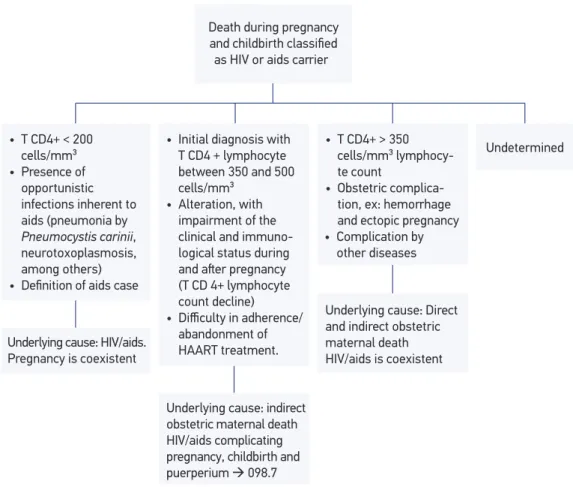
Based on the variables needed for reclassiication of the cases, and during the assessment of the group of specialists, the algorithm presented in Figure 1 was created. All clinical, laboratory and health care information were obtained from secondary data (investigation records and information systems related to maternal death and HIV/aids); of these, only 32% had records of T CD4+ lymphocyte count.
Of the 25 deaths, previously classiied as maternal with code B20‑24, 12 (48%) were con‑ sidered by HIV/aids (B20‑24) and the pregnancy condition was coexistent; only 9 (36%) kept the initial classiication of indirect obstetric maternal death, with code O98.7 proposed by the WHO; 2 deaths (8%) were reclassiied as direct/indirect obstetric maternal death (the direct one being post‑cesarean hemorrhage and the indirect one, deep vein thrombosis); and 2 (8%) were considered indeterminate (Figure 2).
ART: antirretroviral therapy.
Figure 1. Algorithm to reclassify the deaths occurred in pregnancy and childbirth of women with HIV/aids, based on the proposal by the World Health Organization, 2012.
Death during pregnancy
and childbirth classiied
as HIV or aids carrier
Undetermined
Underlying cause: HIV/aids. Pregnancy is coexistent
• T CD4+ < 200 cells/mm³
• Presence of opportunistic infections inherent to aids (pneumonia by
Pneumocystis carinii,
neurotoxoplasmosis, among others)
• Deinition of aids case
• Initial diagnosis with T CD4 + lymphocyte between 350 and 500 cells/mm³
• Alteration, with impairment of the clinical and immuno-logical status during
and aſter pregnancy
(T CD 4+ lymphocyte count decline)
• Difficulty in adherence/
abandonment of HAART treatment.
• T CD4+ > 350 cells/mm³ lymphocy-te count
• Obstetric complica-tion, ex: hemorrhage and ectopic pregnancy
Underlying cause: Direct and indirect obstetric maternal death HIV/aids is coexistent
Underlying cause: indirect obstetric maternal death HIV/aids complicating pregnancy, childbirth and puerperium 098.7
Among the 12 deaths reclassiied as HIV/aids, 3 occurred during pregnancy, 9 in late childbirth and none in early childbirth. In the cases occurred during pregnancy, the woman already had signs of the diseases’ development when pregnant and in late childbirth it was observed that the physiological alteration of pregnancy did not interfere in the progres‑ sion of the disease. When it was possible to locate the results of T CD4+ lymphocytes, these were below 350 cells/mm3 (2 with values below 200 cells/mm3). Seven among the 12 women reclassiied as HIV/aids did not start their ART or it was not mentioned in the beginning of the treatment. Among the comorbidities found, pulmonary tuberculosis, neu‑ rotoxoplasmosis and non‑Hodgkin lymphoma can be mentioned. Of the deaths reclassiied with code O98.7, 8 occurred in early childbirth and only 1 in late childbirth (60 days post‑ partum), this last one with several reports of visits due to fever and diarrhea after normal delivery. Six women already knew they had HIV before the pregnancy that led to death and three got their diagnosis during pregnancy/childbirth. It should be noted that 6 out of the 12 women (50%) had begun their ART. The presence of opportunistic infections, such as pulmonary tuberculosis and neurotoxoplasmosis, and 2 results of T CD4+ lymphocyte lower than 350 cells/mm3 were also detected, though they were related to the commitment of the clinical state during or after pregnancy.
As for the deaths reclassiied as obstetric, the HIV/aids diagnosis did not interfere in the occurrence of death. They resulted from complications intrinsically related (direct) or aggra‑ vated (indirect) by pregnancy and childbirth, both late diagnosed with HIV.
Figure 2. Representation of the reclassiication of death of women with HIV/aids during pregnancy and childbirth.
Indirect – 1 deep vein thrombosis
(O87.9) 12 HIV/aids
(coexisting pregnancy/ childbirth)
9 indirect maternal deaths
(O98.7)
2 direct/indirect obstetric maternal
deaths
2 undetermined
Direct – 1 post-cesarean hemorrhage (O72.1) 25 indirect
The deaths for which it was not possible to establish a relation between HIV/aids and pregnancy and childbirth were reclassiied as indeterminate. In one of the cases, an unspec‑ iied cerebral lesion was detected, with no histopathological result, making it impossible to identify if associated or not with aids. In the other one, occurred in 2000, insuicient data made it impossible to be reclassiied, once there was no information on prenatal care, the beginning of ART and the moment of diagnosis of the disease.
DISCUSSION
The results showed that, from the 25 indirect obstetric maternal deaths previously classi‑ ied by technical groups, only 9 remained with the same classiication, taking over a new code, O98.7. Twelve were reclassiied as deaths of women in reproductive age by HIV/aids, codes B20 to B24, with pregnancy coexisting with the moment of death. This diference in classii‑ cation conirms the importance of an algorithm or a protocol to guide the use of the code.
Few studies examined the causes of maternal death distinguishing indirect deaths related to HIV from coincidental ones. A document from the WHO, 201210, suggests the deaths of pregnant and postpartum women infected by HIV should be categorized as indirect obstet‑ ric deaths (they die from aggravating efects of HIV on pregnancy) and deaths related to HIV (they die from fatal complications of HIV or aids, which coincide with the pregnancy). However, as stated by Calvert and Ronsmans13 (2013), no guidance is made as for how this distinction should be done.
According to the MoH14, from 2013 on, diseases caused by HIV (B20 to B24 – Chapter I) are no longer an exclusion of Chapter XV of ICD‑10 (pregnancy, childbirth and puerpe‑ rium) and became a subcategory of Category O98. Therefore, the deaths of women with aids which, after investigation, have their deaths conirmed due to complications aggravated the physiological efects of pregnancy, were coded as O98.7 (HIV disease complicating preg‑ nancy, childbirth and the puerperium).
Algorithms for this kind of classiication of maternal deaths are still not used in Brazil. This irst exercise was proven important in order to support the technical groups, which do not count, necessarily, on the availability of specialists, and the investigations not always have all information regarding the process of illness and death of women.
Although algorithms are not mentioned, Moran and Moodley5, considering the rules of evaluation of the National Committee on Conidential Enquiries into Maternal Deaths (NCCEMD)16, already emphasized criteria for the attribution of aids as cause of death, which are similar to the ones included in the algorithm in this study, namely: women who had a positive HIV test and a diferentiation cluster 4 (CD4) of < 200 cells/mm3 or an aids‑dein‑ ing condition in order to minimize the bias in relation to a diagnosis mistake as the cause of maternal death.
Considering this, it may be stated that this study is unprecedent in Brazil, since there are no reports in the national literature to classify women during pregnancy and childbirth in terms of “HIV status”. Besides, this new orientation, with the use of the algorithm, may reveal a more realistic role of HIV/aids in maternal deaths, interfering, also, in the distri‑ bution of indirect obstetric deaths in the total maternal deaths.
The mechanism by which the presence of HIV/aids increases the risk of death among pregnant women may be related to immunosuppression during pregnancy associated with infection by HIV, which may accelerate the progression of the disease and increase the risk of obstetric complications17.
International publications, especially in African countries, bring a deeper look upon mater‑ nal health and HIV, due to the high prevalence of the virus and the increased MMR, often coexisting the status of the disease and the pregnant condition. These countries still do not use code O98.7, though they already discuss the relation between HIV/ aids in pregnancy18‑20.
The nature of the interaction between HIV and pregnancy is what underlies the need to classify these deaths. The information about the state of health of the woman during pregnancy and the knowledge of the diagnosis of the infection by the virus were deter‑ mining factors when using the new classiication. Although authors indicate the increased mortality and morbidity is associated to the clinical progression of the disesase, it is essen‑ tial to know the degree of women’s clinial and immunological involvement, evaluated by CD4 counting and viral loads17.
Recent evidences suggest pregnancy seem to have no discernible efect on the increased progression of the infection by HIV in asymptomatic infected women, however, symptomatic infected women are in higher risk of dying by infectious diseases than uninfected women18,20. Eforts in order to prevent, diagnose and treat these conditions before and during pregnancy may reduce morbidity and mortality among infected pregnant women17.
It was observed that 12 of the deaths studies were due to HIV, which was also observed in a recent systematic review13. For these authors, the excessive mortality attributed to HIV among pregnant and postpartum women have a great impact on mortality related to preg‑ nancy, even when the prevalence of HIV is relatively low. Thus, part of the deaths which would be classiied as indirect obstetric maternal ones acquire a new classiication, allowing greater prominence to the infectious disease and lower prominence to maternal mortality. The fact that 7 out of 12 women reclassiied with HIV/aids did not begin ART could be a contributing factor to accelerating the disease. Calvert and Ronsmans13 further describe that this was the inding for most the studies reviewed by them, in which a signiicant num‑ ber of HIV‑infected women would have progressed to clinical stages of aids due to lack of therapy, with high mortality rates as an outcome.
In South Africa, according to NCCEMD16, it was found that 27.8% of maternal deaths, in which the underlying cause of death was classiied as aids, mothers also had an obstetric con‑ dition which could be classiied as the underlying cause of death, such as abortion and postpar‑ tum hemorrhage. Even if these deaths were classiied as maternal ones due to indirect obstet‑ ric causes, 78.9% would still be attributed to HIV infection, similarly to the study carried out. Data from a randomized study, carried out in Uganda, demonstrate that MMR of HIV‑infected mothers was 1686.8/100 thousand live births in comparison to 309.8/100 thou‑ sand live birth of HIV‑non‑infected women21. Moodley et al.17 also stated having no doubt the infection by HIV is the greatest threat to maternal mortality in South Africa.
Due to the lack of an international consensus about the relation HIV/aids and mater‑ nal death, and considering that Brazil has made progress in the prevention, diagnosis and treatment of infected or diseased pregnant women, there is no doubt the algorithm elabo‑ rated may collaborate with the initiatives of the WHO and MoH to classify indirect obstet‑ ric maternal deaths by HIV/aids in Pernambuco and in the country.
In order to assign a causal relation between HIV infection and pregnant and/or post‑ partum conditions, it was necessary to use information contained in the classiication algo‑ rithm. In some cases, the medical chart was retrieved so that more detailed information on the hospitalization of the woman was collected, such as complaints and diagnosis at the moment of admission in healthcare services.
As the study used secondary data for the discussion with the group of specialists, infor‑ mation as for the state of health of the woman during pregnancy and postpartum and the use of ART were not always available, especially for those who spent long period without ambulatorial care or hospitalization. The interview with the family could ensure more reli‑ ability in describing the disease‑pregnancy relation, however, only information recorded during domiciliary investigation conducted by surveillance were used, and a new interview with family members was not conducted.
care. Therefore, it could interfere in the search for specialized health care, and in the man‑ agement and use of ART. In one of the cases in the study, the diagnosis was performed during brain death tests.
The cases studies were classiied twice. The irst classiication was performed by tech‑ nical groups, in which all deaths were considered indirect obstetric maternal ones by con‑ sensus, with reference to ICD‑10, in which all maternal deaths of women with HIV would be classiied with codes B20‑B24. And the second classiication (reclassiication), carried out by the group of specialists, obeyed the logic of the algorithm, also by consensus, with code O98.7 as reference.
CONCLUSION
When inluencing the distribution of maternal deaths and female deaths by HIV, this new perspective may imply in changes in the organization and ofer of care to those women, whether on reproductive health or on infectious diseases. The validation of reclassiication used in this study will need a new reclassiication with other participants in discussing cases and with the standardization of instruments for information collection.
1. World Health Organization, UNICEF, UNFPA, The World Bank, the United Nations Population Division. Trends in Maternal Mortality: 1990 – 2013. Geneva: WHO; 2014.
2. Brito AM, Castilho EA, Szwarcwald CL. aids e infecção pelo HIV no Brasil: uma epidemia multifacetada. Rev Soc Bras Med Trop. 2001;34(2):207‑17.
3. Abdool‑Karim Q, Abouzahr C, Dehne K, Mangiaterra V, Moodley J, Rollins N, et al. HIV and maternal mortality: turning the tide. Lancet. 2010;375(9730):1948‑9. 4. Graham W, Newell ML. Seizing the opportunity:
collaborative initiatives to reduce HIV and maternal mortality. Lancet. 1999;353(9155):836‑9.
5. Moran NF, Moodley J. The efect of HIV infection on maternal health and mortality. Int J Gynaecol Obstet. 2012;119(Suppl. 1):S26‑9.
6. McIntyre J. Maternal Health and HIV. Reprod Health Matters. 2005;13(25):129‑35.
7. Brasil. Portaria MS/GM nº 1.119/2008. Brasília: Diário Oicial da República Federativa do Brasil; 5 de junho de 2008.
8. Organização Mundial de Saúde. Classiicação estatística internacional de doenças e de problemas relacionados à saúde. Décima revisão. Manual de instrução (volume 2).
Centro Colaborador da OMS para a Classiicação de Doenças em Português. São Paulo; 2009.
9. Bonciani RDF, Spink MJP. Morte por aids ou morte materna: a classiicação da mortalidade como prática social. Cad Saúde Pública. 2003;19(2):645‑52. 10. World Health Organization. The WHO Application
of ICD‑10 to deaths during pregnancy, childbirth and the puerperium: ICD MM. 2012. Geneva: WHO; 2012. 11. Laurenti R, Buchalla CM. A elaboração de estatísticas de mortalidade segundo causas múltiplas. Rev Bras Epidemiol. 2000;3(1/3):21‑8.
12. Reichenheim ME, Moraes CL. Operacionalização de adaptação transcultural de instrumentos de aferição usados em epidemiologia. Rev Saúde Pública. 2007;41(4):665‑73. 13. Calvert C, Ronsmans C. The contribution of HIV to pregnancy‑related mortality: a systematic review and meta‑analysis. aids. 2013;27(10):1631‑9.
14. Brasil. Ministério da Saúde. Secretaria de Vigilância em Saúde. Coordenação Geral de Informações e Análises Epidemiológicas. Protocolos de codiicações especiais em mortalidade. Brasília: Ministério da Saúde; 2013. 60p. 15. Alves SV. Maternal Mortality in Pernambuco, Brazil: What Has Changed in Ten Years? Reprod Health Matters. 2007;15(30):134‑44.
16. National Committee on Conidential Enquiries into Maternal Deaths. Saving Mothers 2005–2007: Fourth report on conidential enquiries into maternal deaths in South Africa. Pretoria; 2009.
17. Moodley J, Pattinson RC, Baxter C, Sibeko S, Abdool Karim Q. Strengthening HIV services for pregnant women: an opportunity to reduce maternal mortality rates in Southern Africa/sub‑Saharan Africa. Br J Obstet Gynaecol. 2011;118(2):219‑25.
18. Guidozzi F, Black V. The obstetric face and challenge of HIV/aids. Clin Obstet Gynecol. 2009;52(2):270‑84. 19 Le Coeur S, Khlat M, Halembokaka G, Augereau‑ Vacher C, Batala‑M’Pondo G, Baty G, et al. HIV and the magnitude of pregnancy‑related mortality in Pointe Noire, Congo. aids. 2005;19(1):69‑75.
20. McIntyre J. Mothers infected with HIV. Br Med Bull. 2003;67(1):127‑35.
21. Sewankambo NK, Gray RH, Ahmad S, Serwadda D, Wabwire‑Mangen F, Nalugoda F, et al. Mortality associated with HIV infection in rural Rakai district, Uganda. aids. 2000;14(15):2391‑400.
22. Carvalho JSN. Fatores associados ao desconhecimento do status sorológico para o HIV em gestantes na região metropolitana de Recife, Pernambuco, 2010 [dissertação de mestrado]. Recife: Programa de Pós‑Graduação Integrado em Saúde Coletiva da Universidade Federal de Pernambuco; 2011.
Received on: 08/18/2016