Short Communication
Corresponding author:Meire Cavalieri de Almeida, MSc. e-mail: [email protected]
Received 6 July 2016 Accepted 25 January 2017
Operational research principles for a routine service
process for monitoring the human immunodeiciency virus/
acquired immunodeiciency syndrome treatment cascade:
data from a cohort in Brazil
Meire Cavalieri de Almeida
[1], Fernanda Friggi Araújo
[2],
Guillermo Patricio Ortega-Jacome
[3], Suely Hiromi Tuboi
[4]and Guilherme Côrtes Fernandes
[2],[3][1]. Escola Nacional de Saúde Pública Sérgio Arouca, Fundação Oswaldo Cruz, Rio de Janeiro, RJ, Brasil. [2]. Faculdade de Medicina, Universidade Federal de Juiz de Fora, Juiz de Fora, MG, Brasil.
[3]. Centro de Epidemiologia Estatística e Pesquisa, Santa Casa de Misericórdia de Juiz de Fora, Juiz de Fora, MG, Brasil. [4].Takeda, Vaccines Unit, Rio de Janeiro, RJ, Brasil.
Abstract
Introduction: Bottlenecks still exist during human immunodeiciency virus care that may delay the achievement of better outcomes. Methods: We established a monitoring system to trace patients throughout the human immunodeiciency virus/ acquired immunodeiciency syndrome care process in Juiz de Fora, Brazil, to identify potential bottlenecks. Results: Among 250 patients, 17.6% abandoned follow-up. Our monitoring system tracked 86.4% of patients through the medication logistics control system and 2.3% through the mortality information system. Two percent of patients were not located by our monitoring system. Conclusions: A pathway care process contributes to a better understanding of the barriers to the treatment cascade.
Keywords: Human immunodeiciency virus. Acquired immunodeiciency syndrome. Operational research in health.
Brazil occupies a prominent position on the world stage in the ight against the acquired immunodeiciency syndrome (AIDS) epidemic1. One reason for its success is the universal access to antiretroviral therapy (ART), which accords with the principles of the country’s health policy2.The initial impact of ART on human immunodeiciency virus (HIV)/AIDS patient survival has been documented in the literature3.
However, despite these advances, Brazil’s mortality rates have plateaued since 20054, which may be related to barriers to universal access to ART. High dropout rates have been described in the worldwide literature, which may be related to many factors, such as the infrastructure, personnel, and social problems5,6. In Brazil, dropout incidences of up to 26.5 per 100 person-years are observed7,8, and this is probably one of the
barriers to the country’s development of HIV care. Retention in care is associated with a better prognosis and is recognized as a marker of quality of care9.
Knowing that there are barriers to excellence of care, and that ART not only preserves the health of people with HIV but also lowers their risk of transmitting HIV to others10, quality indicators based on the HIV care-continuum are crucial for identifying bottlenecks in the deined pathways of the process. Information about the role of the treatment cascade collected from well-deined pathways of care has contributed to a better understanding of the bottlenecks and decision-making process, which may inluence strategies for directing action and redeining the care process11. To improve the HIV/AIDS care process, we aimed to establish a monitoring strategy of the pathway care process in order to identify steps sensitive to veriication and assessment and to work toward more effective care.
The sample was followed for 9 months. A model was designed to monitor the distribution of dropouts, which is evidence of the critical points in the local care pathway, in order to detect bottlenecks in the care of patients that already have medical appointments. The monitoring model was based on the local treatment pathway and took into account the Brazilian protocol for HIV/AIDS therapy. It utilized locally available databases and information systems ̶ the SICLOM (an information system for ART medicine delivery), SIH (an information system for hospitalization), and SIM (a mortality information system) ̶ in order to collect data about the routine care.
Patients who did not return for scheduled medical appointments within 90 days after the 60-month follow-up were considered dropouts. These patients were systematically searched for in the databases and information systems. The SPSS (Statistical Package fot the Social Sciences) Statistics for Windows software (v. 17.0; SPSS Inc., Chicago, USA) was used to characterize the cohort and investigate the association between the variables and patient dropout. Descriptive analysis was performed using frequency tables for categorical variables and measurements of central tendency for numeric variables (i.e., median and interquartile range). For the univariate analysis, the variables were categorized and statistical analysis was conducted using relative risk (RR) with 95% conidence intervals (CI).
The cohort included 250 patients receiving ART who attended scheduled medical appointments during July and August 2011. These patients had a median age of 43 years and 132 (52.8%) were male. Patients were receiving ART for a median of 5 years; 144 (59.3%) patients had a CD4 cell count less than or equal to 500 cells/mm³ and 93 (38%) patients had a detectable viral load at the last test prior to the interview. The patients’ demographic and clinical epidemiological characteristics are presented in Table 1.
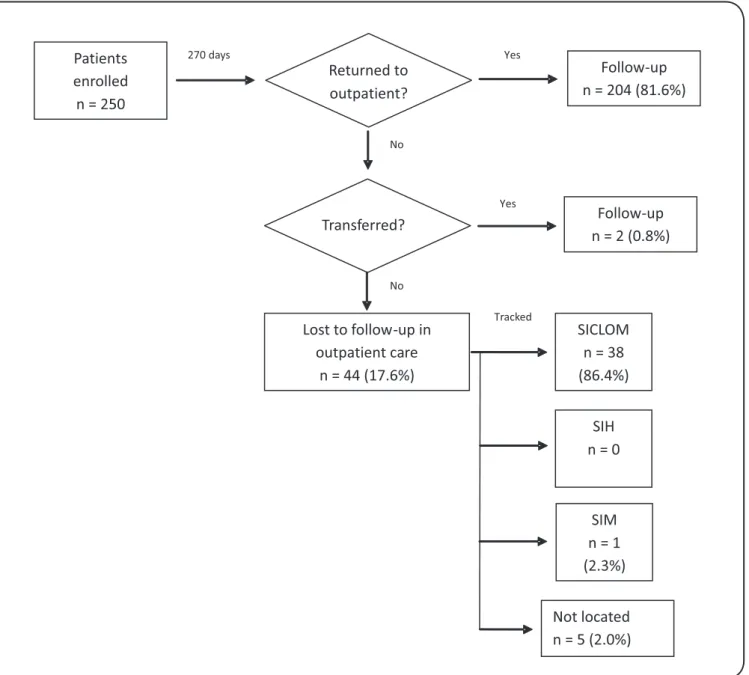
Forty-four (17.6%) patients were considered dropouts. Thirty-eight (86.4%) patients’ records were found in the SICLOM and one (2.3%) record was found in the SIM. Five (2%) records were not located in either database (Figure 1). None of the patients’ records were found in the hospital’s SIH.
Younger age, longer time since admission, and being seen by a speciic physician were potential risk factors for outpatient dropout. Younger patients (≤ 43 vs. > 43 years) (RR: 2.08; 95% CI: 1.2–3.7) and patients with longer admission to the service (> 7 vs. ≤ 7 years) (RR: 1.96; 95% CI: 1.1–3.4) were more likely to dropout. Patients assisted by physician B (RR: 0.13; 95% CI: 0.0–0.9), C (RR: 0.35; 95% CI: 0.2–0.8), or D (RR: 0.16; 95% CI: 0.1–0.5) were less likely to dropout compared with patients assisted by physician E (Table 2).
The estimated patient dropout of 17.6% combined with the identiication of many of these patients in the SICLOM (86.4%) indicates the need for a better understanding of the care process for HIV/AIDS, which would enable this cohort to receive one of the irst steps of this optimization. From observing the health information systems and the data collection using
was developed whereby patient dropouts could be identiied. The aim was to use independent and standardized instruments that will continue to be useful as a routine service tool for the detection of patient dropouts, and that will serve as an additional tool for improvement and contribute to a better understanding of the bottlenecks in the treatment cascade, which may inluence strategies for directing action and resetting care processes.
Operational research is based on the identiication of what hinders the eficient operation of a program. It is possible to identify these challenges by monitoring the process, and solutions are aimed at supporting decision-making, being practically relevant to improving the provision of healthcare, and ensuring that investment is properly used11,12. Regarding HIV/ AIDS, the successful implementation of a sustainable delivery of AIDS treatment and prevention services worldwide is crucial, which is acknowledged by the World Health Organization as one of the ive pillars of its AIDS treatment strategy. This allows providers and policymakers to learn by doing, ultimately contributing to the improvement of care and HIV-related outcomes10. The solution, however, is not to apply it once, but to see it as an ongoing and dynamic process in which constant monitoring is urgent in different contexts. As such, identifying ways to make things feasible after the end of the study was a major concern. As in plan-do-study-act cycles, there must be an iterative testing of changes to improve the quality of the systems13.
Despite the large variability in estimated outpatient dropout rates worldwide, the observed cumulative incidence of 17.6% in Brazil within 90 days after the sixth month of the last visit is high when contrasted to the Ministry of Health’s deinition; within this period, all patients should have returned for scheduled medical appointments. The identiication of potential risks for outpatient dropout among younger patients, patients with longer admission in the service, or those seen by a speciic physician in the univariate analysis highlight the need for local practices targeted at these issues. After identifying this process failure, new strategies are required for a better quality of patient care. However, they should be regarded as, and included in, a process, and not used in isolation.
In addition to providing counseling, the outpatient follow-up is primarily based on patient monitoring, because immunological and virological failure may present asymptomatically and some adverse effects of ART can be assessed only through laboratory testing; thus, dropout may contribute to higher rates of virological failure and increased morbidity and mortality15. The beneits of monitoring, however, include not only the patient's health at the individual level, but also beneits in the context of public health related to increased survival15 and decreased transmission of the virus from suppressing viral loads14,15.
Characteristics Number or median Percentage or IQR Gender
male 132/250 52.8
female 118/250 47.2
Age ( years)
≤ 43 127/250 50.8
> 43 123/250 49.2
Schooling
never studied 4/250 1.6
basic education 155/250 62.0
school 65/250 26.0
technical education or superior 26/250 10.4
Time since admission ( years)
≤ 7 144/250 57.6
> 7 106/250 42.4
median 7 3–10
Time of receiving ART( years)
≤ 5 131/242 54.1
> 5 111/242 45.9
median 5 2–9
missing data 8/250 3.2
CD4 cell count pre-interview
≤ 500 cells/mm³ 144/243 59.3
> 500 cells/mm³ 99/243 40.7
median 440 276–609
missing data 7/250 2.8
Time from CD4 to interview* (months)
≤ 6.44 123/243 50.6
> 6.44 120/243 49.4
median 6.44 3.25–10.61
Viral load pre-interview
≤ 50 cps/ml (undetectable) 152/245 62.0
> 50 cps/ml (detectable) 93/245 38.0
median 1.7 log 10 1.7–2.7
missing data 5/250 2.0
Time from CVto interview*(months)
≤ 5.85 123/245 50.2
> 5.85 122/245 49.8
median 5.85 3.12–10.17
missing data 5/250 2.0
Drug abuse
past 73/250 29.2
current 17/250 6.8
Transportation
bus (rental or not) 211/250 84.4
own vehicle/walking 39/250 15.6
Attending physician
A 22/250 8.8
B 23/250 9.2
C 67/250 26.8
D 56/250 22.4
E 82/250 32.8
IQR: interquartile range; ART: antiretroviral therapy; CD4: CD4 count cell; CV: viral load; cps: copies. *Time between being examined and interviewed. TABLE 1
Lost to follow-up in outpatient care
n = 44 (17.6%)
Follow-up n = 2 (0.8%)
Follow-up n = 204 (81.6%) Patients
enrolled n = 250
SIM n = 1 (2.3%) SICLOM
n = 38 (86.4%)
SIH n = 0 Returned to
outpatient?
Transferred?
Not located n = 5 (2.0%)
270 days Yes
Yes No
No
Tracked
FIGURE 1 - Pathway of the continuity of the care process. SICLOM: Information System for antiretroviral therapy; SIH: Information System for Hospitalization; SIM: Mortality Information System.
individuals who had been using ART for a median of 5 years. As such, an unfavorable outcome in the morbidity and mortality of HIV-infected patients, even in those receiving ART, may be related to outpatient dropout rates. Patients in this cohort did not undergo tests to quantify their viral load or CD4 cell counts for a median of 5.8 and 6.4 months respectively, despite the recommendation that these tests should be conducted three times per year.
The identiication of most of the dropouts’ patient records in the SICLOM, which was allied with the identiication by univariate analysis of the increased dropout risk among patients admitted to the service 7 years or more beforehand, may be related to the saturation of the service. Due to increasing survival, there are more patients in follow-up, and coupled with
Outpatient dropout
Characteristics yes no RR (95% CI)
Gender
male 20/132 (15.2) 112/132 (84.8) 0.74 (0.4–1.3)
female 24/118 (20.3) 94/118 (79.7) 1
Age ( years)
≤ 43 30/127 (23.6) 97/127 (76.4) 2.08 (1.2–3.7)
> 43 14/123 (11.4) 109/123 (88.6) 1
Years of education ( years)
≤ 8 28/160 (17.5) 132/160 (82.5) 0.98 (0.6–1.7)
> 8 16/90 (17.8) 74/90 (82.2) 1
Time since admission ( years)
≤ 7 18/144 (12.5) 126/144 (87.5) 1
> 7 26/106 (24.5) 80/106 (75.5) 1.96 (1.1–3.4)
Time of receiving ART( years)
≤ 5 21/131 (16.0) 110/131 (84.0) 1
> 5 23/111 (20.7) 88/111 (79.3) 1.29 (0.8–2.2)
CD4 cell count pre-interview
≤ 500 cells/mm³ 27/144 (18.8) 117/144 (81.2) 1.24 (0.7–2.2)
> 500 cells/mm³ 15/99 (15.2) 84/99 (84.8) 1
Time from CD4 to interview*(months)
≤ 6.44 25/123 (20.3) 98/123 (79.7) 1
> 6.44 17/120 (14.2) 103/120 (85.8) 0.70 (0.4–1.2)
Viral load pre-interview
≤ 50 cps/ml (undetectable) 22/152 (14.5) 130/152 (85.5) 1
> 50 cps/ml (detectable) 21/93 (22.6) 72/93 (77.4) 1.56 (0.9–2.7)
Time from CV to interview* (months)
≤ 5.85 25/123 (20.3) 98/123 (79.7) 1
> 5.85 18/122 (14.8) 104/122 (85.2) 0.73 (0.4–1.3)
Drug abuse
past 16/73 (21.9) 57/73 (78.1) 1.39 (0.8–2.4)
current 28/177 (15.8) 149/177 (84.2) 1
Transportation
bus (rental or not) 40/211 (19.0) 171/211 (81.0) 1.85 (0.7–4.9)
own vehicle/walking 4/39 (10.3) 35/39 (89.7) 1
Attending physician
A 4/22 (18.2) 18/22 (81.8) 0.53 (0.2–1.4)
B 1/23 (4.3) 22/23 (95.7) 0.13 (0.0–0.9)
C 8/67 (11.9) 59/67 (88.1) 0.35 (0.2–0.8)
D 3/56 (5.4) 53/56 (94.6) 0.16 (0.1–0.5)
E 28/82 (34.1) 54/82 (65.9) 1
RR: relative risk; CI: conidence interval; ART: antiretroviral therapy; CD4: CD4 count cell; CV: viral load; cps: copies. *Time between being examined and
interviewed.
TABLE 2
A meta-analysis that tracked patients lost to follow-up estimated a mortality of 40% among these patients in different African countries6. Using an algorithm of linkage databases in Brazil, one study that evaluated the outcome of the apparent dropout patients through the SIM identiied the death of 23.9% of these patients7. Despite the probable mortality, in this analysis only one (2.3%) patient was located through the SIM, while the SIH did not identify any patients in the cohort. Although the absence of hospitalizations and small number of deaths during monitoring indicate a better prognosis, there were still bottlenecks to care that possibly had a continuous impact throughout the care process and, consequently, affected these patients’ clinical improvement. An investigation that does not inluence policy decisions and practice is a waste; thus, it is relevant that operational research be recognized as a method for obtaining results in services. The main setbacks for its practical application may relate to the lack of knowledge about the necessary steps, and the dificulty of implementation and dissemination of the results, while team engagement (both managers and assistants) is a key feature in the planning, development of issues, and data analysis12. The routine collection of data will often be seen as hard work for the care team; however, the analysis of routinely collected data in the service will increase the reliability and accuracy of information, making the results more valid12,13. After results are measured and questions raised by the team are answered, it is probable that new questions will arise, characterizing the process as continuous and dynamic. The routine and systematic collection of data is a fundamental step when inserted into a pathway, and it enables the analysis of the quality of care, improvement in eficiency, and strengthening of health systems. The eficiency of care in terms of the quality of health, however, should not be based on differing goals, but on unique and patient-centered goals.
Ethical considerations
The study followed the Declaration of Helsinki’s principles and was approved by the ethics committee of the Universidade Federal Fluminense Medical School/Antonio Pedro University Hospital (CEPCMM/HUAPNo.220/05).
Acknowledgments
We thank the patients and staff of the regional referral clinic for HIV/AIDS in the City of Juiz de Fora, Minas Gerais State, Brazil.
Financial support
The study was supported by the Coordenação de Aperfeiçoamento de Pessoal
de Nível Superior.
Conlict of interest
The authors declare that there is no conlict of interest.
REFERENCES
1. Berkman A, Garcia J, Munoz-Laboy M, Paiva V, Parker R. A critical
analysis of the Brazilian response to HIV/AIDS: lessons learned for
controlling and mitigating the epidemic in developing countries.
Am J Public Health. 2005;95(7):1162-72.
2. Brasil. Lei 8.080, de 19 de setembro de 1990. Dispõe sobre as
condições para promoção, proteção e recuperação da saúde. Brasília: 1990.
3. Marins JR, Jamal LF, Chen SY, Barros MB, Hudes ES, Barbosa
AA, et al. Dramatic improvement in survival among adult Brazilian
AIDS patients. AIDS. 2003;17(11):1675-82.
4. Ministério da Saúde. Secretaria de Vigilância em Saúde. Departamento de DST, AIDS e Hepatites Virais. Boletim
Epidemiológico HIV/AIDS. November 19. Brasília: 2014. Available at: http://www.aids.gov.br/sites/default/iles/anexos/ publicacao/2014/56677/boletim_2014_inal_pdf_15565.pdf
5. de Carvalho CV, Merchan-Hamann E, Matsushita R. Determinants
of antiretroviral treatment adherence in Brasília, Federal District: a case-control study. Rev Soc Bras Med Trop. 2007;40(5): 555-65.
6. Brinkhof MW, Pujades-Rodriguez M, Egger M. Mortality of
patients lost to follow-up in antiretroviral treatment programmes in resource-limited settings: systematic review and meta-analysis. PloS One. 2009;4(6):e5790.
7. Pacheco AG, Saraceni V, Tuboi SH, Moulton LH, Chaisson RE,
Cavalcante SC, et al. Validation of a hierarchical deterministic record-linkage algorithm using data from 2 different cohorts of human immunodeiciency virus-infected persons and mortality databases in Brazil. Am J Epidemiol. 2008;168(11):1326-32. 8. Rodrigues CS, Guimaraes MDC, Acurcio FA, Comini CC.
Interrupção do acompanhamento clínico ambulatorial de pacientes
infectados pelo HIV. Rev Saúde Pública. 2003;37(2):183-9.
9. Mugavero MJ, Davila JA, Nevin CR, Giordano TP. From access to
engagement: measuring retention in outpatient HIV clinical care. AIDS Patient Care STDs. 2010;24(10):607-13.
10. Centers for Disease Control and Prevention (CDC). National Center
for HIV/AIDS, Viral Hepatitis, STD, and TB Prevention. Division of HIV/AIDS Prevention. Understanding the HIV Care Continuum. December 2014. Available at: http://www.cdc.gov/hiv/pdf/dhap_
continuum.pdf.
11. Langley GJ, Moen RD, Nolan KM, Nolan TW, Norman CL, Provost
LP. The improvement guide: a pratical approach to enhancing organizational performance. 2nd Edition. San Francisco: Jossey-Bass; 2009. 512 p.
12. Zachariah R, Ford N, Maher D, Bissell K, Van den Boogaard W, Reid T, et al. Is operational research delivering the goods? The
journey to success in low-income countries. Lancet.
2012;12(5):415-21.
13. Taylor MJ, McNicholas C, Nicolay C, Darzi A, Bell D, Reed JE.
Systematic review of the application of the plan-do-study-act method to improve quality in healthcare. BMJ Qual Saf. 2014; 23(4):290-8.
14. Pasternak AO, de Bruin M, Jurriaans S, Bakker M, Berkhout B, Prins JM, et al. Modest nonadherence to antiretroviral therapy
promotes residual HIV-1 replication in the absence of virological rebound in plasma. J Infect Dis. 2012;206(9):1443-52.
15. Pacheco AG, Tuboi SH, Faulhaber JC, Harrison LH, Schechter M.