Prevalence and socioeconomic
factors associated with smoking
in people living with HIV by sex,
in Recife, Brazil
Prevalência e fatores
socioeconômicos associados com o
tabagismo em pessoas vivendo com
o HIV por sexo em Recife, Brasil
Joanna d’Arc Lyra Batista
IMaria de Fátima Pessoa Militão de Albuquerque
IRicardo Arraes de Alencar Ximenes
II,IIIDemócrito de Barros Miranda-Filho
IIHeloisa Ramos Lacerda de Melo
II,IIIMagda Maruza
IVLibia Vilela Moura
IIIEduardo Jaime Seara Pinto da Costa Ferraz
ILaura Cunha Rodrigues
VI Aggeu Magalhães Research Center/FIOCRUZ, Recife, Brazil.
II University of Pernambuco, Recife, Brazil.
III Federal University of Pernambuco, Recife, Brazil.
IV Correia Picanço Hospital, Department of Health, Recife, Brazil
V London School of Hygiene and Tropical Medicine, London, UK.
Funding: This study received support from the Brazilian Ministry of Health/AIDS and STD Pro-gram/UNESCO (CSV 182/06 – “Clinical-Epidemiological Study of HIV/Tuberculosis Co-Infection in Recife, Brazil” project).
Acknowledgements: The authors would like to thank the partial support provided by the Fun-dação de Amparo à Ciência e Tecnologia do Estado de Pernambuco - FACEPE (State of Pernambuco Science and Technology Support Foundation – scholarship IBPG-0898-4.06/08 granted to J.D.L.B.) and Conselho Nacional de Desenvolvimento Cientíico e Tecnológico - CNPq (National Council for Scientiic and Technological Development – scholarship 301779/2009-0 granted to M.F.P.M. and 300917/2006-6 granted to R.A.A.X.).
Correspondence: Joanna d’Arc Lyra Batista. Centro de Pesquisas Aggeu Magalhães/FIOCRUZ. Av. Moraes Rego, s/n Campus da Universidade Federal de Pernambuco, Cidade Universitária, Recife, PE CEP 50670-420 Brazil. E-mail: [email protected]
Abstract
Introduction: Smoking is the leading
cau-se of preventable death in the world. The prevalence of smoking is higher in people infected with HIV than in the general popu-lation. Although it is biologically plausible that smoking increases the morbidity and mortality of people living with HIV/AIDS, few studies in developing countries have analyzed the determinants and conse-quences of smoking in HIV infected people.
Objective: To estimate the prevalence of
smoking and identify the socioecono-mic factors associated with smoking and smoking cessation in patients with HIV by sex. Methods: A cross-sectional study was conducted with baseline data, obtai-ned from an ongoing prospective cohort study of patients with HIV attending two referral centers in Recife, Northeast Region of Brazil, between July 2007 and October 2009. Results: The prevalence of current smoking was 28.9%. For both sexes, smoking was independently associated with heavy alcohol drinking and marijuana use. Among women, smoking was associated with living alone, not being married and illiteracy; and among men, being 40 years or older, low income and using crack. Compared with ex-smokers, current smokers were younger and more likely to be unmarried, heavy drinkers and marijuana users. Conclusions:
It is important to incorporate smoking ces-sation interventions for the treatment of heavy alcohol drinkers and marijuana users with HIV/AIDS, which may increase life expectancy and quality of life, as smoking is related to risk of death, relapse of tuber-culosis, and non communicable diseases.
Keywords: Smoking. HIV. Associated factors.
Resumo
Introdução: Tabagismo é a principal causa
de morte evitável no mundo e a sua preva-lência é maior em pessoas infectadas pelo HIV. Embora haja plausibilidade biológica no fato de o tabagismo aumentar a mor-bimortalidade de pessoas que vivem com HIV, poucos estudos em países em desen-volvimento têm analisado os determinan-tes e as conseqüências desse hábito nessa população. Objetivos: Estimar a prevalência de tabagismo e identiicar os fatores asso-ciados com o tabagismo e com a cessação do tabagismo em infectados pelo HIV, por sexo. Métodos: Estudo seccional utilizando os dados de base de uma coorte prospectiva de pacientes com HIV atendidos em dois centros de referência em Recife, nordeste do Brasil, entre julho de 2007 e outubro de 2009.
Resultados: A prevalência de tabagismo foi
de 28,9%. Para ambos os sexos, o tabagismo esteve associado com alcoolismo e uso de maconha. Entre as mulheres, o tabagismo esteve associado com não ser casada, mo-rar só, e não saber ler e escrever; e entre os homens esteve associado com idade ≥ 40 anos, baixa renda mensal e uso de crack. Comparado com os ex-fumantes, os fuman-tes eram mais jovens, não casados, bebiam mais e fumavam maconha. Conclusão: É importante incorporar intervenções para cessação do tabagismo no tratamento de usuários de maconha e alcoolistas com HIV/ AIDS, o que pode aumentar a qualidade e expectativa de vida desses pacientes, uma vez que o tabagismo está relacionado com maior risco de morte, recidiva da tubercu-lose e também com doenças crônicas não infecciosas.
Palavras-chave: Tabagismo. HIV. Fatores
associados. Fatores socioeconômicos. Prevalência. Sexo.
Introduction
Smoking is the main risk factor for preventable death in the world and there is evidence of its association with cancers, respiratory and cardiovascular diseases1,2. While smoking has decreased in many de-veloped countries, it increased nearly 50% worldwide, between 1975 and 1996, mainly due to an increase in cigarette consumption in developing countries3. There are sex--speciic biological and social differences in both males and females, and tobacco com-panies are investing heavily in low-income and middle-income countries, where most potential new female users live4.
Brazil stands out as the largest exporter and the fourth largest producer of tobacco in the world and it is estimated that about one third of its adult population smokes, totaling about 200,000 deaths a year related to smoking5. In recent years, the Ministry of Health began to develop a broad and hard--hitting Tobacco Control Program, registe-ring a decline in the prevalence of smoking in Brazil from 35% to 16%, between 1989 and 2006. In 2006 the prevalence of smoking among men was 20% and 13% among wo-men in major cities in Brazil3,6. Nevertheless, smoking has increased in low-income and lower literacy populations6, which also have the highest rates in the country for diseases such as HIV/AIDS7.
Studies reporting the effects of tobacco on the acquisition of HIV infection and progression to AIDS show controversial results8-11. There are reports stating that smoking reduces by 40% the immune and virological response to antiretroviral therapies9.
infected with HIV. Apart from the importan-ce of smoking in relation to non-infectious diseases, smoking also appears as a signii-cant risk factor for infectious diseases like tuberculosis, which is a major opportunistic infection and cause of death in HIV/AIDS patients.
In recent years there has been increa-sing interest in studies of the prevalence and factors associated with smoking in people living with HIV in developed coun-tries18-20. Many authors have reported that smoking prevalence is much higher among people with HIV compared to the general population9,10,18,19 with rates ranging from 45-74%16,19. There is evidence that smoking causes immunosuppression in the lungs, characterized by local suppression of CD4, CD8, TNF- and IL-1b, which may predispo-se individuals to bacterial infection21. Ohta et al.22 have described that a decrease in alveolar macrophages could be the cause of this suppression of the local inlammatory response and a predisposition to bacterial and viral infections.
Studies of smoking in patients with HIV/ AIDS are still rare in developing countries, where both the HIV/AIDS epidemics and the burden of smoking are greater. The objective of the present study was to estimate the prevalence of smoking, the characteristics of tobacco use and identify the socioeco-nomic factors associated with smoking and smoking cessation in patients with HIV, exploring differences by sex. The results of this study may contribute to a better unders-tanding of the interrelationship between socioeconomic conditions, smoking and sex in a particular situation of greater vul-nerability to drug use. This may increase the scope of action for the control of morbidity and mortality of patients living with HIV.
Methods
Study Population, Recruitment, and Survey Methods
The study was carried out in Recife, a city in the Northeast Region of Brazil, with an
estimated population of 1,561,659 inhabi-tants in 2009. This cross-sectional study was conducted between July 2007 and October 2009, with HIV/AIDS patients aged 18 years or more, attending two HIV/AIDS referral centers (Oswaldo Cruz University Hospital and Correia Picanço Hospital). These two hospitals are responsible for about 70% of health care for HIV positive individuals in the state of Pernambuco. All the patients who went to these two health services for regular consultation and/or hospitalization were invited to participate in the study. After signing an informed consent form, they were interviewed by trained professionals who used a questionnaire designed speci-ically for this research. Five participants were excluded from the study because they did not provide responses to items relating to smoking behavior.
The study involved two analyses: irst, the prevalence of smoking was estimated and the proile of smoking behavior was described in HIV patients; second, data were analyzed as case-control to identify factors associated with smoking by sex.
Definition of Variables Used in Analyses
The dependent variable was smoking behavior, classiied as: never smoked (those who have never smoked in their life); former smokers (those who were not smoking at the time of the study and had quit smoking at least six months before); and current smokers (those who were smokers at the time of the study or had quit smoking less than six months before). This classiication of smoking behavior was similar to that used in previous studies with people living with HIV23,24.
alcohol drinking status, categorized into two levels: abstainer or light drinker, and heavy drinker).
The criterion adopted for the consump-tion of alcohol was based on the number of drinks per day, according to the deinition of patterns of alcohol drinking accepted by the Centers for Disease Control and Prevention (CDC)25. Individuals were then classiied as abstainers or light drinkers (non drinker or drink no more than 2 drinks per day for men and 1 drink per day for women), and heavy drinkers (drink more than 2 drinks per day for men and 1 drink per day for women).
The variable “monthly income of the head of the household” was classiied accor-ding to the minimum wage (MW) in Brazil during the study period.
The additional analysis (for current smokers alone) considered the dependent variable to be cigarette consumption, cate-gorized as: up to 10 cigarettes per day (half a pack) and more than 10 cigarettes per day (more than half a pack).
Data Analysis
The whole analysis (except for ciga-rette consumption) was stratiied by sex. Multinomial analysis was used because of the interest in studying a single outcome - smoking behavior - with three levels: has never smoked, former smokers and current smokers. In a second multinomial analysis, the objective was to study the factors asso-ciated with being a current smoker, by com-paring this group with that former smokers (who had quitted smoking). All variables which were associated with smoking beha-vior in the univariate analysis with a p value below 0.20 were included in the multinomial logistic regression. The variables whose as-sociation with at least one of the outcome levels was statistically signiicant (p <0.05) remained in the inal model. As the measure of association in the multinomial analysis, the RRR (Relative Risk Ratio) is similar to the OR from a statistical point of view, the tables presented here show the OR. The software used was Stata 9.0 (Stata-Corp LP, College
Station, TX). The study was approved by the Research Ethics Committee of the Health Sciences Center at the Federal University of Pernambuco.
Results
The present study included 1,815 people living with HIV/AIDS, 62.3% being men. The mean age was 39.6 for both sexes, with a standard deviation of 9.6 years for men and 9.4 years for women. The average monthly income was R$ 648.00 (one minimum wage = R$ 350.00 or US$ 191.00 in 2008) and 11.1% were illiterate. The monthly income was higher for men compared with women (p < 0.001).
Table 1 shows characteristics of smoking behavior among people living with HIV/ AIDS, according to sex. The prevalence of smoking in the study was 28.9%, and the distribution by sex showed a statistically signiicant difference (p < 0.001). Smoking for more than 10 years was more frequent among men (84.3%), than women (79.1%), p = 0.045, and the mean age for starting smoking was 16 years (range 6 - 47 years old) for both sexes. Most current smokers (53.5% men and 63.7% of women) reported smoking up to half a pack per day (equiva-lent to 10 cigarettes a day) and only 3.8% of all smokers and former smokers (37/966) started smoking after testing positive for HIV.
Association between smoking behavior and socio-demographic variables
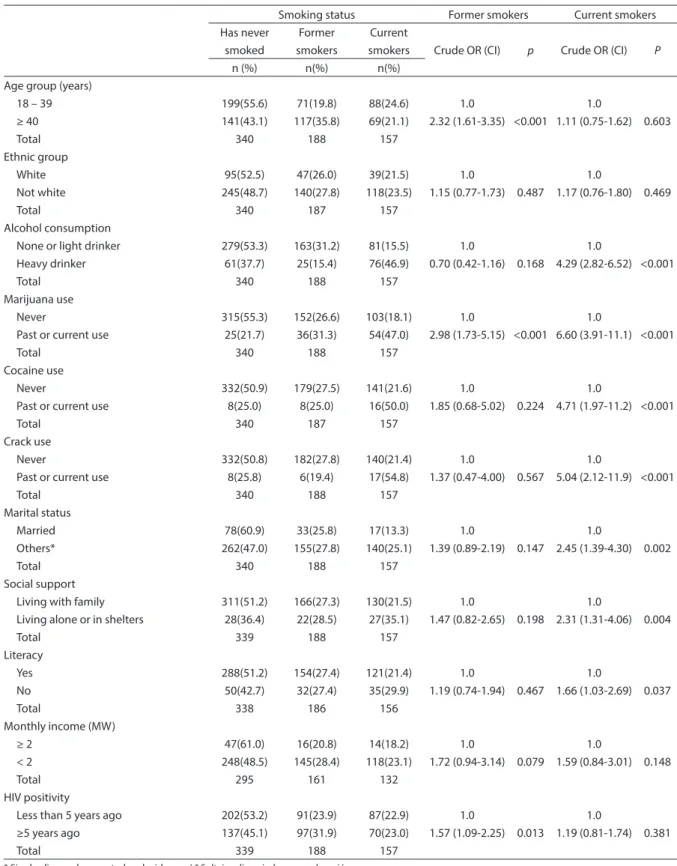
The absolute and relative distribution of smoking behavior according to selected characteristics and the results of univariate multinomial analysis for men are shown in Table 2 and for women in Table 3.
years (OR 2.45, 95% CI 1.72 – 3.50), mariju-ana use (OR 3.55, 95% CI 2.38 – 5.30) and being married (OR 0.63, 95% CI 0.43 – 0.91). Among women, being a former smoker (rather than a non-smoker) was associated with age ≥ 40 years (OR 2.71, 95% CI 1.84 – 3.99) and marijuana use (OR 3.91, 95% CI 2.21 – 6.91).
Compared with non-smokers, the cur-rent smoking behavior among men was associated with age ≥ 40 years (OR 1.56, 95% CI 1.11 – 2.20), heavy drinking (OR 3.68, 95% CI 2.61 – 5.17), marijuana use (OR 4.26, 95% CI 2.90 – 6.27), crack use (OR 4.11, 95% CI 1.72 – 9.86) and a monthly income of < 2MW (OR 2.13, 95% CI 1.42 – 3.19); Compared with non-smokers, current smoking behavior among women was associated with heavy
drinking (OR 4.73, 95% CI 2.99 – 7.48), ma-rijuana use (OR 6.69, 95% CI 3.79 – 11.7), being unmarried (OR 2.39, 95% CI 1.27 – 4.49), living alone or in a shelter (OR 2.23, 95% CI 1.17 – 4.22) and being illiterate (OR 2.01, 95% CI 1.17 – 3.45).
Additional Analysis
In an additional multinomial regression analysis (Table 5), the factors associated with being a current smoker were studied, compared with being a former smoker, which could be a proxy of smoking cessa-tion. The variables associated with being a current smoker among men were: heavy drinking (p < 0.001), crack use (p = 0.027) and not being married (p < 0.001). The
Table 1 - Smoking habit characteristics among people living with HIV, according to sex, Recife, Brazil, 2009.
Tabela 1 - Características do tabagismo entre pessoas que vivem com HIV de acordo com o sexo, Recife, Brasil, 2009.
Men Women
p Total
N (%) N (%) N (%)
Smoking status
Has never smoked 480 (42.5) 340 (49.6) 820 (45.2)
Former smokers 282 (25.0) 188 (27.5) 470 (25.9)
Current smokers 368 (32.5) 157 (22.9) 525 (28.9)
p<0.001* Cigarette consumption (among current smokers)
1 - 10 cigarettes (half a pack) per day 170 (53.5) 86 (63.7) 256 (56.5)
11 - 20 cigarettes (from half a pack to one pack) per day 110 (34.6) 35 (25.9) 145 (32.0)
> 20 cigarettes (> one pack) per day 38 (11.9) 14 (10.4) 52 (11.5)
p=0,096** Started smoking after the HIV diagnosis
Yes 23 (3.7) 14 (4.2) 37 (3.8)
No 607 (96.3) 322 (95.8) 929 (96.2)
p=0.691* Length of time smoking (former and current smokers)
≤ 10 years 97 (15.7) 68 (20.9) 165 (17.5)
> 10 years 521 (84.3) 257 (79.1) 778 (82.5)
p=0.045*
Average age when starting smoking 16.49 16.68 16.55
p=0.614*** Average age when quitting smoking among former
smokers
32.92 31.37 32.35
p=0.073***
Average monthly income among current smokers (R$) 639.8 435.0 577.8
p<0.001*** * Pearson’s Chi-square test. / * Teste qui-quadrado de Pearson.
** Chi-square test for linear trend. / ** Teste qui-quadrado de tendência.
Table 2 - Frequency distribution and univariate analysis of factors associated with smoking behavior in men living with HIV, Recife, Brazil, 2009.
Tabela 2 - Distribuição da freqüência e análise univariada dos fatores associados com o tabagismo em homens que vivem
com HIV, Recife, Brasil, 2009.
Smoking status Former smokers Current smokers
Has never smoked
Former smokers
Current
smokers Crude OR (CI) p Crude OR (CI) P
n (%) n(%) n(%)
Age group (years)
18 – 39 267(46.6) 111(19.4) 195(34.0) 1.0 1.0
≥ 40 213(38.2) 171(30.7) 173(31.1) 1.93 (1.43-2.60) <0.001 1.11 (0.84-1.46) 0.445
Total 480 282 368
Ethnic group
White 124(42.2) 82(27.9) 88(29.9) 1.0 1.0
Not white 356(42.6) 200(23.9) 280(33.5) 0.85 (0.61-1.18) 0.330 1.11 (0.81-1.52) 0.522
Total 480 282 368
Alcohol consumption
None or light drinker 358(50.3) 197(27.6) 157(22.1) 1.0 1.0
Heavy drinker 122(29.2) 85(20.3) 211(50.5) 1.26 (0.91-1.75) 0.157 3.94 (2.95-5.28) <0.001
Total 480 282 368
Marijuana use
Never 407(54.7) 167(22.5) 170(22.8) 1.0 1.0
Past or current use 73(19.0) 114(29.7) 197(51.3) 3.80 (2.69-5.37) <0.001 6.46 (4.68-8.92) <0.001
Total 480 281 367
Cocaine use
Never 453(45.5) 240(24.1) 303(30.4) 1.0 1.0
Past or current use 27(20.3) 41(30.8) 65(48.9) 2.87 (1.72-4.77) <0.001 3.59 (2.24-5.77) <0.001
Total 480 281 368
Crack use
Never 473(45.4) 260(25.0) 309(29.6) 1.0 1.0
Past or current use 7(8.0) 21(24.1) 59(67.9) 5.46 (2.29-13.0) <0.001 12.9 (5.82-28.6) <0.001
Total 480 281 368
Marital status
Married 107(42.8) 88(35.2) 55(22.0) 1.0 1.0
Others* 373(42.4) 194(22.0) 313(35.6) 0.63 (0.45-0.88) 0.006 1.63 (1.14-2.33) 0.007
Total 480 282 368
Social support
Living with family 377(44.2) 217(25.4) 260(30.4) 1.0 1.0
Living alone or in shelters 103(37.5) 64(23.2) 108(39.3) 1.08 (0.76-1.54) 0.671 1.52 (1.11-2.08) 0.008
Total 480 281 368
Literacy
Yes 438(42.0) 260(25.0) 344(33.0) 1.0 1.0
No 41(48.8) 19(22.6) 24(28.6) 0.78 (0.44-1.37) 0.390 0.74 (0.44-1.25) 0.271
Total 479 279 368
Monthly income (MW)
≥ 2 118(48.7) 66(27.3) 58(24.0) 1.0 1.0
< 2 294(41.5) 169(23.8) 246(34.7) 1.03 (0.72-1.47) 0.880 1.70 (1.19-2.43) 0.003
Total 412 235 304
HIV positivity
Less than 5 years ago 254(45.0) 136(24.0) 175(31.0) 1.0 1.0
≥5 years ago 226(40.0) 146(25.8) 193(34.2) 1.21 (0.90-1.62) 0.211 1.24 (0.94-1.62) 0.122
Total 480 282 368
Table 3 - Frequency distribution and univariate analysis of factors associated with smoking behavior in women living with HIV, Recife, Brazil, 2009.
Tabela 3 - Distribuição da freqüência e análise univariada dos fatores associados com o tabagismo em mulheres que vivem
com HIV, Recife, Brasil, 2009.
Smoking status Former smokers Current smokers
Has never smoked
Former smokers
Current
smokers Crude OR (CI) p Crude OR (CI) P
n (%) n(%) n(%)
Age group (years)
18 – 39 199(55.6) 71(19.8) 88(24.6) 1.0 1.0
≥ 40 141(43.1) 117(35.8) 69(21.1) 2.32 (1.61-3.35) <0.001 1.11 (0.75-1.62) 0.603
Total 340 188 157
Ethnic group
White 95(52.5) 47(26.0) 39(21.5) 1.0 1.0
Not white 245(48.7) 140(27.8) 118(23.5) 1.15 (0.77-1.73) 0.487 1.17 (0.76-1.80) 0.469
Total 340 187 157
Alcohol consumption
None or light drinker 279(53.3) 163(31.2) 81(15.5) 1.0 1.0
Heavy drinker 61(37.7) 25(15.4) 76(46.9) 0.70 (0.42-1.16) 0.168 4.29 (2.82-6.52) <0.001
Total 340 188 157
Marijuana use
Never 315(55.3) 152(26.6) 103(18.1) 1.0 1.0
Past or current use 25(21.7) 36(31.3) 54(47.0) 2.98 (1.73-5.15) <0.001 6.60 (3.91-11.1) <0.001
Total 340 188 157
Cocaine use
Never 332(50.9) 179(27.5) 141(21.6) 1.0 1.0
Past or current use 8(25.0) 8(25.0) 16(50.0) 1.85 (0.68-5.02) 0.224 4.71 (1.97-11.2) <0.001
Total 340 187 157
Crack use
Never 332(50.8) 182(27.8) 140(21.4) 1.0 1.0
Past or current use 8(25.8) 6(19.4) 17(54.8) 1.37 (0.47-4.00) 0.567 5.04 (2.12-11.9) <0.001
Total 340 188 157
Marital status
Married 78(60.9) 33(25.8) 17(13.3) 1.0 1.0
Others* 262(47.0) 155(27.8) 140(25.1) 1.39 (0.89-2.19) 0.147 2.45 (1.39-4.30) 0.002
Total 340 188 157
Social support
Living with family 311(51.2) 166(27.3) 130(21.5) 1.0 1.0
Living alone or in shelters 28(36.4) 22(28.5) 27(35.1) 1.47 (0.82-2.65) 0.198 2.31 (1.31-4.06) 0.004
Total 339 188 157
Literacy
Yes 288(51.2) 154(27.4) 121(21.4) 1.0 1.0
No 50(42.7) 32(27.4) 35(29.9) 1.19 (0.74-1.94) 0.467 1.66 (1.03-2.69) 0.037
Total 338 186 156
Monthly income (MW)
≥ 2 47(61.0) 16(20.8) 14(18.2) 1.0 1.0
< 2 248(48.5) 145(28.4) 118(23.1) 1.72 (0.94-3.14) 0.079 1.59 (0.84-3.01) 0.148
Total 295 161 132
HIV positivity
Less than 5 years ago 202(53.2) 91(23.9) 87(22.9) 1.0 1.0
≥5 years ago 137(45.1) 97(31.9) 70(23.0) 1.57 (1.09-2.25) 0.013 1.19 (0.81-1.74) 0.381
Total 339 188 157
variables associated with being a current smoker among women were: being younger (age < 40 years; p = 0.023), heavy drinking (p < 0.001) and marijuana use (p = 0.035).
Additionally, the association between the number of cigarettes smoked per day (cigarette consumption, categorized as: up to 10 and more than 10 cigarettes) and socio-demographic variables and lifestyle habits was analyzed. Only being male and younger (18 to 39 years) were associated with smoking more than 10 cigarettes per day (p = 0.015) (data not shown).
Discussion
The overall prevalence of smoking found in this population was 28.9%. Most of smokers smoked at least 1 – 10 ci-garettes (half a pack) per day and had smoked for over 10 years. The prevalence of smoking found in this population was lower than that found in most studies for individuals with HIV/AIDS in Europe and North America10,16,18-20,26. The prevalence of smoking was higher (p <0.001) among men (32.6%) than women (22.9%). Additionally,
Table 4 - Multinomial logistic regression analysis of the association between smoking behavior and characteristics of individuals living with HIV/AIDS, Recife, Brazil, 2009.
Tabela 4 - Análise de regressão logística multinomial da associação entre tabagismo e características do indivíduo com HIV/
AIDS, Recife, Brasil, 2009.
Men Women
Former smokers* Current smokers* Former smokers* Current smokers*
OR (CI) P OR (CI) p OR (CI) p OR (CI) p
Age group (years)
18 - 39 1.0 1.0 1.0 1.0
≥ 40 2.45(1.72-3.50) <0.001 1.56(1.11-2.20) 0.010 2.71(1.84–3.99) <0.001 1.35(0.87–2.09) 0.181
Alcohol consumption
None or light drinker 1.0 1.0 1.0 1.0
Heavy drinker 1.33(0.92-1.93) 0.132 3.68(2.61-5.17) <0.001 0.72(0.42 –1.22) 0.218 4.73(2.99–7.48) <0.001
Marijuana use
Never 1.0 1.0 1.0 1.0
Past or current use 3.55(2.38-5.30) <0.001 4.26(2.90-6.27) <0.001 3.91(2.21–6.91) <0.001 6.69(3.79–11.7) <0.001
Crack use
Never 1.0 1.0
Past or current use 2.54 (0.99-6.52) 0.051 4.11(1.72-9.86) 0.001
Monthly income (MW)
≥ 2 1.0 1.0
< 2 1.42(0.96–2.08) 0.076 2.13(1.42-3.19) <0.001
Marital status
Married 1.0 1.0 1.0 1.0
Others** 0.63(0.43-0.91) 0.016 1.39(0.91-2.14) 0.127 1.20(0.74–1.93) 0.448 2.39(1.27–4.49) 0.007
Social support
Living with family 1.0 1.0
Living alone or in shelters 1.20(0.64- 2.25) 0.563 2.23(1.17- 4.22) 0.014
Literacy
Yes 1.0 1.0
No 1.15 (0.69-1.89) 0.587 2.01 (1.17-3.45) 0.011
* “Has never smoked” was the base outcome. / * Nunca fumou foi a categoria de referência.
these rates are higher than those found in the general population aged over 15 years and living in Recife (17.4%), the city covered by this study27.
It is worth pointing out that the mean age found for starting smoking was 16 years for both sexes. Only 3.8% started smoking after learning of their HIV-positive status, suggesting that, in general, smoking prece-des infection.
Factors associated with current smoking when compared with not smoking, for both sexes were those related to habits such as heavy alcohol consumption and drug use. The association of heavy consumption of alcohol28,29 and illicit drug use29-31 with smoking in patients infected by HIV has been widely reported in the literature.
Although this association is also found in the general population16, the context of the HIV/AIDS population deserves special attention. The concomitant use of these
substances leads to the interaction of their individual effects on CD4 T cell count, lea-ding to a decline in this count and progres-sion to AIDS, as described in relation to the use of alcohol, crack and cocaine32,33.
The literature does not report a signi-icant association between marijuana use and progression to AIDS or changes in the effects of antiretroviral therapy34, and its use is related to the improvement of various symptoms such as nausea and depression35. Nevertheless, it must be stressed that ma-rijuana may cause memory and attention disturbances that can have an effect on adherence to treatment36,37 and in the pre-sent study, marijuana use was associated with smoking.
Factors associated with current smoking for men exclusively, compared with non--smoking, were age ≥40 years, crack use and low monthly income. On the other hand, factors indicating lack of social support - not
Table 5 - Multinomial multivariate regression analysis of the association between current smokers and former smokers and characteristics of individuals living with HIV/AIDS, Recife, Brazil, 2009.
Tabela 5 - Análise de regressão logística multinomial da associação entre tabagismo – comparado com ex-tabagismo – e
características do indivíduo com HIV/AIDS, Recife, Brasil, 2009.
Men Women
Current Smoker vs Former Smoker* Current Smoker vs Former Smoker*
OR (CI) p OR (CI) P
Age group (years)
18 – 39 1.0 1.0
≥ 40 0.72 (0.52 – 1.01) 0.055 0.58 (0.37 – 0.93) 0.023
Alcohol consumption
None or light drinker 1.0 1.0
Heavy drinker 2.88 (2.06 – 4.03) <0.001 5.75 (3.38 – 9.77) <0.001
Marijuana use
Never 1.0 1.0
Past or current use 1.26 (0.88 – 1.79) 0.197 1.77 (1.04 – 3.03) 0.035
Crack use
Never 1.0
Past or current use 1.92 (1.08 – 3.44) 0.027
Marital status
Married 1.0
Others** 2.11 (1.41 – 3.15) <0.001
* Former Smoker as the base outcome. / * Ex-fumante foi a categoria de referência.
being married, living alone or in shelters and illiteracy - were associated with current smoking among women exclusively. Women had a lower income than men in the study population, a fact that can increase women’s vulnerability to lack of social support.
Several studies have shown a strong association between low socioeconomic status and smoking38-40 and this was also found in the present study. In the final model, monthly family income below two minimum wages remained associated with smoking among HIV-positive men, em-phasizing the impoverishment of smoking among people living with HIV. This is worrying, since, in addition to the greater impairment of individuals’ health on the biological level, much of their meager in-come is used for the purchase of cigarettes, rather than the investing in healthier food, education and health.
The strong association between lack of social support and smoking among women with HIV/AIDS also deserves attention. Strategies speciically addressing smoking cessation in HIV-positive women should be strongly encouraged, because antiretro-viral therapy is not as beneicial in smokers in this group as it is in non-smokers, after adjustment for social variables41, as shown by Feldman et al.
Knowledge of factors associated with current smoking is important, having for-mer smokers as the comparison group, since studies suggest that this behavioral change is more dificult to achieve in people living with HIV/AIDS because they have higher levels of nicotine dependence when com-pared to a similar non-HIV population42. This analysis showed that heavy alcohol drinking, crack use and not being married were characteristics associated with cur-rent smoking for men; and being younger, heavy alcohol drinking and marijuana use were characteristics associated with current smoking for women. Despite the Ministry of Health’s guidelines for smoking cessation recognizing the association of AIDS with smoking and other addictions43 and cessa-tion being reported to be less effective in
patients with HIV compared to the general population44, there is no indication of spe-ciic interventions for people living with HIV/AIDS.
The international literature has often found higher prevalence of smoking among young individuals26, although, in the present study, the prevalence of current smoking was similar in both age groups. However, when the analysis was performed to study cigarette consumption in current smokers exclusively, young adults (18 to 39 years) were found to smoke more than 10 cigaret-tes per day, which points to the need for in-tervention by the Brazilian tobacco control program to speciically address this sector of the HIV/AIDS population.
One limitation of this study was not having included the Fagerström test in the questionnaire to assess the degree of dependence on smoking. Moreover, this is a cross-sectional study with consequent limitations of temporality of associations. Nevertheless, the present results reinforce the importance of smoking control progra-ms speciically aimed at people with HIV/ AIDS.
Smoking has been associated with several AIDS-related diseases, such as pulmonary infections, oral diseases and malignancies. Furthermore, smoking has been associated with tuberculosis in people infected with HIV45, and tuberculosis is the main cause of death among people living with HIV/AIDS in developing countries including Brazil. Savès et al.46, using the Anderson equation to estimate the Relative Risk for coronary heart disease in the HIV-infected population, reported that this risk was higher for smokers in both sexes, with smoking attributable risks being 65% and 29% for men and women, respectively. Moreover, cessation of smoking is more likely to reduce cardiovascular risk than the choice of antiretroviral therapy for HIV-infected persons47.
Conclusions
and guidelines for action addressing HIV patients have excellent approaches for drug usage but do not include interventions re-lating to smoking cessation. Interventions regarding smoking cessation for people living with HIV/AIDS are justiied by the high prevalence of smoking, its biological effects on antiretroviral therapy and its association with adverse treatment events. As the population living with HIV/AIDS seems to be more vulnerable to tobacco
use, the incorporation of smoking cessation interventions in their treatment – especially addressing heavy alcohol drinkers and marijuana users – may increase the life expectancy and quality of life, although smoking cessation programs should take into account the speciicities of this popu-lation, if they are to be successful.
Competing interests: The authors
de-clare that they have no competing interests.
References
1. Stramari LM, Kurtz M, Da Silva LCC. Prevalência e fatores associados ao tabagismo em estudantes de medicina de uma universidade em Passo Fundo (RS). J Bras Pneumol 2009; 35(5): 442-8.
2. Oliveira MVC, Oliveira TR, Pereira CAC, Bonim AV, Leitão Filho FS, Voss LR. Smoking among hospitalized patients in a general hospital. J Bras Pneumol 2008; 34(11): 936-41.
3. Cavalcante T, Pinto M. Considerações sobre tabaco e pobreza no Brasil: consumo e produção de tabaco. INCA, Ministério da Saúde. Brasília, DF; 2006. Available at http://www. inca.gov.br/tabagismo/publicacoes/ tabaco_pobreza.pdf (Accessed February 17, 2011).
4. WHO. Gender and tobacco control: a policy brief. World Health Organization: Geneva; 2007.
5. Araújo AJ, Menezes AMB, Dórea AJPS, et al. Diretrizes para a cessação do tabagismo. J Bras Pneumol 2004; 30(2): 2-76.
6. Iglesias R, Jha P, Pinto M, Silva VLC, Godinho J. Controle do tabagismo no Brasil. Banco Internacional para Reconstrução e Desenvolvimento/The World Bank: Washington DC; 2007
7. Dourado I, Milroy CA, Mello MAG, et al. HIV-1 seroprevalence in the general population of Salvador, Bahia State, Northeast Brazil. Cad Saúde Pública 2007; 23(1): 25-32.
8. Wolf R, Freedman D. Cigarette smoking, sexually transmitted diseases, and HIV/AIDS. Int J Dermatol 2000; 39(1): 1-9.
9. Humleet GL, Delucchi K, Kelley K, Hall SM, Dilley J, Harrison G. Characteristics of HIV-positive cigarette smokers: a sample of smokers facing multiple challenges. AIDS Educ Prev 2009; 21(S3): 54-64.
10. Miguez-Burbano MJ, Ashkin D, Rodriguez N et al. Increased risk of Pneumocystis carinii and community-acquired pneumonia with tobacco use in HIV disease. Int J Infect Dis 2005; 9(4): 208-17.
11. Nieman RB, Fleming J, Coker RJ, Harris JRW, Mitchell DM. The effect of cigarette smoking on the development of AIDS in HIV-1-seropositive individuals. AIDS 1993; 7(5): 705-10.
12. Van Sighem AI, Van de Wiel MA, Ghani AC et al. Mortality and Progression to AIDS after starting highly active antiretroviral therapy. AIDS 2003; 17(15): 2227-36.
13. Marins JRP, Jamal LF, Chen SY et al. Dramatic improvement in survival among adult Brazilian AIDS patients. AIDS 2003; 17(11): 1675-82.
14. Chen SC, Yu JK, Harries AD et al. Increased mortality of male adults with AIDS related to poor compliance to antiretroviral therapy in Malawi. Trop Med Int Health 2008; 13(4): 513-9.
15. Tseng SH, Jiang DDS, Hoi HS, Lo HY, Hwang KP. Effect of Free Treatment and Surveillance on HIV-Infected Persons who have tuberculosis, Taiwan, 1993-2006. Emerg Infect Dis 2009; 15(2): 332-4.
16. Vidrine DJ. Cigarette smoking and HIV/AIDS: health implications, smoker characteristics and cessation strategies. AIDS Educ Prev 2009; 21(S3): 3-13.
17. Chaturvedi AK, Pfeiffer RM, Chang L, Goedert JJ, Biggar RJ, Engels EA. Elevated risk of lung cancer among people with AIDS. AIDS 2007; 21(2): 207-13.
18. Marshall MM, McCormack MC, Kirk GD: Effect of cigarette smoking on HIV acquisition, progression, and mortality. AIDS Educ Prev 2009; 21(S3): 28-39.
19. Reynolds NR. Cigarette smoking and HIV: more evidence for action. AIDS Educ Prev 2009; 21(S3): 106-21.
20. Tesoriero JM, Gieryic SM, Carrascal A, Lavigne HE. Smoking among HIV positive New Yorkers: prevalence, frequency, and opportunities for cessation. AIDS Behav 2010; 14(4): 824-35.
22. Ohta T, Yamashita N, Maruyama M, Sugiyama E, Kobayashi M. Cigarette smoking decreases interleukin-8 secretion by human alveolar macrophages. Respir Med 1998; 92(7): 922-7.
23. Silveira JM, Sassi RAM, de Oliveira Netto IC, Herzel JL. Prevalência e fatores associados à tuberculose em pacientes soropositivos para o vírus da
imunodeiciência humana em centro de referência para tratamento da síndrome da imunodeiciência adquirida na região sul do Rio Grande do Sul. J Bras Pneumol 2006; 32: 48-55.
24. Ariyothai N, Podhipak A, Akarasewi P, Tornee S, Smithtikarn S, Thongprathum P. Cigarette smoking and its relation to pulmonary tuberculosis in adults. Southeast Asian J Trop Med Public Health 2004; 35(1): 219-27.
25. Centers for Disease Control and Prevention (CDC). Fact Sheets in Alcohol and Public Health. Atlanta, GA: CDC. Available at http://www.cdc.gov/alcohol/fact-sheets/ alcohol-use.htm (Accessed March 23, 2011).
26. Bénard A, Tessier JF, Rambeloarisoa J et al. HIV infection and tobacco smoking behaviour: prospects for prevention? ANRS CO3 Aquitaine Cohort, 2002. Int J Tuberc Lung Dis 2006; 10(4): 378-83.
27. Brasil Ministério da Saúde, INCA, Secretaria de Vigilância em Saúde. Inquérito domiciliar sobre comportamentos de risco e morbidade referida de doenças e agravos não transmissíveis: Brasil, 15 capitais e Distrito Federal, 2002-2003; Rio de Janeiro: INCA; 2004.
28. Gritz ER, Vidrine DJ, Lazev AB, Amick III BC, Arduino RC. Smoking behavior in a low-income multiethnic HIV/ AIDS population. Nicotine Tob Res 2004; 6: 71-7.
29. Duval X, Baron G, Garelik D et al. Living with HIV, antiretroviral treatment experience and tobacco smoking: results from a multisite cross-sectional study. Antivir Ther 2008; 13(3): 389-97.
30. Burkhalter JE, Springer CM, Chhabra R, Ostroff JS, Rapkin BD. Tobacco use and readiness to quit smoking in low-income HIV-infected persons. Nicotine Tob Res 2005; 7(4): 511–22.
31. Webb MS, Vanable PA, Carey MP, Blair DC. Cigarette Smoking among HIV+ Men and Women: Examining Health, Substance Use, and Psychosocial Correlates across the Smoking Spectrum. J Behav Med 2007; 30(5): 371-83.
32. Baum MK, Raie C, Lai S, Sales S, Page JB, Campa A. Crack-Cocaine use accelerates HIV disease progression in a cohort of HIV-Positive drug users. J Acquir Immune Defic Syndr 2009; 50(1): 93–9.
33. Baum MK, Raie C, Lai S, Sales S, Page JB, Campa A. Alcohol Use Accelerates HIV Disease Progression. AIDS Res Hum Retroviruses 2010; 26(5): 511-8.
34. Kosel BW, Aweeka FT, Benowitz NL, et al. The effects of cannabinoids on the pharmacokinetics of indinavir and nelinavir. AIDS 2002; 16(4): 543-50.
35. Corless IB, Lindgren T, Holzemer W et al. Marijuana effectiveness as an HIV self-care strategy. Clin Nurs Res 2009; 18(2): 172-93.
36. Wilson KJ, Doxanakis A, Fairley CK. Predictors for non-adherence to antiretroviral therapy. Sex Health 2004; 1(4): 251-7.
37. Tucker JS, Burnam MA, Sherbourne CD, Kung FY, Gifford AL. Substance use and mental health correlates of nonadherence to antiretroviral medications in a sample of patients with human immunodeiciency virus infection. Am J Med 2003; 114(7): 573-80.
38. Menezes AMB, Minten GC, Hallal PC et al. Tabagismo na coorte de nascimentos de 1982: da adolescência à vida adulta, Pelotas, RS. Rev Saúde Pública 2008; 42(2): 78-85.
39. Lolio CA, Souza JMP, Santo AH, Buchalla CM. Prevalência de tabagismo em localidade urbana da região sudeste do Brasil. Rev Saúde Pública 1993; 27(4): 262-5.
40. Falcão TJO, Costa ICC. O tabagismo em um município de pequeno porte: um estudo etnográico como base para geração de um programa de saúde pública. J Bras Pneumol 2008; 34(2): 91-7.
41. Feldman JG, Minkoff H, Schneider MF et al. Association of cigarette smoking with HIV prognosis among women in the HAART era: a report from the women’s interagency HIV study. Am J Public Health 2006; 96(6): 1060-5.
42. Lloyd-Richardson EE, Stanton CA, Papandonatos GD et al. HIV-positive Smokers Considering Quitting: Differences by Race/Ethnicity. Am J Health Behav 2008; 32(1): 3-15.
43. Reichert J, Araújo AJ, Gonçalves CMC et al. Smoking cessation guidelines – 2008. J Bras Pneumol 2008; 34(10): 845-80.
44. Nahvi S, Cooperman NA. Review: the need for smoking cessation among HIV-positive smokers. AIDS Educ Prev 2009; 21(S3): 14-27.
45. Dhungana GP, Ghimire P, Sharma S, Rijal BP.
Characterization of mycobacteria in HIV/AIDS patients of Nepal. J Nepal Med Assoc 2008; 47(169): 18-23.
46. Savès M, Chêne G, Ducimetière P, et al. Risk factors for coronary heart disease in patients treated for Human Immunodeiciency Virus infection compared with the general population. Clin Infec Dis 2003; 37: 292-8.
47. Grinspoon S, Carr A. Cardiovascular risk and body-fat abnormalities in HIV-infected adults. N Engl J Med 2005; 352: 48-62.