Quality of Life in Women with Polycystic Ovary
Syndrome after a Program of Resistance
Exercise Training
Qualidade de vida em mulheres com síndrome de ovários
policísticos após um programa de treinamento de
exercício resistido
Fabiene K. Picchi Ramos
1Lúcia Alves da Silva Lara
1Gislaine Satyko Kogure
1Rafael Costa Silva
1Rui Alberto Ferriani
1Marcos Felipe Silva de Sá
1Rosana Maria dos Reis
11Division of Human Reproduction, Department of Gynecology and Obstetrics, Faculdade de Medicina de Ribeirão Preto, Universidade de São Paulo, Ribeirão Preto, São Paulo, Brazil
Rev Bras Ginecol Obstet 2016;38:340–347.
Address for correspondence Rosana Maria Reis, MD, PhD, Professor, Setor de Reprodução Humana, Departamento de Ginecologia e Obstetrícia, Faculdade de Medicina de Ribeirão Preto, Universidade de São Paulo, Av. Bandeirantes, 3900, 14049-900, Ribeirão Preto, SP, Brazil (e-mail: [email protected]).
Keywords
►
strength training
►
polycystic ovarian
syndrome
►
exercise therapy
►
aerobic exercise
Abstract
Purpose
Aerobic exercises may improve quality of life (QoL) in women with polycystic
ovary syndrome (PCOS). However, there is no data on the effect of resistance exercise
training (RET) programs on the QoL of women with PCOS. Thus, this study aimed to
assess the effect of a 16-week RET program on QoL in PCOS women.
Methods
This 16-week case-control study enrolled 43 women with PCOS (PCOS
group, PCOSG) and 51 healthy pre-menopausal controls aged 18 to 37 years (control
group, CG). All women underwent a supervised RET program for 16 weeks, and were
evaluated in two different occasions: week-0 (baseline), and week-16 (after RET).
Quality of life was assessed using the 36-Item Short Form Health Survey (SF-36).
Results
Testosterone reduced signi
fi
cantly in both groups after RET (
p
<
0.01). The
PCOSG had improvements in functional capacity at week-16 relative to week-0
(
p
¼
0.02). The CG had signi
fi
cant improvements in vitality, social aspects, and mental
health at week-16 relative to week-0 (
p
0.01). There was a weak correlation between
social aspects of the SF-36 domain and testosterone levels in PCOS women.
Conclusion
A 16-week RET program modestly improved QoL in women with PCOS.
Resumo
Objetivos
Exercícios aeróbicos podem melhorar a qualidade de vida (QV) de
mu-lheres com síndrome dos ovários policísticos (SOP). No entanto, não há dados sobre o
efeito de um programa de treinamento de exercício resistido (TER) sobre a QV destas
mulheres. Assim, este estudo teve como objetivo avaliar o efeito de um programa de
TER de 16 semanas na QV em mulheres com SOP.
Métodos
Estudo caso-controle com 16 semanas de duração, para o qual foram
incluídas 43 mulheres com SOP (grupo com SOP, GSOP) e 51 controles saudáveis com
received February 1, 2016 accepted May 23, 2016 published online July 23, 2016
DOI http://dx.doi.org/ 10.1055/s-0036-1585457. ISSN 0100-7203.
Copyright © 2016 by Thieme Publicações Ltda, Rio de Janeiro, Brazil
Introduction
Polycystic ovary syndrome (PCOS) affects 5 to 10% of females who are of reproductive age.1Typical PCOS women show acanthosis nigricans, raising the possibility that they were insulin resistant.2Hyperandrogenism occurs in80 to 85% of patients with PCOS, and manifests as hirsutism, obesity, acne, seborrhea, alopecia, and virilization.3These clinical manifestations can lower self-esteem and reduce quality of life (QoL).4Patients are often depressed or have other affective disorders, and this is a frequent cause of reduced mental well-being and poor QoL.5,6
A change in lifestyle is considered thefirst line of treat-ment for obese women with PCOS as a nonpharmacological treatment.7However, programs that require drastic changes in lifestyle with rapid weight reduction are rarely sustained; sustained weight reduction is best achieved in a gradual and continuous manner.8,9Physical exercise also leads to greater social participation, resulting in better biopsychophysical well-being and improved QoL.10Physical activity is associat-ed with lower depression in women with PCOS,11and is likely to be beneficial to their mental health.12A controlled ran-domized study used a program of diet only, diet and aerobic exercise, or diet and combined aerobic-resistance exercise for 20 weeks of intervention for overweight and obese women with PCOS and showed that dietary restriction alone and combined with exercise had similar benefits to improve depression and QOL.13Furthermore, in women with PCOS, the practice of resistance exercise increases the basal me-tabolism and promotes an increase in lean mass,14improves insulin sensitivity,15,16 and promotes a decrease in lipid levels, as well as a reduction in blood pressure and an improvement in glucose metabolism.17,18In women with PCOS, the preservation of lean mass is important for the promotion of weight reduction and the increase in basal metabolism,19 so regular physical exercise has significant benefits for these women. The objective of the present study was to assess the effect of a resistance exercise training (RET) program on the QoL of women with PCOS.
Methods
Enrollment and Patient Selection
This a non-randomized trial of 16 weeks with women enrolled from the community (aged 18 to 37 years) as controls, and women with PCOS who were recruited from the Endocrine Gynecology Outpatient Clinic of the University Hospital at Faculdade de Medicina de Ribeirão Preto, Universidade de São Paulo. The enrollment period was from August 2010 to December 2013. Polycystic ovary syndrome was diagnosed according to the criteria of the Rotterdam Consensus,1and was based on the presence of at least two of the following conditions: oligomenorrhea or amenorrhea; clinical and/or biochemical signs of hyperandrogenism; and polycystic ova-ries detected by pelvic ultrasound. Women with non-classical congenital adrenal hyperplasia, thyroid dysfunction, hyper-prolactinemia, or Cushing’s syndrome were excluded. Clinical hyperandrogenism was based on the Ferriman & Gallwey index, and biochemical hyperandrogenism was based on the increased level of total testosterone. Women in the control group had regular menstrual cycles, and were recruited using posters placed at health stations in the city of Ribeirão Preto. All enrolled women had body mass index (BMI) values of 18 to 39.9 kg/m2, and did not engage in any regular physical activity. Women with systemic diseases that would contrain-dicate physical activity, users of medications that interfered with the hypothalamus-pituitary-ovary axis, smokers and pregnant women were excluded. This study was approved by the local Ethics Committee, and is derived from a previously published study.20All women gave written informed consent. A total of 350 women were initially invited to participate, and were informed about the nature of the research. One hundred and forty-five women met the inclusion criteria, but 21 did not participate due to scheduling problems, profes-sional commitments, or the use of hormonal medications. Thus, 124 women came to the hospital, responded to the initial questionnaire, and performed the exams. One hun-dred andfifteen women attended the initial RET. Twenty-one of them did not complete the study due to pregnancy or more
idade entre 18 a 37 anos (grupo de controle, GC). Todas as mulheres foram submetidas
ao protocolo TER supervisionado por 16 semanas, e foram avaliadas em dois
momen-tos: na semana 0 (linha de base), e na semana 16 (após TER). A qualidade de vida foi
avaliada pelo 36-Item Short Form Health Survey (SF-36).
Resultados
Houve redução signi
fi
cativa da testosterona em ambos os grupos após o
TER (
p
<
0,01). O GSOP obteve signi
fi
cativa melhora na capacidade funcional na
semana 16 em relação à semana 0 (
p
¼
0,02). O GC apresentou signi
fi
cativa melhora
no escore do domínio vitalidade, aspectos sociais e saúde mental na semana 16 em
relação à semana 0 (
p
0,01). Houve uma fraca correlação entre os aspectos sociais de
domínio SF-36 e o nível de testosterona em mulheres com SOP.
Conclusão
a aplicação de um programa de treinamento físico resistido durante 16
semanas resultou em melhora modesta da QV de mulheres com SOP.
Palavras-chave
►
treinamento de força
►
síndrome do ovário
policístico
than 8 missed sessions. The study results are based on the analysis of 43 women with PCOS and 51 women without PCOS (controls).
Anthropometric and Clinical Measurements
All tests were administered to the PCOS and control groups in two different occasions to allow for intra- and intergroup comparisons: before initiation of the RET (week-0), and after completion of the 16-week RET (week-16).
For blood collection, women were sent to the laboratory after a 12-hour fast for measurement of fasting glucose, total testosterone, androstenedione, insulin, homeostatic model assessment for insulin resistance (HOMA-IR), blood pressure, body weight, height, waist circumference, and a transvaginal ultrasound examination. After these procedures, women were sent to a room where they responded to the Physical Activity Readiness Questionnaire (PAR-Q), an instrument used to screen subjects with diseases (especially cardiovascular con-ditions) that limit physical activity. This is a self-reporting questionnaire that contains seven dichotomous questions, and is recommended by the American College of Sports Medicine before the initiation of physical activity programs. Application of the PAR-Q is considered to involve a minimum standard of pre-participation assessment, because a single positive response indicates the need for medical evaluation.21 Next, the women were sent to a room where they re-sponded to the validated 36-Item Short Form Health Survey (SF-36)22to assess the QoL in the presence of a single rater (FKPR). This is an abbreviated multidimensional instrument used for generic assessment of perceived health status, which consists of 36 items that evaluate physical and mental health statuses. The results of each domain range from 0 (the worst status) to 100 (the best status).22,23
Exercise Program
The womenfirst participated in a protocol of adaptation and learning of resistance exercises that have been accepted for publication elsewhere (Medicine & Science in Sports & Exer-cise, 2015, in press). In summary, this consisted of 3 series of 10 repetitions of each exercise for a period of 2 weeks, or 6 sessions of adaptation of 50 minutes. The training load for each patient was determined after the period of adaptation by a 1 repetition maximum (1-RM) test24that was performed on 2 days with 4 exercises per day, with a 48-hour interval between days. The three exercises were: extensor chair (lower limb), bench press (trunk), and barbell curl (upper limb). The criterion of overload duplication was adopted; thus, if a subject performed the 3 series of 10 repetitions with 30 kg, the initial overload for the 1-RM execution was 60 kg.
Stretching exercises werefirst performed, followed by a series of 8 repetitions of the exercise, with the same load used in the process of adaptation, and a series of 3 repetitions with a 10% increase in overload separated by 1-minute intervals. The test of each exercise was started by gradually increasing the overload to a maximum of 10% until the woman was able to perform a repetition with the maximum weight possible. There was a 3-minute resting period between each 1-RM, with a maximum of 3 attempts.24Thus, the training load for
each woman was determined after the last 1-RM test, and the RET was started during the next session.
The RET consisted of 4 microcycles of 4 weeks each. Intensity increased and volume decreased each week. Under the super-vision of physical educators (RCS and GSK), the women stretched the following muscles: ischiotibial, quadriceps, calf adductors and abductors, armflexors and extensors, and trunk flexors and extensors. Women were sent in pairs to an appara-tus for the execution of the exercises, with one woman perform-ing the exercise and then restperform-ing while observperform-ing the other woman exercise. These sessions consisted of a series of 10 repetitions of the exercise without overload (as a form of warm-up), followed by the execution of the exercise with the load set by the 1-RM test. Each pair of women exercised one muscle group at a time. Muscle groups of the upper and lower parts of the body were exercised alternately to allow muscle recovery between exercises25according to the following protocol: bench press; extensor chair; front pulley; leg curl; side elevation; leg press; triceps pulley; standing plantarflexion or calfflexion in the leg press; barbell; and abdominals.
Linear periodization is a traditional load pattern used for training that refers to a continual increase in the level of demand on a muscle as it becomes able to produce more force or becomes more resistant.25Linear force periodization is implemented by reducing the volume and increasing the intensity during the training period, a variation shown to increase muscle strength.14
Load periodization for each RET microcycle was established. Thefirst microcycle was executed in 3 series of 15 repetitions, with thefirst week at 60% of maximal force; the second week at 65%; the third week at 70%; and the fourth week at 65% of maximal force. The second microcycle was executed in 3 series of 12 repetitions, with thefirst week at 65% of maximal force; the second week at 70%; the third week at 75%; and the fourth week at 70% of maximal force. The third microcycle was executed in 3 series of 10 repetitions, with thefirst week at 70% of maximum force; the second week at 75%; the third week at 80%; and the fourth week at 75% of maximal force. The fourth microcycle was executed in 3 series of 8 repetitions, with the first week at 75% of maximal force; the second week at 80%; the third week at 85%; and the fourth week at 80% of maximal force. The trainers (RCS and GSK) monitored subject compliance with the exercise program in diaries.
SF-36 Instrument
The SF-36 involves aspects such as functional capacity, limitations of physical aspects, pain, general health status, vitality, social aspects, emotional aspects, and mental health. It is a multidimensional questionnaire, and its scores vary from 0 to 100, with zero being the worst and 100 being the best QoL for each domain.26
Statistical Analysis
assumption of independence between observations in the same group is inadequate. The assumption of these models is that their residues have normal distributions, with a mean of 0 and constant variance (σ2). For variables that did not satisfy this assumption, a logarithmic transformation was used for the response variables. Spearman Correlation Coefficient was performed to assess the influence of testosterone on SF-36 domains. This procedure was performed using the PROC MIXED feature of SAS® 9.0 software (SAS Institute Inc., Cary, NC, USA). The post-test for orthogonal contrasts was used for comparisons. The level of significance was set at 0.05 in all analyses.
Results
Baseline Characteristics
Ninety-four women completed the study, 43 in the PCOS group, and 51 in the control group. ►Table 1 shows the anthropometric and clinical characteristics of these 2 groups at baseline (before initiation of the RET). As expected, the PCOS group had higher levels of testosterone (p¼0.02) and androstenedione (p¼0.02). There were no other significant differences between these two groups.
Effect of RET on Testosterone and Androstenedione At week-16, the PCOS group had a significantly lower level of testosterone (88.9334.73 versus 73.2424.63 ng/dL; odds ratio, OR¼16.32, 95% confidence interval, 95%CI
¼7.94 to 24.71,p<0.01) and a higher level of androstene-dione (120.3043.29 versus 140.0855.96 ng/mL; OR¼ -20.43; 95%CI¼-35.31 to -5.55,p<0.01). At this time, the control group also had a significant decrease in testosterone (73.9429.4 versus 62.5322.12 ng/dL; OR¼11.43; 95% CI¼3.95 to 18.91,p<0.01), but no change in androstene-dione (98.4832.78 versus 110.4133.24; OR¼-12.51, 95%CI¼-25.91 to 0.88,p¼0.07).
Effect of RET on Anthropometric Characteristics Anthropometric parameters were also measured at week-16 (after the completion of the RET program). The control group had no significant changes in body weight (67.39 versus 67.25,p¼0.70), waist circumference (75.86 versus 75.48, p¼0.20), or BMI (25.99 versus 25.95,p¼0.72). At week-16, the PCOS group had no significant changes in body weight or BMI, but did have a significant decrease in waist circumfer-ence (80.5911.87 versus 79.3510.54 cm; OR¼0.84, 95%CI¼0.35 to 1.32,p<0.01) (►Table 2). There was a weak negative correlation between the social domain and testos-terone (r¼-0.24618,p¼0.02).
Effect of RET on Quality of Life
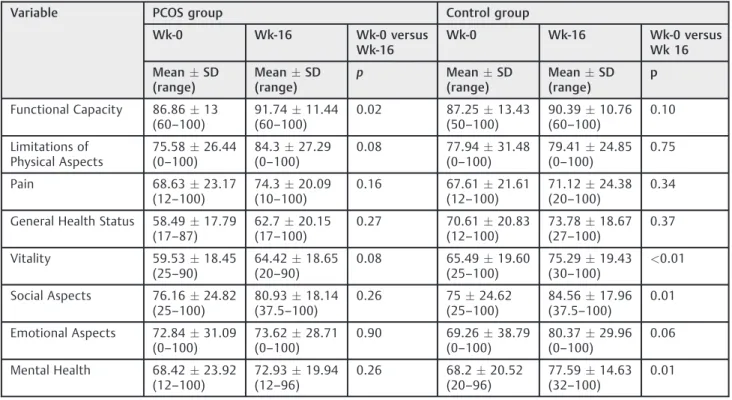
The analysis of the results of the SF-36 questionnaire indicated that the PCOS group had significant improve-ment in the score for functional capacity at week-16 relative to week-0 (86.8613 versus 91.7411.44; OR ¼-4.86, 95%CI¼-8.89 to -0.84,p¼0.02) (►Table 3).
Table 1 Baseline anthropogenic and clinical characteristics of subjects with and without polycystic ovary syndrome (N¼94)
Variable PCOS (N¼43) Control (N¼51) p
MeanSD (range)
MeanSD (range)
Age (years) 27.85.34
(18.33–37.77)
29.745.26 (19.28–37.76)
0.08
Height (m) 1.600.05
(1.46–1.68)
1.610.06 (1.48–1.75)
0.52
Weight (kg) 71.6514.3
(50.7–104.6)
67.3914.71 (46.5–110)
0.15
BMI (kg/m2) 27.91
5.51 (19.83–38.42)
25.995.49 (18.07–39.44)
0.08
Waist circumference (cm) 80.5911.87 (76.94–109.5)
75.8611.19 (59–108)
0.10
Testosterone (ng/dL) 88.9334.73 (30–182)
73.9429.4 (32–172)
0.02
Androstenedione (ng/mL) 120.343.29 (34.6–242.5)
98.4832.78 (42–168.8)
0.02
Glucose (mmol/L) 96.3116.84 (73–131)
95.817.75 (70–146)
0.53
Insulin (mU/L) 8.546.07 (1–24.8)
5.24.52 (1–32.9)
0.001
HOMA-IR 2.111.79
(0.2–10.55)
1.251.25 (0.18–7.53)
0.006
The control group had significant improvements in vitality, social aspects, and mental health at week-16 relative to week-0 respectively (65.4919.6 versus 75.2919.43; OR¼-9.81, 95%CI¼-14.88 to -4.74, p0.01; 75.0024.62 versus 84.5617.96; OR¼-9.57, 95%CI¼-17.22 to -1.92, p¼0.01; 68.220.52 versus 72.9319.94; OR¼-9.40, 95%CI¼-16.70 to -2.10,p¼0.01) (►Table 3).
Comparison of the SF-36 scores in the control and PCOS groups indicated that the control group had significantly better scores in general health status on both occasions (week-0: 58.49 versus 70.61; OR¼14.30, 95%CI¼6.26 to 22.34, p<0.01; week-16: 62.7 versus 73.78; OR¼13.18, 95%CI¼5.16 to 21.20, p<0.01), and vitality at week-16 (64.42 versus 75.29, OR¼11.92, 95%CI¼-1.25 to 15.27, p<0.01).
Discussion
The 16-week RET program improved the functional capacity domain of the SF-36 in women with PCOS. The control group had improved vitality, social aspects, and mental health domains of the SF-36 at 16 weeks.
Comparison of the two groups indicated that the PCOS group had higher baseline levels of testosterone and andro-stenedione, in agreement with the literature.27After the RET program, the PCOS group had a significantly lower level of testosterone and a significantly higher level of androstene-dione. Other investigators reported an increase in testoster-one level in sedentary women following participation in a physical exercise program.28In the present study, there was a reduction of total blood testosterone levels in the PCOS
Table 3 Results of the SF-36 questionnaire in the PCOS and control groups at week-0, week-16 (N¼43)
Variable PCOS group Control group
Wk-0 Wk-16 Wk-0 versus Wk-16
Wk-0 Wk-16 Wk-0 versus Wk 16
MeanSD (range)
MeanSD (range)
p MeanSD
(range)
MeanSD (range)
p
Functional Capacity 86.8613 (60–100)
91.7411.44 (60–100)
0.02 87.2513.43 (50–100)
90.3910.76 (60–100)
0.10
Limitations of Physical Aspects
75.5826.44 (0–100)
84.327.29 (0–100)
0.08 77.9431.48 (0–100)
79.4124.85 (0–100)
0.75
Pain 68.6323.17
(12–100)
74.320.09 (10–100)
0.16 67.6121.61 (12–100)
71.1224.38 (20–100)
0.34
General Health Status 58.4917.79 (17–87)
62.720.15 (17–100)
0.27 70.6120.83 (12–100)
73.7818.67 (27–100)
0.37
Vitality 59.5318.45 (25–90)
64.4218.65 (20–90)
0.08 65.4919.60 (25–100)
75.2919.43 (30–100)
<0.01
Social Aspects 76.1624.82 (25–100)
80.9318.14 (37.5–100)
0.26 7524.62 (25–100)
84.5617.96 (37.5–100)
0.01
Emotional Aspects 72.8431.09 (0–100)
73.6228.71 (0–100)
0.90 69.2638.79 (0–100)
80.3729.96 (0–100)
0.06
Mental Health 68.4223.92 (12–100)
72.9319.94 (12–96)
0.26 68.220.52 (20–96)
77.5914.63 (32–100)
0.01
Abbreviations: PCOS, polycystic ovary syndrome; SD, standart deviation; SF-36, 36-Item Short Form Health Survey; Wk, week. Table 2 Anthropometric data of women with PCOS at week-0, week-16 (N¼43)
Variable Wk-0 Wk-16 Wk-0 versus Wk-16
MeanSD (range)
MeanSD (range)
p
Weight (kg) 71.6514.3
(58.5–104.6)
71.0813.27 (51.4–105)
0.14
BMI (kg/m2) 27.915.51
(19.83–38.42)
27.685.06 (19.83–38.57)
0.12
Waist circumference (cm) 80.5911.87 (64–109.5)
79.3510.54 (64.5–105)
<0.01
group and the control group, as previously demonstrat-ed.29,30High-intensity force training is known to increase testosterone concentrations as an acute response.31 Howev-er, other studies demonstrated that RET causes a significant reduction in the level of the androgen receptor in certain muscle groups. This suggests the presence of different endo-crine responses to different types of exercise, and that there may also be specific responses for each type of skeletal musclefiber.32In the present study, the reduction of testos-terone following a 16-week RET may be explained by an increase in the level of androgen receptor due to physical exercise.33This response may differ according to the dura-tion of the physical training34 and the reduction of body fat.35A limitation of this study is that insulin resistance was not assessed after RET. However, it is important to highlight that basal insulin and HOMA values in the studied group were within normal levels.
In contrast, the 16-week RET increased the level of androstenedione in the PCOS group. A review of the litera-ture was unable to identify any studies that specifically evaluated androstenedione concentration after RET, al-though one study reported an increase of androstenedione concentration in athletes following aerobic exercises.36The present study also indicated a reduction of waist circumfer-ence in the PCOS group at week-16 relative to week-0, presumably reflecting a reduction of visceral fat. Visceral fat is the main substrate of the enzyme aromatase,37and is directly related to the synthesis of sex steroids. Thus, the reduction of visceral fat may have reduced the amount of aromatase, thereby leading to an increase in androstenedi-one concentration. The observation that women with PCOS have reduced waist circumference after RET agrees with other studies that also demonstrated this benefit;38 RET also has a positive impact on the QoL.
The present study showed that the PCOS group had im-proved QoL in all domains analyzed by the SF-36, although only the score for the functional capacity domain reached statistical significance. Functional capacity is a measure of the ability to carry out daily activities. Other studies have also examined the efficacy of physical exercise on the QoL in specific populations. For example, a study with women with fibromyalgia demonstrated improved strength, flexibility, cardiorespiratory function, vitality, emotional aspects, and mental health after aerobic exercise.39,40Another study with women with PCOS who engaged in aerobic exercise also demonstrated improvements in the functional capacity score and in the perception of health status.41However, there is no data on the effect of RET on the QoL of women with PCOS. Although the present study with women with PCOS employed a period of physical training similar to that used by Stener-Victorin et al,41the RET program of the present study consisted of exercises supervised by physical educators that were per-formed three times a week with a personalized resistance load. Thus, the main result of the present study is that a RET program guided by specialized professionals can improve the functional capacity of patients with PCOS.
The PCOS group also had a progressive improvement in the vitality domain, but this reached no statistical signifi
-cance. The control group had a significant improvement in vitality at week-16. Previous research has also reported the positive effects of aerobic exercise, alone or in combination with RET, although no previous studies have documented improvements in the vitality domain after RET in women with PCOS. There is evidence that a combination of RET and aerobic exercise improves the vitality of women with diabe-tes.42It is possible that the use of personalized training in pairs of patients with the supervision of a professional in the present study may be responsible for this result. Indeed, a recent study demonstrated that supervised training serves as a motivating factor, and increases adherence to a physical exercise program.43
Most domains of the SF-36 showed no correlation with testosterone in the PCOS group, except for the social aspects domain, which showed poor negative correlation with this hormone. There is no data in the literature on the influence of testosterone levels in PCOS women on the social aspects of the SF-36 domains. However, an indirect effect of this hormone may be speculated based on the beneficial effects of antiandrogenic compounds on all SF-36 domains (physical function, physical role function, vitality, mental health, social function, and emotional role function), as previously demonstrated.44 This indicates that lower androgen levels may be beneficial for the self-esteem of PCOS women acting positively on the domain“social aspects”, which is one the best evaluated domains in questionnaires that assess QoL in women.45
The control group had a significant improvement of the social domain after RET; in contrast, the PCOS group had no significant improvement in this domain. There were similar findings for the mental health domain. These data agree with other data that demonstrated an improvement of these do-mains with different physical exercise protocols,46 although there have been no previous studies with women with PCOS using the protocol employed in the present study.
A comparison of the control and PCOS groups indicated that the control group had better scores in the general health domain on the two occasions they were measured. These data agree with the literature, and confirm that relative to the general population, women with PCOS have lower QoL scores, especially in the domains of general health status, vitality, mental health, and social aspects.4,47PCOS is well-known to adversely affect various aspects of the social life and emotion-al status of the affected women. The interventions in the present study led to a reduction in waist circumference and an improvement in the functional capacity of women with PCOS, and this may have improved their overall sense of well-being, as well as their sexual function,48with a positive impact in their QoL. Indeed, a previous study indicated that BMI and waist circumference had a negative impact on the QoL of patients with PCOS.4
PCOS,49and these women must improve their metabolic and anthropometric parameters to resume ovulation.50An im-provement of anthropometric parameters is highly related to an improvement in the QoL of these women.
Conclusion
Women with PCOS benefited from RET, with improvement of some SF-36 domains, after 16 weeks of the supervised exercise program. Moreover, PCOS women may benefit from exercise to improve their endocrine parameters, and RET is an effective therapeutic regimen to improve the QoL of PCOS women. Thus, supervised RET is an effective therapeu-tic regimen that could be incorporated into protocols for the treatment of women who have PCOS and require interdisci-plinary care.
Acknowledgments
We would like to thank all of the members of the Centro de Educação Física, Esportes e Recreação (CEFER) at Univer-sidade de São Paulo, and the members of the Department of Obstetrics and Gynecology (FMRP-USP). The Fundação de Amparo à Pesquisa do Estado de São Paulo (FAPESP -process 10/08800–8) and the Coordenação de Aperfeiçoa-mento de Pessoal de Nível Superior (CAPES) funded this study. The authors have no conflicts of interest to declare. The results of the present study do not constitute any endorsement by the American College of Sports Medicine.
References
1 Sirmans SM, Pate KA. Epidemiology, diagnosis, and management of polycystic ovary syndrome. Clin Epidemiol 2013;6:1–13
2 Diamanti-Kandarakis E, Dunaif A. Insulin resistance and the polycystic ovary syndrome revisited: an update on mechanisms and implications. Endocr Rev 2012;33(6):981–1030
3 O’Reilly MW, Taylor AE, Crabtree NJ, et al. Hyperandrogenemia predicts metabolic phenotype in polycystic ovary syndrome: the utility of serum androstenedione. J Clin Endocrinol Metab 2014; 99(3):1027–1036
4 Benetti-Pinto CL, Ferreira SR, Antunes A Jr, Yela DA. The influence of body weight on sexual function and quality of life in women with polycystic ovary syndrome. Arch Gynecol Obstet 2015; 291(2):451–455
5 Drosdzol A, Skrzypulec V, Mazur B, Pawlińska-Chmara R. Quality of life and marital sexual satisfaction in women with polycystic ovary syndrome. Folia Histochem Cytobiol 2007;45(Suppl 1): S93–S97
6 Teede H, Deeks A, Moran L. Polycystic ovary syndrome: a complex condition with psychological, reproductive and metabolic man-ifestations that impacts on health across the lifespan. BMC Med 2010;8:41
7 Moran LJ, Hutchison SK, Norman RJ, Teede HJ. Lifestyle changes in women with polycystic ovary syndrome. Cochrane Database Syst Rev 2011;(2):CD007506
8 Wing RR. Physical activity in the treatment of the adulthood overweight and obesity: current evidence and research issues. Med Sci Sports Exerc 1999;31(11, Suppl)S547–S552
9 Volek JS, Vanheest JL, Forsythe CE. Diet and exercise for weight loss: a review of current issues. Sports Med 2005;35(1):1–9
10 Palomo T, Beninger RJ, Kostrzewa RM, Archer T. Affective status in relation to impulsive, motor and motivational symptoms: per-sonality, development and physical exercise. Neurotox Res 2008; 14(2–3):151–168
11 Banting LK, Gibson-Helm M, Polman R, Teede HJ, Stepto NK. Physical activity and mental health in women with polycystic ovary syndrome. BMC Womens Health 2014;14(1):51
12 Conte F, Banting L, Teede HJ, Stepto NK. Mental health and physical activity in women with polycystic ovary syndrome: a brief review. Sports Med 2015;45(4):497–504
13 Thomson RL, Buckley JD, Lim SS, et al. Lifestyle management improves quality of life and depression in overweight and obese women with polycystic ovary syndrome. Fertil Steril 2010;94(5): 1812–1816
14 Kraemer WJ, Ratamess NA. Fundamentals of resistance training: progression and exercise prescription. Med Sci Sports Exerc 2004; 36(4):674–688
15 Joham AE, Teede HJ, Hutchison SK, et al. Pigment epithelium-derived factor, insulin sensitivity, and adiposity in polycystic ovary syndrome: impact of exercise training. Obesity (Silver Spring) 2012;20(12):2390–2396
16 Harrison CL, Stepto NK, Hutchison SK, Teede HJ. The impact of intensified exercise training on insulin resistance andfitness in overweight and obese women with and without polycystic ovary syndrome. Clin Endocrinol (Oxf) 2012;76(3):351–357
17 Hutchison SK, Stepto NK, Harrison CL, Moran LJ, Strauss BJ, Teede HJ. Effects of exercise on insulin resistance and body composition in overweight and obese women with and without polycystic ovary syndrome. J Clin Endocrinol Metab 2011;96(1):E48–E56
18 Giallauria F, Palomba S, Vigorito C, et al. Androgens in polycystic ovary syndrome: the role of exercise and diet. Semin Reprod Med 2009;27(4):306–315
19 Goss AM, Chandler-Laney PC, Ovalle F, et al. Effects of a eucaloric reduced-carbohydrate diet on body composition and fat distribu-tion in women with PCOS. Metabolism 2014;63(10):1257–1264
20 Kogure GS, Piccki FK, Vieira CS, Martins WdeP, dos Reis RM. [Analysis of muscle strength and body composition of women with polycystic ovary syndrome]. Rev Bras Ginecol Obstet 2012; 34(7):316–322 Portuguese
21 Thomas S, Reading J, Shephard RJ. Revision of the Physical Activity Readiness Questionnaire (PAR-Q). Can J Sport Sci 1992;17(4): 338–345
22 Ware JE Jr, Sherbourne CD. The MOS 36-item short-form health survey (SF-36). I. Conceptual framework and item selection. Med Care 1992;30(6):473–483
23 McHorney CA, Ware JE Jr, Lu JF, Sherbourne CD. The MOS 36-item Short-Form Health Survey (SF-36): III. Tests of data quality, scaling assumptions, and reliability across diverse patient groups. Med Care 1994;32(1):40–66
24 Matuszak ME, Fry AC, Weiss LW, Ireland TR, McKnight MM. Effect of rest interval length on repeated 1 repetition maximum back squats. J Strength Cond Res 2003;17(4):634–637
25 Rhea MR, Phillips WT, Burkett LN, et al. A comparison of linear and daily undulating periodized programs with equated volume and intensity for local muscular endurance. J Strength Cond Res 2003; 17(1):82–87
26 Laguardia J, Campos MR, Travassos CM, Najar AL, Anjos LA, Vasconcellos MM. Psychometric evaluation of the SF-36 (v.2) questionnaire in a probability sample of Brazilian households: results of the survey Pesquisa Dimensões Sociais das Desigual-dades (PDSD), Brazil, 2008. Health Qual Life Outcomes 2011;9:61
27 Li X, Lin JF. [Clinical features, hormonal profile, and metabolic abnormalities of obese women with obese polycystic ovary syn-drome]. Zhonghua Yi Xue Za Zhi 2005;85(46):3266–3271 Chinese
29 Kogure GS, Miranda-Furtado CL, Silva RC, et al. Resistance exercise impacts lean muscle mass in women with polycystic ovary syndrome. Med Sci Sports Exerc 2016;48(4):589–598
30 Miranda-Furtado CL, Ramos FK, Kogure GS, et al. A nonrandom-ized trial of progressive resistance training intervention in wom-en with polycystic ovary syndrome and its implications in telomere content. Reprod Sci 2016;23(5):644–654
31 Miri M, Karimi Jashni H, Alipour F. Effect of exercise intensity on weight changes and sexual hormones (androstenedione and free testosterone) in female rats with estradiol valerate-induced PCOS. J Ovarian Res 2014;7:37
32 Deschenes MR, Maresh CM, Armstrong LE, Covault J, Kraemer WJ, Crivello JF. Endurance and resistance exercise induce musclefiber type specific responses in androgen binding capacity. J Steroid Biochem Mol Biol 1994;50(3–4):175–179
33 Willoughby DS, Taylor L. Effects of sequential bouts of resistance exercise on androgen receptor expression. Med Sci Sports Exerc 2004;36(9):1499–1506
34 Enea C, Boisseau N, Fargeas-Gluck MA, Diaz V, Dugué B. Circulat-ing androgens in women: exercise-induced changes. Sports Med 2011;41(1):1–15
35 McTiernan A, Tworoger SS, Rajan KB, et al. Effect of exercise on serum androgens in postmenopausal women: a 12-month ran-domized clinical trial. Cancer Epidemiol Biomarkers Prev 2004; 13(7):1099–1105
36 Baker ER, Mathur RS, Kirk RF, Landgrebe SC, Moody LO, William-son HO. Plasma gonadotropins, prolactin, and steroid hormone concentrations in female runners immediately after a long-dis-tance run. Fertil Steril 1982;38(1):38–41
37 Rice S, Patel B, Bano G, Ugwumadu A, Whitehead SA. Aromatase expression in abdominal omental/visceral and subcutaneous fat depots: a comparison of pregnant and obese women. Fertil Steril 2012;97(6):1460–6.e1
38 Roessler KK, Birkebaek C, Ravn P, Andersen MS, Glintborg D. Effects of exercise and group counselling on body composition and VO2max in overweight women with polycystic ovary syn-drome. Acta Obstet Gynecol Scand 2013;92(3):272–277
39 Latorre PA, Santos MA, Heredia-Jiménez JM, et al. Effect of a 24-week physical training programme (in water and on land) on pain, functional capacity, body composition and quality of life in women withfibromyalgia. Clin Exp Rheumatol 2013;31(6, Suppl 79)S72–S80
40 García-Martínez AM, De Paz JA, Márquez S. Effects of an exercise programme on self-esteem, self-concept and quality of life in women withfibromyalgia: a randomized controlled trial. Rheu-matol Int 2012;32(7):1869–1876
41 Stener-Victorin E, Holm G, Janson PO, Gustafson D, Waern M. Acupuncture and physical exercise for affective symptoms and health-related quality of life in polycystic ovary syndrome: secondary analysis from a randomized controlled trial. BMC Complement Altern Med 2013;13:131
42 Myers VH, McVay MA, Brashear MM, et al. Exercise training and quality of life in individuals with type 2 diabetes: a randomized controlled trial. Diabetes Care 2013;36(7):1884–1890
43 Courneya KS, Karvinen KH, McNeely ML, et al. Predictors of adherence to supervised and unsupervised exercise in the Alberta Physical Activity and Breast Cancer Prevention Trial. J Phys Act Health 2012;9(6):857–866
44 Caruso S, Rugolo S, Agnello C, Romano M, Cianci A. Quality of sexual life in hyperandrogenic women treated with an oral contraceptive containing chlormadinone acetate. J Sex Med 2009;6(12):3376–3384
45 Urzúa M A, Cortés K, Maita C, Osorio K, Caqueo-Urizar A. [Weight of specific domains on the overall quality of life according to the assessment of participants]. Rev Med Chil 2013;141(8):1010–1018
46 Partonen T, Leppämäki S, Hurme J, Lönnqvist J. Randomized trial of physical exercise alone or combined with bright light on mood and health-related quality of life. Psychol Med 1998;28(6):1359–1364
47 Li Y, Li Y, Yu Ng EH, et al. Polycystic ovary syndrome is associated with negatively variable impacts on domains of health-related quality of life: evidence from a meta-analysis. Fertil Steril 2011; 96(2):452–458
48 Lara LA, Ramos FK, Kogure GS, et al. Impact of physical resistance training on the sexual function of women with polycystic ovary syndrome. J Sex Med 2015;12(7):1584–1590
49 Vosnakis C, Georgopoulos NA, Rousso D, et al. Diet, physical exercise and Orlistat administration increase serum anti-Müller-ian hormone (AMH) levels in women with polycystic ovary syndrome (PCOS). Gynecol Endocrinol 2013;29(3):242–245