Rev Odontol UNESP. 2014 May-June; 43(3): 209-213 © 2014 - ISSN 1807-2577 ORIGINAL ARTICLE
Doi: http://dx.doi.org/10.1590/rou.2014.033
Evaluation of shear bond strength of orthodontic brackets
bonded on the tooth surface ater internal bleaching
Avaliação da resistência ao cisalhamento de briquettes ortodônticos colados na
superfície dentária após clareamento interno
Nadia de Souza FERREIRA
a, Patrícia Campos Ferreira da ROSA
a,
Rafaela Di Iorio Jeronymo FERREIRA
a, Marcia Carneiro VALERA
aaInstituto de Ciência e Tecnologia, UNESP – Univ Estadual Paulista, São José dos Campos, SP, Brasil
Resumo
Introdução: O apelo estético de pacientes que possuem dentes escurecidos é grande, pois atualmente os padrões estéticos se tornaram rigorosos e muitos pacientes antes ou durante o tratamento ortodôntico, realizam o procedimento de clareamento dental. Objetivo: Avaliar a adesão de braquetes ortodônticos em molares humanos que receberam clareamento interno. Material e método: Quarenta coroas de molares humanos foram divididas em quatro grupos, de acordo com o agente clareador utilizado: SP) perborato de sódio + água; SP) peróxido de carbamida; CP+SP) peróxido de carbamida + perborato de sódio; Cont) água (grupo controle). Os agentes clareadores colocados no interior das câmaras pulpares foram substituídos a cada 7 dias por 2 semanas, e a colagem dos braquetes foi efetuada após 30 dias do final do clareamento. O teste de resistência ao cisalhamento foi realizado em máquina de ensaios universal (Emic). Resultado: O teste estatístico ANOVA com nível de significância de 5% (p > 0,05), mostrou que não houve diferença estatística significante entre os grupos (p = 0,1214). Conclusão: Concluiu-se que os diferentes agentes clareadores estudados não interferem na resistência de adesão dos braquetes ao esmalte dentário e a colagem dos braquetes 30 dias após o clareamento interno é um procedimento seguro.
Descritores: Clareamento dental; esmalte dentário; resistência ao cisalhamento; braquetes ortodônticos.
Abstract
Introduction: There is great demand for esthetic treatment by patients who have discolored teeth, because currently aesthetic standards have become stricter and many patients have tooth bleaching procedures performed before or during orthodontic treatment. Objective: To evaluate the bonding of orthodontic brackets to human molars after internal tooth bleaching. Material and method: Forty molars were divided into four groups according to the bleaching agent used: PS) sodium perborate + water; PC) carbamide peroxide; PC + PS) carbamide peroxide + sodium perborate; Cont) water (control group). Bleaching agents placed inside the pulp chambers were replaced every 7 days for 2 weeks, and the brackets were bonded 30 days after the end of bleaching. The shear strength test was performed in a universal testing machine (Emic). Result: ANOVA with a significance level of 5% (p > 0.05), showed no statistically significant difference between groups (p = 0.1214). Conclusion: It was concluded that the different bleaching agents studied did not interfere with the bond strength of brackets to enamel and bonding the brackets 30 days after internal bleaching is a safe procedure.
Descriptors: Tooth bleaching; dental enamel; shear strength; orthodontic brackets.
INTRODUCTION
Bleaching darkened teeth may avoid invasive treatments, such as prosthetic procedures that require the wear of a large quantity of dental tissue when they are performed, so that bleaching is considered a more conservative alternative, which signiicantly changes the appearance of the teeth and increases the patient’s self esteem1,2. Especially in patients who will be submitted to orthodontic treatment, the prosthetic procedure should be avoided or delayed until ater tooth movement has been performed. hus, bleaching is a frequently used procedure in these cases.
he bleaching agents most used for internal tooth bleaching are carbamide and hydrogen peroxide, and sodium perborate3-6. Bleaching agents promote changes in the chemical composition of the tooth7 and may promote failures in the bond to dent and enamel6,8. It has been suggested that the quality of the resin composite bond to dentin may be harmed when restorations are performed immediately ater bleaching treatment9,10.
brackets when internal bleaching is performed in patients who will be submitted to orthodontic treatment.
herefore, the aim of this study was to determine the shear bond strength of orthodontic brackets bonded to the dentin surface of molars, 30 days ater internal bleaching performed with diferent bleaching agents.
he hypothesis of this study was that bleaching agents would diminish the bond strength of brackets.
MATERIAL AND METHOD
Forty molars recently extracted at the Surgery Clinic of the Dental School of São José dos Campos were selected. Ater collection, the teeth were submitted to manual scaling with a periodontal curette, to remove organic residues. he roots were sectioned in the horizontal direction using a double faced diamond coated disc (KG Sorensen, Barueri, São Paulo, Brazil) at low speed, at 2 mm from the amelocement junction. Coronal openings were performed on the occlusal surface with spherical diamond-coated bur number 1012 (KG Sorensen, Brazil) and the remaining pulp tissue from the pulp chamber was completely removed with a Hedströen (Dentisply Maillefer – Ballaigues – Switzerland) type ile, followed by irrigation with saline physiological solution. A 2mm thick bufer was made with glass ionomer cement (Vidrion F – SS White) sealing the entrance of the canal, and this bufer was placed right below the amelocement junction and the apical extremity was externally isolated with light polymerized resin composite (TPH – Dentsply – USA).
he teeth were divided into three experimental groups according to the bleaching agent used, and a control group, each containing 10 specimens.
- Group PS: Teeth bleached with sodium perborate (Farmácia Byofórmula – São José dos Campos – SP) + water;
- Group PC: Teeth bleached with 16% carbamide peroxide gel(Opalescence Endo, Ultradent – South Jordan – Utah – USA);
- Group PC+PS Teeth bleached with 16% carbamide peroxide gel (Opalescence Endo, Ultradent – South Jordan – Utah – USA) + sodium perborate (Farmácia Byofórmula – São José dos Campos – SP, Brazil);
- Control Group (n=10): deionized water.
Ater preparation of the tooth crowns, the bleaching agents were applied, illing the pulp chamber and the bleaching agent was protected with cotton wool. Ater this the access cavities were sealed with glass ionomer cement (Vidrion R – SS White) and the teeth were kept immersed in artiicial saliva13 in an oven at 37°C.
Ater 7 days, the glass ionomer seal was removed, and the cavity was irrigated with deionized water in order to change the bleaching agents, which would remain in the pulp chambers for another 7 days. At the end of the period of 14 days of bleaching, neutralization was performed with calcium hydroxide P.A. for another 7 days.
Ater 30 days from the end of bleaching, the orthodontic brackets were bonded on the vestibular surface of the specimens. With the aid of a laboratory silicone mold (Silibor) the specimens were embedded in colorless acrylic resin (Jet, Artigos
Odontológicos Clássico, São Paulo, SP, Brazil) maintaining the vestibular surface positioned on the bottom of the base. he acrylic resin of the test specimens was polished in a polishing machine with 200, 400 and 600 grit water abrasive papers (3M Brasil). hus the test specimens attained appropriate dimensions to allow them to be ixed to the appliance to perform the shear test.
Forty brackets (Morelli, SP - Brazil) with a base area of 17.64 mm2 were used in all the groups.For bracket bonding, prophylaxis of the specimens was performed . Ater this, they were acid etched with 37% phosphoric acid (Alpha Etch gel - DFL). Next, the primer of the Transbond XT kit (3M Unitek) was applied to the vestibular surface and light polymerized for 20 seconds. Ater this the brackets were bonded with Transbond XT (3M Unitek). he resin excesses were removed with an exploratory probe and the resin was light polymerized for 40 seconds.
he shear bond test was performed in a Universal Test Machine EMIC DL2000 (EMIC Equipamentos e Sistemas de Ensaio Ltda., Paraná – Brazil), with a 50 kg load cell, at a speed of 1.0 mm/min.
he specimens were individually ixed on a metal base and the specimen/metal base set was placed on the bottom portion of the test machine base with the object of avoiding any movement. On the top mobile portion of the machine, a metal tip with the shape of a beveled knife blade was ixed, which fell on the interface of the bracket and tooth enamel surface.
he load necessary to debond or initiate fracture of the test specimen was recorded in kilograms of force per square millimeter (Kgf/mm2), by means of a computer connected to the EMIC universal test machine, in a program managed by Windows 2002, and the value obtained on the surface at the base of the bracket was converted into MPa.
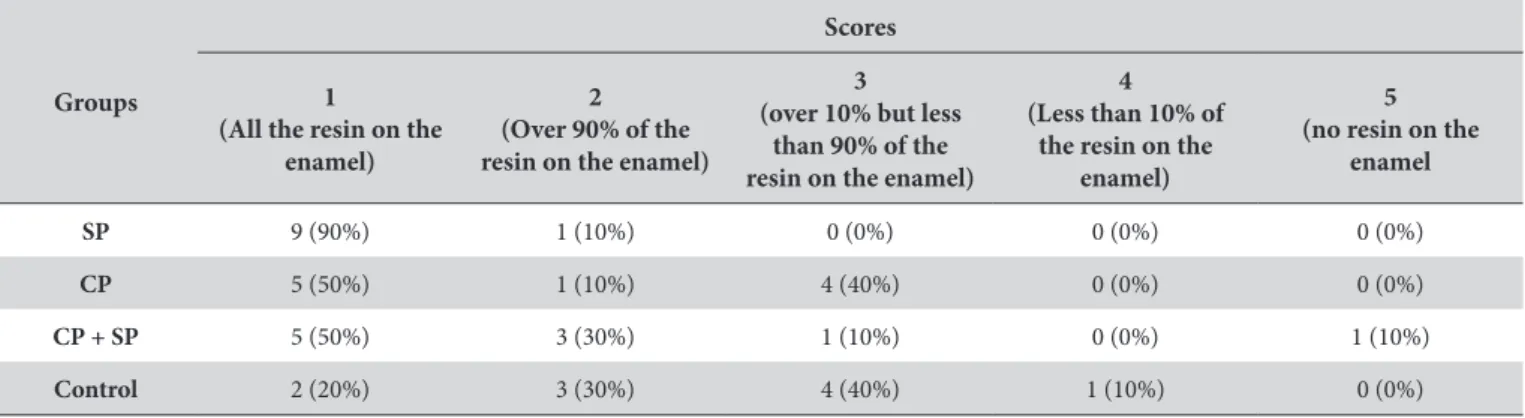
Ater the shear test, all the teeth and brackets were examined at 10X magniication. Any remaining resin ater removal of the bracket was evaluated and scored according the ARI8 scale that has the following scores: 5 – indicates that no resin remained on the enamel; 4 – less than 10% of the resin remained on the specimen; 3 – more than 10% but less than 90% of the resin remained on the specimen; 2 – more than 90% of the resin remained on the enamel and 1 – all the resin remained on the enamel, with the impression of the bracket bases.
he results were submitted to descriptive statistical analysis. he means and standard deviations were obtained, and the one-way ANOVA test was performed.
RESULT
Table 1 shows the descriptive statistics for the shear bond strength values of the diferent groups.
Ater the Kruskall-Wallis statistical test with a level of signiicance of 5%, it could be observed that there was no statistically signiicant diference among the groups (p=0.3102).
DISCUSSION
Alterations in the bond strength are of signiicant importance with respect to clinical procedures that involve the bond of resin composites, bracket bonding, and porcelain veneers, among others3,4
Previous studies have shown that there is a change in the structure of enamel, in its composition and bond strength when it is exposed to bleaching agents14-16. he bleaching procedure may reduce the microhardness of dentin and enamel17, weaken the mechanical properties of the tooth18, and reduce the bond strength of brackets to the tooth surface2, suggesting that bracket bonding should be performed 2 to 3 weeks ater bleaching.
Turkkahraman et al.5, veriied that alterations occur in enamel, caused by the bleaching agent, even with the use of a desensitizing agent19, signiicantly afecting the shear bond strength of orthodontic brackets to human tooth enamel.
However, Mishima et al.20 revealed that the bleaching agent altered the enamel surface, however, did not interfere in the shear bond strength. Uysal et al.1 showed that in oice bleaching with hydrogen peroxide did not afect the bond strength of brackets bonded immediately ater bleaching, or 30 days later. Uysal, Sisman3 showed that the use of carbamide peroxide immediately before bracket bonding signiicantly reduced the shear bond strength values, irrespective of the period of bonding, whether
immediately or 30 days ater bleaching. However, in the present study, it was veriied that bracket bonding 30 days ater bleaching was not afected, indeed some bond strength values were higher.
Furthermore, in the present study the specimens were kept in artiicial saliva during the experiment. he immersion of specimens in distilled water, artiicial saliva or even saline solution enables the reversal of the bond capacity of enamel4,14,21-24. Probably, the fact of the groups with bleaching agents obtained the best results, irrespective of the time of bleaching agent used, was due to the fact that the immersion of the specimens in artiicial saliva removed the residual oxygen from the bleaching material, leading to the dental structure regaining its bond properties to the level it had before bleaching25.
One observes that studies are still somewhat divergent about the interference of bleaching agents in bond strength. A common point observed is the consensus that favorable results are not observed when bracket bonding is performed immediately ater bleaching, recommending a waiting time of 30 days ater the procedure.
CONCLUSION
It was concluded that the diferent bleaching agents studied did not interfere in the bond strength of brackets bonded to enamel 30 days ater bleaching.
Table 2. Frequency of distribution of scores (%)
Groups
Scores
1
(All the resin on the enamel)
2 (Over 90% of the resin on the enamel)
3 (over 10% but less
than 90% of the resin on the enamel)
4 (Less than 10% of
the resin on the enamel)
5 (no resin on the
enamel
SP 9 (90%) 1 (10%) 0 (0%) 0 (0%) 0 (0%)
CP 5 (50%) 1 (10%) 4 (40%) 0 (0%) 0 (0%)
CP + SP 5 (50%) 3 (30%) 1 (10%) 0 (0%) 1 (10%)
Control 2 (20%) 3 (30%) 4 (40%) 1 (10%) 0 (0%)
Table 1. Descriptive statistics for the shear bond strength values (in MPa) of the diferent groups
Groups Mean Standard Deviation Minimum Maximum
SP 30.12 8.93 11.57 48.94
CP 39.95 14.56 17.36 60.15
CP+SP 37.65 14.06 13.14 64.92
REFERENCES
1. Uysal T, Bascitci FA, Usumez S, Sari Z, Buyukerkmen A. Can previously bleached teeth be bonded safely? Am J Orthod Dentofacial Orthop. 2003 Jun;123(6):628-32. http://dx.doi.org/10.1016/S0889-5406(03)00151-3
2. Mullins JM, Kao EC, Martin CA, Gunel E, Ngan P. Tooth whitening efects on bracket bond strength in vivo. Angle Orthod. 2009 Jul;79(4):777-83. PMid:19537855. http://dx.doi.org/10.2319/042308-226.1
3. Uysal T, Sisman A. Can previously bleached teeth be bonded safely using self-etching primer systems? Angle Orthod. 2008 Jul;78(4):711-5. http://dx.doi.org/10.2319/0003-3219(2008)078[0711:CPBTBB]2.0.CO;2
4. Josey AL, Meyers IA, Romaniuk K, Symons AL. he efect of a vital bleaching technique on enamel surface morphology and the bonding of composite resin to enamel. J Oral Rehabil. 1996 Apr;23(4):244-50. PMid:8730271. http://dx.doi.org/10.1111/j.1365-2842.1996.tb00848.x 5. Turkkahraman H, Adanir N, Gungor AY. Bleaching and desensitizer application efects on shear bond strengths of orthodontic brackets.
Angle Orthod. 2007 May;77(3):489-93. http://dx.doi.org/10.2319/0003-3219(2007)077[0489:BADAEO]2.0.CO;2
6. Cavalli V, Shinohara MS, Ambrose W, Malafaia FM, Pereira PN, Giannini M. Inluence of intracoronal bleaching agents on the ultimate strength and ultrastructure morphology of dentine. Int Endod J. 2009 Jul;42(7):568-75. PMid:19467056. http://dx.doi.org/10.1111/j.1365-2591.2009.01543.x
7. Rotstein I, Lehr Z, Gedalia I. Efect of bleaching agents on inorganic components of human dentin and cementum. J Endod. 1992 Jun;18(6):290-3. http://dx.doi.org/10.1016/S0099-2399(06)80956-8
8. Uysal T, Er O, Sagsen B, Ustdal A, Akdogan G. Can intracoronally bleached teeth be bonded safely? Am J Orthod Dentofacial Orthop. 2009 Nov;136(5):689-94. PMid:19892286. http://dx.doi.org/10.1016/j.ajodo.2007.11.033
9. Teixeira EC, Turssi CP, Hara AT, Serra MC. Inluence of post-bleaching time intervals on dentin bond strength. Braz Oral Res. 2004 Jan-Mar;18(1):75-9. PMid:15273791. http://dx.doi.org/10.1590/S1806-83242004000100014
10. Garcia-Godoy F, Dodge WW, Donohue M, O’Quinn JA. Composite resin bond strength ater enamel bleaching. Oper Dent. 1993 Jul-Aug;18(4):144-7. PMid:8152982.
11. Bishara SE, Sulieman AH, Olson M. Efect of enamel bleaching on the bonding strength of orthodontic brackets. Am J Orthod Dentofacial Orthop. 1993 Nov;104(5):444-7. http://dx.doi.org/10.1016/0889-5406(93)70070-5
12. Bishara SE, Oonsombat C, Soliman MM, Ajlouni R, Lafoon JF. he efect of tooth bleaching on the shear bond strength of orthodontic brackets. Am J Orthod Dentofacial Orthop. 2005 Dec;128(6):755-60. PMid:16360917. http://dx.doi.org/10.1016/j.ajodo.2004.07.044 13. Gohring TN, Zehnder M, Sener B, Schmidlin PR. In vitro microleakage of adhesive-sealed dentin with lactic acid and saliva exposure: a
radio-isotope analysis. J Dent. 2004 Mar;32(3):235-40. PMid:15001289. http://dx.doi.org/10.1016/j.jdent.2003.11.003
14. Bulut H, Turkun M, Kaya AD. Efect of an antioxidizing agent on the shear bond strength of brackets bonded to bleached human enamel. Am J Orthod Dentofacial Orthop. 2006 Feb;129(2): 266-72. PMid:16473720. http://dx.doi.org/10.1016/j.ajodo.2004.03.043
15. Miyazaki M, Sato H, Sato T, Moore BK, Platt JA. Efect of a whitening agent application on enamel bond strength of self-etching primer systems. Am J Dent. 2004 Jun;17(3):151-5. PMid:15301208.
16. Romano FL, Tavares SW, Nouer DF, Consani S, Borges de Araujo Magnani MB. Shear bond strength of metallic orthodontic brackets bonded to enamel prepared with Self-Etching Primer. Angle Orthod. 2005 Sep;75(5):849-53. PMid:16285044.
17. Lewinstein I, Hirschfeld Z, Stabholz A, Rotstein I. Efect of hydrogen peroxide and sodium perborate on the microhardness of human enamel and dentin. J Endod. 1994 Feb;20(2):61-3. http://dx.doi.org/10.1016/S0099-2399(06)81181-7
18. Perinka L, Sano H, Hosoda H. Dentin thickness, hardness, and Ca-concentration vs bond strength of dentin adhesives. Dent Mater. 1992 Jul;8(4):229-33. http://dx.doi.org/10.1016/0109-5641(92)90090-Y
19. Shahabi M, Heravi F, Mokhber N, Karamad R, Bishara SE. Efects on shear bond strength and the enamel surface with an enamel bonding agent. Am J Orthod Dentofacial Orthop. Mar;137(3):375-8.
20. Mishima FD, Valentim RG, Araujo MT, Ruellas AC, Sant’Anna EF. he efect of tooth bleaching on the enamel surface and the tensile force to debond orthodontic brackets. J Orthod. 2009 Dec;36(4):236-42. PMid:19934241. http://dx.doi.org/10.1179/14653120723265
21. Miles PG, Pontier JP, Bahiraei D, Close J. he efect of carbamide peroxide bleach on the tensile bond strength of ceramic brackets: an in vitro study. Am J Orthod Dentofacial Orthop. 1994 Oct;106(4):371-5. http://dx.doi.org/10.1016/S0889-5406(94)70058-3
22. Titley KC, Torneck CD, Ruse ND. he efect of carbamide-peroxide gel on the shear bond strength of a microil resin to bovine enamel. J Dent Res. 1992 Jan;71(1):20-4. PMid:1740551. http://dx.doi.org/10.1177/00220345920710010301
23. Bulut H, Kaya AD, Turkun M. Tensile bond strength of brackets ater antioxidant treatment on bleached teeth. Eur J Orthod. 2005 Oct;27(5):466-71. PMid:16043470. http://dx.doi.org/10.1093/ejo/cji044
24. Cavalli V, Arrais CA, Giannini M, Ambrosano GM. High-concentrated carbamide peroxide bleaching agents efects on enamel surface. J Oral Rehabil. 2004 Feb;31(2):155-9. PMid:15009600. http://dx.doi.org/10.1111/j.1365-2842.2004.01138.x
CONFLICT OF INTEREST
he authors declare no conlicts of interest.
CORRESPONDING AUTHOR
Marcia Carneiro Valera
Av. Eng. Francisco José Longo, 777, 12245-000 São José dos Campos - SP, Brasil e-mail: [email protected]