Rev Odontol UNESP. 2014 May-June; 43(3): 172-179 © 2014 - ISSN 1807-2577 ORIGINAL ARTICLE
Doi: http://dx.doi.org/10.1590/rou.2014.032
Weaning and associated factors in children from
low-income communities
Fatores associados ao desmame em crianças de comunidades de baixa renda
Anyele Kleine BUCKSTEGGE
a, Luciana Reichert da Silva ASSUNÇÃO
a,
Fernanda de Morais FERREIRA
a, Fabian Calixto FRAIZ
a, Margaret Cristina da Silva BOGUSZEWSKI
aaUFPR – Universidade Federal do Paraná, Curitiba, PR, Brasil
Resumo
Introdução: A duração média do aleitamento materno ainda é insuficiente e apresenta grandes variações em razão
do local e das características da população estudada. Objetivo: Analisar os fatores associados ao desmame em crianças sul brasileiras de comunidades de baixa renda. Material e método: Estudo transversal realizado através de entrevista envolvendo 124 mães de crianças com até 12 meses de idade, atendidas pela Pastoral da Criança, em Almirante Tamandaré, Paraná, Brasil. O risco ao desmame foi considerado como variável resposta e os dados do questionário, variáveis preditoras. Os dados foram analisados através do método de Kaplan-Meier, modelo de regressão de Cox e correlação de Spearman (α = 0,05). Resultado: A tábua de vida atuarial revelou uma probabilidade condicional de desmame maior aos 12 meses de idade, seguido do primeiro e quarto meses. A análise multivariada mostrou que o contato com a mamadeira antes do sexto mês de vida [HR=17,16 (2,34-125,86)] e o contato com a chupeta antes do sexto mês de vida [HR=3,48 (1,90-6,38)] foram variáveis de risco associadas ao desmame. Entre as crianças desmamadas, por ocasião da entrevista, a duração da amamentação apresentou correlação positiva com a idade do primeiro contato com açúcar (rs=+0,419; p=0,001) e negativa com a duração do uso de chupeta (rs=-0,300; p=0,017). Conclusão: O uso da mamadeira e da chupeta estiveram relacionados a uma menor duração do aleitamento materno nestas comunidades.
Descritores: Aleitamento materno; desmame; fatores de risco.
Abstract
Introduction: The average duration of breastfeeding is still insufficient and differ widely taking in account the location and specific characteristic of local people involved in these studies. Aim: This research aimed at studying factors associated to weaning among South Brazilian children living in a low-income household. Material and
method: Cross-sectional study was carried out enrolling 124 mothers of 1 to 12-month-old children, who were
interviewed at “Pastoral da Criança”(non-governmental organization) in Almirante Tamandaré, Paraná, Brazil. The risk of weaning considered was the dependent variable and the information collected from the questionnaires, independent variables. The method used to collect information in this study was Kaplan-Meier method and Cox regression model and Spearman’s rank correlation (α = 0.05). Result: Actuarial life table presented a higher weaning conditional probability at 12 months of age, followed by first and fourth months of age. Multivariate analysis pointed out that contact with bottle feeding before the sixth month of age [HR=17.16 (2.34-125.86)] and contact with pacifier before the sixth months of age [HR=3.48 (1.90-6.38)] are risk factors associated with weaning. Among children who were not breastfed at the moment of the interview, breastfeeding duration presented a positive correlation with the ages when the children had their first contact with sugar (rs=+0.419, p=0.001) and negative correlation with the use of pacifier (rs=-0.300, p=0.017). Conclusion: Results from this study showed that the use of the feeding bottle and pacifier were related to a shorter breastfeeding time span at these communities.
INTRODUCTION
he World Health Organization recommends exclusive breastfeeding until the child reaches six months of age and that, complemented with other types of nourishment, it persist until twenty-four months or more of age1.
In Brazil, several sectors of society develop actions intended to promote and maintain breastfeeding and, despite advances in the average duration of this practice, it is still insuicient and presents large variations due to the location and socioeconomic characteristics of the population being studied2.
he duration and prevalence of breastfeeding has been less in socioeconomically disadvantaged populations3, where the
negative consequences of the lack of breastfeeding may be even greater. Children who did not receive maternal milk efectively in the irst years of life have greater risk of developing infections, in addition to increased risk of morbidity and mortality from pneumonia and diarrhea4. On the other hand, the practice of
breastfeeding in low-income communities has contributed to the reduction in mortality in children less than ive years of age5.
he practice of breastfeeding is constructed from biological aspects and is socially conditioned6. Its success depends on several
variables and not only on the maternal desire to breastfeed. Cultural practices such as the introduction of other liquids, use of a paciier and bottle may inluence the reduction of the duration of the breastfeeding7. Factors related to the child such as low birth
weight may also contribute to early weaning8. Socioeconomic
status, educational level, working conditions and maternal age may also afect the motivation to breastfeed3,9.
Since breastfeeding is a practice that is intrinsically linked to the socioeconomic and cultural patterns of a particular population, it is highly appropriate that the characteristics of the breastfeeding pattern of speciic populations be known in order to evaluate the risk factors for early weaning and to contribute to the planning of health actions that favor its practice.
herefore, the objective of this study was to analyze the duration of breastfeeding and the factors associated with this practice in children from the south of Brazil, belonging to low-income communities, in the city of Almirante Tamandaré, in the state of Paraná, Brazil.
METHOD
1.
Design and Population of the Study
his is a cross-sectional, epidemiological study using retrospective data collected between June and September 2011, through interviews with mothers of children up to 12 years of age. he mothers were participants in monthly follow-up meetings of the Pastoral da Criança (non-governmental organization that promotes actions aimed at health, disease prevention, nutrition, education and citizenship) in Almirante Tamandaré (PR), in six low-income communities in the city. Pastoral da Criança acts in the prevention of infant mortality through actions promoting
healthy feeding, breastfeeding, monitoring pregnant women and child development.
According to data from the map of poverty and inequality from IBGE10 (2003), the incidence of poverty in the city of Almirante
Tamandaré is 48.63% (percentage of people below the poverty line). Pastoral da Criança monitors those children under six years of age and pregnant women who are part of this low-income population. According to data from the IBGE11 (2010), there were
1743 children under one year of age in the city at the time of the study. In June 2011, 145 children between one and 12 months of age were registered in the Pastoral da Criança Information System in the city of Almirante Tamandaré and were actively monitored, thus constituting the population of the present study. All were invited to participate in the study by means of signing a Free and Informed Consent form, signed by the parents. Criteria for exclusion included: children who, during the four months of data collection, did not show up at any of the Pastoral da Criança
monitoring meetings (n = 15); and, those for whom breastfeeding was impossible since birth due to infectious disease (like HIV) or anatomical problems and post-partum complications related to the mother (n = 6). hus, 124 pairs of mothers and children were evaluated. his study was approved by the Committee for Ethics in Research of the Health Sciences Department of UFPR (record CEP/SD 1095.020.11.03 CAAE 0019.0.091.000-11).
2.
Questionnaire and Pilot Study
A semi-structured questionnaire composed of open and closed questions adapted from another study with similar objectives12, was administered in an interview format.
For cultural adaptation of the language and veriication of its applicability for obtaining data that would respond to the objectives of the study, the questionnaire was submitted to pretesting, and was irst applied to ten mothers of children in the same age range served by Pastoral da Criança in other communities (metropolitan region of Curitiba). he sequence of questions and the timing of the interview were also veriied. he questionnaire was then reformulated and, to verify the understanding and consistency of the new version, a test-retest was done with 12 other mothers within 14 days. his version of the questionnaire was easily understood by all the mothers, having kappa values from 0.756 to 1.0 for nominal category variables and an intraclass correlation coeicient ranging from 0.906 to 1.0 for the numeric variables. he inal version of the questionnaire was used in the data collection, and the interviews were conducted by a single, previously trained researcher (AKB).
Data about gestational age, birth weight and height were obtained from the children’s health portfolios.
irst contact with sugar. Information about the occurrence and duration of the habits of thumb-sucking (“no” and “yes”), the use of a paciier (“no” and “yes”) and the use of the bottle (“no” and “yes”) was also collected.
3.
Statistical Analysis
he survival analysis was done, at irst, using actuarial life tables. For this model, the interruption of breastfeeding was considered the “outcome”. he censored observations were considered when the event of interest (weaning) did not happen13. For the univariate and multivariate analyses, the
outcome variable considered for the analyses was the duration of breastfeeding, measured in months. he independent variables were dichotomized and the reference category was considered to be the category that, according to the literature, hypothetically would be associated with a possible greater period of breastfeeding. his analysis was done using the Kaplan-Meier method, which allows the inclusion of censored data; that is, children who were still breastfeeding13. he survival curves were
compared using the log-rank test. Univariate and multivariate analyses were done using the Cox proportional hazards model. he assumption of proportional hazards was evaluated using the Schoenfeld residuals. he independent variables with p-values ≤0.25 were selected for the multiple regression model in the univariate analysis. his probability was stipulated so that possible predictive variables of the event would not be let out of the analysis14. he multiple model was constructed using the forward selection method.
he individual association between the duration of breastfeeding and the other continuous variables, in children who had already interrupted breastfeeding at the time of the interview,
was tested using the Spearman correlation coeicient (rs). he 5%
level of signiicance was adopted for all analyses, which were done using the STATA program (version 12.0).
RESULT
Among the 124 children evaluated, 64 (51.6%) were female. he mean age was 9.0 months, with a standard deviation (SD) of 3.2. here were 22 children (17.7%) who were less than 6 months old, and 102 (82.3%) were between 7 and 12 months.
he mean duration of breastfeeding was 5.6 months (SD = 4.0), with a median of 5 months.
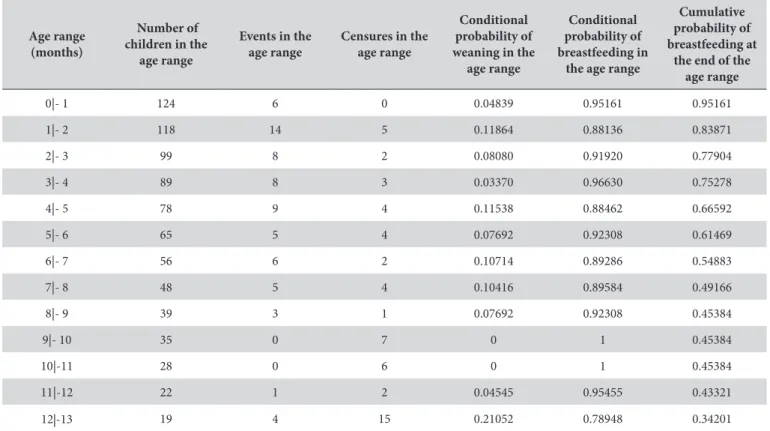
Table 1 shows the survival analysis calculated by the actuarial life table. he cumulative conditional probability of breastfeeding up to 6 months of age was 54.9%; and, up to 12 months, was 34.2%. A greater conditional probability of weaning at 12 months of age (21%) was observed, followed by the irst (11.9%), fourth (11.4%) and sixth (10.7%) months, respectively.
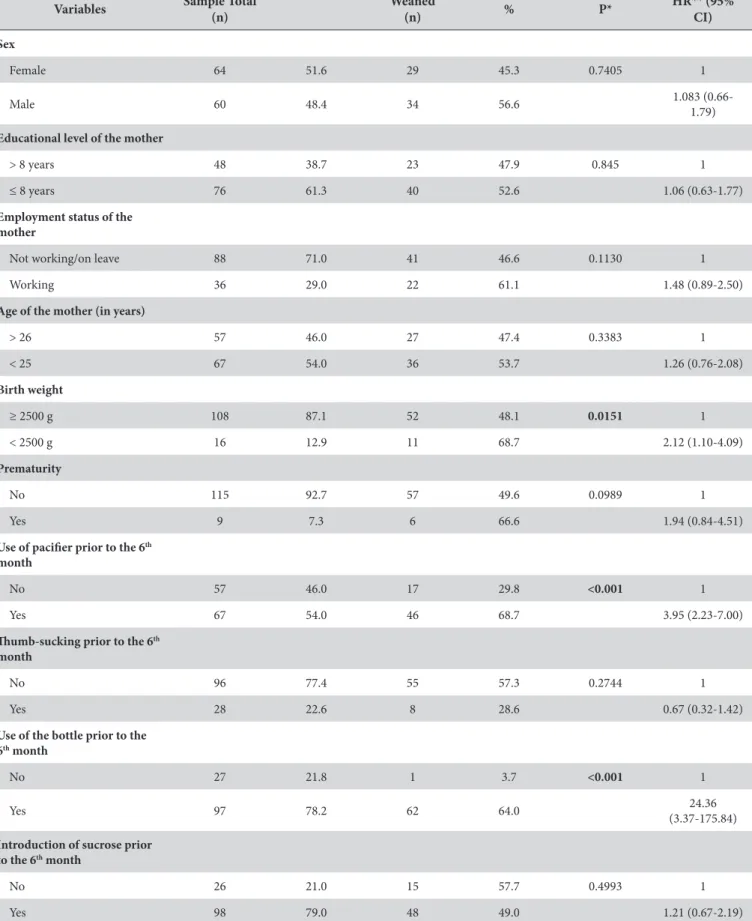
he Cox univariate regression model showed that low birth weight (HR=2.12; CI=1.10-4.09), the use of the bottle (HR=24.36; CI=3.37-175.84) and of the paciier (HR=3.95; CI=2.23-7.00) prior to six months of age were associated signiicantly with weaning (Table 2).
he survival curves showed signiicant diferences in the duration of breastfeeding according to the use of the paciier and bottle (Figure 1), with greater weaning rates among those children who used the paciier and bottle prior to the sixth month of life.
Analysis of the multivariate model showed that the use of the bottle prior to six months of life increased the risk of weaning by 17.16 times. Also, contact with the paciier in this age range
Table 1. Analysis of the actuarial table for breastfeeding
Age range (months)
Number of children in the
age range
Events in the age range
Censures in the age range
Conditional probability of weaning in the
age range
Conditional probability of breastfeeding in
the age range
Cumulative probability of breastfeeding at
the end of the age range
0|- 1 124 6 0 0.04839 0.95161 0.95161
1|- 2 118 14 5 0.11864 0.88136 0.83871
2|- 3 99 8 2 0.08080 0.91920 0.77904
3|- 4 89 8 3 0.03370 0.96630 0.75278
4|- 5 78 9 4 0.11538 0.88462 0.66592
5|- 6 65 5 4 0.07692 0.92308 0.61469
6|- 7 56 6 2 0.10714 0.89286 0.54883
7|- 8 48 5 4 0.10416 0.89584 0.49166
8|- 9 39 3 1 0.07692 0.92308 0.45384
9|- 10 35 0 7 0 1 0.45384
10|-11 28 0 6 0 1 0.45384
11|-12 22 1 2 0.04545 0.95455 0.43321
Table 2. Socio-demographic and behavioral characteristics in the total sample, and for the children who were weaned at the time of the interview
Variables Sample Total (n)
Weaned
(n) % P*
HR** (95% CI)
Sex
Female 64 51.6 29 45.3 0.7405 1
Male 60 48.4 34 56.6 1.083
(0.66-1.79)
Educational level of the mother
> 8 years 48 38.7 23 47.9 0.845 1
≤ 8 years 76 61.3 40 52.6 1.06 (0.63-1.77)
Employment status of the mother
Not working/on leave 88 71.0 41 46.6 0.1130 1
Working 36 29.0 22 61.1 1.48 (0.89-2.50)
Age of the mother (in years)
> 26 57 46.0 27 47.4 0.3383 1
< 25 67 54.0 36 53.7 1.26 (0.76-2.08)
Birth weight
≥ 2500 g 108 87.1 52 48.1 0.0151 1
< 2500 g 16 12.9 11 68.7 2.12 (1.10-4.09)
Prematurity
No 115 92.7 57 49.6 0.0989 1
Yes 9 7.3 6 66.6 1.94 (0.84-4.51)
Use of paciier prior to the 6th
month
No 57 46.0 17 29.8 <0.001 1
Yes 67 54.0 46 68.7 3.95 (2.23-7.00)
humb-sucking prior to the 6th
month
No 96 77.4 55 57.3 0.2744 1
Yes 28 22.6 8 28.6 0.67 (0.32-1.42)
Use of the bottle prior to the 6th month
No 27 21.8 1 3.7 <0.001 1
Yes 97 78.2 62 64.0 (3.37-175.84)24.36
Introduction of sucrose prior to the 6th month
No 26 21.0 15 57.7 0.4993 1
Yes 98 79.0 48 49.0 1.21 (0.67-2.19)
*Log-rank test. **Crude hazard ratio, univariate analysis using the Cox proportional hazards model.
presented a 3.48 times greater risk of weaning, adjusted for the employment status of the mother (Table 3).
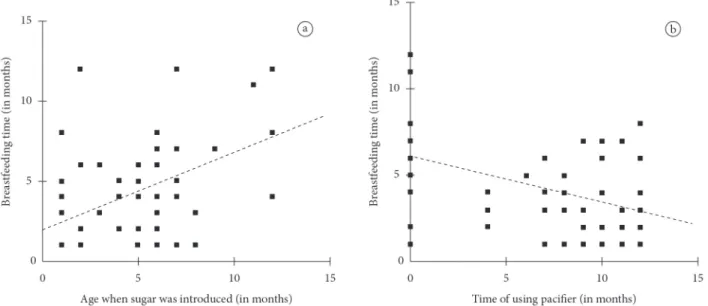
he age at which sugar was introduced was positively correlated with the duration of breastfeeding (Figure 2a); whereas, the time of using the paciier showed an inverse correlation with
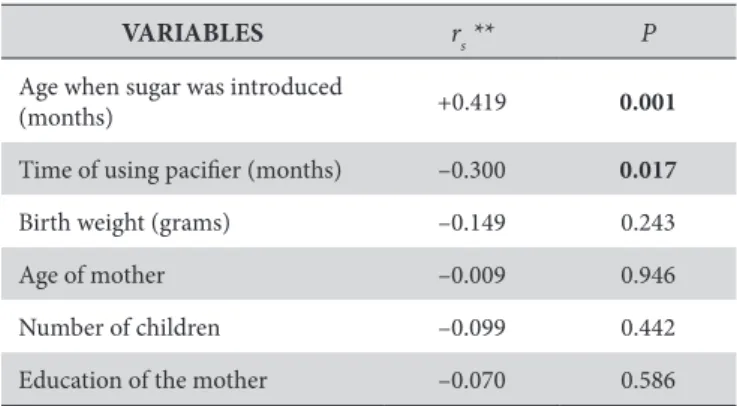
the duration of breastfeeding (Figure 2b) (p < 0.05; rs = +0.419 and
Figure 1. a. Survival curve of the time of breastfeeding stratiied by the use of the paciier prior to the sixth month of life. b. Survival curve of the time of breastfeeding stratiied by the use of the bottle prior to the sixth month of life.
Table 3. Independent variables associated with weaning identiied by the Cox proportional hazards model, adjusted by the employment status of the mother during the period. Multivariate regression analysis
Variable Category HR (crude) HR (adjusted) CI 95% (HR adjusted)
Bottle
No 1 1 1
es 24.36 17.16 2.34-125.86
Paciier
No 1 1 1
Yes 3.95 3.48 1.90-6.38
Employment status of the mother
Not
working/on leave 1 1 1
Working 1.48 1.35 0.79-2.33
DISCUSSION
In this group, the cumulative probability of breastfeeding at 12 months of age (34.2%) was highly similar to the values of the prevalence of breastfeeding at 12 months obtained for the southern region in the 2008 national survey2, which was 37.9%.
At 6 months of age, the cumulative probability of breastfeeding was 54.9%, the approximate value of the prevalence found in a 2012 study conducted in the state of Rio Grande do Sul (56.4%)7.
Contrasted to the results of the present study, a 2009 study performed in Curitiba with children from low-income families showed that 54.2% of children up to 2 years of age were still being breastfed15. he diferences observed in the duration and
prevalence of breastfeeding among populations with geographic proximity, as is the case of Curitiba and Almirante Tamandaré, highlights the complex network of variables capable of inluencing this practice and justiies the development of studies to identify the factors associated with weaning in speciic communities. Independently of the diferences observed, these values are much lower than those recommended by the WHO, which suggests the extent of breastfeeding up to two years of life1.
Among the variables capable of inluencing the duration of breastfeeding, the outstanding socioeconomic and demographic conditions include income3, schooling13, age16 and mother’s
work3. However, in this study, the variables corresponding
to the age, schooling and employment status of the mothers had no statistically signiicant association with the length of breastfeeding.
Univariate analysis showed that low birth weight children had two times greater risk of having been weaned precociously. Another study with children from the south of Brazil belonging to low income families also identiied low birth weight as a risk factor in weaning before two years of life15. Low birth weight,
primarily when associated with prematurity, may cause alterations in the suction of the baby during breastfeeding, consequently resulting in precocious weaning17. he study by Sanches et al.18
found that only 33.3% of low birth weight babies were exclusively breastfed up to 3 months of age and that the diiculties presented in the irst feedings were signiicantly associated to precocious weaning in this population. On the other hand, this variable did not remain in the inal model when adjusted for other factors.
In the present study, the use of the paciier and the longer duration of this habit were associated with the shorter duration of breastfeeding. he use of paciiers as a time modifying factor during breastfeeding has been demonstrated in other Brazilian studies with low-income communities13,19,20. When breastfeeding
has not yet been established, the use of paciiers may result in precocious weaning21. It is possible that the precocious and high
daily frequency use of the paciier may result in reduction of the feedings and, consequently, in less stimulation of the breasts and reduction in the production of maternal milk, creating the need for complementary feeding22. hus, the use of paciiers in the irst
weeks of life should be avoided23. However, the introduction of the
paciier does not appear to afect the prevalence or the duration of breastfeeding when the practice is already established24,
particularly among women with less diiculty and greater conidence in relation to breastfeeding22.
Conirming previous studies7,25, the precocious introduction
of the bottle was a risk factor for weaning in the population studied. Children who use the bottle are more prone to the interruption of breastfeeding and the introduction of new foods in the diet25. Items, such as bottles and paciiers, are culturally
accepted for weaning the child, replacing the maternal nipple22.
he fact that precocious weaning and bottle use may increase the risk of obesity7, childhood diabetes26 and dental caries27 make the
educational measures focused on this aspect highly important. he reduced duration of breastfeeding in children who had contact with sugar at younger ages may be related to the presence of complementary foods which, in low-income populations such as the one in this study, are composed in large part of sugary liquids. Ofering teas and other sweetened milks at a young age may cause gastric illing in the child and reduce the stimulation of the breasts, representing a possible risk factor for weaning28.
In addition, children who are genetically predisposed to prefer sweet tastes tend to prefer foods rich in sugar as a substitute for milk; and, the expressions of this preference may encourage the mothers to increase the ofering of these foods to the detriment of breastfeeding29.
hese aspects should be considered in the formulation of strategies to promote breastfeeding, which potentially will have positive impacts on the prevention of obesity, childhood diabetes and dental caries.
he present study is limited in that it is a cross-sectional survey, which makes it impossible to establish a causal relationship. he data were recorded from the responses regarding phenomena that occurred as much as 12 months previously, raising the possibility of memory bias. However, the reliability of the responses is greater in studies about breastfeeding30.
CONCLUSION
he results of the present study support the conclusion that, in this population, weaning is inluenced mainly by behavioral factors. Measures speciic to these communities should be implemented, including orientation to delay infant contact with sugar, avoid the use of bottles and discourage the use of paciiers when breastfeeding is not yet established.
Table 4. Correlation between duration of breastfeeding and variables of interest (n = 63*)
VARIABLES rs ** P
Age when sugar was introduced
(months) +0.419 0.001
Time of using paciier (months) –0.300 0.017
Birth weight (grams) –0.149 0.243
Age of mother –0.009 0.946
Number of children –0.099 0.442
Education of the mother –0.070 0.586
REFERENCES
1. World Health Organization. Global strategy for infant and young child feeding. Geneva; 2003.
2. Brasil. Ministério da Saúde. Secretaria de Atenção a Saúde. II Pesquisa de prevalência do aleitamento materno nas capitais e Distrito Federal [internet]. Brasília: MS; 2009 [citado em 2012 Fev 30]. Disponível em: http://www.iocruz.br/redeblh/media/pesquisa.pdf 3. Faleiros FTV, Trezza EMC, Carandina L. Aleitamento materno: fatores de inluência na sua decisão e duração. Rev Nutr. 2006;19(5):623-30.
http://dx.doi.org/10.1590/S1415-52732006000500010
4. Giugliani ER, Issler RM, Justo EB, Sefrin CF, Hartmann RM, Carvalho NM. Risk factors for early termination of breast feeding in Brazil. Acta Paediatr. 1992; 81(6-7):484-7. PMid:1392358. http://dx.doi.org/10.1111/j.1651-2227.1992.tb12279.x
5. Jones G, Steketee RW, Black RE, Bhutta ZA, Morris SS. How many child deaths can we prevent this year? Lancet. 2003;362(5):65-71. http://dx.doi.org/10.1016/S0140-6736(03)13811-1
6. Almeida JAG, Novak FR. Amamentação: um híbrido natureza-cultura. J Pediatr. 2004; 80(5 supl): S119-S25.
7. Feldens CA, Vitolo MR, Rauber F, Cruz LN, Hilgert JB. Risk factors for discontinuing breastfeeding in southern Brazil: a survival analysis. Matern Child Health. 2012; 16(6): 1257-65. PMid:21948218. http://dx.doi.org/10.1007/s10995-011-0885-7
8. Granville-Garcia AFG, Lins RDAU, Oliveira ACB, Paiva SM, Sousa RV, Martins V, et al. Factors associated with early-weaning at a child-friendly-health care initiative hospital. Rev Odonto Ciênc. 2012; 27(3): 202-7. http://dx.doi.org/10.1590/S1980-65232012000300005 9. Escobar AMU, Ogawa AR, Hiratsuka M, Kawashita MY, Teruya PY, Grisi S, et al. Aleitamento materno e condições sócio-econômicas
culturais: fatores que levam ao desmame precoce. Rev Bras Saúde Mater Infant. 2002; 2(3): 253-61. http://dx.doi.org/10.1590/S1519-38292002000300006
10. IBGE. Mapa de pobreza e desigualdades. Municípios Brasileiros [ciado em 2011 Nov 15]. Disponível em: http://www.ibge.gov.br/ cidadesat/xtras/temas.php?codmun=410040&idtema=19.
11. IBGE. Censo demográico 2010: sinopse [citado em 2011 May 24]. Disponível em: http://www.ibge.gov.br/cidadesat/xtras/temas. php?codmun=410040&idtema=1
12. Saldiva SRDM, Escuder MM, Mondini L, Levy RB, Venâncio SI. Feeding habits of children aged 6 to 12 months and associated maternal factors. J Pediatr. 2007; 83(1): 53-8. PMid:17279291. http://dx.doi.org/10.2223/JPED.1588
13. Silveira FJF, Lamounier JA. Fatores associados a duração do aleitamento materno em três municípios na região do Alto Jequitinhonha, Minas Gerais, Brasil. Cad Saúde Pública. 2006; 22(1): 69-77. PMid:16470284. http://dx.doi.org/10.1590/S0102-311X2006000100008 14. Hosmer DW, Lemenshow S. Applied logistic regression. New York: Johns Wiley & Sons; 1989.
15. Baptista GH, Andrade AHHKG, Giolo SR. Fatores associados à duração do aleitamento materno em crianças de famílias de baixa renda da região Sul da cidade de Curitiba, Paraná, Brasil. Cad Saúde Pública. 2009; 25(3): 596-604. PMid:19300848. http://dx.doi.org/10.1590/ S0102-311X2009000300014
16. Pinelli J. Atkinson SA, Saigal S. Randomized trial of breastfeeding support in very low-birth-weight infants. Arch Pediatr Adolesc Med. 2001; 155(5): 548-53. PMid:11343496. http://dx.doi.org/10.1001/archpedi.155.5.548
17. Sanches MTC. Clinical managements of oral disorders in breastfeeding. J Pediatr. 2004; 80(5): s155-s62. http://dx.doi.org/10.1590/S0021-75572004000700007
18. Sanches MTC, Buccini GS, Gimeno SGA, Rosa TEC, Bonamigo AW. Fatores associados à interrupção do aleitamento materno exclusivo de lactentes nascidos com baixo peso assistidos na atenção básica. Cad Saúde Púbica 2011; 27(5): 953-65. http://dx.doi.org/10.1590/ S0102-311X2011000500013
19. Franco CS, Nascimento MBR, Reis MAM, Issler H, Grisi SJFE. Aleitamento materno exclusivo em lactentes atendidos na rede pública do município de Joinville, Santa Catarina, Brasil. Rev Bras Saúde Mater Infantil. 2008; 8(3): 291-7. http://dx.doi.org/10.1590/S1519-38292008000300008
20. Cunha AJLA, Leite AM, Machado MMT. Breastfeeding and paciier use in Brazil. Indian J Pediatr. 2005; 72(3): 209-12. http://dx.doi. org/10.1007/BF02859257
21. Cotrim LC, Venancio SI, Escuder MML. Uso de chupetas e amamentação em crianças menores de quatro meses no estado de São Paulo. Rev Bras Saúde Mater Infant. 2002; 2(3): 245-52. http://dx.doi.org/10.1590/S1519-38292002000300005
22. Richard L, Alade MO. Breastfeeding and the paciier use. Birth. 1997; 24(2): 116-20. http://dx.doi.org/10.1111/j.1523-536X.1997.tb00351.x 23. Victora CG, Behague DP, Barros FC, Olinto MT, Weiderpass E. Paciier use and short breastfeeding duration: cause, consequence or
coincidence? Pediatrics. 1997; 99(3): 445-53. PMid:9041303. http://dx.doi.org/10.1542/peds.99.3.445
24. Kronborg H, Vaeth M. How are efective breastfeeding technique and paciier use related to breastfeeding problems and breastfeeding duration? Birth. 2009; 36(1): 34-42. PMid:19278381. http://dx.doi.org/10.1111/j.1523-536X.2008.00293.x
25. Saliba NA, Zina LG, Moimaz SAS, Saliba O. Frequências e variáveis associadas ao aleitamento materno em crianças com até 12 meses de idade no município de Araçatuba, São Paulo, Brasil. Rev Bras Saúde Mater Infantil. 2008; 8(4): 481-90. http://dx.doi.org/10.1590/S1519-38292008000400014
27. Bahuguna R, Younis Khan S, Jain A. Inluence of feeding practices on dental caries. A case-control study. Eur J Paediatr Dent. 2013; 14(1): 55-8. PMid:23597222.
28. Lande B, Andersen LF, Veierod MB, Baerug A, Johansson L, Trygg KU, et al. Breast-feeding at 12 months of age and dietary habits among breast-fed and non breast-fed infants. Public Health Nutr. 2003; 7(4): 495-503.
29. Menella JA, Forestell CA, Morgan LK, Beauchamp GK. Early Milk feeding inluences taste acceptance and liking during infancy. Am J Clin Nutr. 2009; 90(3): 780S-8S. PMid:19605570 PMCid:PMC3136007. http://dx.doi.org/10.3945/ajcn.2009.27462O
30. Vobecky JS, Vobecky J, Froda S. he reliability of the maternal memory in a retrospective assessment of nutritional status. J Clin Epidemiol. 1988; 41(3): 261-265. http://dx.doi.org/10.1016/0895-4356(88)90130-8
CONFLICTS OF INTERESTS
he authors declare no conlicts of interest.
CORRESPONDING AUTHOR
Luciana Reichert da Silva Assunção
Departamento de Estomatologia, UFPR – Universidade Federal do Paraná, Av. Pref. Lothário Meissner, 632, 80210-170 Jardim Botânico, Curitiba - PR, Brasil
e-mail: [email protected]