Fabiola RohdenI Jane RussoII
I Departamento de Antropologia. Instituto de Filosofi a e Ciências Humanas. Universidade Federal do Rio Grande do Sul. Porto Alegre, RS, Brasil
II Departamento de Políticas e Instituições de Saúde. Instituto de Medicina Social. Universidade do Estado do Rio de Janeiro. Rio de Janeiro, RJ, Brasil
Correspondence: Fabiola Rohden Depto. de Antropologia
Instituto de Filosofi a e Ciências Humanas Universidade Federal do Rio Grande do Sul Av. Bento Gonçalves, 9500 – Campus do Vale 91509-900 Porto Alegre, RS, Brasil E-mail: [email protected] Received: 6/24/25010
Approved: 2/27/2011
Article available from: www.scielo.br/rsp
Gender differences in the fi eld
of sexology: new contexts and
old defi nitions
ABSTRACT
OBJECTIVE: To analyze concepts of gender and sexuality present in the fi eld
of sex therapeutic interventions.
METHODOLOGICAL PROCEDURES: An ethnographic observation was
conducted, and it was completed with the analysis of printed material originated from the X Congresso Brasileiro de Sexualidade Humana (10th Brazilian
Congress on Human Sexuality), promoted by the Sociedade Brasileira de Estudos em Sexualidade Humana (Brazilian Society of Human Sexuality Studies), and the VIII Congresso Brasileiro sobre Inadequações Sexuais (8th
Brazilian Congress on Sexual Inadequacies), promoted by the Associação Brasileira para o Estudo das Inadequações Sexuais (Brazilian Association of Sexual Inadequacy Studies), both held in 2005. The analysis emphasized the interaction between the quantitative perspective in the processing of the variables (participants’ gender and profession and lecture topics) and the qualitative perspective in the analysis and interpretation of the more general set of data.
RESULTS: The topics of sessions and focus of presentations suggest that the
fi eld is divided by the contrast between two medical specialties: gynecology and urology, the former is aimed at female and couple dysfunctions, while the latter is aimed at male dysfunctions.
CONCLUSIONS: Male sexuality is approached from the predominantly
biomedical perspective, centered on the physiology of erection and drug prescription, whereas female sexuality is considered to be conditioned by relationship problems, when psychological intervention is more adequate.
DESCRIPTORS: Gender and Health. Sexology. Health Personnel. Health
Knowledge, Attitudes, Practice.
INTRODUCTION
The present article aimed to analyze how doctors’ and psychologists’ modern interventions in sexuality update or redefi ne more traditional concepts of gender and sexuality.
The analysis used studies on gender and science as its framework, showing how gender conditioning factors are involved in the relationship between knowledge production and social context. Considering the fact that there is no production out of context, this analysis points to the complex integration among social demands, scientifi c production and reincorporation of such production in the socio-cultural environment.3,6,10,11,12,16,20,22 The most important aspect of
The focus was on the interaction among different participants and on the interplay of interests and world views involved in the discourses and practices produced in this new phase of medicalization of sexuality. This phase is marked by the great presence of the pharma-ceutical industry and it implies the re-updating of sexual norms, now aimed at obtaining maximum performance with the help of drugs.7,13-15,17
Medicalization has been discussed in the field of sociology of knowledge, which problematizes the reductionist use of the term. Medlicalization is a broad and complex phenomenon, which includes everything from the defi nition of a certain type of behavior as deviant in medical terms to scientifi c discoveries that make this legitimate, proposed treatments and the wide network of social, political and economic interests.5,19
It also includes specifi c correlated questions, such as the de-medicalization process, which involved the doctors’ loss of power to the pharmaceutical industry or the diversifi cation of professionals in sexuality treatment.8,23,24
Sexology, the main theory and practice in this process, had a double birth.1,2 The fi rst one occurred in the
second half of the 19th century, with a focus on
nosog-raphy, in contrast to therapeutics, and favoring sexually transmitted diseases, the psychopathology of sexuality and eugenics. The second one was born in the 1920s, with important landmarks such as Reich’s works on the function of orgasm and those of Kinsey, who helped to establish orgasm as the main problem of studies on sexuality.1,4
Proto-sexology was concentrated on the diffi culties in the functioning of reproductive sexuality, such as sexually transmitted diseases, “sexual aberrations” and contraceptive techniques and it was not concerned about distinguishing itself from other areas of medicine, such as psychiatry, legal medicine or urology. On the other hand, the second sexology established its autonomy from medical specialties, especially through the affi r-mation of a particular object – orgasm – and an essential norm – the “ideal orgasm”. Deviations from “normal” sexuality, about which 20th century sexologists were
concerned, are different from traditional “aberrations”: the focus is on couple and genital sexuality and it involves a broad continuum of sexual dysfunctions.1,4
METHODOLOGICAL PROCEDURES
The partial results of the research project entitled “Sexualidade, Ciência e Profi ssão na América Latina” (Sexuality, Science and Profession in Latin America), which had a socio-anthropological approach and was conducted by the Centro Latino-Americano em Sexualidade e Direitos Humanos (Latin American Center of Sexuality and Human Rights) in partnership
with the Institut National de la Santsé et de la Recherche Medicale, were used as basis for this study. Extensive mapping of interventions in sexuality was conducted, such as the identifi cation of main institutions, profes-sionals, research groups, publications and qualifi cation courses and events in six Latin American countries.18,21
The two most important Brazilian congresses in the area were analyzed: the X Congresso Brasileiro de Sexualidade Humana (10th Brazilian Congress
on Human Sexuality), promoted by the Sociedade Brasileira de Estudos em Sexualidade Humana
(SBRASH – Brazilian Society of Human Sexuality Studies) and the VIII Congresso Brasileiro sobre Inadequações Sexuais (8th Brazilian Congress on Sexual
Inadequacies), promoted by the Associação Brasileira para o Estudo das Inadequações Sexuais (ABEIS – Brazilian Association of Sexual Inadequacy Studies), both held in 2005.
The 10th Brazilian Congress on Human Sexuality
occurred between September 15th and 17th 2005, at the
Centro de Convenções da Associação Médica do Rio Grande do Sul, in Porto Alegre (Southern Brazil), the city that hosted the SBRASH at that moment. The 8th
Brazilian Congress on Sexual Inadequacies, promoted by the ABEIS, was held between July 28th and 30th 2005,
in the city of Belo Horizonte (Southeastern Brazil). An ethnographic observation was conducted and complemented with documental analysis of printed material. Researchers (two in the SBRASH Congress and one in the ABEIS Congress) participated in activi-ties promoted by the congresses. In the lectures and seminars, a diversity of themes was observed, with a focus on the lecturers and audience (number of people, number of women and men, and others) and researchers sought to approach participants in informal conversa-tions. Physical structuring of space (conference rooms and common space between events) was also observed. Folders and promotion materials distributed on stands or during the lectures were collected, in addition to programs and offi cial bulletins from congresses.
RESULTS AND DISCUSSION
History of the fi eld and its main associations
In the 1970s, in the city of Rio de Janeiro (Southeastern Brazil), the Núcleo de Sexologia da Sociedade de Ginecologia e Obstetrícia do Rio de Janeiro (SGORJ – Sexology Center of the Rio de Janeiro Society of Gynecology and Obstetrics) was founded by gyne-cologists and psychologists. In the beginning of the 1980s, participants of this center founded the Comissão Nacional Especializada em Sexologia (Brazilian Committee Specialized in Sexology), included in the
a Sociedade Brasileira de Estudos em Sexualidade Humana. Estatuto. Rio de Janeiro; 2008 [cited 2008 Jan 13]. Available from: http://www. sbrash.org.br/portal/index.php?option=com_content&task=view&id=170&Itemid=104
b Instituto H. Ellis. São Paulo; 2002 [cited 2008 Apr 28]. Available from: http://www.instituto-h-ellis.com.br/unidade_freicaneca/sobre.asp e Obstetrícia (FEBRASGO – Brazilian Federation of
Gynecology and Obstetrics Associations), in partner-ship with professionals from other Brazilian regions. Between 1983 and 1989, seven Encontros Nacionais de Sexologia (National Meetings on Sexology) were held. The assembly for the foundation of the Sociedade Brasileira de Estudos em Sexualidade Humana
(SBRASH) occurred in the city of Gramado, RS, in 1987, while the fi rst congress occurred in Rio de Janeiro, in 1989.
The SBRASH was created to promote scientific exchange among professionals specialized in different dimensions of human sexuality and it was comprised of 227 members in 2005. According to the social statute approved in 2003, it stopped being only a multidisci-plinary group of discussion about sexuality issues, thus broadening its reach. This society aimed to guarantee the preservation of ethical values when fi eld activities are performed, to issue professional qualifi cation certifi -cates, to certify professional qualifi cation courses in this area, and to provide specialized technical support to affi l-iated professionals and institutions.a It is responsible for
the publication of the Revista Brasileira de Sexualidade Humana (Brazilian Journal of Human Sexuality) and it organizes the main event in this area every two years, the Brazilian Congress on Human Sexuality.
The SBRASH is the result of oppositions faced by the Brazilian Committee Specialized in Sexology in the FEBRASGO itself, which included psychologists and educators, among other professionals. The foundation of a multidisciplinary society was the way found to deal with the emerging tension between subordination to medicine and the process of autonomy of their specialty, a landmark in this fi eld.
In São Paulo, the “second sexology” seems to have begun in the same period, between the late 1970s and early 1980s. In 1984, the Instituto H. Ellis (H. Ellis Institute) was founded, a “specialized center of sexu-ality disorders”,b whose group of professionals were
responsible for the creation of the Associação Brasileira para o Estudo da Impotência (ABEI – Brazilian Association of Studies on Impotence) in 1987, founded with the objective of holding the 4th World Meeting
on Impotence in Brazil, in 1990, an event organized by the International Society for Impotence Research. The ABEI became the main promoter of “sexual medi-cine” in this country and it was mostly comprised of urologists. Following the worldwide movement towards replacing the term “impotence” by “erectile dysfunc-tion”, the ABEI became the Associação Brasileira para o Estudo das Inadequações Sexuais (ABEIS) in 2003.
The ABEIS holds regional scientifi c events including more than 300 health professionals, especially doctors (urologists and gynecologists) and psychologists. Themes on sexuality, sexual anatomy and physiology, sexual dysfunction, diagnosis and treatment techniques (medical, drug-based, surgical, and psychotherapeutic) of sexual problems are the issues of the Ciclo de Educação Continuada (Continuing Education Cycle). In 2004, this Cycle was comprised of 143 lecturers and 956 participants in eight Brazilian cities, with the support of the Departamento de Andrologia da Sociedade Brasileira de Urologia (Brazilian Society of Urology Department of Andrology); the Sociedade Latino-americana para o Estudo da Impotência Sexual (Latin American Society of Studies on Sexual Impotence), now known as the Sociedade Latino-americana de Medicina Sexual (Latin American Society of Sexual Medicine); and SBRASH.
ABEIS’ approach is clearly medical, when compared to that of SBRASH, and its association with the Brazilian Society of Urology Department of Andrology appears in partnerships, such as the “Jornadas de Sexualidade” (Sexuality Seminars), held in Brazilian cities. A total of four pharmaceutical laboratories (Lilly, Pfizer, Schering and Medley), manufacturers of drugs used to treat “erectile dysfunction”, sponsor this association. The appearance of ABEIS indicates the beginning of a third phase of sexology, characterized by the “medi-calization” of sexuality. The urologist becomes the professional who stands out and men replace women (and couples) as main clients.
ABEIS remains out of the debate between psychologists and doctors. Although psychologists are included in its staff and management and participate in the events held by this society, the hierarchical superiority of medicine and its practices (especially the freedom to prescribe drugs) is visible in its bulletins and events promoted. At the same time, its certifi cation becomes less relevant, because a degree in medicine enables professionals not to need any other titles.
10th Brazilian Congress on Human Sexuality
The majority of conference participants were women. Among lecturers, 58 were psychologists and 71 doctors (of which 48 were men and 23 were women) (Table 1). There were at least four times more gynecologists (21 men and 15 women) than urologists (eight men). Psychiatrists were men in their majority (14 men and
fi ve women).
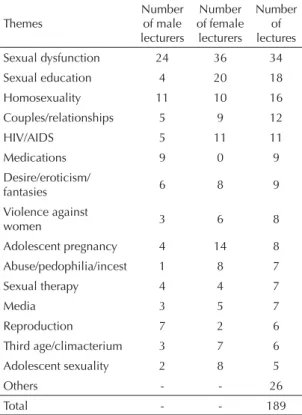
On the other hand, women predominated among psychologists (45 women and 13 men), nurses (seven women and one man) and educators (fi ve women). There was a considerable plurality of themes discussed, although the emphasis was on sexual dysfunction (34 lectures) (Table 2). Sexual education, homosexuality and love relationships were also present. Part of the presentations had more than one author, which resulted in a higher number of lecturers than lectures. As the majority of participants were women, there were more presentations given by them.
Sexual education was a theme presented by 20 women and four men; HIV/AIDS, by 11 women and fi ve men; adolescent pregnancy, by 14 women and four men; and adolescent sexuality, eight women and two men. These numbers indicate the strong presence of women in sexology prevention and education, which have, historically, been focused on adolescence and sexually transmitted disease prevention. In contrast, men stood out in other areas: medications (nine presentations) and reproduction, especially when associated with physi-ological aspects (seven men and two women). The official program, promoted by the Scientific Committee, was comprised of 105 works, and the parallel program, 84 works, aimed to meet the demands of those enrolled. The comparison between the themes of both programs indicates that the congress organizers’ interests are different from those of professionals enrolled. The scientifi c committee prioritized debates about clinical practice in sexual dysfunctions in the offi -cial program, with doctors alongside psychologists. The works of the parallel program mostly dealt with sexual education. The frequency of participants in presentations on sexual education, homosexuality, STDs, HIV/AIDS and contraceptives was reasonably low, compared to the audience of lectures on sexual dysfunctions.
The pharmaceutical industry was present in the main area allocated for exhibits and new products launched by several laboratories, where there were stands representing the Pfi zer, Eli-Lilly, Bayer, Schering do Brasil, Herbarium Fitoterápicos, Jansen, SB Jaynco and Igefarma laboratories. At the entrance to the main room, there was the following warning: “In accordance with RDG 102/2000, issued by Anvisa [National Health Surveillance Agency], pharmaceu-tical laboratories are only authorized to promote or provide materials and drugs to professionals who are permitted to write prescriptions by law, i.e. doctors.
The remaining participants, wearing badges identi-fying them as not authorized to prescribe, can only receive drug samples or products which do not require a prescription.” Although the participation of the phar-maceutical industry is common in health congresses, this particular case shows how recent interventions in sexuality are associated with a greater use of specifi c drugs. In addition, it refl ects the separation of this area between doctors and non-doctors, translated into the identifi cation badges themselves: one identifi ed in red as ‘authorized to prescribe”, distributed to doctors; and another identifi ed in blue as “not authorized to prescribe”, distributed to the remaining professionals.
8th Brazilian Congress on Sexual Inadequacy
In the fi rst congresses held by the institution, doctors and psychologists were divided in distinct rooms and discussed different themes. However, doctors could attend the sessions aimed at psychologists, whereas psychologists could not participate in the sessions aimed at doctors. In 2005, doctors and psychologists shared the same space and discussions and worked together. This does not mean that tensions between these two professional groups have disappeared. Divergences between the practices developed by doctors and psychologists still exist, although in a more subtle form.
Table 1. Lecturers of the 10th Brazilian Congress on Human Sexuality per gender and profession. Porto Alegre, Southern Brazil, 2005.
Profession
Number of male lecturers
Number of female lecturers
Total number of
lecturers
Urologists 8 0 8
Gynecologists 21 15 36
Psychiatrists 14 5 19
Other doctors 5 3 8
Total number of
doctors 48 23 71
Psychologists 13 45 58
Biologists 5 5 10
Nurses 1 7 8
Educators 0 5 5
Social
Communication professionals
3 1 4
Lawyers 1 2 3
Social workers 0 2 2
Others 1 3 4
Not identifi ed 9 28 37
Total 81 121 202
Source: Pesquisa Sexualidade, Ciência e Profi ssão no Brasil
Another change observed was associated with the number of women present in the association events. In the fi rst ABEIS congress, there was only one woman; in 2005, there were more than 30. The scientifi c committee was comprised of ten doctors (eight urologists) and four psychologists and it was presided by an urologist. As there was no space for the enrollment of participants, lectures resembled an intensive refresher course, with the latest developments in the area.
This congress was held by doctors, urologists in their majority, with a strong institutional presence in the pharmaceutical industry, sponsored by four pharmaceu-tical laboratories – three of which were manufacturers of drugs for erectile dysfunctions: Pfi zer, Bayer and Eli Lilli –, specialized companies and bookstores. Of all 40 lecturers, 29 were men (27 doctors and two psychologists) and 11 women (nine psychologists and two doctors) (Table 3). There was a predominance of urologists (21 men and one woman).
In Table 4, the distribution of lecturers per gender and theme presented contrasts with the SBRASH Congress, as the lectures or “classes” were given by one professional only. Of all 62 lectures, men gave 48 of them and thus represented the majority of lecturers,
compared to women, who gave 14. The two themes that were primarily emphasized were sexual dysfunc-tion (19 classes) and medicadysfunc-tions (18 classes). Penis implants/prostheses/ enlargement did not involve female participation.
Table 5 compares the distribution of lecturers per gender and focus of each event. The works presented that favored male or female problems in the exclusive context of sexuality were perceived as the main point of analysis, disregarding works on reproduction, violence, STDs and professional performance.
The SBRASH Congress, due to the greater presence of gynecologists, focused more on female problems (28) than male ones (18). In addition, women (42) more frequently dealt with female problems (28 lectures), compared to male problems (14 lectures). In contrast, men (36) focused on male (18) and female problems (18) equally. The ABEIS Congress showed a predomi-nance of urologists and thus included a higher number of lectures on male problems (35 cases) than female ones (eight cases). Men (36) focused on male problems (32 cases), compared to female ones (four cases); whereas women (seven) dealt with both female (four) and male problems (three).
New contexts and old gender distinctions
Based on the data observed, it is possible to organize the current fi eld of interventions in sexuality according to three main points. The fi rst one refers to the professions involved. There is a contrast, on the one hand, between doctors and non-doctors; on the other, inside the group of doctors, between gynecologists and urologists. The urologist is the major representative of the third phase of sexology, known as “sexual medicine”. The intense medicalization of the traditional “impotence” (currently known as “erectile dysfunction”) implied
Table 2. Lecturers of the 10th Brazilian Congress on Human Sexuality per gender and theme presented. Porto Alegre, Southern Brazil, 2005.
Themes
Number of male lecturers
Number of female
lecturers
Number of lectures
Sexual dysfunction 24 36 34
Sexual education 4 20 18
Homosexuality 11 10 16
Couples/relationships 5 9 12
HIV/AIDS 5 11 11
Medications 9 0 9
Desire/eroticism/
fantasies 6 8 9
Violence against
women 3 6 8
Adolescent pregnancy 4 14 8
Abuse/pedophilia/incest 1 8 7
Sexual therapy 4 4 7
Media 3 5 7
Reproduction 7 2 6
Third age/climacterium 3 7 6
Adolescent sexuality 2 8 5
Others - - 26
Total - - 189
Source: Pesquisa Sexualidade, Ciência e Profi ssão no Brasil
2010 (Sexuality, Science and Profession Survey in Brazil 2010)
Table 3. Lecturers of the 8th Brazilian Congress on Sexual
Inadequacies per gender and profession. Belo Horizonte, Southeastern Brazil, 2005.
Profession
Number of male lecturers
Number of female
lecturers
Total number of
lecturers
Urologists 21 1 22
Gynecologists 4 0 4
Psychiatrists 1 1 2
Cardiologists 1 0 1
Total number of
doctors 27 2 29
Psychologists 2 9 11
Overall Total 29 11 40
Source: Pesquisa Sexualidade, Ciência e Profi ssão no Brasil
a change of direction in the urological practice, as it had primarily followed a surgical approach until then. Based on the so-called male sexual dysfunctions and the association with pharmaceutical laboratories, the area of urology tends to be more and more directed towards clinical practice. The union between gynecologists and psychologists, which marked the beginning of the second phase of sexology that focused on the dysfunc-tional couple, stopped being the integrating center of this fi eld. The main contrast is observed between the two medical specialties. The tension between doctors and psychologists is part of this contrast. In both cases, the double polarity – between gynecologists and urologists, on the one hand, and between doctors and psychologists, on the other – is uniquely marked by gender. The majority of professionals in the medical area are men, whereas women are mostly psycholo-gists. Among doctors, this separation does not result from professionals’ gender primarily (even among gynecologists, there is a majority of men), but rather from clientele (women and couples or men), on the one hand, and from the approach, on the other, thus leading to the second main point.
Urologists – and sexual medicine – are associated with the biomedical approach, centered on anatomical-physiological problems, whereas gynecologists and psychologists tend towards the psychological approach, characterized by the notion of sexuality as a broad and complex phenomenon, which can only be treated through a comprehensive view of an individual.8,9
The third main point, which is integrated with the second one, refers to the opposition between male sexuality (marked by the biomedical perspective, with an emphasis on the erectile dysfunction category) and
female sexuality (shown to be more conditioned by the environment and by relationship or affective problems). Thus, there has been a strong process of medicalization of male impotence with the rise of urologists and of the organicist perspective in the treatment of sexuality since the 1980s. The main symptom of this process was the consolidation of erectile dysfunction as a key category to understand and treat male sexual problems.8,9,13-15
The traditional concept of a man, centered on the notion of potency, on the one hand, and on “non-relational sexuality”, on the other, is emphasized. However, at the same time, there is the redefi nition of this concept, once the need for medication and the resulting dependence on a specialist to guarantee the ideal potency cause man, who traditionally opposes medical control and discourse, to be disempowered.
There are frequent reports of diffi culties faced by doctors and the pharmaceutical industry to establish criteria to defi ne female sexual dysfunction. Differently from male dysfunction, whose criteria of evaluation are regulated by the functioning of the penis (frequency, duration and quality of erection), there are questions about the criteria to be used in the case of women. According to some, the main diffi culty would be how to translate female complaints into specifi c diagnoses. It is argued that the female sexual experience depends on the social context (relationship and previous experiences, among other factors) as much as or more than genital functioning. Male sexuality exists regardless of rela-tionships, unlike female sexuality, which is conceived as an inseparable part of relationships.17
CONCLUSIONS
We conclude that there is again an emphasis on gender differences in sexuality. Whereas male sexuality is defi ned by a logic of performance, assessed by erection and treated with drugs and techniques that
Table 5. Lecturers per gender, focus and type of congress. Porto Alegre, Southern Brazil, 2005; Belo Horizonte, Southeastern, 2005.
Focus Male
lecturers
Female
lecturers Total
10th Brazilian Congress on Human Sexuality
Male problems 18 14 18
Female problems 18 28 28
Total 36 42 46
8th Brazilian Congress on Sexual Inadequacies
Male problems 32 3 35
Female problems 4 4 8
Total 36 7 43
Source: Pesquisa Sexualidade, Ciência e Profi ssão no Brasil
2010 (Sexuality, Science and Profession Survey in Brazil 2010) Table 4. Lecturers of the 8th Brazilian Congress on Sexual
Inadequacies per gender and theme presented. Belo Horizonte, Southeastern Brazil, 2005.
Themes
Number of male lecturers
Number of female lecturers
Number of lectures/
classes
Sexual dysfunction 15 4 19
Medications (sexual dysfunction and hormone replacement)
15 3 18
Penis implant/
prosthesis/enlargement 5 0 5
Professional
performance 2 3 5
Psychopharmacological
drugs 4 1 5
Others 7 3 10
Total 48 14 62
Source: Pesquisa Sexualidade, Ciência e Profi ssão no Brasil
solve the specifi c problem of erectile dysfunction, female sexuality is seen as a complex and intriguing phenomenon, which cannot be reduced to a particular organic function. The current medicalization of sexuality, represented by the success of drugs against erectile dysfunction, seems to concern primarily male sexuality. This would be “naturally” more objective and evidently more organic, in the sense that men are more easily separated from the conjugal pair. Male sexuality is “naturally” thought of as independent from
relationships with partners, an autonomous impulse, uncontrollable, separated from relationships and affec-tion. Women continue to be viewed as an eminently “relational” being. Their sexuality does not exist as an autonomous impulse, separated from conjugality (or from relationships). In this way, it is possible to argue that the “physical-orientation” of male sexuality corroborates the traditional gender duality, which points to women as the foundation of conjugality and vehicles of affection.
1. Béjin A. Crespúsculo dos psicanalistas, manhã dos sexólogos. In: Ariès PH, Béjin A, organizadores. Sexualidades ocidentais. São Paulo: Brasilense; 1987. p.210-35.
2. Béjin A. O poder dos sexólogos e a democracia sexual. In: Ariès PH, Béjin A, organizadores. Sexualidades ocidentais. São Paulo: Brasilense; 1987. p.236-54.
3. Bleier R. Science and gender – a critique of Biology and its theories on women. New York: Teachers College Press; 1997.
4. Carrara S, Russo J. A psicanálise e a sexologia no Rio de Janeiro do entreguerras: entre a ciência e a
auto-ajuda. Hist Cienc Saude-Manguinhos. 2002;
9(2):273-290. DOI:10.1590/S0104-59702002000200003
5. Conrad PH. The medicalization of society: on the transformation of human conditions into treatable disorders. Baltimore: The Johns Hopkins University Press; 2007.
6. Fausto-Sterling A. Sexing the body: gender, politics and the construction of sexuality. New York: Basic Books; 2000.
7. Fishman JR. Manufacturing desire: the commodifi cation of female sexual dysfunction.
Soc Stud Sci. 2004;34(2):187-218. DOI:10.1177/0306312704043028
8. Giami A. De l’impuissance à la dysfonction érectile. Destins de la médicalisation de la sexualité. In: Fassin D, Memmi D, organisateur. Le gouvernement des corps. Paris: EHESS; 2004. p. 77-108.
9. Giami A. Changing relations between medicine, psychology and sexuality: the case of male impotence.
J Soc Med. 2000;37:263-72.
10. Harding S. The science question in feminism. Ithaca: Cornell University Press; 1986.
11. Hubbard R. The politics of women’s biology. New Brunswick: Rutgers University Press; 1990.
12. Jordanova L. Sexual visions, images of gender in science and medicine between the eighteenth and
twentieth centuries. London: Harvester Wheatsheaf; 1989.
13. Lexchin J. Bigger and better: how Pfi zer redefi ned
erectile dysfunction. PLoS Med. 2006;3(4):1-4.
14. Loe M. Fixing broken masculinity: Viagra as a technology for the production of gender and sexuality.
Sex Cult. 2001;5(3):97-125. DOI:10.1007/s12119-001-1032-1
15. Marshall B, Katz S. Forever functional: sexual fi tness
and the ageing male body. Body Soc.
2002;8(43):43-70. DOI:10.1177/1357034X02008004003
16. Moscuscci O. The science of woman: gynecology and gender in England (1800-1929). Cambridge: Cambridge University Press; 1990.
17. Rohden F. Diferenças de gênero e medicalização da sexualidade na criação do diagnóstico das disfunções
sexuais. Rev Estud Fem. 2009;17(1):89-109. DOI:
10.1590/S0104-026X2009000100006
18. Rohden F, Torres I. Le champ actuel de la sexologie
au Brésil: considérations initiales. Sexologies.
2006;15(1):64-71. DOI:10.1016/j.sexol.2005.11.007
19. Rosemberg CE. The tyranny of diagnosis: specifi c
entities and individual experience. Milbank Q.
2002;80(2):237-60. DOI:10.1111/1468-0009.t01-1-00003
20. Russett CE. Sexual science. The victorian construction of womanhood. Cambridge: Harvard University Press; 1995.
21. Russo JA, Rohden F, Torres I, Faro L. O campo da sexologia no Brasil: constituição e institucionalização.
Physis (Rio J). 2009;19(3):617-35. DOI: 10.1590/ S0103-73312009000300004
22. Schiebinger L. O feminismo mudou a ciência? Bauru: Edusc; 2001.
23. Tiefer L. Sex is not a natural act and other essays. Cambridge: Westview Press; 2004.
24. Tiefer L. The Viagra Phenomenon. Sexualities. 2006;
9(3):273-94. DOI:10.1177/1363460706065049 REFERENCES