INTRODUCTION
Article/Artigo
1. Programa de Pós Graduação em Microbiologia Agrícola e do Ambiente, Universidade Federal do Rio Grande do Sul, Porto Alegre, RS. 2.Departamento de Microbiologia, Imunologia e Parasitologia, Instituto de Ciências Básicas da Saúde, Universidade Federal do Rio Grande do Sul, Porto Alegre, RS. 3. Laboratório de Microbiologia, Hospital São Lucas, Pontifícia Universidade do Rio Grande do Sul, Porto Alegre, RS. 4. Serviço de Patologia Clínica, Hospital de Clínicas, Universidade Federal do Rio Grande do Sul, Porto Alegre, RS.
Address to: Dra. Gertrudes Corção. Deptº de Microbiologia, Imunologia e Parasitologia/ICBS/UFRGS. Rua Sarmento Leite 500, Cidade Baixa, 90050-170 Porto Alegre, RS, Brasil.
Phone/Fax: 55 51 3308-4111 e-mail: [email protected] Received in 17/05/2011 Accepted in 29/07/2011
Molecular characterization of clinical multiresistant isolates of
Acinetobacter
sp.
from hospitals in Porto Alegre, State of Rio Grande do Sul, Brazil
Caracterização molecular de isolados clínicos
Acinetobacter
sp. multirresistentes em hospitais
de Porto Alegre, Estado do Rio Grande do Sul, Brasil
Alessandra Einsfeld Ferreira
1, Desirée Padilha Marcheti
2, Gabriela Rosa da Cunha
2, Lyvia Moreira de Oliveira
2,
Daiane Bopp Fuentefria
1, Aline Gehlen Dall Bello
3, Afonso Luis Barth
4and Gertrudes Corção
1,2ABSTACT
Introduction: Hospitals around the world have presented multiresistant Acinetobacter sp. outbreaks. he spread of these isolates that harbor an increasing variety of resistance genes makes the treatment of these infections and their control within the hospital environment more diicult. his study aimed to evaluate the occurrence and dissemination of Acinetobacter
sp. multiresistant isolates and to identify acquired resistance genes. Methods: We analyzed 274 clinical isolates of Acinetobacter sp. from ive hospitals in Porto Alegre, RS, Brazil. We evaluated the susceptibility to antimicrobial, acquired resistance genes from Ambler’s classes B and D, and performed molecular typing of the isolates using enterobacterial repetitive intergenic consensus-polymerase chain reaction (ERIC-PCR) technique. Results: A high (68%) percentage of multiresistant isolates of Acinetobacter sp. was observed, and 69% were resistant to carbapenems. We identiied 84% of isolates belonging to species A. baumannii
because they presented the gene blaOXA-51. he gene blaOXA-23 was detected in 62% of the isolates, and among these, 98% were resistant to carbapenems. Using the ERIC-PCR technique, we identiied clones of Acinetobacter sp. spread among the four hospitals analyzed during the sampling period. Conclusions: he data indicate the dissemination of Acinetobacter sp. isolates among hospitals and their permanence in the hospital ater one year.
Keywords:Acinetobacter sp. blaOXA-23. Clonal dissemination. ERIC-PCR.
RESUMO
Introdução: Hospitais no mundo todo têm apresentado surtos de Acinetobacter sp. multirresistentes. A disseminação destes isolados com uma variedade cada vez maior de genes de resistência torna difícil o tratamento destas infecções e seu controle dentro do ambiente hospitalar. Este trabalho teve como objetivo avaliar a ocorrência e disseminação de isolados de Acinetobacter
sp. multirresistentes e identiicar genes de resistência adquirida. Métodos: Foram avaliados 274 isolados clínicos de Acinetobacter sp. obtidos de cinco hospitais da Cidade de Porto Alegre, RS, Brasil. Avaliamos o peril de suscetibilidade a antimicrobianos, genes de resistência adquirida das classes B e D de Ambler e realizamos a tipiicação molecular dos isolados utilizando a técnica de
enterobacterial repetitive intergenic consensus-polymerase chain reaction (ERIC-PCR). Resultados:
Encontramos uma alta (68%) porcentagem de isolados de Acinetobacter sp. multirresistentes e 69% dos isolados apresentaram resistência aos carbapenêmicos. Foram identiicados 84% de isolados pertencentes a espécie A. baumannii, pois apresentaram o gene blaOXA-51. Em 62% dos isolados, foi detectado o gene blaOXA-23, sendo que 98% destes isolados foram resistentes aos carbapenêmicos. Através da tipiicação molecular pela técnica de ERIC-PCR identiicamos clones de Acinetobacter sp. disseminados entre quatro dos hospitais analisados e nos anos de 2006 e 2007. Conclusões:
Os dados obtidos indicam a disseminação de isolados de Acinetobacter sp. entre hospitais assim como sua permanência no ambiente hospitalar após um ano.
Palavras-chaves:Acinetobacter sp. blaOXA-23. Disseminação clonal. ERIC-PCR.
he genus Acinetobacter is widely distributed in nature; they are endogenous organisms in various types of soil and water and are occasionally found in food1-2. In recent years, members of this group, particularly A. baumannii, have been associated with healthcare-associated infections (HAIs), especially in debilitated patients. he main sites of infection are the respiratory tract, urinary tract, bloodstream, wounds, and burns3. Patients with burns and those in intensive care units and/or using mechanical ventilation are at greater risk. According to Jawad et al.4, Acinetobacter isolates can survive desiccation for extended periods. his characteristic increases the incidence of infections at hospitals because it makes these bacteria capable of staying in the skin of patients, doctors, and nurses, as well as remaining for long periods on hospital equipment.
he treatment of multidrug-resistant strains can be diicult. Since 1970, HAIs caused by Acinetobacter
METHODS
TABLE 1 - Polymerase chain reaction primers and annealing conditions used in this study for detection of the resistance genes.
Annealing Expected
Gene Sequence of the primer temperature size(bp) Reference
bla
OXA-23 F1 (5’ GAT CGG AT GGA GAA CCA GA3’) 51
o 570 Woodford et al.15. R1 (5’ AT TCT GAC CGC AT TCC AT 3’)
bla
OXA-51 F1 (5’ TAA TGC TT GAT CGG CCT TG3’) 53o 353 Woodford et al.15.
R1 (5’ TGG AT GCA CT CAT CT GG 3’) bla
IMP F2 (5’GGA ATA GAG TGG CT AAY TCT C 3’) 53
o 188 Ellington et al.16. R2 (5’ CCA AAC YAC TAS GT ATC T 3’)
bla
VIM F3 (5’ GAT GGT GT TGG TCG CAT A 3’) 52o 390 Ellington et al.16.
R3 (5’ CGA ATG CGC AGC ACC AG 3’) bla
SPM F (5´TCG GAT CAT GTC GAC TG CC -3´) 53
o 344 Fuentefria et al.17. R (5´CCT TCG CT CAG ATC CTC GT - 3´)
The aim of this study was to evaluate the occurrence and dissemination of multiresistant Acinetobacter sp. strains of clinical origin with acquired resistance genes in ive hospitals of Porto Alegre, RS, Brazil.
Hospitals studied and bacterial isolates
Acinetobacter sp. was isolated from clinical samples collected in ive large hospitals in Porto Alegre, Brazil, and they were obtained ater the project was approved by the ethics commitee of each hospital involved. he hospitals included in the study were named with leters A to E. Hospital A has an area of 128,338m2, 897 beds, and 4,499 employees and receives 12,000 people per day. Hospital B, as hospital A, belongs to the Brazilian Health System (SUS), has 603 beds, and receives 18,000 people per day in an area of 49,000m2. Hospitals C, D, and E belong to the same hospital complex but are located in diferent regions of the city, and these hospitals receive only SUS patients. Hospital C is a general hospital, and it has the largest emergency unit in the state, with 801 beds and 4,631 employees in an area of 43,030m2. Hospital D primarily receives victims of traic and work accidents and violence, as well as burn patients; it has 304 beds, 1,291 employees, and an area of 18,835m2. Hospital E receives only obstetric and gynecologic emergency patients, has 189 beds, 737 employees, and an area of 12,273m2. In Hospital A, the sampling period was from February to April 2007 and between July and October 2007. At Hospital B, samples were collected in July 2006 and between July and October 2007. he isolates from hospitals C, D, and E were obtained from October to December 2006 and from May to August 2007. Information on the biological source of the sample from the isolates was also obtained from the laboratories of each hospital.
Identiication of the isolates of Acinetobacter sp.
he isolates were primarily identiied as Acinetobacter sp. by the laboratories of the respective hospital. A further conirmation of the genus was performed by amplifying a fragment of 16S rDNA using the primers: Acin16SF (5'-CCT TGA TGC AGA GYT AAT GC-3') and Acin16SR (5'-GTA GCA ACC CT TGT ACC GA-3'), speciic for the genus Acinetobacter. hese primers were designed by aligning the sequences 16S rRNA gene from 29 species of
Acinetobacter (GENBANK), using the CLC Program FreeWorkbench 2.2. Ampliication reactions were performed in mixtures containing 3.5mM MgCl2, 0.2mM dNTPs, 1µM of each primer, 1 unit of Taq DNA polymerase, 1x reaction bufer of Taq DNA polymerase, and 100ng of bacterial DNA in a inal volume
of 30µL. he ampliication conditions were as follows: an initial cycle of denaturation at 95oC for 5min followed by 25 cycles of denaturation at 95oC for 1min, annealing at 52°C for 1min and extension at 72oC for 1min, and a inal extension cycle of 72oC for 8min.
Antimicrobial susceptibility test
he proile of antimicrobial susceptibility of the isolates was provided by each hospital and was determined using the disk difusion technique according to the standards of the Clinical Laboratory Standards Institute,
20078. We analyzed only the antimicrobial agents tested in common for all hospitals: amikacin (30µg), cetazidime (30µg), piperacillin-tazobactam (100µg/10µg), imipenem (10µg), meropenem (10µg), cefepime (30µg), and ampicillin/sulbactam (10µg/10µg). he strains resistant to four classes of antibiotics were considered multiresistant.
Phenotypic MBL detection test
Phenotypic triage of MBL production was performed by the disk approximation test using imipenem and cetazidime as substrates and ethylenediaminetetraacetic acid (EDTA) and 2-mercaptopropionic acid as inhibitors9-11.
DNA extraction and detection of bla genes
he DNA of the isolates was obtained by the boiling method according to Misbah et al.12. As A. baumannii was identiied by the presence of the gene blaOXA-51, its ampliication was performed with all isolates used in this study. his gene is found exclusively in isolates of this species and can therefore be used to identify it13. Isolates that were resistant to imipenem, meropenem, and/or with a positive triage for MBL production were subjected to polymerase chain reaction (PCR) reaction to assess the presence of the blaOXA-23, blaSPM-1, blaVIM, and blaIMP genes using the primers listed in Table 1. he reactions were performed in mixtures containing 1x Taq Go Master Mix (Promega), 1µM of each primer, and 100ng of bacterial DNA in a inal volume of 15µL. Ampliication conditions were as follows: an initial cycle of denaturation at 94oC for 5min followed by 30 cycles of 94oC for 1min, annealing temperature as in Table 1, extension at 72oC for 1min, and a inal extension at 72oC for 6min. PCR products were visualized on 1% agarose gel stained with ethidium bromide.
ERIC-PCR
RESULTS
one operational taxonomic unit. he results for the ingerprinting were analyzed via SPSS sotware (version 13 for Windows). he similarity matrix was calculated using the Dice coefficient and clustering of the similarity matrix, via the unweighted pair-group method using arithmetic averages (UPGMAs) clustering. Only the visible bands in the ERIC-PCR ingerprinting were used to construct the similarity matrix and the dendrogram. Isolates with more than 80% similarity were considered closely related and, therefore, were treated as clones; these isolates difered in one to two bands.
We analyzed 274 isolates of Acinetobacter sp. obtained from ive hospitals in Porto Alegre, Brazil, in 2006/2007. Hospital A presented the largest number of isolates, 100 isolates, followed by Hospital C with 93 isolates. Hospital D had 45 isolates, Hospital B had 32 isolates, and Hospital E had only four isolates. Only one isolate from each patient was included in this study.
Among the isolates, 69% were resistant to carbapenems. he hospitals with higher levels of carbapenem resistance were Hospital C with 87% and Hospital D with 85%. Hospital A had 53% of isolates resistant to carbapenems, and Hospital B had 41%.
In analyzing the data from all hospitals, antimicrobial resistance to cefepime and piperacillin-tazobactam, 88% and 83%, respectively, was found to be higher. he antibiotics ampicillin-sulbactam showed
low percentages of resistance in Hospitals A and B, with 29% and 55%, respectively, whereas Hospitals C and D showed the highest rates of antimicrobial resistance, with 100% and 97%, respectively. he four isolates from Hospital E were resistant to all antibiotics tested.
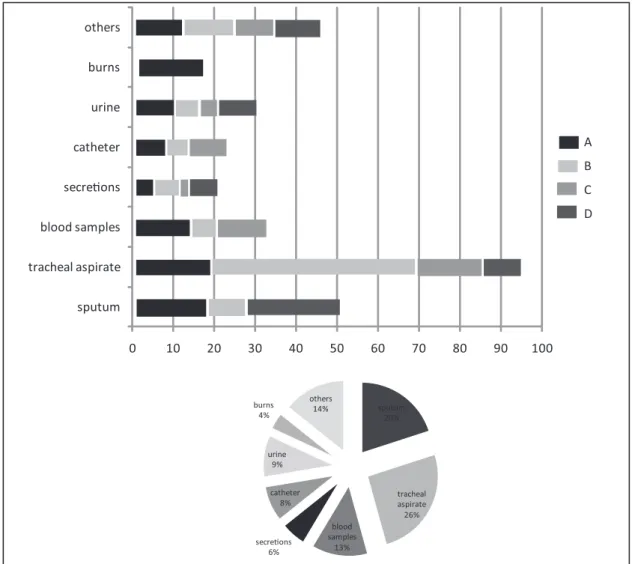
he isolates of Acinetobacter sp. were obtained from various biological samples, with tracheal aspirate being the most frequent, at 26% of isolates, followed by sputum at 20%, when all isolates were compared. hey were also isolated from blood samples (13%), urine (9%), catheter (8%), secretions (6%), and burns (4%) (Figure 1).
Other samples containing Acinetobacter sp. such as pleural luid, abdominal luid, lumbar puncture, scabs, and wound secretion were not detailed in Figure 1 because of their low percentages. hese samples correspond to a total of 14% of the isolates analyzed in this study. As Hospital D has a burn center, it presented seven isolates from burn patients.
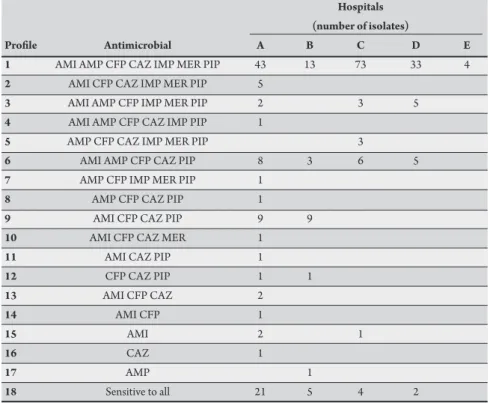
Analyzing the data obtained by the antibiogram, the isolates were grouped into 18 distinct proiles based on their susceptibility to seven antimicrobials (Table 2). he greatest diversity of proiles was found in Hospital A, with 16 diferent proiles, eight of them with just one isolate. In analyzing the ive hospitals, the proile with the largest number of isolates showed resistance to seven (61%) antimicrobials, followed by the susceptibility to all drugs, with 12% of isolates. We found 68% of multiresistant isolates, which corresponded to the proiles 1, 2, 3, 4, 5, and 7 of Table 2.
0 10 20 30 40 50 60 70 80 90 100
sputum tracheal aspirate blood samples secreons catheter urine burns others
A B C D
sputum 20%
tracheal aspirate 26% blood
samples 13% secreons
6% catheter
8% urine
9% burns
4%
others 14%
TABLE 2 - Proiles of non-susceptibility (resistant and intermediary results) of the Acinetobacter sp. isolates in the ive hospitals analyzed.
Hospitals (number of isolates)
Proile Antimicrobial A B C D E
1 AMI AMP CFP CAZ IMP MER PIP 43 13 73 33 4
2 AMI CFP CAZ IMP MER PIP 5
3 AMI AMP CFP IMP MER PIP 2 3 5
4 AMI AMP CFP CAZ IMP PIP 1
5 AMP CFP CAZ IMP MER PIP 3
6 AMI AMP CFP CAZ PIP 8 3 6 5
7 AMP CFP IMP MER PIP 1
8 AMP CFP CAZ PIP 1
9 AMI CFP CAZ PIP 9 9
10 AMI CFP CAZ MER 1
11 AMI CAZ PIP 1
12 CFP CAZ PIP 1 1
13 AMI CFP CAZ 2
14 AMI CFP 1
15 AMI 2 1
16 CAZ 1
17 AMP 1
18 Sensitive to all 21 5 4 2
AMI: amikacin; AMP: ampicillin-sulbactam; CFP: cefepime; CAZ: ceftazidime; IMP: imipenem; MER: meropenem; PIP: piperacillin-tazobactam.
he phenotypic triage for MBL production was carried out with all the isolates. Using the antimicrobial imipenem and the inhibitor EDTA, 10% of the isolates were positive. In the test using the antimicrobial cetazidime and the inhibitor 2-MPA, the percentage of positive isolates increased to 21%.
he detection of the blaOXA-51like gene was performed on all isolates analyzed in this study, and 230 (84%) isolates were positive for the presence of this gene. Hospitals A and C had the greatest number of positive isolates, both with 84 isolates. he four isolates from Hospital E were positive for this gene, whereas Hospital B had 27 positive isolates, and Hospital D had 31. It should be mentioned that among the isolates positive for the blaOXA-51 gene, a high percentage of multidrug resistance was also observed. In Hospitals A and B, 16 and 3 isolates, respectively, were not identiied as A. baumannii because they were negative for the gene blaOXA-51. Of these, 14 were sensitive to all antimicrobial agents analyzed. In Hospitals C and D, 22 isolates were negative for the blaOXA-51 gene, but they showed an opposite behavior when compared with the isolates from the other hospitals because only two isolates were sensitive to all antimicrobials tested.
he presence of the blaSPM-1, blaVIM, and blaIMP genes were analyzed using PCR in the 214 isolates that were resistant to carbapenems and/or positive in the phenotypic test for detection of MBL. None of the isolates was positive for these genes, although there was a large percentage of positive isolates in phenotypic tests (28%). he same 214 isolates were tested for the presence of the blaOXA-23 gene, and it was found in 61.2% of the isolates. he four isolates from Hospital E had the blaOXA-23 gene. he hospital with the greatest number of positive isolates was Hospital C, with 56 (64%) of the 87 positive
isolates examined. Hospital B showed the lowest number (12) of tested isolates, and from these, eight (62%) were positive for the gene. Hospital A had 59% (66 tested) of positive isolates, and Hospital D had 46.6% (45 tested). Twenty-one isolates that were susceptible to carbapenems and positive for the phenotypic screening for MBLs were evaluated for the presence of the blaOXA-23 and blaOXA-51 genes. Eight of these showed the two genes, three isolates from Hospital A, three from Hospital D, and two from Hospital C.
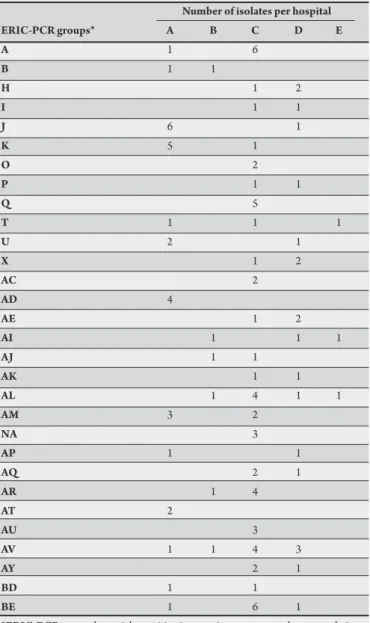
TABLE 3 - Distribution of Acinetobacter sp. isolates in the groups formed with similarity >80% by the ERIC-PCR and UPGMA analysis.
Number of isolates per hospital
ERIC-PCR groups* A B C D E
A 1 6
B 1 1
H 1 2
I 1 1
J 6 1
K 5 1
O 2
P 1 1
Q 5
T 1 1 1
U 2 1
X 1 2
AC 2
AD 4
AE 1 2
AI 1 1 1
AJ 1 1
AK 1 1
AL 1 4 1 1
AM 3 2
NA 3
AP 1 1
AQ 2 1
AR 1 4
AT 2
AU 3
AV 1 1 4 3
AY 2 1
BD 1 1
BE 1 6 1
*ERIC-PCR: enterobacterial repetitive intergenic consensus-polymerase chain reaction; UPGMA: unweighted pair-group method using arithmetic averages.
DISCUSSION
In Brazil, as in many parts of the world, outbreaks of infections caused by multidrug-resistant Acinetobacter have been reported. In this study, we found a high percentage of multidrug-resistant (68%) and carbapenem-resistant (69%) Acinetobacter sp. isolates, which are still the best treatment option in cases of infection by this microorganism. The antimicrobial resistance in this genus is associated with several mechanisms, but the production of β-lactamases has been considered the main one18.
Although Acinetobacter sp. is implicated in a variety of HAIs, including meningitis, urinary tract infections, and surgical infections, it is the predominant etiologic agent of nosocomial pneumonia, especially in patients with ventilator-associated pneumonia, who have been admited to treatment in intensive care units19. his observation concurs with observations obtained in this study regarding isolation of Acinetobacter sp., mainly from sputum and tracheal aspirate samples. Other studies also found similar results to ours, such as
Papa et al.20, who found 20% of isolates obtained from tracheal aspirate, 17% from blood culture, and 15% from catheters. Another study found 32% of isolates from the respiratory tract, 19% from wounds, 19% from urine, 16% from blood, and 13% from catheter21.
Our study found 28% of positive isolates for the phenotypic screening test for MBL, and none of the isolates exhibited the blaIMP,
blaVIM, and blaSPM genes. he disk approximation techniques proposed by Arakawa et al.10 and Lee et al.12 for Gram-negative bacilli were initially efective for the detection of metallo-enzymes β-lactamases. As the technique was used to detect Acinetobacter sp., studies have shown low speciicity for this genus22-23. herefore, it was suggested that positive results in the phenotypic test for detection of MBL should be interpreted carefully in samples of Acinetobacter sp.
he blaOXA-51 gene has been found in all isolates of A. baumannii
tested and is being considered as a natural component of the species chromosome8,24. hus, the presence of this gene has been used to identify A. baumannii. his gene may be associated with resistance to carbapenems when ISAbaI-type insertion sequences, which carry strong promoters, are found upstream to blaOXA genes, resulting in increased expression and concomitant resistance to carbapenems25. In our study, we found a large number of isolates positive for the
blaOXA-51 gene (84%), and results similar to that were found by Wisplinghof et al.26, who observed 86% of isolates positive for the
blaOXA-51 gene. In many studies, the species A. baumannii is the most prevalent and associated with HAIs, and it is also the species with the highest rate of resistance to antimicrobials27-28.
Carbapenem resistance in isolates of Acinetobacter sp. is most often mediated by oxacillinase (OXA)-type enzymes and less frequently by MBLs29. As in ours, other studies have searched for enzymes like MBLs, but the OXA-type enzymes, such as blaOXA-23,
blaOXA-24, blaOXA-51, and blaOXA-58, are the most frequent in this genus7,30-31. In another study also held in Porto Alegre, Brazil, with
Acinetobacter sp., 53 isolates were analyzed, and all of them showed the genes blaOXA-23 and blaOXA-5127. In another study with A. baumannii in Curitiba, Brazil, the blaOXA-23 gene was detected in eight strains resistant to carbapenems. hey also found that isolates susceptible to carbapenems did not have the blaOXA 23 gene32. In our study, we observed eight strains that were sensitive to carbapenems and had the blaOXA-23 and blaOXA-51 genes. OXA-type enzymes exhibit a weak hydrolysis of carbapenems and may not always show resistance proile, but when they are associated with insertion elements, they may have an increase in its expression and show resistance to carbapenems29.
he ERIC-PCR technique is a low-cost, alternative and rapid method that showed good results for the genetic characterization of Acinetobacter sp. isolates. By ERIC-PCR, we identiied clones of
Acinetobacter sp. in diferent hospitals, as well as the permanence of isolates from one year to another in the same hospital. hese data can be related to the dissemination characteristics of this microorganism, its permanence for long periods in hospitals, its main form of dissemination, human contact, and the mobility of patients and staf within and between hospitals. In a work carried out by Jeong et al.33 using the ERIC-PCR in isolates of A. baumannii, identical proiles were observed for seven isolates producing OXA-23 in a hospital in Korea. In another study with seven isolates of A. baumannii producing OXA-23 from the same hospital, two distinct groups were identiied using ERIC-PCR, one group consisting of ive isolates with identical proiles and the other consisting of two isolates6.
epidemiology of Acinetobacter sp. isolates to establish the best treatment and use the correct epidemiological control, to avoid the spread of these microorganisms, because studies like this have shown the dissemination of clones in diferent hospitals. Eicient control measures such as washing hands, keeping patients in isolation, cleaning equipment properly, and ensuring awareness of the technical staf are needed to reduce the outbreaks of Acinetobacter
sp. In our study, we can observe the behavior of the isolates from diferent hospitals analyzed through the antimicrobial resistance and molecular typing proiles and resistance genes found. he ive hospitals exhibited dissemination of multiresistant and carbapenem-resistant Acinetobacter sp. isolates harboring the blaOXA-23 and blaOXA-51
genes, probably acting as the main causing agent of the high rate of carbapenem resistance observed in this study.
ACKNOWLEDGMENTS
he authors declare that there is no conlict of interest. CONFLICT OF INTEREST
FINANCIAL SUPPORT
REFERENCES
We thank the Microbiology Laboratories of the Hospital Conceição, Hospital de Clinicas de Porto Alegre, and Hospital São Lucas for providing the clinical isolates used in this work. We also thank Dr Ana Cristina Gales (Alerta Laboratory and Special Laboratory of Clinical Microbiology, Universidade Federal de São Paulo) for providing the strains used as positive controls in the resistance genes detection.
Coordenação de Aperfeiçoamento de Pessoal de Nível Superior —
Programa de Fomento à Pós-Graduação (CAPES-PROF) and Fundação de Amparo à Pesquisa do Estado do Rio Grande do Sul (FAPERGS).
1. Baumann P. Isolation of Acinetobacter from soil and water. J Bacteriol 1968; 96:39-42.
2. Bifulco J, Shirey J, Bissonnete G. Detection of Acinetobacter sp. in rural drinking water supplies. Appl Environ Microbiol 1989; 55:2214-2219.
3. Karlowsky J, Draghi DC, Jones ME, hornsberry C, Friedland IR, Sahm DF. Surveillance for antimicrobial susceptibility among clinical isolates of Pseudomonas aeruginosa an Acinetobacter baumannii from hospitalized patients in the United States, 1998-2001. Antimicrob Agents Chemother 2003; 47:1681-1688. 4. Jawad A, Seifert H, Snelling AM, Heritage J, Hawkey PM. Survival of Acinetobacter
baumannii on Dry Surfaces: Comparison of Outbreak and Sporadic Isolates. J Clin Microbiol 1998; 36:1938-1941.
5. Hanlon G. he emergence of multidrug resistant Acinetobacter species: a major concern in the hospital seting. Let Appl Microbiol 2005; 41:375-378. 6. Sung JY, Kwon KC, Park JW, Kim YS, Kim JM, Shin KS, et al. Dissemination
of IMP-1 and OXA type b-lactamase in carbapenem-resistant Acinetobacter baumannii Korean J Lab Med 2008; 28:16-23.
7. Mendes RE, Bell JM, Turnidge JD, Castanheira M, Jones RN. Emergence and widespread dissemination of OXA-23, -24/40 and -58 carbapenemases among
Acinetobacter sp. in Asia-Paciic nations: report from the SENTRY Surveillance Program. J Antimicrob Chemoth 2009; 63:55-59.
8. Clinical and Laboratory Standards Institute. M100-S17. Performance standards for antimicrobial susceptibility testing; 16th informational supplement. Wayne, PA: Clinical and Laboratory Standards Institute; 2007.
9. Arakawa Y, Shibata N, Shibayama K, Kurokawa H, Yagi T, Fugiwara H, et al. Convenient Test for Screening Metallo-b-Lactamase producing Gram-Negative Bacteria by Using hiol Compounds. J Clin Microbiol 2000; 38:40-43.
10. Yong D, Lee K, Yum JH, Shin HB, Rossolini GM, Chong Y. Imipenem-EDTA Disk Method for Diferentiation of Metallo-b-Lactamase-Producing Clinical Isolates of Pseudomonas sp. and Acinetobacter sp. J Clin Microbiol 2002; 40:3798-3801. 11. Lee K. Evaluation of the Hodge Test and the Imipenem-EDTA Double-Disk
Synergy Test for Diferentiating Metallo-b-Lactamase-Producing Isolates of
Pseudomonas sp. and Acinetobacter sp. J Clin Microbiol 2003; 41:4623-4629. 12. Misbah S, Hassan H, Yusof MY. Genomic species identiication of Acinetobacter
of clinical isolates by 16S rDNA sequencing. Singapore Med J 2005; 46:461-464. 13. Turton J, Woodford N, Gloves J, Yarde S, Kaufmann ME, Pit TL. Identiication of Acinetobacter baumannii by detection of the blaOXA-51-like carbapenemase
gene intrinsic to this species. J Clin Microbiol 2006; 58:2974-2976.
14. Versalovic J, Koeuth T, Lupski JP. Distribution of repetitive DNA sequences in eubacterial and application to ingerprinting of bacterial genomes. Nucl Acids Res 1991; 19:6823-6831.
15. Woodford N, Ellington MJ, Coelho JM, Turton JF, Ward ME, Brown S, et al. Multiplex PCR for genes encoding prevalent OXA carbapenemases in Acinetobacter sp. Int J Antimicr Agents 2006; 27:351-353.
16. Ellington MJ, Kistler J, Livermore DM, Woodford N. Multiplex PCR for rapid detection of genes encoding acquired metallo-â-lactamases. J Antimicr Chemother 2006; 21:1-2.
17. Fuentefria DB, Ferreira AE, Gräf T, Corção G. Spread of metallo-â-lactamases: screening reveals the presence of a blaSPM-1 gene in hospital sewage in Southern
Brazil. Braz J Microbiol 2009; 40:82-85.
18. Hawkey PM, Jones AM. he changing epidemiology of resistance. J Antimicr Chemother 2009; 64:3-10.
19. Gales AC, Pfaller MA, Sader HS, Hollis RJ, Jones RN. Genotypic characterization of carbapenem-nonsusceptible Acinetobacter sp. isolated in Latin America. Microb Drug Resist 2004; 10:286-291.
20. Papa A, Koulourida V, Souliou E. Molecular epidemiology of carbapenem-resistant Acinetobacter baumannii in a newly established Greek Hospital. Microb Drug Resist 2009; 15:257-260.
21. Abbo A, Navon-Venezia S, Hammer-Muntz O, Krichali T, Siegman-Igra Y, Carmeli Y. Multidrug-resistant Acinetobacter baumannii. Emerg Infect Dis 2005; 11:22-29. 22. Sader HS, Castanheira M, Mendes RE, Toleman M, Walsh T, Jones RN. Dissemination and diversity of metallo-â-lactamases in Latin America: report from the SENTRY Antimicrobial Surveillance Program. Int J Antimicr Agents 2005; 25: 57-61.
23. Yan JJ, Wu JJ, Tsai SH, Chuang CL Comparison of the double-disk, combined disk, and Etest methods for detecting metallo-â-lactamases in gram-negative bacilli. Diagn Microbiol Infec Dis 2004; 49:5-11.
24. Heritier C, Poirel L, Fournier PE, Claverie JM, Raoult D, Nordmann P. Characterization of the naturally occurring oxacillinase of Acinetobacter baumannii. Antimicr Agents Chemother 2005; 49:4174-4179.
25. Queenan AM, Bush K . Carbapenamases: the versatile â-lactamases. Clin Microbiol Rev 2007; 20:440-458.
26. Wisplinghof H, Edmond MB, Pfaller MA, Jones RN, Wenzel RP, Seifert H. Nosocomial bloodstream infections caused by Acinetobacter species in United States Hospitals: clinical features, molecular epidemiology, and antimicrobial susceptibility. Clin Infect Dis 2000; 31:690-697.
27. Martins AF, Kuchenbecker R, Sukiennik T, Bof R, Reiter KC, Lutz L, et al. Carbapenem-resistant Acinetobacter baumannii producing the OXA-23 enzyme: dissemination in Southern Brazil. Infection 2009; 37:474-476.
28. Yang SC, Chang WJ, Chang YH, Tsai YS, Yang TP, Juan CW, Shiau MY. Prevalence of antibiotics resistance and OXA carbapenemases genes in multidrug-resistant
Acinetobacter baumannii isolates in central Taiwan. Eur J Microbiol Infect Dis 2010; 29:601-604.
29. Higgins PG, Dammhayn C, Hackel M, Seifert H. Global spread of carbapenem-resistant Acinetobacter baumannii. J Antimicr Chemoth 2010; 65:233-238. 30. Stoeva T, Higgins PG, Savov E, Markovska R, Mitov I, Seifert H. Nosocomial
spread of OXA-23 and OXA-58 â-lactamase-producing Acinetobacter baumannii
in a Bulgarian hospital. J Antimicr Chemoth 2009; 63:618-620.
31. Mendes RE, Spanu T, Deshpande L, Castanheira M, Jones RN, Fadda G. Clonal dissemination of two clusters of Acinetobacter baumannii producing OXA-23 or OXA-58 in Rome, Italy. Clin Microbiol Infect 2009;15:588-592.
32. Dalla-Costa LM, Coelho JM, Souza HAPHM, Castro MES, Stier CJN, Bragagnolo KL, et al. Outbreak of carbapenem-resistant Acinetobacter baumannii producingthe OXA-23 enzyme in Curitiba, Brazil. J Clin Microbiol 2003; 41:3403-3406.