Copyright
© ABE&M todos os dir
eitos r
eser
vados.
Breaking the vicious circle of obesity:
the metabolic syndrome and low
testosterone by administration
of testosterone to a young
man with morbid obesity
Quebrando o círculo vicioso da obesidade: síndrome metabólica e baixos níveis de testosterona pela administração de
testosterona a um homem jovem com obesidade mórbida
Yuliya Tishova1, Svetlana Y. Kalinchenko2
ABSTRACT
Objective: The metabolic syndrome (MS) is associated with low serum testosterone levels. Con-versely, low testosterone levels induce MS. These operational mechanisms reinforce one ano-ther and induce a vicious cycle. This is a report on a morbid obesity 42 year-old man with the MS and serum testosterone of 5.0 nmol/L (N: 12.0-33.0), who was resistant to treatment with diet and exercise. He was treated with testosterone undecanoate for 16 months. Methods: Anthropo-logical and laboratory variables were measured before and during testosterone administration. Also the Aging Male Symptom Scale (AMS), the International Index of Erectile Function (IIEF) and Beck’s Depression Inventory were assessed. Results: After 16 months, there was a weight loss of 50 kg and a decrease in waist circumference of 36.5 cm. Blood pressure normalized and laboratory variables returned to the normal range. The patient did not meet the criteria for the MS anymore. There were improvements on the AMS, the IIEF and Beck’s Depression Inventory. Conclusions: Normalizing testosterone in men with morbid obesity in combination with diet and exercise, with the MS and low testosterone levels, may rescue them from the MS, improving their mood and their stamina to follow a diet and to exercise. Arq Bras Endocrinol Metab. 2009;53(8):1046-51
Keywords
Obesity; metabolic syndrome; testosterone; erectile function
RESUMO
Objetivo: A síndrome metabólica (SM) está associada a baixos níveis séricos de testosterona. Inversamente, baixos níveis de testosterona induzem a SM. Esses mecanismos operacionais se reforçam mutuamente e levam a um círculo vicioso. Este é o relato de um homem de 42 anos, obesidade mórbida com SM e testosterona sérica de 5,0 nmol/L (N: 12,0-33,5), resistente ao tra-tamento com dieta e exercícios. Ele foi tratado com undecanoato de testosterona por 16 meses. Métodos: Variáveis antropológicas e laboratoriais foram medidas antes e durante a adminis-tração de testosterona. Também foram avaliados a Escala de Envelhecimento Masculino (AMS), o Índice Internacional de Função Erétil (IIEF) e a Escala de Beck para Depressão. Resultados: Após 16 meses, houve uma perda de peso de 50 kg e diminuição de 36,5 cm da circunferência abdominal. A pressão arterial foi normalizada e as variáveis laboratoriais também retornaram para os limites de normalidade. O paciente não preenchia mais os critérios para SM. Houve melhoras da AMS, do IIEF e da Escala de Beck para Depressão. Conclusões: A normalização da testosterona em homens com obesidade mórbida, combinada à dieta e a exercícios, com SM e baixos níveis de testosterona, pode livrá-los da SM, melhorando o humor e o vigor para seguir uma dieta e exercícios. Arq Bras Endocrinol Metab. 2009;53(8):1046-51
Descritores
Obesidade; síndrome metabólica; testosterona; disfunção erétil
1 Department of Andrology and Urology, Research Center for Endocrinology, Moscow, Russia 2 Chair of Clinical Andrology, People’s Friendship, University of Russia, Moscow, Russia
Correspondence to:
Yuliya Tishova
Department of Andrology and Urology, Research Center for Endocrinology
Street D. Ulyanova, 11 Moscow, 117136 Russia
Copyright
© ABE&M todos os dir
eitos r
eser
vados.
INTRODUCTION
T
he metabolic syndrome (MS) is becoming curren-tly a health issue for a wide range of medical spe-cialties, including endocrinologists, cardiologists, dia-betologists, urologists and general practitioners. The International Diabetes Federation (IDF) has formula-ted criterion (1) for a person to be considered with MS presenting central obesity (defined as waist circumfe-rence ≥ 94 cm for European men and ≥ 80 cm for Eu-ropean women, with ethnicity specific values for other groups) plus any two of the following four factors:•raised TG level: ≥ 150 mg/dL (1.7 mmol/L), or specific treatment for this lipid abnormality;
•reduced HDL cholesterol: < 40 mg/dL (1.03 mmol/L) in males and < 50 mg/dL (1.29 mmol/L) in females, or specific treatment for this lipid abnormality;
•raised blood pressure (BP): systolic BP ≥ 130 or diastolic BP ≥ 85 mmHg, or treatment of pre-viously diagnosed hypertension;
•raised fasting plasma glucose (FPG) ≥ 100 mg/ dL (5.6 mmol/L), or previously diagnosed type 2 diabetes mellitus (T2DM).
The prevalence of MS is high in male (from 15% to 30% according to the current data) (2). Diagnosing the MS in men is very important in view of dominant role of MS in the development of the diabetes mellitus type and
the male preponderance of cardiovascular morbidity and mortality (3). The prevalence of androgen deficiency in men with MS is also quite high (4,5). In recent studies, it has been shown that there is a link between low plas-ma testosterone and development of the components of MS, such as cardiovascular disease and T2DM (5,6). Also an association between visceral and central obesity and hypogonadism could be established (7,8). Placebo-controlled studies have shown that treatment with an-drogens of hypogonadal men leads to a reduction of the body mass index (BMI), of visceral obesity, insulin resis-tance, BP and improvement of the lipid spectrum (9). These data should lead to the development of new ap-proaches of diagnosis and treatment of MS in men and of the role of testosterone in its diagnosis and treatment. Apart from testosterone deficiency due to congenital or acquired testicular damage (primary hypogonadism) or hypothalamic and hypophyseal failure (secondary hy-pogonadism) – the “classical” causes of hypogonadism, testosterone deficiency can occur in the process of aging and in severe somatic disease (10). Very often, testoste-rone deficiency can be diagnosed in men with obesity
and MS. While the prevalence of the MS increases with age, also at young age it appears associated with low tes-tosterone levels (11,12). In the latter case, there is pro-bably a vicious circle. Adiposity with its associated hype-rinsulinism suppresses sex hormone-binding globulin (SHBG) synthesis and therewith the levels of circulating testosterone (10). It also may affect the strength of LH signaling to the testis (13). Further, insulin (14) and leptin (15) have a suppressive effect on testicular ste-roidogenesis. Visceral fat cells secrete a large number of cytokines which impair testicular steroidogenesis (16). So, there are reasons to believe that adiposity is a signifi-cant factor in lowering circulating levels of testosterone. While it is clear that disease and, in the context of this contribution, in particular, the MS suppress circulating testosterone levels, it has also been documented that low testosterone induces the MS (17).
Our case report demonstrated that it is possible to break into this vicious circle by raising testosterone le-vels in subjects with the MS, severe obesity and low testosterone who have become resistant to treatment with diet and exercise.
CASE REPORT
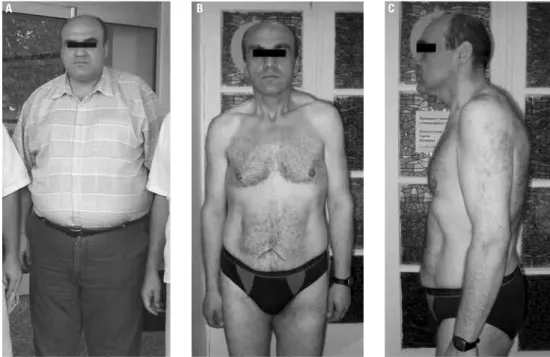
We reported the case of a 42-year old male patient (Figure 1). He consulted because of weight gain, not responding significantly to the effects of dieting and exercise. He complained of sleep apnea, loss of libido, erectile dysfunction, fatigue, depression and hyperten-sion (up to 165/100 mmHg). The patient was not taking any medication for his condition.
Physical examination revealed normal external geni-talia, female type of pubic hair and lipomastia. Anthropo-metric investigation is largely presented in table 1. Scores on the Aging Male Symptoms Scale (AMS) questionnai-re (18) questionnai-resulted in 50 points, indicating sevequestionnai-re androgen deficiency symptoms. Scores on the International Index of Erectile Function (IIEF) (19) were 12 points (mode-rate Erectile Dysfunction (ED). Beck Depression Inven-tory (20) resulted in 20 points, which fulfills the criteria of severe depression. Blood tests are also presented in table 1. Transrectal ultrasound revealed normal prostate volume (20 mL) without any signs of pathology.
Copyright
© ABE&M todos os dir
eitos r
eser
vados.
Figure 1. Patient before treatment (A) and after 16 months of treatment (B e C).
A B C
Table 1. Changes in anthropometric/laboratory variables
Hormones Normal range treatmentBefore
After 16 months of treatment
Total testosterone 13-33.5 nmol/L 5.0 29.1
SHBG 12.9-61.7 nmol/L 33.9 59
Leptin < 12.0 ng/mL 16.8 1.3
Insulin 2.3-26.4 mU/L 17.5 4.1
Estradiol 20-240 pmol/L 164 146
Weight (kg) 152.0 101.8
BMI (kg/m2) 44.4 29.8
Waist circumference (cm) 141 96
Blood pressure (mmHg) 140/90 130/80
Cholesterol 3.3-5.2 mmol/L 5.5 4.8
HDL 0.9-2.6 mmol/L 1.3 1.4
LDL 0.0-3.7 mmol/L 3.4 3.1
Triglycerides 0.1-2.2 mmol/L 2.3 0.5
Glucose 3.05-6.38 mmol/L 5.0 4.2
Total PSA 0.0-4.0 ng/mL 0.4 0.5
The patient was followed up every three month for testosterone dose adjustment and checks of prostate specific antigen (PSA) as well as blood count control. Over the 16 months of follow-up, the patient reported improvement of general well-being accompanied with normalization of BP (up to 130-140/80-90 mmHg in self-measurement, sleep, mood, erectile function and libido). Physical examination revealed improvement of
all anthropometric parameters (Table 1 and Figure 1) – hip circumference: 112 cm (minus 29 cm); waist to hip ratio: 0,86. There was a strong reduction of levels of serum leptin and insulin.
Patient reported that for the whole period of treat-ment he tried to follow a healthy diet and regular exer-cise (1-2 times a week swimming and walking).
Re-assessments of AMS scale resulted in 37 points, corresponding with minor clinical signs of androgen deficiency; of IIEF, in 21 points (no erectile dysfunc-tion); and of Becks’s Depression Inventory, in 9 points (no depression).
All hormones and lipids returned to the normal ranges and diagnosis of MS was no longer applicable. Patient was recommended to continue treatment with testosterone undecanoate at 12-week intervals.
Patient consented that his observational data were reported in the literature.
DISCUSSION
me-Copyright
© ABE&M todos os dir
eitos r
eser
vados.
tabolic situation (21). In our case, the patients could not be helped only by diet and exercise, maybe also due to a depressive mood, as evidenced by the Beck’s Depression Inventory. Administration of testosterone and raising testosterone to eugonadal values brought an amazing and quick recovery over 18 months, with a strong reduction of body weight, and all variables of the MS returned from abnormal to normal. Depressive symptoms improved too.
Mood-elevating effects of testosterone have been reported (22), but the loss of body weight may have had an independent positive effect on mood, though studies indicate that weight loss has a positive effect on psychological factors but improvement of depressive mood states is less clear (23). In population studies, it has been found that erectile function improves when weight declines, so the loss of weight, in this case, may have also been a factor in improvement of scores on the IIEF (24). Effects of weight loss on scores of the AMS have not been reported.
There may have been a role for leptin in this re-covery. Leptin is an adipose tissue hormone with so-called “double action”: it affects receptors on Leydig cells, lowering testicular testosterone secretion. In addition, leptin suppresses hypophyseal LH secretion. Hypogonadal obese men have elevated leptin levels and testosterone therapy reduces leptin levels in addi-tion to the independent effects of weight loss in lowe-ring leptin levels.
The dramatic weight loss and recovery of the MS was unexpectedly quick and successful. A case report does not allow to make far reaching conclusions as to the mechanism but it could be that, in addition to bre-aking the self-sustaining vicious circle of MS-obesity hypognadal testosterone levels, the mood-elevating effects of normalizing testosterone may have played a role (22). More studies are needed to distinguish be-tween the effects of weight loss and/or exercise on so-matic and mental features associated with the MS and to test whether treatment of testosterone has an addi-tional positive effect. The latter appeared to be the case in a study of men newly diagnosed with T2DM (9).
A case report cannot prove a hypothesis to be cor-rect. In the reported case, diet, exercise and testostero-ne supplementation were given in combination, thus it is difficult to disentangle each component in the tre-atment success – though it is of note that the patient had followed a diet and had done exercise earlier, but unsuccessfully.
CONCLUSION
This case shows that extreme obesity is associated with low levels of testosterone, probably maintaining obesity and the MS. Breaking in into this vicious circle by exo-genously raising testosterone levels appeared to have a beneficial effect leading to a strong reduction of body weight and resolution of the signs and symptoms of the MS. Treatment of an obese individual with lifestyle modification and testosterone replacement might be a reasonable alternative for obese patients with moderate to severe signs of hypogonadism. However, this appro-ach has not yet been substantiated in rigorous placebo-controlled studies and, therefore, has not yet found its way into the guidelines of treatment of testosterone deficiency in elderly men as formulated by several pro-fessional organizations (25).
Disclosure: no potential conflict of interest relevant to this article was reported.
REFERENCES
1. Alberti KG, Zimmet P, Shaw J. The metabolic syndrome – a new worldwide definition. Lancet. 2005;366(9491):1059-62.
2. Traish AM, Saad F, Guay A. The dark side of testosterone de-ficiency: II. Type 2 diabetes and insulin resistance. J Androl. 2009;30(1):23-32.
3. Corona G, Forti G, Maggi M. Why can patients with erectile dys-function be considered lucky? The association with testosterone deficiency and metabolic syndrome. Aging Male. 2008;11(4):193-9. 4. Kalyani RR, Dobs AS. Androgen deficiency, diabetes, and the me-tabolic syndrome in men. Curr Opin Endocrinol Diabetes Obes. 2007;14(3):226-34.
5. Traish AM, Guay A, Feeley R, Saad F. The dark side of testosterone deficiency: I. Metabolic syndrome and erectile dysfunction. J An-drol. 2009;30(1):10-22.
6. Corona G, Mannucci E, Forti G, Maggi M. Hypogonadism, ED, metabolic syndrome and obesity: a pathological link supporting cardiovascular diseases. Int J Androl. 2009.
7. Svartberg J, von Muhlen D, Sundsfjord J, Jorde R. Waist circu-mference and testosterone levels in community dwelling men. The Tromso study. Eur J Epidemiol. 2004;19(7):657-63.
8. Allan CA, Strauss BJ, McLachlan RI. Body composition, metabo-lic syndrome and testosterone in ageing men. Int J Impot Res. 2007;19(5):448-57.
9. Heufelder AE, Saad F, Bunck MC, Gooren L. Fifty-two-week treat-ment with diet and exercise plus transdermal testosterone rever-ses the metabolic syndrome and improves glycemic control in men with newly diagnosed type 2 diabetes and subnormal plas-ma testosterone. J Androl. 2009;30(6):726-33.
10. Kaufman JM, Vermeulen A. The decline of androgen levels in el-derly men and its clinical and therapeutic implications. Endocr Rev. 2005;26(6):833-76.
11. Goncharov NP, Katsya GV, Chagina NA, Gooren LJ. Three defini-tions of metabolic syndrome applied to a sample of young obe-se men and their relation with plasma testosterone. Aging Male. 2008;11(3):118-22.
le-Copyright
© ABE&M todos os dir
eitos r
eser
vados.
vels in men: results from the study of health in Pomerania. Diabe-tes.2009;58(9):2027-31.
13. Lima N, Cavaliere H, Knobel M, Halpern A, Medeiros-Neto G. De-creased androgen levels in massively obese men may be asso-ciated with impaired function of the gonadostat. Int J Obes Relat Metab Disord. 2000;24(11):1433-7.
14. Pitteloud N, Hardin M, Dwyer AA, Valassi E, Yialamas M, Elahi D, et al. Increasing insulin resistance is associated with a decrease in Leydig cell testosterone secretion in men. J Clin Endocrinol Metab. 2005;90(5):2636-41.
15. Isidori AM, Caprio M, Strollo F, Moretti C, Frajese G, Isidori A, et al. Leptin and androgens in male obesity: evidence for leptin con-tribution to reduced androgen levels. J Clin Endocrinol Metab. 1999;84(10):3673-80.
16. Eckel RH, Grundy SM, Zimmet PZ. The metabolic syndrome. Lan-cet. 2005;365(9468):1415-28.
17. Laaksonen DE, Niskanen L, Punnonen K, Nyyssonen K, Tuomai-nen TP, ValkoTuomai-nen VP, et al. Testosterone and sex hormone-binding globulin predict the metabolic syndrome and diabetes in middle-aged men. Diabetes Care. 2004;27(5):1036-41.
18. Heinemann LA, Saad F, Zimmermann T, Novak A, Myon E, Badia X, et al. The Aging Males’ Symptoms (AMS) scale: update and compilation of international versions. Health Qual Life Outco-mes. 2003;1(1):15.
19. Rosen RC, Cappelleri JC, Gendrano N 3rd. The International Index of Erectile Function (IIEF): a state-of-the-science review. Int J Im-pot Res. 2002;14(4):226-44.
20. Beck AT, Ward CH, Mendelson M, Mock J, Erbaugh J. An inventory for measuring depression. Arch Gen Psychiatry. 1961;4:561-71. 21. Esposito K, Marfella R, Ciotola M, Di Palo C, Giugliano F,
Giuglia-no G, et al. Effect of a Mediterranean-style diet on endothelial dysfunction and markers of vascular inflammation in the meta-bolic syndrome: a randomized trial. JAMA. 2004;292(12):1440-6. 22. Seidman SN, Orr G, Raviv G, Levi R, Roose SP, Kravitz E, et al.
Effects of testosterone replacement in middle-aged men with dysthymia: a randomized, placebo-controlled clinical trial. J Clin Psychopharmacol. 2009;29(3):216-21.
23. Blaine BE, Rodman J, Newman JM. Weight loss treatment and psychological well-being: a review and meta-analysis. J Health Psychol. 2007;12(1):66-82.
24. Travison TG, Shabsigh R, Araujo AB, Kupelian V, O’Donnell AB, McKinlay JB. The natural progression and remission of erectile dysfunction: results from the Massachusetts Male Aging Study. J Urol. 2007;177(1):241-6; discussion 6.