Oral Health Policies in Brazil
§Abstract: Since Oral Health policies in Brazil have been constructed ac-cording to circumstances and possibilities, they should be understood within a given context. The present analysis contextualizes several is-sues of the Brazilian Oral Health Policy, called “Smiling Brazil”, and de-scribes its present stage of development. Today it involves re-organizing basic oral health care by deploying Oral Health Teams within the Fam-ily Health strategy, setting up Centers of Dental Specialists within an Oral Health network as a secondary care measure, setting up Regional Laboratories of Dental Prosthesis and a more extensive luoridation of the public water supply.
Descriptors: Dental health services; Health services evaluation; Oral health / policies.
Gilberto Alfredo Pucca Junior(a) José Felipe Riani Costa(b) Luciana de Deus Chagas(c) Rosa Maria Sivestre(d)
(a) DDS, National Coordinator of Oral
Health, Ministry of Health, Brazil. MSc in Epidemiology of Aging, São Paulo School of Medicine, Federal University of São Paulo, São Paulo, SP, Brazil.
(b) DDS, Specialist in the regulation of
Additional Health, National Agency for Additional Health, Ministry of Health, Brazil. Specialist in Public Health, Oswaldo Cruz Foundation, Rio de Janeiro, RJ, Brazil.
(c) DDS, Technical Advisor, Office of
Representation of the Pan American Health Organization, World Health Organization, Brazil. MSc in Information Technology, University of Brasília, Brasília, DF, Brazil.
(d)MSc in Social Sciences, Advisor, Health
System and Services, Pan American Health Organization, Brasília, DF, Brazil.
Corresponding author: Gilberto Alfredo Pucca Junior Setor Habitacional Individual Sul
Quadra do Lago 10, cj 2, casa 15, Lago Sul Brasília - DF - Brazil
CEP: 71630-025
E-mail: [email protected]
Received for publication on Nov 28, 2008 Accepted for publication on Apr 30, 2009
§ Paper presented at the “Oral Health
Introduction
Traditional Brazilian Oral Health policies were based on an assistencialist model which featured the mother-infant parameter. Their aim was to reach population groups made up of children and pregnant mothers. Owing to the precariousness of the govern-ment’s role in the supplying of services, the domi-nant pattern of oral health care was a curative one, largely within the private practice domain, coupled to an extremely unreliable intervention of the State. The latter was restricted to low-complexity proce-dures and exclusively for the cases requiring basic care.1,2 To make matters worse, the exclusion level
was high as the needs of large segments of the popu-lation were not addressed by any oral health initia-tive, whether in health promotion or in health care. The situation was characterized by high levels of edentulous people and large unattended sections of the Brazilian population. The Brazilian Oral Health Policy – “Smiling Brazil” – was launched in 2004 under new political conditions. The policy involves an expansion in the deployment of Oral Health Teams within the Family Health strategy, thus in-volving an increase in the provision of federal funds to states and municipalities. The latter re-deined their activities and established a reference and coun-ter-reference stance in secondary care through the setting up of Centers of Dental Specialists, included prosthetic rehabilitation through the setting up of Regional Laboratories of Dental Prosthesis, and ex-panded the luoridation coverage of the public wa-ter supply in Brazil. The above-mentioned strategic fronts changed the Brazilian care model and made Oral Health an integral part of the Public Health System, which was deined by the principles of de-centralization, equity, integrality and social control. Oral Health became a multi-interface policy based on basic care, health promotion activities within the structuring of a health care network. It not only incorporates medium- and high-complexity proce-dures and services but also articulates intersectional activities such as the luoridation of the public water supply and other health supervision procedures.
The history of oral health in Brazil
Inauguration of the Public Health Special Servicein 1952 prompted the irst dental health programs in Brazil.3 They were chiely aimed at school
chil-dren who were considered epidemiologically liable to disease and, at the same time, highly sensitive to public health intervention.3,4
Although the care model was aimed at develop-ing educational activities,5 the clinical practice
ac-tually reproduced what dentists did in their private clinics. The model conceived was highly individu-alistic and did not aim at developing a technology program as the result of a planning process. Never-theless, an important landmark for health in Brazil was achieved during the 1980s owing to the deep transformation which occurred in health policies throughout the country after the Decentralized Uni-ied Health System (SUDS in Portuguese) was inau-gurated. Later on, this system evolved into the cur-rent Brazilian Health System (SUS in Portuguese). The same environment indicating the dire need for changes in the health care model was in place when the basic principles of the Brazilian Health System were deined. In fact, the Brazilian Health Confer-ence in 1986, coordinated by Dr. Sérgio Arouca, President of the Oswaldo Cruz Foundation (FIO-CRUZ) at the time,6 insisted on the guidelines of
health care universality, decentralization, social control and equity. Decentralization of the Brazil-ian health policy, one of the foundational guidelines of the Health Reform movement, remained a basic premise of the Brazilian Health System within the 1988 Constitution and of Law n. 8080 of Septem-ber 19, 1990 which regulated the Brazilian Health System. The establishment of the Basic Operational Norm (NOB-SUS, 1993) consolidated developments such as funding standardization and the decentral-ization process in the administration of services and other activities within the system.7 The
incorpora-tion of coverage of oral health collective procedures (CP), deined by Government Regulation n. 184 of October 9, 1991 published by the Ministry of Health, was a landmark during the 1990s of this important change from an individualistic-curative stance to a collective-preventive one.
practice based on a social epidemiology rationale, it became an eficient strategy for the reorganization of basic care. The establishment of links, commit-ment and responsibility between professionals and the community is one of its high points (Ministério da Saúde, 1997).8 Inclusion of Oral Health Teams
(OHT) within the Family Health Program was ef-fectively deined by Government Regulation n. 1444 of December 28, 2000.9 The Brazilian Oral Health
Policy launched by the Ministry of Health in March 2004 was the result of a long historical process of institutionalization of dentistry within the Brazilian Health System.
Epidemiological aspects
In 1986 the Brazilian Ministry of Health under-took the irst Epidemiological Oral Health Survey with population samples from the greater areas of Brazilian capital cities. Its aim was the planning of programs and strategic fronts.10 A second National
Oral Health Survey11 was undertaken in 1996, and
then again in 2003. The latter was called the “Oral Health Conditions in the Brazilian Population”. Sev-eral dental institutions and organizations, including the Brazilian Dentistry Organization and its regional sections, several universities and state and munici-pal health departments participated in the project. Some two thousand professionals (dentists and assis-tants, health agents and others) from 250 Brazilian municipalities also took part in the survey. Further-more, 108,921 individuals including children (18-36
months old; 5 years old and 12 years old); young people (15-19 years old), adults (35-44 years old) and elderly people (65-74 years old) from urban and rural areas were examined.12 In spite of a sharp decrease
in the level of dental caries among the children popu-lation during the last decades, high levels of oral dis-eases were still extant in certain population groups. Whole sections of the population remained without any sort of care. The results revealed that a mean of 14 teeth were still affected by caries during adoles-cence and adulthood13 (Graph 1).
The level of periodontal diseases was particularly high in all age brackets. Less than 22% of the adult population and less than 8% of elderly people had healthy gums. Data on edentulism in Brazil and the goals established by the World Health Organization (WHO) for 2000 are compared in Table 1.13,14
The WHO goals were merely achieved in the case of 12-year-old children. Dental caries is undoubt-edly an important public health issue featuring great macro-regional differences. Approximately 3 to 5 caries-affected teeth go without any treatment. Flu-orosis has been detected in about 9% of 12-year-old children and in 5% of 15-19-year-old adolescents. Data on the population’s access to dental services showed that over 13% of young people had never been to a dentist. This rate is lowered to 3% and 6% respectively in the adult and elderly populations.13
Owing to the observation of the data above, a Bra-zilian Health Policy started to be planned in 2003. It was meant to retrieve the right of Brazilian citizens to the provision of dental care by governmental pro-grams, thus reversing a historical abandonment, and
Table 1 - Comparison between the WHO goals for 2000 and the Oral Health (OH) results in Brazil by 2003.
Age WHO goals for 2000 OH Brasil, 2003
5 - 6 years 50% without any tooth caries
40% without any tooth caries
12 years DMF Index ≤ 3.0 DMF Index = 2.78
18 years 80% of the population with all teeth
55% of the population with all teeth
35 - 44 years 75% with 20 or more teeth
54% with 20 or more teeth
65 - 74 years 50% with 20 or more teeth
10% with 20 or more teeth
0 5 10 20 30
15 25
12 2.78
15 to 19 6.17
35 to 44 20.13
65 to 74
27.79
D
MF
index
to follow the Brazilian Health System’s principles of universality, equity, decentralization and integrality. Implementing this model required the setting up of “specialized care programs” for children, adoles-cents, adults and the elderly and the establishment of lows which would put into action the health team’s decisions comprising data, information, care and guidance (reference and counter-reference). The patients would know the structure of the services available based on their experience as subjects in-cluded in the health process. Care guidelines would give a new orientation to the working policy, and teamwork would become one of the most important policy features. This new organization, ine-tuned with the patients’ feed-back, is based on the consti-tutional principle of intersectionality. Furthermore, due to its potential of resolving problems, coni-dence links, indispensable for the improvement of health service quality and for the deepening of the humanization of practices, would be created. These guidelines represent a broadening and quality-build-ing of basic care and enable an extended supply of services to all age groups. It also warrants the pro-vision of care at the secondary and tertiary levels, with a view to integrating them.15
The Brazilian Oral Health Policy (“Smiling Bra-zil”) comprises a set of activities at the individual and collective levels that involve health promotion, disease prevention, diagnosis, treatment and reha-bilitation. It is developed through democratic and participation practices, employing teamwork and focusing on the populations that accept the chal-lenge of taking care of their oral health within their region’s dynamics.15
Family Health as a strategic focus
for the organization of basic
health care
Based on the health reform movement of 1986, discussions on the health-disease concept demanded new health activities. The development of commu-nital and family projects and a new model for the organization of health services became viable.
The Family Health Strategy is characterized by vast ramiications as, in fact, the guidelines of the Brazilian Oral Health Policy had emphasized. Its
activities confront health professionals with the de-mands of the population. They are pedagogical spac-es in which practice is the object of the activity and in which the situations are taken for granted. As a result, the teams learn and understand the situations in a very real way, whenever they occur. They are a privileged space for patient-health team collabora-tion, in which action can closely respond to reality.
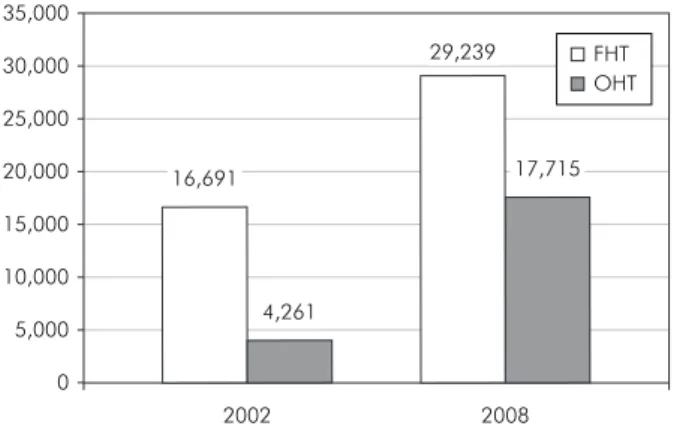
As a matter of fact, 12,541 new family health teams were established from December 2002 to October 2008, with a total of 29,239 teams spread throughout the whole country. Population coverage increased from 54 million in 2002 to 93 million in 2008.16
As to the Communital Health Agents (CHA), 54,115 agents were included between December 2002 and October 2008, totaling 229,578 peo-ple involved in this work. CHA population cover-age rose from 90.7 million in December 2002 to 113,536,269 in October 2008.7
Oral Health within the Family
Health strategy
The inclusion of Oral Health in the Family Health Strategy has allowed practices and relation-ships which could re-orientate the working process and the activities related to Oral Health within health services. Oral Health care requires the set-ting up of a work team that establishes a relation-ship with patients. This team could then participate in service administration to meet the population’s needs and to widen access to the activities and ser-vices designed to promote oral health, prevent oral diseases and recover oral health through collective measures and the establishment of territorial links.
types of Oral Health Teams:
OHT 1, comprising a Dentist (DDS) and a
Den-•
tal Assistant (DA). This modality received proximately US$ 2,200 for setting up and ap-proximately US$ 5,600 per year for costs. OHT 2, comprising a DDS, a DA and a Dental
•
Hygiene Technician (DHT). This modality re-ceived approximately US$ 2,200 for setting up and approximately US$ 7,000 a year for costs. Each Oral Health Team was at irst a reference for two family health teams, so that each OHT cov-ered an average of 6,900 individuals. This average, however, became a restricting factor to the OHT establishment process since the demand for irst-aid procedures was so high that it threatened the incorporation of the Family Health strategy in the working process of the OHT. Through Government Regulation n. 673 of 2003, the Ministry of Health started to fund OHTs in a proportion of 1 OHT for each Family Health Team (FHT). As a result, each OHT started to cover an average of 3,450 individu-als. The same Government Regulation increased the incentives to US$ 6,800 and US$ 8,300 for yearly costs respectively paid to OHT 1 and OHT 2. Gov-ernment Regulation n. 74 of January 20, 200417
decreed new incentive readjustments, so that each OHT 1 and OHT 2 started to receive respectively US$ 8,900 and US$ 11,500 a year. The igures above amounted to a 56.9% increase for OHT 1 and a 65% increase for OHT 2 when compared to the 2001 and 2002 rates. Both modalities received an additional
US$ 2,727 for instruments and equipment. Through the above-mentioned Regulation, OHT 2 received complete dental equipment for the DHT. Govern-ment regulation 2489 of October 21, 2008 read-justed the funding to US$ 10,364 and US$ 13,364 a year respectively for OHT 1 and OHT 2.
As a result, 13,454 new OHTs were established between December 2002 and October 2008 within the Family Health Strategy. A total of 17,715 OHTs were established, representing a 315% increase (Graph 2).16
An increase in the OHT population coverage of more than 58.7 million people occurred. The grand total reached 84,953,611 people covered by these teams16 (Graph 3).
While approximately 25% of the FHTs had OHTs in December 2002, this rate reached 60.5% in October 200816 (Graph 4).
Centers of Dental Specialists
and Regional Laboratories of
Dental Prosthesis
Data from the 2002 survey of the Brazilian Health System’s ambulatory information show that specialized services did not exceed 3.5% of total clinical dental procedures.19 An inadequate
sup-ply of secondary and tertiary care was a fact and jeopardized the establishment of Oral Health ref-erence and counter-refref-erence systems in almost all
0 2,000 4,000 6,000 8,000 10,000 12,000 14,000 16,000 18,000 20,000
2001 2,248
2002 4,261
2003 6,170
2004 8,964
2005 12,602
2006 15,086
2007 15,694
2008 17,715
Graph 2 - Number of Oral Health Teams throughout the years.
0 90,000,000
80,000,000
70,000,000
60,000,000
50,000,000
40,000,000
30,000,000
20,000,000
10,000,000
2002 26,170,330
2008 84,953,611
local and regional health systems. A broadening of the concept of basic care and a consequent increase in the supply of several procedures would increase access to the secondary and tertiary care levels. Through Government regulation n. 1570 of July 29, 2004,20 criteria, rules and requirements were
estab-lished for the setting up and registration of Centers of Dental Specialists (CDS). Furthermore, the fund-ing of these centers was established by Government Regulation n. 1571 of July 29, 200421 to increase
and qualify the supply of specialized dental servic-es. Government Regulation n. 283 of February 22, 200522 anticipated inancial resources for the
set-ting up of these centers. CDSs are reference units for basic care integrated to the local and regional plan-ning process. The role of secondary Oral Health care involves supplying medium-complexity dental treatment procedures and providing treatment plan-ning to referred patients. Further treatment is then undertaken at the primary care level after the case’s counter-reference. Since CDSs are ambulatory units featuring secondary Oral Health care, they should not be confused with specialized services. The CDSs’ role is to supply dental procedures that are not pri-mary care procedures within the Brazilian Health System. Besides, they are reference services, i.e., they are the system’s structuring services and should not be confused with patient admittance units. The CDSs are thus the realization of the right to inte-gral Oral Health care. Through them, the Brazilian State assumes the responsibility for supplying more complex services more extensively. They go beyond
the basic care package formerly supplied by the pub-lic system which left the supply of secondary proce-dures exclusively to the private sector. CDSs provide minimal periodontic, endodontic, oral diagnosis, minor oral surgery, and special patient procedures, and they were formerly classiied in two types. Each CDS 1, with three dental units, received US$ 17,400 for setting up and US$ 2,600 a month for costs. Each CDS 2, with 4 to six dental units, received US$ 21,700 for setting up and US$ 3,500 a month for costs.
Government Regulation n. 1063 of July 4, 200523
restructured the CDSs and created the CDS 3, and Government Regulation n. 1069 of July 4, 200524
ruled that a CDS 3 would receive US$ 36,364 for setting up and US$ 7,000 a month for costs. Fur-thermore, 674 CDSs were set up in 575 municipali-ties up to October 2008.25 Currently all Brazilian
states have at least one CDS (Table 2).
The ramiication of CDSs may be perceived by the fact that 46% have been set up in municipali-ties with up to 50,000 inhabitants, 24% in munici-palities with up to 100,000 inhabitants and 30% in municipalities with more than 100,000 inhabitants (Graph 5).
More than 17 million dental procedures were performed in the above-mentioned CDSs between January 2005 and October 2008.
Government regulation n. 74 of January 20, 200417 included impression taking procedures for
total prostheses in the scope of basic care. Finan-cial resources have been allotted for total prosthesis procedures which may now be performed after an authorization for a high cost/high complexity pro-cedure is obtained, up to a limit of US$ 13 per total prosthesis. There are currently 323 Regional
Labo-Table 2 - Distribution of CDSs by macro-regions.
Macro-region Population Municipalities with CDSs
Central-Western region 13,501,615 33
North-Western region 15,591,792 31
North-Eastern region 52,121,727 234
South-Eastern region 79,633,696 201
Southern region 27,357,275 76
0 35,000
30,000
25,000
20,000
15,000
10,000
5,000
2002 16,691
4,261
2008 17,715
29,239 FHT
OHT
ratories of Dental Prosthesis26 (Graph 6).
Fluoridation of the public
water supply
Baixo-Guandu, ES, Brazil was the irst Brazilian municipality to introduce luoridation, undertaken by SESP in 1953, and Marília, SP, Brazil began luo-ridating its water in December 12, 1956.27 The third
Brazilian city to do so was Taquara, RS, Brazil in October 1957. During the 1970s, approval of the Federal Law n. 6050 in 1974 was the irst sign of the federal government to sanction its participation in the issue. In fact, the Law states that any water treatment station built or enlarged as of that date should have water luoridation. A great expansion in water luoridation occurred in the 1980s.28,29,30
Op-timum luoridation rate in the water supply was set at 0.8 ppm.30
By 2003, more than 70 million Brazilians were supplied with luoridated water. Since the launch of the “Smiling Brazil” policy, the setting up of 711 new luoridation systems occurred, reaching 503 municipalities in 11 States and beneiting 7.6 mil-lion people. This feat was achieved through a joint
venture with the Brazilian Health Foundation (FU-NASA) and the State Health Departments.5
Conclusions
Implementation of the “Smiling Brazil” program in March 2004 brought together several hitherto dispersed fronts, especially with regard to aspects related to the organization and planning of oral health services. A greater participation of the feder-al government in policy structuring, through an in-crease in funding to Oral Health Teams within the Family Health strategy coupled to the implantation of services featuring medium- and high-complexity procedures and the standardization of preventive oral health activities, has allowed the setting up of a network articulated in different health care levels. The concept of integrality has been included in the planning process. The Oral Health policy in Brazil has made a structuring effort to produce intra- and inter-sectional possibilities by deconstructing the false dichotomy between the concepts of health pro-motion and health care, preventive activities and cu-rative activities.
Graph 6 - Setting up of Regional Laboratories of Dental Prosthesis (RLDPs).
0 50 150
100 350
300
200 250
2005 36
2006 161
2007 274
2008 323
Graph 5 - Distribution of CDSs according to population size.
0 5% 10% 15% 20% 25% 30% 35%
250-499.9 4%
500 9%
100-249.9 17%
50-99.9 24%
5-19.9 15%
20-49.9 31%
Population size (thousand)
References
1. Pinto VG. A prevenção da cárie dental no Brasil. Brasília; 1982. [Paper read at the Seminary on Fluoridation of Public Water Supply Systems. São Paulo; 1982]
3. Narvai PC. Odontologia e saúde bucal coletiva. São Paulo: Hucitec; 1994.
4. Moysés SJ, Gevaerd SP. A superação do sistema incremental de atenção a escolares em Curitiba. In: Silveira-Filho AD, Ducci L, Simão MG, Moysés SJ, Gevaerd SP, organizadores. Os dizeres da boca em Curitiba: boca maldita, Boqueirão, bocas saudáveis. Rio de Janeiro: CEBES; 2002. p. 17-26.
5. A política nacional de saúde bucal do Brasil: registro de uma conquista histórica. Brasília: Organização Panamericana da Saúde; 2006. Coordenação Nacional de Saúde Bucal. Ministério da Saúde. Documento técnico. Agosto 2008. 8 p.
6. Escorel S. Reviravolta na saúde: origem e articulação do Mo-vimento Sanitário. Rio de Janeiro: Fiocruz; 1998.
7. Levcovittz E, Lima LD, Machado CV. Política de saúde nos anos 90: relações intergovernamentais e o papel das Normas Opera-cionais Básicas. Ciência & Saúde Coletiva. 2001;6(2):269-91. 8. Brasil. Ministério da Saúde. Secretaria de Assistência à Saúde.
Coordenação de Saúde da Comunidade. Saúde da Família: uma estratégia para reorientação do modelo assistencial. Brasília; 1997.
9. Brasil. Ministério da Saúde. Portaria nº 1.444/GM Estabelece incentivo financeiro para a reorganização da atenção à saúde bucal prestada nos municípios por meio do Programa de Saúde da Família. Diário Oficial da República Federativa do Brasil, Brasília, DF, 28 de dezembro de 2000.
10. Ministério da Saúde. Levantamento epidemiológico em saúde bucal, zona urbana 1986. Brasília. Divisão Nacional de Saúde Bucal; 1988.
11. Ministério da Saúde. Secretaria de Políticas Especiais de Saúde. Área Técnica de Saúde Bucal. Levantamento epidemiológico em saúde bucal 1996 (Primeira etapa - cárie dental). Available from: http://tabnet.datasus.gov.br/cgi/sbucal/sbdesc.htm. 12. Ministério da Saúde. Projeto SB Brasil 2003: condições de saúde
bucal da população brasileira 2002-2003: resultados principais. Brasília: MS; 2004.
13. Brasil. Ministério da Saúde. Projeto SB Brasil 2003: condições de saúde bucal da população brasileira 2002-2003: resultados principais / Ministério da Saúde; 2004. 68 p. Available from: http://www.saude.gov.br/bucal, accessed Oct 2005.
14. World Health Organization. Oral Health. Available from: http:// www.who.int/oral_health/en. Accessed Oct 2005.
15. Brasil. Ministério da Saúde. Diretrizes da política nacional de saúde bucal, 2004. Available from: www.saude.gov.br/bucal, accessed Oct 2005.
16. Sistema de Informação da Atenção Básica. Available from: www. datasus.gov.br/siab, accessed Oct 2008.
17. Portaria nº 74/GM Em 20 de janeiro de 2004. Sistema de Le-gislação da Saúde. Available from: http://dtr2001.saude.gov.
br/sas/PORTARIAS/Port2004/GM/GM-74.htm, accessed Oct 2008.
18. Portaria nº 2489 de 21 de outubro de 2008. Sistema de Le-gislação da Saúde. Available from: http://dtr2004.saude.gov. br/dab/docs/legislacao/portaria2489_21_10_08.pdf, accessed Oct 2008.
19. Sistema de Informação Ambulatorial do SUS. Available from: http://w3.datasus.gov.br/datasus/datasus.php, accessed Oct 2008.
20. Portaria Nº 1570/GM Em 29 de julho de 2004. Sistema de Legislação da Saúde. Available from: http://dtr2001.saude.gov. br/sas/PORTARIAS/Port2004/GM/GM-1570.htm, accessed Oct 2008.
21. Portaria Nº 1571/GM Em 29 de julho de 2004. Sistema de Legislação da Saúde. Available from: http://dtr2001.saude.gov. br/sas/PORTARIAS/Port2004/GM/GM-1571.htm, accessed Oct 2008.
22. Portaria Nº 283/GM Em 22 de fevereiro de 2005. Sistema de Legislação da Saúde. Available from: http://dtr2001.saude.gov. br/sas/PORTARIAS/Port2005/GM/GM-283.htm, accessed Oct 2008.
23. Portaria Nº 1.063/GM de 4 de julho de 2005. Sistema de Le-gislação da Saúde. Available from: http://dtr2001.saude.gov. br/sas/PORTARIAS/Port2005/GM/GM-1063.htm, accessed Oct 2008.
24. Portaria Nº 1.069/GM de 4 de julho de 2005. Sistema de Le-gislação da Saúde. Available from: http://dtr2001.saude.gov. br/sas/PORTARIAS/Port2005/GM/GM-1069.htm, accessed Oct 2008.
25. Fundo Nacional de Saúde. Ministério da Saúde. Governo Fe-deral. Available from: www.fns.saude.gov.br, accessed Nov 2008.
26. Cadastro Nacional de Estabelecimentos de Saúde. Available from: www.cnes.datasus.gov.br, accessed Nov 2008.
27. Buendia OC. Fluoretação de águas de abastecimento público no Brasil: atualização. Rev Assoc Paul Cir Dent. 1984;38(2):138-58.
28. Vianna SM, Pinto VG. Programa de fluoretação da água de abastecimento público. IPEA/IPLAN-CNRH, Brasília; 1983. 18 pp. (Working Document 28).
29. Cury JA. Flúor: dos 8 aos 80? In: Bottino MA, Feller C (org.). Atualização na clínica odontológica. São Paulo: Artes Médicas; 1992. p. 375-82.