Molecular phylogeny of the genus
Saguinus
(Platyrrhini, Primates) based on
the ND1 mitochondrial gene and implications for conservation
Claudia Helena Tagliaro
1, Horacio Schneider
2, Iracilda Sampaio
2, Maria Paula Cruz Schneider
3, Marcelo
Vallinoto
2and Michael Stanhope
41
Universidade Federal do Pará, Campus de Bragança, Laboratório de Conservação e Biologia Evolutiva,
Bragança, Pará, Brazil.
2
Universidade Federal do Pará, Campus de Bragança, Laboratório de Genética e Biologia Molecular,
Bragança, Pará, Brazil.
3Universidade Federal do Pará, Centro de Ciências Biológicas, Departamento de Genética, Laboratório de
Polimorfismo de DNA, Belém, Pará; Brazil.
4
Queen’s University of Belfast, Belfast, Northern Ireland, UK.
Abstract
The systematics of the subfamily Callitrichinae (Platyrrhini, Primates), a group of small monkeys from South America and Panama, remains an area of considerable discussion despite many investigations, there being continuing controversy over subgeneric taxonomic classifications based on morphological characters. The purpose of our research was to help elucidate the phylogenetic relationships within the monkey genusSaguinus (Callitrichinae) using a molecular approach to discover whether or not the two different sections containing hairy-faced and bare-faced species are monophyletic, whetherSaguinus midas midas and Saguinus bicolor are more closely related than are S. midas midas and Saguinus midas niger, and if Saguinus fuscicollis melanoleucus and Saguinus fuscicollis weddelli really are different species. We sequenced the 957 bp ND1 mitochondrial gene of 21 Saguinus monkeys (belonging to six species and nine morphotypes) and oneCebus monkey (the outgroup) and constructed phylogenetic trees using maximum parsimony, neighbor joining, and maximum likelihood methods. The phylogenetic trees obtained divided the genusSaguinus into two groups, one containing the small-bodied species S. fuscicollis and the other, the large-bodied species S. mystax, S. leucopus, S. oedipus, S. midas, S. bicolor. The most derived taxa,S. midas and S. bicolor, grouped together, while S. fuscicollis melanoleucus and S. f. weddelli showed divergence values that did not support the division of these morphotypes into subspecies. On the other hand,S. midas individuals showed divergence compatible with the existence of three subspecies, two of them with the same morphotype as the subspeciesS. midas niger. The results of our study suggest that there is at least one Saguinus subspecies that has not yet been described and that the conservation status ofSaguinus species and subspecies should be carefully revised using modern molecular approaches.
Key words: Saguinus, Callitrichinae, ND1, phylogeny, mtDNA, conservation.
Received: October 20, 2003; Accepted: May 16, 2004.
Introduction
South American and Panamanian small monkeys (marmosets and tamarinds) are classified within the subfamily Callitrichinae (Primates, Platyrrhini, Ceboidea, Cebidae) (Rosenberger, 1981). In their assessment of the diversity of the New World primates, Rylandset al. (2000) stated that the Callitrichinae contained the six genera
Callimico(Goeldi’s monkey), Callithrix(Atlantic
marmo-sets), Cebuella(pygmy marmosets), Leontopithecus(lion or golden tamarins), Mico (Amazonian marmosets) and Saguinus(tamarins), although a previous molecular phy-logeny study of the New World monkeys by Schneideret al. (1996) had groupedCallithrix, CebuellaandMico to-gether in the genus Callithrix. The basal genus of the Callitrichinae isSaguinus(Barrosoet al., 1997; Chaveset al., 1999; Schneideret al., 1996), a widely distributed ge-nus which occurs from the Amazon basin northward into Panama (Hershkovitz, 1977; Rylands et al., 1993), with bothLeontopithecusandSaguinusbeing commonly known as tamarins (Rosenberger, 1978).
The traditional classification of Hershkovitz (1977, 1979, 1982) for theSaguinustamarins contains 10 different species, some of which have been further divided into sub-species which now total 33 taxonomic morphotypes. Hershkovitz (1977) used facial pelage to divide the species
Saguinusinto three sections: the hairy-faced tamarin sec-tion containing the Saguinus nigricollis group or white-mouthed tamarins (S. nigricollis,S. fuscicollis) as well as the Saguinus mystax group or mustached tamarins (S. mystax,S. labiatus,S. imperator) and theSaguinus midas
group or midas tamarins (S.midas midas, S. midas niger); the mottled-faced tamarin section containing Saguinus inustusonly); and the bare-faced tamarin section contain-ing the Saguinus bicolor group (S. b. bicolor, S. b. ochraceus, S. b. martinsi) and theSaguinus oedipusgroup (S. oedipus,S. leucopus). The most primitive group is be-lieved to be the white-mouthed tamarins (Hershkovitz, 1977). Mittermeieret al. (1988) considered that there was the same total number ofSaguinustaxonomic morphotypes (i.e.33), although they divided them into 12 species instead of the 10 accepted by Hershkovitz (1977). The Brazilian taxa of Callitrichinae primates was studied by Coimbra-Filho (1990), who partially agreed with Hershkovitz (1977) but grouped the three Saguinus subspecies S. fuscicollis melanoleucus, S. fuscicollis crandalli and S. fuscicollis acrensis into one independent species, Saguinus melanoleucus, made up of three subspecies (S. m. melanoleucus,S. m. crandalli,S. m. acrensis). Rylandset al. (1993) generally followed Hershkovitz’s (1977) classi-fications as regards sections and groups, except that they agreed with Natori and Hanihara (1992) that a new group should be formed by removing S. midas from the hairy-faced section andS. bicolorfrom the bare-faced sec-tion. In a subsequent paper, Rylandset al.(1995) accepted 12 distinct species and a total of 32 taxonomic morphotypes (S. f. acrensis was not considered a valid form) but still agreed with Hershkovitz (1977) that theSaguinustamarins should be divided into three sections, although they modi-fied the structure of the groups as follows: the hairy-faced tamarin section containing only the nigricollisgroup (S. nigricollis, S. fuscicollis, S. tripartitus) and the mystax
group (S. mystax, S. imperator, S. labiatus, S. midas), formed by combining the mustached and midas groups; the mottled-faced tamarin section containingS. inustus only; and the bare-faced tamarin section consisting of thebicolor
group, containing the threeS. bicolorsubspecies, and the
oedipusgroup (S. oedipus,S. geoffroyi,S. leucopus). More recently, Rylandset al. (2000) re-evaluated the taxonomic status of some forms and reclassified the genusSaguinus
into 15 distinct species with a total of 33 morphotypes, in-cludingS. labiatus rufiventer.
Along with traditional methods, molecular data ob-tained from primate DNA is providing a new approach to taxonomic classifications (Schneideret al., 1993; Good-manet al., 1998; Schneideret al., 1996; Schneider, 2000).
Several fragments of mitochondrial DNA (mtDNA) have recently been sequenced from members of the Callitrichinae and have been shown to be useful for phylo-genetic analysis between genera and at the subgeneric level (Jacobset al., 1995; Tagliaroet al., 1997; Pastoriniet al., 1998; Jacobs-Croppet al., 1999; Tagliaroet al., 2000; Van Roosmalen et al., 2000). Phylogenetic trees based on cytochrome b and D-loop sequence data obtained by Jacobs
et al. (1995) using eightSaguinus species (including six subspecies ofS. fuscicollis) and Jacobs-Croppet al. (1999) using 12Saguinusspecies (some of the species subdivided, totalizing 23 subspecies) suggest thatSaguinusshould be divided into two groups. The trees obtained by Jacobs-Cropp et al. (1999) grouped the tamarins studied into a small-bodied clade (S. fuscicollisspp.,S. tripartitusandS. nigricollis) and a large-bodied clade (S. labiatus,S. imper-ator,S. mystaxspp.,S. inustus,S. geoffroyi,S. oedipus,S. leucopus,S. midasspp. andS. bicolor spp.).
Although nuclear genes are usually too conservative to allow evaluation of close taxonomic relationships (Avise, 1994), Canavezet al. (1999) obtained significant results with respect to the phylogenetic relationships within the Callitrichinae at the subgeneric level by sequencing the first three exons and introns of theβ2-microglobulin
nu-clear gene. According to Canavez et al. (1999), S. fuscicollisappeared as the first divergent lineage within the genusSaguinusfollowed by an unresolved trichotomy (S. mystax-S. imperator,S. midas-S. bicolor, andS. oedipus), this research showing S. midas midas grouping with S. bicolorrather thanS. midas niger. On the other hand, the biochemical analysis carried out by Meireleset al.(1997) and the mitochondrial results obtained by Jacobs-Croppet al.(1999) showed that theS. midassubspecies (S. m. midas
andS. m. niger) are closely related and are separated from the S. bicolor clade (S. b. martinsi, S. b. bicolor, S. b. ochraceus).
The work presented in this paper examined the phylo-genetic relationships between species and subspecies of the genusSaguinusbased on ND1 nucleotide sequences with the aim of discovering whether or not the two different sec-tions containing the hairy-faced and bare-faced secsec-tions are monophyletic, whetherS. bicolorandS. midas midasare more closely related to each other than toS. midas midas
andS. midas niger, and if areS. fuscicollis melanoleucus
andS. fuscicollis weddellireally are different species. The conservation status of Saguinus is also discussed in the light of the results of the phylogenetic analysis.
Materials and Methods
subfamily, because of which we used the monkeyCebus apella(Cebinae, Cebidae), a closely related taxon, as the outgroup. Blood samples (3 mL) were collected from the femoral vein by anesthetizing each animal using 10 mg kg-1 body weight of Ketalar. The collections were carried out by personnel (see acknowledgments) in the institutions hold-ing the monkeys or from animals captured in the field and subsequently released, in either case the blood samples were kept in ice until analyzed.
Total DNA was extracted from each blood sample us-ing the protocol described by Sambrooket al. (1989). For each monkey sampled the sequence of a 1321 bp fragment spanning the ND1 fragment and flanking regions of the
mi-tochondrial DNA was determined by the direct sequencing of PCR-amplified fragments obtained using a 5’-CTACGT GATCTGAGTTCAGACCGG-3’ (forward) and 5’-AGGGTATAACCAACATTTTCGGGGTATG-3’ (re-verse) primer (both designed by Dr. M. Stanhope). In order to eliminate any false priming products that occasionally arise in the original genomic DNA, a second (internal) PCR was performed on the first PCR using the same forward primer and a 5’-CCCGATAGCTTATTTAGCTGACCTT AC-3’ reverse primer, the internal primers used (Table 2) being designed by Dr. C. Tagliaro. The reaction protocol consisted of initial denaturing at 94 °C for 3 min, 30 cycles of one minute at 94 °C and three minutes at 65 °C followed by a final extension at 65 °C for ten minutes. The DNA quences were determined using dye terminator cycle se-quencing reactions and a model 373A automatic sequencer according to protocols supplied by the manufacturers (Ap-plied Biosystems, Foster, CA, USA), additional internal se-quencing primers being designed as necessary. Although the sequenced fragment was 1321 bp, only 957 bp se-quences (including initiation and ending codons) corre-sponding exclusively to the ND1 gene were considered in the analysis.
Initial sequence alignments were performed using the BioEdit (Hall, 1999) and Clustal W (Thompson et al., 1994) programs. The nucleotide frequencies and transi-tion/transversion ratio were obtained using the Mega 2 soft-ware (Kumar et al. 2001) and the saturation test was performed using the DAMBE program (Xia and Xie, 2001). The nucleotide sequence data for the sequences used in this paper were deposited in GenBank under accession numbers AY579985 to AY579990, AY599494 to AY599497 and AY582798. The MODELTEST program, version 3.06 (Posada and Crandall, 1998) was used to iden-tify the evolutionary model that best fitted the data, the di-vergence matrix being generated using the beta version of the PAUP 4.0 program (Swofford, 2002) based on the
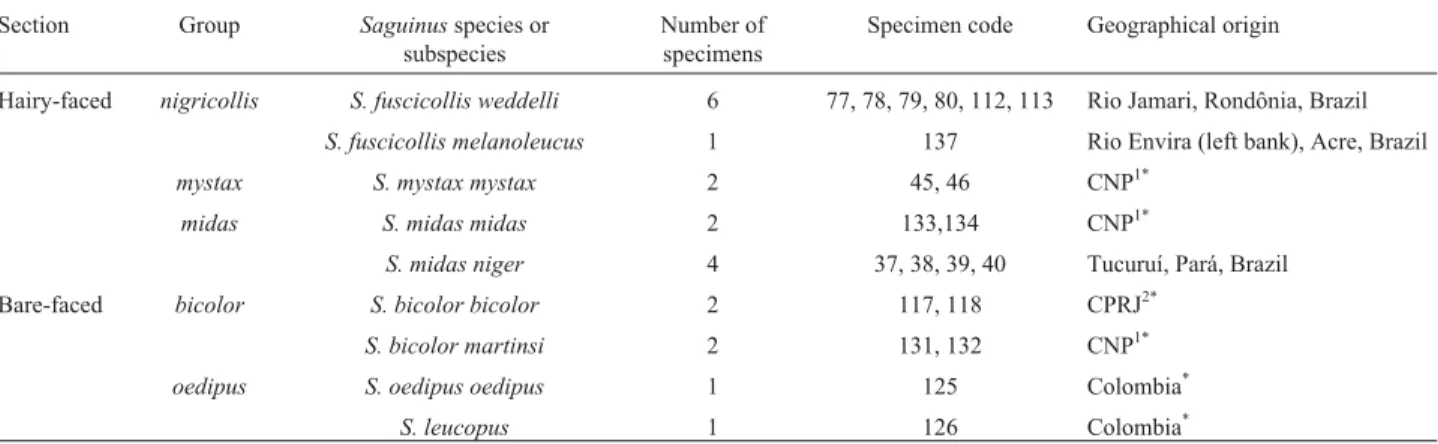
Table 1- Taxonomic and geographical data concerning theSaguinusspecimens used. Classification according to Hershkovitz (1977).
Section Group Saguinusspecies or subspecies
Number of specimens
Specimen code Geographical origin
Hairy-faced nigricollis S. fuscicollis weddelli 6 77, 78, 79, 80, 112, 113 Rio Jamari, Rondônia, Brazil S. fuscicollis melanoleucus 1 137 Rio Envira (left bank), Acre, Brazil
mystax S. mystax mystax 2 45, 46 CNP1*
midas S. midas midas 2 133,134 CNP1*
S. midas niger 4 37, 38, 39, 40 Tucuruí, Pará, Brazil
Bare-faced bicolor S. bicolor bicolor 2 117, 118 CPRJ2* S. bicolor martinsi 2 131, 132 CNP1*
oedipus S. oedipus oedipus 1 125 Colombia*
S. leucopus 1 126 Colombia*
*Exact origin unknown.
1
Centro Nacional de Primatas, Belém, Pará, Brazil.
2Centro de Primatologia do Rio de Janeiro, Rio de Janeiro, Brazil.
model parameters selected by the MODELTEST program. Maximum-parsimony (MP), neighbor joining (NJ) and maximum-likelihood (ML) analyses were performed with the PAUP 4.0 program using an heuristic search. The ro-bustness of the phylogenetic hypothesis obtained was tested by bootstrapping (Felsenstein, 1985) with 2000 pseudo-replicates for NJ and MP, and 500 for ML. The cri-terion adopted to evaluate robustness was to consider boot-strap values equal or superior to 90% as being statistically significant. The Bremer Decay indexes were obtained us-ing the SEPAL program (Salisbury, 1999, 2000).
Results and Discussion
For the 21Saguinusspecimens investigated no inser-tions or deleinser-tions (indels) were detected in the alignments and the average percentage nucleotide composition was thymine (T) 26.5, cytosine (C) 30.1, adenine (A) 31.5 and guanine (G) 11.9. The ND1 nucleotide frequencies ob-tained forSaguinuswere similar to the values previously obtained for other genera of Callitrichinae and Cebus
(Tagliaro, 1997). The average transition/transversion rate was 3.6 (without the outgroup) and the saturation test using
the ND1Saguinussequences detected no saturation at the intrageneric level at any of the codon positions.
The maximum-likelihood best-fit model selected by the MODELTEST program for the 22 samples was the Hasegawa-Kishino-Yano (HYK) model (Hasegawaet al., 1985), which takes into account the proportion of invari-able sites (I), gamma (G) and the gamma distribution shape parameter (HKY+I+G). The settings from the best-fit model selected by hierarchical likelihood ratio tests (HLRTs) were: base frequencies (A = 0.3479, C = 0.3105, G = 0.0982, T = 0.2434); the proportion of invariable sites (Pinv = 0.5802); gamma distribution shape parameter (Rates = gamma, Shape = 3.5920); transition/transversion rate (Tratio = 7.1012); and number of substitution types (Nst = 2).
The small-bodied and large-bodied size division
The trees obtained in this study using different meth-ods (MP, NJ and ML) showed the same general topology (Figure 2), with the genusSaguinusdivided into two major clades, one containing the twoS. fuscicollissubspecies and the other, the larger species (S. oedipus, S. leucopus, S. mystax, S. midas and S. bicolor). The small and large-bodied size division was initially proposed by Jacobs-Croppet al. (1999) and it was also supported by the
Table 2 - Internal primers for the mitochondrial DNA ND1 flanking regions ofCebus apellaand severalSaguinusspecies.
Primers (5’ to 3’)
5’ positions
Primer sequences Saguinus specimens
A - 5’ CTA CGT GAT CTG
AGT TCA GAC CGG 3’
all species sequenced
A2SF 62 5’ CAC TCA CAG AAC GAA AAA TCC TAG GC 3’
S. fuscicollis
A2SO 64 5’ CTC ACA GAA CGA AAA GTG CTA GGC 3’
S. oedipus
A2SL 61 5’ ACA CTC ACA GAA CGA AAA GTA TTG GG 3’
S. leucopus
A2SM 61 5’ ACA CTC ACA GAA CGA AAG ATC CTA G 3’
S. mystax
A2SB 61 5’ ACA CTC ACA GAG CGA AAA GTA TTA GG 3’
S. bicolor, S. midas A2APE 124 5’ CCA TAT GGA GTA
CTC CAA CCA ATC 3’
Cebus apella
A3SN 395 5’ CAC TAC GAG CTG TAG CCC AAA CAA T 3
S. midas, S. oedipus A3SF 395 5’ CAC TAC GAG CTG
TAG CTC AAA CAA T 3’
S. fuscicollis, S. leucopus
A3SB 414 5’ GAC AAT CTC GTA CGA AGT TAC CCT 3’
S. bicolor
A3SM 396 5’ GCT ACG AGC TGT AGC TCA AAC AAT 3’
S. mystax
A3APE 411 5’ CCA GAC CAT TTC ATA CGA AGT CAC 3’
Cebus apella
C (3’ to 5’) - 5’ CCC GAT AGC TTA TTT AGC TGA CCT TAC T 3’
all species sequenced
results of Canavezet al. (1999). Other studies based on morphological features (Hershkovitz, 1977; Natori and Hanihara, 1992) did not agree with this division based on body size, but molecular data indicate that it may be an im-portant morphological character that should be used to clar-ify the evolutionary history of this genus.
The bare-face and hairy-face tamarin sections
The monophyletic origin of the bare-faced S. leucopusandS. oedipuswas not evident in the present anal-ysis since the bootstrap values were not significant in any of the three distinct topologies obtained by MP, NJ and ML. Although our data did not show significance joining S. leucopusandS. oedipus, other molecular and morphologi-cal studies (Jacobset al., 1995; Jacobs-Croppet al., 1999; Natori, 1988; Natori and Hanihara, 1992) and the geo-graphical distribution (Figure 1) of these species indicate that they probably are sister taxa and could be grouped to-gether (oedipusgroup) as proposed by Hershkovitz (1977).
Our phylogenetic analysis strongly supports a clade joining the bare-facedSaguinus bicolorand the hairy-faced
S. midas(bootstrap values: MP = 99%, NJ = 99%, ML = 91%; Decay index = 15), these species are geographically closely related (see Figure 1). The close relationship which we found betweenS. midasandS. bicolorwas first noted by Natori and Hanihara (1992) and supported by Rylandset al. (1993), with these authors even proposing thatS. midasand
S. bicolorshould together form an independent group. Our results showS. midas-S. bicolor grouping with the bare-faced tamarins of northwestern South America (Saguinus oedipus oedipus, S. oedipus geoffroyi, S. leucopus). Hershkovitz (1977), considering morphological features and geographical distribution, suggested that the hairy-faced trait is the most primitive and grouped all the bare-faced tamarins together, although he recognized thatS. bicoloracquired the bare-faced condition independently of the bare-faced tamarins of northwestern South America. According to Hershkovitz (1977), theS. bicolorgroup may have gained the bare-faced condition from a founder colony of hairy-faced tamarins separated by a river-bend cutoff from the an-cestral stock on the south bank of the Amazon west of the Rio Madeira. TheSaguinus oedipusgroup arose independ-ently from an upper Amazonian stock of hairy-faced tamarins, spread northward along the eastern base of the An-des, then west into northern Colombia and Middle America. Although our results do not support the division ofSaguinus
species based on the presence or absence of facial-hair, we agree with Hershkovitz that the bare-faced condition may have arisen in two different lineages by convergence.
AreS. bicolorandS. midas midasmore closely related to each other than toS. midas midasandS. midas niger?
At the species level, all our ND1 phylogenetic trees (Figure 2) showed that all the representatives grouped
ac-cording to the morphological classification of Hershkovitz (1977). The suggestion thatS. bicolorandS. midascould be subspecies of the same species (Canavezet al.,1999), was not supported by our results but they were consistent with those of Meireleset al. (1997) and Jacobs-Croppet al. (1999), joiningS. bicolorandS. midasas sister groups. One possible reason for this discrepancy could be the fact that both we and Jacobs-Croppet al. (1999) used mitochondrial sequences which evolve faster than the nuclear sequences as used by Canavezet al. (1999).
The subspecies ofSaguinus midas
Surprisingly, the S. midas niger clade was not strongly supported by MP (bootstrap = 64%) or NJ (boot-strap = 77%) analysis, although ML analysis (boot(boot-strap = 96%) indicated that the fourS. midas nigerspecimens were not joined together at all, withS. m. nigerspecimen 37 be-ing isolated in its own branch. Distance values showed that specimen 37 diverged by 0.015 from the otherS. m. niger
specimens, this value being closely associated with the di-vergence found between subspecies of the same species,
i.e. S. bicolor bicolorxS. bicolor martinsi(0.017 to 0.018),
S. midas midasxS. midas niger(0.017 to 0.021) (Table 3). Since the distances observed betweenS. m. nigerspecimen 37,S. midas midas133-134 andS. midas nigerspecimens 38-39-40 were almost the same, we concluded that proba-bly there is a third subspecies with a similar morphotype to
S. midas niger. Unfortunately, there were no details on which margin of the Tocantins river the S. midas niger
specimens were captured.
AreS. fuscicollis melanoleucusandS. fuscicollis weddellidifferent species?
Although we sampled only one S. fuscicollis melanoleucusspecimen we decided to use our ND1 mito-chondrial DNA data to test Coimbra-Filho’s proposal that this morphotype should be reclassified as a different spe-cies (Coimbra-Filho, 1990). In all the phylogenetic trees
Saguinus fuscicollis melanoleucus was basal to S. fuscicollis weddellibut this arrangement was not statisti-cally significant for any of the methods used to construct the trees. In fact, the distance matrix (Table 3) showed that the genetic distance values between thisS. f. melanoleucus
morphotype andS. fuscicollis weddellirange from 0.002 to 0.005, which are similar to the genetic distances obtained between theS. fuscicollis weddellispecimens (0 to 0.003). Contrasting with our results, Jacobs-Croppet al., (1999) used cytochrome b and the D-loop mitochondrial DNA data to obtain genetic distance values agreeing with the tra-ditional classification of Hershkovitz (1977), in which both
S. f. melanoleucusandS. f. weddelliare considered as sub-species ofS. fuscicollis. There are two possible explana-tions for these discrepancies, one being that in our study the
taken from this animal in its natural forest environment) and the other being thatS. f. melanoleucusandS. f. weddelli
are in fact the same taxon with regional morphological dif-ferences. Unfortunately, there is no other molecular study published using more than one individual of the sameS. fuscicollissubspecies,which means that the range of diver-gence values of each of these subspecies cannot be verified.
Conservation status ofSaguinus
Primates are important indicators for tropical forests and are a fundamental component for the establishment of biodiversity conservation strategies in biomes, regions and countries (Rylandset al., 1997; Sechrestet al., 2002). Ac-cording to the Mace-Lande system, recently adopted by the International Union for Conservation of Nature and Natural Resources (IUCN), 35 percent of Neotropical primate taxa are threatened (Rylandset al.,1997). Brazil is not only the country with the highest diversity of primates (76 species and a total of 128 species and subspecies) but also has the highest number of threatened species and subspecies of pri-mates, with 38 species and a total of 69 species and subspe-cies being considered as threatened (Rylandset al.1997). Due to an almost complete lack of information on the popu-lations of most of the callitrichids, decisions on their con-servation status are based almost entirely on the size of their geographic range and a gross overview of the state of de-struction and development of the regions involved. Such decisions are also based on taxonomic classifications that depend on morphological studies including pelage color (Rylands et al., 1993). Two genera of Callitrichinae (LeontopithecusandCallimico) and 16 of the total of 55 species and subspecies are considered threatened, includ-ing fiveSaguinusspecies and subspecies, withS. bicolor bicolorandS. oedipusbeing considered endangered andS. nigricollis hernandezi, S. imperator imperator and S. leucopusvulnerable (Rylandset al., 1997).
The study presented in this paper reinforces the value of molecular techniques in confirming traditional taxo-nomic classifications, our results pointing to the existence of a subspecies which has similar morphology toS. midas nigerbut which can be differentiated fromS. midas niger
on the basis of molecular data. None of theS. midas subspe-cies are at present considered threatened, mainly because of their wide geographical distribution (Figure 1), but since our molecular data indicates the possible existence of a new
S. midassubspecies we should be alert to the conservation needs of this new subspecies because we have no idea as to its distribution or population size. Furthermore, the distri-bution area ofS. midas nigeris suffering pressure from de-forestation for agriculture and cattle raising, which may mean that new taxa can disappear before even being de-scribed. There have been few molecular studies of New World monkeys using several individuals of the same spe-cies or subspespe-cies but detailed studies at this level may
veal that the richness of the Amazonian primates is being underestimated.
Acknowledgments
This study was supported by grants to M.J.S. from the Nuffield Foundation, the Royal Society, and the Northern Ireland Development and Research Council. The Brazilian agency CNPq supported C.H.T. We thank Dr. José Augus-to Pereira Carneiro Muniz (Centro Nacional de Primatas, Belém, Pará, Brazil), Dr. Aldemar Coimbra-Filho and Dr. Alcides Pissinati (both from the Centro de Primatologia do Rio de Janeiro, Brazil) and Arlindo Pinto de Souza Jr. (Universidade Federal do Pará, Brazil) for providing the
Saguinusblood samples used in our research. We are grate-ful to Dr. Colin Robert Beasley for help with correcting the English.
References
Avise JC (1994) Molecular Markers, Natural History and Evolu-tion. Chapman and Hall, New York, 511 pp.
Barroso CML, Schneider H, Schneider MPC, Sampaio I, Harada ML, Czelusniak J and Goodman M (1997) Update on the phylogenetic systematics of the New World monkeys: Fur-ther DNA evidence for placing the pygmy marmoset (Cebuella) within the genusCallithrix. International Journal of Primatology 18:651-674.
Canavez FC, Moreira MAM, Simon F, Parham P and Seuánez HN (1999) Phylogenetic relationships of the Callitrichinae
(Platyrrhini, Primates) based onβ2-microglobulin DNA
se-quences. American Journal of Primatology 48:225-236. Chaves R, Sampaio I, Schneider MP, Schneider H, Page SL and
Goodman M (1999) The place ofCallimico goeldiiin the
Callitrichine phylogenetic tree: Evidence from von
Willebrand factor gene intron II sequences. Molecular Phylogenetics and Evolution 13:392-404.
Coimbra-Filho AF (1990) Sistemática, distribuição geográfica e situação atual dos símios brasileiros (Platyrrhini, Primates). Revista Brasileira de Biologia 50:1063-1079.
Felsenstein J (1985) Confidence limits on phylogenies: An ap-proach using the bootstrap. Evolution 39:783-791. Goodman M, Porter CA, Czelusniak J, Page SL, Schneider H,
Shoshani J, Gunnell G and Groves CP (1998) Toward a phylogenetic classification of primates based on DNA evi-dence complemented by fossil evievi-dence. Molecular Phylogenetics and Evolution 9:585-598.
Hall TA (1999) BioEdit: A user-friendly biological sequence alignment editor and analysis program for Windows 95/98/NT. Nucleic Acids Symposium Series 41:95-98. Hasegawa M, Kishino H and Yano T (1985) Dating the
hu-man-ape splitting by a molecular clock of mitochondrial DNA. Journal of Molecular Evolution 22:160-174. Hershkovitz P (1977) Living New World Monkeys (Platyrrhini).
With an Introduction to Primates. v. 1. The University of Chicago Press, Chicago and London, 1117 pp.
Hershkovitz P (1979) Races of the emperor tamarin,Saguinus
im-peratorGoeldi (Callitrichidae, Primates). Primates 20:277-287.
Hershkovitz P (1982) Subspecies and geographic distribution of
black-mantle tamarins,Saguinus nigricollisSpix (Primates:
Callitrichidae). Proceedings of the Biological Society of Washington 95:647-656.
Jacobs SC, Larson A and Cheverud JM (1995) Phylogenetic rela-tionships and orthogenetic evolution of coat color among
tamarins (genusSaguinus). Syst Biol 44:515-532.
Jacobs-Cropp S, Larson A and Cheverud JM (1999) Historical
biogeography of Tamarins, genusSaguinus: The molecular
phylogenetic evidence. American Journal of Physical An-thropology 108:65-89.
Kumar S, Tamura K, Jakobsen IB and Nei M (2001) Mega 2:
Mo-lecular evolutionary genetics analysis software.
Bioinformatics 17:1244-1245.
Meireles C, Sampaio I, Schneider H, Ferrari SF, Coimbra-Filho AF, Pissinati A and Schneider MPC (1997) A comparative
study of eleven protein systems in tamarins, genusSaguinus
(Platyrrhini, Callitrichinae). Brazilian Journal of Genetics 20:13-19.
Mittermeier RA, Rylands AB and Coimbra-Filho AF (1988) Sys-tematics: Species and subspecies – An update. In: Mittermeier RA, Rylands AB, Coimbra-Filho AF and da Fonseca GAB (eds) Ecology and Behaviour of Neotropical Primates. v. 2. World Wildlife Fund, Washington, D.C., pp 13-75.
Natori M (1988) A cladistic analysis of interspecific relationships ofSaguinus. Primates 29:263-276.
Natori M and Hanihara T (1992) Variations in dental
measure-ments betweenSaguinusspecies and their systematic
rela-tionships. Folia Primatol 58:84-92.
Pastorini J, Forstner MRJ, Martin RD and Melnick DJ (1998) A
reexamination of the phylogenetic position of Callimico
(Primates) incorporating new mitochondrial DNA sequence data. Journal of Molecular Evolution 47:32-41.
Posada D and Crandall KA (1998) MODELTEST: Testing the model of DNA substitution. Bioinformatics 14:817-818. Rosenberger AL (1978) Loss of incisor enamel marmosets.
Jour-nal of Mammalogy 59:207-208.
Rosenberger AL (1981) Systematics: The higher taxa. In: Coimbra-Filho AF and Mittermeier RA (eds) Ecology and Behavior of Neotropical Primates. Academia Brasileira de Ciências, Rio de Janeiro, pp 9-27.
Rylands AB, Coimbra-Filho AF and Mittermeier RA (1993) Sys-tematics, geographic distribution, and some notes on the conservation status of the Callitrichidae. In: Rylands AB (ed) Marmosets and Tamarins Systematics, Behaviour, and Ecology. Oxford University Press, Oxford, New York, To-kyo, pp 11-77.
Rylands AB, Mittermeier RA and Rodriguez-Luna, E (1995) A species list for the New World Primates (Platyrrhini): Distri-bution by country, endemism, and conservation status ac-cording to the Mace-Land system. Neotropical Primates 3:113-160.
Rylands AB, Mittermeier RA and Rodríguez-Luna E (1997) Con-servation of Neotropical Primates: Threatened species and an analysis of Primate diversity by country and region. Folia Primatol 68:134-160.
Salisbury BA (1999) Strongest evidence: Maximum apparent phylogenetic signal as a new cladistic optimality criterion. Cladistics 15:137-149.
Salisbury BA (2000) Strongest evidence revised. Cladistics 16(394-402.
Sambrook J, Fritsch E and Maniatis T (1989) Molecular Cloning: A Laboratory Manual. Cold Spring Harbor Laboratory Press, New York.
Schneider H, Schneider MPC, Sampaio I, Harada ML, Stanhope M, Czelusniak J and Goodman M (1993) Molecular phylog-eny of the New World monkeys (Platyrrhini, Primates). Mo-lecular Phylogenetics and Evolution 22:225-242.
Schneider H, Sampaio I, Harada ML, Barroso CML, Schneider MPC, Czelusniak J and Goodman M (1996) Molecular phy-logeny of the New World monkeys (Platyrrhini, Primates) based on two unlinked nuclear genes: IRBP intron 1 and gama-globin sequences. American Journal of Physical An-thropology 100:153-179.
Schneider H (2000) The current status of the New World monkey phylogeny. Anais da Academia Brasileira de Ciências 72:165-172.
Sechrest W, Brooks TM, Fonseca GAB, Konstant WR, Mittermeier RA, Purvis A, Rylands AB and Gittleman JL (2002) Hotspots and the conservation of evolutionary his-tory. Proceedings of the National Academy of Sciences 99:2067-2071.
Swofford DL (2002) PAUP* Phylogenetic Analysis Using Parsi-mony (*and other Methods) Version 4. Sinauer Associates, Sunderland, Massachusetts.
Tagliaro CH (1997) A filogenia molecular na subfamilia Callitrichinae (Platyrrhini, Primates): As relações
intergené-ricas e intragenéintergené-ricas de Callithrix.PhD Thesis,
Univer-sidade Federal do Pará, Belém, Brazil, 187 pp.
Tagliaro CH, Schneider MPC, Schneider H, Sampaio IC and Stanhope M (1997) Marmoset phylogenetics, conservation perspectives, and evolution of the mtDNA control region. Molecular Biology and Evolution 14:674-684.
Tagliaro CH, Schneider MPC, Schneider H, Sampaio I and
Stan-hope M (2000) Molecular studies of Callithrix pygmaea
(Primates, Platyrrhini) based on transferrin intronic and ND1 regions: Implications for taxonomy and conservation. Genetics and Molecular Biology 23:729-737.
Thompson JD, Higgins DG and Gibson TJ (1994) CLUSTAL W: Improving the sensitivity of progressive multiple sequence alignment through sequence weighting, positions-specific gap penalties and weight matrix choice. Nucleic Acids Re-search 22:4673-4680.
Van Roosmalen MGM, Van Roosmalen T, Mittermeier RA and Rylands AB (2000) Two new species of marmoset, genus Callithrix Erxleben, 1777 (Callitrichidae, Primates) from Tapajós/Madeira interfluvium, South Central Amazonia, Brazil. Neotropical Primates 8:2-18.
Xia X and Xie Z (2001) DAMBE: Data analysis in molecular biol-ogy and evolution. Journal of Heredity 92:371-373.