Article
J. Braz. Chem. Soc., Vol. 22, No. 5, 968-975, 2011. Printed in Brazil - ©2011 Sociedade Brasileira de Química 0103 - 5053 $6.00+0.00
A
*e-mail: [email protected]
A Theoretical Study of the Inversion and Rotation Barriers in
Methyl-Substituted Amines
Júnior Nascimento,a Marina Pelegrini,c Luiz F. A. Ferrão,a,b
Orlando Roberto-Netod and Francisco B. C. Machado*,a
aDepartamento de Química and bDepartamento de Física, Instituto Tecnológico de Aeronáutica,
12228-900 São José dos Campos-SP, Brazil
cDivisão de Ensino, Academia da Força Aérea, 13643-000 Pirassununga-SP, Brazil
dDivisão de Aerotermodinâmica e Hipersônica, Instituto de Estudos Avançados,
12228-840 São José dos Campos-SP, Brazil
Barreiras de energia para os movimentos de inversão e rotação das moléculas metilamina, dimetilamina e trimetilamina foram calculadas usando a metodologia CCSD(T)//B3LYP com os conjuntos de funções de base de Dunning, cc-pVTZ, cc-pVQZ e cc-pCVTZ. O procedimento de extrapolação para o conjunto de base completa (complete basis set, CBS) e os efeitos da correlação dos elétrons do caroço também foram incluídos nos cálculos das barreiras de energia. Nossos melhores resultados estão em excelente concordâncias com os dados experimentais, indicando que a metodologia utilizada é recomendada para a predição exata de propriedades estruturais e de barreiras de energia de outros sistemas moleculares.
Barrier heights of the internal rotation and inversion motions of methylamine, dimethylamine and trimethylamine molecules were calculated with the CCSD(T)//B3LYP methodology in combination with the cc-pVTZ, cc-pVQZ, and cc-pCVTZ basis sets of Dunning. The complete basis set (CBS) extrapolation procedure and core-valence (CV) correlation effects are also examined to the barrier heights. Our best estimate results (CCSD(T)/CBS+CV//B3LYP/cc-pVQZ) are in very good agreement with the experimental data, indicating the use of this methodology to provide accurate predictions of structures and barrier heights for other systems.
Keywords: energy barriers, methylamine, dimethylamine, trimethylamine, CCSD//B3LYP
Introduction
The methyl-substituted amines, methylamine (CH3NH2), dimethylamine [(CH3)2NH], and trimethylamine [(CH3)3N]
form an interesting group of molecules which are important in organic syntheses and biological processes, as well as they are eficient corrosion inhibitors of aluminum. Beyond their technological importance, these species are rich in structural features presenting large amplitude internal motions, rotation of the methyl groups and internal inversion of the amino group.
Methylamine has been extensively studied by experimentalists in which its internal rotation and inversion barrier heights were determined using microwave (MW), infrared (IR) and electron diffraction (ED) experiments.1-7
Methylamine is considered a small molecule from the theoretical point of view, therefore it is appropriate to be studied using high level theoretical quantum chemical methodologies, having received many contributions.7-14
Lee et al.8 investigated the origin of the structural stability
of methylamine concluding that the stereo electronic effect is the major interaction force affecting its stability. Csonka and Sztraka9 using density functional and
post-Hartree-Fock methodologies showed that the density functional BP86/6-311G(d) method provides reliable results for geometry and vibrational frequencies, as compared with the experimental results. Smeyers and Villa10 discussed the
inluence of the zero-point energy correction to the rotation and inversion motions based on the MP2 results, and During and Zheng7 calculated these motions barriers using
frequencies, and the barrier heights of the internal rotation and inversion motions of methylamine using the CCSD(T) theory with a systematic improvement via cc-pVDZ, cc-pVTZ, cc-pVQZ, and cc-pCVTZ basis sets and also including the contribution of the inner-shell and valence-shell electrons.11 More recently, Levi et al.12 carried out
accurate calculations of the vibrational frequencies, Kim and Zeroka13 presented new and important results
concerning the inversion and rotational barriers and Ducati
et al.14 calculated the rotational barrier.
Geometries, vibrational frequencies and the inversion and rotation barriers of dimethylamine have been determined both experimentally and theoretically.15-23 The
experimental investigations were obtained using electron diffraction,15 microwave,16,17 and infrared and Raman18,19
spectra. Theoretically, the calculations have been carried out using ab initio methods up to MP4 level.20-23
The trimethylamine molecule has also received various experimental and theoretical studies.24-31 The experimental
data of the geometry, vibrational frequencies and internal-inversion and rotational barriers were obtained using microwave,24,26 infrared and Raman,25,27 techniques and
employing analysis of the ultraviolet absorption and fluorescence spectra.28 Theoretical results were also
obtained using ab initio methods up to MP4 level.29-31
It has been adequately demonstrated that a simultaneous consideration of basis set saturation and core correlation effects using coupled cluster method and extended basis set provide very accurate values of many molecular properties.32,33 Recently, using this methodology, we
have investigated the geometries, harmonic vibrational frequencies, and the barrier heights of methylamine.11
In this work, we are concerned with the calculations of the internal and rotational barrier heights of the methyl-substituted amines, methylamine (CH3NH2), dimethylamine
[(CH3)2NH], and trimethylamine [(CH3)3N].
Methodology
For all conformers, geometry optimizations were performed using the B3LYP exchange-correlation functional at the density functional theory level34,35 and
the cc-pVQZ basis set of Dunning.36 Intrinsic reaction
coordinate (IRC)37 calculations were carried out in order
to verify the connections of the transition states to the equilibrium geometries, as already done for methylamine by Kim and Zeroka13 and for trimethylamine by Tanaka
and Aida.31 Next, using these optimized geometries, the
barrier heights of the internal rotation and inversion motion of the methyl-substituted amines were calculated using coupled cluster theory, including a perturbative
treatment of the triple excitations (CCSD(T)).38 The
correlation-consistent polarized-valence triple and quadruple basis sets of Dunning,36 named as cc-pVTZ,
and cc-pVQZ, were employed. As it is well known, these basis set are built for frozen core electron calculations. The CCSD(T) total energies were extrapolated to the complete basis set (CBS) limit by using the extrapolation procedure of Halkier et al.39
ECBS = [E(n) × n
3] – [E(n− 1) × (n− 1)3] / n3 – (n− 1)3 (1)
where n equals 4 for cc-pVQZ basis set. In order to provide the effect of core-valence correlation (CV) we have also used the correlation consistent core and valence polarization triple zeta basis set (cc-pCVTZ) of Woon and Dunning.40 Thus, these calculations were carried out
correlating both the valence electrons and all electrons. Therefore, the barrier heights (∆E) were calculated using the expression,
∆E = (∆ECBS, valence) + ∆E (cc-pCVTZ, all electrons) –
∆E (cc-pCVTZ, valence) (2)
As stated above, for methylamine, we have recently used CCSD(T) to optimize the geometries for all conformers and to calculate inversion and rotational barrier heights.11
Kim and Zeroka have shown recently two transition state structures for the inversion mode, with one and two imaginary frequencies, respectively.13 In order to clarify the
previous structures of the inversion motion,11 we have also
re-optimized the structures of all methylamine conformers using the CCSD(T) methodology.
All the calculations were carried out using the Gaussian 03 code41 and Molpro 2002.6.42
Results and Discussion
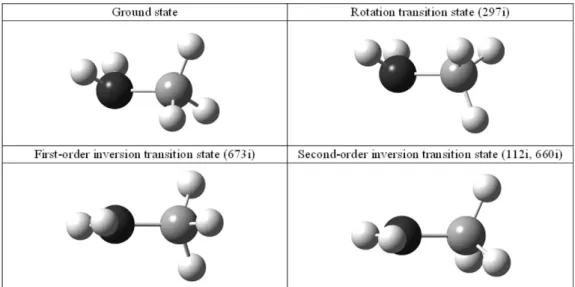
The B3LYP/cc-pVQZ optimized geometries of all methylamine conformers are presented in Figure 1, and in Figure 2 are showed the dimethylamine and trimethylamine conformers.
Methylamine has its ground state equilibrium geometry represented by a staggered conformation, and the eclipsed conformation corresponds to the transition state of the internal rotation due to the torsional motion of a methyl moiety along the CN axis. The wagging motions of the amine hydrogen atoms present two planar conformations, which are irst-order and second-order inversion transition states, as also determined by Kim and Zeroka.13 All of them
belong to the Cs symmetry and are shown in Figure 1.
using the CCSD(T)/CBS methodology11 and, in this work,
as discussed before, we have re-optimized the structures of all conformers using CCSD(T) methodology, in order to clarify the previous structures of the inversion motion. As one can see, the present results show that, in fact, the previous structures11 refer to the irst-order inversion motion
with one imaginary frequency. The imaginary frequencies calculated at the CCSD(T)/cc-pVTZ level are 749i cm−1 for
the irst-order inversion structure, 166i and 740i cm−1 for
the second-order, and 317i cm−1 for the rotation transition
state. These imaginary frequencies calculated at B3LYP/ cc-pVQZ level, are respectively 673i, 112i and 660i, and 297i cm−1 as reported in Figure 1. Note that the B3LYP
imaginary frequencies differ no more than 80 cm−1 from
the CCSD(T)/cc-pVTZ results. All geometric parameters calculated using B3LYP/cc-pVQZ are, in general, in good agreement with the CCSD(T) results and also with previous theoretical calculations7-10,13,14 and experimental data.2-4 We
have also carried out the IRC calculations using the B3LYP/ cc-pVTZ method and the results conirm that the irst-order inversion transition state and the rotation transition state connect to the ground state, as already shown by Kim and Zeroka13 using a more complete two-dimensional potential
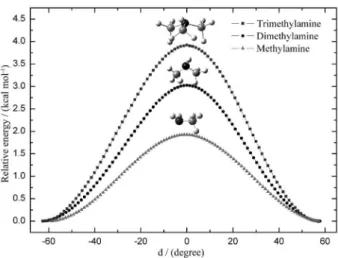
energy surface. In this work, the IRC paths for the rotation motion were calculated by changing the dihedral angle (d) (H−C−N lone-pair). The changes in the energy relative Figure 2. The conformation structures of dimethylamine and trimethylamine. Values in brackets correspond to the imaginary frequencies (in cm−1)
calculated at B3LYP/cc-pVQZ level.
Figure 1. The conformation structures of methylamine. Values in brackets correspond to the imaginary frequencies (in cm−1) calculated at
to the ground state structure (d = ± 60°) are presented in Figure 3. The IRC calculations for the inversion motion are presented in Figure 4 that shows the potential energy as a function of the degree of inversion d, which is deined as:
| d | = α/αgs (3)
where, α is the H−N−C−H dihedral angle, which is ± 58.8º at the ground state conformation (α
gs) and equal to zero at
the irst-order inversion transition state geometry. The origin of the structural stability was conirmed to be essentially due to the stereo electronic effect. As obtained by Lee et al.,8 the change of rotational conformation energy
(∆E) and the change of the C−N distance (∆rCN) varies
almost linearly with either the cosine of the dihedral angle d (H−C−N-lone-pair) or the cosine of 3d.
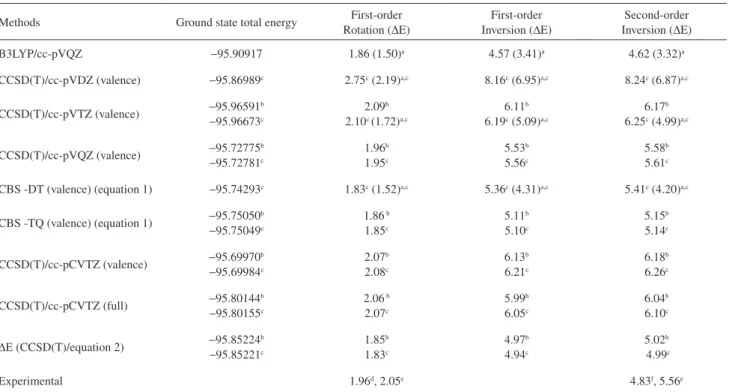
The two CCSD(T) results of the methylamine barrier heights, the single point calculations with the geometries optimized at the B3LYP/cc-pVQZ level and those obtained with the geometries optimized with the CCSD(T), are presented in Table 1. The results obtained with B3LYP/cc-pVQZ and the experimental data1-3,5 are also presented. All
the CCSD(T) results for barrier heights using the B3LYP/ cc-pVQZ optimized geometries are similar to the results calculated with the CCSD(T) geometries, differing no more than 0.08 kcal mol−1. It is important to mention that
calculations of T1 diagnostic were previously carried out11
at the CCSD/cc-pVQZ level with values equal to 0.008 for all conformations, which are small enough to allow the use of the single reference CCSD(T) wave functions in the study of the present molecular conformations. As already noticed,11 the increase of the basis set and the inclusion of
core correlation reduce both barrier height values, as also observed if one compares the CCSD(T)/cc-pVTZ result for the irst-order rotation barrier with the one calculated by Ducati et al.14 with CCSD(T)/aug-cc-pVTZ. The
inclusion of ZPE correction decreases the values of barrier heights underestimating the CBS-DT (CBS extrapolation using double and triple basis set) results compared to the experimental data. The experimental rotation barriers range from 1.962,3 to 2.055 kcal mol−1,and for inversion, from
4.831 to 5.565 kcal mol−1. The CCSD(T) results with the
CBS extrapolation and core-valence correlation corrections (CV) (equation 2), but without ZPE correction, are 1.83 and 4.99 kcal mol−1 for the rotation and inversion barriers.
However, the CCSD(T)/cc-pVQZ (valence) results, without ZPE correction are 1.95 and 5.61 kcal mol−1, respectively.
As one can see, the inclusion of the ZPE correction from the B3LYP/cc-pVQZ or from the CCSD(T)/CBS-DT calculations provide barrier height values lower than the experimental data, which are accurate enough to encourage us in using this methodology in the calculation of larger systems as dimethyl and trimethyl amines. Also, as afirmed above, the CCSD(T) and CCSD(T)//B3LYP barrier height results differ no more than 0.08 kcal mol−1 without
ZPE. Including the B3LYP/cc-pVQZ ZPE correction in the single point CCSD(T) calculations, the difference from the optimized CCSD(T) result is not higher than 0.14 kcal mol−1. Therefore, the CCSD(T) single point
calculations are reliable enough to calculate barrier heights for similar structures, and in this work, were carried out for the larger systems.
The B3LYP/cc-pVQZ dimethylamine conformation structures are presented in Figure 2. The ground state equilibrium geometry has a pyramidal structure with Cs
Figure 4. Potential energy curves (in kcal mol−1) along the IRC path for
the inversion motion at B3LYP/cc-pVTZ. The degree of inversion (d) for methylamine is deined in the text, for dimethylamine see Figure 5, and for trimethylamine see Figure 2 in reference 31. d = −1.0 or 1.0 correspond to the ground state of each molecule and d = 0.0 corresponds to the inversion transition state structures (showed).
Figure 3. Potential energy curves (in kcal mol−1) along the IRC path for the
point group symmetry, and it will be denoted as the eclipsed conformation. The internal rotation of the methyl groups with C1 point group symmetry has a staggered conformation,
and the inversion motion of the amine hydrogen has a planar conformation within C2v point group symmetry.
As obtained to methylamine, all geometrical parameters are in good agreement with previous experimental15,16 and
theoretical results.21-23 In the planar structure, the H−C−
N−C−H atoms are coplanar to the amine hydrogen atom, and in the ground state pyramidal structure, this amine hydrogen atom forms an angle of 53.4 degrees to the H−C−N−C−H plane. These results are in good agreement with the MP2/6-31G(d,p) value, equal to 55.2 degrees, and also with the experimental data of 54.6 degrees.16 The IRC
paths using the B3LYP/cc-pVTZ method for the rotation motion were calculated by changing the dihedral angle (d) (H−C−N−H). As calculated for methylamine, the changes in energy relative to the ground state structure (d = ± 60°) are presented in Figure 3. For the inversion the degree of inversion d is deined as shown in Figure 5 and the IRC path is presented in Figure 4.
As analyzed for methylamine, the change of rotational conformation energy (∆E) and the change of the C−N distance (∆r
CN) varies almost linearly with either the cosine
of the dihedral angle d (H−C−N-lone-pair) or the cosine of 3d. Thus, we also concluded that the origin of the structural stability is due to the stereoelectronic effect.
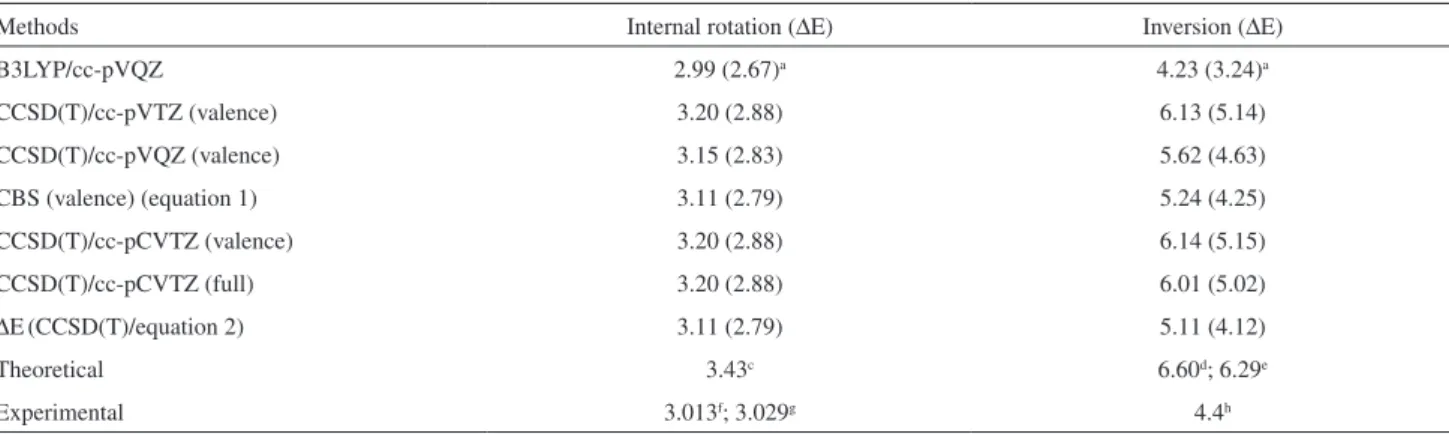
The dimethylamine barrier heights are calculated at the CCSD(T) level using the geometries optimized with B3LYP/cc-pVQZ and are presented in Table 2 together with the experimental data.16-19 As already discussed for the
methylamine, the increase of the basis set and the inclusion of the core correlation reduce both barrier height values. The inclusion of core correlation is more important for the inversion barrier. For the internal rotation barrier, our Table 1. Ground state total energy (in a.u.), internal rotation and inversion barrier heights (in kcal mol−1) of methylamine
Methods Ground state total energy First-order
Rotation (∆E)
First-order Inversion (∆E)
Second-order Inversion (∆E)
B3LYP/cc-pVQZ −95.90917 1.86 (1.50)a 4.57 (3.41)a 4.62 (3.32)a
CCSD(T)/cc-pVDZ (valence) −95.86989c 2.75c (2.19)a,c 8.16c (6.95)a,c 8.24c (6.87)a,c
CCSD(T)/cc-pVTZ (valence) −95.96591
b
−95.96673c
2.09b
2.10c (1.72)a,c
6.11b
6.19c (5.09)a,c
6.17b
6.25c (4.99)a,c
CCSD(T)/cc-pVQZ (valence) −95.72775
b
−95.72781c
1.96b 1.95c 5.53b 5.56c 5.58b 5.61c
CBS -DT (valence) (equation 1) −95.74293c 1.83c (1.52)a,c 5.36c (4.31)a,c 5.41c (4.20)a,c
CBS -TQ (valence) (equation 1) −95.75050b −95.75049c
1.86 b
1.85c
5.11b
5.10c
5.15b
5.14c
CCSD(T)/cc-pCVTZ (valence) −95.69970
b
−95.69984c
2.07b 2.08c 6.13b 6.21c 6.18b 6.26c
CCSD(T)/cc-pCVTZ (full) −95.80144
b
−95.80155c
2.06 b
2.07c
5.99b
6.05c
6.04b
6.10c
∆E (CCSD(T)/equation 2) −95.85224b −95.85221c
1.85b 1.83c 4.97b 4.94c 5.02b 4.99c
Experimental 1.96d, 2.05e 4.83f, 5.56e
aValues in parentheses are with ZPE correction; busing geometries optimized at B3LYP/cc-pVQZ level; cusing the geometry optimized at the CCSD(T)
level; dreferences 2 and 3; ereference 5; freference 1.
Figure 5. Deinition of the degree of inversion (d) in dimethylamine molecule: The N-H vector is directed to N−H bond. In the planar (inversion transition state) structure the H−C−N−C−H atoms are coplanar to the hydrogen amine atom (α = 0), and in the ground state pyramidal structure this hydrogen amine atom forms an angle of 53.4 degrees to the H−C−N−C−H plane (sin α = sin α
best result obtained at the CCSD(T)/CBS+CV//B3LYP/ cc-pVQZ level (equation 2), is 3.11 kcal mol−1, which
include the CBS and core-valence correlation effects. The previous theoretical result15 at MP2/6-31G(df,p)
level is 3.43 kcal mol−1 and our B3LYP/cc-pVQZ result
is 2.99 kcal mol−1. The experimental infrared and Raman
data are respectively 3.01318 and 3.02919 kcal mol−1. Using
ZPE correction, the B3LYP/cc-pVQZ result is 2.67, which is relatively small compared to the experimental data. Using B3LYP ZPE corrections in the CCSD(T)/equation 2 and CCSD(T)/cc-pVQZ results, the rotation barrier are 2.79 and 2.83 kcal mol−1, respectively. For the inversion,
our best results using equation 2 and cc-pVQZ basis set are 5.11 and 5.62 kcal mol−1, respectively. The
B3LYP/cc-pVQZ is 4.23 kcal mol−1 and previous theoretical results
using MP2/6-31G (d,p) and MP4/6-31G(d,p)//MP2/6-31G (d,p) are respectively 6.60 and 6.29 kcal mol−1.22,23 The
experimental result obtained from microwave spectra is 4.4 ± 1 kcal mol−1,16,17 which has an error limit somewhat
large. A better comparison with the experimental data should include the ZPE correction obtained from the B3LYP/cc-pVQZ calculations, which are 3.24, 4.12 and 4.63 kcal mol−1 calculated using B3LYP/
cc-pVQZ, CCSD(T)/equation 2 and CCSD(T)/cc-pVQZ, respectively.
Trimethylamine has its ground state equilibrium geometry well determined24,26,29-31 as a pyramidal
structure with C3v point group symmetry with an eclipsed
conformation. Figure 2 gives the C3v equilibrium
geometry and the two other conformations with Cs point
group symmetry, the staggered and planar structures, which correspond respectively to the internal rotation of the methyl groups and to the skeletal inversion. All geometries were optimized using the B3LYP/cc-pVQZ method. The geometrical parameters, in general, are in
good agreement with previous experimental24,26,27 and
theoretical results.29,30 The IRC paths using the B3LYP/
cc-pVTZ method for the rotation motion were calculated by changing the dihedral angle d (H−C−N-lone pair) and the relative energy from the ground state structure (d = ± 60°), which are presented in Figure 3. For the inversion, the IRC path is presented in Figure 4. The calculations were carried out using the degree of inversion d, as deined by Tanaka and Aida.31 As analyzed for
methylamine and dimethylamine, the structural stability is essentially due to the stereo electronic effect.
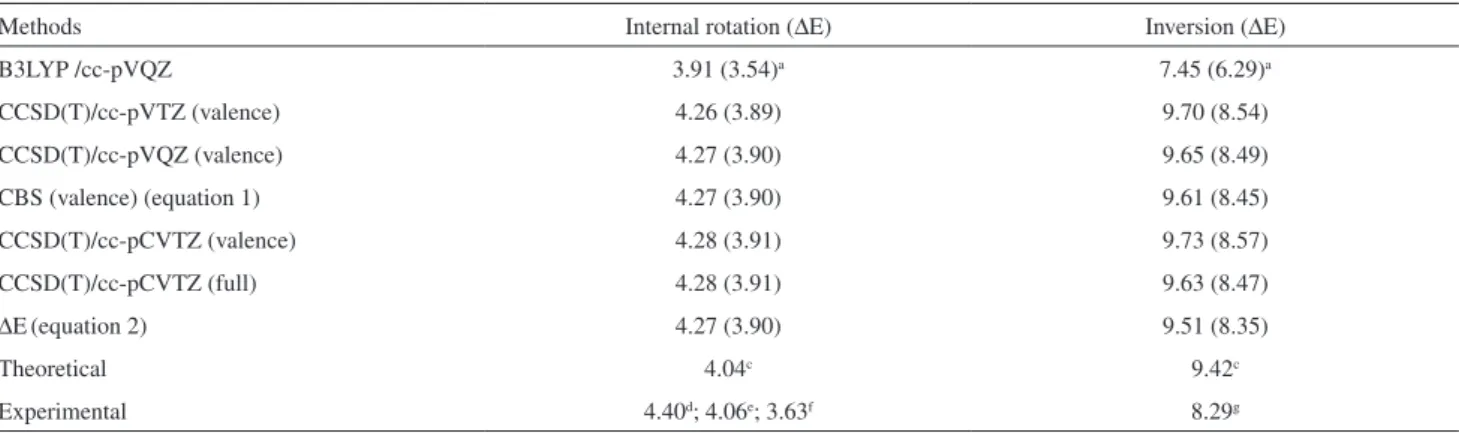
Calculated trimethylamine barrier heights are presented in Table 3 together with the experimental data.24,25,27,28 The
inclusion of core correlation is more important for the inversion barrier, as already discussed for the methylamine and dimethylamine. The calculated barrier height results for the torsion of one methyl group are consistent with the experimental and previous theoretical results. The B3LYP/ cc-pVQZ result without ZPE correction is 3.91 kcal mol−1
and the result with ZPE is 3.54 kcal mol−1, which seems
underestimated compared to the experimental data,
i.e., 4.40,24 4.0625 or 3.6327 kcal mol−1, as also observed
to methylamine and dimethylamine. Our best result (equation 2) is 4.27 kcal mol−1, but if one uses the ZPE
correction from the B3LYP/cc-pVQZ calculations, this value becomes 3.90 kcal mol−1. The previous MP4(SDQ)/
aug-cc-pVTZ result without ZPE is 4.04 kcal mol−1.31 For
the inversion, the B3LYP/cc-pVQZ without and with ZPE are 7.45 and 6.29 kcal mol−1, respectively. Our best result
without ZPE is 9.51 kcal mol−1, which is similar to the
previous theoretical study at MP4(SDQ)/aug-cc-pVTZ level, equal to 9.42 kcal mol−1.31 Using the ZPE correction
from the B3LYP/cc-pVQZ calculations, our best result is 8.35 kcal mol−1, which is in very close agreement with the
experimental value of 8.29 kcal mol−1.28
Table 2. Internal rotation and inversion barrier heights (in kcal mol-1) of dimethylamine. The CCSD(T) results are calculated using the B3LYP/cc-pVQZ
optimized geometries
Methods Internal rotation (∆E) Inversion (∆E)
B3LYP/cc-pVQZ 2.99 (2.67)a 4.23 (3.24)a
CCSD(T)/cc-pVTZ (valence) 3.20 (2.88) 6.13 (5.14)
CCSD(T)/cc-pVQZ (valence) 3.15 (2.83) 5.62 (4.63)
CBS (valence) (equation 1) 3.11 (2.79) 5.24 (4.25)
CCSD(T)/cc-pCVTZ (valence) 3.20 (2.88) 6.14 (5.15)
CCSD(T)/cc-pCVTZ (full) 3.20 (2.88) 6.01 (5.02)
∆E(CCSD(T)/equation 2) 3.11 (2.79) 5.11 (4.12)
Theoretical 3.43c 6.60d; 6.29e
Experimental 3.013f; 3.029g 4.4h
aValues in parentheses are with ZPE correction; bvalues in parentheses are with B3LYP ZPE correction; creference 15, MP2/6-31G (df,p); dreference 22,
Conclusions
In this work, we have used the cc-pVTZ, cc-pVQZ, and cc-pCVTZ basis sets of Dunning and the CCSD(T) theory in order to obtain accurate values of inversion and rotation barrier heights of the methylamine, dimethylamine and trimethylamine molecules using the optimized geometries and frequencies calculated at B3LYP/cc-pVQZ level. CBS extrapolation procedure and core-valence correlation effects are also employed in the calculations of the barrier heights using CCSD(T) single point calculations. Our best estimate results (equation 2) are in very good agreement with the experimental data. Therefore, the methodology, CCSD(T)/ CBS+CV//B3LYP/cc-pVQZ, used in this study provides accurate and consistent predictions of structures and barrier height values of internal motions in methyl substituted amines, and it is also recommended to be applied to other systems.
Supplementary Information
Supplementary information is available free of charge at http://jbcs.sbq.org.br as a PDF ile.
Acknowledgments
The authors acknowledge the continuous research and the fellowship support of the Conselho Nacional de Desenvolvimento Cientíico e Tecnológico (CNPq) and the Fundação de Amparo à Pesquisa do Estado de São Paulo (FAPESP).
References
1. Tsuboi, M.; Hirakawa, A. Y.; Tamagake, K.; J. Mol. Spectrosc. 1967, 22, 272.
Table 3. Internal rotation and inversion barrier heights (in kcal mol−1) of trimethylamine. The CCSD(T) results are calculated using the B3LYP/cc-pVQZ
optimized geometries
Methods Internal rotation (∆E) Inversion (∆E)
B3LYP /cc-pVQZ 3.91 (3.54)a 7.45 (6.29)a
CCSD(T)/cc-pVTZ (valence) 4.26 (3.89) 9.70 (8.54)
CCSD(T)/cc-pVQZ (valence) 4.27 (3.90) 9.65 (8.49)
CBS (valence) (equation 1) 4.27 (3.90) 9.61 (8.45)
CCSD(T)/cc-pCVTZ (valence) 4.28 (3.91) 9.73 (8.57)
CCSD(T)/cc-pCVTZ (full) 4.28 (3.91) 9.63 (8.47)
∆E(equation 2) 4.27 (3.90) 9.51 (8.35)
Theoretical 4.04c 9.42c
Experimental 4.40d; 4.06e; 3.63f 8.29g
aValues in parentheses are with ZPE correction; bvalues in parentheses are with B3LYP ZPE correction; creference 31, MP4(SDQ)/aug-cc-pVTZ; dreference 24; ereference 25; freference 27; greference 28.
2. Takagi, K.; Kojima, T.; J. Phys. Soc. Jpn. 1971, 30, 1145. 3. Belorgeot, C.; Stern, V.; Goff, N.; Kachmarsky, J.; Möller, K.
D.; J. Mol. Spectrosc. 1982, 92, 91.
4. Ijima, T.; Bull. Chem. Soc. Jpn. 1986, 59, 853. 5. Kreglewski, M.; J. Mol. Spectrosc. 1989, 133, 10.
6. Oda, M.; Ohashi, N.; Hougen, J. T.; J. Mol. Spectrosc. 1990, 142, 57.
7. Durig, J. R.; Zheng, C.; Struct. Chem. 2001, 12, 137. 8. Lee, S. J.; Mhin, B.J.; Cho, S. J.; Lee, J. Y.; Kim, K. S.; J. Phys.
Chem. 1994, 98, 1129.
9. Csonka, G. I.; Sztraka, L.; Chem. Phys. Lett. 1995, 233, 611. 10. Smeyers, Y. G.; Villa, M.; Chem. Phys. Lett. 2000, 324, 273. 11. Pelegrini, M.; Roberto-Neto, O.; Machado, F. B. C.; Chem.
Phys. Lett. 2005, 414, 495.
12. Levi, C.; Martin, J. M. L.; Bar, I.; J. Comput. Chem. 2008, 29, 1268.
13. Kim, H.-W.; Zeroka, D.; Int. J. Quantum Chem. 2008, 108, 974. 14. Ducati, L. C.; Custodio, R.; Rittner, R.; Int. J. Quantum Chem.
2010, 110, 2006.
15. Beagley, B.; Hewitt, T. G.; Trans. Faraday Soc. 1968, 64, 2561.
16. Wollrab, J. E.; Laurie, V. W.; J. Chem. Phys. 1968, 48, 5058. 17. Wollrab, J. E.; Laurie, V. W.; J. Chem. Phys. 1971, 54, 532. 18. Durig, J. R.; Grifin, M. G.; Groner, P.; J. Phys. Chem. 1977,
81, 554.
19. Consalvo, D.; van Bladel, J. W. I.; Engeln, R.; Reuss, J.; Chem. Phys. 1993, 171, 221.
20. Skaarup, S.; Grifin, L. L.; Boggs, J. E.; J. Am. Chem. Soc. 1976, 98, 3140.
21. Senent, M. L.; Smeyers, Y. G.; J. Chem. Phys. 1996, 105, 2789. 22. Senent, M. L.; Smeyers, Y. G.; Moule, D. C.; Mol. Phys. 1998,
94, 949.
23. Senent, M. L.; Smeyers, Y. G.; J. Mol. Struct. (Theochem) 1999, 464, 137.
25. Möller, K. D.; DeMeo, A. R.; Smith, D. R.; London, L. H.; J. Chem. Phys. 1967, 47, 2609.
26. Wollrab, J. E.; Laurie, V. W.; J. Chem. Phys. 1969, 51, 1580. 27. Durig, J. R.; Craven, S. M.; Bragin, J.; J. Chem. Phys. 1970,
53, 38.
28. Halpern, A. M.; Ondrechen, M. J.; Ziegler, L. D.; J. Am. Chem. Soc. 1986, 108, 3907.
29. Kölmel, C.; Ochsenfeld, C.; Ahlrichs, R.; Theor. Chim. Acta 1992, 82, 271.
30. Marsh, C. M. B.; Schaefer III, H. F.; J. Phys. Chem. 1995, 99, 195.
31. Tanaka, M.; Aida, M.; Chem. Phys. Lett. 2006, 417, 316. 32. Martin, J. M. L.; Taylor, P. R.; Chem. Phys. Lett. 1995, 242,
343.
33. Martin, J. M. L.; Taylor, P. R.; Chem. Phys. Lett. 1996, 248, 336.
34. Becke, A. D.; J. Chem. Phys. 1993, 98, 5648.
35. Lee, C.; Yang, W.; Parr, R. G.; Phys. Rev. B 1988, 37, 785. 36. Dunning Jr., T. H.; J. Chem. Phys. 1989, 90, 1007.
37. González, C.; Schlegel, H. B.; J. Phys. Chem. 1990, 94, 5523. 38. Raghavachari, K.; Trucks, G. W.; Pople, J. A.; Head-Gordon,
M.; Chem. Phys. Lett. 1989, 157, 479.
39. Halkier, A.; Helgaker, T.; Jørgensen, P.; Klopper, W.; Koch, H.; Olsen, J.; Wilson, A. K.; Chem. Phys. Lett. 1998, 286, 243. 40. Woon, D. E.; Dunning Jr., T. H.; J. Chem. Phys. 1995, 103,
4572.
41. Frisch, M. J.; Trucks, G. W.; Schlegel, H. B.; Scuseria, G. E.; Robb, M. A.; Cheeseman, J. R.; Montgomery, J. A.; Jr.; Vreven, T; Kudin, K. N.; Burant, J. C.; Millam, J. M.; Iyengar, S. S.;
Tomasi, J.; Barone, V.; Mennucci, B.; Cossi, M.; Scalmani, G.; Rega, N.; Petersson, G. A.; Nakatsuji, H.; Hada, M.; Ehara, M.; Toyota, K.; Fukuda, R.; Hasegawa, J.; Ishida, M.; Nakajima, T.; Honda, Y.; Kitao, O.; Nakai, H.; Klene, M.; Li, X.; Knox, J. E.; Hratchian, H. P.; Cross, J. P.; Adamo, C.; Jaramillo, J.; Gomperts, R.; Stratmann, R. E.; Yazyev, O.; Austin, A. J.; Cammi, R.; Pomelli, C.; Ochterski, J. W.; Ayala, P. Y.; Morokuma, K.; Voth, G. A.; Salvador, P.; Dannenberg, J. J.; Zakrzewski, V. G.; Dapprich, S.; Daniels, A. D.; Strain, M. C.; Farkas, O.; Malick, D. K.; Rabuck, A. D.; Raghavachari, K.; Foresman, J. B.; Ortiz, J. V.; Cui, Q.; Baboul, A. G.; Clifford, S.; Cioslowski, J.; Stefanov, B. B.; Liu, G.; Liashenko, A.; Piskorz, P.; Komaromi, I.; Martin, R. L.; Fox, D. J.; Keith, T.; Al-Laham, M. A.; Peng, C. Y.; Nanayakkara, A.; Challacombe, M.; Gill, P. M. W.; Johnson, B.; Chen, W.; Wong, M. W.; González, C.; Pople, J. A.; Gaussian 03, Revision D.01, Gaussian, Inc.: Wallingford CT, 2004.
42. Werner, H. -J.; Knowles, P. J.; Almlöf, J.; Amos, R. D.; Berning, A.; Cooper, D. L.; Deegan, M. J. O.; Dobbyn, A. J.; Eckert, F.; Elbert, S. T.; Hampel, C.; Lindh, R.; Lloyd, A. W.; Meyer, W.; Nicklass, A.; Peterson, K.; Pitzer, R.; Stone, A. J.; Taylor, P. R.; Mura, M. E.; Pulay, P.; Schütz, M.; Stoll, H.; Thorsteinsson, T.; MOLPRO, version 2002.6 a package of ab initio programs. 2002.
Submitted: July 13, 2010 Published online: February 10, 2011
Supplementary Information
S
I
J. Braz. Chem. Soc., Vol. 22, No. 5, S1-S5, 2011.
Printed in Brazil - ©2011 Sociedade Brasileira de Química 0103 - 5053 $6.00+0.00
*e-mail: [email protected]
A Theoretical Study of the Inversion and Rotation Barriers in
Methyl-Substituted Amines
Júnior Nascimento,a Marina Pelegrini,c Luiz F. A. Ferrão,a,b
Orlando Roberto-Netod and Francisco B. C. Machado*,a
aDepartamento de Química and bDepartamento de Física, Instituto Tecnológico de Aeronáutica,
12228-900 São José dos Campos-SP, Brazil
cDivisão de Ensino, Academia da Força Aérea, 13643-000 Pirassununga-SP, Brazil
dDivisão de Aerotermodinâmica e Hipersônica, Instituto de Estudos Avançados,
12228-840 São José dos Campos-SP, Brazil
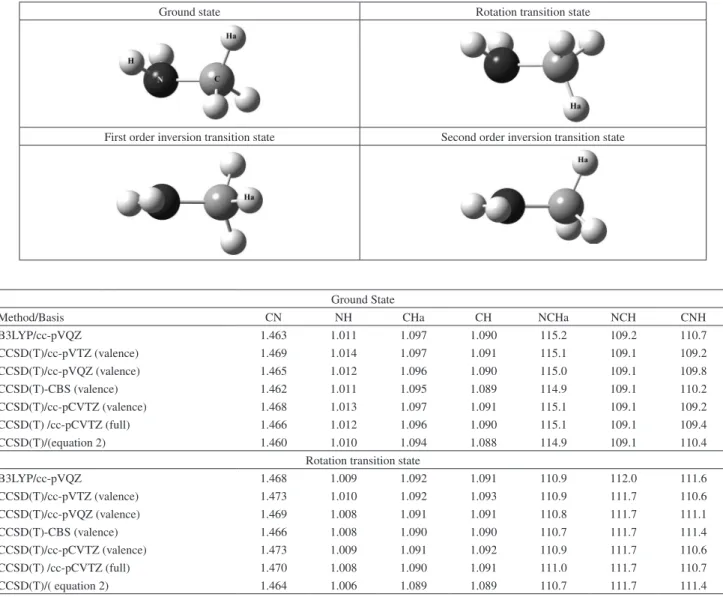
Table S1. Optimized geometries of methylamine. Bond distances (in Å) and angle (in degrees)
Ground state Rotation transition state
First order inversion transition state Second order inversion transition state
Ground State
Method/Basis CN NH CHa CH NCHa NCH CNH
B3LYP/cc-pVQZ 1.463 1.011 1.097 1.090 115.2 109.2 110.7
CCSD(T)/cc-pVTZ (valence) 1.469 1.014 1.097 1.091 115.1 109.1 109.2 CCSD(T)/cc-pVQZ (valence) 1.465 1.012 1.096 1.090 115.0 109.1 109.8
CCSD(T)-CBS (valence) 1.462 1.011 1.095 1.089 114.9 109.1 110.2
CCSD(T)/cc-pCVTZ (valence) 1.468 1.013 1.097 1.091 115.1 109.1 109.2 CCSD(T) /cc-pCVTZ (full) 1.466 1.012 1.096 1.090 115.1 109.1 109.4
CCSD(T)/(equation 2) 1.460 1.010 1.094 1.088 114.9 109.1 110.4
Rotation transition state
B3LYP/cc-pVQZ 1.468 1.009 1.092 1.091 110.9 112.0 111.6
CCSD(T)/cc-pVTZ (valence) 1.473 1.010 1.092 1.093 110.9 111.7 110.6 CCSD(T)/cc-pVQZ (valence) 1.469 1.008 1.091 1.091 110.8 111.7 111.1
CCSD(T)-CBS (valence) 1.466 1.008 1.090 1.090 110.7 111.7 111.4
CCSD(T)/cc-pCVTZ (valence) 1.473 1.009 1.091 1.092 110.9 111.7 110.6 CCSD(T) /cc-pCVTZ (full) 1.470 1.008 1.090 1.091 111.0 111.7 110.7
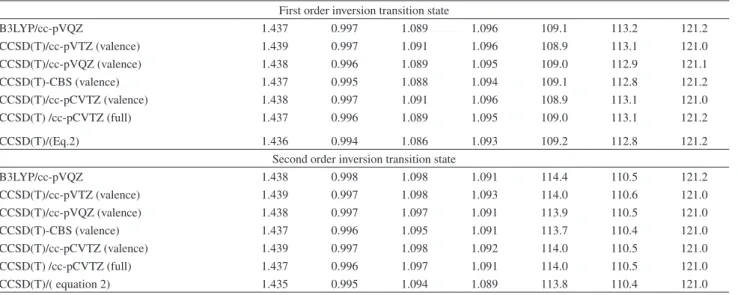
First order inversion transition state
B3LYP/cc-pVQZ 1.437 0.997 1.089 1.096 109.1 113.2 121.2
CCSD(T)/cc-pVTZ (valence) 1.439 0.997 1.091 1.096 108.9 113.1 121.0 CCSD(T)/cc-pVQZ (valence) 1.438 0.996 1.089 1.095 109.0 112.9 121.1
CCSD(T)-CBS (valence) 1.437 0.995 1.088 1.094 109.1 112.8 121.2
CCSD(T)/cc-pCVTZ (valence) 1.438 0.997 1.091 1.096 108.9 113.1 121.0 CCSD(T) /cc-pCVTZ (full) 1.437 0.996 1.089 1.095 109.0 113.1 121.2
CCSD(T)/(Eq.2) 1.436 0.994 1.086 1.093 109.2 112.8 121.2
Second order inversion transition state
B3LYP/cc-pVQZ 1.438 0.998 1.098 1.091 114.4 110.5 121.2
CCSD(T)/cc-pVTZ (valence) 1.439 0.997 1.098 1.093 114.0 110.6 121.0 CCSD(T)/cc-pVQZ (valence) 1.438 0.997 1.097 1.091 113.9 110.5 121.0
CCSD(T)-CBS (valence) 1.437 0.996 1.095 1.091 113.7 110.4 121.0
CCSD(T)/cc-pCVTZ (valence) 1.439 0.997 1.098 1.092 114.0 110.5 121.0 CCSD(T) /cc-pCVTZ (full) 1.437 0.996 1.097 1.091 114.0 110.5 121.0
CCSD(T)/( equation 2) 1.435 0.995 1.094 1.089 113.8 110.4 121.0
Table S1. Optimized geometries of methylamine. Bond distances (in Å) and angle (degree) (cont.)
Table S2. Optimized geometries of dimethylamine. Bond distances (in Å) and angle (degree)
Ground State (Cs) Rotation transition state (C1) Inversion transition state (C2v)
Geometric parameters
Ground State (Cs) Rotation transition state (C1) Inversion transition state (C2v)
B3LYP cc-pVQZ
B3LYP cc-pVQZ
B3LYP cc-pVQZ
R (1-2) 1.011 1.008 0.997
R (2-3) 1.454 1.464 1.432
R (2-7) 1.454 1.454 1.432
R (3-6) 1.091 1.092 1.099
R (7-9) 1.091 1.091 1.099
R (3-5) 1.101 1.093 1.099
R (7-10) 1.101 1.101 1.099
R (3-4) 1.089 1.092 1.089
R (7-8) 1.089 1.090 1.089
A(3,2,7) 113.3 115.1 120.6
A(2,7,8) 109.8 109.5 109.9
A(2,3,4) 109.8 110.9 109.9
A(1,2,7) 109.9 110.1 119.7
A(1,2,3) 109.9 110.5 119.7
A(2,3,6) 109.5 111.4 112.5
A(2,7,9) 109.5 109.8 112.5
A(2,7,10) 114.0 114.4 112.5
A(2,3,5) 114.0 112.3 112.5
|D(1,2,7,8)| 53.2 51.1 0.0
|D(1,2,3,4)| 53.2 129.7 0.0
|D(1,2,3,5)| 68.5 10.1 119.5
|D(1,2,7,10)| 68.5 70.4 119.5
|D(1,2,7,9)| 171.1 168.6 119.5
|D(1,2,3,6)| 171.1 110.7 119.5
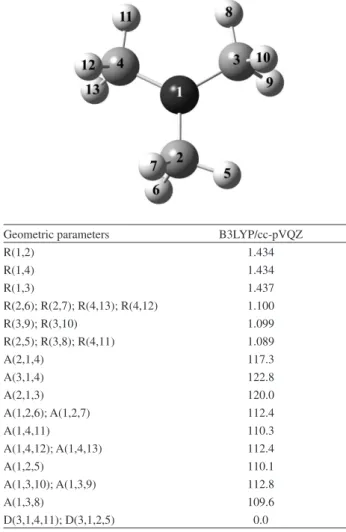
Table S3. Optimized geometries of trimethylamine. Bond distances (in Å) and angle (degree)
Inversion transition state (Cs)
Geometric parameters B3LYP/cc-pVQZ
R(1,2) 1.434
R(1,4) 1.434
R(1,3) 1.437
R(2,6); R(2,7); R(4,13); R(4,12) 1.100
R(3,9); R(3,10) 1.099
R(2,5); R(3,8); R(4,11) 1.089
A(2,1,4) 117.3
A(3,1,4) 122.8
A(2,1,3) 120.0
A(1,2,6); A(1,2,7) 112.4
A(1,4,11) 110.3
A(1,4,12); A(1,4,13) 112.4
A(1,2,5) 110.1
A(1,3,10); A(1,3,9) 112.8
A(1,3,8) 109.6
D(3,1,4,11); D(3,1,2,5) 0.0 Rotation transition state (Cs)
Geometric parameters B3LYP/cc-pVQZ
R (1,2) 1.464
R (1,3) (1,4) 1.450
R (2,5) 1.093
R (2,6) (2,7) 1.092
R (3,8) (4,11) 1.104
R (3,10) (4,12) 1.090
R (3,9) (4,13) 1.090
A (2,1,3) (2,1,4) 113.3
A (3,1,4) 112.4
A (1,2,6) (1,2,7) 111.4
A (1,2,5) 111.5
A (5,2,6) (5,2,7) 107.7
A (6,2,7) 106.8
A (1,3,8) (1,4,11) 113.3 A (1,3,9) (1,4,13) 109.8 A (1,3,10) (1,4,12) 110.1 A (9,3,10) (12,4,13) 107.7 A (11,4,13) (8,3,9) 108.0 A (11,4,12) (8,3,10) 107.8
Ground state (C3v)
Geometric parameters B3LYP/cc-pVQZ R(1,2); R(1,3); R(1,4) 1.451 R(2,6); R(2,7); R(3,9); R(3,10); R(4,12); R(4,13) 1.090 R(2,5); R(3,8); R(4,11) 1.104 A(2,1,3); A(2,1,4); A(3,1,4) 111.8 A(1,2,5); A(1,3,8); A(1,4,11) 112.9 A(6,2,7); A(9,3,10); A(12,4,13) 108.1 A(1,2,6); A(1,2,7); A(1,3,9); A(1,3,10); A(1,4,12);
A(1,4,13)
109.9
A(5,2,6); A(5,2,7); A(8,3,9); A(8,3,10); A(11,4,12); A(11,4,13)
Table S4. Vibrational frequencies (cm−1) of methylamine
Ground state
B3LYP/cc-pVQZ 300 833 975
1055 1173 1348
1461 1499 1518
1664 2965 3055
3089 3496 3570
CCSD(T)/cc-pVTZ 302 877 976
1066 1187 1359
1458 1508 1528
1666 2997 3080
3116 3499 3580
Rotation transition state
B3LYP/cc-pVQZ 297i 799 993
1053 1158 1327
1464 1495 1522
1665 3009 3049
3072 3532 3605
CCSD(T)/cc-pVTZ 350i 914 996
1066 1166 1338
1453 1485 1514
1663 3025 3090
3104 3496 3575
First order inversion transition state
B3LYP/cc-pVQZ 672i 101 921
1114 1169 1287
1472 1482 1535
1636 2967 2986
3085 3659 3779
CCSD(T)/cc-pVTZ 749i 107 918
1137 1174 1292
1470 1493 1545
1642 2993 3027
3106 3700 3826
Second order inversion transition state
B3LYP/cc-pVQZ 660i 112i 922
1109 1170 1290
1461 1502 1525
1635 2948 3027
3065 3660 3778
CCSD(T)/cc-pVTZ 740i 116i 916
1129 1178 1295
1462 1508 1537
1641 2981 3053
3093 3701 3826
Table S5. Vibrational frequencies (cm−1) of dimethylamine
B3LYP/cc-pVQZ
Groundstate 230 258 381
761 938 1036
1102 1168 1187 1268 1443 1470 1477 1488 1495
1517 1518 2923 2926 3041 3041
3089 3089 3525 Rotation transition state 253i 236 391
699 926 1057
1106 1159 1187 1260 1446 1473
1481 1488 1497 1515 1522 2925 2998 3039 3042
3061 3086 3556 Inversion transition state 591i 180 183
381 944 1065
1143 1189 1232 1277 1453 1471
1473 1474 1480 1527 1540 2932 2943 2943 2953
Table S6. Vibrational frequencies (cm−1) of trimethylamine
B3LYP/cc-pVQZ
Groundstate 252 265 265
357 422 422
830 1057 1057 1071 1121 1121 1208 1306 1306
1443 1443 1482 1482 1483 1490
1502 1511 1511 2894 2894 2908 3048 3048 3053
3089 3093 3093 Rotation transition state 268i 242 246
331 425 435
820 1049 1055 1081 1121 1131
1183 1305 1306 1445 1448 1484 1486 1491 1497
1501 1511 1513 2889 2897 2997
3041 3046 3051 3058 3088 3091 Inversion transition state 300i 95 108
134 384 433
808 1074 1093
1106 1122 1153 1170 1331 1391 1447 1458 1469
1472 1484 1500 1514 1528 1541 2922 2927 2930