Printed in Brazil - ©2003 Sociedade Brasileira de Química 0103 - 5053 $6.00+0.00
R
e
v
ie
w
* e-mail: [email protected]
Natural Product-Like Combinatorial Libraries
Pedro M. Abreu* and Paula S. Branco
Departamento de Química, Centro de Química Fina e Biotecnologia, FCT-UNL, 2829-516 Caparica, Portugal
A química combinatorial emergiu ao longo dos últimos anos como uma importante ferramenta na pesquisa de moléculas pioneiras para a modelagem de novos fármacos. Nesta perspectiva, a diversidade estrutural e a vasta gama de propriedades biológicas exibidas pelos metabolitos secundários, constituem um desafio à implementação de estratégias combinatórias na síntese e derivatização de produtos naturais. Este artigo ilustra a aplicação das técnicas combinatórias no desenho e formação de bibliotecas baseadas em produtos naturais de diversa origem biossintética, e seus análogos estruturais.
Combinatorial chemistry has emerged over the last few years as an important tool for drug discovery and lead optimisation. In this approach, the molecular diversity and range of biological properties displayed by secondary metabolites constitutes a challenge to combinatorial strategies for natural products synthesis and derivatization. This article surveys the application of combinatorial techniques to the design of “natural product-looking” libraries covering a wide range of structural diversities.
Keywords: natural products, combinatorial chemistry, drug discovery, lead compounds
1. Introduction
Natural products represent a rich source of biologically active compounds and are an example of molecular diversity, with recognized potential in drug discovery and development.1-5 Despite changing strategies in natural
product research, in which concern sample selection and collection, isolation techniques, structure elucidation, biological evaluation, semisynthesis, dereplication, biosynthesis, as well as optimisation of downstream processing,6,7 the rate of discovery of truly novel natural
product drugs has actually decreased.8 Reasons for this
fact are related to high costs and time consuming of conventional programs in natural products,9,10 which led
to the exploitation of modern high-throughput screening and combinatorial strategies by the pharmaceutical industry, to generate new lead structures.3,8,10-12 However,
far from being competitive, combinatorial and natural product chemistry should complement on a synergistic perspective, since nature continues to be the most diverse and active compound library known.11,13,14 An amazing
example of a natural combinatorial library is illustrated by the pupal defensive secretion of the coccinellid beetle
Epilachna borealis, which is composed principally by
several hundred macrocyclic polyamines (polyazama-crolides) generated by a nonselective oligomerization of three building blocks (Figure 1).15,16
Two main strategies have been applied for the integration of natural products into combinatorial chemistry: the total synthesis of natural compounds and analogues; and their use as templates for the construction of libraries. Advantages and limits of these two approaches have been discussed in previous reviews on the basis of selected examples.13,14,17,18 Polymer-supported liquid-phase
methods for the preparation of libraries of natural product derivatives, were reviewed by Wilson 19 and Thompson,20
respectively, and a comprehensive survey on solution- and COOH
H N HO
H N HO
H N HO
COOH
COOH
O HN
O O
n O
NH
O O
N H m
o
solid-phase strategies for the design, synthesis, and screening of libraries based on natural product templates was recently reported.21
The present article illustrates the importance of combinatorial techniques to generate natural product-based libraries, which were grouped according to type structures of secondary metabolites.
2. Carbohydrates
Carbohydrates are the most abundant group of natural compounds, and, as well as their glycoconjugates, are involved in such important functions as cell-to-cell recognition and communication, inflammation, immunological response, bacterial and viral infection, tumorigenesis and metastasis.22-30 Also, the saccharide
portions of various classes of natural products function as key molecular recognition elements important to the biological properties of the natural compound.24,29,31,32 In
addition, the conformationally rigid and functionally rich carbohydrate system is unparallel in its value as a molecular scaffold for generating molecular-diversity
through combinatorial strategies.24 So far, combinatorial
chemistry of carbohydrates has been mainly focused on the solid and solution-phase synthesis of oligosaccharide libraries, as well as glycomimetics, and several articles have reviewed this area.31, 33-52 A few examples are
highlighted in the section.
The largest oligosaccharide to be constructed on solid phase was achieved by Nicolaou et al.53 Starting from a
stereochemically homogenous conjugate consisting of the first monosaccharide unit, a benzoate spacer and a photolabile o-nitrobenzene linked to a Merrifield resin, a dodecasaccharide was assembled in a building block-type fashion and finally cleaved from the solid support by photolysis (Figure 2). The advantage of this method, highly enabling for the construction of large and diverse libraries of oligosaccharides, include convergence for block-type constructions, high yielding glycosidation steps, maintenance of stereochemical integrity during loading and unloading, and flexibility.
A solution-phase approach to di-, tri-, tetra- and pentasaccharides library assembly was presented by Wong
et al.,54 who designed a building block containing four
O BzO
BzO
OBzO OH
O BnO
BnO
OBz OBn O
O NO2
O
O BzO
BzO O
BnO
FmocO SMe
O BnO
OBz
O BnO
BnO
OBzSPh OBn
O BnO
OBz O
BnO BnO
OBz OBn
O OBzO BnO
O
O BnO
BnO
OBz OBn
O BzO
BzO
OBzO O
OBzO BnO
O
OBz TBDPSO
TBDPSO
O
O BnO
BnO
OBz OBn O
BzO BzO
OBzO O
O BzO
BzO
OBz O O
BnO BnO
OBz OBn
O BzO
BzO
OBzO O
BnO
OBzO O
O TBDPSO
successive coupling with:
i)
ii)
iii)
O
OH SPh
OBz
selectively removable protecting groups as acceptors for glycosylation (Figure 3). This method allows to overcome a major problem of carbohydrate synthesis, that is the lack of an efficient orthogonal protection-deprotection strategy. The search for antibacterial agents led to the synthesis of disaccharides structurally related to lipid A, the bioactive principle of lipopolysaccharide (LPS) in the cell surface of Gram-X negative bacteria.55-59 A combinatorial
approach to study cell surface carbohydrate binding to their protein targets consisted in the preparation of a library of approximately 1300 di- and trisaccharides, including both the α- and β-thiophenyl derivatives of Bauhinia purpurea ligand Gal-β-1,3-GalNAc (Figure 4).60 The library
was synthesized with the use of a split and mix strategy
AcO COOH
Combinatorial STEP 1
Glycosyl acceptor O AcO N3 O O S O O OH Ph O AcO O O O O OH Ph N3 S O O OH S O AcO O O O O OH Ph PMBO S O O OH S O AcO O O OH PMBO S N3 OPMB
Combinatorial STEP 2
Glycosyl donnor SPh O O O OPiv PivO PivO SPh O O OPiv PivO PivO SPh O O PivO OPiv SPh O O OPiv OPiv PivO SPh O O OPiv OPiv O O OPiv SPh O O PivO PivO O O O O O O SPh O N3 O OPiv SPh O PivO PivO O OPiv SPh O SPh O OPiv O O N3 SPh O O O O OPMB SPh O O O PivO O OPiv PivO SPh O OPiv OPiv O
Combinatorial STEP 3
Acyl groups X O Cl O Cl N F NO2 NO2
O2N
Cl O Cl O Cl O S Cl O COOH O O O O O N COOH O Me S O O Cl O OMe Cl
O C NMe S C Me
Ac2O
D Ac Ala OH L Ac Ala OH O O O N3 AcO O O O N3 AcO OPiv OPiv OPMB OPiv OPiv PivO N3 BzO PivO PivO OPiv O O PivO O O OH O S
O NH2
O NH O OH OH OH OH HO
a- and b-thiophenyl derivative of Bauhinia purpurea ligand Gal-b-1,3-GalNAc
Figure 4. Carbohydrate library based on Bauhinia purpurea ligands.
from six glycosyl acceptors attached separately to TentaGel resin (step 1). Twelve different glycoside sulfoxide donors were coupled separately to mixtures of beads containing all the six monomers, which were recombined and split again, after reduction of sugar azides to amines (step 2). The separate pools of beads were then N-acylated (step 3), recombined and finally deprotected. Chemical tags were introduced after every reaction for identification purposes. The outlined strategy, which was complemented with the library screening against B. purpurea lectin, can be used to identify carbohydrate-based ligands for any receptor and for discovering new compounds that bind to proteins participating in cell adhesion.
The moenomycins are a family of natural product antibiotics which are known to inhibit the synthesis of bacterial cell wall peptidoglycan through inhibition of transglycosylase.61 Degradation studies of moenomycin A,
a pentasaccharide containing a long lipid attached to the reducing sugar through a phosphoglycerate unit, showed that cell wall inhibitory activity was retained in a disaccharide core structure and that certain structural elements were important for retaining transglycosylase inhibitory activity. These facts led Sofia and co-workers61
to use moenomycin A disaccharide analogues (1a,b,c) as templates to build a combinatorial library of 1300 disaccharides (Figure 5), employing the IRORI radio-frequency tagging method for directed-sorting mix-and-split.62 Some of the library compounds, as (2), showed
potent antibiotic activity against a panel of Gram-positive and Gram-negative bacteria, with IC50 below 15 µg mL-1.
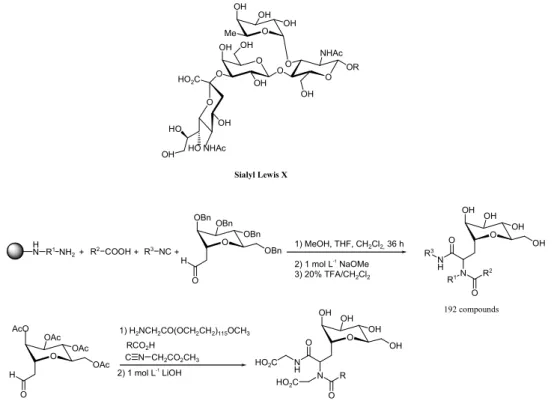
The role of natural carbohydrates in cell adhesion processes, specifically, between the selectins and the Lewis sugars and their derivatives,63 led to the design and
synthesis of mimics of sialyl Lewis X (sLx) and related
oligosaccharides via combinatorial strategies.40,41
Armstrong et al.64 and Wong et al.65 used the Ugi
four-component condensation66 with a variety of functionalised
C-glycosides to construct librairies of sLx mimetics whose constituents were further tested as inhibitors of E- and P-selectin (Figure 6). A solution-phase library approach to mimics aminoglycosidic antibiotics such as neomycin B, was introduced by Wong et al.67,68 and was discussed in
previous reviews.40,50,69
An example of combinatorial synthesis of deoxy sugars, a class of carbohydrates also involved in human physiology and that are constituents of numerous secondary metabo-lites,70 is illustrated by the construction of libraries
composed of linear trisaccharides of 2,6-dideoxy-L-sugars synthesized by an iodonium ion-catalysed “stereoselec-tive-yet-nonregioselective” glycosylation reaction (Figure 7).71 In this approach, a glycal (base building block) was
non-regioselectively coupled with a glycosyl acceptor to produce two regioisomers, which were sequentially O -acetylated and O-desilylated to become an acceptor for the next glycosylation reaction. This procedure was repeated until the desired oligosaccharide length was achieved. Through these sequencial glycosylation reactions, a 2-iodo group was introduced into every monosaccharide residue. For further modification, the 2-iodo groups were reduced or substituted by an X-group.
Combinatorial synthesis can also be used in the search for new bioactive monosaccharide derivatives. For example, using D-galactose as scaffold, Kunz et al.72
achieved the selective coupling of the five hydroxyl groups of the carbohydrate with different side chains R1…R6, in a combinatorial methodology by application
of a set of orthogonally stable protecting groups with a thioglycoside anchor.
3. Steroids
Steroids are of particular interest for design and synthesis of scaffolds for combinatorial chemistry, mainly
O O OH HO
OH
O
O OH
O
HO O
O HO HO
HO
HO O
O
NHAc O
O CONH2 HO
H2NOCO O
P O O OH
CO2H O
Moenomycin A
N
O N
O OH
O CONH2 H
F3CO
H
O PO HO O
CO2H O(CH2)11CH3 O
HO HO HO
NH O
F3C O
O N
RO O
H
Photolinker
SPh R1
NR2 AcO AcO
AcO
O
Moenomycin analogs 1a R = H, CH3, Bz
1b R1 = OLev, N3
1c R2
= Pht, HCOCF3
2
OH
NHAc
H N R1NH
2+ R2COOH + R3NC +
O OH 1) MeOH, THF, CH2Cl2, 36 h
2) 1 mol L NaOMe-1
3) 20% TFA/CH2Cl2
192 compounds
O HO2C
OH HO
OH
O OH
O OH OH
O O
HO NHAc
OR
OH NHAc O
O Me
OH OH OH
Sialyl Lewis X
O OAc H
O AcO
OAc
OAc
O OH
OH OH
OH 1) H2NCH2CO(OCH2CH2)115OCH3
2) 1 mol L LiOH-1
O
N O
R RCO2H
C N CH2CO2CH3 N
H HO2C
HO2C
O OBn
OBn
H O
OBn
OBn
OH OH
OH N
H R3
O
N R1 R
2
O
Figure 6. Construction of librairies of sLx mimetics using Ugi four-component condensation.
CO2H
HO OH
OH
O O R
R R
R N
O
R
O O R
R R
R N
O
R
Figure 8. Cholic acid derivatization through the kombiNATURik concept.
O H3C
TMSO OTMS
O H3C
HO OH
O NHR
I
1. IDCP.catalysed glycosylation 2. O-acetylation
3. O-deTMS
O H3C
O O
O
I
2-iodo series
O H3C
O O
O
H
2-deoxy series
O H3C
O O
O
X
2-X series repeated cycles
Figure 7.Combinatorial synthesis of oligosaccharide library of 2,6-dideoxy sugars.
due to their rigid nucleus which is versatile in terms of functionality and side-chain substitution.73 This is the case
for bile acids, whose potential as templates for combina-torial derivatization has been exploited by Analyticon and Jerini BioTools, that have applied the kombiNATURik concept to improve the pharmacology of cholic acid through the introduction of peptide and sugar moieties (Figure 8).13,74
In the course of studies on therapeutic agents for the treatment of breast cancer, Poirier and co-workers75,76 have
prepared hydroxysteroid libraries with two levels of molecular diversity that were designed as potential
inhibitors of steroid sulfatase and 17β-hydroxysteroid dehydrogenase, two key enzymes involved in the biosynthesis of estradiol. Estradiol libraries bearing functionalised side chains at C-16 (compounds 3 and 4), C-17 (compound 5) and C-7 (compound 7) were synthe-sized from estrone and 6-dehydro-19-nor-testosterone acetate, previously attached to a polystyrene resin through the phenolic function at C-3(Figure 9). The functionality at 16β and 7α was introduced from precursors bearing an azidoalkyl side chain in those two positions, whereas an oxirane group was chosen as the key precursor function to provide the 17α amide side chain of compound 5. This latter methodology was also employed in the construction of libraries from non-phenolic steroids bearing 3β and 17α
The cholesterol derivative 1α,25-dihydroxyvitamin D3 (Vitamine D3) is a natural hormone that exhibits a variety of physiological activities, such as regulation of calcium and phosphorous metabolism, cell differentiation and proliferation, and the immune system. In recent years, a number of analogues of vitamine D3 have been synthesized by many laboratories in order to investigate their structure-activity relationships (SAR) and enhance specific activities. On the basis of the scheme depicted in Figure 10, Takahashi and co-workers constructed a vitamin D3 combinatorial library by means of a split and pool methodology utilizing Radiofrequency Encoded Combi-natorial (REC) chemistry, and a manual parallel synthesizer for side chain diversification and deprotection.77 The
Horner-Wadsworth-Emmons reaction of the solid supported CD-ring building block 10 with the lithiated
A-ring phosphine oxide 11, followed by simultaneous introduction of the side chain and cleavage from resin with a Cu1-catalysed Grignard reagent, afforded the
vitamine D3 analogue 13. Three and four CD- and A-ring building blocks, respectively, and six different side-chains, were used in a parallel synthesis to generate a 72-member vitamin D3 combinatorial library.
4. Fatty Acids Derivatives
The prostaglandin family (PGs) constitutes one of the most pharmacologically active low-MW natural products. Combinatorial access to PGs is based on two main strategies of synthesis of its E- and F-series developed by Janda &
Chen78,79 and Ellman et al.,80 whose details have been
discussed in previous reviews.13,14,19,21,81 In the approach of
HO
O
N H
O (CH2)4CH3 O
HO
OH
N H
O
NH
Ph O
HO
OH
N H 8
O
N O HO
O
Estrone
3
4
5 HO
OH
N
O 5
6
O
OH
HO
OH Dihydrotestosterone
OH
HO N R1
R2
7
Epiandrosterone
HO
OH N
O 5
8 O
H
OAc
6-Dehydro-19-nor-testosterone acetate
OAc
HO 8 N3
9
Janda and co-workers, here illustrated for prostaglandin E2 methyl ester and prostaglandin F2 (Figure 11), a Noyori’s convergent three-component coupling82 was carried out with
a cycopentene core linked to a functionalised polystyrene resin (14), the long-chain cuprate 15 (ω-side-chain), and the triflate 16 (α-side-chain). Using a parallel-pool library strategy, the same research team prepared a library of 16 prostaglandin derivatives distributed in four pools, each containing a constant α-side-chain with four different ω -side-chains resulting from the Noyori’s reaction.83 Some of
these prostaglandin analogues, as compounds 17a-d, have proved to inhibit the growth of the herpes-family virus CMV on infected murines.
Small prostanoid libraries were prepared by Ellman et al.,80 using the bromo-cyclopentene core 18 linked to a
chlorodibutylsilyl polystyrene resin (Figure 11). The introduction of α- and ω-side-chains were successively inserted by a Suzuki cross-coupling with alkylboranes 19a-d and conjugated addition with two types of high order cuprates (Rw = A and B). A library of 20 prostanoids with an amide α-side-chain (22) was generated from the mixture
21a, which was activated for displacement by N -cyanomethylation and then treated independently with 10 diverse amines. Cleavage of the mixture 21b-d from the triethylsilane linker afforded six α-alkylated side-chain compounds (23a-c).
O O O
O
14
OTBS Li2Me(CN)Cu
15
16
TfO CO2Me
X Y
CO2R HO
OH
PGE2 methyl ester X = Y = O; R = Me PGF2a X = H, Y = OH; R = H
O
HO
R'
17a R´= C6H13
17b R´= CH2OH
17c R´= CH(OH)C5H11
17d R´= CH2Ph
Antiviral prostanglandin analogues
Br OTMT
O Si t
Bu
t Bu
18
B
19a R = C4H8C(O)NHSO2Ph
19b R = C7H15
19c R = C8H17
19d R = C9H19
O Si t
Bu
t Bu R
O
R
21a R = C6H12C(O)NHSO2Ph
21b R = C7H15
21c R = C8H17
21d R = C9H19 O Si t Bu
t Bu
O
R
Rw
20a R = C6H12C(O)NHSO2Ph
20b R = C7H15
20c R = C8H17
20d R = C9H19
Li2CuRRRwCN
Rw =
n-Bu OPh
A ,
OH B
i) BrCH2CN ii) HNR1R2 iii) HF/pyridine
HO O
Rw 6
R
R = CONR1R2
22
10 amides HF/pyridine
HO O
R
Rw
23a R = C7H15
23b R = C8H17
23c R = C9H19
Figure 11. Combinatorial libraries prostaglandins. O
O S O
O
O (CH2)9 O Si Et
Et
O O TBSO
POPh2
n-BuLi 10
11
O S O
O
O (CH2)9 O Si Et
Et
O O TBSO
12
OH HO
OH
OH
13 Br
OTMS
Mg, CuBr-Me2S
Acetogenins are one of the most rapidly growing classes of new natural products, which exhibit remarkable cytotoxic, antitumor, antimalarial, immunosuppressive, pesticidal and antifeedant activities.84 A solution-phase synthesis with
potential application in library generation of acetogenins, particularly those belong to the bis-THF subgroup, has been developed by Keinan et al. (Figure 12).85 Based on
retrosynthetic analysis of trilobacin (29), the alcene 24 was selected as “naked carbon skeleton” for the successive introduction of stereogenic carbinol centers of the target molecules. The lactonisation of 24 via the Sharpless asymmetric dihydroxylation reaction yielded the (4R, 5R) and (4S, 5S) stereoisomers of 25, which were respectively converted into the pair of isomers (4R, 5R)/(4R, 5S) and (4S, 5S)/(4S, 5S) (25a) by Mitsunobu inversion of the free alcohol’s configuration. The cis alkenes 26, obtained by Wittig reaction of the aldehydes 25a with pentadec-4-ynyltriphenylphosphorane, were treated separately with vanadium and rhenium organometalics VO(acac)2 and Re2O7, to yield four (8S) and four (8R) isomers (27), respectively. Each one of these compounds was then converted to four bis-THF stereoisomers by using four different reaction conditions: Mitsunobu reaction followed by Re2O7; oxidative cyclization with Re2O7; oxidative cyclization with VO(acac)2/TBHP; and Mitsunobu reaction followed by reaction with VO(acac)2/TBHP. Overall, this approach led to the generation of a 64-member library of bis-THF acetogenin analogues (28). Trilobacin (29) was further synthesized from the (4R, 5R, 8R, 9S, 12R) isomer of 28.
In the search for fatty acids derivatives of biologically importance, a 528-member library of ceramides (32) was generated using 33 acyl groups (30) and 16 sphingosine-like core structures (31), and tested for induction of apoptosis and NF-κB signaling (Figure 13).86 The most
active ceramide analogues showed apoptotic activity in U937 leukemia cells with IC50 values ranging from 4 to 50 µM, whereas NF-κB activation was just induced by compounds (10 µM) having a β-galactose head group (>8-fold increase of NF-κB activity).
Muscone is a sex pheromone of the musk deer and a chemical component of cosmetics. A 12-member library of racemic muscone analogues was synthesized by Nicolaou et al.,87 who employed a cyclorelease method on
solid support to form the macrocycle scaffold (Figure 14). A phosphonate-functionalized resin loaded on encoded SMART microreactors (34) was coupled to olefinic esters
33, to form the β-ketophosphonates 35. Sorting and cross olefin metathesis of 35 with two alkenols followed by oxidation with Dess-Martin reagent gave aldehydes 36. An intramolecular ketophosphonate-aldheyde conden-sation (Horner-Emmons-Wadsworth reaction) of 36 caused smooth cyclorelease of macrocyclic enones 37. Parallel solution phase chemistry completed the sequence.
5. Polyketides
Polyketides are a large family of natural products with a wide range of pharmacological activity (antibiotics, anti-tuberculosis agents, immunosuppressants, cholesterol-lowering agents, antifungal, cancer chemotherapeutics), which occupies a relevant place in pharmaceutical industry.88-91 Although combinatorial biosynthesis is the
method of choice for the generation of polyketide libraries,92-96 a few examples of synthetic protocols have
been reported.
Based on the biosynthesis of erythromycin, whose heptaketide precursor is assembled by a polyketide
Figure 12. Chemical library of acetogenins.
n
OH NH2
OH 30
O
O R
NH2 O
+
31
n
OH NH
OH R
O
32
synthase from a starter unit and six extender units, Paterson and co-workers97 developed a mimetic combinatorial
synthesis using a greater variety of chain extending units, leading to much greater molecular diversity (Figure 15). In this new approach, an aldehyde starter unit (39) attached to a polystyrene support which functions as a surrogate for the acyl carrier protein (ACP), reacts with the chiral ketones
40 to produce the 1,3-diol 41, after ketone reduction. Following the regenaration of the aldehyde functionality,
repetition provides the more elaborate 1,3-diol 42. This leads progressively to the synthesis of polyketide sequences of increasing complexity, where the spacer (HOCH2CH2CH2 for n = 2) is incorporated into the final product. After a single iteration, the resulting sequence has four contiguous stereocenters, while a second iteration introduces eight contiguous stereocenters corresponding to 256 stereoisomers. By varying the substituents R1 and
R2 on the reagent module 40 in a combinatorial sense,
many additional opportunities for structural diversification in 41 and 42 are possible, leading potentially to even larger libraries.
In a complementary approach to the aldol method, Misske and Hoffman98 used one simple racemic substance
as starting product for library generation of stereoisomeric bicyclic, monocyclic, and acyclic building blocks, that may be taken as precursors for segments of natural products, such as the marine metabolites phorboxazole A and B, (+)-discodermolide, and spongistatin 1 (Figure 16). In a sequence of 32 steps from simple racemic trans-2,4-dimethyl-8-oxabicyclo[3,2,1]oct-6-en-3-one (44), a series of twenty-four homochiral buiding blocks was generated, comprising eight stereochemical pentades of ano-meric[3,3,1]lactone acetals, eight stereochemical tetrades of anomeric carbohydrate mimics, and eight stereotetrades of acyclic polypropionate units (Figure 17). Each type of these bicyclic, monocyclic, and acyclic builiding blocks, can be easily transformed in segments of polyoxygenated marine natural products, here illustrated for the case of (+)-discodermolide (Figures 16 and 18). Further progress towards automated procedures and methodology is expected.
Curran and Furukawa99 have applied the concept of
mixture synthesis with separation tags, to synthesize four truncated analogues of discodermolide (Figure 19).
O
R1 R2
RO O
33 R1 3 chains
O P O
CH3 OMe 34 n-BuLi
O P O
OMe
R1 O
35
O P O
OMe O
O 1) Grubb's cat.
OH n 2 alkenols
(n = 1,2)
2) Dess-Martin
periodinate 36
K2CO3 18-C-6
R3 O
R1 R2
37 1) (R3)
2CuLi 2 alkyl groups
2) H2, Pd/C 38
Muscone (R1 = R2 = R3 = H, R3 = Me) SMART
microreactors
R1
Figure 14. Muscone library.
OH OH O OH OH O
S-ACP
Heptaketide precursor of erythromycin
R1
O
OPMB R1
O
OPMB
(R)-40 or
(S)-40 O
n H
O +
39
Step 1: aldol chain extension/reduction
O n
OH R1
OH OPMB
41
Step 2: aldehyde regeneration
O n
O R1
O H
O
42
(R)- or (S)-40
repeat Step 1
O n
O R1
O
43 OH
R2
OH OPMB
256 stereoisomers
polyketide-type libraries
reiteration or cleavage, etc.
Precursors bearing four different groups at C-22, each with an unique fluorous p-methoxybenzyl substituent on the C-17 hydroxy group, were mixed and taken through a nine step sequence. Demixing by fluorous chromatography followed by deprotection and purification provided the individual analogues.
A relatively large number of compounds with various sizes of macrolide rings have been isolated from microbial sources, as a result of screening campaigns in the antibiotic industry. Alternative to the biological approach of combinatorial biosynthesis for the production of macrolide antibiotic libraries,30,95,96,100-102 methods for the construction
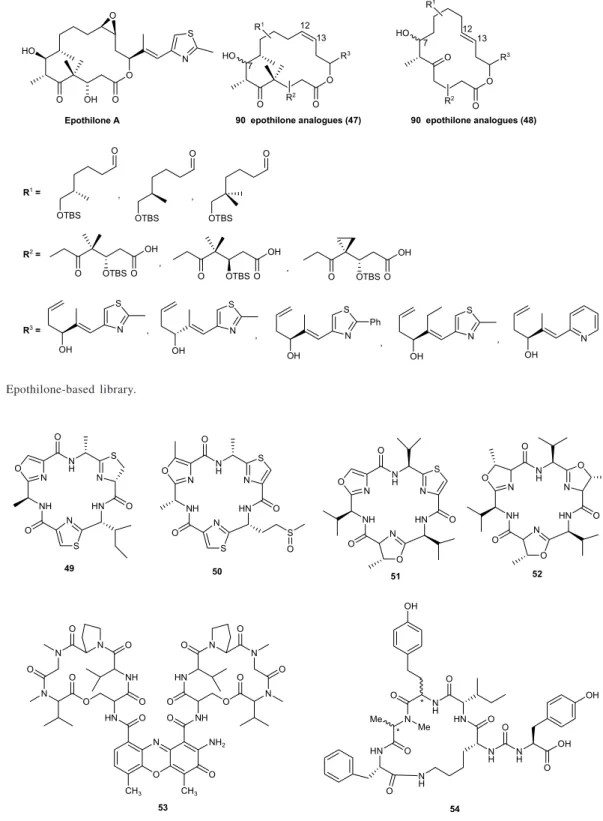
of macrocycles have been developed by Nicolaou and co-workers.103,104 A recent example includes epothilones,
which are among the most interesting metabolites isolated from bacteria (Sorangium sps.) over the last few years.1
Their potential as novel anticancer drug candidates justified an intense effort on the design of classical and combinatorial synthetic strategies that have led to third and fourth generation compounds now heading towards clinical development.105,106 Based on chemistry utilized in
the synthesis of epothilone A,104 Nicolaou et al. synthesized
a split-pool library of 180 12,13-desoxyepothilones A from the three key building blocks R1, R2 and R3, using a
radiofrequency enconding of microreactors (SMART microreactors) (Figure 20).107 Two types of macrocycles
were obtained (47 and 48), each containing 45 compounds with (R) and (S) C-7 configurations, that were epoxidized in solution to deliver the final epothilone library. Further screening of the library to both tubulin assays as well as cytotoxicity assays against human ovarian and breast cancer cells, led to the identification of nine epothilone analogues with IC50 values below 10 (nmol L-1) nM.
Following the biological results, SAR could be deduced for epothilones.
6. Peptides
The search for new clinically antimicrobial agents led to intense efforts in exploiting the chemistry and biology of glycopeptide antibiotics,108 a group of highly complex
molecules whose structural features include cyclopeptide units with recognized potential as scaffolds for the generation of combinatorial libraries. With this purpose, methodologies have been applied to the synthesis of natural cyclopeptides and analogues, as dolastatin E (49),109 dendroamide C (50),110 bistatramide D (51),110
westiellamide (52)110 oscillamide Y (53),111 and
actinomycin D (54) (Figure 21).112 The viability of using
teicoplanin aglycone (55) as a molecular scaffold for library construction was investigated by Seneci and
co-Br
O OMe
OHH OH
O N
O
O O
O N
O
O R1
R2
22 18
24 23 27 25
26
Phorboxazole A and B
O O
OH
OH HO
OH OCONH2 1
2 3 45 H
6 7
(+)-Discodermolide
O
O HO
AcO
O O
O HO
H O
OH
OHOH OH
Cl
O
HO O
OCH3 OAc
O
11 18
Spongistatin 1
Figure 16. Synthetic polyketide and carbohydrate segments of phorboxazole A and B, (+)-discodermolide and spongistatin 1.
O Me
O Me
O
O Me
Me 44
ent-44
O
O OBn
Me Me
O
O OBn Me Me
O O
2 pairs of stereoisomers
2 pairs of stereoisomers Bicyclic stereopentade
S S
Me OBn
Me OH
OMe O Acyclic diols
4 anti-diols and 4 syn-diols O
OBn
Me Me
MeO
CO2Me Carbohydrate mimics
8 stereoisomers
Figure 17. Library of polyketide fragments and carbohydrate mimics.
O
OBn OMe MeO2C
45
O
OBn MeO2C
O 1
2 3 4
5 6 7
46 i) H2O, AcOH
ii) TPAP,NMO
Figure 18. C1-C7 segment of (+)-discodermolide.
O t
Bu
OH
OH OCONH2 R
R = H, CH=CH2, C2H5, C6H5 17
22
HN N
N H
O
O Me
Me O
O
HN O
N H
N H
N H O
OH
O OH *
* OH N
O NH
O
NH
O
N S
HN O
S N
49
O N
CH3 CH3
O NH2 N
O N
N
NH
O O O
O O
O HN
N
O N
N HN
O O
O
O O
NH O
53 N
O NH
O
NH
O
N S
HN O
S N
50
N
O NH
O
NH
O
N S
HN O
O N
51
N
O NH
O
NH
O
N O
HN O
O N
52 S
O
54
Figure 21. Natural cyclopeptides with recognized potential as scaffolds for the generation of combinatorial libraries. O
O HO
OH O
N S
O
O HO
O
Epothilone A O
12 13 R1
R2
R3 7
90 epothilone analogues (47)
O
O R3 R1
HO
O
R2 7
12 13
R1 = OTBS
O
OTBS O
OTBS O
, ,
R2 =
O O
OH
OTBS O O
OH
OTBS ,
O O
OH
OTBS ,
R3 = OH
N S
OH
N S
,
OH
N S
Ph
OH
N S
,
,
OH N ,
90 epothilone analogues (48)
Figure 20. Epothilone-based library.
workers,113 who developed two methods for the attachment
of 56 to resin beads by means of double cleavage linkers selectively attached to the carboxyl functional group. These resin bound derivatives could be used for library generation through randomisation on the NH2 or the OH groups via acylation or reductive amination of the amino
group, and acylation or alkylation of the phenol (Figure 22).
addition to vancomycin-resistant Staphylococcus aureus
strains.114 The molecular basis for vancomycin resistance
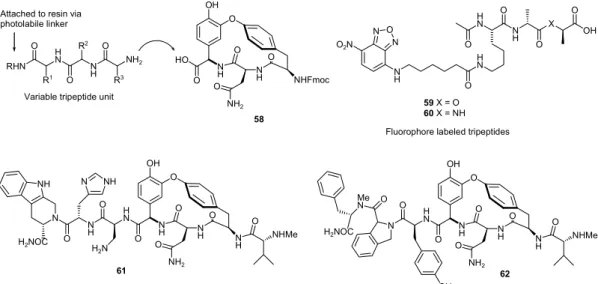
is the replacement of the D-Ala-D-Ala terminus of the bacterial cell wall peptidoglycan precursor by a D-Ala-D-Lac residue, that results in a ~1000-fold reduction in binding affinity to the antibiotic (Figure 23). A combinatorial approach to synthetic receptor molecules targeting vancomycin-resistant bacteria was therefore designed to bind to the mutated sequence
D-Ala-D-Lac.21,115 Using the biaryl ether core macrocycle 58 as an
invariant building block, a library of 39304 theoretical members was prepared by split synthesis on solid support with 34 amino acids inputs used to introduce diversity (Figure 24). The amino-acids chosen for the tripeptide unit were selected on the basis of the side chain display found in the proteinogenic amino acids and on their ability to enhance the rigidity of the receptors. Screening of the resin bound library against tripetides N-Ac2-L-Lys-D-Ala-D-Lac (59) and N-Ac2-L-Lys-D-Ala-D-Ala (60) labeled with the fluorophore nitrobenzodioxazole, led to the identification of the active receptors 61 and 62, both exhibiting slightly
lower binding affinity toward 59 than vancomycin, yet they showed greater binding affinity toward 60, with compound
62 having approximately 5 times greater affinity. The significance of these results is that receptors less structurally complex than vancomycin can exhibit comparable and even enhanced binding affinity toward the same target.21,115
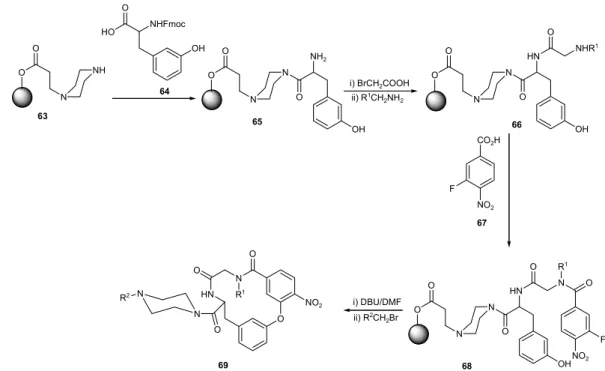
A strategy for the construction of macrocycles containing the nonsymmetrical biaryl ether moiety bore by vancomycin and teicoplanin, was developed by Kiselyov et al.116 In this approach, an assembly of twenty
14-membered macrocycles was achieved utilizing SNAr coupling of fluorine in 3-fluoro-4-nitrobenzoic acid (67) with the hydroxyl group of 3-hydroxytyrosine (66), using an acrylate resin modified with piperazine as solid support (63). Diversity was introduced by N-alkylation of 65 and
68 with R1CH
2NH2 and R
2CH
2Br, respectively (Figure 25).
N H O O N H O OH 58 NH2 O O HO NHFmoc RHN H N N H O O R1
R2 O
R3 NH2 Attached to resin via
photolabile linker
Variable tripeptide unit
N O N O2N
N H O H N N H O X O OH O H N O
59 X = O 60 X = NH
Fluorophore labeled tripeptides
N H O O N H O OH NH2 O O H N N H O NHMe N H
H2N O N
NH N
O H2NOC
NH N H O O N H O OH NH2 O O H N N H O NHMe N O O Me N
H2NOC
OH
61 62
Figure 24. Vancomycin-based receptor library.
OH HO OH NH O HO HO H N Cl O N H O O O
H2N O Cl OH N H O N H O NHMe O O HO OH HO O O OH Me NH2 Me 57
MurNAc L-Ala D-Glu L-Lys
GlcNAc Cell membrane O N H H N O O O D-Ala-D-Ala
Figure 23. Binding of vancomycin to the D-Ala-D-Ala terminus of a peptidoglycan precursor.
N
O O
OH Cl
N
H NH
O NHR OH O O N H O HO HN O OH HO OH Cl H N O O HO HOOC
Attachment to the linker
55 R = H Teicoplanin aglycone 56 R = Boc
H
A general methodology for the construction of cycloserine pharmacophore libraries was presented by Gordeev et al.117
D-cycloserine (70) is a natural antibiotic isolated from fermentation broths of Streptomyces sps.,118 that inhibits the
bacterial cell wall biosynthesis via two mechanisms involving L-alanine racemase and D-alanyl-D-alanine synthetase inhibition.119 Its enantiomeric L-cycloserine structure is
featured as a subunit in lactivicin (71),120 which is the first
non-β-lactam penicillin-binding protein (PBP)
broad-spectrum antibacterial agent with a mode of action similar to that of β-lactams.121 Using Fmoc chemistry and split-and-mix
methodology, protected D-cycloserine was immobilized on Sasrin or 2-chlorotrityl linker resins, and successively coupled with ten and eight amino acids in parallel reactions, to generate a library of 80 dipeptidic D-cycloserine derivatives (Figure 26). At the final stage, immobilized derivatives were Fmoc-deprotected and cleaved from the solid support. The same methodology was also applied to L-cycloserine.
O
HO NHFmoc
OH
NO2 CO2H
F
67 O
O
O HN
N O
NO2 O
O N N
R2 N
NH
63
64
O
N N
O NH2
OH i) BrCH2COOH
O
N N
O HN
OH NHR1 O
O O
O
N N
O HN
OH N O
O
O
F
NO2 ii) R1
CH2NH2
i) DBU/DMF
ii) R2 CH2Br
69
65 66
68
R1
R1
Figure 25. Library generation of 14-membered biaryl macrocycles.
NH O
O H2N
N O
O N H Fmoc
L
N O
O L N
H R1 H N
O
N O
O L N
H R1 H N Fmoc
O
10 parallel reactions
R2 N H
O Fmoc
80 parallel reactions
NH O
O N H R1 H N
O
R2 N H
O Ac
80 Member Library NH O
O H2N
D-Cycloserine (70)
N O
O AcHN
O
O CO2H
Lactivicin (71)
70
10-AA1
8-AA2
Aiming the discovery of new antifungal compounds, Tsukuda and co-workers122 synthesized a nikkomycin
analogue library using the Ugi condensation with the uridine derivative 72, 59 carbocyclic acids (73), 15 isocyanides (74), and an amino component attached to a Rink amide resin (75) (Figure 27).After cleavage from the solid support, the crude samples 77 were tested for the enzyme inhibitory activity against Candida albicans
chitin synthase 1. Among them, 246 samples exhibited more than 50% inhibition against this enzyme at the concentration of 10 µg mL-1. To confirm the structure of
the active component in the crude product, the corres-ponding Ugi products were re-synthesized and purified by HPLC. The purified compounds 78-80 (Figure 28), obtained as a mixture of diastereomers at C-5’, were as potent as nikkomycin Z against Candida albicans chitin synthase 1, with IC50 values of 6.07 µM (µmol L-1),
15.0 µM (µmol L-1), and 16.8 µM (µmol L-1), respectively.
Among these three compounds, only compound 78 showed inhibitory activity against Candida albicans chitin synthase 2 (IC50 = 4.78 µM (µmol L-1)).
Natural products that mimic sterically the bioactive conformation of peptide or protein ligands can be envisioned as privileged frameworks for the design of secondary structure-templated libraries. This conceptual procedure was exemplified by Müller and Giera,123 who
introduced a set of rules for the transformation of molecular frameworks of the natural cyclopeptides 81 and 82, to
generate peptidomimetic libraries (Figure 29). These two cyclopeptides were isolated from Rubia akane and posses potent antutumor activity by inhibiting protein synthesis through eukaryotic 80S ribosomal binding.124
Small molecules that are able to selectively bind DNA and activate (block a repressor) or inhibit (block an activator) gene expression hold great promise as therapeutics, as is the case for the natural antibiotic distamycin A.125 Aiming the
discovery of new bioactive DNA binding agents, Dale and co-workers126 used distamycin A as a lead structure to the
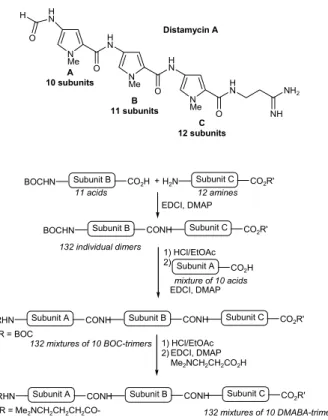
development of solution phase combinatorial strategies to prepare 2640 analogues. Two prototypical libraries of potential DNA binding agents were prepared in a small mixture format (Figure 30). Using eleven N-BOC hetero-cyclic amino acids and twelve amino esters, the individual subunits were coupled to provide all possible 132 individual dipeptides in parallel. These dimers were deprotected and coupled to a mixture of 10 N-BOC carboxylic acids to give 132 mixtures of 10 N-BOC trimers where only the last position (subunit A) is undefined (1320 compounds). This first generation library was further coupled to the basic side chain N,N-dimethylaminobutyric acid (DMABA), affording a second generation DMABA-trimer library. For screening of DNA binding affinity, a rapid high-throughput assay was developed based on the loss of fluorescence from a target oligonucleotide presaturated with ethidium bromide. Deconvolution of the most potent mixtures by resynthesis led to the identification of compounds that are 1000 times
O HN
N O
O
HO OH
N H H N
O O
O
HN N O
O HN
N O
O
HO OH
N H H N
O O
O
HN O
5' 5'
78 79
O HN
N O
O
HO OH
N H
O O
HN O
80 NH2 H2N
5'
Figure 28. Nikkomycin analogues with enzyme inhibitory activity against Candida albicans chitin synthase 1. O
HN
N O
O
O O
O
72
+ R1CO
2H + R2NC+ NH2
73 74 75
O HN
N O
O
O O
N R1
O HN O R2
76 DMF-Py-MeOH
O HN
N O
O
HO OH
N H R1
O HN O R2
77 HCl-MeOH
N Me
H N
O H N H
O
N Me
H N
O N Me
H N
O NH
NH2 A
10 subunits B 11 subunits
C 12 subunits Distamycin A
Subunit B CO2H
BOCHN +H2N Subunit C CO2R'
11 acids 12 amines
EDCI, DMAP
Subunit B CONH
BOCHN Subunit C CO2R'
132 individual dimers
1) HCl/EtOAc 2) Subunit A CO2H
mixture of 10 acids
EDCI, DMAP
Subunit B CONH Subunit C CO2R'
132 mixtures of 10 BOC-trimers
Subunit A
RHN CONH
R = BOC
1) HCl/EtOAc 2) EDCI, DMAP
Me2NCH2CH2CO2H
Subunit B CONH Subunit C CO2R'
132 mixtures of 10 DMABA-trimers
Subunit A
RHN CONH
R = Me2NCH2CH2CH2
CO-Figure 30. Reaction sequence for preparation of distamycin A analogues.
O
H2N O
H N
O OH
OH
81
H N
N H O
O
H2N
X HO
O
82
(X: side-chain of any amino acid residue)
O OH
Figure 29. Potential functional groups (→) for library construction from the natural templates 81 and 82.
more potent than distamycin A in cytotoxic assays (IC50 29 nM (µmol L-1) in the L1210 assay), that bind to
poly[dA]-poly[dT] with comparable affinity, and that exhibit an altered DNA binding sequence selectivity. One component demonstrated high affinity (Kd = 4.5 µM) to the androgen response element (ARE)-consensus sequence, which contains a GC base-pair interrupted five-base-pair AT-rich site relevant to the expression of a gene implicated in cases of prostate cancers that are unresponsive to hormone antagonists.21,126
7. Terpenoids
The diterpenoid paclitaxel (taxol
) (83), first isolated
HO AcO
O
O AcO
OH
83
O O O
OH NH O
Reduction improves activity slightly
May be esterified, epimerized or removed without significant loss of activity
Oxetane ring or close analog requiresd for activity
Removal of acetate reduces activity; some acyl analogs have improved activity
Acyloxy group essential; certain substituted benzoyl groups and other acyl groups have improved activity Removal of 1-OH group
reduces activity slightly Free 2'-hydroxyl group, or a hydrolysable ester thereof required
N-acyl group required
Phenyl group or a close analog required
Acetyl or acetoxy group may be removed without significant loss of activity. Some acyl analogs have MDR-reversing activity
H
Figure 31. Some structure-activity relationships of taxol.
from the bark of the Pacific Yew, Taxus brevifolia Nutt. (Taxaceae), has proved to be the most important drug introduced in the last ten years, with sales of over $1.5 billion in 1999. The chemistry of taxol has been thoroughly investigated in view of determining its SAR (Figure 31) and thus to defining the pharmacophore in chemical terms.127,128 The search for taxol analogues with improved
pharmacological properties led to the design and synthesis of taxoid libraries. Using radiofrequency encoded combinatorial chemistry, Xiao et al.129 synthesized a
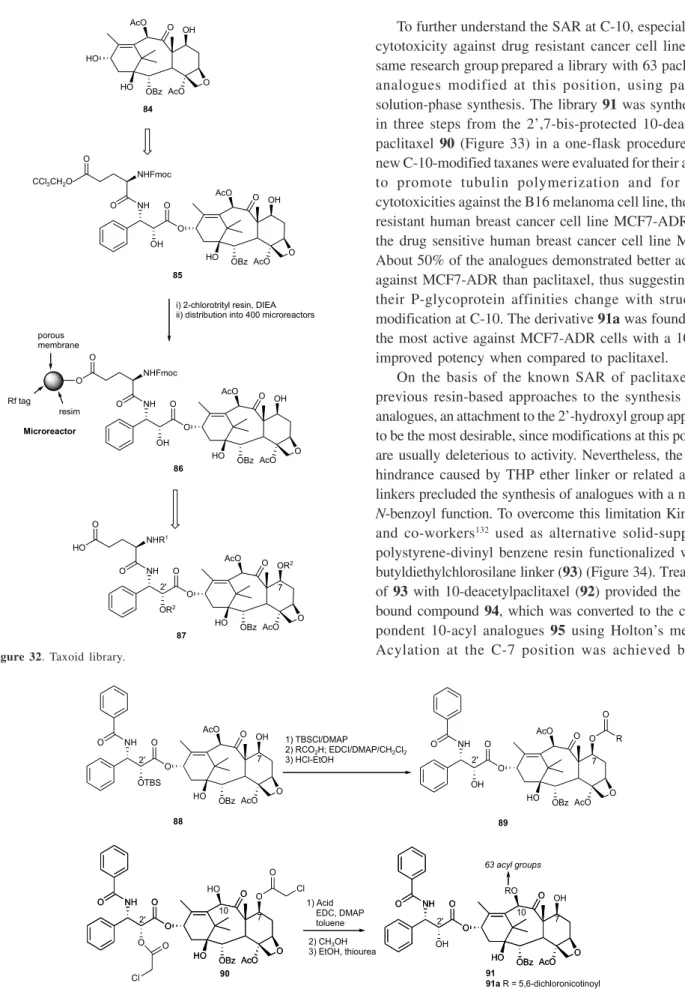
400-membered taxoid library from baccatin III (84) following criteria that included the potential enhancement of water solubility, possible modulation of biological activity, and novel solid phase synthesis. The projected solid phase synthesis of the targeted library 87 required the preparation of the core structure 85 from baccatin III, attached onto 2-chlorotrityl resin (86) (Figure 32). The loaded resin was distributed into 400 microreactors, Fmoc-deprotected, and subject to successive split and coupling with a set of 20 carboxylic acids (R1CO2H and R2CO2H) at the side-chain amino group and another set of 20 carboxylic acids at C-7 and C-2’, yielding 87.
An automated solution phase synthesis of a 26-memberd library of paclitaxel C-7 esters was accomplished by Georg and co-workers.130 Condensation of the 2'-O
To further understand the SAR at C-10, especially the cytotoxicity against drug resistant cancer cell lines, the same research groupprepared a library with 63 paclitaxel analogues modified at this position, using parallel solution-phase synthesis. The library 91 was synthesized in three steps from the 2’,7-bis-protected 10-deacetyl-paclitaxel 90 (Figure 33) in a one-flask procedure. The new C-10-modified taxanes were evaluated for their ability to promote tubulin polymerization and for their cytotoxicities against the B16 melanoma cell line, the drug resistant human breast cancer cell line MCF7-ADR, and the drug sensitive human breast cancer cell line MCF7. About 50% of the analogues demonstrated better activity against MCF7-ADR than paclitaxel, thus suggesting that their P-glycoprotein affinities change with structural modification at C-10. The derivative 91a was found to be the most active against MCF7-ADR cells with a 10-fold improved potency when compared to paclitaxel.
On the basis of the known SAR of paclitaxel and previous resin-based approaches to the synthesis of its analogues, an attachment to the 2’-hydroxyl group appeared to be the most desirable, since modifications at this position are usually deleterious to activity. Nevertheless, the steric hindrance caused by THP ether linker or related alkoxy linkers precluded the synthesis of analogues with a normal
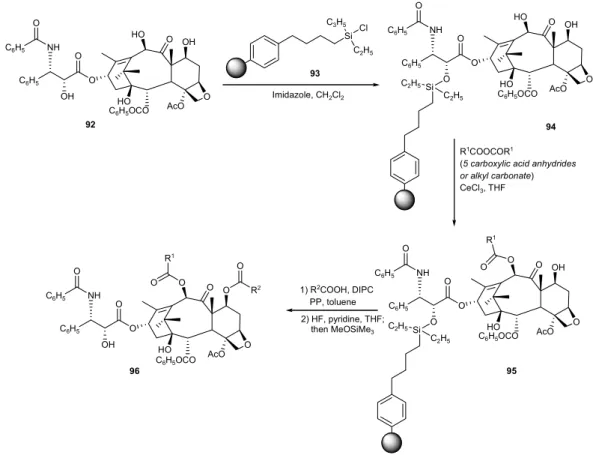
N-benzoyl function. To overcome this limitation Kingston and co-workers132 used as alternative solid-support a
polystyrene-divinyl benzene resin functionalized with a butyldiethylchlorosilane linker (93) (Figure 34). Treatment of 93 with 10-deacetylpaclitaxel (92) provided the resin-bound compound 94, which was converted to the corres-pondent 10-acyl analogues 95 using Holton’s method. Acylation at the C-7 position was achieved by the OBz
HO
HO AcO O
O AcO
OH
84
OBz O
HO AcO
O
O AcO
OH
OH O NH O
NHFmoc O
CCl3CH2O
85
OBz O
HO AcO O
O AcO
OH
OH O NH O
NHFmoc O
O Rf tag
porous membrane
resim
Microreactor
i) 2-chlorotrityl resin, DIEA ii) distribution into 400 microreactors
86
OBz O
HO AcO
O
O AcO
OR2
OR2
O NH O
NHR1
O
HO
87
7 2'
Figure 32. Taxoid library.
OBz O
HO AcO
O
O AcO
OH O
OTBS NH O
OBz O
HO AcO
O
O AcO
O O
OH NH O
7
R O
2'
1) TBSCl/DMAP
2) RCO2H; EDCI/DMAP/CH2Cl2 3) HCl-EtOH
88 89
2' 7
OBz O
HO O
O AcO O
NH O
2'
OBz O
HO O
O AcO O
O NH O
7
90 Cl
O
HO
O Cl
O
10 1) Acid EDC, DMAP toluene
2) CH3OH 3) EtOH, thiourea
OBz O
HO O
O AcO O
NH O
2'
OBz O
HO O
O AcO O
OH NH O
7 RO
OH 10
63 acyl groups
91
91a R = 5,6-dichloronicotinoyl
HO HO
O
O AcO
OH
92 O C6H5
O
OH NH C6H5
O
C6H5OCO
HO HO
O
O AcO
OH
94 O
C6H5 O
O NH C6H5
O
C6H5OCO Si
C2H5 C2H5 Si Cl
C2H5 C3H5
Imidazole, CH2Cl2 93
R1COOCOR1
(5 carboxylic acid anhydrides or alkyl carbonate) CeCl3, THF
HO O
O
O AcO
OH
O C6H5
O
O NH C6H5
O
C6H5OCO Si
C2H5 C2H5
R1
O
95 1) R2COOH, DIPC
PP, toluene
2) HF, pyridine, THF; then MeOSiMe3 HO
O O
O AcO
O
96 O C6H5
O
OH NH C6H5
O
C6H5OCO R1 O
R2 O
Figure34. Solid-phase synthesis of 7,10-diacyl analogues of placlitaxel.
carbodiimide route using 1,3-diisopropylcarbodiimide (DIPC) and acid to generate a 21-member library (96). The authors developed a methodology to determine the tubulin-assembly of compounds thus synthesized, which led to the discovery of three 10-acyl derivatives (95, R1 = COC6H5, COCH=CHCH3 and COOCH2C6H5) and one 7,10-diacyl derivative (96, R1 = COCH2CH3, R2 = COCH2Cl) with improved tubulin-assembly activity as compared with paclitaxel.
Sarcodictyins, isolated from certain species of soft corals,133,134 constitute a group of diterpenoids displaying
potent antitumor activity and taxol-like mode of action, which have became important synthetic targets.135,136 In
order to discover analogues possessing activities superior to those of the natural products, Nicolaou and co-workers have accomplished the generation of sarcodictyin-based libraries,137,138 which have been the subject of detailed
discussion in previous reviews.19,21,81
Starting from the resin attached scaffold 97, a combinatorial library of about 100 sarcodictyin analogues of the general structures 99, 100 and 101 was constructed by modifying the C-8 ester, C-15 ester, and C-4 ketal functionalities (Figure 35).139 The esterification of the
hydroxyl group at C-8 with acetic anhydride, acid chloride, carboxyclic acid or isocyanate, is the first step for
introducing diversity in the library, yielding 98, which constitutes the intermediate for further molecular diversification at C-15 and C-4. In some cases low yields were observed for DCC-coupled products on solid phase, and these compounds had to be prepared in solution. On the basis of the screening results of the synthesized library for induction of tubulin polymerisation, and cytotoxicity studies with ovarian cancer cell lines, SAR of sarcodictyins, here illustraded for sarcodictyin A (102), could be proposed (Figure 35).
The most active analogues found in the above library were the same ones identified by the authors in a previous solution-phase combinatorial approach,137 which employed
the key intermediate 103 to generate a small library of 15 compounds (104) by a series of standard linear transfor-mations (Figure 35). Analogue 104a was the most active in the tubulin polymerization assay (induction of tubulin polymerization of 85%), whereas 104b displayed higher antitumor activity against the parental ovarian carcinoma cell line 1A9 and the taxol-resistant tumor cell lines 1A9PTX10 and 1A9PTX22, with IC50 values of 2.0, 0.6 and 6 nM, respectively.
The labdane diterpenoid 14-deoxyandrographolide (105), one of the active principles of the medicinal plant
O H
H OAc
TIPSO
O L
15 8
4
L =
O
4 4
97
O H
H
OCOR1
HO
O L
98
1) NaOMe 2) R1
COX, DMAP, Et3N
3) TBAF
5 ester groups
O H
H
OCOR1
O OR3
100
O H
H
OCOR1
OR3
101
O H
H
OCOR1
R2 O
OR3
99
H, Me, Et, CH3CF3, nPr
16 ether groups 4 amino groups R4
NHR5
O H
H OH
O H
H OH
OR2
103
OTIPS O
N NMe
O OMe
102 (Sarcodictyin A)
Side chain is crucial for activity
Both nitrogens are important
Ketal substitutions are well tolerated
Esters are prefered over amides; reduction of the ester to the alcohol is not tolerated
O H
H OR1
R3 OR2
104 104a R1
= urocanoyl R2 = Et R3
= CO2Me 104b R1
= urocanoyl R2 = Me R3
= CO2Et 3 R groups 3 ester groups
8 functional groups 4 ester groups
2 acyl groups
Figure 35. Solid- and solution-phase sarcodyctins libraries, and SAR of sarcodyctin A.
OR HO
O
O
19 O
O
O
O
105 R = H
106 R =
PDC, DMF NH2OH.HCl/pyr.
O N
O
O
HO
107 108
O N
O
O
O
109 R
O RCO2H/ DIC/DMAP/DMF
Figure 36. Library generation from the labdane diterpenoid 14-deoxyandrographolide (105).
for the generation of combinatorial libraries using solid-phase methods.140 The first step of the reported synthesis
involved the coupling of the C-19 hydroxyl group of 105
on to 2-chlorotrityl resin, to form the precursor 106, from
which diversification was introduced via the oxime esters
An identical approach was followed for the preparation of combinatorial libraries from ursolic acid and betulinic acid, two pentacyclic triterpenes which have been the subject of numerous biological investigations.141-145 The
triterpene scaffold (110) was immobilized onto a pre-derivatized amino acid 2-chlorotrityyl or Sieber amide resins, and then treated with a variety of aliphatic, aromatic and amino acids, to generate a library of C-3 and C-28 derivatives (111) (Figure 37).146 In another series of
diversity, the C-3 oxime esters 112 were prepared from the immobilized triterpenoid keto scaffolds 113. Two betulinic acid and two ursolic acid derivatives exhibited five-fold increase in the antimalarial activity (MIC 10 µg/ml) in comparison to the parent molecules.
The marine sesterterpene dysidiolide,147 whose absolute
configuration has been established by total synthesis,148 is
the first naturally occurring inhibitor of the dual-specificity cdc25 protein phosphatase family, which plays a crucial role in the regulation of the cell cycle. To determine if the solid-phase synthesis delivered biologically active analogues, 6-epi-dysidiolide 121a and four other diaste-reomers were synthesized on a Merrified resin by means of a Diels-Alder cycloaddition route.149 The diene 116,
prepared by addition of an aldehyde linker (114) to a triphenylphosphonium salt of the iodide 115, reacted with the dienophile 117 to yield the Diels-Alder product 118. After hydrolysis of the acetal, the carbon chain of aldehyde
118 was elongated by means of a Wittig reaction and subsequent hydrolysis of the resulting ether, to yield aldehyde 119. Nucleophilic addition of 3-lithiofuran resulted in a mixture of the 2:1 epimeric alcohols 120. Finally, the furan unit was oxidized with singlet oxygen to form γ
-hydroxybutenolides 121a and 121b, which were released from the polymeric carrier (Figure 38). Based on the above strategy, seven analogues (122-127) were synthesized from the intermediate aldehydes 119 and 120, and further tested as inhibitors of the protein phosphatase cdc25C and in cytotoxicity assays. The ketone 123 proved to be the strongest inhibitor of cdc25C (IC50 0.8 µM (µmol L-1)),
whereas alcohol 122 showed the highest activity in the colon cancer SW480 assay (IC50 1 µM (µmol L-1)).
Cytotoxicity tests performed on the colon cancer cell line HCT116, the prostate cell line PC3 and the breast cell line MDA-MB2312, indicated 6-epi-dysidiolide as the most active compound, with IC50 values of 1.2, 1 and 1.6 µM (µmol L-1), respectively.
8. Flavonoids
The benzopyran moiety is a structural motif of flavonoids, one of the largest group of naturally occurring phenols, and can be labeled as a privileged structure,150,151
a term originally introduced to describe select structural types that bind to multiple, unrelated class of proteins receptors at high affinity ligands.152
Employing a cycloloading strategy that relies on the use of a polystyrene-based selenenyl bromide resin, Nicolaou and co-workers151 synthesized the
2,2-dimethyl-benzopyran motif 131 (Figure 39), to be used as template for the construction of libraries of chalcones, pyranocou-marins, chromene glycosides, stilbenoids, polycyclic steroid biosynthesis inhibitors, N-heterocycles, and pyranoflavones. A family of chalcones (132) with important biological activities, which includes the Cubé resin components
HO
110
O R1
1) RCOOH/DMAP/DIC
2) 2% TFA/DCM
O
O R1 O
R2
111
1) NH2OH.HCl/Py
O R1
113 2) PhCH2COOH/DMAP/HOBt/DC
3) 2 % TFA/DCM
N
PhCH2COO 112
O R1 PDC/DMF
O
O O I EtPPh3I, nBuLi
O
O O
a) C4H9F3O3SSi, CH2Cl2 b) p-TsOH, (CH3)2CO, CH2Cl2
O
O
a) Ph3PCH2OMeCl, KOtBu, THF b) PPTS, THF
O OH
O
O Br
nBuLi, THF OH
O 4
6
O R1
a) O2,hn
b)(PCy3)2Cl2Ru=CHPh 114
115
116
117
118
119
120 121a (6-epi-dysidiolide) R1 =
121b R1=
O
O HO
O
O HO
R O
O
O HO
O
O HO
O
O HO
O
O HO R
O
O HO
R OH
R
O
R
R
R HO
OH R
122 123 124 125 126 127 128
OH OH
25
Figure 38. Dysidiolide analogues obtained in solid-phase synthesis.
OH
R4
R3 R2 R1
129
SeBr
Cycloloading R1
R2 R3 R4
130
Se
O Se R1
R2
R4 R3 6-endo-trig OH
131
Figure 39. Synthesis of 2,2-dimethylbenzopyran scaffolds.
lonchocarpin, 4-hydroxylonchocarpin, 4-hydroxy-3-methoxy-lonchocarpin, and paratocarpin,153-155 was
synthesized by condensation of a variety of 11 aldehydes (133) with a set of resin-bound benzopyrans bearing a methyl ketone substituent (132), followed by cleavage from the resin by hydrogen peroxide promoted selenoxide elimination (Figure 40).151
Another natural product-based library demonstrates the construction of linear and angular pyranocoumarins similar to the Sri Lankan bioactive metabolites seselin, xanthyletin and xanthoxyletin.151,156,158 The library was prepared by a
split-pool strategy with the aid of a radiofrequency encoding using IRORI tags and MacroKan techno-logies.158,159 Reaction pathways commenced from a set of
five resin-bound benzopyrans possessing an o-hydroxy
aldehyde functionality (135), which were treated with aryl, alkyl or alkoxy β-ketoesters (136) to provide the lactones
139 or 140, through a Knoevanagel condensation and concomitant transesterification (Figure 40). Alternatively, these lactones were formed by coupling 135 to four different phenylacetic acids (137) or stabilized Wittig reagents (138). At this stage, structures containing no further functionality were cleaved under standard conditions, whereas any phenol substituents on the scaffold were further derivatized with bromide 141 or by a Mitsunobu reaction with alcohol 142.
A third library was constructed based on a chromene glycoside isolated from Ageratum conyzoides.160 Using
IRORI radiofrequency tagging and MacroKans, trichloro-acetimidates of D-glucose, D-xylose and L-rhamnose (146) were coupled onto three types of phenol-containing scaffolds (145), to afford selectively the β-glycosides 147, which, after deacetylation and cleavage from the resin, gave the chromene glycoside plus eight analogues 148
(Figure 41).151 In alternative to the radiofrequency tagging,
split-and-O Se R1
132 O
R2
R4
R5
R3
O
11 aldheydes 133
O R1
134 O
R2
R3
R4
R5
1) NaOMe 2) H2O2
26 chalcone analogues Lonchocarpin R1 = OH; R2 = R3 = R4 = R5 = H
4-Hydroxylonchocarpin R1 = OH; R2 = R3 = H; R4 = OH; R5 = H
4-Hydroxy-3-methoxy-lonchocarpin R1 = OH; R2 = H; R3 = OMe; R4 = OH; R5 = H O
OH O
O
Paratocarpin A
O Se
135 O
H
R1
HO
R2
O CO2R 136
or
CO2H
R3 137
or
R4
CO2Me
Ph3P 138
O Se O
O R5
139
R5
= R2,
R3
or R4
(R1
= H)
or
O Se R1
O O R5
140
if R3 = p-OTHP
O O O R5
143 Seselin (R5
= H)
or
O R1
O O R5
Xanthyletin (R1 =R5 = H) Xanthoxyletin (R1 =OMe, R5 =H)
144 i) TsOH
ii) Br piperidine,EtCN
DCC, DMAP, DMSO
Et2NPh
K2CO3, DMF
141 or N
OH
PPh3, DEAD 142
H2O2,THF
Figure 40. Chalcone and pyranocoumarin libraries.
pool synthesis. The integration of the NanoKan microreactors in the solid-phase method described above, allowed the rapid construction of a 10000-membered benzopyran libraries, whose constituents were obtained in quantities of 1-2 mg each.161
In addition to these natural and natural product-like libraries based on the benzopyrans scaffold, other molecules of biological interest, which includes an aldosterone biosynthesis inhibitor and related analogues, and a phosphodiesterase IV inhibitor, were also synthesized according the selenoether linking strategy.151
Based on the fact that many natural and designed benzopyrans that contain modifications of the pyran olefin exhibit higher and/or different activity than that of the parent molecule (ex. β-lapachone, (+)-kellactone) (Figure
41),162-164 the Nicolaou group165 developed a solution-phase
“library-from-library” strategy166 in which the previous
libraries were employed for further derivatization at the pyran olefin, thereby increasing the structural diversity. Starting from scaffolds 149 released from the selenenyl resin into 96-well plates, the new library 150 was prepared by epoxidation of 149, followed by nucleophilic cleavage of the epoxide and derivatization of the resulting secondary alcohol with electrophiles.
Some naturally occurring flavonoids, as well as the flavone nucleus itself, were found to be ligands to central benzodiazepine receptors (BDZ-Rs). In the search for new compounds with affinity for the BDZ-Rs, Marder and co-workers167 have described a solution synthesis of small
O Se R1
HO
145
O
OAc OAc O
AcO R2
CCl3
HN
146
BF3.OEt2
O Se R1
O O
OR R2
RO RO
147
O R1
O O
OH R2
HO HO
148 H2O2
THF
R = Ac R = H
NaOMe chromene glycoside
( R1 = H, R2 =CH
2OH,all eq.OH's)
O O
O O
HO O O
b-Lapachone (+)-Khellactone
O
R O
Nu
OEl
149 150
OH
O R1
151 (R1 = H, F, Cl, Br)
+ Cl
O R2
152 R2
: 9 functional groups
Step 1: pyridine Step2: pyridine/KOH Step 3: H2SO4/AcOH
O
R1
R2
O 153
36 analogues in 9 sublibraries of four
Figure 41. Chromene glycoside, benzopyran, and flavonoid libraries.
cyclized into flavone derivatives 153 by successive addition of hydroxide base (step 2) and heating with acid (step 3) (Figure 41).167 Several library members showed
high binding affinity to rat cerebral cortex BDZ-Rs with Kis in the range of 17-23 nM (µmol L-1), whereas
pharma-cological experiments in mice revealed that 6,3’-dibromo-flavone has anxiolytic effect.
A combinatorial biocatalysis approach has also been used in the generation of 600-member library of bergenin derivative, in an automated two-step synthesis involving independent biotransformations by 16 purified enzymes and 25 microorganisms.168
9. Alkaloids
In recent years, a nearly exponentially increasing number of polymer supported syntheses providing a variety of N-heterocyclic compounds amenable for the combina-torial synthesis has emerged, as can be recognized by numerous reviews that have been published previously.169-173
However, most of them describe reaction conditions for only a limited number of building blocks without being
used for real library synthesis but merely, for parallel synthesis of single compounds. In this section, we highlight combinatorial chemistry strategies leading to different alkaloid ring systems that were used for library generation. One of the earliest reports on the combinatorial modification of natural products describes the derivatization of the Rauwolfia indole alkaloids yohimbine (154) and rauwolscine (155).174 These compounds have been shown
to have activity as antihypertensive agents, anti-arrythmics, and as adrenoreceptor antagonists,175 making them attractive
targets for library synthesis. The alkaloid templates were attached to Tentagel resin-bound α-amino acids viathe E-ring carboxyl group, to yield intermediates 156, which were then acylated with a range of carboxylic acids to afford a 792-member library (157) (Figure 42).13,21,174
Fumitremorgin C (158) and related analogues consti-tute a group of alkaloid mycotoxins with an indolyl diketo-piperazine core,176 that are considered lead compounds for
cancer chemotherapy.177 Koomen and co-workers178