0103 - 5053 $6.00+0.00
A
r
ti
c
le
* e-mail: [email protected]
A New Class of Dihaloquinolones Bearing
N’
-Aldehydoglycosylhydrazides,
Mercapto-1,2,4-triazole, Oxadiazoline and
α
α
α
α
α
-Amino Ester Precursors: Synthesis and Antimicrobial Activity
Yaseen A. Al-Souda and Najim A. Al-Masoudi *,b
a
Department of Chemistry, College of Science, University of Al al-Bayt, Al-Mafraq, Jordan
b
Fachbereich Chemie, Universität Konstanz, Postfach 5560, D-78457 Konstanz, Germany
A reação das quinolonas 6-8 com hidrazina forneceu as hidrazidas 9-11 em rendimentos moderados. A condensação de 9 e 11 com CS2/KOH rendeu os sais de potássio 13 e 14, respectivamente, que espontaneamente forneceram as 3-(1,2,4-triazolil)-quinolonas 15 e 16, respectivamente, quando tratadas com hidrazina. A reação de 9 com CS2/KOH sob refluxo resultou na 3-(1,2,4-oxadiazolil)-quinolona 17. Alternativamente, 15 foi preparado a partir de 17. O derivado
12, obtido a partir de 10,forneceu o derivado α-amino ester 18 mediante reação com o éster etílico da glicina. O acoplamento de 10 com vários açúcares forneceu as N ’-(aldeidoglicosil-quinolona-3-il)carbohidrazidas 19a-e. Os novos compostos sintetizados foram avaliados quanto a sua atividade antibacteriana.
Reaction of the quinolones 6-8 with hydrazine afforded the hydrazide 9-11 in moderate yields. Condensation of 9 and 11 with CS2 /KOH furnished the potassium salts 13 and 14, respectively, which spontaneously afforded the 3-(1,2,4-triazolyl)-quinolones 15 and 16, respectively, on treatment with hydrazine. Reaction of 9 in refluxing CS2 /KOH gave the 3-(1,2,4-oxadiazolyl)-quinolone 17. Alternatively, 15 was prepared from 17. The azide derivative 12, obtained from 10, furnished the α -amino ester derivative 18, on reaction with the glycine ethyl ester. Coupling of 10 with various sugars gave the N’-aldehydoglycosyl-quinolone-3-yl)carbohydrazides 19a-e. The newly synthesized compounds were screened for their antibacterial activity.
Keywords: antimicrobial activity, hydrazides, quinolones
Introduction
The second generation of fluoroquinolones1-3 such as
norfloxacin42, the modified analogue of nalidixic acid51,
ciprofloxacin6 3, ofloxacin7 4, and sparfloxacin8 5 are
known as a major class of antibacterial agents and widely used to treat patient with infections. In recent years, and due to the increasing of resistance of many infections by gram negative and gram positive bacteria to these quinolones, several studies9 described various
modifications in the quinolone ring, for example: substitution with different groups at aromatic ring,10-13
replacement of the same ring by thiophene moiety,13,14
introduction of amido group14,15 at C-3, as well as
substitution at N-1 by sugar16-19 or acyclic moieties.20
Nevertheless, some quinolones cause injury to the chromosome of eukaryotic cells.21,22 These findings
prompted us to optimize the substituent at C-3, by
introduction of heterocyclic, α-amino acid ester precursors or N’-aldehydoglycosylcarbohydrazide moities to evaluate the effect of these groups on the antibacterial activity. It had been reported23 that heterocycles such as
antitubercular, bacteriostatic, hypoglycemic, antiviral, antifungal, antithyroid, carcinostatic and strong herbicidal activity. Some reported mercaptotriazole derivatives showed potent activity24 more than streptomycin against Candida albicans, whereas derivatives of 5-substituted 1,2,4-oxadiazole-2-thiones are known to possess interesting pharmacodynamic property and some have exhibited remarkable activity25 against Mycobacterium tuberculosis. Recently, bactericidal and/or fungicidal or antimicrobial activity was reported for oxadiazolidi-nethiones.26 Furthermore, a number of 1,2,4-triazole
derivatives are angiotensin II receptor antagonists. To the best of our knowledge, only two examples of quinolone 3-hydrazides are reported: 1-phenyl-27 and
1-methyl-4-oxo-1,4-dihydroquinoline-3-carboxylic acid hydrazides.28
Experimental
General procedures
Melting points are uncorrected. The 1H-NMR and 13
C-NMR spectra were recorded on DRX 600, VRX 200 and UNITY 300 spectrometers with tetramethylsilane as an internal standard (δ scale in ppm and coupling constants in Hz). The signal assignments in the 1H-NMR spectra were
confirmed by selective proton decoupling or by COSY spectra. Heteronuclear assignments were verified by 1 H-13C COSY or HMQC experiments. EI and FAB mass were
measured on an MAT 312 mass spectrometer using 3-nitrophenol (NBOH) or glycerol as matrix.
Preparation of 6-chloro-1-ethyl- and 6,7-dihalo-1,4-dihydro-4-oxoquinoline-3-carboxylicacid hydrazides ( 9-11)
To a stirred suspension of 6-8 (10 mmol) in MeOH (50 mL) was added hydrated hydrazine (2.5 g, 50 mmol) at 23 °C. After stirring with EtOH (70 mL) for 72 h, the suspension was evaporated to dryness and the residue was washed with diethyl ether (50 mL), filtered and recrystallized from EtOH to give the desired products 9-11, respectively, asyellow crystals.
6,7-Dichloro-1-ethyl-1,4-dihydro-4-oxoquinoline-3-carboxylic acid hydrazide (9)
From 6 (3.14 g). Yield: 2.01 g (67%); mp 204-206 °C;
1H-NMR (DMSO-d
6) δ 11.64 (s,br, 3H, NH, NH2); 8.99 (s,
1H, H-2); 8.38 (s, 1H, H-8); 8.38 (s, 1H, H-5); 4.45 (q, J 7.0 Hz, 2H, CH2CH3); 1.60 (t, 3H, CH2CH3). 13C-NMR
(DMSO-d6) δ 175.0 (C-9); 164.8 (C-4); 149.8 (H-2); 140.4 (C-7);
137.8 (C-8a); 132.7 (C-6); 128.5 (C-5); 126.2 (4a); 118.8 (C-8); 108.8 (C-3); 50.8 (CH2CH3); 14.2 (CH2CH3); MS m/z
(EI, relative abundance %) 300/302 (M+•,38/24).
6-Chloro-1-ethyl-7-fluoro-1,4-dihydro-4-oxoquinoline-3-carboxylic acid hydrazide (10)
From 7 (2.98 g). Yield: 1.50 g (53%) as a yellow crystals; mp 263–264 °C; 1H-NMR (DMSO-d
6) δ 10.43 (s, 1H, NH);
8.85 (s, 1H, H-2); 8.24 (d, 1H, JH8-F 5.5 Hz, H-8); 8.11 (d, 1H, JH5-F 8.3 Hz, H-5); 7.20 (s, br, 2H, NH2); 4.52 (q, 2H, J
7.1 Hz, CH2CH3); 1.38 (t, 3H, J 7.1 Hz, CH2CH3); 13C-NMR
(DMSO-d6) δ 173.5 (C-9); 163.1 (C-4); 154.2 (d, JC6-F 247.7 Hz, H-6); 147.6 (C-2); 135.6 (C-8a); 127.3 (d, JC4a-F 5.5 Hz, C-4a); 125.9 (d, JC7-F 20.4 Hz, C-7); 120.0 (C-8); 112.1 (d,
JC5-F 22.6 Hz, C-5); 110.6 (C-3); 48.6 (CH2CH3); 14.4 (CH2CH
3); Anal. calc. for C12H11FClN3O2: C, 50.81; H, 3.91;
N, 14.81. Found: C, 50.70; H, 3.87; N, 14.70; MS m/z (EI, relative abundance %) 283/285 (M+•,50/19).
6-Chloro-1-ethyl-1,4-dihydro-4-oxoquinoline-3-carboxylic acid hydrazide (11)
From 8 (2.80 g). Yield: 1.72 g (65%); mp 224-226 °C;
1H-NMR (DMSO-d
6) δ 11.64 (s, br, 3H, NH, NH2); 8.99 (s,
1H, H-2); 8.38 (dd, 1H, JH7-8 9.5 Hz, H-8); 8.28 (d, 1H, JH5-7
3.0 Hz, H-5); 7.92 (m, 1H, H-7); 4.45 (q, 2H, J 7.0 Hz,
CH2CH3); 1.60 (t, 3H, J 7.0 Hz, CH2CH3); 13C-NMR
(DMSO-d6) δ 175.0 (C-9); 164.8 (C-4); 149.8 (H-2); 140.4 (C-7); 137.8 (C-8a); 132.7 (C-6); 128.5 (C-5); 126.2 (4a); 118.8 (C-8); 108.8 (C-3); 50.8 (CH
2CH3); 14.2 (CH2CH3); Anal. calc. for C12H12ClN3O2: C, 54.25; H, 4.55; N, 15.81. Found: C, 54.10; H, 4.49; N, 15.67; MS m/z (EI, relative abundance %) 264/266 (M+•,45/24).
3-(4-Amino-5-thioxo-4,5-dihydro-1H-1,2,4-triazol-3-yl)-6-chloro-1-ethyl-1,4-dihydro-4-oxoquinoline (15)
(0.96 g, 60%); mp 239-240 °C; 1H-NMR (DMSO-d 6) δ
13.20 (s, 1H, NH); 8.54 (s, 1H, H-2); 8.22 (d, 1H, JH5-8 < 1.0 Hz, H-5); 7.98 (d, 1H, JH8-5 < 1.0 Hz, H-8); 6.67 (s, br, 2H, NH2); 4.43 (q, 2H, J 7.1 Hz, 2H, CH2CH3); 1.40 (t, 3H, J 7.1 Hz, CH2CH
3);
13C-NMR (DMSO-d
6) δ 172.6 [C-12, (C=S)];
163.7 (C-4); 146.6 (C-9); 145.9 (H-2); 137.6 (H-8a); 132.6 (C-6); 129.6 (C-5); 127.5 (C-4a); 124.9 (C-7); 119.8 (C-8); 107.4 (C-3); 48.00 (CH2CH3); 14.3 (CH2CH3); Anal. calc. for C13H11Cl2N5SO: C, 43.83; H, 3.11; N, 19.66. Found: C, 43.61; H, 3.02; N, 19.38; MS m/z (EI, relative abundance %) 355/357 (M+•,35/30).
Method B. A solution of 17 (1.00 g, 3.42 mmol), H2O (3 mL) and 95% N2H4 (1.60 g) was heated under reflux for 4 h. After cooling, the solution was diluted with cold H2O (20 mL), acidified by dropwise addition of concentrated HCl, and filtered. The solid was washed with a minimium of cold H2O, dried and recrystallized from 1:1 EtOH:H2O to give 15 (0.70 g, 57%). The product had identical mp, mixed mp (238-240 °C) and other physical properties for those of the authentic sample prepared in method A.
3-(4-Amino-5-thioxo-4,5-dihydro-1H-1,2,4-triazol-3-yl)-6,7-dichloro-1-ethyl-1,4-dihydro-4-oxoquinoline (16)
This compound was prepared from 11 (1.20 g, 4.52 mmol) in a similar manner as desribed for the preparation of 15 (method A) via salt 14. Yield: 1.20 g, (83%); mp 235-238 °C; 1H-NMR (DMSO-d
6) δ 13.81 (s,
1H, NH); 8.55 (s, 1H, H-2); 8.7 (s, 1H, H-5); 8.20 (s, 1H, H-8); 5.68 (s, br, 2H, NH2); 4.33 (q, 2H, J 7.0 Hz, CH
2CH3);
1.40 (t, 3H, J 7.0 Hz, CH2CH3); 13C-NMR (DMSO-d 6) δ
172.9 [C-12, (C=S)]; 163.8 (C-4); 150.8 (C-2); 145.9 (C-9); 138.9 (C-7); 136.8 (H-8a); 128.6 (C-6); 127.8 (C-5); 126.6 (C-4a); 118.5 (C-8); 108.5 (C-3); 48.8 (CH
2CH3);
15.0 (CH2CH3); Anal. calc. for C13H12ClN5SO: C, 48.52; H, 3.76; N, 21.76. Found: C, 48.36; H, 3.67; N, 21.49; MS
m/z (EI, relative abundance %) 321/323 (M+•,100/45).
6,7-Dichloro-1-ethyl-4-dihydro-3-(5-thioxo-1H-1,3,4-oxadiazol-3-yl)-4-oxoquinoline (17)
To a solution containing EtOH (20 mL) and KOH (5.00 mmol) dissolved in H2O (5 mL), the hydrazide 9 (1.50 g, 5.00 mmol) was added. After solution occurred, CS2 (0.42 g, 5.51 mmol) was added and the mixture was heated under reflux for 3 h. After concentration of the solution to a small volume, the residue was dissolved in H2O (10 mL). A precipitate was obtained by adding the solution to ice containing concentrated HCl. The solid was filtered off and dried. Recrystallization from EtOH gave the title
compound 17 (1.00 g, 58%); mp 227-229 °C; 1H-NMR
(DMSO-d6) δ 11.05 (s, 1H, NH); 9.045 (s, 1H, H-2); 8.47 (s, 1H, H-5); 7.88 (s, 1H, H-8); 4.50 (q, 2H, J 7.0 Hz, CH
2CH3);
1.65 (t, 3H, J 7.0 Hz, CH2CH3); 13C-NMR (DMSO-d 6) δ
175.2 (C=S); 165.0 (C-4); 150.0 (C-2); 141.0 (C-9); 138.0 (C-7); 133.4 (H-8a); 128.6 (C-6); 126.2 (C-5); 121.6 (C-4a); 119.1 (C-8); 108.7 (C-3); 51.2 (CH
2CH3); 14.4
(CH2CH3); Anal. calc. for C13H9Cl2N3SO2: C, 45.63; H, 2.65; N, 12.28. Found: C, 45.42; H, 2.56; N, 12.02; MS m/z (EI, relative abundance %) 341/343 (M+•,20/14).
7-Chloro-1-ethyl-6-fluoro-1,4-dihydro-4-oxoquinoline-3-carboxylic acid azide (12)
To compound 10 (1.00 g, 2.84 mmol) was added a mixture of 2.0 mol L-1 HCl (12 mL, 40 mmol) and AcOH
(2 mL, 80 mmol) at – 10 °C with stirring, followed by addition of NaNO2 solution (0.40 g in 3 mL H2O). After additional 15 min stirring between 0 °C and – 10 °C, the yellow azide product 12 was collected, washed with cold H2O and used immediately for the preparation of 18. The title azide 12 is rather unstable, and starts to decompose in the solid state at 23 °C within two days. However, this azide is stable when stored as solid at – 10 °C: IR νmax/cm-1:
2100 (azide group), (KBr); 1H-NMR (DMSO-d
6) d 8.74 (s,
1H, H-2); 8.14 (d, 1H, J8,F 5.4 Hz, H-8); 8.02 (d, 1H, J5,F 8.1 Hz, H-5); 4.48 (q, 2H, J 7.0 Hz, CH
2CH3); 1.32 (t, 3H, J 7.0
Hz, CH2CH3); MS m/z (FAB, relative abundance %) 293/295 (MNa+•,87/25).
(7-Chloro-1-ethyl-6-fluoro-1,4-dihydro-4-oxoquinolino-3-yl)-α-amino acetic acid ethyl ester (18)
To a solution of 12 (1.20 g, 4.07 mmol) in DMF (40 mL) was added glycine ethyl ester (0.70 g, 6.79 mmol) at – 10 °C, followed by slow addition of Et3N (0.60 g, 5.93 mmol). After stirring at 0 to 5 °C for 1 h, the mixture was added to an ice-cold water (150 ml) and the precipitate was filtered, dried and recrystallized from CHCl3 to give
18 (0.72 g, 50%); mp 258-260 °C; 1H-NMR (CDCl 3) δ
10.10 (s, 1H, NH); 8.80 (s, 1H, H-2); 8.20 (d, 1H, J5,F 8.5 Hz, H-5); 7.51 (d, J8,F 5.8 Hz, 1H, H-8); 4.19 (m, 6H, 3xCH2); 1.58, 1.22 (m, 6H, 2xCH2CH
3); δC (DMSO-d6): 175.1,
175.0, 169.8 (C=O); 164.8 (C-4); 155.4 (d, J5,F 251.1; C-5); 147.6 (C-2); 135.5 (d, J8a,F 1.6 Hz, C-8a); 128.2 (d,
J4a,F 6.3 Hz, C-4a); 127.7 (d, J7,F 21.6 Hz, C-7); 118.3 C-8); 113.7 (d, J5,F 23.6 Hz, C-5); 111.5 (C-3); 61.3 (C-10); 49.5 (NCH2CH3); 41.5 (OCH2CH3); 14.5 (OCH2CH3); 14.2 (NCH2CH
3); Anal. calc. for C16H16FClN2O4: C, 54.17; H,
4.55; N, 7.90. Found: C, 53.95; H, 4.50; N, 7.78; MS m/z
N’-D-Aldehydoglycosyl-(7-chloro-l-ethyl-6-fluoro-1,4-dihydro-4-oxoquinolin-3-yl)carbohydrazide (19a-e)
A suspension of 10 (1.40 g, 4.93 mmol) in EtOH (50 mL) and the sugar moiety (5.20 mmol) was heated under reflux for 4-6 h. After cooling, the product was collected and recrystallized from EtOH to afford the desired product 19.
N’-D -Aldehydoarabinosyl-(7-chloro-l-ethyl-6-fluoro-1,4-dihydro-4-oxoquinolin-3-yl)carbohydrazide (19a)
From D-arabinose (0.78 g). Yield: 2.01 g (98%); mp 225 °C; 1H-NMR (600 MHz, HMQC, DMSO-d
6) δ 12.69
(s,1H, NH); 8.99 (s,1H, H-2); 8.32 (d,1H, JH8-F 5.4 Hz, H-8); 8.15 (d, 1H, JH5-F 8.4 Hz, H-5); 7.65 (d, 1H, J 5.5 Hz, OH, exchangable with D2O); 4.99 (d, 1H, J 5.5 Hz, OH); 4.64 (m, 5H, H-1’, CH2CH3, 2xOH, exchangable with D2O); 4.38 (dd, 1H, J 8.0 Hz, J 3.2 Hz, H-2’); 4.30 (dd, 1H, J 3.2 Hz, J
8.3 Hz, H-3’); 3.60 (m, 2H, H-4’, H-5’); 3.46 (dd, 1H, JH5’,H5”
12.0 Hz, H-5”); 1.42 (t, 3H, J 7.1 Hz, CH2CH
3);
13C-NMR
(DMSO-d6) δ 173.9 (C-9); 160.3 (C-4); 155.9 (d, JC6-F 180.3 Hz, C-6); 151.9 (N=CH-1’); 148.7 (C-2); 135.7(C-8a); 127.3 (d, JC4a-F 5.4 Hz, C-4a); 126.2 (d, JC7-F 20.3 Hz, C-7); 120.2 (C-8); 112.2 (d, JC5-F 22.3 Hz, C-5); 110.3 (C-3); 73.3 (C-3’); 70.9 (C-4’); 70.3 (C-2’); 63.3 (C-5’); 48.8 (CH
2CH3); 14.4 (CH2CH3); Anal. calc. for C17H19FClN3O6:
C, 49.11; H, 4.61; N, 10.11. Found: C, 49.00; H, 4.50; N, 9.85; MS m/z (FAB, relative abundance %) 438/440 (MNa+•, 100/36).
N’-D -Aldehydoxylosyl-(7-chloro-l-ethyl-6-fluoro-1,4-dihydro-4-oxoquinolin-3-yl)carbohydrazide (19b)
From D-xylose (0.78 g). Yield: 1.90 g (93%); mp 131 °C, decomposed; 1H-NMR (DMSO-d
6) δ 10.92 (s, 1H, NH);
8.90 (s,1H, H-2); 8.28 (d,1H, JH8-F 5.3 Hz, H-8); 8.15 (d, 1H,
JH5-F 8.5 Hz, H-5); 6.00 (t, 1H, JOH-H5’,H5” 5.5 Hz, C5’-OH, exchangable with D2O); 5.05 (s, br, 1H, OH, exchangable with D2O); 4.92 (m, 2H, 2xOH, exchangable with D2O); 4.54 (m, 4H, H-1’, H-2’, CH
2CH3); 4.34 (m, 1H, H-3’); 3.84
(m, 1H, H-4’); 3.55 (m, 1H, H-5’); 3.42 (m, 1H, H-5”); 1.40 (t, 3H, J 7.0 Hz, CH2CH
3);
13C-NMR (DMSO-d
6) δ 173.6
(C-9); 163.5 (C-4); 154.5 (d, JC6-F 195.2 Hz, H-6); 149.0 (N=CH-1’); 148.1 (C-2); 135.7(C-8a); 127.3 (d, JC4a-F 6.1 Hz, C-4a); 125.8 (d, JC7-F 20.0 Hz, C-7); 120.1 (C-8); 112.2 (d, JC5-F 23.0 Hz, C-5); 110.0 (C-3); 76.5 (C-3’); 70.7 (C-4’); 69.7 (C-2’); 67.1 (C-5’); 48.7 (CH2CH3); 14.4 (CH2CH
3); Anal. calc. for C17H19FClN3O6: C, 49.11; H, 4.61;
N, 10.11. Found: C, 48.82; H, 4.52; N, 9.89; MS m/z (FAB, relative abundance %) 438/440 (MNa+•,86/38).
N’-D -Aldehydoribosyl-(7-chloro-l-ethyl-6-fluoro-1,4-dihydro-4-oxoquinolin-3-yl)carbohydrazide (19c)
From D-ribose (0.78 g). Yield: 1.80 g (88%); mp 168-171 °C; 1H-NMR (DMSO-d
6) δ 12.58 (s, 1H, NH); 8.97
(s,1H, H-2); 8.32 (d,1H, JH8-F 6.0 Hz, H-8); 8.17 (d, 1H,
JC5-F 9.4 Hz, H-5); 6.15 (t, 1H, JOH-H5’,H5” 5.3 Hz, C5’-OH, exchangable with D2O); 5.50-4.65 (m, 3H, 3xOH, exchangable with D2O); 4.56 (m, 4H, H-1’, H-2’, CH
2CH3);
3.40-3.33 (m, 3H, H-3’, H-4’, H-5’); 3.37 (dd, 1H, J 12.1 Hz, J 4.4 Hz, H-5”); 1.42 (t, 3H, J 7.1 Hz, CH2CH
3); Anal. calc. for C17H19FClN3O6: C, 49.11; H, 4.61; N, 10.11. Found: C, 48.87; H, 4.52; N, 9.87; MS m/z (FAB, relative abundance %) 438/440 (MNa+•, 100/36).
N’-D -Aldehydomannosyl-(7-chloro-l-ethyl-6-fluoro-1,4-dihydro-4-oxoquinolin-3-yl)carbo-hydrazide (19d)
From D-mannose (0.94 g).Yield: 2.1 g (95%); mp 88-90 °C; 1H-NMR (DMSO-d
6) δ 10.92 (d, 1H, JNH,1’ 1.2 Hz,
NH); 8.88 (s,1H, H-2); 8.28 (d,1H, JH8-F 5.2 Hz, H-8); 8.12 (d, 1H, JH5-F 8.3 Hz, H-5); 4.76-4.51 (m, 3H, 3xOH, exchangable with D2O); 4.59 (m, 5H, H-1’, H-2’, CH
2CH3,
OH); 4.54 (s, br, 1H, OH, exchangable with D2O); 4.20 (dd, 1H, JH2’-H3’ 9.2 Hz, JH3’-H4’ 1.2 Hz, H-3’); 3.76 (dd, 1H,
JH3’-H4’ 1.2 Hz JH4’-H5’ 9.1 Hz, H-4’); 3.64 (dd, 1H, JH5’-H6’ 5.3 Hz, JH6’-H6” 12.0 Hz H-6’); 3.50 (dt, 1H, JH5’-H.6’ 5.3 Hz,
JH5’-H.6” 3.0 Hz, H-5’); 3.36 (d, 1H, JH6’-H6” 12.0 Hz, H-6”); 1.38 (t, 3H, J 7.1 Hz, CH2CH
3);
13C-NMR (DMSO-d 6) δ
173.5 (C-9); 161.8 (C-4); 154.5 (d, JC6-F 210.2 Hz, H-6); 152.6 (N=CH-1’); 147.9 (C-2); 135.6 (C-8a); 127.3 (d, JC4a-F
6.1 Hz, C-4a); 125.0 (d, JC7-F 20.4 Hz, C-7); 120.1 (C-8); 112.1 (d, JC5-F 23.5 Hz, C-5); 110.8 (C-3); 78.2 (C-3’); 74.2 (C-5’); 69.9 (C-4’); 67.2 (C-2’); 61.4 (C-6’); 48.6 (CH2CH3); 14.4 (CH2CH
3); Anal. calc. for C18H21FClN3O7: C, 48.49;
H, 4.75; N, 9.43. Found: C, 48.31; H, 4.64; N, 9.21; MS
m/z (FAB, relative abundance %) 468/470 (MNa+•, 100/38).
N’-D -Aldehydogalactosyl-(7-chloro-l-ethyl-6-fluoro-1,4-dihydro-4-oxoquinolin-3-yl)carbohydrazide (19e)
From D-galactose (0.94 g). Yield: 1.90 g (86%); mp 114-117 °C; 1H-NMR (DMSO-d
6) δ 10.78 (d, 1H, JNH,1’ 2.0
Hz, NH); 8.78 (s,1H, H-2); 8.28 (d,1H, JH8-F 5.1 Hz, H-8); 8.13 (d, 1H, JH5-F 8.4 Hz, H-5); 5.98 (t, 1H, JOH-H6’,H6” 2.0 Hz, C6’-OH, exchangable with D2O); 4.88-4.72 (m, 3H, 3xOH, exchangable with D2O); 4.66 (s, br, 1H, H-1’); 4.57 (m, 4H, H-2’, CH
JH6’-H6” 12.2 Hz, H-6’); 3.45 (dt, 1H, JH5’-H6’ 5.6 Hz, JH5’-H6”
3.5 Hz, H-5’); 3.38 (d, 1H, JH6’-H6” 12.2 Hz, H-6”); 1.39 (t, 3H, J 7.0 Hz, CH2CH
3);
13C-NMR (DMSO-d
6) δ 173.6
(C-9); 163.8 (C-4); 155.0 (d, JC6-F 212.8 Hz, H-6); 151.8 (N=CH-1’); 148.2 (C-2); 135.7 (C-8a); 127.3 (d, JC4a-F 6.1 Hz, C-4a); 126.1 (d, JC7-F 20.3 Hz, C-7); 120.1 (C-8); 112.2 (d, JC5-F 22.3 Hz, C-5); 110.0 (C-3); 76.7 (C-3’); 73.3 (C-5’); 68.3 (C-4’); 68.0 (C-2’); 60.5 (C-6’); 48.7 (CH2CH3); 14.4 (CH2CH
3); Anal. calc. for C18H21FClN3O7: C, 48.49;
H, 4.75; N, 9.43. Found: C, 48.29; H, 4.61; N, 9.32; MS m/z
(FAB, relative abundance %) 468/470 (MNa+•, 100/40).
Results and Discussion
Hydrazides 9-11 were prepared in 67, 53 and 65% yield, respectively, as key intermediates for the synthesis of the target molecules from reaction of the quinolones 6-8 with the hydrated hydrazine at 23 °C for 72 h (Scheme 1). Condensation of the carboxylic acid hydrazides 9 and 11
with CS2 in ethanolic KOH afforded the unseparable potassium 3-quinolonodithio-carbazates 13 and 14, respectively. These salts were cyclized, at refluxing
temperature, with hydrazine followed by acidification with conc. HCl to furnish triazoles 15 and 16 in 60 and 83% yield, respectively. The 1,3,4-oxadiazole-2-thione derivative 17 was prepared from 9, following Young and Wood29 in 58% yield. Alternatively, 17 could be converted
with hydrazine into the triazole 15 in 57% yield. Treatment of 10 with with NaNO2 in the presence of 2 mol L-1 HCl
and AcOH mixture at – 10 °C afforded the unstable carboxylic acid azide derivative 12, which was used immediately for the next step. Condensation of the azide derivative 12 with glycine ethyl ester in the presence of base at – 10 °C for 1 h afforded the ethyl ester derivative
18 in 50% yield (Scheme 1). The structures of the newly compounds were confirmed by homo- and heteronuclear NMR spectroscopy methods and mass spectrometry. The proton spin systems of compounds 13-16 were elucidated from their DQF-COSY30 spectra (chemical shifts are listed
in experimental section). Compound 18 was selected for further NMR studies via gradient selected HMBC31
spectrum: the carbonyl group (C-9) at δC169.8 shows a
3J
C,H correlation to CH2-11 at δH 4.19, meanwhile C-2 at δC
147.6 shows the same correlation to N1-CH
2CH3 at δH 4.19.
Derivatization of the carboxylic group of the quinolone bases was extended next. The hydrazide key intermediate was used here for the synthesis of the 3-carbohydrazide-sugar compounds as promising antibacterial agents. Thus, boiling of 10 with five aldehydosugars (D-arabinose,
D- xylose, D-ribose, D-mannose and D-galactose) for 2-4 h afforded, after purification, the yellowish 3-carbo-hydrazide derivatives 19a-e in 86-98% yield (Scheme 2). The structures of these compounds were confirmed on the basis of their NMR spectra, which were characterized by the presence of a singlet in the region δH 8.99 – 8.78 (H-2) and two doublets at δH 8.32 – 8.24 with large coupling constant (JH8-F ~ 8.5 Hz), and at δH 8.15 – 8.11 with small coupling constant (JH5-F ~ 5.5 Hz), assigned to H-8 and H-5, respectively. The protons of the carbohydrate moiety were resolved, after exchanging the hydroxyl groups with D2O, and comparison of their coupling constants with those of the corresponding free sugars. The proton spin system of 19a,c was further confirmed from DFQ-COSY spectrum: H-1’ of 19a appeared as doublet at δH 4.99, while H-2’ – H-5’ in the region δH 4.64 – 3.46, and these protons correlated to the signals at δC 151.9, 70.3, 73.3, 70.9 and 63.3 for C-1’ – C-5’, respectively. Similarly, both protons and carbons of 19b-d were identified, whereas the 13C-NMR signals of
the quinolone residue in 19a-e were analysed by comparison to those of the previously reported quinolone nucleosides.32
Bioassay
Two factors influence the Minimal Inhibitory Concen-tration (MIC) of fluoroquinolones: the rate of peneConcen-tration into bacterial cell and its inhibitory activity of DNA gyrase.33 Although, most of the studies proposed that a
substituent at 7-position of the quinoline ring is related to the binding site with enzyme through electrostatic
interactions,34,35 our aim here was to study the influence of
the structural change of the carboxylic group of the quinolone ring by N’-aldehydoglycosyl-carbohydrazides as well as a new heterocycle and a-amino acid ester groups on the antibacterial activity. The in vitro antimicrobial activity of compounds 15-18 and 19a-e was testedby using the Escherichia coli K 12 wild-type strain D10, a gram negative bacterium, and wild-type Bacillius subtilius, a gram-positive bacterium, as well as Staphylococcus aureus. 104 Cells x mL-1 were incubated into LB medium
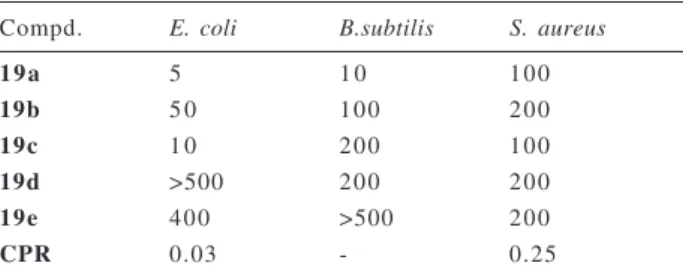
containing the indicated amount of a given compond. After growth overnight at 37 °C, the optical density of the culture was determined. The minimal inhibitory concentrations (MIC) of 13-19 were determined by assaying the effect of each compound at concentrations of 0.1, 0.5, 1, 10, 50, 100, 200 and 500 mg x mL-1, and none of them showed
significant activity. The screening results of compounds
19a-e are summarized in Table 1, using ciprofloxacine (CPR), as standard, for comparison.
The above data showed that the newly prepared compounds have slightly or no activity against the mentioned organisms, except 19a which exhibited slight activity against E. coli. In conclusion, the substitution of the carboxylic group of the quinolones by 1,2,4-triazolyl,
Scheme 2. Synthesis of N’-aldehydoglycosyl-dihaloquinolone-carbohydrazides 19a-e from the dihaloquinolone-carbohydrazide 10.
N
CONHNH2
Et O
F
Cl N
CONHN=CHR
Et O
F
Cl
10 19a-e
a: D-arabino- b: D-xylo- c:D-ribo- d: D-manno- e: D
-galacto-HO
HO
OH
OH
CH2OH
OH
HO
HO
OH
CH2OH
OH
HO
OH
CH2OH
OH
OH
OH
CH2OH
HO
OH
OH
CH2OH
RCHO, EtOH
reflux, 4-6 h, (81-89%)
2 3
6
8 8a 7
5
4 4a
9 1'
2'
3'
4'
6' 5'
R:
Table 1. Invitro antibacterial screeninga
Compd. E. coli B.subtilis S. aureus
1 9 a 5 1 0 100
19b 5 0 100 200
19c 1 0 200 100
19d >500 200 200
19e 400 >500 200
CPR 0.03 - 0.25
1,3,4-oxadiazolyl, α-amino ester or hydrazide derivatives
of aldehydosugars does not influence the antibacterial activity, since the new compounds are nearly inactive.
Acknowledgments
We thank Mrs. A. Friemel for the NMR (DFQ-COSY, ROESY, HMQC) experiments, Dr. M. Eherman, Fakultät für Biologie, Universität Konstanz, Germany, for the antibacterial screening, and Mr. K. Hägele for the mass spectra. We thank also Professor A. El Ashry of Alxanderia University, Egypt, for supporting the sugar compounds.
References
1. For some recent reviews see: Chu, T. D. W.; Fernandez, P. B.;
Adv. Drug Res.1991, 21, 39; Wentland, M. P. In The New Generation of Quinolones; Siporin, C.; Heifetz, C. L.; Domagala, J. M., eds.; Maecel Dekker Inc.: New York, 1990, p. 1; Andriole, V. T.; TheQuinolones; Academic Press: New York, 1988. 2. Chu, D. T. W.; Fernandez, P. B.; Antimicrob. Agents Chemother.
1989, 33, 131.
3. Smith, T. J.; Lewin, C. S. In The Quinolones; Anderiole, V. T., ed.; Academic Press: London, 1988, ch. 2.
4. Koga, H.; Itoh, A.; Murayama, S.; Suzue, S.; Ivikura, T.; J. Med. Chem. 1980, 23, 1358.
5. Lesher, G. Y.; Froelich, E. J.; Gruett, M. D.; Bailey, J. H.; Brundage, P. R.; J. Med.Chem.1962, 5, 1963.
6. Wise, R; Andrews, J. M.; Edwards, L. J.; Antimicrob. Agents Chemother.1983, 23, 559.
7. Hayakawa, I.; Hiramitsu, T.; Tanaka, Y.; Chem. Pharm. Bull.
1984, 32, 4907.
8. Miyamoto, T.; Matsumoto, J.; Chiba, K.; Egawa, H.; Shibamori, K.; Minamida, A.; Nishimura, Y.; Okada, H.; Fuzita, M.; Hirose, T.; Nakano, J.; J. Med. Chem. 1990, 33, 1645.
9. Ueda, Y.; Shimizu, K.; Konno, M.; Matsumoto, F. ,eds.; The Quinolones; Life Sciences Publisher: Tokyo, 1991, p. 315. 10. El-Subbagh, H. I.; Abadi, A. H.; Al-Khawad, I. E.; Al-Rashood,
K. A.; Arch. Pharm.Pharm. Med. Chem.1999, 332, 19. 11. Yoshida, T.; Yamamatoo, Y.; Orita, H.; Kakiuchi, M.; Takahashi,
Y.; Itakura, M.; Kado, N.; Mitani, K.; Yasuda, S.; Kato, H.; Itoh, Y.; Chem. Pharm. Bull.1996, 44, 1074.
12. Nieto, M. J.; Alovero, F. d. L.; Manzo, R. H.; Mazzieri, M. R.;
Eur. J. Med. Chem.1999, 34, 209.
13. El-Abadelah, M. M.; Sabri, S. S.; Al-Ashqar, H. A.; Hetero-cycles1997, 45, 255.
14. El-Abadelah, M. M.; Nazer, M. Z.; Sabri, S.; Khalid, S. M.; Voelter, N.; Geiger, M.; Z. Naturforschung1997, 52b, 419. 15. El-Abadelah, M. M.; Nazer, M. Z.; El-Abadelah, N. S.; Meier,
H.; Heterocycles1995, 41, 2203.
16. Al-Masoudi, N. A.; Al-Soud, Y. A..; Eherman, M.; De Clercq, E.; Nucleos. Nucleot. 1998, 17, 2255.
17. de la Cruz, A; Elguero, J.; Goya, P.; Matinez, A.; De Clercq, E.;
J. Chem. Soc. PerkinTrans. 11993, 845.
18. da Matta, A. D.; Bernardino, A. M. R.; Romeiro, G. A.; de Oliveira, M. R. P.; de Souza, M. C. B. V.; Ferreira, V. F.;
Nucleos. Nucleot.1996, 15, 889.
19. Al-Masoudi, N. A.; Al-Soud, Y. A.; Al-Masoudi, I. A.; Sulfur Lett.2000, 24, 13.
20. Al-Masoudi, N. A.; Al-Soud, Y. A.; Eherman, M.; De Clercq, E.; Bioorg. Med. Chem. 2000, 8, 1407.
21. Gootz, T. D.; Barrett, J. F.; Sutcliffe, J. A.; Antimicrob. Agents Chemother.1990, 34, 8.
22. Shimada, H.; Itoh, S.; Program and Abstracts of 31th. ICAAC,
American Soc. for Microbiology, Washington D. C., 1991. 23. For references see: Ram, V. J.; Pandey, H. N.; Chem. Pharm.
Bull.1974, 22, 2778; Ram, V. J.; Pandey, H. N.; Agr. Biol. Chem.1973, 37, 1465 and 2191.
24. El-Khawass, S. M.; Habib, N. S.; J. Heterocyclic Chem.1989,
26, 177.
25. Mir, I.; Siddiqui, M. T.; Comrie, A. M.; J. Chem. Soc. (Org.)
1971, 2798.
26. For biological activity of 1,3,4-oxadiazoles, see: Hill J. In The Comprehensive Heterocyclic Chem. II; Storr, R. C., ed.; Pergamon, Elsevier Science Ltd.: Oxford, 1996, ch. 4.06, p. 285; For biological activity of 1,2,4-triazoles, see: ch. 4.02, pp. 162, 163.
27. Oldfield, W.; GB pat. 1, 147, 3361965(CA 71: P49795t). 28. Kozello, I. A.; Khmelevskii, V. I.; Gasneva, A. Ya.; PCJOAU,
Pharma. Chem. J.(Engl. Transl.) 1971, 5, 21 (CA 74: P99832k).
29. Young, R. W.; Wood, K. H.; J. Am. Chem. Soc.1955,77, 400. 30. Paintini, U.; Sørensen, O. W.; Ernst, R.; J. Am. Chem. Soc.
1982, 104, 6800.
31. Willker, W.; Leibfritz, D.; Kerssebaum, R.; Bermel, W.; Mag. Res. Chem.1993, 31, 287.
32. Al-Masoudi, N. A.; Al-Soud, Y. A.; Geyer, A.; Spectroscopy Lett.1998, 31, 287.
33. Bazile, S.; Moreau, N.; Bouzard, D.; Essiz, M.; Antimicrob. Agent Chemother.1992, 36, 2622.
34. Hooper, D. C.; Wolfson, J. S. eds; Quinolone Antibacterial Agents, 2nd ed., American Society for Microbiology:
Wash-ington DC., 1993, p. 489.
35. Shen, L. L.; Mitcher, L. A.; Sharma, P. N.; O’Donnell, T. J.; Chu, D. W. T.; Cooper, C. S.; Pernet, T. A. G.; Biochemistry
1989, 28, 3886.
Received: January 31, 2002