Hugo Rojas Corral
BIOPOLITICS AND
HOMO SACER
IN A TORTURE
CENTER IN CHILE
BIOPOLÍTICA E HOMO SACEREM UM CENTRO DE TORTURA NO CHILE
RECIBIDO 09.07.2014 | APROBADO 10.07.2015
ABSTRACT
THIS ARTICLE EXPLAINS HOW THE CONCEPTS OF
BIOPOLITICS AND HOMO SACER CONTRIBUTE TO THE UNDERSTANDING OF WHAT HAPPENED IN THE VILLA
GRIMALDI CONCENTRATION CAMP AND TORTURE CENTER DURING THE DICTATORSHIP OF GENERAL AUGUSTO
PINOCHET, INCHILE. PRISONERS WERE HUMILIATED AND TORTURED, LOSING THEIR CONDITION AS SUBJECTS OF LAW. THE REIFICATION PROCESS OF THE PRISONERS BY SADIST GUARDS AND AGENTS WAS ADDED TO THE IMPOSSIBILITY OF THE VICTIMS TO LEGALLY DEFEND THEMSELVES IN FRONT OF TRIBUNALS. THE ARCHAIC
ROMAN LAW FIGURE OF HOMO SACER IS PERFECTLY APPLICABLE TO EXPLAIN THE SITUATION OF THE PERSONS KEPT IN CLANDESTINE CONCENTRATION CAMPS ASVILLA
GRIMALDI. THE NOTION OFSUPERSTES TORMENTORUM (SURVIVOR OF TORTURES) IS ALSO PRESENTED HERE FOR FURTHER DISCUSSION IN ORDER TO REFER TO THE COMPLEX AND OFTEN PAINFUL PROCESS IN WHICH THE
‘VICTIMS-SURVIVORS-WITNESSES’ OF THE HORROR OF
VILLAGRIMALDI AND OTHER SIMILAR SPACES TRY TO REINSERT IN SOCIETY.
KEYWORDS
BIOPOLITICS; HOMO SACER; TORTURE; MILITARY DICTATORSHIP; VILLAGRIMALDI.
RESUMO
ESTE ARTIGO EXPLICA COMO OS CONCEITOS DEBIOPOLÍTICA EHOMO SACERCONTRIBUEM PARA A COMPREENSÃO DO QUE ACONTECEU NO CAMPO DE CONCENTRAÇÃO E CENTRO DE TORTURAVILLAGRIMALDI, DURANTE A DITADURA DO GENERALAUGUSTOPINOCHET, NOCHILE. OS PRESOS ERAM HUMILHADOS E TORTURADOS, PERDENDO SUA CONDIÇÃO DE SUJEITOS DE DIREITO. O PROCESSO DE REIFICAÇÃO DOS PRISIONEIROS REALIZADO PELOS GUARDAS E AGENTES SÁDICOS SOMOU-SE À IMPOSSIBILIDADE DE AS VÍTIMAS SE DEFENDEREM LEGALMENTE DIANTE DOS TRIBUNAIS. A FIGURA ARCAICA ROMANA DOHOMO SACER
É PERFEITAMENTE APLICÁVEL PARA EXPLICAR A SITUAÇÃO DAS PESSOAS MANTIDAS EM CAMPOS DE CONCENTRAÇÃO CLANDESTINOS COMOVILLAGRIMALDI. A NOÇÃO DE
SUPERSTES TORMENTORUM(SOBREVIVENTE DA TORTURA) É TAMBÉM APRESENTADA AQUI PARA UMA DISCUSSÃO MAIS APROFUNDADA, A FIM DE SE REFERIR AO PROCESSO COMPLEXO E DOLOROSO EM QUE AS“TESTEMUNHAS -VÍTIMAS-SOBREVIVENTES” DO HORROR DAVILLAGRIMALDI E OUTROS ESPAÇOS SIMILARES TENTAM SE REINSERIR NA SOCIEDADE.
PALAVRAS-CHAVE
BIOPOLÍTICA; HOMO SACER; TORTURA; DITADURA MILITAR; VILLAGRIMALDI.
I
NTRODUCTIONThe main purpose of this article is to explain how the philosophical notions of biopol-itics, presented by Michel Foucault (1926-1984)1 and, homo sacer, reformulated by
Giorgio Agamben (1942-),2 are applicable to what happened at Terranova
concentra-tion camp in Chile. This clandestine detenconcentra-tion, interrogaconcentra-tion, torture, and even execu-tion center better known as Villa Grimaldi was managed by the Naexecu-tional Intelligence Directorate (DINA) between 1974 and 1977 and then, by the National Information Center (CNI) between 1977 and 1989. Although the military dictatorship headed by General Augusto Pinochet lasted 17 years from the coup d’étatfrom September 11th 1973 to March 11th 1990 , this research only concentrates in the period that DINA managed Villa Grimaldi as a headquarter of the Metropolitan Brigade and concentra-tion camp. It is considered that between 4,500 and 5,000 left-wing supporters were detained in that place, most of them were tortured and, 226 of them were executed or are still disappeared.
From a methodological point of view, after revising the specialized literature, secondary sources and different testimonies of survivors of Villa Grimaldi, field work was conducted in Chile during August 2011. The visits to the Villa Grimaldi Peace Park including its Oral Archive ,3 the Museum of the Memory and Human Rights4
and, the Vicarage of Solidarity Archives5 allowed me to confirm or correct the
pre-liminary drafts of this document. I want to thank the recommendations of Pedro A. Matta, a law student at University of Chile at the time of his arrest, on May 1975 and prisoner during thirteen months in different camps/centers, including Villa Grimal-di and the suggestions made by Elizabeth Lira, Commissioner of the National Com-mission on Torture and Political Imprisonment (Valech ComCom-mission, 2003-04) and Commissioner of the Presidential Advising Commission for the Qualification of Dis-appeared Detainees, Executed Prisoners, and Victims of Torture and Political Impris-onment (Valech Commission II, 2010-11).6
1 B
IOPOLITICS AND HOMO SACER1.1 THE NOTIONS OF POWER AND BIOPOLITICS INMICHELFOUCAULT
extreme spaces of disciplinary control of the prisoners’ bodies. Also, the camps can be seen as the climax of rational and technological calculated oppression, in the serv-ice of the interests of someone who exercises power.7
Also, in the last chapter of the first volume of The History of Sexuality, Foucault begins a reflection on how since the 18th century politics and in particular the state has penetrated in the biological life of the citizens (FOUCAULT, 1978 [1976], p. 163-169). The state power has entered into demographic aspects and concerns, regulating aspects of life like births and abortions, health and illnesses, the mobility of people, death, races, etc. (FOUCAULT, 2010 [2004], p. 359). What Foucault notices is that the field of interest or the center of gravity of politics has changed in comparison with the previous centuries and, it is perfectly possible, and even preferable, to understand politics as ‘biopolitics’. If, since the 18th century, a fundamental change has taken place in politics when the biological dimension of people’s lives became controlled by the state, then the relationship between the exercise of power by the authority and the right of life and death of the citizens had to be different (FOUCAULT, 2003 [1997], p. 240). For example, if sovereign power in the past was characterized by the capac-ity of taking life or letting live, in the last centuries in contrast, the sovereign also has the power to ‘make live and let die’ (FOUCAULT, 2003 [1997], p. 241). Additional-ly, biopolitics cannot be conceived in individual terms like disciplinary devices, but in a global mass macro-level: “Biopolitics deals with population, with the population as a political problem, as a problem that is at once scientific and political, as a biolog-ical problem and as power’s problem” (FOUCAULT, 2003 [1997], p. 245). The exer-cise of biopolitics implies more risks for mankind than disciplinary power, preexer-cisely for being the state the main institution that can completely regulate and control the life of the population.
Consequently, the fusion of disciplinary techniques with state regulations of life and death, forces us to understand how power has been exercised in modern society in a very different way compared to previous historical stages. When biopower and dis-ciplinary devices are applied by a totalitarian regime, dictatorship, or liberal democra-cy in a state of constitutional exception, then the consequences in the lives of citizens can be horrible, as we have seen in the 20th century. A central aspect in this debate and new perception of political power has to do with the foundations of biopolitics. I disagree with Foucault when he affirms that “once the State functions in the biopower mode, racism alone can justify the murderous function of the State” (FOUCAULT, 2003 [1997], p. 256), because ideologies can also be seen as a central element that can define the regulation of the population, as it happened in Pinochet’s dictatorship.
1.2 THE NOTION OFHOMO SACERINGIORGIOAGAMBEN
who decides on the exception” (SCHMITT, 1965 [1922]), p. 5). The sovereign can determine the suspension of certain rules and, in particular norms that recognize fun-damental rights so, they are not effective during a period of time while the authori-ty is able to put an end to an emergency, conflict, war, etc.8In such a sense, the state
of constitutional exception is a kind of no man’s land between public law and polit-ical facts (AGAMBEN, 2010 [2003], p. 10), where the legal order is redefined (AGAMBEN, 2010 [1999], p. 49). When the political authority establishes the state of exception, risks like the implementation of concentration camps in the country appear, and also transitory measures with time can become the general rule. For example, “Auschwitz is indeed the place where the state of exception coincides per-fectly with the rule and, an extreme situation becomes the paradigm itself of the day to day” (AGAMBEN, 2010 [1999], p. 50).
In the archaic Roman law, the enigmatic notion of the homo sacer (sacred man, bare life, zoē) refers to the person who was condemned to live outside the city for
having committed serious offenses. An offender that received the condition of homo sacerlost all social and legal relevance:
Homo Sacer is a juridical term from archaic Roman law designating an individual who, in response to a grave trespass, is casted out of the city. From the moment of his ritual pronouncement as homo sacer, he can be killed with impunity by anyone but cannot be employed in sacrificial rituals that require the taking of a life. This “sacred man” is thereby removed from the continuum of social activity and communal legislation; the only law that still applies to him is the one that irrevocably casts him out of the communal sphere (DURANTAYE, 2009, p. 206).9
From the moment the individual was named homo sacer, anyone who killed such individual would be deemed to have committed homicide and the body could not be offered as sacrifice (sacrificium) to the gods of Rome (AGAMBEN, 1998 [1995], p. 8).10
To explain the situation in which the prisoners of the concentration camps of the Nazi régime were, Agamben resurrects and appeals to the figure of the homo sacer. Once the individual was arrested and entered the camp, he/she did not have any pos-sibility to defend him/herself and, if somebody killed him/her, no crime was com-mitted by the perpetrator. The camp “is a portion of the territory that is placed outside the normal juridical order but, not because of that it is simply an external space” (AGAMBEN, 2010 [1996], p. 39). The problem is that in the camp the biolog-ical and politbiolog-ical become indistinguishable between each other (AGAMBEN, 2010 [1996], p. 115)11and, whether we want it or not, maybe that is the biggest
Inasmuch as its inhabitants have been stripped of any political status and reduced completely to naked life, the camp is also the most biopolitical space that has ever been realized – a space where power confronts nothing other than pure biological life without any mediation. The camp is the paradigm itself of political space at the point in which politics become biopolitics and the homo sacer becomes undistinguishable from the citizen (AGAMBEN, 2000, p. 40).
2 DINA
ANDV
ILLAG
RIMALDIDINA was the secret police of the Military Junta during the first four years of the dictatorship although, in reality, they responded directly to General Pinochet. Its purpose was to carry intelligence work in order to disarticulate the leaders and intellectuals of the left-wing Unidad Popular. Besides the intelligence tasks and main-taining Pinochet informed about the situation in the country, it was an organism that assumed repressive functions as well. Among the operations carried out by its agents were housebreakings, detentions, kidnappings, interrogations and executions of ‘inter-nal enemies’ during the periods of constitutio‘inter-nal exception. Its legal existence is dated to June 1974,12 but the fact is that it began operating at the end of 1973. In
charge of DINA was lieutenant colonel Manuel Contreras, who in 1967 was trained in a military intelligence unit at Fort Benning, United States (ENSALACO, 2002, p. 105) and later reached the rank of general. Contreras had relationships with the CIA and, even received money in exchange of information.13His office was in
down-town Santiago but he regularly visited the different detention and concentration camps Villa Grimaldi (Terranova Barracks), 38 London St. (Yucatan Barracks), 1367 José Domingo Cañas St. (Ollagüe Barracks), Venda Sexy or Discothèque (3037 Iran St.), 8630 Simón Bolívar Ave., etc. and was daily informed by his subordinate offi-cers. In the last two decades, Contreras has been convicted in several cases of assas-sination, kidnapping, and forced disappearance of prisoners, and is currently serving sentences in Punta Peuco prison, near Santiago.
At the beginning of the dictatorship the repression of DINA was massive but from 1974 it focused on the capture of the leaders of the parties of the Unidad Popular and MIR. In that sense, in 1974 DINA strongly repressed MIR, until disarticulat-ing it, in 1975 the PS, and in 1976 the PC (POLICZER, 2009, p. 83). The auton-omy and power that gradually DINA was acquiring besides the questioning for the systematic violations to the human rights that its agents made mainly in Chile although also abroad14 , generated nuisances in some high officers of the armed forces.
Pinochet used DINA to impose and consolidate his power (POLICZER, 2009, p. 69-71), although internal and foreign pressures persuaded him to dissolve it in 1977. But, he substituted with another repressive organism: the National Informa-tion Center (CNI).15
DINA’s main and more symbolic operations center was Villa Grimaldi, a 12,000 square meters property (TOLEDO et al., 2009, p. 123), located at 8200 José Arri-eta Ave., Peñalolén, in Santiago’s south-east, near the Andes Mountains. It is inter-esting to see the historical evolution of the property of the place because it exemplifies great part of the history of Chile: since time immemorial the property belonged to the Picunche indigenous communities; during the Spanish Colony the Hacienda Peñalolénwas given to the Society of Jesus (expelled in 1767 and, its lands were distributed among influential Creoles); in the 19th century it was in the hands of Juan Egaña, an intellectual and liberal politician and, later his family sold it to José Arrieta, a wealthy man. The mansion of the hacienda is today a private university, while the large house was acquired in 1964 by Emilio Vasallo Rojas who conditioned it as Restaurant Villa Grimaldi Paradise, in honor to his father, Emilio Vasallo Grimal-di.16On September 12th 1973, one day after the coup, the large house was searched
FIGURE1 –
R
EPLICA OFV
ILLAG
RIMALDIPhoto: Fernando Rojas Corral © 2015 (printed with permission).
3 B
IOPOLITICS ANDHOMO SACER INV
ILLAG
RIMALDIloss of the sphincter control, what made prisoners defecate and, some of the perpe-trators forced them to eat their own excrements.18As María Eugenia Rojas explains,
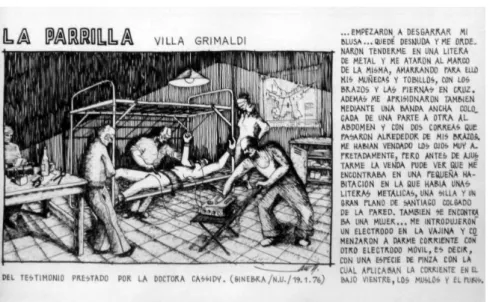
[In the interrogation room] the detainee is insulted and hit; if he/she does not respond is undressed and placed on the grill, tied and gagged. It is frequent that a radio is played up loud to suffocate the screams of the victim. The use of physical and psychological torture, can last for several days; this depends on the attitude assumed by the detainee and the urgency with which the agents require the wanted information (ROJAS, 1988, p. 50-51).
FIGURE2 –
T
HEG
RILLDrawn by prisoner Miguel Lawner (1976). Source: Lawner, 2003. The original drawing is part of a collection on exhibition at the Museo de la Memoria y los
Derechos Humanos (reference code: CL MMDH 00000014-000005-000053).
also to the serious after-effects of such acts (ROJAS, H., 2012, p. 343-405). Do not think that only the women were object of sexual humiliations in Villa Grimaldi because, men also had to suffer sexual taunts. For example, Ángela Jeria General Alberto Bachelet’s widow, who died in prison in 1974 and, mother of Michelle Bachelet, Pres-ident of Chile (2006-2010 and 2014-) and former Executive Director of the United Nations Entity for Gender Equality and the Empowerment of Women (UN Women, 2010-2013) has mentioned the following aberration that she observed through the cell where she was kept:
They took a group of young men in very bad conditions there, some of them wounded. They forced them to put their pants down and, to align in front of others. To those that were behind, they ordered them to put a finger in the anus of the person in front while masturbated. All this among the laughter and gibes of those who watched over them (GUZMÁN; ROJAS, 2005, p. 129; VILLAGRÁN, 2002, p. 101-102).19
The interrogations had the purpose of obtaining information about the leaders of the parties of Unidad Popular and MIR. For example, agents asked for names, meet-ing places, hidmeet-ing places, contacts, collaborators, networks, etc. The declarations of the detainees were used as records to pursue and arrest other people and so, to ruin any possible resistance against Pinochet’s military government. For example, Manuel Donoso lost consciousness as result of the electricity in his body. On the following day, agents took him out again for further interrogation and, they asked for names of members of the PC and their meeting places. As he did not provide any information, they hit him with fists, kicks and gun butts all over his body; they put him against a wall and made the machine guns sound (DONOSO, 2008, p. 165). There is no doubt that mock shootings are a psychological torture technique because, “right after it, one did not know if he was dead or alive” (HERMOSILLA, 2008, p. 272). In spite of the fear produced by mock shootings, there were other worse tortures. For exam-ple, agents brought other people into the camp including family members and friends and placed them on other grill and torture them, so they could listen the screams and because of that obtain the sought information. The collection of sur-vivors’ testimonies One Hundred Voices Break the Silence(2008, in Spanish) includes the heartbreaking stories of Hernán Villegas and his 15 year-old son. As the minor could not bear the pain of the tortures any longer, he begged his father to tell the agents what they wanted. In those stories written 30 years after the arrests, it is possible to see the horror of that time and the long-terms effects in their lives.
told me: ‘Daddy, daddy, tell them what you know so they won’t kill me…Daddy, daddy, save me, don’t let them kill me.’ He was 14 years old… In that time he was studying but, he could not go on with his studies because they screwed him (VILLEGAS, H., 2008, p. 577).
Son– They tortured me a lot: electricity, burns, blows in my whole body but, mainly in my testicles and head…I begged my dad to answer everything they asked so that they didn’t make me suffer anymore (VILLEGAS, J., 2008, p. 575).
It is appropriate to mention that during the interrogations not only agents of DINA participated but, rather in occasions there were also medical doctors that col-laborated in the tasks of reviving those who were tortured or to indicate the moment in which the interrogators should stop otherwise, the prisoner would die. Once the tortures finished, the detainees were taken to small cells where they had to remain the rest of the time. For example, the denominated Casas Chile(Chile Houses) were a 0.7 square meters wooden box of 2 meters of height, with a very small opening at the bottom of the door for air (LEYTON, 2008, p. 301). Some years ago, a sur-vivor explained to me that to rest in a place like that you had to learn how to sleep standing up and leaning on the walls of the box. Héctor González, who was detained in Villa Grimaldi for six months, has explained that the reason of placing the prisoners in Casas Chilewas to isolate and torture them in totally closed cells: “It was exasperating to be inside there, without light, with very little air and very hot, standing up or sat down on the floor with the legs bent because, it was not possible to stretch them...how many days and nights we spent there because, it was the place where you lost the notion of time more quickly” (LEYTON, 2008, p. 300).
as both knew they were in the same detention center but could not see each other, she sang to him loud not only to encourage only him but also all the other prisoners.
Claudio resisted and survived the torture sessions thanks to the solidarity of the rest of the detainees and, to Gabriela’s chant, his partner, who was also detained in some place of the enclosure. She, with her melodious voice offered us songs that the wind took charge of diffusing. Her singing was listened all over the camp, it went through the walls of the cells and, silenced the threats of the torturers… until arriving to the lover’s ears that received the message and, saw his energy to resist multiply (MOYA, 2008, p. 358-359).
FIGURE3 –
C
ELL FOR PRISONERS ATV
ILLAG
RIMALDIPhoto: Fernando Rojas Corral © 2015 (printed with permission).
the tower, there was also a small room specially equipped to interrogate and torture the prisoners. It is known that very few were able to survive the tower. In fact, those who were sent to that place were usually because DINA had decided to end their lives. The prisoners that were in the tower remember that they listened how during the summer nights, men and women that worked as agents of DINA in that place, dove and enjoyed the pool. The contrast could not be more shuddering: on the one hand, agents that made parties in a pool located beside the cells of the prisoners whose deaths had already been resolved; while on the other hand, prisoners had to listen to the laughs and drunken agents’ orgies in a pool that had been used for tor-turing prisoners with the ‘submarine’ technique during the day.20
FIGURE4 –
T
HET
OWER ATV
ILLAG
RIMALDIPhoto: Fernando Rojas Corral © 2015 (printed with permission).
forced to sign documents in which they declared being well treated by the police (HER-MOSILLA, 2008, p. 272). And then, they were taken to Cuatro Álamos or Tres Álam-os concentration camps and detention centers. In thÁlam-ose enclÁlam-osures they would remain for several months, until DINA took a final decision or changed its mind. In Tres Álam-os the conditions were better than in Cuatro ÁlamÁlam-os; the detainees could be visited shortly by their relatives and were able to receive food and clothes. The information mentioned above, has been confirmed by many survivors who have said that Tres Álam-os allowed victims to recover while, in Cuatro ÁlamÁlam-os “the detainees were in wait and they could be sent to Villa Grimaldi” (VIDAL, 2008, p. 567-568).
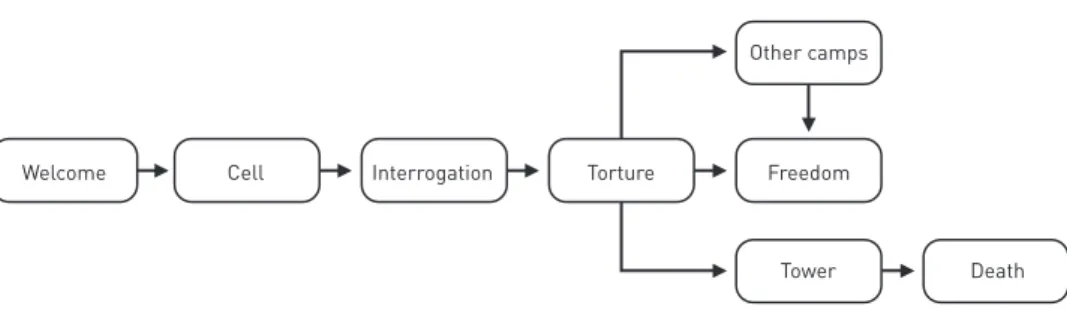
As it can be seen, the proceedings used by DINA agents in Villa Grimaldi were sim-ilar to any assembly line (TAYLOR, 1967 [1911])21: (1) the person was arrested and
kidnapped; (2) when entering the place, the person became a prisoner and agents gave him a ‘welcome’ reception; (3) then the interrogations and tortures began; (4) the pris-oner was located in small cells so, he/she could not rest and recover; (5) if agents con-sidered it necessary, the prisoner was subjected to interrogations, humiliations and tortures again and again; (6) finally, the decision regarding the prisoner’s life was taken by differing among those who were taken to the tower or other detention centers. Just as José Moya has explained it; to be detained in Villa Grimaldi was like “to be sat in a lobby waiting for your turn to meet with death… Both, detainees and death, we were caught by a group of wicked armed ones that day and night inside these haunts delight-ed with the physical pain they inflictdelight-ed to men and women” (MOYA, 2008, p. 355). In substance, individuals were reified, they were not longer considered as people and, they simply became a number and an object to hit and torture with total freedom and impunity. The life conditions were inhuman, food was precarious, detention places were boxes in which not even animals deserve to be in, prisoners were isolated and blindfold-ed the whole time, suffering tortures and listening how other prisoners were torturblindfold-ed. In sum, the power of the state on the prisoners’ bodies was absolute. To be in Villa Grimaldi was probably one of the nearest experiences to spend a season in hell.
In that context of abuse and total control by the state, we have to add the nonex-istence of appropriate legal mechanisms to defend the prisoners. Those who were arrested by DINA and taken to Villa Grimaldi were no longer subjects of law. The state and the secret police penetrated in the biological life of the detainees with impunity. The clandestine detention camp is the ultimate expression and paroxysm of biopolitics and disciplinary mechanisms. Just as the figure of the homo sacerin the Archaic Roman law, these people were outside the law and the act of killing them was not considered a crime. DINA agents did not have to respond before anybody for the death of a prisoner in Villa Grimaldi. Everything that happened in that place was a secret and denied by DINA and, in case of internal questionings, the ‘national security’ and ‘internal war’ arguments prevailed. Detained people were not entitled to anything; they could not make a phone call or communicate with their relatives, much less receive visits or hire the services of a lawyer. When their relatives looked for them and formulated habeas corpusor other legal petitions, the judges of the Court of Appeals of Santiago, as well as the vast majority of the judiciary, only conformed transmitting the answers they received from the Ministry of Interior: the individuals have not been arrested nor they are in the lists of prisoners. For example, between September 1973 and September 1983 the Committee of Cooperation for the Peace and the Vicarage of Solidarity gave assistance on the preparation or presentation of 5,400 habeas corpusbefore the Court of Appeals of Santiago, which together accept-ed ten habeas corpusand only in four cases the freedom of the prisoner was achieved (ROJAS, 1988, p. 11). In consequence, the executive branch and the judiciary did not do anything to impede the violations of human rights made by the agents of DINA or other state officials.
Once the prisoner was released and the fear of being kidnapped or tortured once again vanishede.g. exiles abroad, end of the dictatorship in 1990, etc. he/she is no longer a homo sacerand (supposedly) recovers the condition of subject of law. The expe-rience of being tortured in camps like Villa Grimaldi makes it impossible to assume that the victim will be the same as before the arrest: it is now a victim, a survivor, and a witness. The recovery of fundamental rights does not mean that the survivors’ nightmare has ended. In many cases the pain continues for diverse reasons, such as: lack of understanding and empathy of the rest of the society; having to leave the coun-try and start a new life abroad; prejudices, stigmatization, and discrimination; seri-ous physical and psychological after-effects; destruction of dreams, ideals, and life’s projects; insufficient state reparation to compensate the damage; loss of relatives and friends; impunity of perpetrators, etc. (ROJAS, H., 2012, p. 353-405).
of homo sacerloses its significance and opportunity once the prisoner is released and recovers the condition of subject of law. Maybe a way to talk about the survivor that leaves the camp, returns to the polis and, faces some of the difficulties previously mentioned, could be the expression superstes tormentorum(torture survivor). In other words, I believe a different concept to homo saceris needed in order to allude to the person that has been detained and tortured in clandestine centers, without judicial guarantees, during a de factoregime or state of constitutional exception and, that later is liberated and then has to deal with a set of unexpected problems that affect his/her life and development as person, amplifying or prolonging the pain.
C
ONCLUSIONSThis article has shown how during the dictatorship of General Pinochet in Chile non-human disciplinary and control devices were applied in concentration camps like Villa Grimaldi. These techniques became more ‘efficient’ after DINA agents learned and accumulated experience in the commission of acts of torture against political prison-ers. Villa Grimaldi should not only be seen as a matter of control and ‘normalization’ of nearly 5,000 individuals in a ‘disciplinary’ society under the rule of the armed forces. In addition, the Chilean state used the camps to seek information through extreme repressive measures, threatened the population and prevented any opposition of the members of the left-wing parties to the exercise of the armed forces’ political and military powers. Pinochet’s dictatorship killed and tortured people with ideological purposes, for this he invoked not only his sovereign power to kill his opponents but also his regulatory power over the life of the population. Consequently, Villa Grimal-di can be interpreted as an example of modern techniques of inGrimal-dividual control and Grimal- dis-cipline and of an abusive exercise of state’s biopolitics, as Foucault has warned us in his mature writings. One critic presented in this occasion to Foucault’s theory of power has to do with the emphasis he makes in race and racism as the ultimate foundation of biopolitics. The revision of the Chilean experience allows me to conclude that it is not possible to ignore or exclude political ideologies as an important variable in the exercise of biopower in modern societies.
conditions of life in the camps and the horror of systematic torture sessions exceed the imaginable. In Villa Grimaldi, prisoners were put in an assembly line that start-ed with the welcoming reception (ritual of passage) and in occasions endstart-ed with death, passing by the grill, hangings, threats, submarine, rapes, the tower, and other control devices. In that sense, the expression homo sacerappropriated by Agamben from the archaic Roman law is a useful figure to understand the complex legal condition of the prisoners tortured in the camps. For the agents of DINA the death of a prison-er was irrelevant and did not imply the commission of a homicide. Nevprison-ertheless, it has been explained that the notion of homo sacer does not make sense to allude to the situation of the ‘victim-survivor-witness’ after the act of liberation. Who survives the nightmare of the camp has to face several difficulties and, it is not reasonable to pre-tend that the human condition and life of the survivor will be the same as it was before the arrest. I argued that is preferable to use another expression that better reflects the life conditions of the victim-survivor-witness that comes back to the polis and restarts a new life. The notion presented here for further discussion is superstes tor-mentorum(torture survivor), which might contribute to the understanding about the complexities in the life of a homo sacerthat recovers freedom and faces unpredicted and even more painful circumstances than torture because the trauma does not end with the mere act of release.
NOTES
* I would like to thank the contributions made by Simón Escoffier, María Angélica Garrido, Alejandro Gómez,
Milena Grass, Evelyn Hevia, Yanina Hinrichsen, Ronald Jennings, Elizabeth Lira, Pedro Matta, Tim Murphy, María Antonieta Nestor, Leigh Payne, Mariana Penna, and Robert Wardrop. All errors are mine.
Agamben (1998 [1995]; 2010 [1996]; 2010 [1999]; 2010 [2003]). All translations are mine.
1
Foucault (1987 [1975]; 1978 [1976]; 2003 [1997]; 2010 [2004]). All translations are mine.
2
For more information, see <http://www.villagrimaldi.cl>.
3
For more information, see <http://www.museodelamemoria.cl>.
4
For more information, see <http://www.vicariadelasolidaridad.cl>.
5
For more information, see <http://www.comisionvalech.gov.cl>. The Valech Report IIwas presented to
6
For example, see Buchenwald and Mittelbau-Dora Memorials Foundation, The Engineers of the “Final
7
Solution”. Topf & Sons – Builders of the Auschwitz Ovens(Weimer: 2005).
Modern constitutionalism has accepted the inclusion of state of exception’s norms in constitutions. For
8
example, Hitler invoked Article 48, 2, of the Weimar Constitution to rule between 1933 and 1945. See Kennedy (2004).
As Pompeius Festus explains, “The sacred man is the one whom the people have judges on account of a crime. It
9
is not permitted to sacrifice this man, yet he who kills him will not be condemned for homicide; in the first tribunitian law, in fact, it is noted that “if someone kills the one who is sacred according to the plebiscite, it will not be considered homicide.” This is why it is customary for a bad or impure man to be called sacred” (quoted by G. AGAMBEN, 1998 [1995], p. 71).
As Katia Genel points out, “The life of Homo sacer, an obscure figure of archaic Roman law which can be
10
killed without committing homicide but which cannot be sacrificed in any ritual form, is a life destined to die with complete impunity” (GENEL, 2006, p. 51).
According to Agamben, “The Foucaldian thesis will … have to be corrected or, at least, completed, in the
11
sense that what characterizes modern politics is not so much the inclusion of zoēin the polis—which is, in itself,
absolutely ancient—nor simply the fact that life as such becomes a principal object of the protections and calculations of State power” (AGAMBEN, 1998 [1995], p. 9).
Decree Law n. 521, 14 June de 1974, was partially published in the official gazette and some of its norms
12
were only known by a limited number of persons.
Hinchey Report, ‘Relationship with Contreras,’ available at <http://foia.state.gov/reports/
13
hincheyreport.asp>.
For example, in 1974 former Commander in Chief of the Army Carlos Prats and his wife were killed in
14
Buenos Aires. In 1975, former Vice President Bernardo Leighton and his wife were seriously injured. In 1976, former Minister Orlando Letelier and his secretary were killed in Washington, D.C.
Decree Law n. 1.878, August 13th, 1977.
15
“Except for a short period as a restaurant, Villa Grimaldi was a place of imitation, where the elite displayed
16
its economic difference and indifference to Chile’s popular classes through a grandeur and opulence it could not sustain.” (GÓMEZ-BARRIS, 2009, p. 44-5)
Information based in Corporación Parque por la Paz Villa Grimaldi, Exposición Villa Grimaldi. Presente, pasado y futuro
17
(Santiago: privately printed, s.d.); Corporación Parque por la Paz Villa Grimaldi Website, <http://www.villagrimaldi.cl>; N. Fuentes et al. (s.d.), 9’20’’, available at <http://www.youtube.com/watch?v=xaBgoBAmCbU>; M. Gómez-Barris2009, p. 44-5; P. Matta (2000); S. Milla et al., (2007), 10’27’’, available at <http://www.youtube.com/watch?v=vE8Ve8-xPwc>; M.E. Rojas (1988), p. 50-4; H. Vásquez (coord.), (2010, p. 47-8), available at <http://www.londres38.cl/1937/articles-90933_recurso_1.pdf>; Resolution n. 3.575, Corporación de Mejoramiento Urbano; 1974; Decree n. 264, Ministery of Education, 27 April 2004; Rettig Report(1) 55 and (2) 720; Ministerio de la Vivienda y Urbanismo, Memoria de la ciudad (2009, p. 44).
P. Matta, ‘Ante el suicidio de mi torturador’, Revista Puro Chile, 30 January 2005, available at
18
<http://www.paxsocial.com.ar/ante%20el%20suicidio.htm>.
In 2000, Mrs. Jeria recognized in the news the voice of the person that tortured her in Villa Grimaldi and,
19
later noticed that the perpetrator was one of her neighbors.
The wet submarine consists in introducing the head of the prisoner in a container with liquid, causing
20
temporal asphyxia.
I owe this comment to Pedro Matta. For a more detailed description of the torture process in Villa
21
REFERENCES
Books, articles and documents
AGAMBEN, G. Homo Sacer. Sovereign Power and Bare Life. Stanford: Stanford University Press, 1998 [1995]. ________. Medios sin fin. Notas sobre la política. Valencia: Pre-Textos, 2010 [1996].
________. Means Without End: Notes on Politics. Minneapolis: University of Minnesota Press, 2000. ________. Lo que queda de Auschwitz. El archivo y el testigo. Homo Sacer III. Valencia: Pre-Textos, 2010 [1999]. ________. Estado de Excepción. Homo Sacer II, 1. Valencia: Pre-Textos, 2010 [2003].
BECKER, N. Una mujer en Villa Grimaldi. Santiago, Pehuén, 2011. BENTHAM, J. The Panopticon Writings. London: Verso, 1995 [1791].
CASTRO, E. Giorgio Agamben. Una arqueología de la potencia. Buenos Aires: UNSAM EDITA, 2008), esp. Ch. 2 ‘Soberanía y Excepción’, p. 49-85.
COMISIÓN NACIONAL DE VERDAD Y RECONCILIACIÓN, Informe Final. Rettig Report). Santiago: Gobierno de Chile, 1991.
CORPORACIÓN Parque por la Paz Villa Grimaldi, Exposición Villa Grimaldi. Presente, pasado y futuro. Santiago: privately printed, s.d.), available at <http://www.villagrimaldi.cl/images/stories/docs/ed_revista_villa_ grimaldi.pdf?ml=4&mlt=villa_grimaldi&tmpl=>.
DONOSO, M. Un testigo de la historia represiva de Chile. In: KUNTSMAN, W.; TORRES, W. & V. (eds.). Cien voces rompen el silencio. Testimonios de ex presos políticos de la dictadura militar en Chile (1973-1990).Santiago: Ediciones de la Dirección de Bibliotecas, Archivos y Museos, 2008, p. 163-167.
DURÁN, F. Lo que no se debe olvidar. In: KUNTSMAN, W.; TORRES, W. & V. (eds.). Cien voces rompen el silencio. Testimonios de ex presos políticos de la dictadura militar en Chile (1973-1990).Santiago: Ediciones de la Dirección de Bibliotecas, Archivos y Museos, 2008, p. 171-173.
DURANTAYE, L. de la. Giorgio Agamben. A Critical Introduction. Stanford, CA: Stanford University Press, 2009. ENSALACO, M. Chile bajo Pinochet. La recuperación de la verdad. Madrid: Alianza Editorial, 2002.
FOUCAULT, M. Vigilar y castigar. Nacimiento de la prisión. México D.F.: Siglo XXI, 1987 [1975]. ________. Historia de la sexualidad. México, DF: Siglo XXI, 1978 [1976]. Vol. 1, La Voluntad de Saber. ________. Society must be defended. Lectures at the Collège de France 1975-1976. London: Penguin, 2003 [1997]. ________. Nacimiento de la Biopolítica. Curso en el Collège de France 1978-1979. Buenos Aires: Fondo de Cultura Económica, 2010 [2004].
FUENZALIDA, N. Cuartel Terranova. Análisis de la configuración espacial en relación a las estrategias de represión y control de detenidos y torturados. La zaranda de ideas, v. 7, n.1, Jan./June 2011.
GENEL, K. The Question of Biopower: Foucault and Agamben. Rethinking Marxism: A Journal of Economics, Culture & Society, 18(1), 2006, p. 43-62.
GÓMEZ-BARRIS, M. Where Memory Dwells. Culture and State Violence in Chile. Berkeley: University of California Press, 2009.
GUZMÁN R.; ROJAS, G. Bachelet. La Hija del Tigre. Santiago: RIL Editores, 2005.
HEFFES, O. D. Foucault y Agamben o las diferentes formas de poner en juego la vida. Revista Aulas, 3. Dec. 2006 - Mar. 2007, p. 1-22.
HERMOSILLA, M. Mujer y tortura. In: KUNTSMAN, W.; TORRES, W. & V. (eds.). Cien voces rompen el silencio. Testimonios de ex presos políticos de la dictadura militar en Chile (1973-1990).Santiago: Ediciones de la Dirección de Bibliotecas, Archivos y Museos, 2008, p. 269-272.
HINCHEY REPORT, Relationship with Contreras. Available at <http://foia.state.gov/reports/hincheyreport.asp>. KENNEDY, E. Constitutional failure. Carl Schmitt in Weimar. Durham, NC: Duke University Press, 2004. LAWNER, M. Isla Dawson, Ritoque, Tres Álamos…: La vida a pesar de todo. Santiago: Lom Ediciones, 2003. LEYTON, L. Yo también estuve en la Villa Grimaldi. In: KUNTSMAN, W.; TORRES, W. & V. (eds.). Cien voces rompen el silencio. Testimonios de ex presos políticos de la dictadura militar en Chile (1973-1990).Santiago: Ediciones de la Dirección de Bibliotecas, Archivos y Museos, 2008, p. 299-302.
MATTA, P. Villa Grimaldi, Santiago de Chile. A Visitor’s Guide. Santiago: privately printed, 2000. ________. Ante el suicidio de mi torturador. Revista Puro Chile, 30 January 2005. Available at <http://www.paxsocial.com.ar/ante%20el%20suicidio.htm>.
MINISTERIO DE VIVIENDA Y URBANISMO, Memoria de la ciudad. Santiago: Gobierno de Chile, 2009. MOYA, J. Con la venda sobre los ojos. In: KUNTSMAN, W.; TORRES, W. & V. (eds.). Cien voces rompen el silencio. Testimonios de ex presos políticos de la dictadura militar en Chile (1973-1990).Santiago: Ediciones de la Dirección de Bibliotecas, Archivos y Museos, 2008, p. 353-361.
International Law Journal, v. 42, n. 2, Spring 2012, p. 353-405.
ROJAS, M. E. La represión política en Chile. Los hechos. Madrid: IEPALA, 1988.
SALAZAR, G. Villa Grimaldi. Cuartel Terranova. Historia, testimonio reflexión. Santiago: Lom, 2013.
SCHMITT, C. Political Theory. Four Chapters on the Concept of Sovereignty. Cambridge MA: The MIT Press. 1965 [1922]. TOLEDO et al., M.I. Visita a un lugar de memoria. Guía para el trabajo en derechos humanos. Santiago: Lom Ediciones, 2009.
VÁSQUEZ, F. De la microfísica del poder a la gubernamentalidad neoliberal. Nota sobre la actualidad filosófica-política de Michel Foucault. Contrahistorias. La otra mirada de Clío, 12. May - Aug. 2009, p. 71-92. VÁSQUEZ H. (ed.). Una luz sobre la sombra. Detenidos desaparecidos y asesinados de la Pontificia Universidad Católica de Chile. Santiago: 2010. Available at <http://www.londres38.cl/1937/articles-90933_recurso_1.pdf>. VIDAL, H. Todavía me siento joven y con ganas de trabajar por una sociedad mejor. In: KUNTSMAN, W.; TORRES, W. & V. (eds.). Cien voces rompen el silencio. Testimonios de ex presos políticos de la dictadura militar en Chile (1973-1990).Santiago: Ediciones de la Dirección de Bibliotecas, Archivos y Museos, 2008, p. 565-571. VILLAGRÁN, F. Disparen a la bandada. Una crónica secreta de la FACH. Santiago: Planeta 2002.
VILLEGAS, H. Aún no sé dónde estaban las armas. In: KUNTSMAN, W.; TORRES, W. & V. (eds.). Cien voces rompen el silencio. Testimonios de ex presos políticos de la dictadura militar en Chile (1973-1990).Santiago: Ediciones de la Dirección de Bibliotecas, Archivos y Museos, 2008, p. 577-578.
VILLEGAS, J. Nunca supe por qué me torturaron. In: KUNTSMAN, W.; TORRES, W. & V. (eds.). Cien voces rompen el silencio. Testimonios de ex presos políticos de la dictadura militar en Chile (1973-1990).Santiago: Ediciones de la Dirección de Bibliotecas, Archivos y Museos, 2008, p. 575-576.
Audiovisual and oral archives
FUENTES N. et al. Historia de la Ex Villa Grimaldi. Santiago: Universidad Metropolitana de Ciencias de la Educación, s.d.), 9’20’’. Available at <http://www.youtube.com/watch?v=xaBgoBAmCbU>.
MATTA, P. Remembrance and Hope. Conference at Missouri State University, 2008). Available at <http://www.youtube.com/watch?v=e_5fgBpd4lg>.
MILLA S. et al. ‘Villa Grimaldi, Espacio de Memorias’. Santiago: Universidad de Santiago & Cosmovisión Producciones, 2007), 10’27’’. Available at <http://www.youtube.com/watch?v=vE8Ve8-xPwc>. PARQUE POR LA PAZ VILLA GRIMALDI, Archivo Oral. Santiago: 2011.
Websites
Centro de Derechos Humanos – Universidad de Chile, <http://www.cdh.uchile.cl>. Corporación Parque por la Paz Villa Grimaldi, <http://www.villagrimaldi.cl>.
Comisión Nacional sobre Tortura y Prisión Política (Valech Commission), <http://www.comisionvalech.gov.cl>. Fundación Centro de Documentación y Archivo Vicaría de la Solidaridad, <http://vicariadelasolidaridad.cl>. Memoria Viva, <http://www.memoriaviva.com>.
Museo de la Memoria y los Derechos Humanos, <http://www.museodelamemoria.cl>.
Santiago – Chile
Hugo Rojas Corral PROFESSOR OFSOCIOLOGY OFLAW(ALBERTO