ABSTRACT: Retaining the mineral N in the form of NH4+ in the soil for a lengthy period is desir-able for reducing losses. Furthermore, there is evidence that sugarcane prefers NH4+-N in place of NO3−-N. This study aimed firstly, to evaluate the potential of root extracts of Bracchiaria humidicola and Saccharum spontaneum, in contrast with the DCD (Dicyandiamide) inhibitor, to increase absorption of N by plants fertilized with ammonium sulfate, and secondly, to quantify the emission of N2O fluxes with the use of this inhibitor. The experiment was developed in a glasshouse in an entirely randomized design where four treatments were applied: AS) ammonium sulfate (control); AS+DCD) ammonium sulfate associated with dicyandiamide; AS+BCH) ammo-nium sulfate associated with root extracts of Brachiaria humidicola; and AS+SCS) ammonium sulfate associated with root extracts of Saccharum spontaneum. Differences were observed in biomass production in plants 45 and 60 days after fertilization (DAF) and 15 and 60 days in bio-mass accumulation of roots. The application of AS associated with DCD synthetic inhibitor kept NO3−-N values low throughout the evaluation period, while in other treatments the concentration increased right up to the second evaluation 15 DAF. Sugarcane plants did not benefit from the increased presence of ammoniacal N promoted by DCD. The use of DCD reduced the average flux of N2O during the evaluation period compared to plants receiving AS treatments only, which was not observed when root extracts of B. humidicola and S. spontaneum were used. Keywords: ammonium, nitrate, dicyandiamide, nitrification, nitrous oxide
1Brazilian Bioethanol Science and Technology Laboratory − National Centre for Research in Energy and Materials, R. Giuseppe Máximo Scolfaro, 10000 − 13083-970 − Campinas, SP − Brazil.
2Agronomic Institute of Campinas − Soil and Environmental Resources Center, C.P. 28 − 13020-902 − Campinas, SP − Brazil.
3University of São Paulo/ESALQ − Dept. of Soil Science, C.P. 09 − 13418-900 − Piracicaba, SP − Brazil.
4Center for Nuclear Energy in Agriculture − Dept. of Stable Isotopes, C.P. 09 − 13416-000 − Piracicaba, SP – Brazil. *Corresponding author <[email protected]>
Edited by: Francesco Montemurro
Root extracts of
Bracchiaria humidicola
and
Saccharum spontaneum
to increase N
Oriel Tiago Kölln1*, Henrique Coutinho Junqueira Franco1, Danilo Alves Ferreira1, Vitor Paulo Vargas2, Saulo Augusto de Quassi
Castro3, Heitor Cantarella2, Camila Caldana1, Paulo Cesar Ocheuze Trivelin4
Received March 04, 2015 Accepted June 24, 2015
Introduction
One of the most controversial issues in sugarcane crop management is nitrogen fertilization. Regardless of the dose of N-fertilizer used on this crop, the uptake efficiency of the plant in N provided by fertilizers is almost always lower than 50 % (Cantarella, 2007). For this reason, countless studies have focused on finding strategies to improve the efficiency of fertilizers that will yield a higher economic payback and reduce en-vironmental impact. The losses of N in the sugarcane fields occur through volatilization of NH3, leaching of nitric forms, and denitrification of the N-fertilizer to N2 or N2O (Cantarella, 2007). When added to the soil, under aerobic conditions, NH4+ from
ammonia-cal fertilizers can be rapidly nitrified (production of NO3−), N
2O is also a by-product of nitrification. NO3
− from nitrification, or from nitrate fertilizers, is subject to leaching losses by water drainage, or denitrification under conditions of low oxygen supply (Pierzynski et al., 2000). In view of this, it is desirable to have N in the ammoniacal form, which may be adsorbed by soil negative charges. One of the strategies used to retain N as NH4+ after its application is the use of nitrification
inhibitors. Dicyandiamide (DCD), which has bacterio-static action and inhibits the first stage of nitrification, has been the product most often used for this purpose (Zaman et al., 2009). On the other hand, there is evi-dence that inhibition on nitrification occurs naturally
use by sugarcane
in agricultural or uncultivated soils, since some plants produce compounds that have inhibitory action of ni-trification, of which Brachiaria is one of the most com-mon species (Subbarao et al., 2007). Countless studies have related cultivation or occurrence of Brachiaria sp. to the predominance of N in ammoniacal form (Carmo et al., 2005; Moro et al., 2013; Fernandes et al., 2011) It is possible that the direct ancestor of cultivated sug-arcane, such as Saccharum spontaneum, has a similar mechanism, since sugarcane seems to prefer to absorb N as NH4+ instead of NO
3
− (Robinson et al., 2011). Con-firmation of this information would be valuable to the genetic improvement of sugarcane, and may contribute to the understanding of the limited response of sugar-cane to the application of N on certain occasions.
This study aimed to evaluate the potential of root extracts of Bracchiaria humidicola and Saccharum
spon-taneum, in contrast with DCD to increase the
absorp-tion of N by plants fertilized with ammonium sulfate and to quantify the emission of N2O fluxes with the use of this inhibitor.
Materials and Methods
Characterization and experimental design
experimental design was entirely randomized with four treatments and four replications. For the destructive evaluation, five sets of pots were installed for the five pe-riods of evaluation. The treatments were: AS ammonium sulfate (300 mg kg−1 of N) (control); AS+DCD)
ammoni-um sulfate + dicyandiamide (5 % of N dose); AS+BCH) ammonium sulfate + root extract of Brachiaria humidi-cola; AS+SCS) ammonium sulfate + root extract of
Sac-charum spontaneum. The amount of root extracts was 100
mL per pot. The N was applied exclusively as NH4+.
Each experimental unit consisted of one pot (6 L) without holes in the base, filled with 5.5 kg of air-dried soil sifted using a 2-mm mesh sieve removed from Psam-ments (Soil Survey Staff, 2010). The soil was removed from the surface layer (0-20 cm), an area cultivated with sugarcane for over 30 years using a system of prior burn-ing of the crop, but havburn-ing adopted mechanized harvest with preservation of residues on the soil over the past eight years. The physic and chemical characteristic of the soil are shown on Table 1.
Soil pH correction and the increase of calcium and magnesium contents were effected by the application of dolomitic lime (PRNT 90 %) to reach 70 % of base saturation of the cation exchange capacity (CEC), as de-scribed by Raij et al. (2001). After liming, the soil was incubated for 16 days, with moisture adjusted to 70 % of the maximum capacity of water retention.
The seedlings of the RB915156 variety of sug-arcane (mini sets with a 25-mm-long bud) were tak-en from ripe stalks of plants cultivated in a nursery. The extracted buds were germinated and cultivated for three weeks in inert vermiculite deprived of nu-trients. The plants were transferred to a plastic pot with supplementation of phosphorus (50 mg kg−1 of
soil), together with 67 % of the recommended dose of potassium (118 mg K kg−1) and 50 % of the need
of micronutrients (3 mg Zn kg−1; 1 mg B kg−1; 0.5 mg
Cu kg−1; 5 mg Fe kg−1; and 4 mg Mn kg−1), the
treat-ments were applied 20 days after transposition of the stocks. The remaining doses of potassium and micro-nutrients were applied 40 days after transplantation of the young plants.
Root extracts were obtained according to the methodology described by Gopalakrishnan et al., (2009), in which 400 grams of fresh roots of Brachiaria
humidicola or Sacharrum spontaneum were washed in
running water, set in a container, slightly macerated using a spatula and placed in 2 L of distilled water for 36 h under 20 ºC to transfer the extracts to the solu-tion. Polar metabolites were extracted from 100 µL of
root extracts of Brachiaria humidicola and Sacharrum
spontaneum, using the methodology described by
Gia-valisco et al., (2011). After extraction, the samples were derivatized (Lisec et al., 2006) and analyzed using a GC-MS equipment. The parameters for acquisition of chromatograms were identical to those described by Weckwerth et al., (2004). Chromatograms were export-ed from the ChromaTOF software (version 3.25) to the R 2.12.2 software. Detection of peaks, alignment of re-tention times, and searches in libraries were done using the TargetSearch package of the Bioconductor (Cuad-ros-Inostroza et al., 2009). Metabolites were quantified by peak intensity of a selected mass, which was later, using an internal pattern (sorbitol C13), transformed by base-2 logarithm. Forty-five polar metabolites were found in the extracts of B. humidicola and S. spontane-um,but in concentrations very similar in both extracts (Table 2). After this period, the solution was filtered through analytical filter paper and kept chilled (2.5 ºC) up to the time of application. The plants of B. humidi-cola were obtained from an area where this species has grown for over 25 years, located in the municipality of Bebedouro-SP. The roots of S. spontaneum were col-lected at the breeding station in Camamu-BA.
Evaluations
Five evaluations were made to measure the avail-ability of inorganic NO3−-N and NH
4
+-N in the soil 7, 15,
30, 45, and 60 days after fertilization (DAF). The sam-ples, once collected, were stored forthwith in a freezer to reduce microbiological activity, in order to prevent changes in the contents of NH4+-N and NO
3
−
-N in the soil.
For extraction of the inorganic forms of N, a sam-ple of five grams of moist soil and 25 mL of solution of KCl 2 mol L−1 were shaken in an orbital shaker for one
hour, then filtered through a blue ribbon analytical filter paper. Later, the inorganic N was determined via flow injection analysis (FIA).
The NH4+-Nwas analyzed in alkaline medium
passing through a hydrophobic membrane (PTFE), with the flow directed to a conductivity cell (Reis et al., 1997). The forms of nitric N (NO3−-N+NO
2
−-N) were simultane-ously determined by spectrophotometric method, with the reduction of nitrate to nitrite by a copperized cad-mium column, followed by reaction of nitrate with sulfa-nilamide in an acidic medium forming an azo compound (Giné et al., 1980). The results of N mineral were cor-rected and expressed in a mass of oven-dried soil, after drying of subsamples at 105 ºC.
Table 1 − Chemical and physical characteristics of the soil used in experiment.
Depth pH T.O.C. Al NO3--N NH
4+-N P S K Ca Mg CEC V Sand Silt Clay
cm g dm−3 --- mg dm−3 --- --- mmol
c dm−3 --- % --- g kg−1
---0 - 2---0 5.2* 8 <1 8.96 0.0 14 4 0.5 7 3 23.2 45 952** 23 25
In each evaluation, the following characteristics were also determined: plant height (H), measured from the base of the stalk up to the insertion of the +1 leaf;
plant diameter (DIA), measured at the medium third of
the plants; and dry biomass of plants and roots, includ-ing concentration of N in these two parts of the plant after processing. For this, the samples of the plant and roots were dried in a forced-air ventilation oven at 65 ºC, with subsamples submitted to sulfuric digestion for the determination of total N using the Kjeldahl method (Nelson and Sommers, 1973).
N2O emission was evaluated during the entire ex-perimental period. For this we developed sampling cham-bers that were positioned inside each pot of the last group of pots to be dismounted 60 days after the application of the treatments. The structure of the chambers was in two parts: a PVC base with 5-cm in diameter and 15-cm high, and a lid made with 5-cm-diameter PVC caps. The lid was perforated and a butyl rubber plug (22.5 mm) was perfectly adjusted to prevent any gas leak. The chambers had a minimum volume of approximately 0.2 dm³. The bases were fixed to the soil next to the sugarcane plant and remained open, except during sampling. Samples for analysis of N2O fluxes were taken daily during the first month of evaluation, and every other day during the sec-ond month. For this, the bases were closed by a perfectly adjusted lid, preventing any leak, and a sample of gas (20 mL) accumulated after 30 minutes was removed through the plug and stored in Exetainer flasks (12 mL). In order to
determine the concentration of N2O in the environment at the time of closing the chamber (t0),four samples of air from the glasshouse were taken, simultaneously with the plot samples. N2O concentration was analyzed by gas chromatography (Chromatograph Model GC 2014), with determination of N2O concentration by an electron cap-ture detector (ECD) operating at 325 °C. Further details of the gas chromatography system may be found in the work by Vargas et al. (2014).
The gas flux (µmol mol h−1) was calculated as a
linear increment/decrease in concentration inside each chamber during the collection of samples, as suggested by Livingston and Hutchinson, (1995). The fluxes were corrected according to the temperature and atmospheric pressure inside the glasshouse, using the following equa-tion (Jantalia et al., 2008):
f CC C t
V A
m V
t t
m
= 30− 10∗ ∗
∆
where: f is the flux of each gas; ∆ ∆
C
t is the variation of concentration of each gas inside the chambers during the time they remained closed (30 minutes); V and A are, respectively, the volume and the area of the chamber;
m is the molar mass of each gas, and Vm is the molar volume of N2O at the sampling temperature. The fluxes were expressed in µg N m−2 d−1. Estimates of the
cumu-lative emission of each gas were made via linear inter-polation between the daily fluxes of adjacent sampling dates, considering the interval between samplings. Table 2 − Polar metabolites identified in the extracts of B. humidicola (BCH) and S. spontaneum (SCS).
Met ID BCH extract SCS extract Met ID BCH extract SCS extract
Log 2 Log 2 Log 2 Log 2
2-Hydroxypyridine 14.51 14.85 Glutamate 10.36 11.19
Acetate 14.93 15.53 C5H10O5 [Ribulose|Xylulose] 9.89 7.59
Glycerol 15.93 16.60 (r|x) Putrescine 16.14 15.93
Isoleucine NA 12.72 (r|x) Dodecanoate 13.42 13.44
Glycine 12.99 13.91 Phenylalanine 9.15 10.70
Orthophosphate 15.12 14.07 Ribonate 10.62 10.05
Benzoate 13.60 14.20 4-Hydroxybenzoate 13.93 12.56
Succinate 11.36 10.84 Arabinono-1.4-lactone 10.28 7.74
(r|z) Riboflavin 17.50 15.90 2-Aminoadipat 10.69 NA
Phenylacetate 8.89 7.63 (r|x) 1.5-Diaminopentane 15.67 12.34
Nicotinate 11.37 9.18 Suberate 9.80 9.71
b-Alanine 12.17 10.46 Ornithine 11.03 11.68
Erythrose 11.66 8.99 Tridecanoate 9.96 10.01
C4H10O4 [Erythritol|Threitol] 12.10 10.74 Quinate 10.24 10.01
Citramalate 9.70 7.95 C6H12O6 [Mannose|Allose] 17.10 17.58
Decanoate 12.23 12.72 Citrate 14.53 9.41
Malate 10.93 9.73 Glucose NA 11.48
4-Aminobutanoate 13.97 10.64 Putrescine 10.94 9.84
Threonate 8.40 7.63 Tetradecanoate 14.97 15.55
Deoxyribose 11.00 10.06 myo-Inositol 16.03 9.25
Adipate 11.92 NA 4-Coumarate 11.56 11.53
1.3-Diaminopropane 13.33 11.14 Heptadecanoate 13.71 14.30
3-Hydroxybenzoate 9.98 11.12 Sucrose 12.54 12.35
At 7 DAF, the concentration of N in the plant was lower in the AS + BCH and AS + SCS treatments. The application of DCD together with N increased the N con-tent in the plant and in the roots to the same degree as at the beginning of the period (Table 4). However, the greatest concentration of nitrogen in plant and roots did not result in further accumulation of this nutrient, due to the lower accumulation of biomass obtained when the commercial nitrification inhibitor was used.
The concentration of N in the plant was reduced during the experimental period, except for the evalua-tion made 30 DAF. Contrarily, the concentraevalua-tion of N in the roots increased throughout this same period (Table 4). The general mean concentration of N in the plant was 40.9; 38.2; 45.7; 37.1 and 34.3 g kg−1 and in the roots
was 24.6; 30.6; 34.9; 31.0 and 39.5 g kg−1 for the
evalua-tions performed 7, 15, 30, 45, and 60 DAF, respectively.
Availability of NH4+-N and NO 3
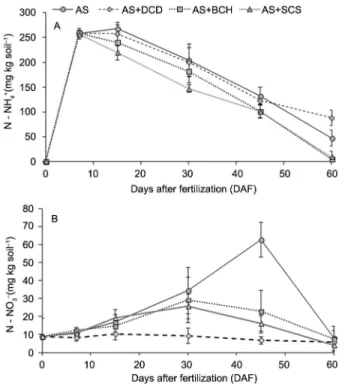
−-N in the soil At 7 DAF, a higher peak of 250 mg NH4+-N kg−1
of soil relative to the application of 300 mg N kg−1 the
soil was recorded for all treatments (Figure 2). Later we Soil moisture was adjusted on a daily basis to 70 %
of the maximum capacity of retention by weighing. The pots where the chambers were installed for sampling N2O emissions were also weighed, and the moisture at the base of the chamber was corrected according to its area, with the use of a syringe. This operation was al-ways carried out after collection of the gases. During the experimental period, the relative humidity of the air and the temperature inside the glasshouse were recorded hourly using a data logger.The mean temperature dur-ing the experimental period was 24 ºC and the relative humidity 80 %.
Analyses of variance were performed to deter-mine treatment effects. All comparisons were made at the 0.05 probability level except N2O fluxes which used a probability level of 0.1, unless otherwise stated using the Tukey test.
Results
Biometric parameters and biomass and N accumu-lation in plants
The application of ammonium sulfate (AS) associ-ated with nitrification inhibitors, dicyandiamide (DCD) and root extracts of Brachiaria humidicola (BCH), and of
Saccharum spontaneum (SCS), did not increase the height
nor diameter of the plants at most periods of (Table 3). 15 and 30 DAF, the application of BCH with ammonium sulfate had an effect superior to the control (AS) in rela-tion to height; 45 DAF, the control plants showed smaller diameters than the plants treated with the two root ex-tracts, no different from plants that received DCD as a nitrification inhibitor.
There was a difference (p < 0.05) between the treatments for biomass accumulation by the plants 45 and 60 DAF, and for biomass accumulation in the roots 15 and 60 DAF (Figure 1). As regards biomass accumula-tion, the highest yields was obtained with AS + BCH and AS + SCS 45 DAF. In turn, 60 DAF, the the biomass AS+SCS treatment was higher (Figure 1). The treatment with the highest root yield was AS + BCH, superior to both AS and AS + DCD 15 DAF, and superior to the AS + DCD at 60 DAF.
Table 3 − Height (H) and diameter (DIA) of the plants related the ammonium sulfate (AS) application with nitrification inhibitor dicyandiamide (DCD) and extracts of B. humidicola (BCH) and S. spontaneum (SCS).
TRAT Days after fertilization (DAF)
0 7 15 30 45 60
H DIA H DIA H DIA H DIA H DIA H DIA
AS 10.5 3.5 10.8 3.1 15.8 bc 5.1 15.7 b 6.0 26.5 8.1 b 23.2 10.3
AS+DCD 10.1 4.0 12.3 3.6 13.1 ab 4.6 21.2 a 7.3 24.7 8.9 ab 23.7 10.5
AS+ BCH 10.3 2.7 11.4 3.6 17.0 a 4.9 20.9 a 7.6 23.8 10.3 a 24.0 10.4
AS+SCS 10.9 4.4 11.4 3.8 12.4 c 5.3 21.7 a 7.7 25.4 10.0 a 26.7 11.6
LSD 1.9 1.3 2.8 1.4 2.9 0.7 3.9 1.5 5.1 1.4 3.7 1.2
p > 0.05 ns ns ns ns * ns * ns ns * ns ns
AS = Ammonium sulfate; DCD = dicyandiamide; BCH = Root extracts of Brachiaria humidicola; SCS = Root extracts of Saccharum spontaneum; H = Height of plants (cm); DIA = diameter of plants (mm); Means with the same lowercase letter in columns do not differ according to Tukey test p < 0.05; ns: not significant; LSD = least significant difference; *p < 0.05 = significant at 5 % by Tukey test.
verified a linear decrease in concentration of NH4+-N,
this reduction occurring due to the nitrification of part of the N and also the increase in N consumption by the plants. In the final period of evaluation, the NH4+
con-tent in the soil in the pots that received the AS + DCD treatment was almost twofold higher than the content in the control, indicating a more gradual oxidation of NH4+ to NO
3
−, evidencing inhibition in the process of nitrification of NH4+ from the fertilizer. Such inhibition
was not detected with the use of root extracts of
Bra-chiaria humidicola and Saccharum spontaneum, since for
both treatments the contents of NH4+ were similar to the
control during the entire evaluation period. The contents of NO3− were variable: higher contents were confirmed in the intermediate period for the treatments AS + BCH and AS + SCS (30 DAF), reaching the peak 45 DAF in the AS. At the end of the experimental period, the contents were similar for both.
N2O Fluxes
In spite of the experiment having been conducted in a semi-controlled environment, the N2O fluxes had a temporal oscillation as a function of the daily varia-tion in temperature. Negative fluxes, indicating N2O con-sumption by the soil, were also recorded. At 60 days after the evaluation that followed the application of the nitrogen fertilizer, associated or not with DCD and to the root extracts, the N2O fluxes oscillated between <0.1 to 3.4; 0.1 and 1.4; <0.1 to 3.4; and <0.1 to 1.9 mg N2O-N
Table 4 − N content and N accumulation in the plant and roots during the experimental period related the ammonium sulfate (AS) application with nitrification inhibitor dicyandiamide (DCD), and root extracts of B. humidicola (BCH), and root extracts of S. spontaneum (SCS).
Treatments
Days after fertilization (DAF)
7 15 30 45 60 7 15 30 45 60
N content N Accumulation
--- g kg−1 --- ---- mg per pot ---N in plant
AS 45.9 a 40.5 47.9 36.7 34.8 b 35.2 90.2 278.8 602.0 1037.6
AS+DCD 44.3 ab 37.9 48.9 37.8 40.0 a 46.1 75.7 353.1 613.2 1003.2
AS+ BCH 35.5 b 37.5 46.4 36.7 31.2 b 34.9 104.4 369.7 825.7 1164.0
AS+SCS 38.1 b 36.9 39.8 37.2 31.3 b 41.6 80.0 390.3 780.6 1273.5
LSD 10.2 5.6 19.1 6.2 6.1 12.3 33.3 223 199.2 438.0
CV 15.6 30.1 26.1 10.5 11.2 19.5 23.7 40.0 17.6 24.8
p > 0.05 * ns ns ns * ns ns ns ns ns
N in roots
AS 22.9 21.3 36.9 34.0 43.5 ab 1.97 4.5 b 44.8 129.2 195.1 bc
AS+DCD 19.9 32.9 35.7 30.5 45.3 a 2.29 8.1 b 47.4 108.3 130.5 c
AS+ BCH 23.8 34.9 36.7 27.2 37.0 ab 3.52 19.7 a 59.8 155.6 294.4 a
AS+SCS 20.6 33.2 30.4 32.6 33.2 b 2.45 12.3 ab 55.6 155.1 276.6 ab
LSD 6.7 12.7 10.0 11.7 11.2 2.25 9.0 35.6 86.1 94.4
CV 19.2 25.9 17.9 23.64 17.7 55.2 50.7 42.8 39.3 26.3
p > 0.05 ns ns ns ns * ns * ns ns *
AS: Ammonium sulfate; DCD: dicyandiamide; BCH: Root extracts of B. humidicola; SCS: Root extracts of S. spontaneum; LSD: least significant difference; CV: Coefficient of variation; Means with the same lowercase letter in columns do not differ according to Tukey test p < 0.05; ns: not significant; *p < 0.05 = significant at 5 % by Tukey test.
Figure 2 − Availability of NH4
+-N (A) and availability NO 3
m−2 d−1, respectively, in the AS, AS+DCD, AS+BCH,
and AS+SCS treatments. Considering the accumulated losses of N as N2O, the highest emission was observed in pots fertilized with ammonium sulfate only, and when the fertilizer was associated with the extract of B.
hu-midicola (AS+BCH). In these cases, N2O emission
ex-ceeded 60 µg m−2 in the last evaluation 60 DAF. On the
other hand, the use of DCD associated with ammonium sulfate reduced the emission of N2O by 57 % in relation to the use of that nitrogen fertilizer (Figure 3).
Discussion
Evaluating root exudates, Subbarao et al., (2007) found positive effects of sorghum and peanuts as inhibi-tors of nitrification; among forage grasses, the most in-tense inhibition of nitrification was found in B. decum-bens and B. humidicola. Sugarcane was not included in their study. Since sugarcane seems to prefer absorption of NH4+-N, it is possible that its roots also produce
com-pounds that preserve this chemical form of N in the soil.
S. spontaneum, a species that forms the sugarcane
hy-brids currently cultivated, contributes mainly to provide rusticity and an abundant root system (Matsuoka and Garcia, 2011), and may be a possible source of this char-acteristic. Largely cultivated in the Brazilian savannas, pastures of B. humidicola and B. decumbens are highly adapted to conditions of low availability of N. In this sense, as reported by Subbarao et al., (2007), it is pos-sible that species better adapted to the Brazilian savan-nas are provided with mechanisms to conserve and use N efficiently, the main factor limiting growth and yield (Lata et al., 2004).
Subbarao et al. (2009) were able to isolate an effec-tive nitrification inhibitor (brachialactone) from the root exudates of B. humidicola. Gopalakrishnan et al., (2009) also reported a 29 % reduction in nitrification with an application of 182 mg (NH4)2SO4-N kg−1 of soil associated
with the application of exudates of B. humidicola. Although this study was not designed to measure the inhibiting effect of nitrification of B. humidicola and
S. spontaneum,the content of NO3−-N in the soil 45 days after application of ammonium sulfate containing DCD or extracts of the two species of grasses was lower than that observed in the control treatment, only with the ni-trogen fertilizer (Figure 2). However, the inhibiting ef-fect, if any, was smaller than that of DCD, which main-tained the contents of nitrate in the soil at about 10 mg N kg−1 during the entire period, while extracts of roots of
grasses were not so effective in the samples of soil taken 15 and 30 days after fertilization (Figure 2).
The data on N2O emission (Figure 3) may also be indirect indicators of nitrification inhibition. The emis-sions were lower (p < 0.05) in the treatment with DCD (Figure 3). Several studies indicate that nitrification in-hibitors result in reduction of N2O emission (Snyder et al., 2009; Snyder et al., 2014), including in sugarcane (Soares et al., 2015). Nevertheless, in the present study, some reduction of N2O was observed with the treatment containing extract of S. sponteneum, but not with B.
hu-midicola (Figure 3). Accordingly, the evidence that the
extracts of roots of these grasses led to reductions in ni-trification in this study may be considered preliminary and not conclusive. Subbarao et al., (2009) indicated that production of nitrification inhibitor compounds by roots is stimulated when plants grow in a medium containing ammoniacal N. The pasture from where the plants of
B. humidicola were obtained had no fertilizer, and there are no records of the management practices in adopted the area from which the roots of S. spontaneum were removed. Therefore, it is possible that the production conditions of these grasses had not been ideal for the formation of nitrification inhibitors.
Other studies conducted in Brazil also indicate that the effects of brachiarias were relatively little or almost insignificant in terms of nitrification reduction. Moro et al., (2013) did not find effects of prior cultiva-tion of brachiarias, including B. humidicola, on the accu-mulation of NH4+ in soil in comparison with the use of
Figure 3 − N2O daily fluxes (A) and cumulative N2O emission (B) as a function the ammonium sulfate (AS) application with nitrification inhibitor dicyandiamide (DCD), and root extracts of B. humidicola
DCD. Otherwise, Fernandes et al., (2011) observed that the content of nitrate in soil fertilized with ammonium sulfate was lower when B. brizantha, B. ruziziensis and B.
decumbens had been previously cultivated, as compared
to the control treatment, without plants.
Since the soil used in the experiment was obtained from a sugarcane plantation, it is possible that the micro-biota responsible for nitrification had been sufficiently active, since at the time of the application of treatments, the quantity of NO3−-N was about 9 mg NO
3
−-N kg−1 of
soil, and the availability of NH4+-N was very low. In
spite of the values of NO3−-N 45 DAF in the AS + DCD treatment having been lower (p < 0.05) than the AS, the low values of NO3−-N observed during the study are due to the effect of the nitrification inhibitor 45 DAF there was a peak of NO3−-N in the soil in the AS treatment, indicating higher nitrification in the treatment without application of the inhibitor.
Even without causing an inhibitory effect in the nitrification process, the addition of root extracts of B.
humidicola and B. decumbens to the nitrogen fertilizer en-hanced sugarcane growth (Figure 1). This effect may be related to the presence of about 45 compounds in the extracts of BCH and SCH. The action of a number of these metabolites on the growth of roots and plant has already been proved. This was the case of the nonpro-tein gamma-aminobutyrate (GABA), whose exogenous application may influence the absorption of nitrate, stim-ulating root growth as observed in Arabidopis thaliana by Barbosa et al. (2000). Another example of positive effects on the growth of plants was reported by Stoyanova and Doncheva, (2002). These authors demonstrated that the presence of succinate promotes higher root growth by increasing the absorption of phosphorous. Considering that the solution of BCH and SCH had been extracted from root macerate, it is probable that it contained a sig-nificant quantity of phytohormones such as auxin (AIA). Synthesized in the apical meristem and translocated to-ward the root system where it promotes the growth of this tissue (Overvoorde et al., 2010).
The addition of DCD together with ammonium sulfate has caused a more gradual oxidation of NH4+ to
NO3−, reducing nitrification. As a consequence, a reduc-tion in the daily fluxes of N2O (Figure 3) was verified, providing a reduction in accumulated N2O emission equivalent to 57 % at the end of the experiment. In spite of there continuing to exist controversial information on the use of these additives under different agricultural systems, the effect of DCD has resulted in an effective strategy in the reduction of N2O emission associated with the use of nitrogen fertilizers in sugarcane in Bra-zil, a country where, in view of the tropical climate, one could expect lower efficiency of these molecules. Vargas et al. (2014) demonstrated that the synergistic effect of keeping the straw of the sugarcane and nitrogen fertil-ization on the emission of N2O was reduced by the use of DCD together with the nitrogen fertilizer by up to 70 %, depending on the quantity of straw on the soil. In
a field experiment conducted over two years, Soares et al., (2015), found that reductions in N2O emission as a function of the application of DCD together with urea in sugarcane may be in the range of 81-95 %. These au-thors have also verified that reapplication of DCD did not cause any loss of efficiency of DCD in its mitigating effect on N2O emission.
Thus, this study confirms previous reports that the use of nitrification inhibitors is a tool which can re-duce the environmental impact of nitrogen fertilization of sugarcane. Nitrification inhibitors can contribute to reductions in N2O emissions, by delaying the nitrifica-tion process in the soil (Weiske et al., 2001; Chen et al., 2010), and by reducing the quantity of NO3−available to denitrification that occurs under conditions of low pressure of O2. In this study, the losses of N2O in both processes may have occurred simultaneously, but it is probable that losses caused by nitrification may be pre-dominant, since there was no limitation of O2 during the experiment, and the soil, formed almost totally of sand, had little or no sites with low O2 pressure as a function of its macroporosity.
The root extracts of B. humidicola did not reduce N2O emission when it was associated with ammonium sulfate in comparison with AS alone (Figure 3). It is possible that the method used to obtain the root ex-tracts may have influenced the capacity of inhibiting nitrification and the N2O emission. When performing a slight maceration of the root system, there is a re-lease of soluble C applied to the soil together with the extract. The increase in availability of soluble C may have stimulated denitrification as it is a source of ener-gy for microorganisms (Firestone and Davidson, 1989), even if the extracts had acted inhibiting nitrification and reducing the availability of NO3− in the soil. Under natural conditions in the brachiaria pastures, the bra-chialactone is released in the soil as a function of the availability of NH4+, and probably there is no increase
in the concentration of soluble C as a function of this release. Although further studies may be required, Sub-barao et al. (2007) observed that in the brachiaria pas-tures the population of nitrifiers is suppressed, directly influencing nitrification and the production of N2O. The addition of DCD caused a reduction in nitrifica-tion, with no effect on the production of dry matter or accumulation of N in the sugarcane plants cultivated in pots. This indicates that, at least in the initial stages of cultivation, the predominance of N in the ammoniacal form brought no nutritional advantages to the plants. Accordingly, the data does not allow us to confirm the observations of Robinson et al., (2011) as regards pref-erential absorption of NH4+ by this species.
Conclusions
The application of root extracts of Brachiaria
hu-midicola and Saccharum spontaneum together with
but the effect on nitrification and N2O emission from the soil was of low significance. The use of DCD together with the N-fertilizer inhibited nitrification of the N ap-plied, and consequently, the emission of N2O from the soil, without increasing initial sugarcane growth. The plants did not benefit from the increased presence of ammoniacal N promoted by DCD. The addition of grass extracts promoted an increase in yield of dry matter of sugarcane, probably due to the effect of existing growth promoting compounds in the extracts.
Acknowledgments
The authors wish to thank Juliana Aparecida Ari-cetti for conducting the metabolic analyses, and the Sug-arcane Technology Center for the supply of Saccharum spontaneum roots.
References
Barbosa, J.M.; Locy, R.D.; Barger, T.W.; Singh, N.K.; Cherry, J.H. 2000. GAGA Increases the rate of nitrate uptake and utilization In Arabidopsis Roots. p. 53-63. In: Cherry, J.H.; Locy, R.D.; Rychter, A., eds. Plant tolerance to abiotic stresses in agriculture: role of genetic engineering. Springer, Berlin, Germany.
Cantarella, H. 2007. Nitrogen. p. 375-470. In: Novais, R.F.; Alvarez, V.H.V.; Barros, N.F.; Fontes, R.L.F.; Cantarutti, R.B.; Neves, J.C.L.,eds. Soil fertility. Brazilian Society of Soil Science, Viçosa, MG, Brazil (in Portuguese).
Carmo, J.B.; Neill, C.; Garcia-Montiel, D.C.; Piccolo, M.C.; Cerri, C.C.; Steudler, P.A.; Andrade, C.A.; Passianoto, C.C.; Feigl, B.J.; Melillo, J.M. 2005. Nitrogen dynamics during till and no-till pasture restoration sequences in Rondônia, Brazil. Nutrient Cycling in Agroecosystems 71: 213-225.
Chen, D.; Suter, H.C.; Islam, A.; Edis, R. 2010. Influence of nitrification inhibitors on nitrification and nitrous oxide emission from a clay loam soil fertilized with urea. Soil Biology and Biochemistry42: 660-664.
Cuadros-Inostroza, A.; Caldana, C.; Redestig, H.; Kusano, M.; Lisec, J.; Pena-Cortes, H.; Willmitzer, L.; Hannah, M.A. 2009. TargetSearch: a bioconductor package for the efficient preprocessing of GC-MS metabolite profiling data. BMC Bioinformatics 10: 428.
Fernandes, A.M.; Andrade, G.J.M.; Souza, E.F.C.; Rosolem, C.A. 2011. Brachiaria species affecting soil nitrification. Revista Brasileira de Ciencia do Solo 35: 1699-1706.
Firestone, M.K.; Davidson, E.A.1989. Microbiological basis on NO and N2O production and consumption in soil. p. 7-21. In: Andreae, M.O.; Schimel, D.S., eds. Exchange of trace gases between terrestrial ecosystems and atmosphere. Wiley, New York, NY, USA.
Giavalisco, P.; Li, Y.; Matthes, A.; Eckhardt, A.; Hubberten, H.M.; Hesse, H.; Segu, S.; Hummel, J.; Köhl, K.; Willmitzer. L. 2011. Elemental formula annotation of polar and lipophilic metabolites using (13)C, (15)N and (34)S isotope labelling, in combination with high- resolution mass spectrometry. Plant Journal 68: 364-376.
Giné, M.F.; Bergamin Filho, H.; Zagatto, E.A.G.; Reis, B.F. 1980. Simultaneous determination of nitate and nitrite by flows injection analysis. Analytical Chimica Acta 114: 191-197. Gopalakrishnan, S.G.; Watanabe, T.; Pearse, S.J.; Ito, O.; Hossain,
Z.A.K.M.; Subbarao, G.V. 2009. Biological nitrification on inhibition by Brachiaria humidicola roots varies with soil type and inhibits nitrifying bacteria, but not other major soil microorganisms. Soil Science and Plant nutrition 55: 725-733. Jantalia, C.P.; Santos, H.P.; Urquiaga, S.; Boddey, R.M.; Alves,
B.J.R. 2008. Fluxes of nitrous oxide from soil under different crop rotations and systems in the south of Brazil. Nutrient Cycling and Agroecosystems 82: 161-173.
Lata, J.C.; Degrange, V.; Raynaud, X.; Maron, P.A.; Lensi, R.; Abbadie, L. 2004. Grass population control nitrification in Savanna soils. Functional Ecology 13: 762-763.
Lisec, J.; Schauer, N.; Kopka, J.; Willmitzer, L.; Fernie, A.R. 2006. Gas chromatography mass spectrometry-based metabolite profiling in plants. Nature Protocols 1: 387-396.
Livingston, G.P.; Hutchinson, G.L. 1995. Enclosure-based measurement of trace gas exchange: applications and sources of error. p. 14-51. In: Matson, P.A.; Harris, R.C., eds. Biogenic trace gases: measuring emissions from soil and water. Blackwell, Oxford, UK.
Matsuoka, S.; Garcia, A.A.F. 2011. Sugarcane underground organs: going deep for sustainable production. Tropical Plant Biology 4: 22-30.
Moro, E.; Crusciol, C.A.C.; Nascente, A.S.; Cantarella, H. 2013. Soil inorganic nitrogen content according to cover crops, nitrogen sources and nitrification inhibitor. Pesquisa Agropecuaria Tropical 43: 424-435 (in Portuguese, with abstract in English). Nelson, D.W.; Sommers, L.E. 1973. Determination of total
nitrogen in plant material. Agronomy Journal 65: 109-112. Overvoorde, P.; Fukaki, H.; Beeckman, T. 2010. Auxin Control of
Root Development. Cold Spring Harbor Perspectives in Biology 2: a001537.
Pierzynski, G.M.; Thomas, S.; Vance, G.F. 2000. Soils and Environmental Quality. 2ed. CRC Press, Boca Raton, FL, USA. Raij, B. van; Cantarella, H.; Quaggio, J.A.; Furlani, A.M.C. 2001. Recommendations Fertilization and Liming for the São Paulo State = Adubação e Calagem: Recomendações para o Estado de São Paulo. 2ed. Instituto Agronômico, Campinas, SP Brazil. (in Portuguese).
Reis, B.F.; Vieira, J.A.; Krug, F.J.; Giné, M.F. 1997. Development of a flow injections system two analytical paths for ammonium determination in soil extracts by conductometry. Journal of the Brazilian Chemical Society 8: 523-528.
Robinson, N.; Brackin, R.; Soper, K.V.F.; Gamage, J.H.H.; Paungfoo-Lonhienne, C.; Rennenberg, H.; Lakshmanan, P.; Schmidt, S.2011. Nitrate paradigm does not hold up for sugarcane. PloS One 6: 19045.
Snyder, C.S.; Bruulsema, T.W.; Jensen, T.L.; Fixen, P.E. 2009. Review of greenhouse gas emissions from crop production systems and fertilizer management effects. Agriculture Ecosystems & Environment 133: 247-266.
Soares, J.R.; Cantarella, H.; Vargas, V.P.; Carmo, J.B.; Martins, A.A.; Sousa, R.M.; Andrade, C.A. 2015. Enhanced-efficiency fertilizers in nitrous oxide emissions from urea applied to sugarcane. Journal of Environmental Quality 21: 423-430. Soil Survey Staff. 2010. Keys to Soil Taxonomy 2010. 11ed.
USDA-Natural Resources Conservation Service, Washington, DC, USA.
Stoyanova, Z.; Doncheva, S. 2002. The effect of zinc supply and succinate treatment on plant growth and mineral uptake in pea plant. Brazilian Journal of Plant Physiology. 14: 111-116. Subbarao, G.V.; Nakahara, K.; Hurtado, M.P.; Ono, H.; Moreta,
D.E.; Salcedo, A.F.; Yoshihashi, A.T.; Ishiwawa, T.; Ishitani, M.; Ohnishi-Kameyama, M.; Yoshida, M.; Rondon, M.; Rao, I.M.; Lascano, C.E.; Berry, W.L.; Ito, O. 2009. Evidence for biological nitrification inhibition in Brachiaria pastures. Proceedings of the National Academy of Sciences 106: 17301-17307.
Subbarao, G.V.; Rondon, M.; Ito, O.; Ishikawa, T.; Rao, I.M.; Nakahara, K.; Lascano, C.; Berry, W.L. 2007. Biological nitrification inhibition (BNI): is it a widespread phenomenon? Plant and Soil 294: 5-18.
Vargas, V.P.; Cantarella, H.; Martins, A.A.; Soares, J.R.; Carmo, J.B. 2014. Sugarcane crop residue increases N2O and CO2 emissions under high soil moisture conditions. Sugar Tech 16: 174-179.
Weckwerth, W.; Wenzel, K.; Fiehn, O. 2004. Process for the integrated extraction identification, and quantification of metabolites, proteins and RNA to reveal their co-regulation in biochemical networks. Proteomics 4: 78-83.
Weiske, A.; Benckiser, G.; Ottow, J.C.G. 2001. Effect of the new nitrification inhibitor DMPP in comparison to DCD on nitrous oxide (N2O) emissions and methane (CH4) oxidation during 3 years of repeated applications in field experiments. Nutrient Cycling in Agroecosystems 60: 57-64.