Behavioral modulation by
mutilation
pictures in women
1Departamento de Neurobiologia, Instituto de Biofísica,
Universidade Federal do Rio de Janeiro, Rio de Janeiro, RJ, Brasil
2Departamento de Fisiologia e Farmacologia, Universidade Federal Fluminense, Niterói, RJ, Brasil
3National Institute of Mental Health, Bethesda, MD, USA M.G. Pereira1, E. Volchan1,
L. Oliveira2, W. Machado-Pinheiro2, J.A. Rodrigues2, F.V.P. Nepomuceno2 and L. Pessoa3
Abstract
Previous studies have shown that women are more emotionally ex-pressive than men. It is unclear, however, if women are also more susceptible to the emotional modulation of behavior imposed by an affective stimulus. To investigate this issue, we devised a task in which female subjects performed six sequential trials of visual target detection following the presentation of emotional (mutilation and erotic) or neutral pictures (domestic utensils and objects) and com-pared the data obtained in the present study with those described in a previous study with male subjects. The experiment consisted of three blocks of 24 pictures and each block had an approximate duration of 4 min. Our sample consisted of 36 subjects (age range: 18 to 26 years) and each subject performed all blocks. Trials following the presenta-tion of mutilapresenta-tion pictures (283 ms) had significantly slower reacpresenta-tion times than those following neutral (270 ms) pictures. None of the trials in the “pleasant block” (271 ms) was significantly different from those in the “neutral block”. The increase in reaction time observed in the unpleasant block may be related in part to the activation of motiva-tional systems leading to an avoidance behavior. The interference effect observed in this study was similar to the pattern previously described for men. Thus, although women may be more emotionally expressive, they were not more reactive to aversive stimuli than men, as measured by emotional interference in a simple reaction time task.
Correspondence
M.G. Pereira
Departamento de Neurobiologia Instituto de Biofísica, UFRJ CCS, Bloco G
21949-900 Rio de Janeiro, RJ Brasil
Fax: +55-21-2280-8193 E-mail: [email protected] Research supported by PRONEX/MCT, CNPq and FAPERJ.
Received March 14, 2003 Accepted November 10, 2003
Key words
•Emotion •Behavior •Reaction time •Sex differences •Affective stimulus
Introduction
The fast, effortless processing of poten-tially threatening stimuli is highly advanta-geous and may be critical for survival. Sev-eral researchers have proposed that the pro-cessing of a negative stimulus may be “auto-matic” (1,2). Psychophysical studies have shown that observers exhibit fast, involun-tary responses to emotional stimuli, such as faces with fearful expressions or aversive
Kring and Gordon (8) stated that women do not report experiencing more emotion than men and their skin conductance activity is different but not directly consistent with the view that women are more emotional. Ac-cording to those investigators, differences between men and women in the physiologi-cal response, at least for skin conductance activity, varied according to type of emotion, particularly for negative emotions. In these experiments, men showed greater reactivity to fear and anger films, and women had greater reactivity to sad and disgusting films.
Other studies suggest that women are more reactive to unpleasant events, espe-cially those that are threatening or traumatic (9). Bradley et al. (10) investigated sex dif-ferences in emotional picture processing and obtained results consistent with the idea that women are more reactive to aversive stimu-lation. In their study, they compared the responses of men and women to pleasant and unpleasant pictures (of varied contents) and demonstrated that women were more reactive to unpleasant materials, rating the pictures as more arousing and more unpleas-ant, and also reacted with more marked changes in electromyographic recordings of corrugator activity. Women also responded with greater fear bradycardia (cardiac decel-eration) when viewing unpleasant pictures. According to the investigators, these data suggest that symbolic picture cues activate the defensive motivational system more in-tensely in women than in men. In contrast, men tended to be marginally more reactive than women when viewing pleasant pictures, rating these pictures slightly more pleasant and more arousing, and reacting with more skin conductance activity (10).
In addition to the wide range of direct emotional responses evoked by affective pic-tures (3,11) the processing of emotional stimuli by human subjects can also interfere with the performance of non-emotional attentional tasks (12,13). On the basis of the
statement made by Bradley et al. (14,15) that, among others, erotic and attack-mutila-tion pictures most strongly activate the pri-mary motivational states (i.e., appetitive and defensive states, respectively), we tested the effects of viewing these categories of pleas-ant and unpleaspleas-ant pictures in a subsequent simple detection task in a male sample. In this study (16) we demonstrated that emo-tional pictures induced a sustained interfer-ence with a simple detection task. Subjects performed six sequential trials of simple tar-get detection following the offset of each picture. Reaction times for trials presented after mutilation pictures were significantly slower than those presented after erotic or neutral pictures. As discussed above, many studies have measured direct physiological or evaluative responses evoked by affective stimuli and have suggested that women ap-pear to be more emotionally expressive than men, and there is also some evidence for their hyperreactivity to aversive pictures. Would this mean that women are more sus-ceptible to the emotional modulation of be-havior imposed by affective stimuli (at least highly arousing stimuli)?
To investigate this issue, we repeated the same paradigm as used in our previous study, but now applied to a group of women. By comparing the data obtained in the present study to the results described previously for men, we can assess if emotional modulation of a behavioral task has a similar pattern for both sexes. Evaluative judgments were also performed in order to check for sex differ-ences in rating reports (10) in our sample.
Subjects and Methods
Subjects
psychiatric disorders, and none were taking medication. All of them were right-handed according to the Edinburgh Inventory (17) and had normal or corrected vision. The local Ethics Committee approved the exper-imental protocol and each subject gave writ-ten informed consent to participated in the study.
Apparatus and stimulus selection
Subjects were tested in a sound-attenu-ated room under dim ambient light. Stimulus timing and presentation, as well as collec-tion of responses, were controlled by a com-puter. Stimulus presentation was pro-grammed using MEL software (Psychology Software Tools Inc., Pittsburgh, PA, USA). The subjects’ head was positioned on a head-and-chin rest 57 cm from the screen.
Ninety pictures were used in the whole experiment. Seventy-nine were selected from the International Affective Picture System, a collection of standardized color photographic material (18,19). Eleven additional erotic male pictures were obtained on the Internet. We divided these pictures into four sets. Three sets of 24 pictures each were used in test blocks: pleasant (erotic males or erotic couples), neutral (household and inanimate objects) and unpleasant (mutilated bodies). One set of 18 pictures with wide-ranging valence and arousal ratings was selected for a practice block (see below).
Design and procedure
The experimental session consisted of an initial practice block followed by three test blocks. During each test block, 24 pictures of a single type were used (erotic, neutral, or mutilation). The serial position of each test block was counterbalanced across partici-pants using all six possible orders. Pictures were presented in a fixed order within a block for all participants. We carefully aligned the pictures in a manner as unbiased
as possible according to the valence and arousal ratings (18).
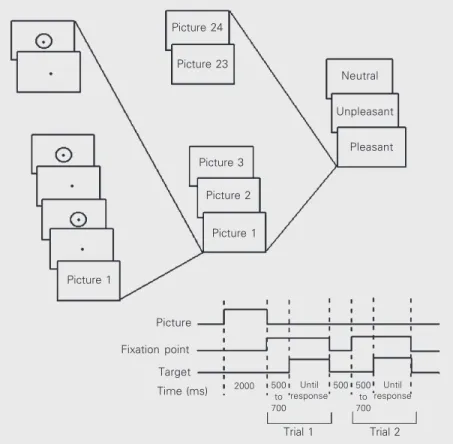
For all blocks, each picture was presented for 2 s, followed by six trials of target detec-tion. Subjects were instructed to attend to the picture as long as it was displayed. After picture offset, a fixation spot was presented in the center of the screen for 500 to 700 ms and then the target (a small annulus) ap-peared around it (see Figure 1). Both the fixation spot and the target were presented in white on a black screen and remained on until the subject’s response. Subjects were required to press a button with the right index finger as soon as they detected the target. The next trial began 500 ms after the subject’s response, with the onset of the fixation spot. After six trials, a new picture appeared on the screen. Trials with responses longer than 1000 ms or shorter than 100 ms
Picture 24
Picture 23
Picture 3
Picture 2
Picture 1
Picture 1
Neutral
Unpleasant
Pleasant
Picture
Fixation point
Target
Time (ms) 2000 500to
700 Until response
500 Until response 500
to 700
Trial 1 Trial 2
were considered errors and were discarded (less than 5% of the trials).
The choice for a blocked presentation of pictures was based on the study by Bradley et al. (20), who reported that emotional modu-lation in the interpicture interval is only elic-ited under a blocked paradigm.
During the practice block a visual feed-back of the response latency (in millisec-onds) appeared on the screen for 1 s. After the offset of the display with reaction time, a new trial began. Errors were displayed on the screen as “anticipation” or “slow re-sponse”, also for 1 s. There was no visual feedback of the response latency in test blocks.
Statistical analysis
Data from two subjects who had a mean reaction time slower than the group average
minus 3 standard deviations were not in-cluded in the analysis of the test blocks. The mean reaction time for each block was sub-mitted to a repeated-measures ANOVA test. Valence (pleasant, neutral or unpleasant) and trial number (1-6) were used as
within-subject factors. Post hoc tests were carried
out by the Newman-Keuls method. The level of significance adopted was P < 0.05.
Rating session
After the end of the behavior experimen-tal session, an evaluative report of the previ-ously presented pictures began. The pictures used in the rating session were presented in three sets of 30 pictures each. They were the same 90 pictures as described before, but randomly distributed. The rating session be-gan with a preparation slide (“Get ready to rate the next image”), which was presented for 5 s. Then images were presented for 6 s. During the 10-s interval between pictures, participants were asked to rate the picture (in a ratings booklet) on the dimensions of va-lence and arousal using the paper and pencil version of the self-assessment manikin, an affective rating system devised by Lang et al. (18,21). In this system, ratings of valence are indicated by 5 graphic representations of facial expressions ranging from a severe frown (most negative) to a broad smile (most positive). For arousal, the manikin varies from a state of low to high agitation. Partici-pants may select any of the five figures com-prising each scale, or the boxes between any two figures, which results in a nine point rating scale for each dimension. In the va-lence dimension, 9 represents the extreme of pleasantness and 1 the extreme of unpleas-antness. For the arousal dimension, ratings are such that 9 represents a high rating and 1 represents a low rating. Before the rating of the pictures, 9 pictures were used in order to demonstrate the rating scales. Additionally, subjects practiced their ratings on 3 practice pictures.
Figure 2. Ratings of women (closed symbols) and men (open symbols). Each symbol depicts the mean valence and arousal ratings for pleasant, unpleasant and neutral pictures. The data for women are from the present study and the data for men were taken from a previous study (16).
Valence
9
8
7
6
5
4
3
2
1
1 2 3 4 5 6 7 8 9
Arousal
Results
Valence ratings of erotic (mean = 6.9) pictures were significantly higher and va-lence ratings of mutilation pictures (mean = 1.9) were significantly lower than valence ratings of neutral pictures (mean = 5.1). Arousal ratings were greater for pleasant (mean = 4.7) and mutilation (mean = 6.3) pictures than for neutral ones (mean = 1.8); mutilation and erotic pictures differed sig-nificantly in arousal level (see in Figure 2). As proposed by Bradley et al. (10), by com-puting the correlation between pleasure and arousal ratings it is possible to determine the “vectors” that describe appetitive and defen-sive motivation. To assess these motivation vectors, we computed the correlation be-tween pleasure and arousal ratings for each group of pictures separately. There was a significant correlation between ratings of pleasure and arousal for erotic (r = 0.73, P < 0.001) and mutilation (r = -0.60, P = 0.002) pictures, but no correlation was found for neutral pictures (r = 0.02, P = 0.92).
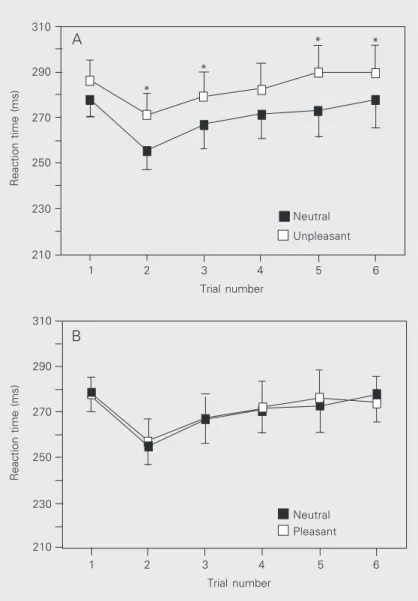
The analysis of reaction times revealed a main effect of valence (F[2,66] = 4.06, P = 0.02). Mean reaction times to targets were significantly slower following mutilation pic-tures (283 ms) than those following neutral pictures (270 ms) and erotic pictures (271 ms). There was no significant difference in reaction time between erotic and neutral blocks (P = 0.93).
There was also a main effect of trial number (F[5,165] = 3.5, P = 0.004), with a faster reaction time for the second trial (262 ms) following picture offset compared to all other trials (P < 0.05), except for trial 3 (271 ms), for which only a trend was observed (P
= 0.08). Post hoc analyses revealed that the
second, third, fifth and sixth trials during unpleasant blocks were significantly slower than those during neutral blocks. This sus-tained effect is illustrated in Figure 3A. Dur-ing erotic blocks, none of the trials were significantly different from those during
neu-Figure 3. Sustained interference effect. Data are reported as means ± SEM. A, A significant slowing down of manual reaction time following unpleasant pictures compared to neutral pictures was observed for trials 2, 3, 5 and 6. B, None of the trials involving pleasant blocks differed significantly from those involving neutral blocks.
tral blocks (Figure 3B).
Discussion
Evaluative judgments confirmed that the affective pictures used in this experiment were associated with reports of pleasure or displeasure. Moreover, there was a correla-tion between pleasure and arousal ratings indicating that as pictures were rated as in-creasingly more pleasant or more
unpleas-Reaction time (ms)
310
290
270
250
230
210
1 2 3 4 5 6
Trial number *
*
* *
A
Neutral
Unpleasant
B
Reaction time (ms)
310
290
270
250
230
210
1 2 3 4 5 6
Trial number
ant, arousal ratings tended to increase as well. We compared the ratings of the female group with the men’s ratings obtained in our previous study (16) to determine if there were significant differences in evaluative judgments between groups. The pictures used in the previous study were the same, except for the pleasant pictures that were erotic photos of females instead of males. Table 1 presents the mean ratings of pleasure and arousal for women (present study) and men (16) when viewing erotic, neutral and muti-lation pictures. Values reported by Lang et al. (18) for North Americans are presented in Table 2. The Brazilians’ ratings for each of the 72 pictures used in the test blocks are presented in Figure 2 separately for men and women. Women rated negative pictures as significantly more unpleasant than men and
positive pictures as significantly less pleas-ant than men. There was no difference be-tween groups in valence ratings for neutral pictures. Men’s arousal ratings for erotic and neutral pictures were significantly higher than for women. In our samples women did not find the mutilation pictures more arous-ing than men which is different from data reported by Bradley et al. (10) and Lang et al. (18). A comparison between the vectors de-scribing appetitive and defensive motivation revealed that women showed a stronger cou-pling between increased arousal and
unpleas-antness (r = -0.6 vs r = -0.13 for women and
men, respectively; P = 0.04). Previous stud-ies also described stronger linear defense motivation vectors for women than for men when subjects rated pictures (10), sounds or words (22,23). On the other hand, these
Table 2. International Affective Picture System (IAPS) ratings of valence and arousal for women and men when viewing pleasant, neutral and unpleasant pictures.
Valence Arousal
Women Men Significance Women Men Significance
Erotic nudes 6.5 ± 0.5 7.5 ± 0.5 P < 0.0001 5.9 ± 0.4 6.8 ± 0.5 P < 0.0001
Objects 5.0 ± 0.3 4.8 ± 0.2 P = 0.0793 2.6 ± 0.4 2.4 ± 0.4 P = 0.0529
Mutilated bodies 1.5 ± 0.3 2.1 ± 0.4 P < 0.0001 6.9 ± 0.7 6.1 ± 0.6 P < 0.0001
Data are reported as mean ± SD.The statistical test used to compare men to women was the t-test. The data for both females and males were taken from IAPS (18). The ratings for the 13 erotic pictures were selected from IAPS (19).
Table 1. Ratings of valence and arousal when viewing pleasant, neutral and unpleasant pictures for women and men.
Valence Arousal
Women Men Significance Women Men Significance
Erotic nudes 6.9 ± 0.5 7.5 ± 0.5 P = 0.0002 4.7 ± 0.8 6.0 ± 0.6 P < 0.0001
Objects 5.1 ± 0.2 5.1 ± 0.2 P = 0.9055 1.8 ± 0.2 2.4 ± 0.4 P < 0.0001
Mutilated bodies 1.9 ± 0.2 2.4 ± 0.3 P < 0.0001 6.3 ± 0.5 6.5 ± 0.4 P = 0.2248
studies described a stronger linear appetitive motivation vector for men than for women. We did not observe any difference in linear approach vector between women and men (r = 0.73 and r = 0.64, respectively; P = 0.54). The data obtained in the behavioral ses-sion showed that the valence of task-unre-lated pictures affects the performance of a subsequent non-emotional reaction time task in women. More specifically, responses fol-lowing mutilation pictures were slower than those following neutral or erotic pictures, and there was no difference in reaction time between pleasant and neutral blocks. This slowing down of reaction time during the unpleasant block was not a transient effect of brief duration, but rather it persisted for at least 6 s after picture offset. This sustained effect may be linked to the blocked presenta-tion mode of the experiment. There was no significant linear trend for an increase or a decrease of the reaction time slowing down effect across the block.
The interference effect observed in the present study is similar to the pattern re-ported for men by Pereira et al. (16). The difference in mean reaction time during un-pleasant blocks compared to neutral blocks was virtually identical for both sexes, i.e., 13.7 ms for men and 12.6 ms for women. These data do not provide evidence of greater emotional modulation on task performance in women compared to men. Although being more emotionally expressive than men (see Ref. 7), women showed equal emotional interference with behavior, as measured by emotional influence on reaction time to on-going tasks. Bradley et al. (10) suggest that symbolic picture cues activate the defensive motivational system more intensely in women than in men and that they are more reactive to aversive stimulation. At least for an indi-rect measurement of emotional influence, as used in this study, we found no support for a greater reactivity to aversive stimuli in women. One possibility is that women and men differ only in the expression of emotion,
but the responses and influences of emo-tional stimulation are the same in both sexes. In fact, Gross and John (24) pointed out that men mask their feelings more than do women, which suggests an expressive difference, and not necessarily an experiential difference, between men and women.
A possible explanation for the present interference effect of mutilation pictures is that they are more attentionally demanding, thereby reducing available resources for the subsequent target detection task. The capac-ity for emotional stimuli to engage attention has been well documented (20). Selective attention effects are, in general, very fast and transient (25), with attentional dwelling time of the order of 600-800 ms (26). In our task, the slowing down of reaction time during the unpleasant block was observed until the sixth trial (not less than 6 s). The long duration of this effect does not favor explanations solely in terms of typical selective attention effects, which, as observed above, occur within less than a second. Therefore, it is likely that other processes are involved.
demonstrated that evidence of death, mutila-tion and blood from a conspecific member is an important fear-evoking stimulus. Indeed, in 1946 Hebb (31) had observed that pri-mates react with avoidance to signs of death or mutilation of a species member. Stevens and Gerzov-Thomas (32) working with rats, observed strong fright reactions to conspe-cific blood and muscle and not to tissues from another rodent species. Bradley et al. (14) also showed that humans present marked psychophysiological reactions to mutilation pictures. Additionally, work from our labo-ratory recording body oscillations with a force platform (33) showed that the visual-ization of a block of mutilation pictures de-creased the postural sway and caused a marked bradycardia, revealing a defensive reactivity.
Thus, an alternative explanation for the long-duration effects observed in the present study is based on the idea that activation of motivational systems prompts approach and avoidance behavioral tendencies (1). Chen and Bargh (34) tested whether automatic stimulus evaluation results directly in be-havioral predisposition towards a stimulus, such that positive evaluations would pro-duce immediate approach tendencies, and negative evaluations would produce imme-diate avoidance tendencies. Subjects re-sponded to attitude object stimuli either by pushing or by pulling a lever. They responded faster to negatively valenced stimuli when pushing the lever away (“avoid”) than when pulling it toward them (“approach”), but responded faster to positive stimuli by pull-ing than by pushpull-ing the lever. The results of Chen and Bargh (34) suggest that the auto-matic classification of stimuli as either posi-tive or negaposi-tive appears to have direct be-havioral consequences. Duckworth et al. (35) used positive and negative novel pictures on a paradigm of simple reaction time. The participants in the approach condition were instructed to pull a lever towards them when they detected the picture and responded faster
to positive than to negative stimuli. Those in the avoidance condition responded by push-ing the lever away from them. Responses were now faster to negative than to positive novel stimuli. They concluded that, as found for familiar stimuli, the automatic evalua-tion of novel stimuli has direct and immedi-ate consequences for approach and avoid-ance behavioral tendencies. In a related study by Wentura et al. (36), subjects participated in a go/no-go lexical decision task in which they had to withdraw their finger from a pressed key (“avoid”) or had to press a key (“approach”) if a word was presented. Re-sponses to negative words were relatively faster in the withdraw condition, whereas responses to positive words were relatively faster in the press condition.
expe-rience when viewing erotic pictures of the opposite sex, with a higher proportion of men reporting that they felt “sexy” and “ex-cited”, whereas women reported feeling “amused” and “embarrassed”, and with less agreement amongst themselves. In the pres-ent study we found no evidence that erotic stimuli induce a different pattern of behav-ioral response between women and men. Bradley et al. (10) reported that when ex-posed to nude pictures of their same sex, both men and women rated them as neutral and low arousing. Interestingly, physiologi-cal measures, such as heart rate and startle reflex magnitude, showed that implicit emo-tional reactions were as strong as those for the opposite sex pictures. This may mean that explicit reports are more prone to be
constrained by social influences. Then, dif-ferences in evaluative judgments of emo-tional pictures do not always predict their modulatory effect on behavior.
Beyond the comparisons between men and women, taking individual differences into account has shed light on the mechan-isms underlying emotional reactions (see re-view by Kosslyn et al., Ref. 38). Measures of affective trait will be conducted in our future studies. Other issues for future investiga-tions include increasing the number of trials after the picture’s offset to check for the extent to which the modulation by unpleas-ant pictures is present, and employing func-tional neuroimaging techniques to unravel the neural circuits underlying the behavioral modulation reported here.
References
1. Lang PJ, Davis M & Ohman A (2000). Fear and anxiety: animal models and human cognitive psychophysiology. Journal of Affec-tive Disorders, 61: 137-159.
2. LeDoux J (1996). The Emotional Brain. Simon & Schuster, New York, 384.
3. Lang PJ, Greenwald MK, Bradley MM & Hamm AO (1993). Looking at pictures: affective, facial, visceral, and behavioral reactions. Psy-chophysiology, 30: 261-273.
4. Ohman A (2000). Fear and anxiety: evolutionary, cognitive, and clinical perspectives. In: Lewis M & Havilland-Jones M (Editors),
Handbook of Emotions. Guilford Press, New York, 573-593. 5. Ohman A, Esteves F & Soares JJ (1995). Preparedness and
preattentive associative learning: Electrodermal conditioning to masked stimuli. Journal of Psychophysiology, 9: 99-108.
6. Fischer AH & Manstead ASR (2000). The relation between gender and emotion in different cultures. In: Fischer AH (Editor), Gender and Emotion: Social Psychology Perspectives. Cambridge Univer-sity Press, New York, 71-94.
7. Brody LR & Hall JA (1993). Gender and emotion. In: Lewis M & Havilland JM (Editors), Handbook of Emotions. Guilford Press, New York, 447-460.
8. Kring AM & Gordon AH (1998). Sex differences in emotion: expres-sion, experience, and physiology. Journal of Personality and Social Psychology, 74: 686-703.
9. Allen JG & Haccoun DM (1976). Sex differences in emotionality: A multidimensional approach. Human Relations, 29: 711-722. 10. Bradley MM, Codispoti M, Sabatinelli D & Lang PJ (2001). Emotion
and motivation II: Sex differences in picture processing. Emotion, 1: 300-319.
11. Lang PJ, Bradley MM & Cuthbert BN (1997). Motivated attention: Affect, activation, and action. In: Lang PJ, Simons RF & Balaban MT (Editors), Attention and Orienting: Sensory and Motivational Pro-cesses. Lawrence Erlbaum Associates, Mahwah, NJ, USA, 97-135.
12. Hartikainen KM, Ogawa KH & Knight RT (2000). Transient interfer-ence of right hemispheric function due to automatic emotional processing. Neuropsychologia, 38: 1576-1580.
13. Tipples J & Sharma D (2000). Orienting to exogenous cues and attentional bias to affective pictures reflect separate processes.
British Journal of Psychology, 91 (Part 1): 87-97.
14. Bradley MM, Codispoti M, Cuthbert BN & Lang PJ (2001). Emotion and motivation I: Defensive and appetitive reactions in picture pro-cessing. Emotion, 1: 276-298.
15. Bradley MM, Sabatinelli D, Lang PJ, Fitzsimmons JR, King W & Desai P (2003). Activation of the visual cortex in motivated atten-tion. Behavioral Neuroscience, 117: 369-380.
16. Pereira MG, Volchan E, Machado-Pinheiro W, Oliveira L, Rodrigues JA, Nepomuceno FVP, Pessoa L & Gawryszewski LG (2001). Un-pleasant pictures induce a prolonged increase in manual reaction time. Society for Neuroscience 31st Annual Meeting, Abstract 645.10.
17. Oldfield RC (1971). The assessment and analysis of handedness: the Edinburgh Inventory. Neuropsychologia, 9: 97-113.
18. Lang PJ, Bradley MM & Cuthbert B (1997). International Affective Picture System (IAPS): Instruction Manual and Affective Ratings.
University of Florida, NIMH Center for the Study of Emotion and Attention,Gainesville, FL, USA.
19. Center for the Study of Emotion and Attention (1999). The Interna-tional Affective Picture System: Digitized Photographs. University of Florida, Gainesville, FL, USA.
20. Bradley MM, Cuthbert BN & Lang PJ (1996). Picture media and emotion: effects of a sustained affective context. Psychophysiol-ogy, 33: 662-670.
22. Bradley MM & Lang PJ (1999). Affective Norms for English Words (ANEW): Instruction Manual and Affective Ratings (Tech. Rep. No. C-1). University of Florida, The Center for Research in Psychophysi-ology, Gainesville, FL, USA.
23. Bradley MM & Lang PJ (1999). International Affective Digitized Sounds (IAD): Instruction Manual and Affective Ratings (Tech. Rep. No. B-1). University of Florida, The Center for Research in Psycho-physiology, Gainesville, FL, USA.
24. Gross JJ & John OP (1998). Mapping the domain of expressivity: multimethod evidence for a hierarchical model. Journal of Personal-ity and Social Psychology, 74: 170-191.
25. Duncan J, Ward R & Shapiro K (1994). Direct measurement of attentional dwell time in human vision. Nature, 369: 313-315. 26. Muller MM, Teder-Salejarvi W & Hillyard SA (1998). The time course
of cortical facilitation during cued shifts of spatial attention. Nature Neuroscience, 1: 631-634.
27. Lang PJ, Bradley MM, Fitzsimmons JR, Cuthbert BN, Scott JD, Moulder B & Nangia V (1998). Emotional arousal and activation of the visual cortex: an fMRI analysis. Psychophysiology, 35: 199-210. 28. Mourao-Miranda J, Volchan E, Moll J, Oliveira-Souza R, Oliveira L, Bramati I, Gattass R & Pessoa L (2003). Contributions of stimulus valence and arousal to visual activation while viewing emotion-laden stimuli. Neuroimage (in press).
29. Codispoti M, Gerra G, Montebarocci O, Zaimovic A, Raggi MA & Baldaroa B (2003). Emotional perception and neuroendocrine changes. Psychophysiology, 40: 863-868.
30. Marks IM (1987). Fears, Phobias and Rituals. Oxford University
Press, Oxford, New York.
31. Hebb DO (1946). On the nature of fear. Psychological Review, 53: 250-275.
32. Stevens DA & Gerzov-Thomas DA (1977). Fright reactions in rats to conspecific tissue. Physiology and Behavior, 18: 47-51.
33. Azevedo TM, Volchan E, Rodrigues EC, Pantoja ALH, Imbiriba LA, Oliveira JM, Lutterbach LG, Franca JG & Vargas CD (2002). Cardiac and postural modulation by affective pictures in humans. Society for Neuroscience 32nd Annual Meeting,Abstract 381.5.
34. Chen M & Bargh JA (1999). Consequences of automatic evaluation: Immediate behavioral predispositions to approach or avoid the stimulus. Personality and Social Psychology Bulletin, 25: 215-224. 35. Duckworth KL, Bargh JA, Garcia M & Chaiken S (2002). The
auto-matic evaluation of novel stimuli. Psychological Science, 13: 513-519.
36. Wentura D, Rothermund K & Bak P (2000). Automatic vigilance: the attention-grabbing power of approach- and avoidance-related social information. Journal of Personality and Social Psychology, 78: 1024-1037.
37. Kaviani H, Gray JA, Checkley SA, Kumari V & Wilson GD (1999). Modulation of the acoustic startle reflex by emotionally-toned film-clips. International Journal of Psychophysiology, 32: 47-54. 38. Kosslyn SM, Cacioppo JT, Davidson RJ, Hugdahl K, Lovallo WR,