PHONOLOGICAL AWARENESS ASSESSMENT
IN WILLIAMS SYNDROME
Avaliação da consciência fonológica na Síndrome de Williams
Miriam Segin (1), Natália Martins Dias (2), Alessandra Gotuzo Seabra (1),
Maria Cristina Triguero Veloz Teixeira (1), Luiz Renato Rodrigues Carreiro (1)
(1) Universidade Presbiteriana Mackenzie, São Paulo, SP,
Brasil.
(2) Centro Universitário FIEO, Osasco, SP, Brasil.
Support sources: CAPES, Mackpesquisa
Conlict of interest: non-existent
there are more severe cases, most people with WS present mild to moderate intellectual disability (ID) 8. In the last 10 years, the WS has been receiving
considerable attention due to its speciic cognitive
proile9-13. In terms of neurocognitive phenotype, WS
is often described as a proile of “peaks and valleys”. People with WS are relatively proicient in concrete language skills and have a better performance in expressive language than in receptive; this contrasts sharply with the diiculties in syntactic-pragmatic language skills, structural and functional linguistic limitations, deicits in executive and visuospatial
skills (work memory and planning) and severely impaired learning12-14.
Studies on phonological awareness in individuals with WS have shown that the phonological process
plays an important role for the acquisition of reading
skills15-17. Phonological awareness is an intentional
relection on speech that has diferent levels, i.e., the segmentation of spoken language can happen in diferent units: a sentence can be segmented
in words, words can be segmented in syllables
INTRODUCTION
Williams Syndorme (WS) is a genetic disorder caused by a multigenic hemizygous deletion in
chromosome 7q11.23 that, in 95% of the cases,
encompasses from 1,5 to 1,6 Mb (deletion of approx
-imately 26 genes), with prevalence above 1:7.500
live borns1-4. WS is diagnosed through clinical assessment, usually during childhood, based on phenotypic traits such as prominent cheek, upturned nose, long philtrum and cardiovascular symptoms, especially supravalvular aortic stenosis. Other
typical alterations are neurobehavioral dysfunc
-tions, growth altera-tions, gastrointestinal and renal
dysfunctions5-7. The deinite diagnosis must be
conirmed by genetic-molecular exams. Although
ABSTRACT
Purposes: assess the performance of children and adolescents with Williams Syndrome in tasks
of phonological awareness and analyze it in terms of age, education and indicators of intellectual
skills. Methods: twenty two children and adolescents (11 boys and 11 girls), aged 7 to 18 years old,
took Block Design and Vocabulary subtests of Wechsler Intelligence Scale for Children to estimate
intellectual skills, and the Phonological Awareness Test by Oral Production. Results: participants obtained estimate IQ values compatible with intellectual disability. Phonological awareness results
indicated that participants with the syndrome had a lower performance in nine out of ten subtests of the Phonological Awareness Test compared to standard scores for children with same age and education level. No signiicant correlations were found among phonological awareness, intellectual skill indicators,
age and level of education. Conclusions: results corroborate the indings of international researches
that suggest diiculties in phonological awareness processes in Williams Syndrome. Considering the relevance of these indings, it is necessary to include continuous stimulation programs, including early intervention for preschoolers with Williams Syndrome, adaptation of teaching methods and curriculum.
1) syllabic synthesis: the child has to unite the
syllables spoken by the examiner and speak
the resulting word;
2) phonemic synthesis: the child has to join
phonemes spoken by the examiner;
3) rhyme: the child has to choose, out of three
words, two that end with the same sound;
4) alliteration: the child has to choose, out of three
words, two that start with the same sound; 5) syllabic segmentation: the child has to divide a
word spoken by the examiner into its component
syllables;
6) phonemic segmentation: the child has to divide a word spoken by the examiner into its
component phonemes;
7) syllabic manipulation: the child has to add and subtract syllables and say the word that is
formed;
8) phonemic manipulation: the child has to add or subtract phonemes and say the word that is
formed;
9) syllabic transposition: the child as to invert
syllables and say the word that is formed;
10) phonemic transposition: the child has to invert
phonemes and say the word that is formed. In order to assess the response patterns for each participant, the total number of correct answers in
the test was analyzed. Individual results were then compared to standardized data25 obtained from the
performance of children enrolled in pre-school and elementary school, with conversion of raw scores into
standard scores (Mean = 100; Standard Deviation =
15). We used Wilcoxon analysis to compare mean results according to level of education (WS group X
Normative group) and Pearson correlation analysis to describe associations among age, education
and indicators of intellectual abilities. Results with p values ≤0,05 were considered signiicant.
RESULTS
Table 1 presents the general proile of the
22 children and adolescents with WS in terms
of gender, age, education, intellectual abilities (estimate IQ) and total performance at the PAT-OP. Children and adolescents that formed the sample
obtained estimate IQ values compatible with mild to moderate intellectual disability according to the
standardization of the test.
The comparison of PAT-OP results of children
with WS and normative data according to age25
revealed that 3 participants had “low” classiication while 19 were classiied as “very low”. However,
considering that most individuals with WS do not study at the grade corresponding to their age, we have opted to consider the mean age equivalent and syllables can be segmented in phonemes18,19.
Indeed, knowing that the language has a speciic system of sounds, that these units are repeated in diferent spoken words and that orthography can be converted in phonology is a relevant aspect for
reading acquisition. Thus, phonological processing
is required for the acquisition of reading skills through decoding letters and groups of letters in
their corresponding sounds. This skill is, in its turn,
key to the capacity of reading words luently19- 21.
Considering the relevance of phonological awareness for the acquisition of written language and the scarce number of studies that assess
phonological awareness in children with WS, the
present study had the objective of assessing the performance of children and adolescents with WS
in phonological awareness tests and analyzing this
performance in terms of age, education level and
intellectual ability (estimate intelligence quotient - IQ).
METHODS
The present study was approved by the
Ethics Committee of Universidade Presbiteriana
Mackenzie and was registered under CEP/UPM nº 1191/11/2009 and CAAE nº 0090.0.272.000.09.
According to ethical norms for researches with
humans, all participants and their legal guardians
were instructed in advance about the objectives of the study and signed an informed consent form.
Participants
22 children and adolescents diagnosed with WS
took part of this study, 11 of them (50%) were male and 11 (50%) female, ranging from 7 to 18 years
old (M=11,6; SD=3,7). Concerning school atten
-dance, 12 (54,6%) are enrolled in a mainstream
public school, 5 (22,7%) in private schools and 5 (22,7%) special education schools. Each child was assessed individually in a 90’-session with intervals between tasks.
Tools and Procedures
To assess the sample’s intellectual potential we used Block Design and Vocabulary subtests
of Wechsler Intelligence Scales, WISC-III22 or
WAIS-III23 depending on the age, in order to obtain the estimate IQ24.
After that, participants took the Phonological
Awareness Test by Oral Production (PAT-OP) 19,
with 1st grade; 11y with 5th grade; 13y7m with 7th grade; and above 14y with 8th grade.
Table 2 shows that phonemic aspects of phono
-logical awareness present a higher degree of dii
-culty in syllabic aspects.
In the studied sample, the group presented
relatively high percentages of aspects of syllabic
synthesis, rhyme, alliteration and syllabic
segmen-tation; unlike aspects of phonemic synthesis,
segmentation, manipulation and transposition, which were relatively low.
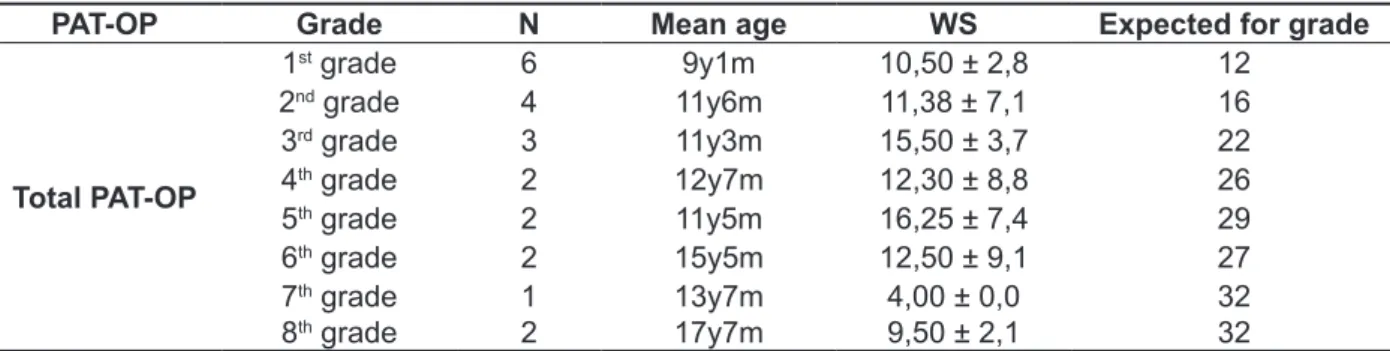
Table 3 summarizes results of the group with WS at PAT-OP for each school grade. Wilcoxon analysis revealed a signiicant diference (Z = - 4,110; p <
0,001) between the performance of the WS group and the expected result according to level of
education based on PAT-OP’s normative data25. A Pearson correlation analysis was also made
of total performance at PAT-OP and age (months),
years of study / education (1st to 8th) and indicators
of intellectual abilities. As it can be seen on Table 4, no signiicant correlations were observed.
to each grade. Thus, we considered the following:
7 years old = 1st grade; 8 years old = 2nd grade; 9 years old = 3rd grade; 10 years old = 4th grade; 11 years old = 5th grade; 12 years old = 6th grade; 13 years old = 7th grade; and 14 years old = 8th grade. Then, we proceeded to comparing normative data according to grade, so that participants with WS were compared to younger children but which study
at the same grade. Concerning the classiication at PAT-OP, the comparison of performances of
children with WS with normative data according to education25 revealed that one participant presented
low classiication while the remaining 21 presented “very low” classiication. These indings indicate that children with WS had performances below the expected at PAT-OP considering standard scores according to age and level of education, even when
compared to younger children. Table 1 shows the
classiication of participants according to age and level of education.
Special education (SE) students were compared to the grade that corresponds to their age: 8y10m
Table 1 – Characterization of participants, including gender, education, IQ, total score at pat-op and
classiication considering normative data
N Gender Age Grade IQ Total
PAT-OP
Classiication
PAT-OP (Age)
Classiication
PAT-OP (Education)
1 F 7y 5m 1st 77 09,5 Low Very low
2 M 7y 9m 1st 62 11,0 Low Very low
3 F 8y 1st 83 05,5 Very low Very low
4 M 9y1m 1st 56 13,5 Very low Very low
5 M 16y3m 1st 45 11,0 Very low Very low
6 F 8y10m 1st SE 80 12,5 Very low Very low 7 M 8y 1m 2nd 68 06,5 Very low Very low
8 M 9y2m 2nd 85 22,0 Low Low
9 M 12y10m 2nd 49 08,0 Very low Very low 10 F 17y10m 2nd 48 09,0 Very low Very low 11 M 9y9m 3rd 65 11,5 Very low Very low 12 F 10y10m 3rd 56 16,0 Very low Very low
13 F 14y 3rd 68 19,0 Very low Very low
14 F 11y2m 4th 54 06,0 Very low Very low 15 F 14y2m 4th 62 18,5 Very low Very low
16 M 12y11m 5th 68 21,5 Very low Very low 17 F 11y 5th SE 59 11,0 Very low Very low
18 M 15y 6th 56 19,0 Very low Very low
19 M 16y10m 6th 56 06,0 Very low Very low
20 F 13y7m 7th SE 45 04,0 Very low Very low 21 M 17y11m 8th SE 65 08,0 Very low Very low 22 F 18y3m 8th SE 62 11,0 Very low Very low
N: Participant number; IQ: Intelligence Quotient; PAT-OP: Phonological Awareness Test by Oral Performance; M: Male; F: Female; SE:
Table 2 – Descriptive analysis of phonological awareness aspects
Aspect N Mean SD Minimum Maximum
Syllabic synthesis 22 3,8 0,4 3 4
Phonemic synthesis 22 1,0 0,9 0 3
Rhyme 22 0,9 1,2 0 4
Alliteration 22 1,0 1,3 0 4
Syllabic segmentation 22 3,0 1,4 0 4
Phonemic segmentation 22 0,5 0,8 0 3
Syllabic manipulation 22 1,2 0,9 0 3
Phonemic manipulation 22 0,3 0,6 0 2
Syllabic transpositions 22 0,3 0,8 0 3
Phonemic transposition 22 0,1 0,3 0 1
N: Number of participants; SD: Standard deviation.
Table 3 – Mean total correct answers in pat-op for the group with Williams Syndrome and normative
group
PAT-OP Grade N Mean age WS Expected for grade
Total PAT-OP
1st grade 6 9y1m 10,50 ± 2,8 12 2nd grade 4 11y6m 11,38 ± 7,1 16 3rd grade 3 11y3m 15,50 ± 3,7 22 4th grade 2 12y7m 12,30 ± 8,8 26 5th grade 2 11y5m 16,25 ± 7,4 29
6th grade 2 15y5m 12,50 ± 9,1 27 7th grade
8th grade
1 2
13y7m 17y7m
4,00 ± 0,0 9,50 ± 2,1
32 32
Special education (SE) students were compared to the corresponding grade for their age: 8y10m with 1st grade; 11y with 5th grade
and 13y7m with 7th grade and above 14y with 8th grade.
N: Number of participants per grade; PAT-OP: Phonological Awareness Test by Oral Production; WS: Group with Williams Syndrome.
Table 4 – Pearson correlation analysis of results in the phonological awareness test and factors age
(months), education (1st to 8th grade) and indicators of intellectual skills
Age Education IQ
TOTAL
PAT-OP
r -0,011 -0,06 0,294
p 0,962 0,801 0,184
N 22 22 22
N: Number of participants; IQ: Intelligence quotient; PAT-OP: Phonological Awareness Test by Oral Production; p: signiicance; r: cor
-relation coeicient.
DISCUSSION
Compared to normative data, results obtained by individuals with WS were lower in almost all PAT-OP subtests. Only at the syllabic synthesis subtest did individuals with WS present adequate
results in relation to normative data indexes. This information suggests individuals with WS acquire syllabic awareness before phonemic awareness, as
it is the case for people with typical development18.
Moreover, syllabic skills seem to be less impaired than general intelligence skills, as shown in Table 1.
However, it is important to point that this is the
simplest subtest, seeing that syllabic analysis and other supra-segmental skills tend to develop more naturally once that syllables are units that require
less analysis efort18. Lower scores were found in
grapho-phonemic activities17. Thus, we can interpret that, when children become aware, analyze and
manipulate segments or pieces of speech, besides
having perceived that oral language is made
of words, syllables and phonemes, they have
developed or are developing and using their phono-logical awareness18-21,25.It is still possible to consider that the learning process is not the same and does
not occur at the same time for all children, and this diference can be directly related to intrinsic factors,
which, in their turn, depend on environmental,
socioeconomic and cultural factors.
CONCLUSION
Data from this study corroborate the indings of literature that suggest that individuals with WS present diiculties in phonological processing tasks.
These results have important implications for inter
-vention programs and educational planning aimed
at teaching writing and reading skills for children with WS. It is necessary, for instance, to consider in such programs the fact that this population presents
intellectual disability, which is particularly important
in Brazilian context where inclusion process present severe laws for the education of children
with special needs. It is also necessary to include continuous stimulations programs, with early
inter-ventions for children with WS in preschool age,
adapted teaching methods and curriculum.
Further research is required to broaden the
characterization of the proile of phonological
processing skills in WS. Some aspects that could be
contemplated in further studies are: larger sample;
more detailed metalinguistic analysis; assessment
of reading and writing skills for those who attend elementary school and efects of interventions using
phonic method to develop phonological awareness skills.
phonemic transposition. This can be explained by the fact that phonemes are the smallest units of the language (which can also explain the diiculty
to perceive them) and that phonetic and phonemic
segments require a high degree of analytical
capacity. Nevertheless, possible relations between phonemic awareness and syllabic skills in children with WS are still not well established2. The impaired
phonological awareness skills found in the group with WS can be part of the typical language phenotype of the syndrome, in which there is often sophisticated domain of syntax and vocabulary, while metacognitive deicits are also present, once
the individuals themselves do not understand the
immediate implications of phrases and sentences
they say14,15,26.
Both age and level of education inluence the development of phonological awareness, that is, these two factors contribute to the development
of metaphonoloical competences27. However,
Pearson correlation analysis of performance and
variables such as age, level of education (1st to 8th
grade) and IQ did not reveal signiicant correla
-tions. The indings corroborate previous studies28,29.
According to normative data25 there is a progression
in scores related to higher level of education in all
PAT-OP subtests and that determines a growth in total correct answers. Individuals with WS, on the other hand, present irregularity in all analyzed items;
this shows that, unlike the control group, for this group there is no relation between level of education and number of correct answers at PAT-OP.
Data from the present study was analyzed
without considering the participants’ ability to read and write. Phonological awareness depends on the writing system that is being taught and phonemic awareness appears to be achieved only with the
introduction of an alphabetic system18-21,25,27.This
capacity gradually develops as the child experi
REFERENCES
1. Porter MA, Dobson-Stone C, Kwok JBJ,
Schoield PR, Beckett W, Beckett W et al. A Role for Transcription Factor GTF2IRD2 in Executive Function in Williams-Beuren Syndrome. PLoS
One. 2012;7(10):e474-570.
2. Mervis CB, Velleman S. Children with Williams
Syndrome: Language, Cognitive, and Behavioral Characteristics and their Implications for Intervention. Perspect Lang Learn Educ. 2011;1;18(3):98-107. 3. Karmilof-Smith A, D’Souza D, Dekker TM, Van Herwegen J, Xu F, Rodic M et al. Genetic and
environmental vulnerabilities in children with neurodevelopmental disorders. Proc Natl Acad Sci
U S A. 2012;16;109(Suppl 2):17261-5.
4. Collins RT, Aziz PF, Gleason MM, Kaplan PB,
Shah MJ. Abnormalities of cardiac repolarization
in Williams syndrome. Am J Cardiol. 2010;
1;106(7):1029-33.
5. Greer J, Riby DM, Hamiliton C, Riby LM. Attentional
lapse and inhibition control in adults with Williams Syndrome. Res Dev Disabil. 2013;34(11):4170-7.
6. Lima SFB, Teixeira MCTV, Carreiro LRR, Seraceni
M, Kim CA, Segin M et al. Manejo comportamental de crianças e adolescentes com Síndrome de
Williams: guia para professores, pais e cuidadores. São Paulo: Memnon Edições Cientíica; 2013.
7. Pober BR. Williams-Beuren syndrome. N Engl J
Med. 2010;21;362(3):239-52.
8. Honjo RS. Detecção da microdeleção 7q11.23 por MLPA® e estudo clínico dos pacientes com
síndrome de Williams-Beuren [tese]. São Paulo (SP): Universidade de São Paulo; 2012.
9. Martens MA, Wilson SJ, Reutens DC. Research Review: Williams syndrome: a
critical review of the cognitive, behavioral, and
neuroanatomical phenotype. J Child Psychol
Psychiatry. 2008;49(6):576-608.
10. Mervis CB, Velleman SL. Children with Williams Syndrome: Language, Cognitive, and Behavioral Characteristics and their Implications for Intervention. Perspect Lang Learn Educ. 2011;18(3):98-107. 11. Teixeira, MCTV, Segin M, Martin MAF, Lellis
VRR, Araujo MV, Schwartzman JS et al. Protocolo de avaliação neuropsicológica, comportamental e clínica para rastreamento de indicadores de desatenção e hiperatividade na síndrome de Williams-Beuren. Cad. pos-grad. disturb. desenvolv. 2010;10(1):59-75.
12. Osório A, Cruz R, Sampaio A, Garayzábal E, Martínez-Regueiro R, Gonçalves ÓF et
al. How executive functions are related to
intelligence in Williams syndrome. Res Dev
Disabil. 2012;33(4):1169-75.
13. Nunes MM, Honjo RS, Dutra RL, Amaral VS, Amaral VAS, Oh HK et al. Assessment of Intellectual
and VisuoSpatial Abilities in Children and Adults with Williams Syndrome. Universitas Psychologica. 2013;12(2):581-9.
RESUMO
Objetivos: avaliar o desempenho de crianças e adolescentes com Síndrome de Williams em tarefas
de consciência fonológica e analisar esse desempenho em função da idade, escolaridade e indicado
-res de habilidade intelectual. Métodos: vinte e duas crianças e adolescentes (11 meninos e 11 meni-nas) com idades entre 7 e 18 anos realizaram os subtestes cubos e vocabulário das Escala Wechsler de Inteligência para estimativa de habilidades intelectuais e responderam a Prova de Consciência Fonológica por produção oral. Resultados: os participantes obtiveram valores do quociente de
inteli-gência estimado compatível com rebaixamento intelectual. Nas habilidades de consciência fonológica os resultados mostraram que os participantes com a síndrome obtiveram desempenho rebaixado em nove dos dez subtestes da prova de consciência fonológica em relação à pontuação padronizada em função da idade, assim como do nível escolar. Não foram encontradas correlações signiicantes
entre consciência fonológica, indicadores de habilidade intelectual, idade e escolaridade. Conclusão:
os resultados corroboram os encontrados em pesquisas internacionais sugerindo rebaixamento em consciência fonológica na Síndrome de Williams. Dada a relevância desses achados é necessário
incluir programas de estimulação contínua, inclusive com intervenções precoces dirigidas a crianças
com Síndrome de Williams em idade pré-escolar, adequação de métodos de ensino e de currículo
adaptado.
22. Wechsler, D WISC III: Escala de inteligência Wechsler para crianças: manual. 3.ed. São Paulo: Casa do Psicólogo; 2002.
23. Nascimento E. Adaptação e validação do teste
WAIS-III para um contexto brasileiro [tese]. Brasília
(DF): Universidade de Brasília; 2000.
24. Mello CB, Argollo N, Shayer BPM, Abreu N,
Godinho K, Durán P et al. Abbreviated version of
the WISC-III: correlation between estimated IQ and
global IQ of brazilian children. Psicologia Teoria e
Pesquisa. 2011;27(2):149-55.
25. Dias NM, Trevisan BT, Seabra AG. Dados normativos da Prova de Consciência Fonológica por produção Oral. In: Alessandra G. Seabra; Natália Martins Dias, organizador. Avaliação
Neuropsicológica Cognitiva: Linguagem Oral. São Paulo: Memnon Edições Cientíicas; 2012. p.
109-15.
26. Piattelli-Palmarini M. Speaking of learning: how do we acquire our marvellous facility for expressing
ourselves in words? Nature. 2001;411:887-8.
27. Maluf MR, Zanella MS, Pagnez KSMM.
Metalinguistic abilities and written language in brazilian research. Boletim de Psicologia.
2006;LVI(124):67-92.
28. Laing E, Hulme C, Grant J, Karmilof-Smith A. Learning to read in Williams syndrome: looking beneath the surface of atypical reading development. J Child Psychol Psychiatry. 2001;42(6):729-39. 29. Menghini D, Verucci L, Vicari, S. Reading and
phonological awareness in Williams syndrome. Neuropsychology. 2004;18(1):29-37.
14. Mervis CB. Language andLiteracy Development
of Children with Williams Syndrome. Top Lang
Disord. 2009;29(2):149-69.
15. Laing E, Hulme C, Grant J, Karmilof-Smith A. Learning to read in Williams syndrome: looking beneath the surface of atypical reading development. J Child Psychol Psychiatry 2001;42(6):729-39. 16. Menghini D, Verucci L, Vicari S. Reading and
phonological awareness in Williams syndrome. Neuropsychology. 2004;18(1):29-37.
17. Becerra AM, John AE, Peregrine E and Mervis CB.
Reading Abilities of 9 – 17-Year- Olds with Williams Syndrome: Impact of Reading Method. Symposium on Research in Child Language Disorders; Madison,
WI. 2008.
18. Seabra AG, Capovilla FC. Problemas de leitura
e escrita: Como identiicar, prevenir e remediar numa abordagem fônica. 6.ed. São Paulo: Memnon Edições Cientíicas. 2012.
19. Seabra AG, Dias NM. Avaliação Neuropsicológica Cognitiva: Linguagem oral. São Paulo: Memnon
Edições Cientíicas, 2012.
20. Seabra AG, Dias NM. Métodos de alfabetização:
delimitação de procedimentos e considerações
para uma prática eicaz. Rev. Psicopedag 2011;28(87):306-20.
21. Maluf MR. Do conhecimento implícito à
consciência metalinguística indispensável na
alfabetização. In: Guimarães SRK, Maluf MR.
Aprendizagem da linguagem escrita: contribuições da pesquisa. São Paulo: Vetor Editora. 2010. p. 17-32.
Received on: May 05, 2015 Accepted on: July 03, 2015
Mailing address:
Luiz Renato Rodrigues Carreiro
Rua da Consolação, 896, prédio 28, 1º andar
São Paulo - SP CEP: 01302-907