Revista Gaúcha
de Enfermagem
How to cite this article:
Fernandes VMB, Santos EKA, Erdmann AL, Pires DEP, Zampieri MFM, Gregório VRP. Establishment of lactaton rooms in public and private companies: potentialities and difficulties. Rev Gaúcha Enferm. 2016;37(spe):e2016-0046. doi: http:// dx.doi.org/10.1590/1983-1447.2016. esp.2016-0046.
doi: http://dx.doi.org/10.1590/1983-1447.2016.esp.2016-0046
Establishment of lactaton rooms
in public and private companies:
potentialities and diiculties
Implantação de salas de apoio à amamentação em empresas públicas e privadas: potencialidades e dificuldades
Despliegue de habitaciones lactancia de apoyo en empresas públicas y privadas: capacidades y dificultades
a Universidade do Sul de Santa Catarina (UNISUL),
Unidade Pedra Branca, Faculdade de Enfermagem, Palhoça, Santa Catarina, Brasil.
b Universidade Federal de Santa Catarina (UFSC),
Programa de Pós-Graduação de Enfermagem. Flori-anópolis, Santa Catarina, Brasil.
Vanessa Martinhago Borges Fernandesa Evanguelia Kotzias Atherino dos Santosb Alacoque Lorenzini Erdmannb Denise Elvira Pires de Piresb Maria de Fátima Mota Zampierib Vitória Regina Petters Gregóriob
ABSTRACT
Objective: To know how managers of public and private companies view lactation support rooms and their implantation.
Method: This is study is based on qualitative, exploratory, and descriptive research. Twenty managers from Greater Florianópolis participated in the research, in 2015. Data were collected by means of semi-structured/projective interviews, and subjected to content analysis associated with Atlas.ti software.
Results: Data analysis led to the following two categories: difficulties and facilities of establishing a lactation room, with a predo-minance of financial difficulties and the lack of physical space. Dialectically, the subjects also recognised the low cost involved, which facilitates establishment.
Conclusion: Financial, cultural, and political aspects make it difficult to set up lactation rooms, but the importance of this measure was acknowledged. Although the success of breastfeeding partly depends on these support rooms, it also requires multiple actions, especially the effective participation of nurses and other health workers.
Keywords: Women, Working. Breast Feeding. Legislation. Public Health Policy.
RESUMO
Objetivo: Conhecer a visão de gestores de empresas públicas e privadas acerca das salas de apoio à amamentação, com vistas à sua implantação.
Método: Pesquisa qualitativa, exploratória descritiva, realizada em 2015, da qual participaram 20 gestores da Grande Florianópolis. Para a coleta de dados, foram utilizadas entrevistas semiestruturadas/projetivas e, para a análise, a Análise de Conteúdo, associada aos recursos do software Atlas.ti.
Resultados: Emergiram duas categorias, a saber, dificuldades e facilidades na implantação de sala de apoio à amamentação, com predomínio de aspectos dificultadores, especialmente financeiros, envolvidos na disponibilização de espaço físico. Dialeticamente, também houve reconhecimento do baixo custo envolvido, o que facilitaria sua implantação.
Conclusões:Aspectos financeiros, culturais e políticos dificultam a implantação de salas de apoio à amamentação, mas há o reconheci-mento da importância da medida. Para o sucesso da amamentação, a implantação de salas de apoioé importante, porém, não suficiente, sendo necessárias múltiplas ações e, principalmente, uma atuação mais efetiva da enfermagem e dos demais profissionais de saúde.
Palavras-chave: Trabalho feminino. Aleitamento materno. Legislação. Políticas públicas de saúde.
RESUMEN
Objetivo: Conocer la visión de los gestores de la empresa pública y privada sobre las habitaciones de apoyo a la lactancia, con vistas a su puesta en práctica.
Método: La investigación fue cualitativa, exploratoria y descriptiva. Participaron 20 gerentes en Florianópolis en 2015. Para la recolección de datos se utilizaron entrevistas semiestructuradas/proyectiva y para análisis, Análisis de Contenido asociado a los recursos del software Atlas.ti.
Resultados: Surgieron dos categorías, las dificultades y las facilidades en la implantación de sala de apoyo a la lactancia, donde predominan los aspectos que obstaculizan, especialmente los financieros, involucrados en el espacio físico. Dialécticamente, también hubo reconocimiento del bajo costo involucrado, lo que facilitaría su aplicación.
Conclusión: Los aspectos financieros, culturales y políticos dificultan la implantación de salas de lactancia materna,es importsnte implantar salas de apoyo, sin embargo, no es suficiente, requiere múltiples acciones y, sobre todo, un funcionamiento más eficaz de la enfermería y otros profesionales de la salud.
INTRODUCTION
Breastfeeding is not simply an instinctive practice; it should be perceived as a fundamental necessity that must be continued in a timely manner. Healthcare pro-fessionals should be qualified to holistically accommo-date and respond to the needs of nursing mothers at the workplace, and provide humanised and individualised care for these workers(1)
In Brazil, several achievements have been made to re-store this practice; however, family policies are still insuf-ficient with respect to the reconciliation of women’s paid work and breastfeeding, and family care as a whole. It is therefore prudent to discuss how the country is promot-ing these actions and how they respond to the official pro-breastfeeding discourse(2).
In the quest for better results, the “Ação da Mulher
Tra-balhadora que Amamenta” (action of the working
wom-an who breastfeeds) was launched in 2010. This action is part of a priority care line of the general coordination of the child health and breastfeeding of the Brazilian ministry of health, and consists of creating a culture of respect and support for breastfeeding in public and private companies to promote the health of workers and their infants, with direct benefits for firms and society(3).
Simultaneously, the Brazilian ministry of health and the national health inspection agency published a technical note entitled, “Sala de Apoio à Amamentação em Empresas” (breastfeeding support room in companies), subsequently approved as Ordinance 193, on 23 February 2010, to guide on the establishment and inspection of lactation rooms in private and public companies, together with the local health inspection(4).
A number of activities was initiated in Brazil focusing on three ideals: increasing maternity leave to 180 days; the in-stallation of nurseries in workplaces; and the establishment of lactation rooms in enterprises(3).
There are three main reasons that justify the need for an appropriate location for breastfeeding, namely main-taining milk production; providing relief from the dis-comfort of leaking breasts during the time mothers are at work; and the correct storage of breast milk to feed the worker’s child or for donation to a human milk bank(4). However, it was noted that most companies do not pro-vide a suitable place for nursing workers to pump their breasts during the workday.
It is not only the mother and child who benefit from lactation rooms; companies that invest on this strategy also benefits from less absenteeism, as breastfed children get
sick less often; greater adherence to work due to the pro-vided comfort and appreciation of women’s’ needs, which cuts the cost of hiring and training of new employees; and a positive company image (4).
Moreover, companies should ensure the continuity of breastfeeding to discourage total or partial early weaning. In addition to the appropriate place for breastfeeding or milk pumping, the conduct of health workers regarding breastfeeding is often inadequate. It has been observed that nursing teams are failing to provide the most basic guidance during the breastfeeding process and directly in the way they conduct their practice(1).
Given the scientific gap regarding the perspective of managers on breastfeeding in the workplace(5), it is important to find a new outlook for working mothers, where the views of managers on establishing a lactation room reorient the work of nurses and other health work-ers directly involved with these women, and transform healthcare inside the workplace. Therefore, the research question was, “How do the managers of public and pri-vate companies view lactation rooms and their possible implementation?”
Thus, the aim of this paper was to learn about the view of public and private company managers in greater Flori-anópolis, Santa Catarina, on lactation rooms and their pos-sible installation.
METHODOLOGY
This is qualitative, exploratory, and descriptive research conducted in Greater Florianópolis, Santa Catarina, Brazil.
The participants were 20 managers of 10 public companies and 10 private companies. The selected par-ticipants had the greatest power of decision on the es-tablishment of a lactation room in the institutions. The sample size was determined using theoretical satura-tion, where the equal number of both company types was intentional.
The criteria for inclusion included businesses located in this area with more than 30 working women of childbear-ing age. The criterion for exclusion was companies that had lactation rooms.
invited to participate in the research, of which 20 accepted and 19 refused.
Data were collected in August 2015 using two types of techniques with all the participants: semi-structured inter-view and projective interinter-view. The first stage consisted of a script of questions on the prior experiences of the manag-ers in relation to the rights of workmanag-ers who breastfeed and the importance of breastfeeding for children, the family, and society. In the second step, the projective interview was used to capture the perception of the managers re-garding lactation rooms and their opinion about setting up a room in their companies.
The data were stored and analysed using software for qualitative data analysis, Atlas.ti version 7.0(6). Data were subjected to categorical and thematic content analysis proposed by Laurence Bardin(7), based on three stages: pre-analysis, exploitation or coding of material, and pro-cessing of results and interpretation. The first is the stage of organisation; the second comprises coding operations; and, the third consists of processing raw results to make them meaningful and valid.
The study was approved by the research ethics commit-tee of the Universidade Federal de Santa Catarina – CAAE n. 44950615500000121, according to Resolution 466/2012, of the national health council. All the participants signed an informed consent statement. This article originated from a master’s dissertation(5).
RESULTS AND DISCUSSION
Characterisation of participants and study sites
The managers were mostly men (75%), aged between 30 and 61 years, with post-graduate degrees (90%), mar-ried (70%) and with children (80%). In terms of position, 35% were executive managers, 35% were members of the board, and 30% were managers. In terms of the compa-nies, 50% were private, 50% were public, and 80% of the total had subsidiaries. The companies diversified in the sectors of public security, judiciary, healthcare, education, electronics, steelworks, telecommunications, trade, and credit union.
Diiculties and facilities in the establishment of lactation rooms
The vision of the managers on setting up lactation rooms resulted in two categories: category 1, difficulties, and category 2, facilities.
Category 1 – Diiculties for the establishment of lactation rooms
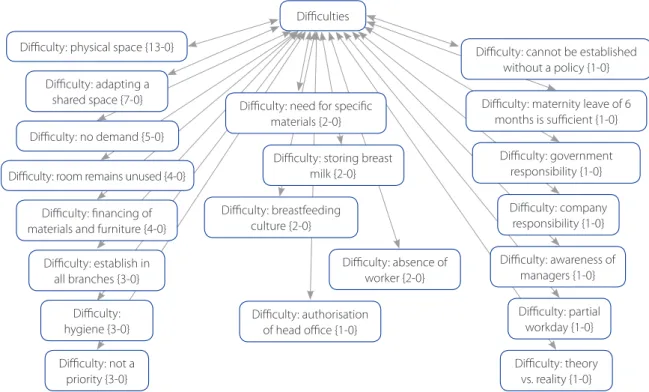
The difficulties pinpointed by the managers were mostly related to structural requirements, namely, lack of space; problems adapting shared spaces; low number of breastfeeding workers; the company’s financial prob-lems, such as difficulties in providing human and materi-al resources; and the improbability of establishing these rooms in the entire company network. We also identi-fied difficulties such as lack of breastfeeding culture; lack of awareness of the managers; and doubts in relation to who is responsible for setting up the lactation rooms (company or government). These findings can be seen in Figure 1.
According to the managers, the predominant diffi-culties setting up a lactation room in the workplace were space and costs. Among the companies surveyed, 100% did not have lactation rooms, but 45% provided some space if required by the workers.
All the space inside a company is extremely precious and we do not make space to leave it open (Manager 20, Man-ager 9/Category 1: Difficulties/Physical Space).
I don’t know if we need all that apparatus or if there could only be that room without all the apparatus, be-cause I think that would make it hard to put into prac-tice (Manager 17/Category 1: Trouble/Need for specific materials).
How would I organise myself and how can I demand strict cleaning and dedication of the state in relation to that room in particular to guarantee the safety and health for the mother and the mother’s milk? (Manager 19/Category 1: Difficulties/Hygiene).
It is worth noting that, according to other studies, pro-viding exclusive space is a small investment, and educat-ing the managers on the return of this application can ease their concerns regarding cost/effectiveness(8). The lactation room requires at least one comfortable chair, a small table, one tap with running water, an electrical outlet, and a door with a lock(9). It also needs milk extraction pumps, refriger-ator, privacy, and time to breast-feed or to extract breast milk(10). Namely, it requires a low investment.
Not that we are against it, but it’s a matter of demand (Manager 20/Category 1: Difficulties/No demand).
The number of babies born is not so significant (Manager 5/Category 1: Difficulties/No demand).
In general, the space would not be used that much (Man-ager 16/Category 1: Difficulties/Room remains unused).
Of all the research sites, 50% were private companies and 50% were public companies, and of this total, 80% owned subsidiaries. The number of employees of the com-panies ranged from 70 to 18,000, of which 30 to 10,800 were women. Therefore, the number of working women of childbearing age in all these companies justifies the reali-sation of pro-breastfeeding actions.
As found in this research, in addition to the functional-ity, the challenges of cost/effectiveness and schedule are some of the concerns of employers already mentioned in other studies(8). This problem could be remedied with the work of a health professional, who is aware of the demand, the types of materials that are used, and their financial costs.
The participants of this study stressed that the solu-tion to the problem of funcsolu-tionality/demand/space could
be adapting a room with another purpose so it could be shared as a lactation room.
I couldn’t make this room exclusively for this purpose, but it could be an area that could be useful for this purpose (Manager 17/Category 1: Difficulties/Adapting a shared space).
There is the study room, if adapted, it could be reserved for that period. Now do a specific room to be closed a few years ago, to be eventually a situation, wouldn’t have the slightest condition (Manager 20/Category 1: Difficulties/ Adapting a shared space).
Literature provides records of the concerns of em-ployees with the functionality of the lactation room and the suggestion for its multipurpose use(8-11). In contrast, there are also records that spaces exclusive-ly intended for lactation increase the worker’s desire to continue breastfeeding(12). In Pakistan, a study com-pared different lactation rooms and found that work-ing mothers with access to these rooms had greater awareness, while the workers without this exclusive space for lactation felt ashamed to use them in front of their coworkers(10).
Figure 1 – Category 1: Difficulties. Difficulties mentioned by the managers for the establishment of lactation rooms.
Source: Research data, 2015, figure created with Atlas.ti software. Difficulty: physical space {13-0}
Difficulty: adapting a shared space {7-0}
Difficulty: no demand {5-0}
Difficulty: room remains unused {4-0}
Difficulty: financing of materials and furniture {4-0}
Difficulty: establish in all branches {3-0}
Difficulty: hygiene {3-0}
Difficulty: not a priority {3-0}
Difficulty: need for specific materials {2-0}
Difficulty: storing breast milk {2-0}
Difficulty: breastfeeding culture {2-0}
Difficulty: absence of worker {2-0}
Difficulty: authorisation of head office {1-0}
Difficulty: cannot be established without a policy {1-0}
Difficulty: maternity leave of 6 months is sufficient {1-0}
Difficulty: government responsibility {1-0}
Difficulty: company responsibility {1-0}
Difficulty: awareness of managers {1-0}
Difficulty: partial workday {1-0}
The absence of a written breastfeeding policy in the institutions hinders the establishment of a lactation room. Ideally, this could be constructed by a healthcare professional. None of the studied sites had a written or official policy on breastfeeding; the companies provided some form of lactation support, but they did not provide full support.
Of the studied companies, 35% provided healthcare professionals, of which 10% were in other main offices and another 10% had health-related professionals; only 5% had nurseries and 35% provided financial nursery assistance. However, the professional work in the public and private sectors does not focus on preventing early weaning, and this topic is minimally explored in care, in research, and in teaching. This lack of exploration prevents the effective re-alisation of any action related to breastfeeding.
If I had this philosophy and that gestational organisation, of public management, it would be entirely feasible (Man-ager 19/Category 1: Difficulties/Cannot be established without policy).
More comprehensive support could be provided by the company with a written policy. The lactation room can-not be provided in isolation, without guidance or regula-tory standards.
According to literature, setting up an appropriate room for breastfeeding or extracting milk without a pol-icy does not guarantee the maintenance of breastfeed-ing(13). In Twain, 98.3% of the workers were aware of the availability of the lactation room, but only 36.2% used it(12). This finding shows that health workers, especially nurses, should explore this field more closely based on the assumption that they are the agents who can trans-form this reality, starting with the construction of policies or written support guidelines and the promotion and protection of working woman who breastfeed in public and private companies.
The managers who participated in this study stated they have too many responsibilities and little support from the government. According to literature, government sup-port to guarantee the right to breastfeed imposes on the state the obligation of providing safe, hygienic, and digni-fied conditions for breastfeeding, free from all forms of vio-lence and discrimination against the employee(14).
Anything, no matter how well intentioned you are. De-pending on the situation, you get fined, even legal action (Manager 7/Category 1: Difficulties/Storing breast milk).
Everything the government proposes is great, the congres-sional representative speaks, the senator speaks, the mayor speaks, everyone speaks. Then you go to work and it’s not what everybody says, it’s not what was presented (Manag-er 20/Category 1: Difficulties/Theory vs. Reality).
A law that obliges companies with workers of child-bearing age in provide lactation rooms should be ap-proved, as one of the obligations of the current govern-ment. The responsibilities regarding the establishment and operation of these rooms would continue in charge of the companies. However, the criticism of the managers of this study does not refer to the lack of laws and policies, but to the lack of effective government support, in the financial sense.
In addition to the lack of support to establish lactation areas, some managers also showed concerns with the re-sponsibilities to maintain these rooms in terms of frequent cleaning and proper storage of breast milk. These concerns could be remedied with the help of a qualified health pro-fessional, especially a nurse.
Pumping breast milk in the workplace is uncommon and rarely mentioned from pregnancy to the puerperal period(1). Managers and workers need guidance on how to support the continuation of breastfeeding in the company. Moreover, it is important for health workers to get involved in breastfeeding support in the context of public and pri-vate companies.
In this research, we also observed the managers lack awareness on the importance and benefits of this measure.
It is because maybe it´s not reaching us in a way that in-creases more awareness than the cost from central admin-istration (Manager 11/Category 1: Difficulties/Awareness of managers).
Although the managers have a background in higher education, high decision-making power, and personal and professional maturity, they are all unaware of the recom-mendation of the ministry of health to establish lactation support or of ways to support breastfeeding workers.
According to literature, it is important to focus on the factors associated with awareness of the support of breast-feeding workers. Some states of the United States approved campaign laws to raise awareness about the importance of breastfeeding and the rights of women(15).
One of the difficult aspects mentioned by the manag-ers were factors associated with time (pause for breastfeed-ing/maternity leave/working hours).
In those cases when the employee stays at work for 10 hours and starts to feel that discomfort, then it’s justified. But here, it’s 7 hours, when the body begins to show signs that you have to breastfeed, it’s time to go home (Manager 15/Category 1: Difficulties/Partial workday).
Regarding maternity leave at the surveyed locations, the public companies offer 180 days and the private com-panies offer 120 days; only one offers 135 days. With re-spect to the break to breastfeed, 50% allowed time since they were private companies of a civil-service regime, while others reported offering a casual break because their companies were not supported by the law.
In relation to the workload of the women at the sur-veyed companies, 5% worked 25 hours; 15%, 30 hours; 10%, 35 hours; 5%, 36 hours; 30%, 40 hours; and 35%, 44 hours a week. That is, most women work full time.
The absence of working women to pump breast milk was considered a difficulty by the interviewed managers since it depends on the good sense of managers and co-workers because this right is not ensured for the entire lac-tation period(16).
According to other studies, women who breastfeed mentioned the lack of privacy and breaks to pump milk in the workplace(17). Women who do not have breaks for breastfeeding in the workday are more likely to wean be-fore the sixth month than women who have a breastfeed-ing break in the workday(13; 18). And the duration of breast-feeding is longer for women who have a partial working day than for the women who work full time(11).
That is, the time of maternity leave and an appropriate working day alone are insufficient to maintain breastfeeding for two years or more; there must be a legally required breast-feeding break after women go back to work until the end of the breastfeeding period. Even if women work part time, they must still commute to and from work and complete their daily workload. Therefore, it is imperative that the companies allow time for a break to breastfeed and pump milk.
Furthermore, the companies are not adopting the
Programa Empresa Cidadã (citizen company programme)
based on the law that allows companies to increase ma-ternity leave from 120 to 180 days in exchange for tax ex-emptions from the government. By adhering to this pro-gramme, they can also increase the paternity leave from five to 20 days(19).
Category 2 – Facilities for the establishment of lactation rooms
Although the lack of physical space and the econom-ic aspects were considered hindrances for the establish-ment of lactation rooms, these aspects were also men-tioned as facilitators.
Some of the most cited facilities by the interviewed managers for the establishment of lactation rooms were lack of financial problems, the availability of physical space, and the positive opinion of these managers, among other possibilities, as shown in Figure 2.
The low cost for setting up and effectively using lactation rooms was acknowledged by the managers of this survey.
I actually have it here in the company, due to important actions with suppliers, sometimes it’s a structure that part of it is already in place (Manager 11/Category 2: Facilities/ Materials available).
I think it’s a minimum cost to the institution, which is pret-ty good. It’s a big company, a minimum budget, I think it would be well diluted. The priority is not a luxury! (Manag-er 19/Category 2: Facilities/Financial issues).
Support at work, from managers and coworkers, such as emotional support and practical help, is also consid-ered essential and highly influential for the practice of breastfeeding(12).
I thought that the child had to be there to breastfeed (Man-ager 4/Category 2: Facilities/No need to take the child).
A lactation room is used to pump and store breast milk(4), which does not require the moving of women or their children, thus reducing financial costs and optimising service time.
A budget to cover the requirements of setting up and maintaining a lactation room could ease the anxiety of managers and increase the feasibility of creating lactation rooms in work environments.
I thought I would be harder, that it would be like a nursery, someone would have to bring the child, having to move around and all that. [...] It is not that difficult to do, it’s simple (Manager 4/Category 2: Facilities/Thought to be simple).
This kind of facility was considered by some man-agers of this study as being simple because it does not require high technology; feasible because it does not require trained professionals; suitable because it does not require large physical space due to the number of workers who breastfeed; and facilitated because it does not require the presence of the child. In other words, it was considered a simple investment by the companies that do not see difficulties in setting up a room for this purpose and include it in future planning of new buildings.
Another aspect was the positive vision of the manager in relation to this initiative.
As support, I think it’s great. [...] Of course, after our con-versation I’m going to talk to our administrator (Manager 1/Category 2: Facilities/Positive opinion of the manager).
To set it up, I think it would not be difficult to convince the central administration, since it is a family business (Man-ager 11/Category 2: Facilities/Family business).
We have a certain awareness with the child who is the son of that worker, we’re not exempt of the responsibility of monitoring this process that is very difficult for the family (Manager 5/Category 2: Facilities/Educational institution).
In this study, the participants positively associated support with breastfeeding when they referred to being a family company and more sensitive to support, which
facilitates the establishment of other support actions in the companies. Through the promotion and support of managers, it is possible to influence the time women breastfeed and, thus, improve the health of the mother and baby. This could also reduce absenteeism at work and increase the productivity and job satisfaction of working women(9).
Some managers have a positive attitude in relation to providing a mother-friendly environment at work; how-ever, some clearly defend the idea of disadvantages for the enterprise(10). In general, companies are not open to receiving requests for breastfeeding support, and they often deal with problems as they arise(11), including lac-tation rooms.
Consequently, it is important to go beyond simply providing information to managers; it is necessary to chal-lenge their negative attitude toward breastfeeding(10).
CONCLUSION
This study shed light on the vision of managers of public and private companies in Greater Florianópolis, Santa Catari-na, on lactation rooms and their possible establishment.
The managers mentioned several difficulties for the establishment of lactation rooms in the companies. The difficulties include financial problems, lack of space or the impossibility of providing an exclusive area, equip-ment, and material, and lack of an institutional culture or social awareness of the importance of establishing breastfeeding support measures. Some managers were
Figure 2 – Category 2: Facilities mentioned by the managers for the establishment of lactation rooms
Source: Research data, 2015, figure created using Atlas.ti software. Facility: positive opinion
of the manager {5-0}
Facility: financial issues {5-0}
Facility: physical space {5-0}
Facility: thought to be simple {4-0}
Facility: thought to be viable {3-0}
Facility: family business {1-0}
Facility: future project {3-0}
Facility: low cost {1-0}
Facility: does not require large space {3-0}
Facility: predominancy of women {1-0}
Facility: no need to take the child {1-0}
Facility: educational institution {1-0}
Facility: similar environment {1-0}
concerned about the structure, others with the furni-ture and materials, and others with maintaining this type of room.
Dialectically, in the category of facilities, it was ac-knowledged that establishing lactation rooms is not costly, and awareness of their importance, on the part of managers, women and society, contribute to their establishment.
In view of the problems presented, nursing is con-sidered one of the professional categories with the greatest involvement in the promotion and support of breastfeeding, whether in hospitals, health centres, home care, or other health scenarios, including private and public companies.
The nurses who work in this field can raise the awareness of managers of the culture of breastfeed-ing and provide spaces to divulge knowledge on the establishment of lactation rooms. Nurses also provide other forms of support for the construction of policies and written routines for breastfeeding and the dissemi-nation of policies and laws to support working women who breastfeed.
This study strengthens the role of nursing in companies that support working women who breastfeed, and also support the managers. Consequently, it expands the sub-ject for research and extension, and serves as a pathway for the construction of knowledge and as a basis for scientific progress and education by providing a broader view for fu-ture professionals. To ensure the expansion of knowledge, it is necessary to train future professionals through service education and at academic level.
This study contributes to care and proposes political and strategic actions that stress the need to transform the practice of workers who participate in the process of moth-erhood in multiple care scenarios by empowering nursing mothers, guaranteeing their labour rights, and offering ad-equate support for the continuation of breastfeeding after women return to work.
It is necessary to create laws that ensure the establish-ment of lactation rooms, and written breastfeeding poli-cies for each company with fiscal and financial incentives and provisions, and consequences in the case of violation. Bigger investments are needed to increase the knowledge and awareness of the population regarding lactation sup-port in the workplace since it requires the mobilisation of all sectors of society.
This research has weak points, such as the selection of public and private companies, and companies of several industries and sectors. Its limitation may be the number
of interviewed managers and exclusive regional coverage. Future research can explore the generalisation of these re-sults in other types of companies.
The support of health workers to managers can in-fluence the duration of breastfeeding and improve the health of mother and baby, as well as reduce absen-teeism and increase the productivity and satisfaction of workers.
Furthermore, in this context, it also provides helps to create a culture of breastfeeding by adjusting the current model of care within the workplace. The mere establish-ment of a lactation room in companies is insufficient to en-sure the benefits of breastfeeding if it is not accompanied with essential support devices, such as maternity leave, breaks for breastfeeding, hours of work, and others, legally guaranteed through health professionals.
REFERENCES
1. Oliveira CS, Iocca FA, Carrijo MLR, Garcia RATM. Amamentação e as inter-corrências que contribuem para o desmame precoce. Rev Gaúcha Enferm. 2015;36(esp):16-23.
2. Kalil IR, Aguiar AC. Trabalho feminino, políticas familiares e discursos pró-alei-tamento materno: avanços e desafios à equidade de gênero. Saúde em debate. 2016;110(40):208-23.
3. Ministério da Saúde (BR). Mulher trabalhadora que amamenta. Brasília (DF); 2013.
4. Ministério da Saúde (BR). Guia para implantação de salas de apoio à amamen-tação para a mulher trabalhadora. Brasília (DF); 2015.
5. Fernandes VMB. Salas de apoio à amamentação: conhecimento de gestores de empresas públicas e privadas com vistas à sua implantação [dissertação]. Flo-rianópolis: Graduação de Enfermagem, Universidade Federal de Santa Catarina; 2015.
6. Friese S. Atlas.ti 6 Quick Tour. Berlin: Atlas.ti Scientific Software Development GmbH; 2010.
7. Bardin L. Análise de Conteúdo. São Paulo: Edições 70; 2011.
8. Bai YK, Wunderlich SM, Weinstock M. Employers’ readiness for the mother-friendly workplace: an elicitation study. Matern Child Nutr. 2012;8(4):483-91.
9. Abdulloeva S, Eyler AA. Policies on worksite lactation support within states and organizations. Res J Womens Health. 2013;22(9):769-74.
10. Hirani SAA, Karmaliani R. Evidence based workplace interventions to promote breastfeeding practices among Pakistani working mothers. Women Birth. 2013;26(1):10-6.
11. Hojnacki SE, Bolton T, Fulmer IS, Olson BH. Development and piloting of an instrument that measures company support for breastfeeding. J Hum Lact. 2012;28(1):20-7.
12. Tsai S. Impact of a breastfeeding-friendly workplace on an employed mother’s intention to continue breastfeeding after returning to work. Breastfeed Med. 2013;8(2):210-6.
14. Lima IMSO, Leão TM, Alcântara MAR. Proteção legal à amamentação, na pers-pectiva da responsabilidade da família e do Estado no Brasil. Rev Dir Sanit. 2013;14(3);66-90.
15. Nguyen TT, Hawkins SS. Current state of US breastfeeding laws. Matern Child Nutr. 2013;9(3):350-8.
16. Brasil. Decreto-lei n. 5.452, de 01 de maio de 1943: dispõe sobre a Consolidação das Leis do Trabalho (CLT). Brasília (DF); 1943.
17. Cooklin AR, Rowe HJ, Fisher JRW. Paid parental leave supports breastfeed-ing and mother-infant relationship: a prospective investigation of maternal postpartum employment. Aust N Z J Public Health. 2012;36(3):249-56. 18. Heymann J, Rauba A, Earleb A. Breastfeeding policy: a globally comparative
analysis. Bull World Health Organ. 2013;91(6):398-406.
19. Brasil. Lei n. 11.770, de 09 de setembro de 2008: dispõe sobre a criação do Pro-grama Empresa Cidadã. Brasília (DF); 2008.
Corresponding author:
Vanessa Martinhago Borges Fernandes E-mail: [email protected]