302
Rev Dor. São Paulo, 2015 oct-dec;16(4):302-5
ABSTRACT
BACKGROUND AND OBJECTIVES: Geriatric population
is considerably increasing. However, musculoskeletal disorders, especially chronic low back pain, which is one of the most com-mon complaints during outpatient assistance, seem to grow together with this phenomenon and physiotherapy may be an alternative to treat such pathology. his study aimed at reviewing in the literature information about physiotherapeutic manage-ment for chronic low back pain in the elderly.
CONTENTS: Twenty-six articles were selected by means of a query with research keywords in electronic databases Scielo and Pubmed, published in Portuguese and English, using the key-words low back pain (dor lombar), chronic pain (dor crônica), physical therapy specialty (fisioterapia) and aged (idoso), and published between 2006 and 2015.
CONCLUSION: Diferent physiotherapeutic techniques and resources are efective to manage the impact of low back pain in the elderly, such as kinesiotherapy (especially by means of sta-bilizing exercises), electrotherapy, hydrotherapy and individual education management.
Keywords: Chronic pain, Elderly, Low back pain, Physiotherapy.
RESUMO
JUSTIFICATIVA E OBJETIVOS: A população geriátrica vem crescendo consideravelmente nos últimos tempos. Contudo, os distúrbios osteomioarticulares, especialmente a dor lombar crônica, que é uma das queixas mais comuns nos atendimentos ambulatoriais, parecem crescer juntamente com esse fenômeno e a isioterapia pode servir como alternativa no tratamento dessa doença. O objetivo deste estudo foi revisar na literatura informa-ções a respeito do tratamento isioterapêutico no impacto da dor lombar crônica em idosos.
Physiotherapeutic intervention on chronic lumbar pain impact in the elderly
Intervenção fisioterapêutica no impacto da dor lombar crônica em idosos
Matheus Santos Gomes Jorge1, Caroline Zanin2, Bruna Knob3, Lia Mara Wibelinger3
1. Universidade de Passo Fundo, Faculdade de Fisioterapia, Bolsista Probic/FAPERGS, Sole-dade, RS, Brasil.
2. Universidade de Passo Fundo, Faculdade de Fisioterapia, Bolsista Pibic/CNPQ, São Jorge, RS, Brasil.
3. Universidade de Passo Fundo, Faculdade de Fisioterapia, Passo Fundo, RS, Brasil.
Submitted in August 05, 2015.
Accepted for publication in October 20, 2015. Conlict of interests: none – Sponsoring sources: none.
Correspondence to: Matheus Santos Gomes Jorge BR 285 – São José
99052-900 Passo Fundo, RS, Brasil. E-mail: [email protected]
© Sociedade Brasileira para o Estudo da Dor
CONTEÚDO: Foram selecionados 26 artigos por meio de uma consulta de indexadores de pesquisa nas bases de dados eletrôni-cos Scielo e Pubmed publicados nas línguas portuguesa e inglesa partindo dos descritores dor lombar (low back pain), dor crônica (chronic pain), isioterapia (physical therapy specialty) e idoso (aged), publicados no período de 2006 à 2015.
CONCLUSÃO: Diversas técnicas e recursos isioterapêuticos atuam com eiciência no tratamento do impacto da dor lom-bar crônica em idosos, como a cinesioterapia (especialmente por meio de exercícios estabilizadores), a eletroterapia, a hidroterapia e a gestão na educação do indivíduo.
Descritores: Dor crônica, Dor lombar, Fisioterapia, Idoso.
INTRODUCTION
In Brazil, elderly are individuals aged 60 years or above1. In
the next 20 years, the number of elderly people may exceed 30 million, corresponding to almost 13% of future popula-tion2.
Worldwide, approximately 100 million individuals have chronic musculoskeletal pain (CP), especially the elderly. he planning of public policies, the implementation of preventive programs and its control are needed to promote functionality and quality of life (QL)3.
CP in geriatric population represents almost 60% of com-plaints, especially in lumbar and cervical spine4 being that in
almost 80% of cases pain persists for at least 2 years5.
Among the elderly, predominance of chronic low back pain (CLBP) may reach approximately 70%, being more frequent among females6, between 60 and 69 years of age7, and in
individuals with low school education6. CLBP may also be
referred in diferent structures such as lower limbs9, causing
incapacity for daily life activities (DLA) and major impact on QL5.
Since CLBP restricts and afects DLA, occupational activities, leisure activities, functionality and physical capacity of the elderly, physiotherapy, by means of its diferent therapeutic resources, aims at providing symptoms relief, at preventing new injuries caused by the disease, in addition to assuring wellbeing and better QL for the geriatric population10.
So, this study aimed at addressing physiotherapeutic inter-ventions to improve CLBP in the elderly.
CONTENTS
his was a literature review where articles indexed in Scielo and Pubmed electronic databases were manually consulted
REVIEW ARTICLE
303
Physiotherapeutic intervention on chroniclumbar pain impact in the elderly
Rev Dor. São Paulo, 2015 oct-dec;16(4):302-5
from January 2006 to September 2015. Articles were selected as from the descriptor low back pain (dor lombar), crossed with keywords chronic pain (dor crônica), physiotherapy specialty (isioterapia) and aged (idoso), according to Science Health descriptors (DeCS).
Inclusion criteria were systematic reviews; clinical trials and case studies; articles in Portuguese and English; articles char-acterizing “CLBP, with emphasis in the elderly”, “physio-therapeutic approach for CLBP with emphasis in the geriatric population”; articles evaluating and/or having as one outcome pain, incapacity and/or QL; articles freely available in full in some of mentioned databases.
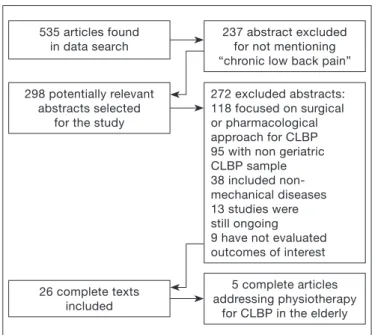
Exclusion criteria were articles not meeting mentioned crite-ria, articles addressing non-mechanical and/or acute pain or with a diferent approach from what had been proposed. After recruiting studies and their qualitative analysis, data were presented as follows. After an extensive search, 535 ar-ticles were found. heir abstracts were read and initially 298 articles were selected for being relevant for the study. After a judicious qualitative analysis, 26 complete articles were se-lected for meeting inclusion criteria and providing the theo-retical support of this study. Among included articles, 5 ad-dressed physiotherapeutic treatment of CLBP in the elderly within required criteria.
Figure 1 shows results of recruited and selected studies for this review.
Among selected studies, two involved electrotherapy, being that one has addressed aerobic exercises; one has involved just LBP management by self-care of the spine; one has involved water intervention by the Tai Chi method; and one has con-templated lumbar stabilization exercises, together with educa-tion of the elderly in pain handling. Sample size of included studies has varied from 16 to 200 individuals with CLBP. All studies had comparisons with at least two groups, of which
237 abstract excluded for not mentioning “chronic low back pain”
272 excluded abstracts: 118 focused on surgical or pharmacological approach for CLBP 95 with non geriatric CLBP sample 38 included non-mechanical diseases 13 studies were still ongoing
9 have not evaluated outcomes of interest
5 complete articles addressing physiotherapy
for CLBP in the elderly 535 articles found
in data search
298 potentially relevant abstracts selected
for the study
26 complete texts included
Figure 1. Flowchart of articles selection strategy
CLBP = chronic low back pain.
Table 1. Characterization of studies about physiotherapeutic intervention on chronic low back pain impact in the elderly Authors Sample Intervention protocol Study outcome
Döhnert, Bauere Pavão11
28 individuals with CLBP and aged characteristics
G1: IC (intervention) G2: TENS (controle) Time: 10 sessions (5 weeks)
G1 and G2: ↓ pain and incapacity and ↑ functionality No group was better than the other
Rios et al.12 30 active elderly with
CLBP
G1: speciic spinal self-care booklet and workshops
G2: without intervention Time: 4 weeks
G1: ↓ pain, incapacity, n. of painful points aud use of drugs
G2: without satisfactory results
Hall et al.13 160 volunteers aged
be-tween 18 and 79 years with CLBP
G1: Tai Chi exercises in water G2: routine health care Time: 18 sessions (10 weeks)
G1: ↓ presence of painful symptoms, pain intensity and functional incapacity
Hyoung14 16 elderly women with
CLBP
G1: LSE + education in pain management in daily life
G2: without intervention Time: 24 sessions (8 weeks)
G1: ↓ pain and incapacity, ↑ lexibility, satisfaction with life and MS
G2: without satisfactory results
Weineret al.15 200 ederly of both
gen-ders with CLBP
G1: PENS 30 min G2: PENS 5 min G3: PENS 30 min + AE G4: PENS 5 min + AE Time: 12 sessions (6 weeks)
All groups: ↓pain and impact on LBP and DLA; ↑ it-ness
PENS groups with AE: higher ↓impact of CLBP on DLA and ↑ itness
PENS groups without AE: higher ↓ pain
CLBP = chronic low back pain; G1 = Group 1; G2 = Group 2; LSE = lumbar stabilization exercise; ↓ decrease; ↑ increase; MS = muscle strength; IC = interferential current; TENS = transcutaneous electric nerve stimulation; PENS = percutaneous electric nerve stimulation; DLA = daily life activities; AE = aerobic exercises.
two have used control groups and the others have compared between intervention methods.
304
Jorge MS, Zanin C, Knob B and Wibelinger LM
Rev Dor. São Paulo, 2015 oct-dec;16(4):302-5
DISCUSSION
Our review has found diferent strategic ways to handle CLBP in the elderly, among them kinesiotherapy, electrotherapy, hydrotherapy and pain control management in daily lives of patients.
Population aging is currently a global phenomenon and studies intend to assure to the geriatric population better QL, evaluating morbidity factors to which the elderly are subject16. Among them, there is CP which, added to the
fast population aging process, assures to health profession-als an increasingly common experience difficult to handle in their daily practice17. In the elderly, CP is predominant
especially in lumbar spine and lower limbs, being that the higher its intensity the worse the health self-perception of the elderly18.
Initially, education of the elderly with CLBP by means of spi-nal self-care programs is a useful tool for treatment. In addi-tion to allowing better pain control, it decreases incapacity and costs generated by the disease12. When this approach is
associated to strengthening lumbar region with stabilizing exercises14, since the elderly afected by low back pain have
further spinal instability19, treatment becomes more efective
and promising.
Os exercícios de estabilização segmentar promovem contração da musculatura profunda do tronco, principalmente dos mús-culos transversos do abdômen e multíido. Esses exercícios são eicazes para reduzir a incapacidade e a dor na DLC20.
Segmental stabilization exercises promote deep trunk muscles contraction, especially transverse muscles of the abdomen and multiidus. hese exercises are efective to decrease CLBP in-capacity and pain20.
In the elderly, CLBP may be associated to physical incapacity and depression – both as risk factor and as depression as a consequence – which in turn interfere with patients’ recov-ery21. So, professionals evaluation should take into
consider-ation such related factors for a more concise approach8.
In addition to psychological factors, CLBP in the elderly has been related to decreased physical function, to increased probability of falls, and worse balance due to important pos-tural changes in the geriatric population22. A plausible
expla-nation for such could be sarcopenia (loss of muscle mass and strength), commonly associated to the aging process, which may impair functionality and QL of the elderly23.
his loss of muscle mass and strength, in addition to reaching peripheral muscles, may also afect deep abdominal muscles and cause lumbar spine instability. So, stabilizing exercises may be indicated as a more efective approach to strengthen such muscles14.
here are many reasons for pain in this population, which may be mechanical (where pain increases with movement or load) or non-mechanical (when pain is present at rest)24.
Electrotherapy may be a major ally for the treatment of CLBP in the elderly. Treatment modalities, such as interfer-ential current and transcutaneous electric nerve stimulation, provide significant pain and functionality improvement for
patients11, but electrotherapy should not be used as single
therapy.
Percutaneous electric nerve stimulation (PENS) applied for at least 5 minutes and going up to 30 minutes, provides signii-cant pain improvement. When associated to other kinesio-therapeutic strategy, such as aerobic exercises, in addition to decreasing pain, it ofers other important beneits for CLPB individuals, such as decreased impact of CLBP on DLA and improved ittness15. So, it is believed that treatment based
only on electrotherapy is not a satisfactory approach to han-dle CLBP in the elderly and that there is the need for the association of other physiotherapeutic techniques, especially kinesiotherapy, to treat CLBP in the elderly.
Spinal pain is a major reason for inactivity and diiculty to practice physical activities by the elderly25. he level of
inca-pacity is determined by pain location and by diferent intensi-ties, among other aspects5.
Hydrotherapy also seems to be beneicial to treat CLBP, more speciically the Tai Chi method, since it is a safe and efec-tive method for symptomatic treatment of CLBP, decreasing the number of painful points, pain intensity and incapacity caused by the disease13.
Our review has observed that long-term physiotherapy has signiicant efects on CLBP in the elderly. When encouraged to continue with physical exercises after discharge, in addi-tion to improving QL and decreasing the use of continuous drugs, adhesion to treatment by the elderly is signiicant, which is important to improve functionality26.
CONCLUSION
Physiotherapeutic techniques and resources are efective to treat CLBP in the elderly. It is important to observe that ki-nesiotherapy is the most indicated intervention, especially by means of stabilizing exercises. Electrothermophotothera-peutic measures seem to be interesting for momentary pain relief, but this review stresses that they should not be used as isolated therapeutic approaches. Finally, management and re-education of the elderly should be the irst intervention considered to treat CLBP in the elderly.
REFERENCES
1. WHO) Active Ageing – A Police Framework. A Contribution of the World Heal-th Organization to Heal-the second United Nations World Assembly on Aging. Madrid: Spain; April, 2002.
2. Instituto Brasileiro de Geograia e Estatística – IBGE. Peril dos idosos responsáveis pelos domicílios. Brasília: 2010. [Acesso em: 22 de setembro de 2014]. Disponível em: URL: <http://www.ibge.gov.br/home/presidencia/noticias/25072002pidoso.shtm>. 3. Kayser B, Miotto C, Dal Molin V, Kummer J, Klein SR, Wibelinger LM. Inluência
da dor crônica na capacidade funcional em idosos. Rev Dor. 2014;15(1):48-50. 4. Celich KL, Galon C. Dor crônica em idosos e sua inluência nas atividades da vida
diária e convivência social. Rev Bras Geriatr Gerontol. 2009;12(3):345-60. 5. Dellaroza MS, Pimenta CA, Duarte YA, Lebrão ML. [Chronic pain among elderly
residentes in São Paulo, Brazil: prevalence, characteristics, and association with func-tional capacity and mobility (SABE Study)]. Cad Saude Publica. 2013;29(2):325-34. Portuguese.
6. Werber A, Zimmermann-Stenzel M, Moradi B, Neubauer E, Schiltenwolf M. Aware-ness of the German population of common available guidelines of how to cope with lower back pain. Pain Physician. 2014;17(3):217-26.
305
Physiotherapeutic intervention on chroniclumbar pain impact in the elderly
Rev Dor. São Paulo, 2015 oct-dec;16(4):302-5
8. Figueiredo VF, Leani SM, Ferreira PH, Pereira AM, Amorim JS. Incapacidade funcional, sintomas depressivos, e dor lombar em idosos. Rev Fisioter Mov. 2013;26(3):549-57. 9. Rudy TE, Weiner DK, Lieber SJ, Slaboda J, Boston JR. he impact of chronic
low back pain on older adults: a comparative study of patients and controls. Pain. 2007;131(3):293-301.
10. Silveira MM, Pasqualotti A, Colussi EL, Vidmar MF, Wibelinger LM. Abordagem i-sioterápica na dor lombar crônica no idoso. Rev Bras Ciênc Saude. 2010;8(25):56-61. 11. Dohnert MB, Bauer JP, Pavão TS. Study of the efectiveness of interferential current as
compared to transcutaneous electrical nerve stimulation in reducing chronic low back pain. Rev Dor. 2015;16(1):27-31.
12. Rios JC, Leite TK, Pereira MM, Sousa FC, Safons MP. Efeitos de um programa edu-cacional de autocuidado da coluna em idosos com dor lombar crônica: um estudo quase-experimental. Motric. 2015;11(1):53-63.
13. Hall AM, Maher CG, Lam P, Ferreira M, Latimer J. Tai chi exercise for treatment of pain and disability in people with persistent low back pain: a randomized controlled trial. Arthritis Care Res. 2011;63(11):1576-83.
14. Hyoung HK. Efects of a strengthening program for lower back in older women with chronic low back pain. J Korean Acad Nurs. 2008;38(6):902-13.
15. Weiner DK, Perera S, Rudy TE, Glick RM, Shenoy S, Delitto A. Eicacy of per-cutaneous electrical nerve stimulation and therapeutic exercise for older adults with chronic low back pain: a randomized controlled trial. Pain. 2008;140(2):344-57. 16. Dellaroza MS, Pimenta CA, Matsuo T. [Prevalence and characterization of chronic pain
among the elderly living in the community]. Cad Saude Publica. 2007;23(5):1151-60. Portuguese.
17. Santos FC, Souza PM, Nogueira SA, Lorenzet IC, Barros BF, Dardin LP. Programa de autogerenciamento da dor crônica no idoso: estudo piloto. Rev Dor. 2011;12(3):209-14. 18. Pereira LV, de Vasconcelos PP, Souza LA, Pereira Gde A, Nakatani AY, Bachion MM.
[Prevalence and intensity of chronic pain and self-perceived health among elderly peo-ple: a population-based study]. Rev Lat Am Enfermagem. 2014;22(4):662-9. English, Portuguese, Spanish.
19. Kuo YL, Huang KY, Chiang PT, Lee PY, Tsai YJ. Steadiness of spinal regions during single-leg standing in older adults with and without chronic low back pain. PLoS One. 2015;10(5):e0128318.
20. Ferreira PH, Ferreira ML, Maher CG, Herbert RD, Refshauge K. Speciic stabi-lisation exercise for spinal and pelvic pain: a systematic review. Aust J Physiother. 2006;52(2):79-8.
21. Kaptan H, Yalçin ES, Kasimcan O. Correlation of low back pain caused by lumbar spinal stenosis and depression in women: a clinical study. Arch Orthop Trauma Surg. 2012;132(7):963-7.
22. Pereira DS, Argôlo IP, Rosa NM, Felício DC, Queiroz BZ, Silva JP, et al. História de quedas e peril inlamatório em idosos com dor lombar crônica. Cad Educ Saude Fisioter. 2014;1(1). http://revista.redeunida.org.br/ojs/index.php/cadernos-educacao-saude-isioterapia/article/view/61.
23. Silva TA, Frisoli Junior A, Pinheiro MM, Szejnfeld VL. Sarcopenia associada ao envelhecimento: aspectos etiológicos e opções terapêuticas. Rev Bras Reumatol. 2006;46(6):391-7.
24. Cecchi F, Pasquini G, Paperini A, Boni R, Castagnoli C, Pistritto S, et al. Predictors of response to exercise therapy for chronic low back pain: result of a prospective study with one year follow-up. Eur J Phys Rehabil Med. 2014;50(2):143-51.