ORIGINAL
ARTICLE
ENGLISH VERSION
reliable to measure habitual physical activity in Brazilian adult men.
Key words: Habitual physical activity. Evaluation. Questionnaire.
Men.
INTRODUCTION
There are different methods to assess habitual physical
activity (HPA), being the questionnaires the most
accessi-ble for epidemiologic studies1. Different questionnaires
presented in the literature were summarized in a 1997
sup-plement2. However, for the Brazilian population, there are
few validated instruments. Another problem is related to the validation standards. There is not yet a golden standard
to measure physical activity or fitness against HPA
ques-tionnaires. Methods such as energy exertion measured by doubly labelled water, or motion sensors such as acceler-ometers are being used in validation studies. The first meth-od, however, is quite expensive and difficult to apply. The second is more feasible in terms of costs, but its applica-tion and control of participants are difficult to do, particu-larly in developing countries, such as Brazil, as they de-mand high compliance level from participants in using, handling and giving the devices back. Inquiries on energy exertion have been an alternative for measuring physical activity, as the subjects need to record their physical activ-ities over a pre-defined period of time only. Also as alter-natives, physical fitness measures have been used, as they require only attendance of the subject at the lab or field to
carry out the test. Baecke’s questionnaire for HPA3 is a
re-cording tool for the past 12 months, easy to understand and apply, and measures qualitative and quantitative indi-ces, addressing dimensions such as occupational physical activity, physical exercises in leisure, and leisure and loco-motion activities. This instrument has been used in an
epi-demiologic study of the Brazilian population4. The
pur-pose of this study was to investigate validity and reliability of the scores from physical exercises in leisure, and leisure and locomotion activities assessed by Baecke’s habitual physical activity questionnaire for Brazilian adult males.
Validation and reliability of the Baecke questionnaire for
the evaluation of habitual physical activity in adult men
*
Alex Antonio Florindo
1and Maria do Rosario Dias de Oliveira Latorre
1* Apoio através de bolsa de doutorado da Fapesp para Alex Antonio Flo-rindo.
1. Departamento de Epidemiologia da Faculdade de Saúde Pública da Uni-versidade de São Paulo.
Received in 6/12/02 2nd version received in 16/2/03 Accepted in 20/4/03
Correspondance address:
Alex Antonio Florindo
Departamento de Epidemiologia, Faculdade de Saúde Pública, Universidade de São Paulo
Av. Dr. Arnaldo, 715 01246-904 – São Paulo, SP
Tel.: +55(11) 3066-7744, fax: +55(11) 3082-2920 E-mail: [email protected]
ABSTRACT
The aim of this study was to verify validity and reliabil-ity of the scores for physical exercise in leisure (PEL),
lei-sure and locomotion activities (LLA), and total score (TS)
of the Baecke habitual physical activity questionnaire in adult males. Twenty-one students of Physical Education were evaluated. For validation, the maximum oxygen
up-take (VO2max) and the decrease of the heart rate in
percen-tile (%DHR) were measured through the Cooper’s 12-minute
walk or run test, and an annual index of physical exercise
(IPE), and a week index of locomotion activities (ILA). The
reliability was verified through test-retest with interval of 45 days. The Pearson correlation coefficient, and partial correlation adjusted for age and body mass index were used for validation. The intraclass correlation and paired t-test
were used for reliability. The results indicated that %DHR
was correlated with LLA and TS (r = 0.47 and p = 0.030; r =
0.48 and p = 0.027, respectively). IPE was correlated with
PEL and TS (r = 0.56 and p = 0.008; r = 0.46 and p = 0.036,
respectively). ILA was correlated with LLA and TS (r = 0.64 and p = 0.002 and r = 0.51 and p = 0.017, respectively).
There was no significant difference in PEL, LLA and TS
means in test-retest. The intraclass correlations were r =
0.69; r = 0.80 and r = 0.77, respectively for PEL, LLA and
METHODS Subjects
The studied population included male students attend-ing the sixth semester of the Physical Education School of the Escola da Polícia Militar do Estado de São Paulo (EEFPMSP), and data collection was carried out between August and September, 2001. From a total of 26 students enrolled, two were excluded for impossibility of physical activity assessment, and three for not completing all the tests, remaining 21 students to be evaluated.
The calculation of the size of the sample was carried out assuming a 0.50 correlation as the average result of the
correlation coefficients of studies relating total Baecke’s
HPA scores with maximum oxygen uptake5-7, employing a
type I (α) error of 5%, and a type II (β) error of 20%, in
accordance with Browner et al. (2001)8. This study was
part of a broad Ph.D. program research approved by the Ethics Committee of the Public Health School from the Universidade de São Paulo.
Habitual physical activity questionnaire
Baecke’s questionnaire includes 16 questions
compre-hending three HPA scores from the past 12 months: 1)
oc-cupational physical activities score (8 questions); 2) phys-ical exercises in leisure (PEL) score (4 questions); 3) leisure
Please, m ake a circle around the appropriate answ er for each question, considering the past 12 m onths:
1. Do you or did you practice sports or physical exercise w ithin the past 12 m onths: yes/no
Which sport or physical exercise do you or did you practice m ore often?
– how m any hours a w eek?
– how m any m onths a year?
If you practice or practiced a second m odality of sport or physical activity, w hat is it?:
– how m any hours a w eek?
– how m any m onths a year?
2. When com pared to others of m y age, I think m y physical activity during leisure hours is: 5 4 3 2 1 m uch m ore/m ore/the sam e/less/m uch less
3. During leisure hours, I sw eat: 5 4 3 2 1
very often/often/som etim es/seldom /never
4. During leisure hours, I practice sports or physical exercises: 1 2 3 4 5 never/seldom /som etim es/often/very often
5. During leisure tim e, I w atch TV: 1 2 3 4 5
never/seldom /som etim es/often/very often
6. During leisure hours, I w alk: 1 2 3 4 5
never/seldom /som etim es/often/very often
7. During leisure hours I ride a bike: 1 2 3 4 5
never/seldom /som etim es/often/very often
8. For how m any m inutes a day do you w alk or ride a bike going back and forth from w ork,
school or shopping? 1 2 3 4 5
< 5/5-15/16-30/31-45/> 45
Total in m inutes
FIGURE 1
and locomotion physical activities (LLA) score (4 ques-tions). In this investigation, as the subjects were students,
the PEL and LLA scores were used, the total score being the
sum of these (TS = PEL + LLA). The questionnaire with PEL
and LLA scores, and their calculation formulas are in
fig-ures 1 and 2, respectively.
Methodology
The sixth semester class of the course was selected, be-cause of the facility in applying the assessment tests, as they were taking practical, field classes. The first approach was done in the classroom. First, the person responsible for the investigation explained the purposes of the study, and all those who agreed to take part signed the informed consent form. After this step, two questionnaires were
hand-ed out, one on demographics and the HPA questionnaire.
The students were asked to call the person in charge of the investigation if they had any questions to ask, without
leav-ing their seats. The average response time for the HPA
ques-tionnaire was 5 minutes. Once all students completed the questionnaire, they were taken to the athletic track for phys-ical assessment.
Criteria validity
To check cardiorespiratory capacity, Cooper’s 12-minute
walk or run test was used9. The test was carried out in
EEF-PMSP’s official athletic track. Based on the total distance
attained, maximum oxygen intake (VO2max) was measured,
in milliliter per kilo of body weight per minute (ml/kg/ min), in accordance with the formula proposed by Cooper
and described by Leite10:
VO2m áx (m l/kg/m in) = (distance attained in m eters – 504)/45
Final heart rate (HRfinal) was assessed immediately after
the test, and recovery heart rate (HRrecovery) was assessed
Physical exercises in leisure (PEL)
Calculating the first question related to the practice of sports/ physical exercises:
• Intensity (type of m odality) = 0.76 for m odalities of m ild energy exertion, or 1.26 for m odalities of m oderate energy exertion, or 1.76 for m odalities of strenuous energy exertion (as determined from the answ er as to the type of
modality: energy exertion should be checked in Ainsw orth’s compendium of physical activities13)
• Tim e (hours per w eek) = 0.5 for less than one hour a w eek, or 1.5 from m ore than one hour and less than tw o hours a w eek, or 2.5 for m ore than tw o hours a w eek and less than three hours a w eek, or 3.5 for m ore than three and up to four hours a w eek, or 4.5 for m ore than four hours a w eek (as determined from the answ er as to number of
hours per w eek of physical activities practice)
• Proportion (m onths a year) = 0.04 for less than one m onth, or 0.17 for betw een one and three m onths, or 0.42 for
betw een four and six m onths, or 0.67 for betw een seven and nine m onths, or 0.92 for m ore than nine m onths (as
determined for the answ er as to the number of months a year one of physical activities practice)
To calculate the score of this question, the values should be multiplied and added:
M odality 1 = (Intensity* Tim e* Proportion) + M odality 2 = (Intensity* Tim e* Proportion)
For the final amount, a score w ill be found according to values from the formula:
0 (no physical exercise) = 1/betw een 0.01 up to < 4 = 2/betw een 4 up to < 8 = 3/betw een 8 up to < 12 = 4/≥ 12,00 = 5
Scores for questions tw o to four w ill be calculated in accordance w ith Likert’s scales responses. Final PEL score should be calculated according to the formula below :
PEL score = question 1 + question 2 + question 3 + question 4 + question 3 + question 4 4
Leisure and locomotion activities (LLA)
Scores for questions five to eight are calculated in accordance w ith Likert’s scales responses. Final PEL score should be calculated according to the formula below :
ALL score = (6 – question 5) + question 6 + question 7 + question 8
ALL score = 4
Total score (TS) = PEL + LLA FIGURE 2
one minute after the test, through Polar® monitors models
Beat and Favor. The percentile for decrease of heart rate
(%DHR) was calculated through the formula adapted from
Oliveira et al.11 and used by Florindo12:
%DHR = (HRfinal-HRrecovery)* 100/HRfinal
Concurrent validity
To assess concurrent validity, a record of physical exer-cise over the past 12 months was used. Detailed questions on the practice of physical exercise in terms of frequency in months per year, and duration in hours per week were asked for the two main modalities. The intensity of the modalities in mets was determined in accordance with
Ainsworth et al.’s compendium of physical activities13. A
total index of physical exercises (IPE) was calculated for
the previous 12 months in kilocalories per year (kcal/year)
according to a model proposed by Kriska2:
FREQUENCY (m onths/year)* DURATION (hours/m onth)* INTENSITY (m ets hours/year)* WEIGHT (kg)
↓
INDEX OF PHYSICAL EXERCISES (use of energy in kcal/year)
The question about locomotion activities from the ques-tionnaire (the last question) was transformed in the index
of locomotion activities (ILA), measured in kcal, by
multi-plying the total number of hours per week walking or riding a bike to go to and come back from work, school, shop-ping by the average mets of these two activities as
deter-mined in the compendium of physical activities13 and
weight:
DURATION (hours/w eek)* INTENSITY (m ets hours/w eek)* WEIGHT (kg)
↓
INDEX OF LOCOM OTION ACTIVITIES (use of energy in kcal/w eek)
Reliability
After 45 days, the measurement was repeated (retest) according to the criteria used in the first measurement.
Statistical analysis
Validation analysis used the Pearson correlation
coeffi-cient, and age- and body mass index (BMI) adjusted
coeffi-cient between HPA and VO2max, IPE and ILA scores, after checking that data had normal distribution through the Kolmogorov-Smirnov test.
For reliability analysis, the intraclass correlation test and
t-paired test were used.
For all analyses, a significance level of p < 0.05 was used. All calculations were done with the software
Statisti-cal Package for the Social Sciences (SPSS) version 10.0.
RESULTS
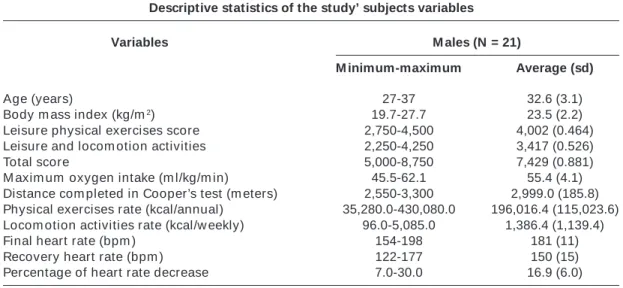
Table 1 presents the features of the sample. Age ranged from 27 to 37 years, mean of 32.6 years (sd = 3.2 years). Weight ranged from normal to overweight with no obese
student. VO2max had a high average rate, showing the good
cardiorespiratory capacity of the subjects. It was noted that the average annual energy exertion on physical exercises within the sample was high, however, with significant
vari-TABLE 1
Descriptive statistics of the study’ subjects variables
Variables M ales (N = 21)
M inimum-maximum Average (sd)
Age (years) 27-37 32.6 (3.1)
Body m ass index (kg/m2) 19.7-27.7 23.5 (2.2) Leisure physical exercises score 2,750-4,500 4,002 (0.464) Leisure and locom otion activities 2,250-4,250 3,417 (0.526)
Total score 5,000-8,750 7,429 (0.881)
ations among the subjects. The weekly energy exertion in locomotion activities was relatively low, but also showed important variations.
It has been noted that PEL and TS scores were correlated
to IPE, and correlation improved after adjusted for age and
BMI (table 2). LLA and TS scores were correlated to ILA,
and correlation improved for LLA after age and BMI
adjust-ments, and maintained on TS evaluation. There was no
sig-nificant correlation among the PEL, LLA and TS scores with
VO2max. As for %DHR, a significant correlation with LLA
and TS was noted, which improved for LLA after age and
BMI adjustments, and was maintained for TS.
In regard to reliability measures (table 3), it was noted that intraclass correlation coefficients were significant for
all HPA scores, being the highest values found,
respective-ly, in TS, LLA and PEL scores. There were no significant
differences between the average of the first and second
mea-surements for all HPA scores.
DISCUSSION
In this study, physical activity (IPE and ILA) and
physi-cal fitness (VO2max and %DHR) standards were compared
to Baecke’s HPA questionnaire scores.
VO2max is related to energy exertion, and is chiefly
in-fluenced by age14 and physical fitness level. In this study,
no HPA score was significantly correlated with VO2max.
Sig-nificant results were found in the correlation of physical
exercises score with peak VO
2 (r = 0.47) among Belgian
adult males5, and with VO
2max (r = 0.52) in American male
and female adults7. In the analysis of modified Baecke’s
questionnaire, correlation values of 0.45 for American
fe-males and 0.67 for American fe-males were obtained15. It is
believed that significant correlation values were not
ob-tained in this study due to the homogeneity of VO2max
val-ues (sample of EEFPMSP Physical Education students), as
the average value from the group was high, with little vari-ation, which impaired the analysis.
TABLE 2
Pearson correlation coefficient and adjusted coefficients betw een HPA scores and physical fitness and physical activity standards
M easurements PEL LLA TS
r(p) r(p) r(p)
Simple correlation
VO2m áx (m l/kg/m in) 0.04 (0.867) 0.24 (0.285) 0.17 (0.470) %DHR 0.38 (0.091) 0.47 (0.030)* 0.48 (0.027)*
IPE (kcal/year) 0.56 (0.008)* 0.28 (0.224) 0.46 (0.036)*
ILA (kcal/w eek) 0.25 (0.264) 0.64 (0.002)* 0.51 (0.017)*
Age and BM I adjusted correlation
VO2m ax (m l/kg/m in) 0.15 (0.539) 0.42 (0.069) 0.33 (0.169) %DHR 0.32 (0.172) 0.51 (0.026)* 0.47 (0.043)*
IPE (kcal/annual) 0.61 (0.005)* 0.25 (0.292) 0.47 (0.043)*
ILA (kcal/w eekly) 0.22 (0.355) 0.69 (0.001)* 0.52 (0.022)*
* p < 0,05; PEL (physical exercises in leisure score); LLA (leisure and locom otion activities); TS (total score); %DHR (percent-age of heart rate decrease); IPE (physical exercises index); ILA (index of locom otion activities).
TABLE 3
Paired t-test and intraclass correlation coefficients significance values for repeated measurements
Scores M easurement 1 M easurement 2 t test Intraclass correlation
average (sd) average (sd) P r (IC)
PEL 4,011 (0.464) 3,952 (0.640) 0.542 0.69 (0.40-0.86)*
LLA 3,417 (0.526) 3,440 (0.713) 0.797 0.80 (0.57-0.91)*
TS 7,429 (0.881) 7,393 (1.286) 0.832 0.77 (0.52-0.90)*
It is to be stressed the magnitude of correlation values obtained from each score. One believes that, being a
phys-ical fitness measurement, VO2maxbetter differentiates
phys-ical exercises from other physphys-ical activities. However, ac-cording to the results of this study, higher values were obtained in comparing leisure and locomotion activities. Other investigations have found lower correlation between
leisure and locomotion activities score and VO2max5,7.
Baecke’s questionnaire includes comparison and self-assessment questions. There can be some difficulties for
answering the questions16. Due to the importance of
ques-tions addressing sweating or perspiration for HPA
assess-ment16,17, correlation between the gross value from
self-assessment on sweating with VO2max was tested. There was
positive correlation after age and BMI adjustment (r = 0.51;
p = 0.027) (data not shown). These results are similar to those found in the analysis of the perspiration report by correlating Paffenbarger’s questionnaire total score with
VO2max (r = 0.54) in adult and elder American males16.
Heart rate and its recovery processes are considered
phys-ical fitness indicators11. The %DHR index is correlated to
VO
2max12. In this study, once more an interesting result has
been found, with significant correlation between %DHR and
HPA scores, underlining the highest magnitude obtained
with leisure and locomotion activities. Using the workload from a maximum treadmill test as an indicator, Jacobs et
al. (1993)7 showed significant correlation with physical
exercises score (r = 0.57) and total score (r = 0.51), and finally with leisure and locomotion score (r = 0.33). Other studies using the Minnesota questionnaire reached signifi-cant correlation on the assessment of the total score and
submaximal heart rate in male American adults (r = 0.59)16,
and in American males and females as a group (r = 0.45)7.
There was significant correlation between energy
exer-tion measured by IPE and the physical exercises score, which
remained constant even after adjusted for age and BMI. The
standard used in this study was a detailed recording of phys-ical exercises over the past 12 months. This means that the standard reflects this type of physical activity within the past year. It is to be noted that literature data are controver-sial as to the magnitude of the correlation of this score with the recorded data and with other comparative standards. In the analysis of daily energy exertion, an index of r = 0.58
from physical exercises score in American adult males15,
and r = 0.51 from total score in Dutch elderly females were
obtained18. As to other standard measurements, such the
use of an accelerometer, values of r = 0.34 from physical
exercises score in Belgian adult males5, and r = 0.34 with
physical exercises score in American adult males15 were
obtained. With doubly labeled water, r = 0.46 was obtained from the correlation with the physical exercises score in
Belgian adult males19. In this population a physical
activi-ty index was calculated based on energy exertion divided by metabolic rate in hours of sleep, and a correlation of r =
0.55 was obtained from the physical exercises score19.
A significant correlation between ILA-measured energy
exertion and leisure and locomotion physical activities score was found. Also significant correlations between the daily energy exertion and the leisure and locomotion activities were also found for American females (r = 0.42) and males
(r = 0.37)15, and with the total score for Dutch females (r =
0.52)6. In comparing with the accelerometer, a correlation
of r = 0.285 with the leisure and locomotion activities score
in Belgian adult males was found; and with doubly labeled water, the correlation was r = 0.5019.
A number of studies have shown good reliability indices
for Baecke’s HPA questionnaire. The values for physical
exercises score were of r = 0.92 and r = 0.88 respectively,
for American females and males15, and r = 0.93 for Belgian
adult males20. The total score follows the other indices,
reaching correlation values of r = 0.93 for adult American
males and females7, and r = 0.86 for Belgian adult males20.
Values assessed with a 15-day interval did not present ma-jor changes, as shown in Belgian adult males, being of r =
0.79 for physical exercises19. In the analysis of leisure and
locomotion physical activities score, with a 30-day inter-val, high correlation values were obtained from American
females and males (r = 0.87 and r = 0.86, respectively)15,
and from Belgian adult males (r = 0,87)20. With a 15-day
interval, values of r = 0.66 were obtained from Belgian
males19. In the analysis of longer intervals, such as between
five and 11 months, coefficients of r = 0.88 and r = 0.81
were obtained for PEL, and r = 0.76 and r = 0.71 for LLA in
Dutch adults and elders, respectively18. Such reliability
re-sults from Baecke’s HPA scores are similar to those found
for the population of the present study.
CONCLUSION
From the results shown for the population of the present study, and from comparison with results of studies from
developed countries, on concludes that Baecke’s HPA
ques-tionnaire is a good option to assess habitual physical activ-ities in Brazilian adult males.
ACKNOWLEDGMENTS
Polícia Militar, and to Professor Paulo Merino for his help in applying the instruments.
All the authors declared there is not any potential conflict of interests regarding this article.
REFERENCES
1. Paffenbarger Jr RS, Blair SN, Lee IM, Hyde RT. Measurement of phys-ical activity to assess health effects in free-living populations. Med Sci Sports Exerc 1993;25:60-70.
2. Pereira MA, Fitzgerald SJ, Gregg EW, Joswiak ML, Ryan WJ, Sumins-ki RR, et al. A collection of physical activity for health related research. Med Sci Sports Exerc 1997;29:S1-205.
3. Baecke JA, Burema J, Frijters JE. A short questionnaire for the mea-surement of habitual physical activity in epidemiological studies. Am J Clin Nutr 1982;36:936-42.
4. Florindo AA, Latorre MRDO, Jaime PC, Tanaka T, Pippa MGB, Zerbini CA. Past and present habitual physical activity and its relationship with bone mineral density in men aged 50 years or older in Brazil. J Gerontol A Biol Sci Med Sci 2002;57:M654-7.
5. Phillippaerts RM, Westerterp KR, Lefevre J. Comparison of two ques-tionnaires with a tri-axial accelerometer to assess physical activity pat-terns. Int J Sports Med 2001;22:34-9.
6. Pols MA, Peeters PHM, Kemper HCG, Collette HJA. Repeatability and relative validity of two physical activity questionnaires in elderly wom-en. Med Sci Sports Exerc 1996;28:1020-5.
7. Jacobs Jr DR, Ainswoth BE, Hartman TJ, Leon AS. A simultaneous eval-uation of 10 commonly used physical activity questionnaires. Med Sci Sports Exerc 1993;25:81-91.
8. Browner WS, Newman TB, Cummings SR, Hulley SB. Estimating sam-ple size and power: the nity-gritty. In: Hulley SB, Cummings SR, Browner WS, Grady D, Hearst N, Newman TB, editors. Designing clinical
re-search: an epidemiologic approach. 2nd ed. Baltimore: Ed. Williams & Wilkins, 2001;65-91.
9. Cooper KH. A means of assessing maximal oxygen intake. JAMA 1968; 203:201-4.
10. Leite PF. Fisiologia do exercício: ergometria, condicionamento físico e cardiologia desportiva. 4a ed. São Paulo: Robe Editorial, 2000. 11. Oliveira FR, Silva AS, Araujo AS, Costa RF, Colantonio E, Kiss
MAPDM. Cinética da recuperação da freqüência cardíaca como indica-dor de capacidade aeróbica em correindica-dores. Jornal Informativo da FIEP 1994;2:8.
12. Florindo AA. O percentual de decréscimo da freqüência cardíaca como indicador da aptidão aeróbia. Anais do I Simpósio Fitness Brasil, San-tos, SP, 1997;15.
13. Ainsworth BE, Haskell WL, Whitt MC, Irwin ML, Swartz AM, Strath SJ, et al. Compendium of physical activities: an update of activity codes and MET intensities. Med Sci Sports Exerc 2000;32:S498-504. 14. Berthouze SE, Minaire PM, Castells J, Busso T, Vico L, Lacour JR.
Relationship between mean habitual daily energy expenditure and max-imal oxygen uptake. Med Sci Sports Exerc 1995;27:1170-9.
15. Richardson MT, Ainsworth BE, Wu HC, Jacobs Jr DR, Leon AS. Ability of the atherosclerosis risk in communities (ARIC)/Baecke questionnaire to assess leisure-time physical activity. Int J Epidemiol 1995;24:685-93. 16. Siconolfi SF, Lasater TM, Snow RCK, Carleton RA. Self-reported phys-ical activity compared with maximal oxygen uptake. Am J Epidemiol 1985;122:101-5.
17. Leon AS, Jacobs Jr DR, DeBacker G, Taylor HL. Relationship of phys-ical characteristics and life habits to treadmill exercise capacity. Am J Epidemiol 1981;113:653-60.
18. Pols MA, Peeters PHM, Bueno-de-Mesquita HB, Ocké MC, Wentink CA, Kemper HCG, et al. Validity and repeatability of a modified Baecke questionnaire on physical activity. Int J Epidemiol 1995;24:381-8. 19. Phillippaerts RM, Westerterp KR, Lefevre J. Doubly labelled water
val-idation of three physical activity questionnaires. Int J Sports Med 1999; 20:284-9.
20. Phillippaerts RM, Lefevre J. Reliability and validity of three physical activity questionnaires in Flemish males. Am J Epidemiol 1998;147:982-90.