ABSTRACT
BACKGROUND AND OBJECTIVES: Among temporoman-dibular disorder classiications, masticatory muscles myofascial pain is the most frequent. Its multifactorial etiology makes its treatment diicult. Identifying other painful sites related to tem-poromandibular disorders may help controlling comorbidities and, as a consequence, improving their symptoms. his study aimed at evaluating the presence of body pain in temporoman-dibular disorder patients, the frequency of such reports and their location.
METHODS: We have evaluated 328 medical charts of the Den-tal Research Center São Leopoldo Mandic, with diagnosis of muscular temporomandibular disorder. Patients were evaluated by means of a body map to locate pain complaints.
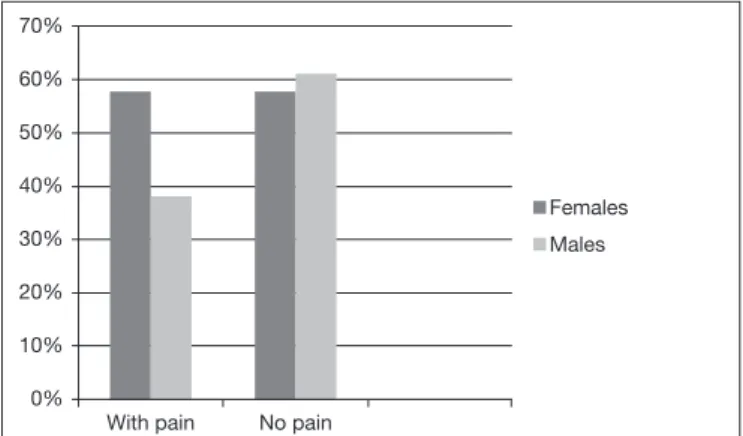
RESULTS: From 328 analyzed medical charts, 180 (55%) had body pain (160 females, 20 males), and 148 (45%) had facial pain only (116 females, 32 males). Areas with most frequent pain reports were cervical, lumbar and shoulders. Females had more body pain (with pain n=160, without pain n=116, p<0.001) as compared to males (with pain n=20, without pain n=32) with statistical diference. In most cases pain has afected both body sides (bilateral face 67%, bilateral body 92%).
CONCLUSION: Most patients with temporomandibular dis-order had pain in body parts diferent from the face. Regions marked in human body drawings with more pain were cervical followed by lumbar and shoulders.
Keywords: Cervical pain, Generalized pain, Myofascial pain, Temporomandibular disorder.
Evaluation of body painful areas in patients with muscular
temporomandibular disorder: a retrospective study
Avaliação das áreas de dor no corpo em pacientes com disfunção temporomandibular
muscular: estudo retrospectivo
Luci Mara França Correia1, Antonio Sergio Guimarães1, Marcelo Luschesi Teixeira1, Luciane Lacerda Rodrigues1
1. Centro de Pesquisa Odontológica São Leopoldo Mandic, Departamento de Mestrado em Dor e Disfunção Temporomandibular, Campinas SP, Brasil.
Submitted in October 23, 2014.
Accepted for publication in October 15, 2015. Conlict of interests: none – Sponsoring sources: none.
Correspondence to: Luci Mara França Correia Rua Paraíba, 2902 – Bairro Guaíra 80630-000 Curitiba, PR, Brasil. E-mail: [email protected]
© Sociedade Brasileira para o Estudo da Dor
RESUMO
JUSTIFICATIVA E OBJETIVOS: Dentre as classiicações das disfunções temporomandibulares, as dores miofasciais nos mús-culos da mastigação são as mais frequentes. Sua etiologia multi-fatorial diiculta o tratamento. Reconhecer outros locais de dor relacionados à disfunção temporomandibular pode ajudar no controle das comorbidades e consequentemente melhorar o seu quadro. O objetivo deste estudo foi avaliar a presença de dor no corpo em pacientes com disfunção temporomandibular, a frequência desses relatos e sua localização.
MÉTODOS: Foram avaliados 328 prontuários do Centro de Pesquisa Odontológica São Leopoldo Mandic, com diagnóstico de disfunção temporomandibular muscular. Os pacientes foram avaliados por meio de desenhos de mapa corporal para determi-nar a localização de queixas de dor.
RESULTADOS: Dos 328 prontuários analisados, 180 (55%) apresentaram registro de dor pelo corpo (160 mulheres, 20 ho-mens), e 148 (45%) apresentavam dor apenas na região da face (116 mulheres, 32 homens). As áreas com maior relato de dor foram: cervical, lombar e ombros. O gênero feminino apresen-tou maior frequência de dores no corpo (com dor n=160, sem dor n=116, p<0,001) que o gênero masculino (com dor n=20 e sem dor n=32) com diferença estatística. Na maior parte dos casos a dor acometeu os dois lados do corpo (face 67% bilateral e corpo 92% bilateral)
CONCLUSÃO: A maioria dos pacientes com diagnóstico de disfunção temporomandibular apresentou dor em outras partes do corpo além da face. A região anotada nos desenhos do corpo humano com maior acometimento da dor foi a cervical seguida da lombar e ombros.
Descritores: Cervicalgia, Disfunção temporomandibular, Dor generalizada, Dor miofascial.
INTRODUCTION
Temporomandibular disorders (TMD) are represented by musculoskeletal abnormalities involving a large spectrum of clinical temporomandibular joint (TMJ) and masticatory muscles problems. hese disorders are primarily characterized by pain, joint sounds and irregular or limited jaw function1
.
TMD etiology is multifactorial, including parafunctional and inadequate postural habits, bruxism, occlusal changes, over-load, trauma, growth changes and stress2.
Its pathophysiology is not yet clearly defined by the litera-ture and it may have characteristics similar to other orofacial system diseases, or even as comorbidity of such changes3.
There is comorbidity when two diseases have correlation and temporal continuity, and may appear simultaneously or one precede the other with more than casual association, and may share common pathophysiological aspects and clinical characteristics4, which often leads to diagnostic difficulty in
the dental clinic. Trigeminal neuralgia, pulpitis, migraine, tension headache and fibromyalgia5,6-18 are some of the most
common TMD-related comorbidities.
TMD is considered a chronic disease, being muscular TMD a functional pain syndrome with characteristics similar to cervical pain, fibromyalgia, interstitial cystitis, irritable bowel syndrome and chronic fatigue syndrome3,5,8. These
conditions seem to have common etiologic factors which explain major comorbidity of symptoms.
Its pathophysiological mechanisms are still being studied9
and seemingly show changes in sensory processing with in-creased neuronal membrane excitability, inin-creased substance P levels, NMDA receptors activation, increased brain areas responsible for pain processing and decreased inhibitory in-fluence of dorsal horn neurons on descending pain system, thus facilitating the development of central sensitization10
and perpetuating pain.
Clinical studies have shown that TMD patients may have several comorbidities, such as migraine, ibromyalgia, sleep disorders, anxiety and depression, and myofascial pain in ad-dition to orofacial pain11-13 which may worsen pain and
inlu-ence the possibility of developing central sensitization6,14,15.
TMD may also influence the management of other pain presentations. A double-blind randomized study in females with migraine and TMD has shown that migraine would only improve when both conditions were treated11.
With regard to fibromyalgia, it is important to identify whether just masticatory muscles are involved with TMD or there is a generalized muscle pain where both diseases may be present, thus potentiating diffuse pain. Depression and sleep disorders are frequent among fibromyalgia patients and could be responsible for TMD chronicity when con-comitant16.
In the relationship between myofascial TMD and tension headaches, masticatory muscles pain is the common link and it is not totally clear whether it results from a specific peripheral response to central sensitization of there is lo-cal disease17. Orofacial dysfunctional signs and symptoms,
such as teeth clenching, parafunctional habits, irregular jaw movement and temporomandibular noises are significantly increased in tension headache patients as compared to pa-tients without tension headache17.
In case of trigeminal neuralgias it is extremely important not to confuse its diagnosis with dental problems or TMD be-cause orofacial activities (such as teeth brushing, chewing) may trigger neuralgia crises and lead to unnecessary dental procedures, such as extractions or endodontic treatments. A study from the Universidade de São Paulo group has shown
a sample of 38% of patients who could be victims of such confusion because they presented both diseases, trigeminal neuralgia and odontogenic diseases, among them TMD5.
Pain in other parts of the body in addition to face in TMD patients may impact pain control and contribute to persis-tence of masticatory muscles myofascial pain18-20. In
addi-tion, such comorbidity may be a risk factor for the develop-ment of TMD21,22.
So, for facial pain diagnosis and treatment it is important to recognize the relationship between muscle TMD pain and pain in different body parts, as well as to be aware of their prevalence in the population23,24
.
A way to evaluate patients’ complaint of body pain are body surface maps used in medicine for the first time in 194925
where patients are oriented to mark on the drawing the loca-tion and distribuloca-tion of their pain24.
Drawings by patients have been used in different low back pain studies and some migraine, fibromyalgia, chronic and postsurgical cervical pain studies23. In orofacial studies,
drawings were used by Hagberg14; Allerbring &
Haegers-tam26; Hagberg, Hagberg & Kopp27, and Blasberg &
Chalm-ers28.
To improve the understanding of the extension to which facial muscle pain is followed by pain in other body parts, body map drawings of myofascial TMD patients were sys-tematically analyzed.
This study aimed at evaluating the frequency of such reports and the location with higher prevalence of body pain.
METHODS
his study was carried out in the Centro de Pesquisa Odon-tológica São Leopoldo Mandic. Data were collected from medical charts, with records of assistance of specialization and master courses on TMD and orofacial pain, of patients referred to the orofacial pain center.
Clinical evaluation has followed the guidelines of the Ameri-can Academy of Orofacial Pain (2103) and of the Diagnostic Criteria for Temporomandibular Disorders (DC-TMD) with regard to diagnostic criteria: muscle pain complaint in jaw, temple, ear, or in front of the ear, which is afected by move-ment and jaw function or parafunction. his familiar pain is replicated with masticatory muscle challenge test, that is, palpation of masseter and temporal muscles in three areas and asking patients to report whether pain is familiar or not and whether its spreads to a site diferent from the palpated region, thus minimizing the possibility of comorbidities in-luencing the diagnosis29.
TMD patients were oriented to mark in a human body con-tour drawing other body areas with pain for more than three months, considered chronic, thus avoiding pain caused by re-cent trauma or other wounds.
pres-ence of pain drawings showing other body pains reported by patients.
From 401 evaluated medical charts, 73 were excluded for hav-ing incomplete data, totalhav-ing a sample of 328.
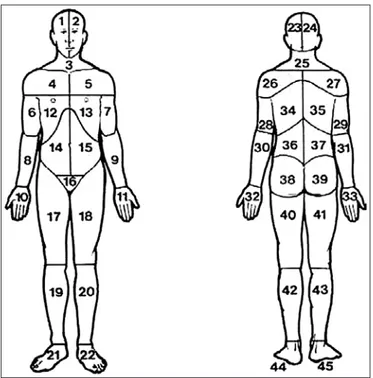
Body drawings used by patients to indicate pain area were divided in 45 anatomic areas according to Margolis, Tait & Krause30, viewed from the front and back (Figure 1). he
pro-fessional who had diagnosed TMD was the same orienting patients about illing the drawing.
Figure 1. Body division into 45 anatomic areas
Cards were visually inspected by the chief researcher and more frequent pain areas were recorded. It was also evaluated in how many drawings pain was restricted to the face and how many had pain reports in other body parts, as well as the afected side (right, left or bilateral). In the frontal view, the drawing was divided in 22 areas and in the back view in 23 areas.
Statistical analysis
Statistical analysis of variance (ANOVA) and equality of two proportions and Chi-square tests were applied, being p<0.05. his study was approved by the institution’s Ethics Commit-tee under protocol 0351/2009.
RESULTS
From 328 analyzed medical charts, 180 (55%) had body pain on drawings (160 females and 20 males) and 148 (45%) pre-sented just facial pain (116 females and 32 males), with no diference between situations for this sample (Figure 2). Areas with most frequent pain reports were cervical region followed by lumbar region, shoulders back view, shoulders front view and lower limbs front view (Figures 3 and 4).
60%
50%
40%
30%
20%
10%
0%
Pain restricted to the face Body aches
Figure 2. Percentage of body pain or just facial pain in TMD patients
Figure 3. Frontal view of areas with most pain reports
Prevalence with regard to gender shows that females were more affected by body pain as compared to males, with sta-tistically significant difference (p<0.001) among females when the number of patients with just facial pain was com-pared to the number of patients with pain in other body parts (Figure 5).
To evaluate pain laterality (right or left), only 180 patients had both facial and body pain. Most evaluated patients have reported pain on both sides. Figure 6 shows this relationship on the face.
In the body, most reports were also bilateral (Figure 7).
DISCUSSION
his study has found frequency of 55% of body pain pres-ent for more than 3 months in patipres-ents with muscle TMD, similar to a study by Sipilä et al.22who have also found 55%
of generalized pain in TMD patients and lower than other studies, such as the study26 that has found 71% of body pain
in TMD patients and the study of Türp et al.24 which has
found 67%.
It is necessary to highlight that there is high frequency of pain outside the face, which may inluence TMD management since pains may be added, generating central sensitization and wors-ening pain. Our objective was not to evaluate the etiology of such pains, however updated studies have shown that comor-bidities such as ibromyalgia, myofascial pain and migraine9,10,
among others, are closely related to TMD, thus increasing the need for diagnosis of each disease for total pain control. he use of body surface maps may be a tool to help evaluation of comorbidities which may inluence TMD control.
With regard to areas afected by pain, our study has shown that patients with TMD and myofascial pain often have cervi-cal pain. his was the region with the highest index of pain with 62% (females 64% and males 45%), followed by lumbar and shoulders. Such results support the conclusion by De Laat et al.7 about the coexistence of TMD signs and functional
limi-tation and cervical pain, when clinical TMD signs were com-pared to brain-cervical disorders. In this study24, 30% of cases
of pain were in the lumbar region, value close to that found in our study, which was 35% (34% females and 47% males), and lower than a diferent study with 61% of back pain27.
A possible reason for the coexistence of TMD and cervical pain is based on the neurophysiologic conversion and sen-sitization principle. A constant nociceptive input in second order neurons may increase neuronal sensitivity and, with this, non-nociceptive impulses of other areas within the same segment converging to such neurons may increase the noci-ceptive sensation, that is, frequent impulses coming from the upper region of the trapezium may increase trigeminal spinal nucleus sensitivity and so non-nociceptive stimuli in the mas-ticatory system could lead to painful sensation in the trigemi-nal region6. In these cases, patients have painful sensation in
orofacial and cervical regions.
With regard to gender, our study indings have shown that most patients looking for TMD management are females, in a total of 276 as compared to 52 males. hese data are al-ready known by the literature where females have more TMD symptoms as compared to males19,21. Generalized pain was
also more often reported by females, conirming data which report higher prevalence of generalized pain in females27.
he association between widespread pain and TMD in fe-males may be important for collective public health, since currently females have a very important role also in the eco-nomic lives of families and the presence of both situations could keep them away from work for a larger period of time, thus causing social problems13. It was observed that females
with myofascial pain and history of concomitant widespread
Unilateral Bilateral
80%
70%
60%
50%
40%
30%
20%
10%
0%
Unilateral Bilateral
100%
90%
80%
70%
60%
50%
40%
30%
20%
10%
0%
Figure 7. Pain in just one or both sides of the body
Figure 6. Pain in just one or both sides of the face
Figure 5. Body pain report in females and males
With pain No pain
Females
Males 70%
60%
50%
40%
30%
20%
10%
pain were more prone to having depression as compared to females with just orofacial pain.
Considering the laterality of pain, it was observed that bilat-eral reports were the most frequent, both in face (67.2%) and body (92%), which conirms a diferent study28 where 66%
of cases of pain were bilateral. Türp et al.24 have also reported
that bilateral pain was present in 82.5% of the sample. Since there are evidences that muscle TMD may be associated to pain in diferent body regions, early interventions should be the objective of the multidisciplinary team.
Our results stress the need for improving the understanding of comorbidities afecting TMD patients to improve treat-ment and provide their control.
CONCLUSION
Most patients with temporomandibular disorder had pain in other body parts diferent from the face. Most common re-gion marked on human body drawings was cervical, followed by lumbar and shoulders.
REFERENCES
1. Carlsson GE, Magnusson T, Guimarães AS. Tratamento das disfunções temporoman-dibulares na clínica odontológica. São Paulo: Quintessence; 2006.
2. Buckingham RB, Braun T, Harinstein DA, Oral K, Bauman D, Bartynski W, et al. Temporomandibular joint dysfunction syndrome: a close association with systemic joint laxity (the hypermobile joint syndrome). Oral Surg Oral Med Oral Pathol. 1991;72(5):514-9.
3. Stiesch-Scholz M, Fink M, Tschernitschek H. Comorbidity of internal derangement of the temporomandibular joint and silent dysfunction of the cervical spine. J Oral Rehabil. 2003;30(4):386-91.
4. Lipton RB, Silberstein SD. Why study the comorbidity of migraine? Neurology 1994;44(10 Suppl 7):S4-5.
5. de Siqueira SR, da Nóbrega JC, Teixeira MJ, de Siqueira JT. Masticatory problems af-ter balloon compression for trigeminal neuralgia: a longitudinal study. J Oral Rehabil. 2007;34(2):88-96.
6. Furquim BD, Flamengui LM, Conti PC. TMD and chronic pain: a current view. Dental Press J Orthod. 2015;20(1):127-33.
7. De Laat A, Meuleman H, Stevens A, Verbeke G. Correlation between cervical spine and temporomandibular disorders. Clin Oral Investig. 1998;2(2):54-7.
8. Visscher CM, Lobbezoo F, de Boer W, van der Zaag J, Naeije M. Prevalence of cervical spinal pain in craniomandibular pain patients. Eur J Oral Sci. 2001;109(2):76-80. 9. Kim SE, Chang L. Overlap between functional GI disorders and other functional
syndromes: what are the underlying mechanisms? Neurogastroenterol Motil. 2012;24(10):895-913.
10. Latremoliere A, Woolf CJ. Central sensitization: a generator of pain hypersensitivity by central neural plasticity. J Pain. 2009;10(9):895-926.
11. Goncalves DA, Camparis CM, Speciali JG, Castanharo SM, Ujikawa LT, Lipton RB, et al. Treatment of comorbid migraine and temporomandibular disorders: a factorial, double-blind, randomized, placebo-controlled study. J Orofac Pain. 2013;27(4):325-35.
12. da Silva LA, Kazyiama HH, de Siqueira JT, Teixeira MJ, de Siqueira SR. High preva-lence of orofacial complains in patients with ibromyalgia: a case-control study. Oral Surg Oral Med Oral Pathol Oral Radiol. 2012;114(5):e29-34.
13. Raphael KG, Marbach JJ, Klausner J. Myofascial face pain. Clinical characteristics of those with regional vs. widespread pain. J Am Dent Assoc. 2000;131(2):161-71. 14. Hagberg C. General musculoskeletal complaints in a group of patients with
cranio-mandibular disorders (CMD). A case control study. Swed Dent J. 1991;15(4):179-85. 15. McMillan AS, Wong MC, Zheng J, Luo Y, Lam CL. Widespread pain symptoms
and psychological distress in southern Chinese with orofacial pain. J Oral Rehabil. 2010;37(1):2-10.
16. Velly AM, Look JO, Schifman E, Lenton PA, Kang W, Messner RP, et al. he ef-fect of ibromyalgia and widespread pain on the clinically signiicant temporoman-dibular muscle and joint pain disorders--a prospective 18-month cohort study. J Pain. 2010;11(11):1155-64.
17. Silva Jr AA, Brandão KV, Faleiros BE, Tavares RM, Lara RP, Januzzi E, et al. Temporo-mandibular disorders are an important comorbidity of migraine and may be clini-cally diicult to distinguish them from tension-type headache. Arq Neuropsiquiatr. 2014;72(2):99-103.
18. Lim PF, Smith S, Bhalang K, Slade GD, Maixner W. Development of temporo-mandibular disorders is associated with greater bodily pain experience. Clin J Pain. 2010;26(2):116-20.
19. Rammelsberg P, LeResche L, Dworkin S, Mancl L. Longitudinal outcome of tem-poromandibular disorders: a 5-year epidemiologic study of muscle disorders deined by research diagnostic criteria for temporomandibular disorders. J Orofac Pain. 2003;17(1):9-20.
20. Macfarlane TV, Blinkhorn AS, Davies RM, Kincey J, Worthington HV. Predictors of outcome for orofacial pain in the general population: a four-year follow-up study. J Dent Res. 2004;83(9):712-7.
21. John MT, Miglioretti DL, LeResche L, Von Korf M, Critchlow CW. Widespread pain as a risk factor for dysfunctional temporomandibular disorder pain. Pain. 2003;102(3):257-63.
22. Sipilä K, Ylöstalo PV, Joukamaa M, Knuuttila ML. Comorbidity between facial pain, widespread pain, and depressive symptoms in young adults. J Orofac Pain. 2006;20(1):24-30.
23. Steinmetz A, Zeh A, Delank KS, Peroz I. Symptoms of craniomandibular dysfunction in professional orchestra musicians. Occup Med. 2014;64(1)17-22.
24. Türp JC, Kowalski CJ, O’Leary N, Stohler CS. Pain maps from facial pain patients indicate a broad pain geography. J Dent Res. 1998;77(6):1465-72.
25. Cummings GS, Routan JL. Accuracy of the unassisted pain drawings by patients with chronic pain. J Orthop Sports Phys her. 1987;8(8):391-6.
26. Allerbring M, Haegerstam G. Characteristics of patients with chronic idiopathic oro-facial pain. A retrospective study. Acta Odontol Scand. 1993;51(1):53-8.
27. Hagberg C, Hagberg M, Kopp S. Musculoskeletal symptoms and psychosocial factors among patients with craniomandibular disorders. Acta Odontol Scand. 1994;52(3):170-7.
28. Blasberg B, Chalmers A. Temporomandibular pain and dysfunction syndrome associ-ated with generalized musculoskeletal pain: a retrospective study. J Rheumatol Suppl. 1989;19:87-90.
29. Koutris M, Visscher CM, Lobbezoo F, Naeije M. Comorbidity negatively the out-comes of diagnostic tests for musculoskeletal pain in the orofacial region. Pain. 2013;154(6):927-32.