AR
TICLE
1 Programa de Pós-Graduação em Ciências e Saúde, Centro de Ciências e Saúde da Universidade Federal do Piauí (UFPI), Av. Frei Serafim 2280, Centro. 64001-020 Teresina, Piauí, Brasil.
[email protected] 2 Departamento de Odontologia, UFPI.
Bruxism and quality of life in schoolchildren aged 11 to 14
Abstract The purpose of this study is to assess quality of life in relation to oral health in school-children with sleep bruxism. It is a transversal observational study of 594 schoolchildren (aged 11–14) of the municipality of Teresina, in the Bra-zilian State of Piauí. Quality of life was assessed through the Brazilian version of the CPQ11-14 ques-tionnaire, in the short form (ISF:16).The pres-ence of sleep bruxism was assessed from reports by the people legally responsible for the children. The results were analyzed by: calculation of an Odds Ratio (OR) estimate of chances; descriptive analysis; a Pearson Chi-squared test; a Likeli-hood Ratio test; and multiple logistic regression. A statistically significant association was found between sleep bruxism and the total score on the CPQ11-14 (p < 0.001), and with the scores in two domains: functional limitation (p = 0.033);and social wellbeing (p= 0.020).No association was found between quality of life and the variables
gender or age. The final regression model showed
that the presence of sleep bruxism increases the chance of having a greater effect on quality of life (ORadj=1.82 (1.54 – 2.10), IC = 95%).It is con-cluded that sleep bruxism had a negative impact on the quality of life of the schoolchildren, prin-cipally in the two domains functional limitations and changes in social wellbeing.
Key words Sleep bruxism, Adolescent, Quality of life
Arethuza de Melo Brito Carvalho 1
Marina de Deus Moura de Lima 2
José Mário Nunes da Silva 2
Neusa Barros Dantas Neta 2
C
ar
v
alho AMB Introduction
Bruxism is a repetitive activity of the jaw mus-cles, characterized by grinding or clenching of the teeth, and/or exercising pressure of the jaws.
It can occur during sleep or while awake1.
The occurrence of sleep bruxism (herein for quick reference ‘SB’) in schoolchildren var-ies from 3.5% to 40.6%, depending on the age group, gender and methods used for
measure-ment2-6.There is an inverse relationship between
the occurrence of sleep bruxism and age, with a
significant reduction in adolescence3,7-8.
The presence of sleep bruxism in the stage of growth and development can contribute to the emergence of craniofacial and temporomandib-ular alterations, such as musctemporomandib-ular fatigue, heache, respiratory difficulties, tooth wear, and
ad-verse effects on quality of life8-10.
The etiology of sleep bruxism is still not the subject of consensus, the general indication be-ing multi-factorial causes, associated with local, systemic, psychological, occupational and
hered-itary factors6,11-16.
Assessment of the quality of life of
individu-als related to oral health has been studied17-21, but
there is little in the literature about the associa-tion between quality of life and sleep bruxism in schoolchildren aged 11-14.
Assessment of quality of life related to oral health involves an evaluation of the effect that oral illnesses set off in individuals’ daily activities, interfering in their psychological and emotional
wellbeing22.
The objective of the study was to assess the effect that sleep bruxism causes on the quality of life on schoolchildren aged 11-14.
Materials and methods
Sample
This was a transversal observational study carried out with a representative sample of schoolchildren aged 11 to 14 registered in public and private schools of the municipality of Ter-esina in the State of Piauí, Brazil. In 2011 there were 54,056 schoolchildren registered in schools
at Teresina23.
The sample was probabilistic, stratified and random, with calculation made on the software Epi-info 7.0, in the STATCALC module which
applies the formula: n = ∂’2.p.q.N / e2.(N-1)+
∂’2.p.q, in which ‘n’ is the sample that was
calcu-lated, ‘∂’ is the confidence level, ‘p.q’ is the
preva-lence with which the phenomenon occurs, ‘N’ is the population, and ‘e’ is the sampling error.The calculation of the size of the sample was based on
data published by Serra-Negra et al.24, who
report-ed prevalence of sleep bruxism of 35.3% (~36%) in Brazilian children aged 7 to 10, and in the pop-ulation of schoolchildren in 2011.A correction factor of 1.5 was applied to increase the precision of the stratified sample, with confidence inter-val (CI) of 95% and standard error of 5%.Thus, the size of the ideal sample should be at least 524 schoolchildren.20% was added to compensate for any possible losses. A total of 629 schoolchildren were invited to take part in the study.
The study was proportionally stratified by type of school (25.9% private and 74.1% public) and by zone of location (north, south, southeast, east and center), in accordance with the quanti-tative levels of public and private schools in the teaching network of Teresina. Three schools were randomly chosen for each location zone. After this random choice, the classes and the individ-ual schoolchildren were randomized.
The study included schoolchildren aged 11 to 14 who agreed to participate in the study and whose parents or guardians also authorized par-ticipation. The criteria of exclusion were: school-children outside the age range 11 to 14, presen-tation of toothache, absence on the day of data collection, and/or schoolchildren who did not accept taking part in the study. As a result 24 schoolchildren were excluded who did not accept taking part in the study, and 11 who were absent on the day of collection of data.
The final sample, taking into account the losses of 5.6%, comprised 594 schoolchildren and was divided into two groups: group 1, of schoolchildren with sleep bruxism; and group 2 without it. This division was based only on the report of the parents or guardians about whether or not sleep bruxism was present.
Collection of data
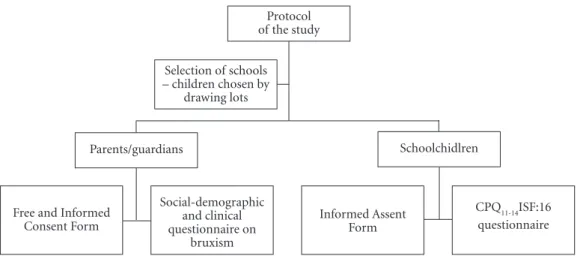
Data was collected over the period Septem-ber to NovemSeptem-ber 2013, through application of questionnaires with the schoolchildren and their parents/guardians (Figure 1).
prob-aúd
e C
ole
tiv
a,
20(11):3385-3393,
2015
lems reported, and whether or not the child had the habit of grinding his/her teeth while asleep. In the assessment of the questionnaires, when unanswered questions were found, telephone contact was made with the parents/guardians to obtain the data.
Schoolchildren who had the consent form signed by the parent/guardian were chosen ran-domly, organized into small groups and sent to a chosen room for application of the questionnaire on health and quality of life.
For assessment of Quality of Life the CPQ
11-14 ISF:16, validated by Torres et al.
25, was used,
self-applied under the supervision of the
investi-gator responsible. The CPQ11-14 ISF:16comprises
16 items in 4 areas:1. Oral symptoms (questions 1 to 4); 2. Functional limitations(questions 5 to 8); 3.Emotional wellbeing (questions 9 to 12); and 4. Social wellbeing (questions 13 to 16).Re-plies were scored on the following scale:never = 0; one/two times = 1; sometimes = 2; frequently = 3; and everyday/almost every day = 4.The total score could thus vary between 0 and 64, higher values showing a greater impact of the condition
on the quality of life25.
The impact on quality of life was assessed
through the median total score on the CPQ11-14.
The presence of sleep bruxism was decided on the basis of report by the parent/guardian, a cri-terion proposed by AAMS (American Academy
of Sleep Medicine)26, indicated by Lobezoo et al.1
for the purposes of research.
The variables gender and type of school were dichotomized as female and male, public and
private, respectively. Age is a continuous quanti-tative variable that was categorized into 11, 12, 13 and 14 years. Monthly income was categorized at less than two times the minimum wage (MW) and 2 MW or more, in accordance with the cut-off point determined by the median. The general condition of health was assumed as reported by the parent/guardian and categorized as presence or absence of health problems, in accordance with mention of at least one of the problems listed in the questionnaire (psychological, neuro-logical, respiratory, circulatory or immunological problems, and parasites).
Before the collection of data, a pilot study was carried out to assess the methodology proposed, with 52 schoolchildren, who did not participate in the sample, selected in a school that was not among those chosen by lots for the study.After this phase it was observed that there was no need to modify the methodology of the study.
Statistical analysis
The statistical analysis was made using the statistical software for generation of results SPSS® version 21.0. In the univariate analysis a descriptive analysis was made of the data through the measures of central tendency, dispersion and percentages.
In the bivariate analysis, the Chi-squared (χ2)
test and the Likelihood Ratio test were used, to determination association between presence or
absence of sleep bruxism and the scores on CPQ
11-14 (ISF:16), of each domain, and the total score.
Figure 1. Protocol of the study.
Protocol of the study
Schoolchidlren Parents/guardians
Selection of schools – children chosen by
drawing lots
CPQ11-14ISF:16 questionnaire Social-demographic
and clinical questionnaire on
bruxism
Informed Assent Form Free and Informed
C
ar
v
alho AMB A multivariate analysis was made through
bi-nary logistic regression to assess the association of sleep bruxism with the social-demographic and clinical characteristics in the quality of life,
through the total score on the CPQ11-14 (ISF:16),
the Odds Ratio (OR) being used as a measure of effect with all the variables that showed p < 0.20 in the bivariate analysis, using the stepwise forward method. The level of significance estab-lished was 5%.
Ethical aspects
The study was approved by the Research Eth-ics Committee of the Federal University of Piauí (UFPI).The participation by the schoolchildren was voluntary. The parents or guardians signed
the Free and Informed Consent form (Termo de
Consentimento Livre e Esclarecido – TCLE) and the schoolchildren signed a Free and Informed
Assent form (Termo de Assentimento Livre e
Es-clarecido –TALE), confirming awareness and acceptance of participation in the survey, as per
Resolution 466/1227 of the Brazilian National
Health Council.
Results
A total of 594 (94.4%) schoolchildren took part in the study.The social-demographic and clinical characteristics of the sample are shown in Table 1. In accordance with the report by the parents/ guardians, this sample was divided into 2 groups: group 1 (with sleep bruxism, n = 132, 22.2%) and group 2 (without sleep bruxism, n = 462, 77.8%). Among the relationships between sleep bruxism and social-demographic and clinical variables, there was a significant association of
sleep bruxism with gender (p = 0.012) and age (p = 0.031) (Table 1).
Table 2 is a description and comparison in
relation to the use of the CPQ11-14 on the groups
of the sample (with and without sleep bruxism), both in relation to the final score and in relation to the counting of each domain. There was a sta-tistically significant difference between the total
Variables Gender Male Female Age (years) 11 12 13 14 Family income (multiples of MW)
< 2
≥ 2
Type of school Public Private General condition of health reported
Presence of problems Absence of problems Group 1 With SB n = 132 n (%) 61 (46.2) 71 (53.8) 37 (28.0) 41 (31.1) 18 (13.6) 36 (27.3) 118 (22.6) 14 (19.4) 106 (80.3) 26 (19.7) 63 (47.7) 69 (52.3)
Table 1. Social-demographic and clinical profile of the schoolchildren with and without SB (n = 594).
P* 0.012 0.031 0.545 0.064 0.149 Group 2 Without SB
n = 462 n (%) 158 (34.2) 304 (65.8) 117 (25.3) 120 (26.0) 120 (26.0) 105 (22.7) 404 (77.4) 58 (80.6) 334 (72.3) 128 (27.7) 188 (40.7) 274 (59.3)
* Pearson Chi-Squared (c²); MW = minimum wage (R$ 678.00).
CPQ11-14
Total score (0-64) Sub-scales
Oral symptoms (0-16) Functional limitation (0-16) Emotional well-being (0-16) Social well-being (0-16)
Number of items 16 4 4 4 4
Table 2. Descriptive and comparison data from the CPQ11-14: total and sub-scales of schoolchildren with and without SB. P* 0.048 0.212 0.033 0.301 0.020
* Likelihood ratio test.
Average (SD) 14.0 (8.3) 4.6 (2.6) 4.0 (3.0) 3.0 (2.7) 2.5 (2.7) Median 14 4 4 3 2 Min-Max 0-47 0-12 0-12 0-12 0-16
With SB Without SB
aúd
e C
ole
tiv
a,
20(11):3385-3393,
2015
scores found in the groups with SB and without
SB (p = 0.040), and also in the domains of
func-tional limitation (p = 0.033) and social wellbeing
(p = 0.020). The medium score on the CPQ11-14
was higher in the group with SB, principally in
the two domains functional limitation and social
wellbeing.
Quality of life was classified using the median
of the total scores on the CPQ11-14as the dividing
point. The scores on the CPQ11-14 varied from 0
to 47, with median of 10, in which values of 0-10
represented low impact and > 10 were classified as high impact on quality of life. The majority of the schoolchildren (51%) presented low impact. However, among the group with SB (n =132), the majority (n = 81) showed high impact of SB on the quality of life, as per the Chi-squared test (Table 3).
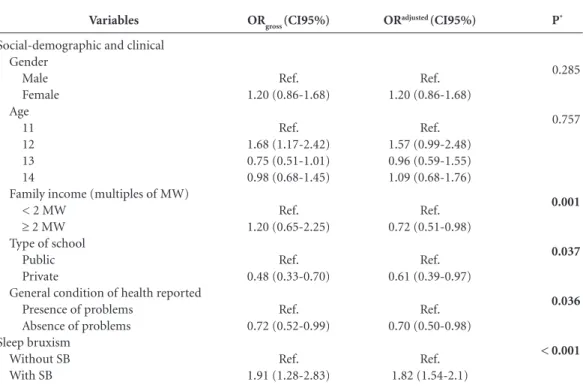
The logistic regression analysis showed that monthly family income of 2 MW or more {OR-adj = 0.72 (0.51-0.98)}, and being a student in a private school {ORadj = 0.61 (03.9-0.97)}, with absence of health problems {ORadj = 0.70 (0.50-0.98)} reduced the impact on the quality of life with pupils with SB. The independent variables gender (p = 0.285) and age (p = 0.757) were not statistically significant. The present of SB in-creased by 82% (or 1.82 times) the chance of a high impact on the quality of life of the school-children {ORadj = 1.82 (1.54 – 2.1); IC = 95%}, with statistical significance (p < 0.001) (Table 4).
Discussion
Sleep Bruxism is a highly frequent condition that can interfere in the quality of life of
individu-With SB Without SB Total
Low impact (CPQ11-14 0-10)
n (%)
51 (16.8) 252 (83.2) 303 (100.0)
Table 3. Association between quality of life and SB in the schoolchildren participating in the study (n = 594).
P*
0.001 High impact (CPQ11-14 > 10-47)
n (%)
81 (27.8) 210 (72.2) 291 (100.0)
* Pearson Chi-squared test (c²).
Variables
Social-demographic and clinical Gender
Male Female Age
11 12 13 14
Family income (multiples of MW) < 2 MW
≥ 2 MW Type of school
Public Private
General condition of health reported Presence of problems
Absence of problems Sleep bruxism
Without SB With SB
Table 4. Logistic regression model for the impact of quality on quality of life by the CPQ11-14, taking into account SB and all possible confusion factors (n = 594).
OR adjusted: variables adjusted; CI95%: Confidence interval 95%; * Wald test for trend; Hosmer-Lemeshow Test = 0.896.
ORgross (CI95%)
Ref. 1.20 (0.86-1.68)
Ref. 1.68 (1.17-2.42) 0.75 (0.51-1.01) 0.98 (0.68-1.45)
Ref. 1.20 (0.65-2.25)
Ref. 0.48 (0.33-0.70)
Ref. 0.72 (0.52-0.99)
Ref. 1.91 (1.28-2.83)
ORadjusted (CI95%)
Ref. 1.20 (0.86-1.68)
Ref. 1.57 (0.99-2.48) 0.96 (0.59-1.55) 1.09 (0.68-1.76)
Ref. 0.72 (0.51-0.98)
Ref. 0.61 (0.39-0.97)
Ref. 0.70 (0.50-0.98)
Ref. 1.82 (1.54-2.1)
P*
0.285
0.757
0.001
0.037
0.036
C
ar
v
alho AMB als28, and is studied through validated
question-naires25,29.
Studies seeking to establish prevalence, etiol-ogy and the possible factors associated with brux-ism have not been the subject of wide consensus, with variations in methodology and in the age
group of samples of studies2,4,30,31. In the
analy-sis of the social-demographic and clinical profile of the sample, among the variables studied, only
gender and age showed a significant relationship for the sample. However, the American Academy
of Sleep Medicine (AASM)26 affirms that there is
no influence of gender on the prevalence of SB.
Studies carried out in Iran9, Brazil30 and Israel31
also found no association between gender and SB. The intense variability of the studies on brux-ism also makes it difficult to associate SB with age, thus it is not possible to state, nor find a justifi-cation to explain, the higher frequency of SB in adolescents of age 12 – since the literature is con-tradictory to the results found in this sample, and surveys in general tend to show that prevalence of
bruxism diminishes with increasing age7,32.
Studies prove that oral disturbances exercise an influence on people’s functional,
psycholog-ical and social aspects18,33-35. Functional
limita-tions and limitalimita-tions of social wellbeing affected the quality of life of the schoolchildren of this sample, and these results corroborate with those
presented by other authors18,34,35. This result can
be explained by the muscular pain caused by
SB2,8-10 and by the fact that the population of the
age studied presented better perception on its health and quality of life, and capacity to make
judgments on its social wellbeing36.
The domain of functional limitation com-prises issues that deal with the children’s expe-rience as to difficulties in the physiological func-tions of biting or chewing food, pronouncing certain words and eating or drinking hot or cold food. The domain of social wellbeing investigates issues associated with social co-existence, such as avoiding smiling or laughing in public, argu-ing with another pupil or family member, or the child suffering due to being given a nickname on
account of her/his teeth, lips, mouth or jaws25.
Literature associating bruxism with quality of life in the 11 to 14 age group, using the
in-strument CPQ11-14, is still very scarce, and thus
the data were compared with other age groups and/or other conditions that affect oral health. A study that relates bruxism and quality of life used the instrument AUQUEI on children in the age group 6 to 8, and found no association between
bruxism and impact on quality of life37.This
dis-cussion is weakened when comparisons are made with different methodologies and different age groups, and for this reason we suggest that oth-er studies should be carried out using the same questionnaire with populations that have differ-ent social-demographic conditions.
The majority of the schoolchildren diag-nosed with SB presented higher scores on the
CPQ11-14questionnaire.According to the logistic
regression model, schoolchildren with SB pre-sented almost twice the chance of a high impact on quality of life compared to those without it. These results can be justified by the association of SB with psycho-emotional and/or systemic
problems2,38-42.
Health and wellbeing are influenced by age and gender, in which older children present perception on the impact that illnesses cause in
their lives35.In the sample studied, gender did
not present interference in quality of life, a result
corroborated by other authors33,43. Other studies
showed that schoolchildren of the female gender with other oral health problems presented worse
quality of life18,44.
The variable age showed no effect on the
quality of life of the sample studied. In harmo-ny with this result is the study on schoolchildren undergoing orthodontic treatment, by Costa et
al.18. However, the study by Oliveira and
Shei-ham45, on individuals of age 15 and 16
undergo-ing orthodontic treatment usundergo-ing the instrument OIDP contrasts with this result. In the
construc-tion of the short versions of the CPQ11-14 (ISF:8
and ISF:16) questions were selected from its long version that most represented the schoolchil-dren’s principal complaints, and for this reason the short versions showed good sensitivity to a detection of alterations in the quality of life of
schoolchildren in the 11-14 age group46.
Social-demographic, psychosocial and life-style factors adopted by the individuals can also influence behavior in relation to health at any
phase of life47. The final regression model showed
that in this sample the quality of life was positive-ly influenced by higher famipositive-ly income, private school and good health condition, and that these can be considered as factors of protection for the quality of life for schoolchildren with SB.
The analysis of the association of quality of life with social-economic factors showed that higher family income was a factor of protection for the high impact on the quality of life of school-children with SB. Inflammatory oral illnesses are
more frequent in poor populations44,47,48. Thus,
con-aúd
e C
ole
tiv
a,
20(11):3385-3393,
2015
ditions and lifestyle29,47,49. The result found in this
study corroborates with results presented in oth-er surveys that evaluated quality of life in
school-children of the same age group50,51. However, the
study by Nurelhuda et al.52, in Sudan with
school-children aged 12, using the OIDP, contrasts with these results.
Economic status also reflects a greater power to achieve better living conditions, property and levels of education. The significant association of the type of school with quality of life, in which individuals at private school had lower chanc-es of high impact on the quality of life, can be considered a reflection of the results found in the analysis of the economic situation presented in the sample. This result was also observed in the
study by Paula et al.51 and is contrary to Costa et
al.18, who found no statistically significant
associ-ation between quality of life and type of school. The association of other clinical conditions with oral problems increased the impact on
qual-ity of life45,49,53. Good general health, in this study,
presented a significant association with better quality of life in schoolchildren with bruxism, and these results agreed with those presented by
Di Francesco et al.54 and Liu et al.55.
In view of the results found in this sample, which showed a negative impact of SB on quality of life, this study has clinical importance to serve
as a basis for studies and for assistance to pa-tients, for the purpose of providing better quality of life. However, transversal studies have limita-tions: the information collected was in relation to a given moment in the life of the schoolchildren, and for this reason the associations found cannot be considered to be a causal relationship.
The report of the variables SB and general conditions of health also may be considered to be a limitation of the survey, since the parents/ guardians might possibly not perceive the signs and symptoms of SB, for example because they do not sleep in the same environment as the school-children, and due to the lack of confirmation of the existence of health problems. The diagnosis of SB was based only on the self-report of the parents/guardians, which in spite of being one of the criteria proposed by the AASM, can be used in association with other diagnostic criteria such as clinical examination, electromyography and polysomnography (considered the gold standard for this diagnosis).The use of these criteria would give greater epidemiological viability to the study.
It is recommended that further studies be carried out, for the purpose of comparing the results found in the sample studied, through lon-gitudinal studies that can enable greater compre-hension of the effects of SB on the quality of life of individuals.
Collaborations
C
ar
v
alho AMB
Rossi D, Manfredini D. Family and school environmen-tal predictors of sleep bruxism in children. J Orofac Pain 2013; 27(2):135-141.
Kiyak HA. Does orthodontic treatment affect patients’ quality of life? J Dent Educ 2008; 72(8):886-894. Costa AA, Ferreira MC, Serra-Negra JM, Pordeus IA, Paiva SM. Impact of wearing fixed orthodontic appli-ances on bucal health-related quality of life among Bra-zilian children. J Orthod 2011; 38:275-281.
Aguilar-Díaz FC, Irigoyen-Camacho ME, Borges- Yáñez SA. Bucal-health-related quality of life in school-children in an endemic fluorosis area of Mexico. Qual-ity of life research 2011; 20(10):1699-1706.
Barbosa TS, Leme MS, Castelo PMC, Gavião MBD. Evaluating bucal health-related quality of life measure for children and preadolescents with temporomandib-ular disorder. Health Qual Life Outcomes 2011; 9:32. Leal SC, Bronkhorst EM, Fan M, Frencken JE. Untreat-ed CavitatUntreat-ed Dentine Lesions: Impact on Children’s Quality of Life. Caries research 2012; 46(2):102-106. Locker D, Allen F. What do measures of ‘bucal health-related quality of life’ measure? Community Dent Bucal Epidemiol 2007; 35(6):401-411.
Secretaria de Estado da Educação e Cultura do Piauí (SEDUC-PI). Censo Escolar 2011: Matrícula do Ensino Fundamental por Idade. Teresina: SEDUC-PI; 2011. Serra-Negra JM, Paiva SM, Seabra AP, Dorella C, Le-mos, BF, Pordeus IA. Prevalence of sleep bruxism in a group of brazilian schoolchildren. Eur Arch Paediatr Dent 2010; 11(4):192-195.
Torres CS, Paiva SM, Vale MP, Pordeus IA, Ramos-Jor-ge ML, Oliveira AC, Allison PJ. Psychometricproperties of the brazilian version of the Child Perceptions Ques-tionnaire (CPQ11–14) – Short Forms. Health Qual Life Outcomes 2009; 7:43-49.
American Academy of Sleep Medicine. International classification of sleep disorders, revised: diagnostic and coding manual. Chicago: American Academy of Sleep Medicine; 2001.
Brasil. Ministério da Saúde (MS). Conselho Nacional de Saúde. Resolução nº 466, de 12 de dezembro de 2012. Diretrizes e Normas Regulamentadoras de Pes-quisas Envolvendo Seres Humanos. Diário Oficial da União 2012; 13 dez.
Barbosa TS, Mialhe FL, Castilho ARF, Gavião MBD. Qualidade de vida e saúde bucal em crianças e adoles-centes: aspectos conceituais e metodológicos. Rev Saú-de Coletiva 2010; 20(1):283-300.
Minayo MCS, Hartz ZMA, Buss PM. Qualidade de vida e saúde: um debate necessário. Cien Saude Colet 2000; 5(1):7-18.
Serra-Negra JM, Tirsa-Costa D, Guimarães FH, Pai-va SM, Pordeus IA. EPai-valuation of parents/guardian knowledge about the bruxism of their children: family knowledge of bruxism. J Indian Soc Pedod Prev Dent 2013; 31(3):153-158.
16.
17. 18.
19.
20.
21.
22.
23.
24.
25.
26.
27.
28.
29.
30. References
Lobbezoo F, Ahlberg J, Glaros AG, Kato T, Koyano K, Lavigne GJ, Leeuw R, Manfredini D, Svensson P, Win-ocur E. Bruxism defined and graded: an international consensus. J Oral Rehabil 2013; 40(1):2-4.
Gonçalves LPV, Toledo OAD, Bezerra ACB, Leal SC. Variables associated with bruxism in children and ado-lescents. Conscientiae Saúde 2009; 8(3):397-403. Manfredini D, Restrepo C, Diaz-Serrano K, Winocur E, Lobbezoo F. Prevalence of sleep bruxism in children: a systematic review of the literature. J Oral Rehabil 2013; 40(8):631-642.
Serra-Negra JM, Paiva SM, Abreu MH, Flores-Men-doza CE, Pordeus IA. Relationship between tasks per-formed, personality traits, and sleep bruxism in brazil-ian school children - a population-based cross-section-al study. Plos One 2013; 8:11.
Thomaz EBAF, Cangussu MCT, Assis AMO. Malocclu-sion and deleterious bucal habits among adolescents in a developing area in northeastern Brazil. Braz Bucal Res 2013; 27(1):62-69.
Serra-Negra JM, Paiva SM, Fulgêncio LB, Chavez BA, Lage CF, Pordeus IA. Environmental factors, sleep du-ration, and sleep bruxism in brazilian schoolchildren: a case-control study. Sleep Med 2014; 15(2):236-239. Liu X, Ma Y, Wang Y, Jiang Q, Rao X, Lu X, Teng H. Brief report: an epidemiologic survey of the prevalence of sleep disorders among children 2 to 12 years old in Beijing, China. Pediatrics 2005; 115(1):266-268. Carra MC, Huynh N, Morton P, Rompre PH, Papadakis A, Remise C, Lavigne GJ. Prevalence and risk factors of sleep bruxism and wake-time tooth clenching in a 7- to 17-yr-old population. Eur J Oral Sci 2011; 119(5):386-394.
Ghafournia M, Tehrani MH. Relationship between bruxism and malocclusion among preschool children in Isfahan. J Dent Res Dent Clin Dent Prospects 2012; 6(4):138-142.
Serra-Negra JM, Paiva SM, Auad SM, Ramos-Jorge ML, Pordeus IA. Signs, symptoms, parafunctions and associated factors of parent-reported sleep bruxism in children: a case-control study. Braz Dent J2012; 23(6):746-752.
Lavigne GJ, Huynh N, Kato T, Okura K, Adachi K, Yao D, Sessle B. Genesis of sleep bruxism: motor and autonomic-cardiac interactions. Arch Oral Biol 2007; 52(4):381-384.
Lavigne GJ, Khoury S, Abe S, Yamaguchi T, Raphael K. Bruxism physiology and pathology: an overview for clinicians. J Oral Rehabil 2008, 35(7):476-494. Diniz MB, Silva RC, Zuanon ACC. Bruxismo na infân-cia : um sinal de alerta para odontopediatras e pedia-tras. Rev Paul Pediat2009;27(3):329-334.
Seraidarian P, Seraidarian PI, Cavalcanti BN, Marchini L, Neves ACC. Urinary levels of catecholamines among individuals with and without sleep bruxism. Sleep Breath 2009; 13(1):85-88.
Manfredini D, Lobezoo F. Role of psychosocial factors in etiology of bruxism. J Orofac Pain 2009; 23(2):153-166.
1.
2.
3.
4.
5.
6.
7.
8.
9.
10.
11.
12.
13.
14.
aúd
e C
ole
tiv
a,
20(11):3385-3393,
2015
Emodi-Perlman A, Eli I, Friedman-Rubin P, Goldsmith C, Reiter S, Winocur E. Bruxism, oral parafunctions, anamnestic and clinical findings of temporoman-dibular disorders in children. J Oral Rehabil 2012; 39(2):126-135
Laberge L, Tremblay RE, Vitaro F, Montplaisir J. De-velopment of Parasomnias From Childhood to Early Adolescence. Pediatrics 2000; 106(1):67-74.
Foster Page LA, Thomson WM, Jokovic A, Locker D. Validation of the Child Perceptions Questionnaire (CPQ11-14). J Dent Res 2005; 84(7):649-652.
O’brien C, Benson PE, Marshman Z. Evaluation of a quality of life measure for children with malocclusion. J Orthod 2007; 34(3):185-193.
Bendo CB, Paiva SM, Torres CS, Oliveira AC, Goursand D, Pordeus IA, Vale MP. Association between treated/ untreated traumatic dental injuries and impact on quality of life of Brazilian schoolchildren. Health Qual Life Outcomes 2010; 8:114.
Jokovic A, Locker D, Guyatt G. What do children’s global ratings of oral health and well-being measure? Community Dent Oral Epidemiol 2005; 33:205-211. Castelo PM, Barbosa TS, Gavião MBD. Quality of life evaluation of children with sleep bruxism. BMC bucal health 2010; 10:16.
Shinkai RSA, Santos LM, Silva FA, Nobre dos Santos M. Contribuição ao estudo da prevalência de bruxismo ex-cêntrico noturno em crianças de 2 a 11 anos de idade. Rev Odontol Univ. São Paulo 1998; 12(1):29-37. Ferreira AM, Clemente V, Gozal D, Gomes A, Pissarra C, César H, Coelho I, Silva C F, Azevedo MHP. Snor-ing in Portuguese Primary School Children. Pediatrics 2000; 106(5):E64.
Bader G, Lavigne G. Sleep bruxism: an overview of an oromandibular sleep movement disorder. Sleep Medi-cine Reviews 2000; 4(1):27-43.
Blini CC, Morisso MF, Bolzan GP, Silva AMT. Relação entre bruxismo e o grau de sintomatologia de disfun-ção temporomandibular. Rev CEFAC 2009; 12(3):427-433.
Ferreira-Bacci ADV, Cardoso CLC, Díaz-Serrano KV. Behavioral problems and emotional stress in children with bruxism. Brazilian dental jornal 2012; 23(3):246-251.
Oliveira CM, Sheiham A. The relationship between normative orthodontic treatment need and oral health-related quality of life. Community Dent Oral Ep-idemiol 2003; 31:426-436.
Piovesan C, Antunes JLF, Guedes RS, Ardenghi TM. Impact of socioeconomic and clinical factors on child oral health-related quality of life (COHRQoL). Qual Life Res 2010; 19(9):1359-1366.
Oliveira CM, Sheiham A. Orthodontic treatment and its impact on bucal health-related quality of life in Bra-zilian adolescents. J Orthod 2004; 31(1):20-27. Jokovic A, Locker D, Guyatt G. Short forms of the Child Perceptions Questionnaire for 11-14-year-old children (CPQ11-14):Development and initial evaluation. Health Qual Life Outcomes 2006; 4:4.
Davoglio RS, Aerts DRGC, Abegg C, Freddo SL, Mon-teiro L. Fatores associados a hábitos de saúde bucal e utilização de serviços odontológicos entre adolescen-tes. Cad Saude Publica 2009; 25(3):655-667.
Scapini A, Feldens CA, Ardenghi TM, Kramer PF. Malocclusion impacts adolescents’ oral health-related quality of life. Angle Orthod 2013; 83(3):512-518. Kumar S, Kroon J, Lalloo R. A systematic review of the impact of parental socio-economic status and home environment characteristics on children’s buccal health related quality of life. Health Qual Life Outcomes 2014; 12:41-56.
Locker D. Disparities in oral health-related quality of life in a population of Canadian children. Community Dent Oral Epidemiol 2007; 35(5):348-356.
Paula JS, Leite ICG, Almeida AB, Ambrosano, GMB, Pereira AC, Mialhe FL. The influence of oral health conditions, socioeconomic status and home environ-ment factors on schoolchildren’s self-perception of quality of life. Health Qual Life Outcomes 2012; 10:6. Nurelhuda NM, Ahmed MF, Trovik TA, Astrom AN. Evaluation of oral health-related quality of life among Sudanese schoolchildren using Child-OIDP inventory. Health Qual Life Outcomes 2010; 8:152-164.
Foster Page LA, Thomson WM, Ukra A, Baker SR. Clinical status in adolescents: is its impact on oral health-related quality of life influenced by psycho-logical characteristics? Eur J Oral Sci 2013; 121(3 PT 1):182-187.
Di Francesco RC, Fortes FSG, Komatsu CL. Melhora da qualidade de vida em crianças após adenoamigdalec-tomia. Rev Bras Otorrinolaringol 2004; 70(6):748-751. Liu LJ, Xiao W, He QB, Jiang WW. Generic and bucal quality of life is affected by bucal mucosal diseases. BMC bucal health 2012; 12:2.
Article submitted 28/09/2014 Approved 22/05/2015
Final version submitted 24/05/2015 31.
32.
33.
34.
35.
36.
37.
38.
39.
40.
41.
42.
43.
44.
45.
46.
47.
48.
49.
50.
51.
52.
53.
54.