Original Article
Artigo Original
Hearing Health Care: perception of the
users of a public service
Atenção à saúde auditiva: percepção dos
usuários de um serviço público
Débora Soares Jardim1 Fernanda Jorge Maciel2 Marina Teixeira Piastrelli3 Stela Maris Aguiar Lemos3
Keywords
Evaluation Satisfaction Hearing Loss Uniied Health Care System Speech, Language and Hearing
Sciences.
Descritores
Avaliação Satisfação Perda Auditiva Sistema Único de Saúde Fonoaudiologia
Correspondence address:
Débora Soares Jardim
Junta de Saúde Auditiva Microrregional de Betim
Rua Alessandra Salum Cadar, 651/202, Buritis, Betim (MG), Brazil, CEP: 30575-190.
E-mail: [email protected]
Received: October 12, 2015
Study carried out at Universidade Federal de Minas Gerais – UFMG - Belo Horizonte (MG), Brazil.
1 Junta de Saúde Auditiva Microrregional de Betim - Betim (MG), Brazil. 2 Escola de Saúde Pública de Minas Gerais - Belo Horizonte (MG), Brazil. 3 Universidade Federal de Minas Gerais – UFMG - Belo Horizonte (MG), Brazil.
Financial support: nothing to declare.
Conlict of interests: nothing to declare. ABSTRACT
Purpose: Evaluate hearing health service under the users’ perspective according to the aspects: access, care,
communication, and professional competence, and its correlation with clinical, sociodemographic and assistance characteristics. Methods: This is an observational analytic cross-sectional study with a probability sample
stratiied by gender and age. The Hearing Health Care Assessment questionnaire and the Brazilian Economic Classiication Criterion questionnaire were used. In total, 214 users were interviewed, which were assisted from May 2009 to May 2013. Results: It was observed that most of the evaluated users are female, elderly, literate,
presenting moderate degree of hearing impairment, who had access to transportation out-of-pocket, was submitted to ENT evaluation for diagnosis and sought the service to purchase a hearing aid, besides belonging to class C. Regarding user satisfaction, most were satisied with access, hearing evaluation, personalized service, beneit for the family, communication and information, and professional competence. In the analysis of correlation between the scores, it was found that when users are satisied with access, as well as with communication and information, the total score increases with moderate correlation coeficient. Conclusion: The users showed
greater satisfaction with the professional competence domain and lower satisfaction with the beneit for the family. In addition, assessment proved that access and communication are considered important quality indicators for the hearing health service according to users.
RESUMO
Objetivo: Avaliar um serviço de saúde auditiva sob a perspectiva do usuário segundo os aspectos: acesso,
atendimento, comunicação, competência proissional e veriicar sua correlação com características clínicas, sociodemográicas e assistenciais. Método: Trata-se de estudo observacional analítico transversal, realizado com
amostra probabilística estratiicada por gênero e idade. Foram utilizados os questionários de Avaliação do Serviço de Saúde Auditiva e o Critério de Classiicação Econômica Brasil. No total, foram entrevistados 214 usuários, atendidos no período de maio de 2009 a maio de 2013. Resultados: Foi possível observar que a maioria dos
usuários avaliados é do gênero feminino, encontra-se na faixa etária idosa, alfabetizada, grau de diiculdade auditiva moderada, teve acesso ao transporte por recursos próprios, passou por avaliação otorrinolaringológica para diagnóstico, buscou o serviço para aquisição do aparelho de ampliicação sonora individual e é da classe econômica C. Quanto à satisfação dos usuários, a maioria demonstrou estar satisfeita quanto ao acesso, avaliação da audição, ao atendimento personalizado, ao benefício para a família, à comunicação e informação e competência proissional. Na análise de correlação entre os escores, veriicou-se que, quando o usuário avalia bem o acesso, assim como a comunicação e informação, aumenta o escore total, com coeiciente de correlação moderado. Conclusão: Os usuários apontaram maior satisfação com o domínio Competência Proissional e
INTRODUCTION
With the development of Política Nacional de Atenção à Saúde Auditiva (PNASA) [National Policy for Hearing Health Care] in October 2004, the Ministry of Health provides for full medical care for hearing impaired persons, with actions to promote health, prevention and rehabilitation. With its deployment, an increase of 113% in service coverage and 61% in the amount of medium and high-complexity diagnostic procedures in hearing health was observed throughout the entire national territory between 2004 and 2011(1).
The medium and high-complexity hearing health care services advocated by PNASA present actions for hearing rehabilitation, provides for itting of the personal sound ampliication devices (PSAP), professional medical and speech-language follow-up, adjustments and periodical checks of the technical conditions and beneits obtained from PSAPs, speech-language therapy, and social and psychological assistance(2).
From 2012, these services became part of Rede de Cuidados à Pessoa com Deiciência [Health Care Network for Persons with Disabilities] in the National Uniied Health Care System (SUS), with the same guidelines aiming to provide full care to persons with hearing disabilities(3).
Several studies describe quality indicators of hearing health
care and management(1,4-7) as a way to contribute to the actions
developed by health care public policies in Brazil.
In order to build care and management quality indicators, assessing services is recommended as a way to contribute to the improvement of decision-making, programming, and organization processes. Results of evaluative research may therefore point to the weaknesses of a program, the organizational weaknesses and gaps around problems existent at various levels and layers of the Uniied Health Care System(8).
In Brazil, hearing health care has been the object of evaluative research touching on aspects related to care activities and user
satisfaction(6), presenting structure, process and results as the dimensions for evaluation(9).
In this study, satisfaction is one of the components of the health care quality evaluation(10). Its objective is to evaluate a
hearing health care service from the perspective of users according to the following aspects: access, service, communication, and professional competence, verifying their correlation with clinical, sociodemographic and assistance characteristics.
METHODS
This is a cross-sectional analytical observational study conducted with a probability sample stratiied by gender and age.
The research data was obtained from a regional hearing health care facility of medium complexity in the state of Minas Gerais.
Junta de Saúde Auditiva Microrregional (JSAM) is located
in Betim municipality, part of the metropolitan region of Belo Horizonte, with 408,873 inhabitants. It is the ifth largest city in the state, and one of the ifty largest in the country.
This study was carried out with the approval of the institution in which the service is located and of the Research Ethics Committee of Universidade Federal de Minas Gerais under protocol CAAE 0671.0203,000-11. All of the study’s participants have signed the Informed Consent.
The research included users seen at JSAM-Betim for assessment before receiving a Personal Sound Ampliication Device, who then received the device between May 2009 and May 2013, and who live in Betim. Users who underwent cochlear implant surgery and, therefore, presented a different health care journey, were excluded from the study.
With regard to age range, patients were classiied according to Instituto Brasileiro de Geograia e Estatística(11): children
and adolescents from 0 to 14 years old, youngsters and adults at working age, from 15 to 60 years old, and elderly people above 60 years of age.
The sample calculation was deined considering a random sampling stratiied by gender and age, with proportional allocation, with an estimated value of 253 users. To meet the goal, 306 users were invited to participate in the study. However, 86 failed to attend the appointment for the meeting and 1 refused to take part in the interview. Thus, the inal sample was composed of 214 users, with a sample loss of 15%. It is considered that the loss did not inluence the results analyzed in the present study, as in the sample size calculation a sample increase correction of 20% was performed.
The instruments used were the Hearing Health Care Assessment questionnaire proposed in the literature(6), which
contains 18 questions based on the Hearing and Communication Group(12). This evaluates hearing-impaired user satisfaction
with the service offered in terms of: access to the service (four questions); hearing assessment (two questions); personalized service (two questions); beneits for the family (two questions); communication and information (six questions); and professional competence (two questions). For each question, answers were presented in multiple choice format and at a 5-point grading
scale.
In the questions regarding sociodemographic characteristics, we adjusted the original instrument as to educational level. The options were: illiterate, incomplete elementary school, elementary school, high school, and higher education.
The Brazilian Economic Classiication Criterion [Critério de Classiicação Econômica Brasil] (CCEB)(13) questionnaire
was also used. It consists of a set of questions used to compose an indicator that aims to estimate the purchasing power of individuals and families. The instrument provides a classiication of economic classes, from A to E, based on variables possession of items and educational level of the head of the family. CCEB assigns scores according to the characteristics of each household and adds up these scores. Correspondence is made between the criterion’s scoring ranges and classiication strata.
The questionnaires were applied as an individual interview by a researcher. The interviews were audio recorded with a digital Sony recorder, ICD - PX 820, lasting approximately 30 minutes. The information collected was typed into a database designed on Excel. Software STATA (Stata Corporation, College Station, Texas) version 12.0 was adopted.
For the descriptive analysis of the data, the categorical variables were presented with their respective frequencies and proportions; for the continuous variables, the mean, standard deviation, quartiles, minimum, maximum and median were
presented.
Inferential analysis of the data was performed using the Spearman correlation to verify correlation among the following variables: age, education, degree of hearing impairment (self-reported), time for adaptation to PSAP, economic classiication, and the domains of access, hearing evaluation, personalized care, beneit for the family, communication and information, and professional competence.
Correlation among the total score and the variables access, hearing evaluation, personalized care, beneit for the family, communication and information, and professional competence was also performed. A level of signiicance of 5% was adopted.
RESULTS
It was observed that the female gender (54.7%) is presented in slightly higher proportion than males (45.3%). The following presented in higher proportion: the elderly age range (61.7%), incomplete primary education (48.4%), moderate hearing loss degree (45.2%), access to transportation out-of-pocket (98.1%), otorhinolaryngological evaluation for diagnosis (49.5%), and people that sought the service for the personal sound ampliication device (59.1%). The year which presented the highest number of PSAP itting was 2012, with 25.23% of ittings performed within the period studied. With regard to the economic aspect, none of the users was classiied as belonging to class A1 or A2, and class C presented the highest percentage (Table 1).
Results regarding the distribution of scores per domain obtained from the Hearing Health Care Assessment questionnaire
are described in Table 2.
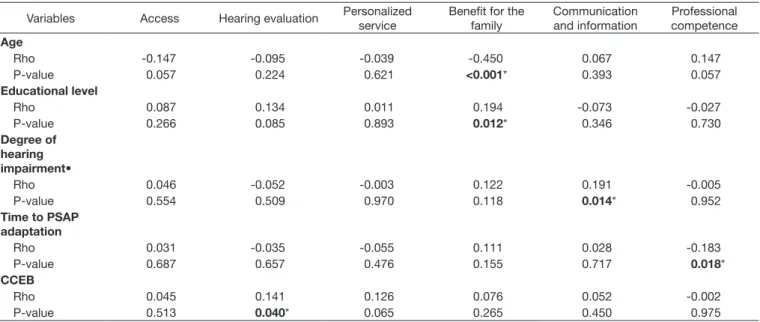
Table 3 shows that the correlations between the socio-demographic
data and the domains of the Hearing Health Care Assessment questionnaire were mostly poor and not signiicant.
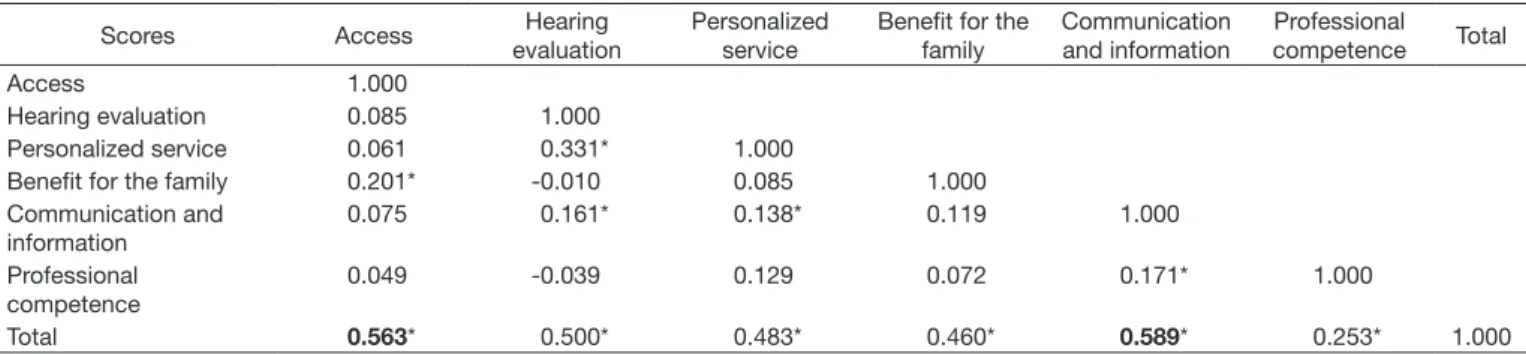
The correlation analysis between scores veriied that the ones found to be most related to the total were Access (0.563) and Communication and Information (0.589), both with moderate
correlation magnitude (Table 4).
Table 1. Socio-demographic characteristics of users seen at JSAM Betim and fitted with PSAP between May 2009 and May 2013 and Brazilian Economic Classification (CCEB) (n=214)
Variables n %
Gender
Female 117 54.7
Male 97 45.3
Age range
Youngsters 11 5.1
Adults 71 33.2
Elderly 132 61.7
Educational level
Illiterate 54 25.4
Incomplete elementary school 103 48.4
Elementary school 32 15
High school 20 9.4
Higher education 4 1.9
Degree of hearing impairment (self-reported)
None 4 2.4
Mild 20 11.9
Moderate 76 45.2
Severe 45 26.8
Deep 23 13.7
Transportation
provided 4 1.9
Out-of-pocket 210 98.1
Appointment scheduling
Direct 99 49
Otolaryngologist 100 49.5
Hearing tests 3 1.5
Table 1. Continued...
Variables n %
Type of service sought
Hearing tests 69 33.2
Hearing test/aid 14 6.7
Hearing aid 123 59.1
Speech-language therapy 1 0.5
Others 1 0.5
Year of PSAP fitting
(First concession) 2009 30 14.02
2010 16 7.48
2011 36 16.82
2012 78 36.45
2013 54 25.23
Brazilian Economic Classification
A1 0 0.0
A2 0 0.0
B1 9 4.2
B2 47 22.0
C1 58 27.1
C2 67 31.3
D 31 14.5
E 2 0.9
Caption: PSAP - personal sound amplification device/product
Table 2. Distribution of scores per domain obtained from the Hearing Health Care Evaluation questionnaire
Scores Mean Standard
deviation Minimum 1st Quartile Median 3rd Quartile
Access 61.1 18.0 10 50 65 75
Hearing evaluation 81.5 24.9 0 60 100 100
Personalized service 79.5 22.2 10 60 85 100
Benefit for the family 51.7 23.0 0 40 50 60
Communication and information 86.4 12.8 26.7 80 86.7 100
Professional competence 95.9 11.3 30 100 100 100
Total 76.7 9.4 41.1 71.1 77.8 83.3
Table 3. Correlation among clinical, audiological and sociodemographic variables and the domains of Hearing Health Care Assessment questionnaire (n=214)
Variables Access Hearing evaluation Personalized
service
Benefit for the family
Communication and information
Professional competence Age
Rho -0.147 -0.095 -0.039 -0.450 0.067 0.147
P-value 0.057 0.224 0.621 <0.001* 0.393 0.057
Educational level
Rho 0.087 0.134 0.011 0.194 -0.073 -0.027
P-value 0.266 0.085 0.893 0.012* 0.346 0.730
Degree of hearing
impairment•
Rho 0.046 -0.052 -0.003 0.122 0.191 -0.005
P-value 0.554 0.509 0.970 0.118 0.014* 0.952
Time to PSAP adaptation
Rho 0.031 -0.035 -0.055 0.111 0.028 -0.183
P-value 0.687 0.657 0.476 0.155 0.717 0.018*
CCEB
Rho 0.045 0.141 0.126 0.076 0.052 -0.002
P-value 0.513 0.040* 0.065 0.265 0.450 0.975
DISCUSSION
The sample characterization corroborates the literature related to hearing health care(6). The female gender predominance
was also found in the satisfaction survey of patients submitted to physiotherapy(14). As for educational level, the majority of
respondents present incomplete elementary education, which is consistent with that expected for the elderly population in Brazil, whose average number of years of formal education is 4.2(11). With
regard to self-reported hearing impairment, the majority of users reported moderate dificulty and that they had been referred by the otorhinolaryngologist to begin the process of personal sound ampliication device itting. This relects the low of care, in which the user and/or family, upon perceiving hearing impairment, seeks
medical care(15). The predominant means of transportation was
out-of-pocket, in other words, the user was responsible for their own transportation from/to home/health care unit.
The year 2012 presented a greater number of users itted with PSAP, and this is a consequence of the distribution of quotas by municipalities, which has undergone changes with the increase regulated by the Secretaria Estadual de Minas Gerais [State Secretariat of Minas Gerais](16).
Assessment of the CCEB questionnaire showed that no users were classiied in class A, and that the majority of patients seen by the service was classiied under class C. This means that the gross family income of the majority of respondents corresponds to values between one and a half minimum wage and two minimum wages. This result corroborates the report by Associação Brasileira de Empresas de Pesquisas [Brazilian Association of Research Companies] (ABEP) from 2010, in which the majority of the population in the metropolitan area of Belo Horizonte is classiied under class C(12).
Upon analysis of the results of the scores distribution by domains obtained from the Hearing Health Care Assessment questionnaire, users reported they are less satisied with the beneit for the family and more satisied with professional competence.
In a study conducted in Bauru (SP)(6), analysis of the beneit
for the family score obtained the second lowest result. Thus, its authors proposed that this domain be removed from the protocol, as this topic is dificult to interpret in assessing hearing health care quality due to its subjectivity.
In the present study, this domain was not removed because it was considered important to evaluate and obtain data so that the service develops actions aimed at family relationships, at quality assistance to the user, with guidance and monitoring by interdisciplinary teams, so as to guarantee a comprehensive care
service. It was observed that the instrument in fact fails to provide objective responses regarding the degree of dificulty for families.
In addition, it should be emphasized that assessment of the beneit for the family can be better performed by means of two concomitant strategies: questionnaire application by health agents and self-report of users. This model seems to be more effective in identifying signiicant improvements in communication of daily activities and, therefore, of their positive effects within the family context(17). In this sense, a closer tie among Hearing Health Care
Services, Family Support Health Centers, and Family Health Strategy is essential to guarantee comprehensive care.
With regard to professional competence, users state they are satisied with the professional team. Some authors point out that, in assessing public services, the bias of gratitude may inluence
responses(18-20). From this perspective, users omit their opinion and
fail to report negative criticism due to fear of losing the service or the right to it, as well as of impacting their relationship with health care professionals. However, the instrument does not bring enough questions to deepen and/or address the complexity of this issue. Therefore, new research is needed on this topic to understand the relationship between professionals’ skills, training, and performance, and the degree of user satisfaction.
The second lowest-rated domain was access. In the instrument used, “access” comprises geographical accessibility taking into consideration not only to the distance, but also to the time required
for transportation(9). In this sense, geographical proximity and the
users’ dificulty to arrive at the service unit constitute signiicant
barriers to access(14,20). In this study, this fact can be explained by
referral of Betim users to the Hearing Health Care Services in Belo Horizonte and Nova Lima, which corresponds to a distance of approximately 30 kilometers. Transportation is not free of charge for these users, which lowers the score.
A study that discusses access, such as access of deaf people to health care, found signiicant challenges regarding communication of professionals with the deaf population, and point out gaps on knowledge of the hearing impaired about their health condition(21).
Also with regard to the discussion of results of scores per domain, the lowest minimum results are worth noting: hearing assessment and beneits for the family. The highest minimum was communication and information, and professional competence.
Although the minimum value for hearing assessment was 0, the irst quartile was 60, i.e. the item was well assessed by users. Professional competence presented a maximum score as early as the irst quartile. The beneit for the family presented a value below the others and remained with a low score.
Table 4. Correlation among domain variables and total score of Hearing Health Care Assessment questionnaire (n=214)
Scores Access Hearing
evaluation
Personalized service
Benefit for the family
Communication and information
Professional
competence Total
Access 1.000
Hearing evaluation 0.085 1.000
Personalized service 0.061 0.331* 1.000
Benefit for the family 0.201* -0.010 0.085 1.000
Communication and information
0.075 0.161* 0.138* 0.119 1.000
Professional competence
0.049 -0.039 0.129 0.072 0.171* 1.000
Total 0.563* 0.500* 0.483* 0.460* 0.589* 0.253* 1.000
It is worth noting that, although the correlations among socio-demographic data and the questionnaire domains were mostly poor, their discussion is considered important.
Assessment of the beneit for the family was negatively correlated to increased user age, and it is believed that this fact may be related to the functional dependence bias. The literature reports that the elderly are uncomfortable around their family due to hearing impairment(22), and that users have speciic needs
related to the psychosocial and economic vulnerability situation in which they ind themselves(23).
Upon verifying effective use of PSAP by the elderly, its social beneits and their relationship with cognitive performance, researchers(24) found that patient follow-up by means of conventional
tests and self-assessment questionnaires promote eficacy of PSAP use, reducing the number of patients who stop using the device because of dissatisfaction, whether due to functional or psychosocial aspects. In addition, they point out that the patient’s cognitive state reveals whether there is a need for closer follow-up and speciic family guidance.
A positive correlation was also observed between the domain of beneit for the family and the educational level variable, as observed in the literature with regard to user satisfaction with the
services(20). According to the framework of Functional Literacy
in Health Care(25), an increase in educational level allows the user
to have greater knowledge and autonomy concerning daily care and handling of the PSAP, a factor that contributes to decrease dependence on family with regard to use of the personal sound ampliication device and, consequently, to increase the beneit for the family.
In this study, it was observed that an increase in self-reported hearing impairment is correlated with higher satisfaction as to communication and information received by the service’s professionals. This may show that users with a higher degree of impairment receive differentiated attention on the part of professionals, allowing for better communication and user-professional dialog and, consequently, greater adequacy of communication to the patient’s sociocultural particularities (23,26-29).
Therefore, providing appropriate attention may have positive effects in the user satisfaction assessment, as it is an important measure in health care.
Under the Hearing Assessment domain, the higher the users’ economic classiication, the higher user satisfaction. This was also found by a study that revealed that users with higher family income were more satisied with the medical consultation and its scheduling process(28).
Assessment of professional competence was negatively inluenced as the time to adaptation to the PSAP increases. This may be related to the lack of continuity of service when patients fail to go back to the service unit for speech-language therapy. A discrepancy between the average number of patients itted and production of speech therapy is found in Minas Gerais(5).
In this sense, the network’s biggest challenge is to strengthen the longitudinal dimension and decentralization of care by means of decentralized speech-language therapy. This fact may be due to lack of user knowledge about this follow-up(7) or even a lack of
active search for patients by the service. The timeliness bias is also worth considering, since users with longer adaptation time
may have dificulties to remember the quality of service provided at the time of PSAP itting.
The correlation analysis among the domains variables and total questionnaire score found a higher correlation of domains access and communication and information with the overall satisfaction score. This shows that these are the critical aspects for quality of care from the user’s perspective.
The literature presents a wide variety of approaches to analysis of access, such as reducing barriers, dificulty to schedule appointments, waiting time for appointments, which inluence user satisfaction with the service(28-30). Thus, establishing a clear
communication of professionals by means of building a dialogical and horizontal relationship allows for greater participation of the user in their treatment and inluence their assessment of the
service(28-30). In this vein, communication is highlighted as a key
element to create bonds and, consequently, for the development of a care process that makes sense to the user and considers their life context. Therefore, hearing health services should be turned towards the establishment of comprehensive communication with the user, so that they achieve the perspective of self-care and create a bond with the program.
This study contributes to the assessment of hearing health care services under users’ perspective and points out the challenges faced by the health care network in the sense of strengthening actions related to speech-language therapy actions following PSAP itting and to communication between professionals and users and between hearing health care services and primary care, so as to ensure continuity of care. However, it is worth noting that other user satisfaction studies that take into consideration not only the users’ perspective, but also the health care managers’ and professionals, are necessary. Furthermore, although it is not included in the initial proposal of the instrument used, the research carried out inferential analysis of variable correlations of domains and total score of the Hearing Health Care Assessment questionnaire and was described with poor and insigniicant correlations, indicating a possible weakness of the instrument proposed in evaluating these aspects.
CONCLUSIONS
Assessment of the hearing health care service under the users’ perspective indicated that more than three quarters of respondents are satisied with the service provided. The Hearing Health Care Assessment questionnaire was useful to characterize service, where the most highly considered aspects according to users are
professional competence and communication and information.
Access to service and beneit for the family were the aspects presenting the lowest satisfaction rates.
With regard to study of the questionnaire and the other variables, a consistent correlation between the PSAP beneit for the family and age was observed, where the higher the users’ age, the lower the beneit for the family.
REFERENCES
2. Brasil. Ministério da Saúde. Portaria 589/GM, de 8 de outubro de 2004 [Internet]. Diário Oficial da União; Brasília; 2004 [citado 2014 Ago 29]. Disponível em: http://bvsms.saude.gov.br/bvs/saudelegis/sas/2004/prt0589_08_10_2004_rep. html
3. Brasil. Ministério da Saúde. Portaria 793/GM, de 24 de abril de 2012. Diário Oficial da União; Brasília; 2012 [citado 2014 Mar 1]. Disponível em: http:// bvsms.saude.gov.br/bvs/saudelegis/gm/2012/prt0793_24_04_2012.html 4. Freitas CD, Costa MJ. Processo de adaptação de próteses auditivas em usuários
atendidos em uma instituição pública federal – parte I: resultados e implicações com o uso da amplificação. Rev Bras Otorrinolaringol. 2007;73(5):744-51. http://dx.doi.org/10.1590/S0034-72992007000600005.
5. Maciel FJ, Januário GC, Henriques CMA, Esteves CC, Silva MA, Carvalho SAS, et al. Indicadores de saúde auditiva em Minas Gerais: um estudo por macrorregião. Audiol Commun Res. 2013;18(4):275-84. http://dx.doi.org/10.1590/ S2317-64312013000400008.
6. Armigliato ME, Prado DGA, Melo TM, Martinez MANS, Lopes AC, Amantini RBC, et al. Avaliação de serviços de saúde auditiva sob a perspectiva do usuário: proposta de instrumento. Rev Soc Bras Fonoaudiol. 2010;15(1):32-9. http:// dx.doi.org/10.1590/S1516-80342010000100008.
7. Barbosa MR, Medeiros DS, Ribeiro GM, Rossi-Barbosa LAR, Caldeira AP. Satisfação com Aparelhos de Amplificação Sonora Individual entre usuários de serviços de saúde auditiva. Audiol Commun Res. 2013;18(4):260-7. http:// dx.doi.org/10.1590/S2317-64312013000400006.
8. Teixeira CF. Institucionalizando a prática de avaliação em saúde: significado e limites. Cien Saude Colet. 2006;11(3):572-4. http://dx.doi.org/10.1590/S1413-81232006000300007.
9. Donabedian A. The definition of quality and approaches to its assessment. Ann Arbor: Health Administration Press; 1980. (His Exploration in Quality Assessment).
10. Weiss GL. Patitents satisfaction with primary medical care: evaluation of sociodemographic and predisposition al fator. Med Care. 1988;26(4):383-92. PMid:3352331. http://dx.doi.org/10.1097/00005650-198804000-00007. 11. IBGE: Instituto Brasileiro de Geografia e Estatística. Síntese de indicadores
sociais: uma análise das condições de vida da população brasileira. Rio de Janeiro: IBGE; 2013.
12. ABEP: Associação Brasileira de Empresa de Pesquisa. Critério de Classificação Econômica Brasil. São Paulo: ABEP; 2010.
13. The Scottish Government. Draft quality standarts for adult hearing rehabilitation [Internet] 2008 [citado 2016 Jul 1]. Disponível em: http://www.scotlandd.gov. uk/publications/2008/01/09093543/0
14. Gonçalves JR, Veras FEL, Matos ACM, Lima ISA. Avaliação da satisfação dos pacientes submetidos à intervenção fisioterápica no município de Campo Maior, PI. Fisioter Mov. 2011;24(1):47-56. http://dx.doi.org/10.1590/S0103-51502011000100006.
15. Pinho LB, Kantorski LP, Saeki T, Duarte MLC, Sousa J. A integralidade no cuidado em saúde: um resgate de parte da produção científica da área. Rev Eletr Enf. 2007;3(9):835-46.
16. Minas Gerais. Secretaria de Estado da Saúde. Resolução SES 1669, de 19 de novembro de 2008. Diário Oficial do Estado de Minas Gerais; Belo Horizonte; 2008 [citado 2014 Ago 29]. Disponível em: http://www.saude.mg.gov.br/ atos_normativos/resolucoes/2008/RESOLUCaO SES No1669 DE 19 DE NOVEMBRO DE 2008.pdf
17. Abraham V, Job A, Emerson LP. Pilot study to evaluate hearing aid servisse delivery model and measure benefit using self-report outcome measures using
community hearing workers in Developing Country. ISRN Otolaryngol. 2013;2013:1-6.
18. Esperidião MA, Leny ABT. Avaliação de satisfação de usuários: considerações teórico-conceituais. Cad Saude Publica. 2006;22(6):1267-76. PMid:16751966. http://dx.doi.org/10.1590/S0102-311X2006000600016.
19. Donabedian A. Aspects of medical care administration: specifying requiriments for health care. Cambridge: Havard University; 1973.
20. Pereira JM, Salomão SR, Cinoto RW, Mendieta L, Sacai PY, Berezovsky A, et al. Avaliação dos serviços de assistência ocular em população urbana de baixa renda da cidade de São Paulo – Brasil. Arq Bras Oftalmol. 2009;72(3):332-40. PMid:19668962. http://dx.doi.org/10.1590/S0004-27492009000300010. 21. Kuenburg A, Fellinger P, Fellinger J. Healt care access among deaf people. J Deaf
Stud Deaf Educ. 2016;21(1):1-10. PMid:26405210.http://dx.doi.org/10.1093/ deafed/env042.
22. Fialho IM, Bortoli D, Mendonça GG, Pagnosim DF, Scholze AS. Percepção de idosos sobre o uso de AASI concedido pelo Sistema Único de Saúde. Rev Cefac. 2009;11(2):338-44. http://dx.doi.org/10.1590/S1516-18462009000200020.
23. Vianna NG, Cavalcanti MLT, Acioli MD. Princípios de universalidade, integralidade e equidade em um serviço de atenção à saúde auditiva. Cien Saude Colet. 2014;19(7):2179-88. PMid:25014297. http://dx.doi.org/10.1590/1413-81232014197.09392013.
24. Ávila VD, Guia ACOM, Friche AAL, Nascimento LS, Rosa DOA, Carvalho SAS. Relação entre o benefício do Aparelho de Amplificação Sonora Individual e Desempenho Cognitivo em usuário idoso. Rev Bras Geriatr Gerontol. 2011;14(3):475-84. http://dx.doi.org/10.1590/S1809-98232011000300008. 25. Adams RJ, Stocks NP, Wilson DH, Hill CL, Gravier S, Kickbusch I, et al.
Health literacy: a new concept for general practice? Aust Fam Physician. 2009;38(3):144-7. PMid:19283256.
26. Sucupira AC. A importância do ensaio da relação médico-paciente e das habilidades de comunicação na formação do profissional de saúde. Interface Comunicacao Saude Educ. 2007;11(23):619-35. http://dx.doi.org/10.1590/ S1414-32832007000300016.
27. Ricci NA, Wanderley FS, Oliveira MS, Rebelatto JR. O hospital-escola de São Carlos: análise do funcionamento por meio da satisfação dos usuários. Cien Saude Colet. 2011;16(1, Supl 1):1125-34. PMid:21503460. http://dx.doi. org/10.1590/S1413-81232011000700044.
28. Bastos GAN, Fasolo LR. Fatores que influenciam a satisfação do paciente ambulatorial em uma população de baixa renda: um estudo de base populacional. Rev Bras Epidemiol. 2013;16(1):114-24. PMid:23681328. http://dx.doi. org/10.1590/S1415-790X2013000100011.
29. Santos MA, Nemes MIB, Nasser ACA, Basso CR, Paiva VSF. Intervenção em adesão baseada na abordagem construcionista do cuidado: perspectiva dos profissionais de saúde. Temas Psicol. 2013;21(3):651-73. http://dx.doi. org/10.9788/TP2013.3-EE02PT.
30. Assis MMA, Jesus WLA. Acesso aos serviços de saúde: abordagens, conceitos, políticas e modelos de análise. Cien Saude Colet. 2012;17(11):2865-75. PMid:23175292. http://dx.doi.org/10.1590/S1413-81232012001100002.
Author contributions