THE EVALUATION OF COMFORT OF THE PERSONAL
HEARING PROTECTION DEVICES AS AN INTERVENTION
FOR HEARING LOSS PREVENTION
Avaliação do conforto do protetor auditivo individual numa intervenção
para prevenção de perdas auditivas
Patricia Schiniski Sviech (1), Claudia Giglio de Oliveira Gonçalves (2),
Thais Catalani Morata (3), Jair Mendes Marques (4)
RESUMO
Objetivo: analisar o conforto do protetor auditivo individual como parte de uma intervenção para prevenção de perdas auditivas em trabalhadores expostos a elevados níveis de ruído, por meio da utilização de um questionário de avaliação de conforto. Método: realizou-se análise dos documentos da empresa, investigação do ruído e uso de protetor auditivo individual anterior, seleção do prote-tor auditivo individual, atividades educativas, aplicação de questionário e realização audiometrias. A população foi composta de 20 trabalhadores expostos a ruído acima de 80 dB(A). Os trabalhadores utilizaram protetores tipo inserção e concha, cada um durante 15 dias e responderam ao questionário de avaliação do conforto em duas ocasiões. Resultados: dentre os participantes 85% eram homens e 15% mulheres, idade média 35 anos. O Índice de Conforto do protetor tipo inserção foi 4,6 e concha 6,1, com tempo médio de utilização de 6 horas 40 minutos. Dentre as razões negativas ao uso do equipamento destacaram-se: interferência com a comunicação (20%), diminuição da audição (10%) e não sentir necessidadede usar (10%). Conclusão: os protetores auriculares estudados tiveram seus escores cotados em níveis aceitáveis, sendo considerados ambos confortáveis. Contudo, existiu uma diferença signiicante no Índice de Conforto entre protetores de diferentes tipos (inserção e concha). Com isso, pôde-se concluir que, o protetor auditivo individual tipo concha foi considerado o mais con-fortável e melhor aceito pela população estudada.
DESCRITORES: Ruído; Perda Auditiva; Prevenção de Doenças
(1) Occupational Health Nurse; Master Degree in Communica-tion Disorders at the Universidade Tuiuti do Paraná – UTP. (2) Phonoaudiologist, Professor of the Masters Program in
Communication Disorders at the Universidade Tuiuti do Paraná – UTP, Curitiba, Paraná, Brazil; Doctorate in Public Health at the Universidade Estadual de Campinas. (3) Phonoaudiologist, Professor of the Masters Program in
Communication Disorders at the Universidade Tuiuti do Paraná – UTP, Curitiba, Paraná, Brazil; PhD at the Nacio-nal Institute of OccupatioNacio-nal Safety Health USA.
(4) Chemical Engineer; Professor of the Masters Program in Communication Disorders at the Universidade Tuiuti do Paraná – UTP, Curitiba, Paraná, Brazil; Doctorate in Geo-detic Sciences at the Universidade Federal do Paraná.
Conlict of interest: non-existent
INTRODUCTION
The health of people inside their workplace is a segment of occupational health that has the purpose to adjust the workplace to indivivuals and consequently to their work environment 1-3.
In Brazil, the Portaria 3214 of the Ministry of Labor and Employment from 06.07.1978 regulates the health, safety and industrial hygiene in public and private institutions, they are called Normas Regulamentadoras (NR). Among these standards,
NR 9 classiies the environmental risks, dividing
everyone inside the company, including supervisory and the impacted workers 20.
Based on this need, this study had the objective to analyze the comfort of the individual hearing devices as part of an intervention to the prevention of hearing loss in workers exposed to high noise levels, using a questionnaire which evaluates the comfort of these equipments.
METHOD
The research was conducted in a frigoriic in
Curitiba, using an intervention study type.
To select the population for this study, two types of criteria were used: exposure to occupational noise above 80 dB (A) during the working shift and the use of hearing protector devices, by workers during the execution of their daily working activities. Thirty workers were eligible and were invited to participate. Twenty (66.6%) workers accepted to be in this study (N = 20). Workers who refused to participate in this study (34.4%) were afraid that there could be negative consequences to their careers if they participated in the research.
Among the participants, three were women (15%) and seventeen were men (85%), aged between 18 and 72 years old (average 35 years old, median 32 years old), having worked for the company from 2 months to 5 years (average 2 years and 6 months)
with an 8 hour working shift, ive days during the
week, with no possibility of overtime work.
Regarding the level of education, 10% of the workers were illiterate, 40% had completed basic education and 50% had completed high school.
The study took place in six distinct steps:
1 – Analysis of company documents: Programa de Prevenção de Riscos Ambientais (PPRA – Brazilian Law), Programa de Controle Médico e de Saúde Ocupacional (PCMSO – Brazilian Law) and medical records;
2 – Research of the history of the use of hearing protectors devices and work with noise;
3 – Selection of the individual hearing protectors devices for the study in the company, following
the criteria of mitigation cost, approval certiicate
(CA – Certiicado de Aprovação – Brazilian Law) and ease in handling;
4 – Conducting an educational activity inside the company, by the researchers, obtaining 100% of participation from those who were involved in the research. There were ten meetings focusing on hearing health, involving two employees in each activity;
5 – Testing the comfort and effectiveness of individual hearing devices: hearing protector devices were delivered: earplug and earmuff
are capable of causing damage to the workers’ health 4 due to its nature, concentration and / or
intensity and exposure time.
From all the physical hazards, noise is now considered the most common health aggressor
agent found at theworkplace, impacting a signiicant
number of workers 5-7. The exposure to this risk for
years can cause damage to the workers hearing health, mainly causing Hearing Loss, a pathology easily preventable 7-9.
Therefore, Hearing Conservation Programs arise, characterized as a set of actions in order to eliminate or minimize the effects of noise in the human hearing, thus avoiding the triggering and / or worsening Hearing Loss 5,10. One of its stages refers
to the adoption of individual hearing protection devices, however its choice should take into consid-eration cost, accessibility, safety and comfort for workers 11-15.
The selection of a proper hearing protector device, attention to some factors is necessary such as attenuation, comfort, acceptability, price, individual characteristics both from the user and the device, among others. Nevertheless the best hearing protector device is the one that the employee believes to be comfortable and is willing to use correctly during the entire work shift 16.
The adaptation of the worker to the hearing protector device is a challenge because while there is resistance to its use by workers, employers may also neglect to provide adequate hearing protection to the employees 14. There are also other factors
that inluence workers’ decision whether or not to
use the hearing protector devices. These include comfort, interference to communication and to job performance, lack of sense of self-effectiveness (belief that the individual is able to make the best judgement regarding ones ownmedical health), among others17.
For hearing protection devices to be success-fully implemented, it is vital to count on employees own willingness towards its use, the model of the device and the adaptation of the equipment insinde employees’ external auditory canal. Such features neglected can cause decrease in the level of hearing protection, if compared to what is obtained in the laboratory18.
The hearing protection device should adapt to
the worker, but there still is a signiicant concern
with its attenuation, and the comfort is left behind
19. Each employee reacts individually to the
characteristics of comfort and effectiveness of each hearing protector device (Image 1); 6 – Conducting audiometry to assess whether the
employees’ hearing study participants and their possible inluence on the comfort Index presented by workers.
types. The researchers performed individual guidance on their correct use. The workers used each individual hearing protector device while performing their activities for a period of 15 consecutive days. After using this hearing protector device, employees completed the Arezes questionnaire 14, reporting the
Feeling related to the HPD 1 2 3 4 5 6 7 Feeling related to the HPD
Painless Causes pain
Uncomfortable Comfortable
Not too much pressure Excessive pressure Intolerable Tolerable
Tight Loose
Convenient Nuisance
Heavy Lightweight
Awkward Pleasant
Flexible Hard
Fresh Hot
Soft Rough
Feeling of isolation No feeling of isolation
Easy to put Complex to put
Complex No complex
Difficulties to move the head Easy to move the head
Feeling of clogged ears No feeling of clogged ears
Figure 1 – Bipolar Grid Coded
The questionnaire used in the evaluation of these devices contained an evaluation grid, previously validated by Casali Park 21 in another study, and
years later, translated and adapted to Portuguese by Arezes 14.
The grid data contains 16 bipolar scales that are formed by a descriptor for a particular sensation, relating to one side comfort and its opposite on the other side.
The sixteen sensations related to discomfort are: causes pain, uncomfortable, excessive pressure, intolerable, tight, nuisance, heavy, awkward, hard, hot, rough, feeling of isolation, complex to put, complex, dificulties to move the head and feeling of clogged ears. The sixteen sensations associated with comfort on the grid are: painless, pleasant, fresh, soft, no feeling of isolation, easy to put, not complex, easy to move the head, no feeling of
clogged ears. The central scale of the questionnaire refers to that which describes the sensations of “comfortable” and its opposite as “uncomfortable”.
To record the feeling of comfort, workers would have to evaluate the hearing protector devices, after using the equipment, placing an “X” in the 16 assessment scales that contain the sensations (vertical grid), to the right or to the left as horizontal scale (1, 2, 3, 4, 5, 6, 7) which separate the sensa-tions on one side to the other as comfort and discomfort.
In order to avoid a biased opinion, the scales were coded by Arezes 14, with some of their descriptors
switched in relation to the comfort central scale. After applying this questionnaire these grids were decoded into the following: pain, pressure,
conve-nience, lexibility, thermal sensation, texture and
Feeling related to the HPD 1 2 3 4 5 6 7 Feeling related to the HPD
Causes pain Painless
Uncomfortable Comfortable
Excessive pressure Not too much pressure Intolerable Tolerable
Tight Loose
Nuisance Convenient
Heavy Lightweight
Awkward Pleasant
Hard Flexible
Hot Fresh
Rough Soft
Feeling of isolation No feeling of isolation
Complex to put Easy to put
Complex No complex
Difficulties to move the head Easy to move the head
Feeling of clogged ears No feeling of clogged ears
Once obtained the answers in the questionnaire, the grids that required inversion, taking values 1-7 respectively replies closest descriptor of left and right. Thereafter, for the scales whose orientation was reversed scale ofice (“ uncomfortable – comfortable “), the values would also be reversed, for example, the value of 1 would be 7, and the value of 2 goes to 6, and so on.
Once decoded all responses, it was necessary to determine correlations between each scale (sensa-tions) and central scale (scale “uncomfortable – comfortable”) in line with Spearman correlation test.
It started from the assumption that the central scale, or comfort, indicated the subjective feeling that corresponds to the best indication of the overall assessment of hearing protector devices to the user. All scales that had a high correlation with the central scale would be likely to be included in the quanti-ication of the Comfort Index and thus intervene in the global perception of comfort. The Comfort Index was obtained by calculating the average of the responses which obtained correlation with the central scale of comfort.
To be considered statistically signiicant, the variables should present P value < 0.05 to be correlated with the central scale of comfort, thus presenting statistical signiicance level of 95%.
The closer employee´s response was to the comfort central scale index, the more comfortable
hearing protector device was considered. Thus the closer to 7 the response rate the greater the comfort of the device.
In the same questionnaire workers recorded how long they used the devices for on a daily basis, and at the same time,in case they did not ind a feeling of discomfort which described the use of the hearing device they could use the same material to document that. The questionnaire was read along with the workers during two sessions (for the earplug and for the earmuff groups). The workers used the hearing protector devices during two stages, for a period of time of 15 days and after that, they had to answer the questionnaire mentioned, expressing their subjective feeling of comfort (16 grids) based on seven scales that compose the bipolar grid of comfort.
This study was approved by the Ethics in Research on October 27, 2008, through the case number 00079 /2008.
The Spearman correlation coeficient was also performed regarding the Comfort Index and the following variables: age, sex, education, length of employment with the company, working time with noise, previous work with noise, use of hearing protector devices in another company, audio-metric change and justiication for disliking hearing protectors devices.
with attenuation of 14dB (A), the following technical
speciications were from Ministry of Labor, following
four fundamental aspects: mitigation, cost, valid
certiicate of approval by the Ministry of Labor and
ease in handling.
Prior to the data collection an activity of health education was carried aimingthe promotion of hearing health, in loco, achieving 100% of partici-pation of those involved in the research.
The health education activity was based on:
– Hearing physiology;
– Auditory and extra-auditory effects of noise in the human body;
– Noise emission sources in daily life and at work; – Prevention of diseases caused by occupational
noise exposure;
– Hearing protector devices;
– Care, handling, placement and packaging of the hearing protection devices.
However, during the health education activity, it was noted that 100% of participants did not know how to care, handle, condition or even put the hearing protection devices properly. These aspects can affect the attenuation and comfort provided by
the equipment. This was the irst event of health
education, focused on health promotion and prevention of hearing that the company participated in 10 years of practice with occupational health.
After the health education session, workers used the hearing protector devices (earplugs and earmuffs) in two occasions, during 15 days each, and after that, workers responded to the question-naire of comfort evaluation from Arezes 14 for both
hearing protector devices (earplugs and earmuffs). To compose the Comfort Index the bipolar grid was decoded for both questionnaires (earplugs and earmuffs). After this procedure, it was possible to observe the percentage of responses for the two questionnaires related to the two hearing protector devices (Images 3 and 4)
To be considered statistically signiicant, the variables should present P value <0.05 to be corre-lated with the score of each of the two questionnaires (earplugs and earmuffs), thus presenting statistical signiicance level of 95%.
The statistical tests used in this study were obtained through the Average of Excel software (version 2007), Spearman correlation test and Spearman correlation coeficient, obtained through Statistica software (version 07). The survey data was categorized into an Excel spreadsheet (version 2007) and then discharged into the Statistica (version 07) for calculating the Spearman corre-lation test and Spearman correcorre-lation coeficient.
RESULTS
The Company has a history of working with hearing protector devices (earmuffs and earplugs) since the implementation of the occupational health program (10 years ago) done by an outsourced Company.
According to PPRA (occupational health program – Brazilian Law) that was written for the company,
the frigoriic presents occupational hazards of the
following groups: chemical, biological, physical, ergonomic and for accidents. Among the physical risks, there is noise measured between levels 60 dB (A) 99 dB (A).
Regarding workers history with hearing protection devices in other companies, the results were: 60% of workers had never used the devices and 40% had already used hearing protection devices in previous companies they worked for.
Out of the twenty workers participating in this study, twelve (60%) of them had already worked with noise at another company before joining the
frigoriic and eight (40%) had never worked with
noise before.
Figure 3 – Questionnaire answers percentage related to hearing protector device type earmuffs
described above was used, and after that, three scales were selected and the remaining 13 were eliminated for the calculation of the Comfort Index of each hearing protector device (Table 1 and 2). The Comfort Index was calculated using a
selection criteria to include scales, which consists in
the presence of statistical signiicance (| rs |> 0.45
and p <0.05) between the central range studied and the comfort feeling. The elimination criteria
QUESTIONNARIE QUESTIONS n Rs p
COMFORT AND PAIN 7 0,7027 0,0782
COMFORT AND PRESSURE 7 0,9009 0,0056
COMFORT AND TOLERANCE 7 -0,0909 0,8463
COMFORT AND ADAPTATION 7 0,2477 0,5922
COMFORT AND CONVENIENCE 7 0,7364 0,0591
COMFORT AND WEIGHT 7 0,8228 0,0230
COMFORT AND WELL BEGIN 7 0,6545 0,1106
COMFORT AND FLEXIBILITY 7 0,8091 0,0275
COMFORT AND THERMAL SENSATION 7 0,7207 0,0676
COMFORT AND TEXTURE 7 0,5049 0,2478
COMFORT AND ISOLATION FEELING 7 0,1284 0,7837
COMFORT AND COMPLEXITY TO PUT 7 0,5984 0,1558
COMFORT AND COMPLEXITY 7 0,3000 0,5133
COMFORT AND DIFFICULTIES TO MOVE THE HEAD 7 0,6358 0,1249
COMFORT AND HEARING 7 0,2455 0,5957
Table 1 – Spearmann correlation between comfort question of the questionarie and other questions from the questionarie for earplugs
n= Comfort Index (scale 1 to 7)
QUESTIONNARIE QUESTIONS n Rs p
COMFORT AND PAIN 7 0,3686 0,4159
COMFORT AND PRESSURE 7 0,2658 0,5645
COMFORT AND TOLERANCE 7 0,1957 0,6742
COMFORT AND ADAPTATION 7 0,5766 0,1754
COMFORT AND CONVENIENCE 7 0,8383 0,0185
COMFORT AND WEIGHT 7 0,0613 0,8961
COMFORT AND WELL BEGIN 7 0,0895 0,8487
COMFORT AND FLEXIBILITY 7 0,6338 0,1264
COMFORT AND THERMAL SENSATION 7 0,8383 0,0185
COMFORT AND TEXTURE 7 0,6952 0,0829
COMFORT AND ISOLATION FEELING 7 0,5761 0,1759
COMFORT AND COMPLEXITY TO PUT 7 0,8847 0,0081
COMFORT AND COMPLEXITY 7 0,4674 0,2903
COMFORT AND DIFFICULTIES TO MOVE THE HEAD 7 0,3680 0,4166
COMFORT AND HEARING 7 0,5761 0,1759
Tabela 2 – Spearmann correlation between comfort question of the questionarie and other questions from the questionarie for earmuffs
softness, since they were statistically signiicant. Items that made the composition of the Comfort Index for earmuffs were: uncomfortable, hot and dificult to put, since they were statistically signif-icant. (Table 1 and 2).
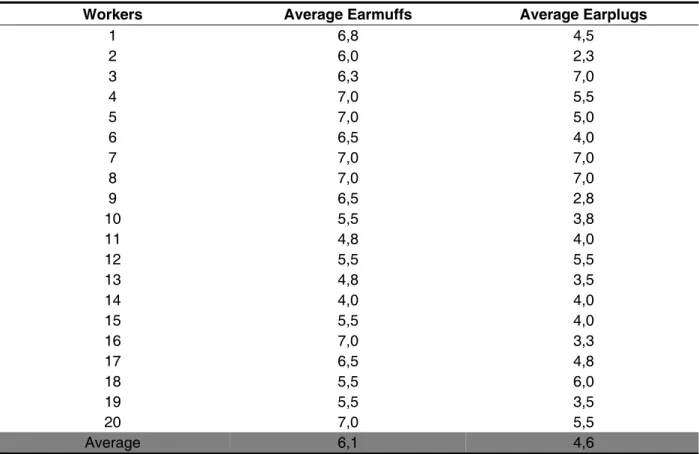
The Comfort Index for the devices tested was obtained by means of the averages of the responses that obtained correlation with the comfort scale (Table 3). The end result of the Comfort Index was 6.1 (87.1% Comfort Index) for earmuffs and 4.6 (65.7% Comfort Index) for earplugs.
Items that did not make the composition of the Comfort Index for earplugs were: pain, comfort (central grid), tolerance, tight, convenience, pleas-antness, lexibility, softness, feeling of isolation, complexity, dificulties to move the head and feeling of clogged ears. Items that did not make the composition of the Comfort Index for earmuffs were: pain, comfort (central grid), tolerance, tight, weight, lexibility, softness, feeling of isolation, dificulties to move the head and feeling of clogged ears.
Items that made the composition of the Comfort Index for earplugs were: pressure, weight and
Workers Average Earmuffs Average Earplugs
1 6,8 4,5 2 6,0 2,3 3 6,3 7,0 4 7,0 5,5 5 7,0 5,0 6 6,5 4,0 7 7,0 7,0 8 7,0 7,0 9 6,5 2,8 10 5,5 3,8 11 4,8 4,0 12 5,5 5,5 13 4,8 3,5 14 4,0 4,0 15 5,5 4,0 16 7,0 3,3 17 6,5 4,8 18 5,5 6,0 19 5,5 3,5 20 7,0 5,5
Average 6,1 4,6
Tabela 3 – Average to compose the Comfort Index based on the workers answers for the questionnaire
Other feelings described by users regarding the use of the hearing protector devices included: the need to communicate (20%), hearing loss (10%) and does not feel the need to use (10%).
The average time use of the hearing protection devices by employees during the study period was approximately 6 hours and 40 minutes daily during the workday. The workers did not use hearing protection devices during lunchtime rest period, or during the 15 minute breaks in the morning and in the afternoon.
Regarding the audiograms, 90% of audiometry results were classiied as normal and 10% were classiied as altered suggesting Hearing Loss caused by noise exposure.
p = 0.0316, r = 0.4814), question 8 (sense of well-being, p = 0.0306, r = 0.4839), question 9 (lexibility, p = 0.0385, r = 0.4656), and question 11 (texture, p = 0.0200, r = 0.5154).
DISCUSSION
This study analyzed the comfort of the hearing protector devices as part of an intervention for prevention of hearing loss in workers exposed to high noise levels, using a questionnaire that evaluated the comfort of these devices.
By monitoring workers exposed to occupational hazards, mainly to noise, it is clear that many are still unaware of their rights and duties regarding their occupational health, and are afraid to engage in activities targeted towards that. This can be seen since 33.33% of the population where the study was conducted did not want to take part in this study, justifying that they were uncertain regarding the results of the study and possible retaliation from company’s management. Such information shows a point to be worked with the workers and companies leadership team, regarding their participation and interaction in their own process for producing healthy work environment, so that everybody is engaged in activities aiming everybody’s health and safety and knows both their rights and responsibilities regarding their own occupational health.
The choice of hearing protection devices used in this research considered the following aspects: mitigation, working hours, approval certiicate (CA) by the Ministry of Labor, cost and ease for handling, consistent with the reality of the company and the literature 4, 21, 22.
The workers that participated on this research had lack of prior knowledge about how to use properly the hearing protection devices, and this aspect would have negative inluence on comfort and acceptance of these devices by employees in the period prior to the beginning of this investi-gation. Upon completion of the educational activity, the hearing protection devices were better accepted by the employees. It was observed that the educa-tional activities have contributed to the perception of comfort and acceptability of the hearing protection devices, and fostered more involvement of the employees in their own hearing health process.
The educational activity conducted on this research contributed to check the knowledge of the participants regarding hearing protection, which was low. When it comes to comfort of the hearing protection device, the practical activities and the perception of workers are essential to reach the comfort and acceptability of hearing protection devices by the employees. Knowing how to properly performed to check whether there was a correlation
between these variables and the Comfort Index found in this research.
It was not possible to apply a statistical test to the variable sex of the participants for the two types of hearing protector device, because of the number of female subjects composed by 3 individuals. Additionally the occurrence of statistical correla-tions between the two types of hearing protector device and variables change in the audiograms and reasons to dislike the use of hearing protector devices could not be studied, due to the number of selections being less than ive, not enabling a speciic statistical test.
For the earplugs, there was no signiicant corre-lation between age and the questionnaire speciic questions regarding the equipment, as well as no signiicant correlation between the results of the audiometry exams and the questionnaire score. To calculate the correlation between educational level and questionnaire score, the following coding was considered :1 (illiterate), 2 (elementary eduaction) and 3 (high school education). However, there was no signiicant correlation between these variables. As per period of time working for the Company and the question data signiicant correlation was found between length of service and the question 11 (texture, p = 0.0151, r = 0.5348) and the question 14 (complexity, p = 0.0238, r = 0.5029). When the questionnaire score and the occupational noise in the workplace were studied, a statistically signiicant correlation was found only between occupational noise and the question 7 (weight, p = 0.0015, r = 0.6605).
should be complementary to the evaluation of these other issues raised.
Regarding the results of the questionnaires and other variables, it was observed that for the earplugs there were signiicant correlations between length of service and the perception of texture and complexity of the equipment. This demonstrates that the bigger the knowledge about the equipment, the most detailed it is the knowledge about it 19, 25. There has
also been a signiicant correlation between occupa -tional noise and weight of the hearing protector device, a correlation that has no other similar indings in literature, allowing only speculation of possible explanations that may involve the level of stress associated with higher noise.
For earmuffs, there was a signiicant corre-lation between age and adaptation to the hearing protection devices, suggesting that age is a factor to be considered in the selection of the equipment 19,25.
There also was a signiicant correlation between education and thermal sensation, which can suggest that education should be considered in the adaptation of earmuffs, through health educational activities. There were also signiicant correlations between occupational noise and pressure, weight, sense of well-being, lexibility and texture. These features suggest that high noise level can enhance the general feeling of discomfort, which is expressed to various aspects of the device.
However, there are other aspects that must be taken into consideration when choosing a hearing protection device. According to the results of this research, these aspects include excessive pressure on the head of the worker, the weight of equipment, lexibility of the device, ear discomfort that is caused by pressure of the equipment into the ear canal, auricular heat and dificulty to put the equipment caused by lack of knowledge from the user or complexity of the equipment. If such aspects were evaluated before the choice of the device, they could help professionals when choosing a good hearing protector device, therefore the equipment could be more easily accepted and more comfortable to the user
This study had some limitations, especially regarding the number of subjects, in particular females. It is recommended to carry out a further study with a larger number of participants, and uncontrolled duration of the use of the equipment, to better assess these aspects.
The health education activity and the application of the questionnaire assessing the comfort of hearing protection presented in this research had a positive impact on the acceptability of the indicated hearing protectors. This questionnaire points directly to the professional which is the aspect that bothers the use and handle the equipment can prevent errors
and false analyses from the worker regarding the comfort of the device 14, 15, 19, 20, 23, 24.
The questionnaire results indicated a signiicant difference between the perception of different models of hearing protection devices (earplugs and earmuffs). The earplugs received a score of 4.6 (65.7% Comfort Index) and earmuffs received a score of 6.1 (87.1% Comfort Index). In both cases, speciic issues were raised related to the comfort of the equipment, which may contribute to the selection of an even more comfortable device. To consider a hearing protection device comfortable or uncomfortable it is necessary to observe its Comfort Index. The closer the Comfort Index is to 7, the more comfortable it is, whereas the closer the Comfort Index is to 1, the more uncomfortable the equipment is 19.
In a similar study, Arezes and Miguel 19 used the
same tool to compare two types of earplugs and two types of earmuffs. Earplugs received scores of 4.1 (58.5% of Comfort Index) and 3.7 (52.8% Comfort Index) while the earmuffs received scores of 6.4 (91, 4% Comfort Index) and 6.2 (88.5% Comfort Index), equivalent to those found in the present study. The difference between the two protectors of each type was not signiicant, but it was signiicant among the protectors of different types, also found in the present study. In the study of Arezes and Miguel 19 it was noted a statistically signiicant
association between the Comfort Index and the time of its use, which cannot be assessed in this study because the workers were ordered to wear the device throughout their work shift and request was followed. The authors also indicated that the feeling of comfort may vary not only from device to device, but also with the thermal and acoustic environment.
Other perceptions were raised, not restricted to the comfort, but that may inluence this aspect and hence the acceptability of the hearing protection devices. Among those reasons the following were identiied: the need for communication (20%) insertion type, hearing loss (10%) insertion type and lack of feeling of necessity (5%) for earmuffs (5%) for earplugs. These can be compared to those reported by the literature, which identiies several barriers perceived by users for regular use of hearing protection devices 14, 16, 19, 24. These barriers
include apart from the discomfort, interference with communication and job performance, lack of sense of self-eficacy (clarity or belief that the individual has the need to use the equipment and that one is able to take effective measures to protect their medical health) and others 18, 25. These results suggest that
thorough analysis. The comfort is taken into account, for some agents; there is no individual work in order to ergonomically adapt to devices, when individual and collective adaptation of all workers to the use of hearing protection takes place. The attenuation is not sought for the speciic noise level, but the maximum attenuation that the device can provide, which is also not advisable as it creates communi-cation dificulties and the feeling of isolation 13.
The hearing protector devices, noise control and health education contribute in signiicant ways to minimize the effects of noise on workers’ health. However, the provision of hearing protection devices should not be done without an adaptation campaign.
The results of this study suggest that the Comfort Index alone is not suficient to assess own comfort of the hearing protection devices and its acceptability, but it should be supplemented by the following items: analysis of adequate attenu-ation offered and interference of the device in the communication, emphasizing the need for the use of hearing protection devices in pathophysiological terms, instruction for correct placement and use of the device and conducting practical exercises and activities of health education aimed at handling, cleaning, maintenance and proper custody of such equipment.
CONCLUSION
The hearing protection devices studied, had their scores at acceptable levels quoted above 4 (57.1% to show Comfort), both being considered comfortable. However, there was a signiicant difference in the Comfort Index between different types of protectors (earplugs and earmuffs). Thus, it was concluded that the earmuff hearing protection device type was considered the most comfortable and best accepted by the population of this study. employee on equipment usage, that way, it is easier
to act correctively on this process, and in ultimately achieve success in the prevention of Hearing Loss caused by exposure to noise.
The noise attenuation provided by hearing protection devices depends on several asscoaited parameters, including: the user (shape and geometry of the ear, canal, user experience related to the usage of the equipment), shield type (mechanical design of the hearing protector device including the geometric shape, materials, dimensions, size, arc force) and the environment in which the worker is inserted (noise levels, frequency, usage of other protective equipment) 16.
The greatest dificulty in choosing and obtaining appropriate hearing protection device is caused because each worker has their own anatomical and physiological characteristic of the ear, and it can be the cause of many problems related to the dificulty of getting good isolation from the universal size of the devices found in the market. Inherent attenu-ation aspects of device(quality), the user’s personal characteristics (size of the external auditory canal, shape of the face and head), compatibility with other personal protection equipment , type of duties, proper use, preferences and level of noise where the worker works must always be taken into consid-eration 26-28.
For the correct selection a good hearing protection device three factors must be taken into account: attenuation, comfort and communication 22.
As seen, the hearing protectors should not be chosen only by their noise attenuation. The hearing protectors should be comfortable in order for them to be effective 14. Therefore, it is necessary that
employees have choices of different types of devices that can provide the necessary attenuation 25 so that
each individual can ind the most comfortable type of the device 25.
9. Caldart AU, Adriano CF, Terruel I, Martins RF, Caldart AU, Mocellin M. Prevalência da perda auditiva induzida pelo ruído em trabalhadores de Industria têxtil. Arq. Int. Otorrinolaringologia. 2006;10(3):192-6.
10. Gonçalves CGO, Iguti AM. Análise de programas de preservação da audição em quatro indústrias metalúrgicas de Piracicaba. Cadernos de Saúde Pública. 2006; 22(3):609-18.
11. Gonçalves CGO. Implantação de um programa de preservação auditiva em metalúrgica: descrição de uma estratégia. Distúrbios da Comunicação. 2004;16(1): 43-51.
12. Augusto Neto N. Veriicação dos níveis de atenuação de protetores auriculares do tipo concha, utilizando microfone sonda [dissertação]. São Paulo: Programa de Pós-Graduação em Design da Universidade Estadual Paulista; 2007.
13. Nielsen RM. Comportamento de três protetores auriculares tipo concha, em ambientes com ruído em baixa frequência [Dissertação]. Rio Grande do Sul: Programa de Pós-Graduação em Engenharia de Produção da Universidade Federal; 2001. 14. Arezez PM. Proteção individual auditiva: conforto vs. eicácia. In: Segunda Conferência Internacional de Ergonomia – Livro de Comunicações de Ergonomia, Segurança e Higiene Ocupacionais; 1999 maio. Braga. Universidade do Minho; 1999. 15. National Institute For Occupational Safety And Health – NIOSH. Criteria for a Recommended Standard. Occupational Exposure to Noise. Revised
REFERENCES
1. Organización Internacional del Trabajo. Convención 161: servicios de salud en el trabajo. Geneva: Organización Internacional del Trabajo; 1985.
2. Organización Panamericana de la Salud. Programa de Salud de los Trabajadores: ante-projeto. Washington DC: Organización Panamericana de la Salud; 1983.
3. Lacaz FAC. O campo saúde do trabalhador: resgatando conhecimentos e práticas sobre as relações trabalho-saúde. Cadernos de Saúde Pública. 2007;23(4):757-66.
4. Brasil. Ministério do Trabalho e Emprego. NR–09 – Programa de Prevenção de Riscos Ambientais. Aprovada pela Portaria n.º 3214 de 8 de junho de 1978. Brasília: Ministério do Trabalho e Emprego. 5. Arezes PM, Miguel AS. Risk perception and safety behavior: a study in an occupational environment. Safety Science. 2008;26:900-7.
6. Dias A, Cordeiro R, Corrente JE, Gonçalves, CGO. Associação entre perda auditiva induzida pelo ruído e zumbidos. Cadernos de Saúde Pública. 2006; 22(1): 63-8.
7. Gabas G. Escute bem e proteja-se. Revista Proteção. 2007;181:54-61.
8. Guida HL. Efeitos psicossociais da perda auditiva induzida pelo ruído em ex-funcionários da indústria. ACTA ORL / Técnicas em Otorrinolaringologia. 2007;25 (1):78-83.
ABSTRACT
Purpose: to analyze the comfort of the individual hearing protectors as part of an intervention for prevention of hearing loss in workers exposed to high noise levels, using a questionnaire of comfort assessment. Method: company safety and health records were reviewed, noise measurements were performed, new HPDs were selected, the comfort of the devices was evaluated and audiometric tests were conducted. The study population was 20 workers exposed to noise levels above 80 dB(A). The workers used two types of HPD (earplugs and earmuffs), each for 15 days, followed by an application of the questionnaire after each trial period. Results: 85% of the participants were males and 15% females and their average age was 35 years old. The comfort index for the studied earplug was 4.6, and for the studied earmuff was 6.1. The participants wore the HPDs during their full work shift which lasted 6 hours and 40 minutes. Other barriers were indentiied to the use of hearing protection: interference with communication (20%), decreased hearing (10%) and lack of clarity on the need to use it (10%). Conclusion: the HPDs analyzed in this study had their scores acceptable and were considered both comfortable. However, there was a signiicant difference in the comfort Index between protectors of different types (earplug and earmuff). The conclusion was that the earmuff is considered the most comfortable and more accepted HPDs by this population.
23. Bramatti L, Morata TC, Marques JM. Ações educativas com enfoque positivo em programa de conservação auditiva e sua avaliação. Revista CEFAC. 2008;10(3): 398-408.
24. Berger E. The Ardent Hearing Conservationist. In Invited Paper at the 26th Annual Conference of the National Hearing Conservation Association. 2001. USA, Raleigh, NC; 2001.
25. Morata TC, Fiorini AC, Fischer FM, Krieg EF, Gazzoli L, COLACIOPPO S. Factors affecting the use of hearing protectors in a population of printing workers. Noise and Health. 2001;4(13):25-32. 26. Rodrigues MAG, Dezan AA, Marchiori LLM. Eicácia da escolha do protetor auditivo pequeno, médio e grande em programa de conservação auditiva. Revista CEFAC. 2006;8(4):543-7.
27. Toivonen M, Paakkonen R, Savolainen S, Lehtomaki K. Noise attenuation and proper insertion of earplugs into ear canals. Ann Occup Hyg. 2002;46(6):527-30.
28. Gonçalves CGO, Coutoll CM, Malteza C, Leonelli BS. Avaliação da colocação de protetores auriculares em grupos com e sem treinamento. Revista CEFAC. 2009;11 (2):345-52.
Criteria. Cincinnati: USDHHS, PHS, CDC, NIOSH, publication no. 98-126; 1998.
16. Gerges SNY. Ruído: fundamentos e controle. Florianópolis: NR; 1999.
17. Svensson EB, Morata TC, Nylén P, Krieg EF, JohNson, AC. Beliefs and attitudes among wwedish workers regarding the risk of hearing loss. International Journal of Audiology. 2004;43:583-93. 18. Faria CAR, Suzuki, FA. Avaliação dos limiares auditivos com e sem proteção individual. Revista Brasileira Otorrinolaringologia. 2008;74(3):417-22. 19. Arezes OM, Miguel AS. Hearing protectors acceptability in noisy environments. British Occupational Hygiene Society and Occupational Hygiene. 2002;46(6):531-6.
20. National Institute for Occupational Safety and Health. Preventing occupational hearing loss a practical guide. Cincinnati: National Institute for Occupational Safety and Health; 1996.
21. Park M, Casalo JG. An empirical study of comfort afforded by various hearing protection devices: laboratory versus ield results. Appl Acoust. 1991;34:151-79.
22. Ciote FA, Ciote RFF, Harber J. Análise de atenuação de ruído de protetores auriculares. Exacta. 2005;3:71-7.
Received on: October 06, 2011 Accepted on: April 11, 2012 Mailing address:
Patricia Schiniski Sviech
Rua Fernandes Vieira, 35 apartamento 03 Curitiba – Paraná
CEP: 81020-650