Oral infections and orofacial
pain in Alzheimer’s disease
Case report and review
Silvia Regina Dowgan T. de Siqueira
1, Thaís de Souza Rolim
2, Manoel Jacobsen Teixeira
3,
Ricardo Nitrini
4, Renato Anghinah
5, José Tadeu T. de Siqueira
6Abstract – Dental infections, frequent in the general population, are a common cause of inflammation with systemic impact, and are the most common cause of orofacial pain. Temporomandibular disorders are also frequent in the elderly and represent an important cause of secondary headache. Both inflammation and pain can also contribute to cognitive, functional and behavioral impairment of the elderly and aggravate symptoms of patients with Alzheimer’s disease (AD). We report a case of a 74-year-old woman with AD and chronic facial pain who had a significant improvement in functional activities as well as in cognition and depressive symptoms after successful treatment of her facial pain. Patients with AD have higher compromise of oral health with infections and teeth loss. The investigation of orofacial pain should be performed in patients with AD, because of the associations reviewed and given the potential for improvement as highlighted by this case.
Key words: Alzheimer’s disease, elderly, dementia, temporomandibular disorder, orofacial pain.
Infecção oral e dor orofacial na doença de Alzheimer: relato de caso e revisão
Resumo – Infecções dentárias, frequentes na população e geral, são uma causa comum de inflamação com impacto sistêmico e a causa mais comum de dor orofacial. Disfunções temporomandibulares também são prevalentes nos idosos, causam cefaléia secundária. Tanto a dor quanto a inflamação podem também contribuir com o comprometimento cognitivo, funcional e comportamental em idosos e agravar sintomas em pacientes com doença de Alzheimer (DA). Este é um relato de um caso de uma mulher com 74 anos de idade com DA e dor orofacial crônica que apresentou uma melhora significante nas atividades funcionais assim como na cognição e sintomas depressivos depois do tratamento da dor facial. Pacientes com DA tem alto comprometimento da saúde oral com infecções e perdas dentárias. A investigação da dor orofacial deveria ser realizada em pacientes com DA devido às associações revisadas e à possibilidade de melhora como destacadas por este relato.
Palavras-chaves: doença de Alzheimer, idoso, demência, disfunção temporomandibular, dor orofacial.
1DDS, PhD, Assistant Professor, Gerontology, School of Arts, Sciences and Humanities, University of São Paulo, São Paulo SP, Brazil. 2DDS, Postgraduate
Student, Member of the Orofacial Team, Hospital das Clínicas, Medical School, University of São Paulo, São Paulo SP, Brazil. 3MD, PhD, Chairman of
Neurosurgery, Neurology Department, Medical School, University of São Paulo, São Paulo SP, Brazil. 4MD, PhD, Associate Professor, Head of Group of
Cognitive and Behavioral Medicine, Neurology Department, Hospital das Clínicas, Medical School, University of São Paulo, São Paulo SP, Brazil. 5MD,
Group of Cognitive and Behavioral Medicine, Neurology Department, Hospital das Clínicas, Medical School, University of São Paulo, São Paulo SP, Brazil.
6DDS, PhD, Head of the Orofacial Pain Team, Dentistry Division, Medical School, University of São Paulo, São Paulo SP, Brazil.
Silvia Regina Dowgan T. de Siqueira – Rua Carlos Weber 1319 / apto P164 - 05303-000 São Paulo SP - Brazil. E-mail: [email protected] Disclosure: The authors report no conflict of interest.
Received February 19, 2009. Accepted in final form April 20, 2010.
The aging process, or senescence, is characterized by gradual reduction in the functional reserve of the body, a phenomenon which compromises the ability to adapt to external and internal changes but is not an illness state.1,2
The elderly can be classified into three groups according to their general state of health: healthy (60% to 75% of
elder-ly), chronically ill (20% to 35%) and fragile (2% to 10%).1
Among diverse symptoms that this group reports, pain can and must be evaluated as a potential sign of disease.1 Many
(AD) is the most prevalent.3,4 The objective of this article
was to present a case and review the role of oral infections and orofacial pain in AD. Articles published between 1984 and 2008 were searched according to the following key-words: Alzheimer’s disease OR elderly OR dementia AND orofacial pain OR oral infections. A case reported in the literature is described below.
Case report
A woman aged 74 years, diagnosed with mild to mod-erate AD5 an MMSE (Mini Mental State Exam)6 score of
18, and presenting severe functional impairment identified by a score of 30 on the Functional Activity Questionnaire (scores above 5 are indicative of functional impairment in dementia)7 had a complaint of left pre-auricular pain
which spread to the head. The pain was throbbing and un-bearable, with long crises (hours to days) 2-3 times a week, and had started 3 years earlier but had worsened in the last 10 months. She had little relief with common analgesics. She was completely edentulous but only using the superior prosthesis. Her masticatory muscles (temporalis, masseter and neck muscles) were painful on palpation on both sides. A dental exam was performed using the DMFT (decays, ex-tractions and fillings), the OHIP (45) (assessing quality of life associated to oral health), and the Research Diagnostic Criteria for Temporomandibular Disorders (RDC/TMD) Axis I and II for musculoskeletal diagnosis of the
mastica-tory system and psychosocial aspects involved (depression, anxiety and limitations in quality of life).
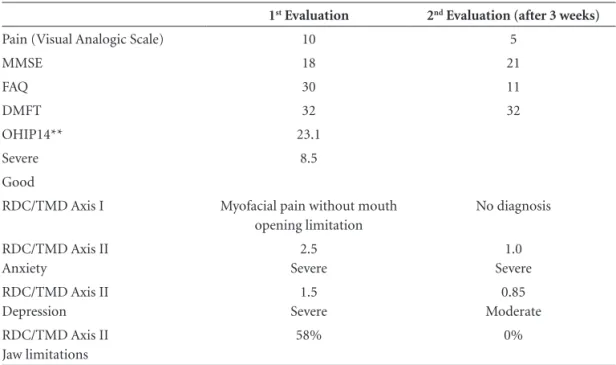
The proposed initial treatment was 4 applications of TENS (transcutaneous electric neural stimulation) to the masseter muscles, hot water compresses on the face and neck, and physiotherapeutic mouthwashes with 2% phenol water, three times a day. After 3 weeks, her pain had been alleviated and there was a marked improvement in the FAQ score, as well as in the MMSE and depressive symptoms (Ta-ble 1). She was referred for prosthesis treatment at the clin-ic, which was completed within 3 months. In the follow-up evaluation, she reported no pain or mandibular limitations.
Facial pain in the elderly
Pain was defined by the International Association for the Study of Pain (1986), as a sensorial and emotional un-pleasant experience, associated to a real or potential tis-sue injury, or described in such terms.8 The denomination
Orofacial Pain includes all painful conditions of the mouth and face, which are specific to dentistry, and including tem-poromandibular disorders (TMD).8 It s important to note
that this is one of the areas of the whole body with the most types of diagnosis, often overlapping, and with sig-nificant psychological and social impact.8,9 Chronic pain in
the community varies from 7% to 40%, and is persistent in 8% of individuals. In general, the most common cause is musculoskeletal, often diffuse.10
Table 1. Cognitive, behavioral, functional, and mandibular characteristics of the patient before and after treatment.
1st Evaluation 2nd Evaluation (after 3 weeks)
Pain (Visual Analogic Scale) 10 5
MMSE 18 21
FAQ 30 11
DMFT 32 32
OHIP14** 23.1
Severe 8.5
Good
RDC/TMD Axis I Myofacial pain without mouth
opening limitation
No diagnosis
RDC/TMD Axis II Anxiety
2.5 Severe
1.0 Severe
RDC/TMD Axis II Depression
1.5 Severe
0.85 Moderate
RDC/TMD Axis II Jaw limitations
58% 0%
MMSE, Mini Mental State Examination; FAQ, Functional Activities Questionnaire; DMFT, Number of decayed, missing and filled teeth; OHIP 14, Oral Health Impact Profile.45 RDC/TMD Axis I and Axis II: Research Diagnostic Criteria for Temporomandibular Disorders, Axis
The perception of painful stimuli may be quantitatively and qualitatively modified by a series of internal and ex-ternal factors9,11 where these include emotional state and
awareness, social, cultural and environmental aspects, the meaning of pain experiences and finally, the context in which pain occurred. The first step in the sequence of events that give rise to the sensitive phenomenon of pain is the transformation of environmental stimuli into action potentials that are transmitted to the Central Nervous Sys-tem (CNS) by the peripheral sensitive fibers.12 The activity
of the nociceptors is modulated by chemical substances released in high concentrations in the tissue environment due to inflammatory, traumatic and/ or ischemic process-es.13 Pain is the most common symptom reported by the
el-derly and is present in more than 50% of their complaints; 19% of hospitalized elderly have moderate to severe pain. However, significant growth in the elderly population is ex-pected in the next 50 years (groups more than 65 years old will grow from 7.4% to 16.4% and those older than 80 years old will triple by 2050 worldwide).2,8 In parallel with this
increase in life expectation, quality of life and physical, psy-chological and social wellbeing is expected to be preserved at this age. Thus, pain should be identified and controlled.
In the elderly, pain is in general chronic and associated to degenerative and articular diseases, which occur in 50% to 70% of individuals between 60 and 85 years old. Head-aches and facial pains are present in 3% to 5% of this group and completely edentulous patients are very common in the general population (particularly the third age), consti-tuting an important cause of secondary headache largely due to TMD.8
Dental infection and orofacial pain
Besides TMD, dental pain is an important cause of oro-facial pain.Dental infections have an important role in the dentistry routine due to the risk of dissemination and given the severe complications that they can cause.14 The normal
oral microorganism organization is very complex, and in-fection occurs with the imbalance between the commonly found microorganisms (which are the natural protection against throat and upper airway infections) and the patho-genic microorganisms under specific conditions.14
Such infections are generally not localized and in some circumstances affect bone tissue, muscles and mucosa spreading throughout the space of the fascias resulting in severe infection which can be extremely painful and even lead to mortality.7 The etiology of the oral septic process
and the course of evolution of the infection will depend on the resistance of the organism and on the virulence of the pathogens.7
When the patient has a degree of immune compromise
because of a primary pathology or a therapeutic situations (e.g. Transplants), dental infections carry higher risks due to immune suppression. Under these circumstances, pa-tients can have higher dissemination of inflammation and infection, and more pain. It is important to bear in mind that the chemical mediators involved in periodontal in-flammation are not only locally released by inflammatory cells but also by peripheral nerve endings causing neuro-genic inflammation, usually diffuse and spread, which is very similar to masticatory muscle pain or atypical facial pain.7,9 In chronic patients with pain, periodontal disease
should be investigated as a determinant factor as its treat-ment can improve the facial pain.
The release of bioproducts by the dental infection can activate the synthesis of prostaglandins and the release of bradykinin by plasmatic precursors. These, along with other mediators such as histamine from the mastocytes, act synergistically increasing edema through the accumulation of plasma fluid in the tissue. The inflammatory mediators excite and sensitize the peripheral nerve fibers resulting in spontaneous pain and in the increase of the pain sensation after a stimulus, characterizing hyperalgesia. The chemical mediators stimulate the release of neuropeptides by the nerve fibers.9. Recent studies demonstrate that substance P,
the calcitonin gene related peptide (CGRP) and neurokinin A are higher in the gingival fluid in patients with irreversible pulpar pain compared to those with painless teeth, where these mediators are reduced after dental treatment.15-16
These neuropeptides are commonly found at the trigeminal ganglion17 and vary in the gingival fluid or saliva according
to the presence of periodontal disease.18,19
Chronic infections are often associated to pain, espe-cially in acutization. Among the possible causes, imbalance between the host and infection agent may be an underlying factor caused by increased virulence or weakness of the host. On the other hand, recent evidence shows that peri-odontal pain might occur even in chronic cases due to al-gogenic mediators in the tissue.12,16-19 There is also constant
release of interleukins due to immune activation.14,20-22
Other diseases associated to the inflammatory process that can be worsened by dental infections are: rheumatic diseases, because of the pathogenic role of cytokines and interleukins;23 diabetes mellitus, given its association with
higher prevalence of infections and the proinflammatory role of insulin;24 coronariopathies, owing to the
inflamma-tion role in vascular disease etiology,25,26 and also AD.
Inflammatory activity and Alzheimer’s disease (AD)
There is evidence that inflammatory processes are rele-vant in the pathophysiology of AD 27-30 Cytokines represent
growth, development and activation of the immune sys-tem and in the mediation of the inflammatory response throughout the body.23,24 Patients with AD have high levels
of interleukin 1 (IL-1), interleukin 6 (IL-6), and tumoral necrosis factor (TNF) in blood serum and in extracts of brain tissue. However, the exact role of the inflammatory process in AD is not known.31-34
Dental infections and the Alzheimer’s disease (AD)
Many recent studies have shown that patients with AD have higher compromise of oral health with decays, infec-tions and teeth loss.30,35-39 Among people with dementia,
the prevalence of edentulism is higher than in the general population.28,37,38 There is also a reduction in masticatory
efficiency proportional to cognitive impairment29,40 and it
is noteworthy that cognitive impairment in patients with AD may contribute to the worsening of oral hygiene thus aggravating oral infections.36,39,41
Among dental infections, periodontal disease have be-ing demonstrated as one of the most important in terms of activation of inflammation and systemic impact.23
Peri-odontal disease is defined as the infection and chronic in-flammation of the supporting tissues of the teeth (gingival, periodontal ligament, alveolar bone) (American Academy of Periodontology - AAP, 1999). Many forms of periodontal disease can result in systemic inflammation which is char-acterized by increased serum C Reactive Protein, IL-1 and IL-6.42 Akin to other systemic diseases such as diabetes
mel-litus, rheumatoid arthritis and coronariopathies, periodon-tal disease can play a role in AD as an underlying chronic inflammation.43 Periodontal disease can predict higher
se-rum C Reactive Protein concentration,19 where treatment
of periodontal disease can reduce its concentration21,23.
On the other hand, these inflammatory factors (IL-1, IL-6, TNF, C Reactive Protein) are also increased in the blood of patients with AD33,34 and in elderly without AD
but with cognitive impairment,32 and thus can be a marker
for risk of developing dementia.30 In addition, infection
can act directly by increasing the deposits of Aβ in patients with AD.2
Pain relief and improvement of dementia symptoms
Dental infections and orofacial pain can play a role in cognitive, functional and behavioral impairments in AD as shown by the case of an individual with AD who had severe orofacial pain due to TMD and after TMD treatment and pain relief showed substantial improvement in emotional (anxiety and depression) aspects, quality of life and func-tional activities. The pain in this case was associated with a severe chronic headache, which was diagnosed as mas-ticatory myofascial pain secondary to TMD.44 This type
of TMD is characterized by diffuse, spreading, deep pain which is often related to the adjacent areas (head and neck). When evaluating a patient with AD, cognitive impairment represents only part of the signs and symptoms that can be affected, and this case reported an improvement in other parameters besides cognition, that contribute to dementia severity through the treatment of orofacial pain.
Dementia can impact mandibular function,40 and this
might explain the development of TMD in this patient with AD. Moreover, the pain can aggravate function, qual-ity of life and cognition.11 It is also known that the loss of
posterior teeth can contribute to TMD,10 and that AD can
contribute to teeth loss.38 The investigation of the causes of
orofacial pain is crucial in patients with dementia given the associations reviewed and observed in this case.
To conclude, many studies have shown that individuals with cognitive impairment have more dental decay, worse oral hygiene and fewer teeth. Inflammatory activation by dental infections and its systemic implications can con-tribute toward modulating and aggravating the neurode-generative process that occurs in AD. Long-term studies investigating the severity of dental infections, especially periodontal disease, along with its systemic interactions such as blood concentration of C Reactive protein and cy-tokines in patients with AD and healthy subjects should be conducted and future studies should investigate orofa-cial pain complaints to determine their exact participation and possible factors underlying these correlations. The role of masticatory function compromise in patients with AD should also be investigated.
Acknowledgements – The authors would like to thank the FAPESP (Research Support Foundation of Sao Paulo) for financial support of this study (2007/04930-1).
References
1. Gomes JCP. Pain in the elderly. In: Teixeira MJ. Manual for the general practitioner. São Paulo: Atheneu; 2006:423-435. 2. Finch CE, Morgan TE. Systemic inflammation, infection,
ApoE alleles, and Alzheimer disease: a position paper. Curr Alzheimer Res 2007;4:185-189.
3. Herrera E Jr, Caramelli P, Silveira ASB, Nitrini R. Epidemio-logic survey of dementia in a community-Dwelling Brazilian population. Alzheimer Disease Assoc Dis 2002;16:103-108. 4. Caixeta L. Dementia: Multidisciplinary assessment. São Paulo.
Atheneu; 2006.
6. Folstein MF, Folstein SE, McHugh PR. Mini-mental state: a practical method for grading the cognitive state of patients for the clinician. J Psych Res 1975;12:189-198.
7. Pfeffer RI,Kurosaki TT, Harrah CH Jr, et al. Measurement of functional activities in older adults in the community. J Gerontol 1982;37:323-329.
8. IASP: International Association for the study of pain subcom-mittee on taxonomy: classification of chronic pain, descrip-tion of chronic pain syndromes and definidescrip-tions of pain terms. Pain 2006;3:S1-S225.
9. Melzack R, Wall PD. Pain mechanisms: a new theory. Science 1965;50:971-979.
10. Lipton JA, Ship JA, Larach-Robinson D. Estimated prevalence and distribution of reported orofacial pain in the United States. J Am Dent Assoc 1993;124:115-121.
11. Seminowicz DA, Davis KD. A re-examination of pain-cogni-tion interacpain-cogni-tions: implicapain-cogni-tions for neuroimaging. Pain 2007; 130:8-13.
12. Sessle BJ. Acute and chronic craniofacial pain: brainstem mechanisms of nociceptive transmission and neuroplasticity, and their clinical correlates. Crit Rev Oral Biol Med 2000;11: 57-91.
13. Rubin S, Chawla S. Chronic pain in the dental patient. Dent Clin North Am 1999;43:421-433.
14. Van Oijen M, de Maat MP, Kardys I, et al. Polymorphisms and haplotypes in the C-reactive protein gene and risk of dementia. Neurobiol Aging 2007;28:1361-1366.
15. Dimopoulos N, Piperi C, Salonicioti A, et al. Indices of low-grade chronic inflammation correlate with early cognitive deterioration in an elderly Greek population. Neurosci Lett 2006;398:118-123.
16. Griffin WS. Inflammation and neurodegenerative diseases. American J Clin Nut 2006; 83:470S-474S.
17. Haan MN, Aiello AE, West NA, Jagust WJ. C-reactive protein and rate of dementia in carriers and non carriers of Apo-lipoprotein APOE4 genotype. Neurobiol Aging 2008;29: 1774-1782.
18. Mrak RE, Griffin WS. Interleukin-1, neuroinflammation, and Alzheimer’s disease. Neurobiol Aging 2001;22:903-908. 19. Rogers J, Lue LF. Microglial chemotaxis, activation, and
phagocytosis of amyloid beta-peptide as linked phenomena in Alzheimer’s disease. Neurochem Int 2001;39:333-340. 20. Schmidt R, Schmidt H, Curb JD, Masaki K, White LR, Launer
LJ. Early inflammation and dementia: a 25-year follow-up of the Honolulu-Asia Aging Study. Ann Neurol 2002;52:168-174. 21. Tan ZS, Beiser AS, Vasan RS, et al. Inflammatory markers and the risk of Alzheimer disease: the Framingham Study. Neurol-ogy 2007;68:1902-1908.
22. Lalla E, Kaplan S, Yang J, Roth GA, Papapanou PN, Greenberg S. Effects of periodontal therapy on serum C-reactive protein, sE-selectin, and tumor necrosis factor-alpha secretion by
pe-ripheral blood-derived macrophages in diabetes: a pilot study. J Periodont Res 2007;42:274-282.
23. Nilsson M, Kopp S. Gingivitis and periodontitis are related to repeated high levels of circulating tumor necrosis factor-alpha in patients with rheumatoid arthritis. J Periodontol 2008;79: 1689-1696.
24. Loos BG. Systemic effects of periodontitis. Ann R Aust Coll Dent Surg 2006;18:27-29.
25. Nóbrega JC, Siqueira SR, Siqueira JT, Teixeira MJ. Differential diagnosis in atypical facial pain: a clinical study. Arq Neurop-siquiatr 2007;65 256-261.
26. Awawdeh LA, Lundy FT, Linden GJ, Shaw C, Kennedy JG, Lamey PJ. Quantitative analysis of substance P, neurokinin A and calcitonin gene-related peptide in gingival crevicular fluid associated with painful human teeth. Eur J Oral Sci 2002;110: 185-191.
27. Ide M, Jagdev D, Coward PY, Crook M, Barclay GR, Wilson RF. The short-term effects of treatment of chronic periodon-titis on circulating levels of endotoxin, C-reactive protein, tu-mor necrosis factor-alpha, and interleukin-6. J Periodontol 2004;75:420-428.
28. Ioannidou E, Malekzadeh T, Dongari-Bagtzoglou A. Effect of periodontal treatment on serum C-reactive protein levels: a systematic review and meta-analysis. J Periodontol 2006;77: 1635-1642.
29. Beck JD, Offenbacher S. Systemic effects of periodontitis: epi-demiology of periodontal disease and cardiovascular disease. J Periodontol 2005;76(Suppl):2089-2100.
30. Pussinen PJ, Jousilahti P, Alfthan G, Palosuo T, Asikainen S, Salomaa V. Antibodies to periodontal pathogens are associ-ated with coronary heart disease. Arteriosclerosis Thrombosis Vasc Biol 2003;23:1250-1254.
31. Gazelius B, Edwall B, Olgart L, Lundberg JM, Hokfelt T, Fisher JA. Vasodilatory effects and coexistence of calcitonin gene-related peptide (CGRP) and substance P in sensory nerves of cat dental pulp. Acta Physiol Scand 1987;130:33-40. 32. Linden GJ, McKinnel J Shaw FT. Substance P and neurokinin
A in gingival crevicular fluid in periodontal health and dis-ease. J Clin Periodontol 1997;24:799-803.
33. Lundy FT, Shaw C, McKinell J, Lamey P-J, Linden GJ. Calci-tonin gene-related peptide in gingival crevicular fluid in peri-odontal health and disease. J Clin Periodontol 1999;26:212-216. 34. Blum A, Front E, Peleg A. Periodontal care may improve
sys-temic inflammation. Clin Invest Med 2007;30:E114-117. 35. Avlund K, Holm-Pedersen P, Morse DE, Viitanen M, Winblad
B. Tooth loss and caries prevalence in very old Swedish people: the relationship to cognitive function and functional ability. Gerodontol 2004;21:17-26.
37. Newton JP. Dementia, oral health and the failing dentition. Gerodontol 2007;24:65-66.
38. Stein PS, Desrosiers M, Donegan SJ, Yepes JF, Kryscio RJ. Tooth loss, dementia and neuropathology in the Nun study. J Am Dent Assoc 2007;138:1314-1322.
39. Syrjälä AM, Ylöstalo P, Sulkava R, Knuuttila M. Relationship between cognitive impairment and oral health: results of the Health 2000 Health Examination Survey in Finland. Acta Od-ontologica Scand 2007;65:103-108.
40. Miura H, Yamasaki K, Kariyasu M, Miura K, Sumi Y. Relation-ship between cognitive function and mastication in elderly females. J Oral Rehab 2003;30:808-811.
41. Padilha DM, Hugo FN, Hilgert JB, Dal Moro RG. Hand
func-tion and oral hygiene in older institufunc-tionalized Brazilians. J Am Ger Soc 2007;55(90):1333-1338.
42. Rogers J. The inflammatory response in Alzheimer’s disease. J Periodontol. 2008;79(8 Suppl):1535-1543.
43. Kamer AR, Craig RG, Dasanayake AP, Brys M, Sobanska LG, Leon MJ. Inflammation and Alzheimer’s disease: possible role of periodontal diseases. Alz Dementia 2008;4:242-250. 44. Dworkin SF, LeResche L. Research diagnostic criteria for
tem-poromandibular disorders: review, criteria, examinations and specifications, critique. J Craniomand Dis 1992;6:301-355. 45. Slade GD. Derivation and validation of a short-form oral