275
ABSTRACT
BACKGROUND AND OBJECTIVES: he glossopharyngeal neuralgia is a neuropathy considered rare that manifests itself in the IX cranial nerve distribution characterized by an electric shock-like pain, often associated with hyperalgesia and allodyn-ia. he etiology may be related to vascular changes, brain tumor, or even idiopathic. he aim of this study was to report a case of glossopharyngeal neuralgia secondary to a brain tumor diag-nosed in a dental clinic, highlighting its clinical manifestations and discussing its nosological limit with other orofacial pain. CASE REPORT: Female patient, 63 years old, sought care at a dental outpatient clinic of Orofacial Pain complaining about an intense electric shock and jumping pain of sudden onset on the lower right edge region and right tongue base. She reported that the events were triggered and exacerbated when chewing, opening the mouth, laughing and talking. he diagnostic hy-pothesis of glossopharyngeal neuralgia was tested by momen-tary depletion to the application of benzocaine 20% and pain remission with the administration of carbamazepine (400mg/ day) for 20 days. he patient was referred to the Neurology service of the hospital, where the magnetic resonance imaging presented an expansive, solid, extra-axial lesion in the right pre-pontine cistern, suggesting meningioma.
CONCLUSION: he professional should be aware of the difer-ential diagnosis of orofacial pains, especially in episodic neuropa-thies, to rule out the tumor etiology. In these cases, the quick referral to tertiary centers is fundamental for the good prognosis. Keywords: Neoplasia, Neuralgia, Orofacial pain.
Glossopharyngeal neuralgia of tumor origin diagnosed in dental care.
Case report
Neuralgia do glossofaríngeo de origem tumoral diagnosticada em atendimento odontológico.
Relato de caso
Gisele Marchetti1, Daniel Bonotto1, Paulo Afonso Cunali1
1. Universidade Federal do Paraná, Curitiba, PR, Brasil.
Submitted in January 17, 2017. Accepted for publication in April 17, 2017. Conlict of interests: none – Sponsoring sources: none.
Correspondence to:
Rua Engenheiro Ostoja Roguski, 631 – Jardim Botânico 80210-390 Curitiba, PR, Brasil.
E-mail: [email protected]
© Sociedade Brasileira para o Estudo da Dor
RESUMO
JUSTIFICATIVA E OBJETIVOS: A neuralgia do glossofarín-geo é uma neuropatia considerada rara que se manifesta na distribuição do IX par craniano com característica de dor em choque elétrico, muitas vezes associada à hiperalgesia e alodínea. A etiologia pode estar relacionada a alterações vasculares, a tumor intracraniano, ou ainda idiopática. O objetivo deste estudo foi relatar um caso de neuralgia do glossofaríngeo secundário a tu-mor intracraniano, diagnosticada em ambulatório odontológico, destacando suas manifestações clínicas e discutindo seu limite nosológico com outras dores orofaciais.
RELATO DO CASO: Paciente do sexo feminino, 63 anos pro-curou atendimento em ambulatório odontológico de Dor Oro-facial com queixa de dor intensa em choque elétrico e pontadas de início súbito na região de rebordo inferior direito e base de língua direita. Relatou que os eventos eram delagrados e exacer-bados na mastigação, ao abrir a boca, rir e falar. A hipótese diag-nóstica de neuralgia do glossofaríngeo foi testada pela depleção momentânea à aplicação de benzocaína a 20% e pela remissão da dor com administração de carbamazepina (400mg/dia) por 20 dias. A paciente foi referida para serviço hospitalar de neurologia, onde após ressonância magnética nuclear foi diagnosticada lesão expansiva sólida extra-axial na cisterna pré-pontina à direita, sug-estiva de meningioma.
CONCLUSÃO: O proissional deve estar atento no diagnóstico diferencial das dores orofaciais, especialmente nas neuropatias episódicas, pois a etiologia tumoral deve ser descartada. Nesses casos, a rápida referência a centros terciários é fundamental para o bom prognóstico.
Descritores: Dor orofacial, Neoplasia, Neuralgia.
INTRODUCTION
Orofacial pain is a factor of concern for the patient because many times it afects important physiological functions, such as chewing, swallowing, speak and laugh, also compromising the well-being and the quality of life (QoL) of the individual. he concept of QoL is marked by subjectivity, involving all the essen-tial components of the human condition, whether physical, psy-chological, social or cultural. Pain, both facial and dental, is the most cited aspect of oral health indicators that impact the QoL, followed by sleep loss and masticatory problems1. However, in addition to these, a number of painful conditions afect the face, making it essential to establishing diferential diagnosis2.
Rev Dor. São Paulo, 2017 jul-sep;18(3):275-8 CASE REPORT
276
Marchetti G, Bonotto D and Cunali PA
Rev Dor. São Paulo, 2017 jul-sep;18(3):275-8
An example of such conditions is neuropathic pain that results in a primary injury or diseases of the somatosensory nervous sys-tem. It can be triggered by local trauma or systemic diseases, af-fecting peripheral or central nerve structures and can be classiied into episodic or continuous3.
Neuropathies vary according to with the involved nerve4. he glossopharyngeal nerve (IX) provides a general somatic sensa-tion to touch, pain, and temperature of the posterior third of the tongue, pharynx, middle ear and the area near the external acoustic meatus3. he glossopharyngeal neuralgia (GPN) has a paroxysmal character in the innervation area. he prevalence is very low when compared with other neuropathies, estimated be-tween 0.2 and 0.7 cases for every 100,000 people per year5. he accepted description for GPN is a painful disorder characterized by unilateral pain usually brief, electric shock type, with abrupt start and end, afecting the ear, the base of the tongue, the tonsil-lar fossa or beneath the angle of the jaw6.
GPN is divided into two clinical types based on pain distribu-tion: eardrum (afecting the ear) and oropharyngeal (afecting the oropharynx area)7. It is often diicult for patients with GPN to identify what are the areas of origin of pain since these struc-tures are in deep regions of the mouth, pharynx and the ear8. GPN etiology seems to be related to the demyelination of axons or degeneration of the IX and X cranial nerves, and it can be associated with the compression of IX nerve by vascular structures, intracranial injuries or tumors. he compression causes constant mechanical ir-ritation of the nerve and can signiicantly decrease the excitability threshold and promote an increase in the action potential9.
hus, the diferential diagnosis of orofacial pain is extremely important considering its huge negative impact on QoL of the patient, symptoms and possible tumor causes.
he objective of this study was to discuss the semiological tech-niques and the approach of GPN with tumor etiology for a pa-tient who came to a dental clinic in search for treatment.
CASE REPORT
Female patient, 63 years old, with a prosthesis (dentures) in the upper and lower dental arches for eight years, sought care at the Orofacial Pain dental outpatient clinic. he major complaint was severe pain which started eight years ago, in the region of the lower edge and the right side of the base of the tongue, referring 10 on the visual analog scale (VAS). She described the pain with characteristics of an electric shock and sudden stinging.
During the history taking, she told that the pain events were triggered and exacerbated when chewing, opening the mouth, laughing, speaking and wearing the total inferior prosthesis. he episodes of pain were described as brief and very frequent and were also associated with vertigo and dizziness. She said she usu-ally took paracetamol and dipyrone, but with no signiicant ef-fect on pain relief. Furthermore, she reported headache events once to twice a week, with no nausea or changes in vision. As for the medical history, the patient reported being on pharmaco-logical control for hypertension and hypothyroidism. he family had a history of stroke, cardiac alterations, and cancer. Regarding the psychosocial situation, she reported having little hope in the
future, irritation, lack of energy, tiredness and social withdrawal since the pain started. She added that the pain interferes with her sleep and disrupts her daily activities.
In the physical examination, the cranial nerves were normal, except for the glossopharyngeal, due to the motor limitation of the poste-rior region of the tongue, that was attributed to the algesic condi-tion. Even a light touch on the mucosa of the lower-right edge and the base of the tongue generated a painful response. he application of topical benzocaine at 20% in this region led to a momentary pain depletion, conirming the GPN diagnostic hypothesis.
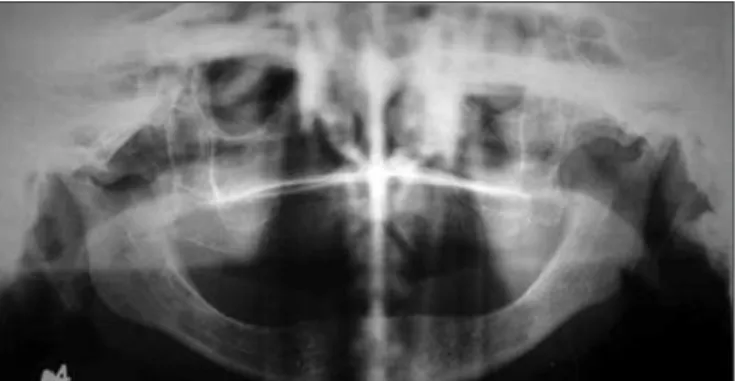
As an initial approach, with the purpose of conirming the di-agnostic hypothesis, we prescribed carbamazepine (200mg/day) during the irst seven days, and then 400mg/day. It was further requested a panoramic radiograph (Figure 1) and lateral X-Rays of the temporomandibular joint (TMJ) (Figure 2), to rule out somatic causes linked to the masticatory system.
Figure 1. Panoramic radiograph within the normality standards for the age and dental condition of the patient
Figure 2. Lateral radiograph of the temporomandibular joint showing absence of external interference at the site of pain
When the patient returned 20 days later, she reported a signii-cant improvement in pain (VAS=5). Pain remission with the use of carbamazepine strengthened the diagnostic hypothesis of neu-ropathic pain. he dose was adjusted to 200 mg/day because of complaints of drowsiness with the use of the drug. With the diag-nostic hypothesis established, we perceived the need for multidis-ciplinary care. herefore, the patient was referred to the neurology service of a local hospital, where the magnetic resonance imaging (MRI) presented an expansive, solid, extra axial lesion in the right prepontine cistern, suggesting meningioma (Figure 3).
prosthe-277
Glossopharyngeal neuralgia of tumor origindiagnosed in dental care. Case report
Rev Dor. São Paulo, 2017 jul-sep;18(3):275-8
sis was adjusted aiming at the elimination of possible compres-sion in the sublingual trigger areas. he dose of carbamazepine was adjusted from 200 to 400mg/day.
She returned six months later reporting the absence of pain events. Currently, the patient has quarterly consultations with a neurologist and is waiting for availability for neurosurgery.
DISCUSSION
he nosological limit of orofacial neuropathic pain can be diicult to measure due to the absence of clinically diagnosable injury, the disproportion between the painful stimulus and the response, and the overlapping of structures with distinct innervation. Although it is not possible yet to deine a universal consensus on the diag-nostic criteria, several clinical characteristics are suggestive of these diseases, such as paroxysmal pain along the pathway of the afect-ed nerve, allodynia, hyperalgesia and trigger areas able to trigger short-term pain events, with the characteristic of electric shock10. In this clinical case, the patient sought help at a dental center with the main complaint of intense pain in the lower edge re-gion and on the right side of the base of the tongue, suggesting a possible problem of the prosthesis. However, the observation of the characteristics of the pain and the physical examination con-ducted led to the hypothesis of GPN, a possibility reinforced by the fact that the patient was over 50 years, the age group where painful facial neuropathies become more common9,11. MRI was performed to rule out secondary neuralgia to intracranial inju-ries. his procedure is justiied by several authors11,12.
We also noticed that the pain reported by the patient was unilat-eral, a factor supported by the literature, that demonstrates that neuropathic pain is, for the most part, established on only one side, being bilateral in rare cases6.
In GPN, painful events can occur spontaneously, but they are generally associated with a speciic trigger stimulus. Some stimuli
are chewing, swallowing, coughing, yawning, sneezing, blowing the nose, touching the ear, talking, laughing, ingesting acid, sweet, cold or hot food, or even turning the head to one side1,13. Such stimuli were reported by the patient, reinforcing the diag-nosis for GPN.
In these cases, when daily and common activities become pain triggers, the QoL of the patient can be seriously compromised, with a heavy impact on its physical and emotional well-being1. In this sense, the patient of this case study reported that pain disrupted her sleep and daily activities, causing irritation, lack of energy, tiredness, and social withdrawal.
To relieve pain, the patient took paracetamol and dipyrone, with no satisfactory results. Supericial somatic pain, such as the ul-ceration of the oral mucosa that often afects patients wearing a prosthesis, usually improves with this kind of drug. However, neuropathic pain such as GPN does not respond to common pain medications10.
Pain assessment using VAS throughout the reassessment period showed a general reduction in the painful condition. VAS is con-sidered a useful tool with good reproducibility to measure pain13 because it turns the subjectivity of a painful experience into ob-jective for clinical evaluation.
During the physical examination, the momentary depletion of pain by the application of benzocaine at 20% in the poste-rior region of the tongue, region innervated by the glossopha-ryngeal nerve, conirmed the diagnostic hypothesis of GPN. his response to the topical anesthetic on the trigger area in the mucosa is considered a useful clinical test for diferential diagnosis6. Studies have shown that pain can be proven by the stimulation of speciic points in the area of supericial distribution of the glossopharyngeal nerve14. herefore, the adjustments made on the base of the inferior prosthesis aim-ing at the reduction of the compression in these trigger areas are justiied.
Pharmacotherapy is the irst line of treatment for GPN. he drugs of choice are carbamazepine, gabapentin, and pregaba-lin15. he selection of carbamazepine is based on several studies in which this drug proved efective for the treatment of paroxys-mal nerve pain16,17. However, many patients are sensitive to car-bamazepine and develop adverse reactions, especially drowsiness, dizziness, vomiting, diarrhea, rashes or even bradycardia17. Such efects can be minimized when the dose is gradually increased16. herefore, it is crucial that the dental surgeon know the clinical characteristics of neuralgias that involve the face and be prepared to perform the diferential diagnosis. In the diagnostic hypoth-esis of paroxysmal neuropathic pain, ruling out secondary neu-ralgia is a priority, and the referral to a neurological evaluation becomes of key importance.
CONCLUSION
he dental surgeon should be skilled to make the diferential diagnosis of orofacial pain, especially of paroxysmal neuralgia. Recognize the clinical characteristics and properly refer the pa-tient to a neurological center is fundamental for a good prog-nosis, especially in cases of neuralgia of tumor etiology.
278
Marchetti G, Bonotto D and Cunali PA
Rev Dor. São Paulo, 2017 jul-sep;18(3):275-8
REFERENCES
1. Kuroiwa DN, Marinelli JG, Rampani MS, Oliveira W, Nicodemo D. Desordens tem-poromandibulares e dor orofacial: estudo da qualidade de vida medida pelo Medical Outcomes Study 36 – Item Short Form Health Survey. Rev Dor. 2011;12(2):93-8. 2. Zakrzewska JM. Multi-dimensionality of chronic pain of the oral cavity and face. J
Headache Pain. 2013;14(1):37.
3. Kosminsky M, Nascimento MG. Primary auriculotemporal neuralgia. Case report. Rev Dor. 2015;16(4):312-5.
4. Blumenfeld A, Nikolskaya G. Glossopharyngeal neuralgia. Curr Pain Headache Rep. 2013;343(17):3-5.
5. Koopman JS, Dieleman JP, Huygen FJ, Mos M, Martin CG, Sturkenboom MC. In-cidence of facial pain in the general population. Pain. 2009;147(1-3):122-7. 6. Singh PM, Manpreet K, Anjan T. An uncommonly common: glossopharyngeal
neu-ralgia. Ann Indian Acad Neurol. 2013;16(1):1-8.
7. Son KB. he glossopharyngeal nerve, glossopharyngeal neuralgia and the Eagle’s syn-drome-current concepts and management. Singapore Med J. 1999;40(10):659-65. 8. Rozen TD. Trigeminal neuralgia and glossopharyngeal neuralgia. Neurol Clin.
2004;22(1):185-206.
9. Gaul C, Hastreiter P, Duncker A, Naraghi R. Diagnosis and neurosurgical treatment
of glossopharyngeal neuralgia: clinical indings and 3-D visualization of neurovascular compression in 19 consecutive patients. J Headache Pain. 2011;12(5):527-34. 10. Schestatsky P. Deinição, diagnóstico e tratamento da dor neuropática. Rev HCPA.
2008;8(3):184-5.
11. Teixeira MJ, Siqueira SR. Neuralgia do segmento facial. J Bras Oclusão ATM Dor Orofacial. 2003;3(10):101-10.
12. Lemos L, Fontes R, Flores S, Oliveira P, Almeida A. Efectiveness of the association between carbamazepine and peripheral analgesic block with ropivacaine for the treat-ment of trigeminal neuralgia. J Pain Res. 2010;34(3):201-12.
13. Singh, PM, Dehran M, Mohan VK, Trikha A, Kaur M. Analgesic eicacy and safety of medical therapy alone vs combined medical therapy and extra oral glossopharyngeal nerve block in glossopharyngeal neuralgia. Pain Med. 2013;14(1):93-102. 14. Berkowitz RI, Wadden TA, Tershakovec AM, Cronquist JL. Behavior therapy and
sibutramine for the treatment of adolescent obesity. JAMA. 2003;289(14):1805-12. 15. Slavin KV. Glossopharyngeal neuralgia. Sem Neurosurg. 2004;(15):71-8. 16. Dworkin RH, O’Connor AB, Backonja M, Farrar T, Finnerup NB, Jensen TS.
Phar-macologic management of neuropathic pain: Evidence-based recommendations. Pain. 2007;132(5):237-51.