Development of (Nb,Ta)
3Sn Multifilamentary Superconductor Wire
for High Current Applications
Durval Rodrigues Jr., João Paulo Barros Machado
Faculdade de Engenharia Química de Lorena,
Departamento de Engenharia de Materiais, C.P. 116, 12600-000 Lorena - SP, Brazil
Received: May 16, 2000;Revised: October 24, 2000
The optimization of the energy generated by a MagnetoHydroDynamic (MHD) channel using a superconducting magnet demands the optimization of the magnetic field of the system and of the critical points on the magnet winding. This work must include the development of a high ance superconductor wire suitable for this system. Aiming to the construction of improved perform-ance MHD channel, it was developed a low cost superconductor wire, with the required characteristics. The wire was made using a technology compatible with the assembling steps and heat treatment conditions of the MHD superconducting magnets fabrication. It was used the internal Sn method in Nb-7.5wt%Ta tube to fabricate a 271-filament wire with a diameter of 0.81 mm and a Cu/nonCu ratio of 2.3. The wire was heat treated at 200 °C to diffuse the Sn into the Cu shell, producing bronze, followed by the final reaction at temperatures ranging from 670 °C to 730 °C during 25 to 150 h, to produce (Nb,Ta)3Sn. The superconducting wire characterization was made measuring the critical current Icversus the applied magnetic field in the range of 5 to 20 T, the critical temperature Tcand the residual resistivity ratio (RRR). The wire transported critical currents above those available in commercial superconducting wires. These values of Icare higher than the expected values for the optimization of the MHD channel.
Keywords:superconductivity, magnetohydrodynamic channel, Nb3Sn
1. Introduction
The development of high performance superconductor wires capable of carrying high critical currents Icunder magnetic fields between 5 and 12 T is the goal of the international manufacturers for several applications, like the fusion projects.
The development of superconducting applications de-mands high critical currents for high magnetic field opera-tions. Applications like the International Thermonuclear Experimental Reactor (ITER) needs very high critical cur-rents to generate magnetic fields of 12 T in a large volume, while the 1 GHz NMR system demands very high critical currents to generate a very high magnetic field of 23 T.
In special, the Department of Materials Engineering -DEMAR of the Faculdade de Engenharia Química de Lorena - FAENQUIL is developing a project to generate energy using a MagnetoHydroDynamic (MHD) channel and cellulignin as fuel1. This channel, in its initial concep-tion, was made of two race-track type magnets using NbTi
conductors (cable with 14 wires) generating a maximum central magnetic field of 4.5 T, with critical points in the magnet winding reaching 7 T. If the critical points reach magnetic fields above the superconducting upper critical field of the material, the superconductivity is locally de-stroyed and the superconducting magnet will quench, which can result in magnet damage.
The optimization of the generated energy by the MHD channel requires a central field of 5.0-5.5 T. At these fields, the critical points in the magnet winding can reach 10 T, frustrating the use of NbTi conductors for the required operational safety margins. This leads to the use of materi-als with higher superconducting critical currents, like the Nb3Sn.
For this MHD channel, the critical current that opti-mizes the superconducting magnet, and the generated en-ergy in its channel, should be 250 A at 10 T, using a conductor of 0.7 mm in diameter (critical current density Jc around 650 A/mm2). Aiming to the development of a low
cost Nb3Sn superconductor with required characteristics and using a technology compatible with the assembling steps and heat treatment conditions of the MHD supercon-ducting magnets, it was fabricated a superconductor wire using the internal Sn method in Nb-7.5wt%Ta tube2.
This process enables the production of a high critical current superconductor due to the low pre-strain and thicker (Nb,Ta)3Sn layer formed after heat treatment. The Ta doping increases the upper critical field of the supercon-ducting phase, increasing the transport critical current of the material.
2. Methodology
The development of a high performance supercon-ducting wire must account for: 1) Nb/Sn volume ratio, which influences the volume fraction of Nb3Sn formed during the heat treatment and the compressive strain on the Nb3Sn layer when the composite is cooled down to 4.2 K, the liquid helium and operation temperature; 2) filament size, a smaller filament needs shorter heat treatment times at lower temperatures to form the superconducting phase; 3) element addition (doping), which increases the upper critical magnetic field Bc2and the transport critical current density jc; and 4) heat treatment conditions.
The heat treatment can be considered the most impor-tant parameters to optimize the critical current densities of the superconducting wire, controlling four metallurgical factors: the volume fraction of the Nb3Sn layer and average grain size, which increase as the heat treatment time and temperature increase; the compositional profile of the su-perconducting phase; and the compositional profile close to the grain boundaries. The grain boundaries are the most efficient pinning centers acting on this type of supercon-ductor and the optimization of the transport properties are directly related to the flux line pinning in the superconduc-tor. To improve the pinning strength one must increase the density of grain boundaries, decreasing the average grain size of the Nb3Sn through the determination of the best heat treatment conditions3.
The development of the superconductor wire used a Nb-7.5wt%Ta alloy. The fabrication was based on the solid-liquid diffusion method and the tube technique, with some modifications to improve the conductor stability.
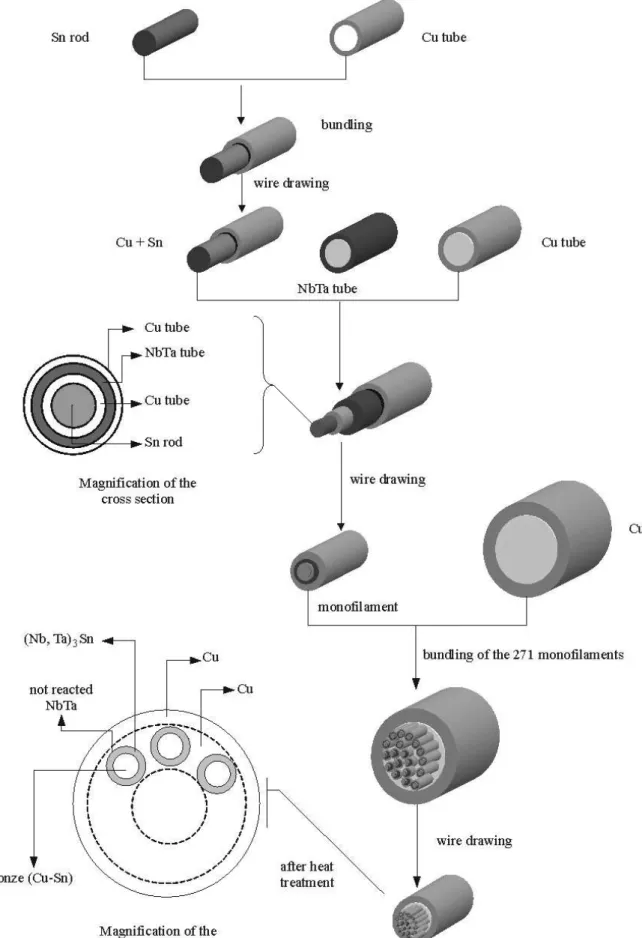
This modified fabrication process used Cu tubes plus Sn rods, inside NbTa tubes, to generate the superconducting layer during the final heat treatments. This process keeps all elements in the pure state during the mechanical proc-essing and improve the deformability of the system4.
The Fig. 1 shows the fabrication route of the (Nb,Ta)3Sn superconductor wire with 271 filaments of NbTa+Cu+Sn. The Cu tubes were Oxygen Free High Conductivity (OFHC).
The monofilament was produced inserting a Sn rod with 4.55 mm in diameter into a OFHC Cu tube with outer diameter of 6.6 mm and internal diameter of 4.7 mm. Then the Cu+Sn bundling was inserted in a NbTa tube prepared with a outer diameter of 10.4 mm and a internal diameter of 6.73 mm. Finally, all the set was introduced into another OFHC Cu tube with outer diameter of 15.87 mm and internal diameter of 12.70 mm. This entire set was de-formed by wire drawing down to the external diameter of 1.0 mm and it was cut in pieces to be used in the final bundling. The Fig. 2 shows the monofilament cross section at the final diameter of 1.0 mm.
In the final bundling, 271 monofilaments of NbTa+Sn+Cu were bundled and placed inside a OFHC Cu tube with external diameter of 25.4 mm (1”) and internal diameter of 20.64 mm (13/16”). This set was drawn down to 0.81 mm in diameter. In Fig. 3 it is shown the supercon-ductor wire at the final diameter of 0.81 mm.
The Table 1 shows the characteristics of the (Nb,Ta)3Sn multifilamentary wire. The Cu/nonCu volume ratio was 2.3 (70% of the volume is OFHC Cu). The total volume ratio was Cu: NbTa: SnCu≡5.9: 1.5: 1.
The formation of the superconducting phase was per-formed through heat treatments. To avoid the liquid Sn phase during the heat treatments, it was performed a first step annealing at 200 °C during 50 h. This step also had the objective to homogenize the Sn+Cu phase inside the NbTa tube, improving the Sn diffusion during the final heat treatment. The formation of the superconducting phase was performed in a second step using different combination of temperatures and times, aiming to the optimization of the transport properties. This second heat treatment was per-formed at temperatures in the range of 670-730 °C during 25 to 150 h.
Table 1.Characteristics of the (Nb,Ta)3Sn superconductor wire. Fabrication method Conductor
diameter (mm)
Area without Cu, or non-Cu area (volume%)
Number of filaments; alloy
used in the filaments
Diameter of the filament (µm)
Area of the SnCu core (volume%)
Diameter of the SnCu core (µm)
Solid-liquid diffusion (Internal Sn)
0.81 29.7 271;
Nb-7.5wt%Ta
3. Low Temperature Characterization
After the heat treatments, the samples were charac-terized at low temperature (liquid helium at 4.2 K) through the measurements of: the critical current Ic versus the applied magnetic field in the range of 5 to 20 T, the critical temperature Tcand the residual resistivity ratio (RRR). The morphological characterization was performed and com-pared using metalography before and after the heat treat-ments.
The measurements of critical currents vs. applied magnetic field (Ic x B) up to 20 T, at 4.2 K, were performed in short samples using the four probe method with a electrical field criterion of 0.1 µV/cm. These measurements were carried out using water cooled Bit-ter-type magnets at the Francis Bitter Magnet Laboratory of the Massachusetts Institute of Technology, Cam-bridge, MA, USA.
The Fig. 4 shows the comparison of the critical currents Icfor all samples studied. It can be seen that all samples presented a similar average behavior, represented by the dashed line. The maximum values of Icat 10 T are close to 350 A for this wire with 0.81 mm in diameter. This value is equivalent to a Icof 260 A for a wire of 0.7 mm in diameter, therefore above the necessary value for the MHD channel.
4. Conclusion
The development of a (Nb,Ta)3Sn multifilamentary superconductor wire using the internal Sn method in Nb-7.5wt%Ta tube was described. The 0.81 mm outer diameter wire has 271 filaments and a Cu/nonCu ratio of 2.3.
The wire presented superconducting transport proper-ties higher than those available in commercial conductors. The measured critical current Icwas around 260 A at 10 T, corresponding to a critical current density of 680 A/mm2 for a 0.7 mm diameter wire. These values are higher than the expected values for the optimization of the MHD chan-nel. The magnetic field of 10 T is that found at the critical points of the superconducting magnet, for the conditions where the MHD channel has the optimized generated en-ergy.
The heat treatment temperatures were low enough and the heat treatment times were short enough to avoid struc-tural problems with the MHD channel materials.
The fabrication of the superconductor wire can be scaled up to supply the minimum length necessary for the MHD superconducting magnets through the use of extru-sion in the initial stage of the deformation process. This extrusion can use billets with larger initial diameter, which will generate longer final lengths after the deformation. These longer lengths can also be reached using bundling in longer Cu tubes and deformation through wire drawing.
Figure 2.Monofilament with 1.0 mm after drawing operation. The shine material with dark contour in the center is Sn, the next phase is Cu, the third phase with irregular contour is NbTa and the outer layer is Cu.
Figure 4. Critical current versus applied magnetic field for the (Nb,Ta)3Sn superconductor wire. Comparison between all samples. The
measurements were performed at 4.2 K.
Figure 3.(Nb,Ta)3Sn superconductor wire with 0.81 mm and 271
Acknowledgments
The authors would like to thank the financial support by CNPq-Brazil under grant no. 260008/92 and by FAPESP-Brazil under grant no. 99/03129-5.
References
1. Pinatti, D.G., Ferrari, C.A., Soares, A.G., Vieira, C.A., Cruz, J.A., Neto, L.A., In:2ndInternational Confer-ence on Physics and Industrial Development: Bridg-ing the Gap, Belo Horizonte, July 7-10, 1996.
Gazzinelli, R., eds. Singapore: World Scientific, p. 441-446, 1997.
2. Rodrigues Jr., D., Campinas: Instituto de Física Gleb Wataghin, Universidade Estadual de Campinas. PhD Thesis. 1997.
3. Rodrigues Jr., D., Foner, S., Pinatti, D.G.,Advances in Cryogenic Engineering, v. 44, p. 959, 1998. 4. Murase, S., Nakayama, S., Aoki, N., Kobayashi, N.,
In: High Field Superconductors.Sendai, Japan: Insti-tute for Materials Research, The Science Reports of the Research Institutes Tôhoku University, v. 37, n. 1, p. 125, 1992.