*e-mail: [email protected]
1. Introduction
Mullite (3Al2O3.2SiO2) is one of the foremost ceramic materials and extensively studied crystalline phases in the Al2O3–SiO2 binary system1. Mullite has become a strong candidate material for advanced structural and functional ceramics in recent years, due to its outstanding properties of low thermal expansion, low thermal conductivity, and excellent creep resistance. Other favorable characteristics of mullite are suitable high temperature strength and excellent stability in harsh chemical environments2.
However, the sintering of commercial mullite powders to produce dense compacts requires relatively high temperatures (>1600 °C) due to the strong covalent bonds in mullite and to the low interdiffusion rates of Si4+ and Al3+ within the mullite lattice3-5. Therefore, studies on the use
of sintering aids to enhance the densiication and sintering kinetics and lower the sintering temperature of mullite bodies are very important in order to produce high-strength low-cost bodies6.
The role of sintering additives has been attributed to the formation of liquid phase and to a reduction in viscosity of the glassy (or liquid) phase or to a reduction in mullite formation temperature in gel-derived powders, thereby leading to higher mobility of diffusing species7-11.
Reports in the literature on studies involving mullite have focused on the nucleation of gel-derived mullites and doped mullites5,7,12-16 and on the conventional sintering of mullite compacts17-20. Few researches have investigated the fast sintering behavior of mullite bodies21-25, and even fewer studies26,27 have sought to ascertain the
inluence of additives on the rapid sintering of mullite. In this context, some studies have observed beneits in the use of MgO9,18,28 and L
2O3
10,29-31 as sintering aids in the
densiication, microstructure evolution and strength of sintered mullite bodies.
Studies17,18 on the sintering of industrial mullites in the presence of magnesia as a sintering aid attributed the enhanced densification of doped mullite bodies to the formation of liquid phase. The amount of glassy phase signiicantly inluenced the sinterability of mullite, which decreased when the amount of glassy phase was reduced. Similar to MgO, La2O3 also shows a strong glass forming tendency according to the La2O3-Al2O3-SiO2 system10,32.
However, as depicted before, few studies26,27, and using
only pulse electric current sintering, focused in the inluence of these additives in the fast sintering of mullite, despite the advantages and beneits of the fast-iring technology.
The objective of fast iring is to enhance the ratio of the densiication rate to the coarsening rate by rapidly reaching the sintering temperature. Because coarsening mechanisms commonly prevail over densiication mechanisms at lower temperatures, it has been suggested that rapid heating to higher temperatures can favor the attainment of high density allied to ine grain size33,34.
However, fast sintering involves some difficulties. The problem most often encountered in conventional fast iring is differential sintering, which causes differential densiication, non-uniform microstructures and specimen cracking24. In this context, microwave sintering has emerged in recent years as an alternative technique to overcome
Evaluation of the Inluence of MgO and La
2O
3on the Fast Sintering of Mullite
Pollyane Márcia de Soutoa*, Romualdo Rodrigues Menezesb,
Ruth Herta Goldschmidt Aliaga Kiminamia
aDepartment of Materials Engineering, Federal University of São Carlos – UFSCar,
Rod. Washington Luiz, km 235, CEP 13565-905, São Carlos, SP, Brazil
bDepartment of Materials Engineering, Federal University of Campina Grande – UFCG,
Av. Aprígio Veloso, 882, Bodocongo, CEP 58429-900, Campina Grande, PB, Brazil
Received: January 19, 2014; Revised: January 12, 2015
The inluence of MgO and La2O3 on the fast sintering of mullite was evaluated in this work. High-purity mullite was doped with MgO and La2O3, conventionally sintered, fast sintered, and microwave-sintered in rapid sintering cycles. The results showed that MgO and La2O3 strongly affected the densiication of fast sintered samples; and only doped bodies reached high densities when fast sintered. However, the densiication behavior of doped samples was dependent on the amount of sintering aids. MgO doped samples presented better densiication behavior than La2O3 doped samples. Microwave-processed samples required a balance between power, time and amount of additives to obtain highly dense and homogenous microstructures.
2015; 18(1) Evaluation of the Inluence of MgO and La2O3 on the Fast Sintering of Mullite 43
the problems of conventional fast sintering. Because it is a noncontact technique and the heat is transferred to the product via electromagnetic waves, large amounts of heat can be transferred into the material, minimizing the effects of differential sintering. In addition, it is believed35 that
densiication processes during sintering can be accelerated by microwave energy, the microwave effect.
An analysis of data reported in the literature indicates that a basic understanding of the role of sintering additives in the fast sintering of mullite is still limited. Thus, this work aimed to evaluate the inluence of MgO and La2O3 on the fast sintering of mullite.
2. Experimental Procedure
Commercial high-purity (99.5%) mullite (SCIMAREC MP40) powder was used in this work. Mullite powder is characterized elsewhere6. The chemical composition of mullite powder is similar to that of other commercial powders17, but it contains large amounts of ZrO
2 (0.27%) and TiO2 (0.14%). The mullite used here had a D50 of about 1.5μm and a D10 and D90 of about 0.8 and 4.0μm,
respectively. The powder’s wide particle size distribution ranged from 0.3 to 7μm, with a high concentration of particles sizes of about 2μm.
Pure mullite powder with and without sintering aids (MgO and La2O3) was dispersed in an alcoholic medium by ball milling for 8h. Doped mullite was prepared by adding suitable amounts of magnesium oxide (MgO, > 98.5%, Merck) and lanthanum oxide (La2O3, 99.5%, Merck) to obtain additive concentrations of 0.5 wt.%, 1.0 wt.% and 2.0 wt.% of MgO (M) and La2O3 (L). The formulations containing 0.0 wt.%, 0.5 wt.%, 1.0 wt.% and 2.0 wt.% are identiied here as Pure; 0.5M and 0.5L; 1M and 1L; and 2M and 2L, respectively. Disk-shaped samples (approximately 12 mm in diameter and 3 mm thick) were produced by unidirectional pressing under 40 MPa, followed by cold isostatic pressing (CIP) under 200 MPa. The average green density of the compacted disks was approximately 58% of the theoretical density, as determined from their dimensions and weights. Powder compacts of pure and 2% MgO doped mullite of approximately 38 mm in diameter and 5 mm thick were also produced and are identiied as Pure38D and 2M38D.
Powder compacts were sintered from 1400 °C to 1600 °C with a soaking time of 120 min and a heating rate of 5 °C/min in conventional sintering processes. Samples were sintered at 1600 °C for 30min using heating rates of 40, 60 and 80 °C/min in rapid iring processes. Samples were sintered in a microwave furnace (multimode cavity) at 2.45GHz (Cober Electronics, MS6K), using susceptor materials as auxiliary heating elements, in rapid sintering cycles. Details of this sintering assembly are given elsewhere24. Input power ranging from 0.9 to 2.4 kW and sintering times of up to 40 min were used in the microwave fast sintering processes. The cooling cycles of fast sintering and microwave sintering were not controlled, but the entire sintering (heating and cooling) cycle took < 1.5h in both processes.
The densities of sintered samples were determined by the water-immersion technique using the Archimedes
method. X-ray diffraction analysis was performed using CuKα radiation (40 kV and 40mA as working conditions) (Siemens D-500) to identify the presence of MgO or La2O3 related phases after the sintering process. Scanning electron microscopy (SEM) (PHILIPS, models XL30-FEG and XL30-TMP) was used to analyze the microstructural evolution. SEM samples were prepared according to the standard ceramographic techniques (cross sections of samples were polished and thermally etched). Grain sizes were measured using the linear-intercept technique and a stereographic correction factor of 1.56 was used. At least 600 grains were measured in each region.
3. Results and Discussion
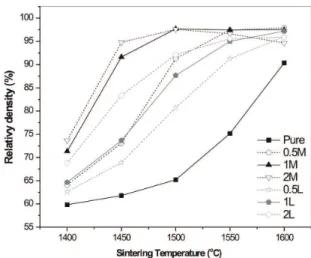
Densities of conventionally sintered mullite (pure and doped) are shown in Figure 1. Sintering pure mullite up to 1550oC did not signiicantly increase the density of the compacts. At 1600oC, the density of pure mullite was approximately 90%. The addition of MgO and La2O3 favors the densiication of mullite bodies, and all the doped samples presented higher densities than the pure mullite, which is consistent with reports in the literature9,10,18,30,31. MgO
enhanced the inal density of mullite bodies considerably. At 1500oC, the addition of 1.0 wt.% and 2.0wt.% of MgO increased the density to values exceeding 97%. Similar additions of La2O3 increased the density up to only 87% and 92%, respectively, at 1500 °C. At 1600 °C, both additives effectively improved the densities, and additions of only 0.5% increased the density to values of about 96%. The mechanism of densiication in mullite is grain boundary mass transport or diffusion, and the densiication rates are essentially controlled by the presence of a liquid ilm2. Thus, higher densities of doped mullite bodies have been attributed to the presence of liquid phase at sintering temperature, resulting from the addition of additives6,9,10.
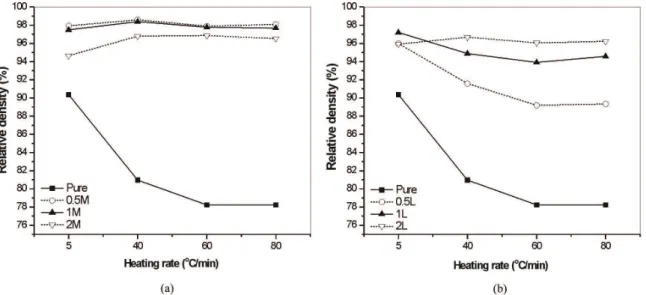
The density of pure mullite decreased considerably as the heating rate rose (Figure 2). This is probably due to need of mullite of long times for diffusion and densiication. MgO doped samples, whose density did not decrease with the heating rate, reached densities similar to the highest ones
attained in conventional sintering (Figure 1). The addition of a mere 0.5% of MgO favored 98% densiication in mullite bodies, despite the fast heating rates. Samples doped with 0.5 and 1% of La2O3 showed a reduction in densities in response to the increase in heating rates, decreasing from 96-97% to approximately 89% and 94%, respectively. However, the samples containing 2% of La2O3 behaved similarly to MgO doped samples, i.e., their density was not affected by fast iring. Doped bodies presented higher densities than pure mullite bodies at all the heating rates applied here. This may be attributed to the presence of liquid phase in these bodies during sintering, which improved the mobility of diffusing species favoring densiication
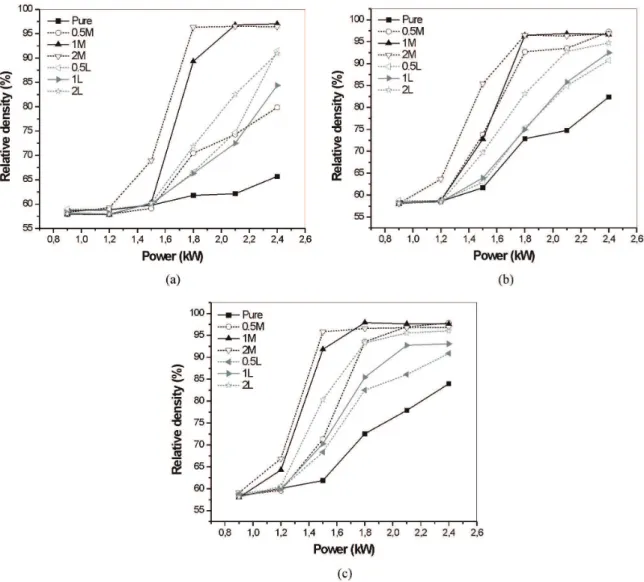
Figure 3 shows the densities of microwave-sintered mullite. The densities of pure mullite did not change significantly when microwave-heated for 20min, and increased by up to 80% when microwave-sintered for 30 and 40 min. This value is lower than that achieved in conventional sintering, but is similar to the values attained at high heating rates (Figure 2). The power levels and sintering times applied in this study appeared to be insuficient for pure mullite to reach the critical temperature and couple eficiently with microwaves, which is necessary for fast sintering. This dificulty in microwave heating is the result of the very low dielectric loss factor of mullite, which requires very high temperatures for eficient coupling with microwaves.
Power levels of 0.9 and 1.2kW did not improve the densities of doped samples in any of the sintering times employed here. This may be attributed to insuficient energy (power and time) to raise the temperature of the samples and develop a densiication process using microwave energy. However, at higher power levels, doped mullite achieved densities of approximately 97% in heating cycles of only 20 minutes. Doped bodies will develop liquid phase with heating, and this liquid phase increases the bodies’ dielectric loss and hence their microwave absorption characteristics. Moreover, liquid phase is heated selectively, which increases
its temperature and decreases its viscosity, improving even more the diffusion and densiication mechanisms.
Microwave fast-sintered bodies were devoid of cracks, which is a reliable indicator of homogeneous distribution of temperature in the bodies. However, samples Pure38D and 2M38D presented some cracks when conventionally fast sintered at 80oC/min. This indicated that despite the
improvement in the densiication behavior in response to MgO doping, the conventional fast sintering process presented limitations as a function of sample size.
MgO doped samples presented better densiication behavior than La2O3 doped mullite. MgO doped mullite achieved densities of around 95% at a power level of 1.8kW, while lanthanum doped bodies reached similar densities at a power of 2.4kW and longer sintering times. However, all the doped samples exhibited higher densities than those of pure bodies in all the processing conditions of this study.
Pure samples and bodies containing 0.5 and 1.0% of sintering aids presented only mullite as crystalline phase after conventional sintering, fast sintering and microwave fast heating, according to the X-ray diffraction analysis. La2O3 or La2O3 related compounds were not observed in samples doped with 2.0%, irrespective of the processing conditions employed.
A change in mullite composition and related silica or alumina segregation is a phenomenon that occurs during high temperature processing or applications. Changes in concentration are due to the fact that the stability ield of mullite tends towards Al2O3 at temperatures higher than 1600 °C36,37. This indicates that microwave iring did not reach temperatures higher than 1600 °C or the cycle time was insuficient to decompose the mullite, which explains why only mullite was observed in the XRD patterns of pure samples.
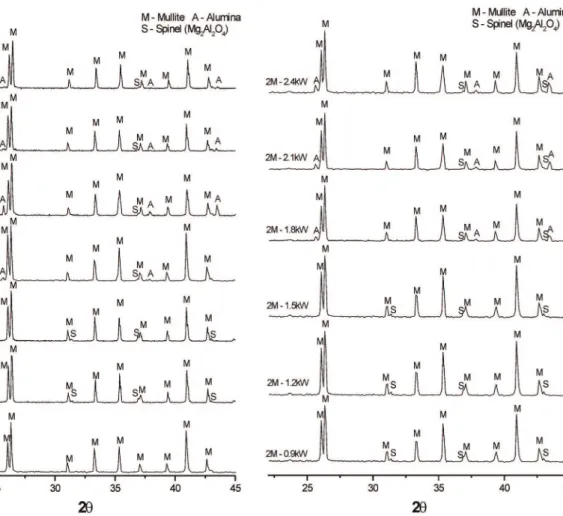
However, spinel and alumina were detected in 2M samples. Figure 4 shows the XRD patterns of pure mullite ired at 1600 °C, 2M conventionally sintered samples and 2M fast ired samples. 2M microwave-sintered samples
2015; 18(1) Evaluation of the Inluence of MgO and La2O3 on the Fast Sintering of Mullite 45
Figure 3. Relative density of samples microwave-sintered for: a) 20min, b) 30min and c) 40min.
also presented spinel and alumina when sintered for 40min, Figure 5.
Many authors9,17,18 have reported that sintering additives such as MgO, promote sintering in the presence of liquid phase, and that the addition of MgO increases the amount of glassy phase and induces partial dissolution of mullite18. It can be understood from the MgO–Al2O3–SiO2 phase diagram that MgO addition can produce MgO–Al2O3 spinel at high temperatures. However, it should be emphasize that the analysis of the development of the crystalline phases depends on the system composition, the doping levels. In samples doped with 2.0 wt.% of MgO the inal composition will enter the mullite-cordierite-sapphirine triangle, in which liquid forms at 1460 °C, and phases like cordierite or sapphirine could be expected after sintering (if there is enough cooling time). At high temperatures (higher than 1480 °C) and considering this equilibrium triangle the present phases are mullite, alumina and spinel. Temperatures lower than 1578 °C and regions with micro-heterogeneities richer in MgO will favor the formation of spinel. Thus, the presence of alumina and spinel observed in 2M samples is
a consequence of the system composition, of the processing temperatures and of the reaction kinetics during the cooling cycles.
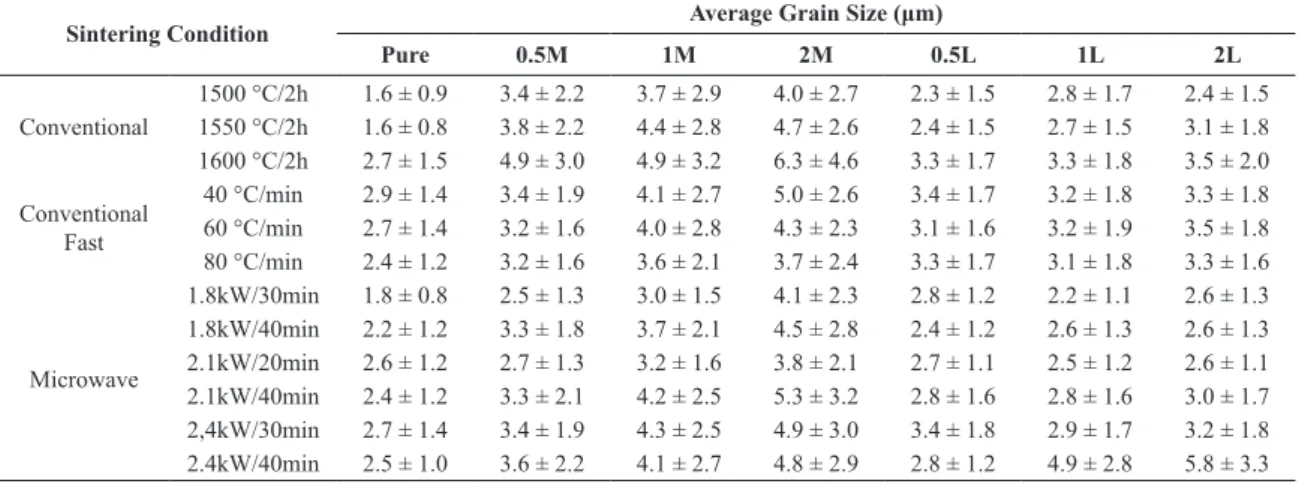
densities, MgO doped fast sintered samples showed a slightly smaller average grain size, while the average grain size of La2O3 doped bodies remained practically unchanged (Table 1). These results suggest that increasing the heating rate from 5 to 80oC/min when sintering doped bodies favors
a narrower grain size distribution but not a reduction in grain size (comparing bodies with similar densities). The exception was the 2M sample, which exhibited a statistic signiicant decrease in average grain size (t test, p<0.001) and different grain size distribution (Mann-Whitney test, p<0.001) when the heating rate was increased from 40 to 80 °C/min. This behavior suggests that the fast sintering seems to be more effective in samples containing higher amount of MgO, favoring densiication over coarsening mechanisms.
Figures 12 and 13 depict the microstructures of m i c r o w a v e - s i n t e r e d s a m p l e s . I n g e n e r a l , t h e microwave-sintered samples exhibit greater homogeneity and narrower grain size distributions than those of conventionally sintered samples. However, the possible presence of liquid phase during sintering enhances the absorption of microwaves and promotes a rise in temperature and accelerates diffusion. This favors not only densiication but also grain growth and the formation of elongated grains. Figure 4. XRD patterns of the conventionally and fast sintered
2M samples.
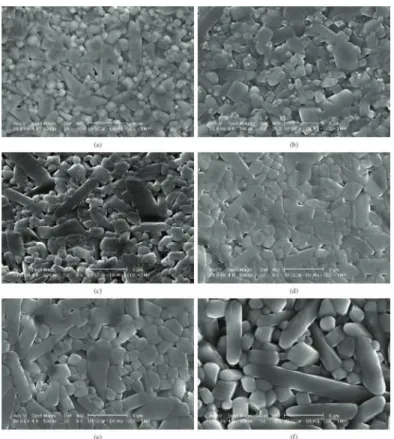
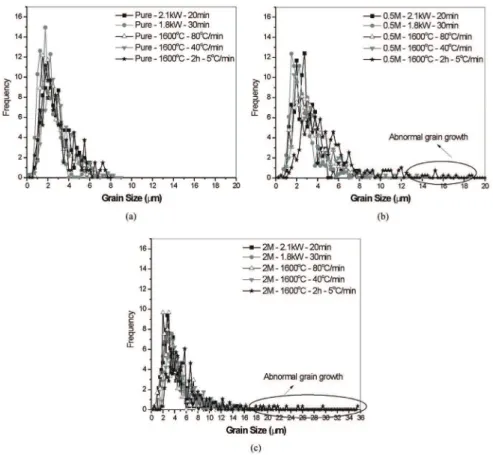
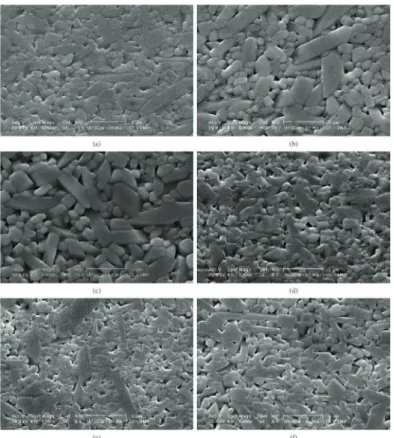
Figures 6 and 7 depict SEM micrographs and Figures 7 and 8 show the grain size distribution of conventionally sintered doped samples. Mullite grain size increased as the amount of sintering aids increased, presenting a broader grain size distribution, irrespective of the sintering temperature. This effect was more pronounced in MgO doped samples. MgO doped samples presented heterogeneous microstructures with elongated grains after sintering at 1600 °C, whatever the amount of additive used. The La2O3 doped samples also displayed elongated grains, but presented less heterogeneous microstructures. Doped samples presented a broader grain size distribution (Figure 8 and 9) due to the presence of liquid phase. The literature2,38 indicates that mullite prepared in the absence of liquid phase invariably leads to an equiaxial (or quasi-equiaxial grain) microstructure, whereas the formation of elongated grains requires the presence of a liquid phase. S E M m i c r o g r a p h s o f f a s t s i n t e r e d s a m p l e s (Figure 10 and 11) revealed the presence of elongated grains that were iner and more homogenous than those of samples conventionally sintered at 1600 °C. Increasing the heating rate resulted in more homogenous microstructures, with narrower grain size distributions, (Figures 8 and 9). Compared to conventionally sintered samples with similar
2015; 18(1) Evaluation of the Inluence of MgO and La2O3 on the Fast Sintering of Mullite 47
Figure 6. SEM micrographs of MgO doped samples conventionally sintered at 1500 °C/2h: (a) 0.5M, (b) 1M, (c) 2M; and at 1600 °C/2h (d) 0.5M, (e) 1M, (f) 2M.
Figure 7. SEM micrographs of La2O3 doped samples conventionally sintered at 1500 °C/2h: (a) 0.5L, (b) 1 L, (c) 2L; and
Figure 8. Grain size distribution of sintered MgO doped samples: (a) Pure, (b) 0.5M, (c) 2M.
2015; 18(1) Evaluation of the Inluence of MgO and La2O3 on the Fast Sintering of Mullite 49
Figure 10. SEM micrographs of samples fast sintered at a heating rate of 40oC/min: (a) 0.5M, (b) 1M, (c) 2M, (d) 0.5L, (e) 1L, and
(f) 2L.
Table 1. Average grain size of conventionally and fast sintered samples.
Sintering Condition Average Grain Size (μm)
Pure 0.5M 1M 2M 0.5L 1L 2L
Conventional
1500 °C/2h 1.6 ± 0.9 3.4 ± 2.2 3.7 ± 2.9 4.0 ± 2.7 2.3 ± 1.5 2.8 ± 1.7 2.4 ± 1.5 1550 °C/2h 1.6 ± 0.8 3.8 ± 2.2 4.4 ± 2.8 4.7 ± 2.6 2.4 ± 1.5 2.7 ± 1.5 3.1 ± 1.8 1600 °C/2h 2.7 ± 1.5 4.9 ± 3.0 4.9 ± 3.2 6.3 ± 4.6 3.3 ± 1.7 3.3 ± 1.8 3.5 ± 2.0
Conventional Fast
40 °C/min 2.9 ± 1.4 3.4 ± 1.9 4.1 ± 2.7 5.0 ± 2.6 3.4 ± 1.7 3.2 ± 1.8 3.3 ± 1.8 60 °C/min 2.7 ± 1.4 3.2 ± 1.6 4.0 ± 2.8 4.3 ± 2.3 3.1 ± 1.6 3.2 ± 1.9 3.5 ± 1.8 80 °C/min 2.4 ± 1.2 3.2 ± 1.6 3.6 ± 2.1 3.7 ± 2.4 3.3 ± 1.7 3.1 ± 1.8 3.3 ± 1.6
Microwave
1.8kW/30min 1.8 ± 0.8 2.5 ± 1.3 3.0 ± 1.5 4.1 ± 2.3 2.8 ± 1.2 2.2 ± 1.1 2.6 ± 1.3 1.8kW/40min 2.2 ± 1.2 3.3 ± 1.8 3.7 ± 2.1 4.5 ± 2.8 2.4 ± 1.2 2.6 ± 1.3 2.6 ± 1.3 2.1kW/20min 2.6 ± 1.2 2.7 ± 1.3 3.2 ± 1.6 3.8 ± 2.1 2.7 ± 1.1 2.5 ± 1.2 2.6 ± 1.1 2.1kW/40min 2.4 ± 1.2 3.3 ± 2.1 4.2 ± 2.5 5.3 ± 3.2 2.8 ± 1.6 2.8 ± 1.6 3.0 ± 1.7 2,4kW/30min 2.7 ± 1.4 3.4 ± 1.9 4.3 ± 2.5 4.9 ± 3.0 3.4 ± 1.8 2.9 ± 1.7 3.2 ± 1.8 2.4kW/40min 2.5 ± 1.0 3.6 ± 2.2 4.1 ± 2.7 4.8 ± 2.9 2.8 ± 1.2 4.9 ± 2.8 5.8 ± 3.3
2015; 18(1) Evaluation of the Inluence of MgO and La2O3 on the Fast Sintering of Mullite 51
Thus, a balance must be achieved between the amount of additive, the power level and the sintering time in the microwave sintering process to attain not only high densities but also homogeneous microstructures. A good example of this requirement is the increase in sintering time from 30 to 40min at a power level of 1.8kW, which was applied to process MgO doped mullite (Figure 12). The longer sintering time led to a broader grain size distribution and increased the amount of elongated grains.
Microwave-sintered samples doped with La2O3 required higher power levels to reach densities similar to those of MgO doped bodies, as can be seen in Figure 3. This is due to the lower densiication or heating behavior of La2O3 doped samples in microwave sintering. However, the use of an adequate sintering cycle results in more homogenous microstructures, with a smaller average grain size and narrower grain size distribution.
The microstructures of microwave-processed samples proved to be highly dependent on the sintering conditions, as mentioned earlier. Thus, according to the power level and heating time used, microstructures may be similar, iner or coarser than those achieved when conventionally fast sintering doped bodies.
Based on a comparison of the densities and microstructures of pure and doped mullite, the pure samples were found to present a more porous microstructure in all the analyzed conditions. This difference was more pronounced in fast iring cycles, with pure mullite bodies presenting signiicantly lower densiication. The short time of fast sintering processes and the slow diffusion in mullite systems appeared to be the reasons for the dificulty in achieving densiication of fast sintered pure mullite. The conclusions and results obtained here indicate that effective fast sintering of mullite bodies seems to be dependent on the use of liquid Figure 13. SEM micrographs of La2O3 doped samples microwave-sintered at: 2.1kW/30min (a) 0.5L, (b) 1L, (c) 2L; and 2.1kW/40min
phase-promoting additives. Moreover, in microwave fast sintering a liquid phase will also improve the coupling with microwaves, accelerating the densiication process.
4. Conclusions
The inluence of MgO and La2O3 on the fast sintering of mullite was investigated here. MgO and La2O3 exerted a marked inluence on the densiication process of fast sintered samples, and only the doped bodies achieved high densities when rapidly sintered. Fast sintering of mullite bodies seems to be highly dependent on the presence of some liquid phase-promoting additive. The microstructures of doped fast sintered bodies were more homogenous than those of conventionally sintered samples, but presented a similar
average grain size. The additives signiicantly improved mullite coupling with microwaves, and only doped bodies displayed high densities in microwave fast sintering. The microstructures of microwave-processed samples showed a strong dependence on the sintering conditions, and it was found that a balance is required between power, time and amount of additives to obtain highly dense and homogenous microstructures.
Acknowledgements
The authors gratefully acknowledge the Brazilian agencies FAPESP (proc. 07/59564-0) and CNPq (grants nos. 472638/2008-4, 303388/2009-9 and 308980/2012-3) for their inancial support.
References
1. Ebadzadeh T, Sarrafi MH and Salahi E. Microwave-assisted
synthesis and sintering of mullite. Ceramics International. 2009; 35(8):3175-3179. http://dx.doi.org/10.1016/j. ceramint.2009.05.013.
2. Schneider H and Komarneni S, editors. Mullite. Weinheim:
Wiley-VCH Verlag GmbH & Co. KGaA; 2005.. http://dx.doi.
org/10.1002/3527607358.
3. Burgos-Montes O, Moreno R, Colomer MT and Fariñas JC. Synthesis of mullite powders through a suspension combustion process. Journal of the American Ceramic Society. 2006; 89(2):484-489. http://dx.doi.org/10.1111/j.1551-2916.2005.00771.x.
4. Baudin C and Moya JS. Influence of titanium dioxide on the sintering rate and microstructural evolution of mullite. Journal of the American Ceramic Society. 1984; 67:C130-C131. 5. Rani DA, Jayaseelan DD and Gnanam FD. Densification
behavior and microstructure of gel-derived phase-pure mullite in the presence of sinter additives. Journal of the European Ceramic Society. 2001; 21(12):2253-2257. http://dx.doi. org/10.1016/S0955-2219(00)00328-9.
6. Souto PM, Menezes RR and Kiminami RHGA. Sintering of
commercial mulite powder: Effect of MgO dopant. Journal of Materials Processing Technology. 2009; 209(1):548-553. http://dx.doi.org/10.1016/j.jmatprotec.2008.02.029.
7. Hong SH, Cermignani W and Messing GL. Anisotropic grain growth in seeded and B2O3-doped diphasic mullite gels.
Journal of the European Ceramic Society. 1996; 16(2):133-141. http://dx.doi.org/10.1016/0955-2219(95)00144-1. 8. She JH, Mechnich P, Schmucker M and Schneider H.
Low-temperature reaction-sintering of mullite ceramics with an Y2O3 Addition. Ceramics International. 2001; 27(8):847-852. http://dx.doi.org/10.1016/S0272-8842(01)00039-6.
9. Viswabaskaran V, Gnanam FD and Balasubramanian M. Effect
of MgO, Y2O3 and Boehmite Additives on the Sintering
Behaviour of Mullite formed from Kaolinite-Reactive Alumina. Journal of Materials Processing Technology. 2003; 142(1):275-281. http://dx.doi.org/10.1016/S0924-0136(03)00577-6.
10. Kong LB, Zhang TS, Ma J, Boey F and Zhang RF. Mullite
phase formation in oxide mixtures in the presence of Y2O3, La2O3 and CeO2. J. All. Comp. 2004; 372(1-2):290-299. http:// dx.doi.org/10.1016/j.jallcom.2003.10.022.
11. Arellano-López AR, Meléndez-Martínez JJ, Cruse TA, Koritala RE, Routbort JL and Goretta KC. Compressive creep of mullite
containing Y2O3. Acta Materialia. 2002; 50(17):4325-4338. http://dx.doi.org/10.1016/S1359-6454(02)00264-1.
12. Hong SH and Messing GL. Anisotropic grain growth in diphasic-gel-derived titania doped mullite. Journal of the American Ceramic Society. 1998; 81(5):1269-1277. http:// dx.doi.org/10.1111/j.1151-2916.1998.tb02478.x.
13. Chakraborty AK and Das S. Al–Si spinel phase formation in
diphasic mullite gels. Ceramics International. 2003; 29(1):27-33. http://dx.doi.org/10.1016/S0272-8842(02)00084-6. 14. Sola ER, Estevan F and Alarcón J. Low-temperature
Ti-containing 3:2 and 2:1 mullite nanocrystals from single-phase gels. Journal of the European Ceramic Society. 2007; 27(7):2655-2663. http://dx.doi.org/10.1016/j. jeurceramsoc.2006.09.014.
15. Gridi-Bennadji F, Zimová J, Laval JP and Blanchart P. Mullite interaction with bismuth oxide from minerals and sol–gel processes. Ceramics International. 2010; 36(1):129-134. http:// dx.doi.org/10.1016/j.ceramint.2009.07.021.
16. Zhang G, Fu Z, Wang Y, Wang H, Wang W, Zhang J, et al. Boron-doped mullite derived from single-phase gels. Journal of the European Ceramic Society. 2010; 30(12):2435-2441. http://dx.doi.org/10.1016/j.jeurceramsoc.2010.05.017. 17. Montanaro L, Tulliani JM, Perrot C and Negro A. Sintering of
industrial mullites. Journal of the European Ceramic Society. 1997; 17(14):1715-1723. http://dx.doi.org/10.1016/S0955-2219(97)00043-5.
18. Montanaro L, Perrot C, Esnouf C, Thollet G, Fantozzi G
and Negro A. Sintering of industrial mullites in the presence of magnesia as a sintering aid. Journal of the American Ceramic Society. 2000; 83(1):189-196. http://dx.doi. org/10.1111/j.1151-2916.2000.tb01169.x.
19. Ebadzadeh T. Formation of mullite from precursor powders:
sintering, microstructure and mechanical properties. Materials Science and Engineering A. 2003; 355(1-2):56-61. http:// dx.doi.org/10.1016/S0921-5093(03)00049-2.
20. Chen Z, Zhang L, Cheng L, Xiao P and Duo G. Novel method of adding seeds for preparation of mullite. Journal of Materials Processing Technology. 2005; 166(2):183-187. http://dx.doi. org/10.1016/j.jmatprotec.2004.07.105.
21. Gao L, Hong JS, Miyamoto H and De La Torre SE. Superfast densification of oxide ceramics by spark plasma sintering.
Journal of Inorganic Materials. 1998; 13:18-22.
22. Fang Y, Roy R, Agrawal DK and Roy DM. Transparent
2015; 18(1) Evaluation of the Inluence of MgO and La2O3 on the Fast Sintering of Mullite 53
conventional processings. Materials Letters. 1996; 28(1-3):11-15. http://dx.doi.org/10.1016/0167-577X(96)00028-6. 23. Gahler A, Heinrich JG and Günster J. Direct laser sintering
of Al2O3–SiO2 dental ceramic components by layer-wise slurry deposition. Journal of the American Ceramic Society. 2006; 89(10):3076-3080. http://dx.doi.org/10.1111/j.1551-2916.2006.01217.x.
24. Souto PM, Menezes RR and Kiminami RHGA. Microwave
hybrid sintering of mullite powders. American Ceramic Society Bulletin. 2007; 86(1):9201-9206.
25. Zhang G, Wang Y, Fu Z, Wang H, Wang W, Zhang J, et al. Transparent mullite ceramic from single-phase gel by spark plasma sintering. Journal of the European Ceramic Society. 2009; 29(13):2705-2711. http://dx.doi.org/10.1016/j. jeurceramsoc.2009.04.012.
26. Sivakumar R, Jayaseelan DD, Nishikawa T, Honda S and Awaiji H. Influence of MgO on microstructure and properties of mullite-Mo composites fabricated by pulse electric current sintering. Ceramics International. 2001; 27(5):537-541. http:// dx.doi.org/10.1016/S0272-8842(00)00115-2.
27. Jayaseelan DD, Rani A, Anburaj DB and Ohji T. Pulse electric current sintering and microstructure of industrial mullite in the presence of sintering aids. Ceramics International. 2 0 0 4 ; 3 0 ( 4 ) : 5 3 9 - 5 4 3 . h t t p : / / d x . d o i . o rg / 1 0 . 1 0 1 6 / j . ceramint.2003.09.005.
28. Viswabaskaran V, Gnanam FD and Balasubramanian M.
Mullite from clay-reactive alumina for insulating substrate application. Applied Clay Science. 2004; 25(1-2):29-35. http:// dx.doi.org/10.1016/j.clay.2003.08.001.
29. Mitamura T, Kobayashi H, Ishibashi N and Akiba T. Effects of
rare earth oxide addition on the sintering of mullite. Journal of the Ceramic Society of Japan. 1991; 99(1149):351-356. http:// dx.doi.org/10.2109/jcersj.99.351.
30. Wang W, Weng D and Wu XD. Structure evolution and thermal stability of La2O3-doped mullite fibers via sol-gel method.
Journal of Rare Earths. 2012; 30(2):175-180. http://dx.doi. org/10.1016/S1002-0721(12)60018-0.
31. Ji HP, Fang MH, Huang ZH, Chen K, Xu YG, Liu YG, et al.
Effect of La2O3 additives on the strength and microstructure of mullite ceramics obtained from coal gangue and gamma-Al2O3. Ceramics International. 2013; 39(6):6841-6846. http:// dx.doi.org/10.1016/j.ceramint.2013.02.016.
32. Regiani I, Magalhães WLE, Souza DPF, Paiva-Santos CO and Souza MF. Nucleation and growth of mullite whiskers
from lanthanum-doped aluminosilicate melts. Journal of the American Ceramic Society. 2002; 85(1):232-238. http://dx.doi. org/10.1111/j.1151-2916.2002.tb00071.x.
33. Harmer MP, Brook RJ. Fast firing: microstructural benefits.
Transaction of the British Ceramic Society. 1981; 80:147-148. 34. Lin FJT, De Jonghe LC and Rahaman MN. Initial coarsening
and microstructural evolution of fast-fired and MgO-doped Al2O3. Journal of the American Ceramic Society. 1997; 80(11):2891-2896. http://dx.doi.org/10.1111/j.1151-2916.1997. tb03208.x.
35. Clark DE and Sutton W. Microwave processing of materials.
Annual Review of Materials Science. 1996; 26(1):299-331. http://dx.doi.org/10.1146/annurev.ms.26.080196.001503.
36. Klug FJ, Prochazka S and Doremus RH. Alumina-silica
phase diagram in the mullite region. Journal of the American Ceramic Society. 1987; 70(10):750-759. http://dx.doi. org/10.1111/j.1151-2916.1987.tb04875.x.
37. Fielitz P, Borchardt G, Mechnich P and Schmücker M. Kinetics
of alumina segregation in mullite ceramics. Journal of the European Ceramic Society. 2008; 28(2):401-406. http://dx.doi. org/10.1016/j.jeurceramsoc.2007.03.014.