Microneurography and Venous Occlusion Plethysmography in Heart
Failure: Correlation with Prognosis
Robinson Tadeu Munhoz, Carlos Eduardo Negrão, Antonio Carlos Pereira Barretto, Marcelo Eidi Ochiai, Juliano
Novaes Cardoso, Paulo Cesar Morgado, Carlos Henrique Del Carlo, José Antonio Franchini Ramires
Instituto do Coração do Hospital das Clínicas da Faculdade de Medicina da Universidade de São Paulo (IncorFMUSP), São Paulo, SP - Brazil
Summary
Background: Microneurography and venous occlusion plethysmography can be considered methods of assessment of the sympathetic activity.
Objective: To evaluate the intensity of the sympathetic activity through microneurography and venous occlusion plethysmography in patients with heart failure (HF) and correlate this intensity with prognosis.
Methods: 52 patients with HF (ejection fraction < 45% at the echocardiogram): 2 with FCII and 40 with FCIV. After compensation, the muscular sympathetic nervous activity (MSNA) in the peroneal nerve (microneurography) and the muscular blood flow (MBF) in the forearm were evaluated (venous occlusion plethysmography). After an 8-month follow-up, the patients were divided in 3 groups: 2 with FCII, 9 with FCIV that did not die and 2 with FCIV that died. The intensity of the sympathetic activity was compared in the three different groups.
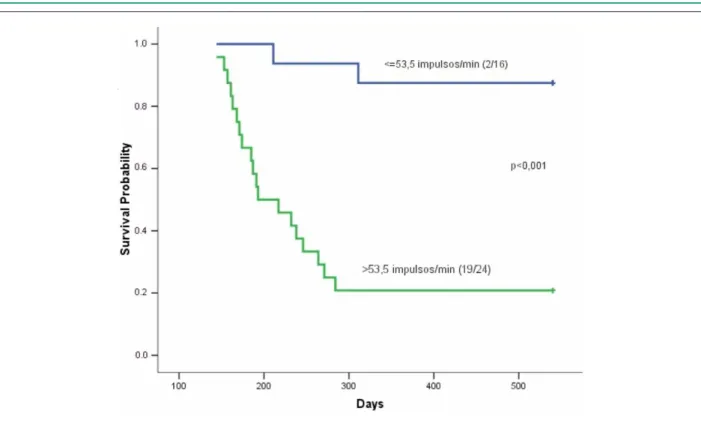
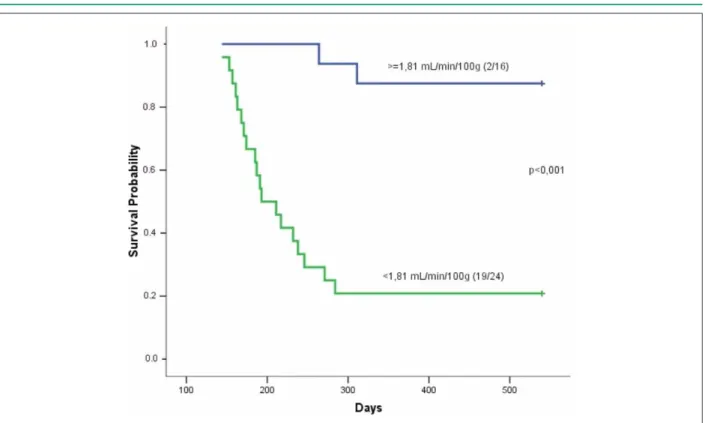
Results: Patients with FCII presented lower MSNA (p=0.026) and higher MBF (p=0.045) than the ones with FCIV that did not die. The patients with FCIV that died presented higher MSNA (p<0.00) and lower MBF (p=0.002) than the patients with FCIV that did not die. ROC curve: cutoff >53.5 impulses/min for MSNA (S=90.55. E=73.68%) and < .8 ml/min/00gr for MBF (S=90.4%. E=73.7%). Kaplan-Meier curve: higher survival with MSNA < 53.5 impulses/min (p<0.00), and/or MBF >.8 ml/min/00gr (P<0.00). Logistic regression analysis: the higher the MSNA and the lower the MBF, the higher is the probability of death.
Conclusion: The intensity of the MSNA and the MBF can be considered prognostic markers in advanced HF. (Arq Bras Cardiol 2009;92():44-5)
Key words: Heart failure, electromiography, plethysmography, prognosis.
Mailing address: Robinson Tadeu Munhoz •
Rua Cayowaa 854 / 143, Perdizes, 05018-001, São Paulo, SP - Brazil E-mail: [email protected]
Manuscript received January 29, 2008; revised manuscript received April 14, 2008; accepted April 17, 2008.
in the infusion of tritium-labeled norepinephrine allows the assessment of the regional sympathetic activity (appearance, spillover) (4). Wallin et al showed that the sympathetic activity can be directly quantified in the peripheral nerves (peroneal, brachial or median) through the microneurography technique. These nerves release activity discharges (impulses), which are numerically counted (number of impulses per minute), reflecting the intensity of the muscular sympathetic nervous activity (MSNA)6,7. Some studies have shown that, in patients with HF, the MSNA is higher than in normal individuals; however, these studies did not show any association between this activity and prognosis8-10. He measurement of the muscular blood flow (MBF) through venous occlusion plethysmography can be considered an indirect method of assessing the sympathetic activity. The mechanisms involved in the MBF variation are: endothelial dysfunction, characterized by the impairment of the vasodilating response due to the attenuation of nitric oxide production; activation of neurohormonal factors, represented by the stimulation of the renin-angiotensin system and production of vasodilating hormones; activation of the sympathetic nervous system11.
Introduction
Heart failure (HF) is characterized by a generalized activation of the sympathetic nervous system and inhibition of the parasympathetic nervous system. At the start of the myocardial lesion, the adrenergic stimulation occurs as an adaptive response. However, the long-term sustained sympathetic activation leads to the myocardium destruction, sodium retention, peripheral vasoconstriction and disease progression1,2.
The aim of this study was to determine the intensity of the sympathetic activity in patients with HF, through microneurography and venous occlusion plethysmography and correlate this intensity with prognosis.
Methods
A total of 40 inpatients admitted at Hospital Auxiliar de Cotoxó of Hospital das Clínicas of the School of Medicine of the University of São Paulo (HC-FMUSP) with a diagnosis of HF FCIV (NYHA) and 12 outpatients from the Outpatient Clinic of Instituto do Coração (The Heart Institute) of HCFMUSP with FCII (NYHA) were prospectively studied. All of the patients presented left ventricular (LV) systolic dysfunction and ejection fraction (EF) < 45% at the echocardiogram. The exclusion criteria were: age < 15 years or > 65 years; current alcoholism; neuropathies of any etiology; valvular diseases; acute coronary failure; symptomatic cardiac arrhythmia; diabetes mellitus; arterial hypertension; renal failure (creatinine > 2.0 mg%); chronic or degenerative diseases. Regarding the sample, 30 patients presented a diagnosis of idiopathic dilated cardiomyopathy (7 with FCII, 23 with FCIV), 9 had Chagasic cardiomyopathy (1 with FCII, 8 with FCIV), 6 had ischemic cardiomyopathy (4 with FCII and 2 with FCIV), 5 had hypertensive cardiomyopathy with FCIV and 2 had peripartum cardiomyopathy with FCIV (diagnosis attained for more than 1 year). The 40 patients with FCIV were compensated; five patients that did not die and 10 patients that died needed a vasoactive drug (dobutamine) due to the significant low cardiac output. After the clinical stabilization and dobutamine withdrawal, all patients with FCIV received the following medications (individualized doses): captopril - 75 mg to 150 mg/day, furosemide - 80 to 160 mg/day, spironolactone - 25 mg/day, hydralazine - 100 to 300 mg/day, dinitrate of isosorbide - 80 to 120 mg/day and 23 patients received digoxin - 0.25 mg/day. None of the patients presented cardiac cachexia. Before the betablocker introduction, the 40 patients with FCIV were submitted to the microneurography and venous occlusion plethysmography. Similarly, the 12 patients with FCII were compensated and received the following medications: captopril - 100 mg/day, spironolactone 25 mg/day, furosemide 40 to 80 mg/day and 7 patients received digoxin 0.25 mg/day. Before the betablocker introduction and approximately 7 days after the clinical compensation, the 12 patients were submitted to microneurography and venous occlusion plethysmography.
The MSNA was assessed through the multiunit recording of the efferent postganglionic pathway, of the muscular nervous fascicle, in the posterior side of the peroneal nerve, immediately inferior to the fibular head. The recordings were obtained through the implantation of a microelectrode in the peroneal nerve and a reference microelectrode approximately 1 cm far from the first one. The electrodes were connected to a preamplifier and the nerve signal was fed through a bandpass filter and then routed through an amplitude discriminator to a storage oscilloscope and loudspeaker. For registering and analysis purposes, the filtrated neurogram was fed through a
capacitance-resistance integrator to obtain the mean voltage of the neural activity. The MSNA was assessed by counting the number of discharges (impulses) per minute. The MBF was evaluated by venous occlusion plethysmography, immediately after the MSNA. The contralateral non-dominant arm (the one not undergoing the isometric exercise) was elevated above the heart level to guarantee an adequate venous drainage.
A silastic tube filled with mercury, connected to a low-pressure transducer was placed around the forearm, 5 cm from the humeral-radial joint and connected to a plethysmograph-Hokanson 201 AG. A cuff was placed around the wrist and another on the upper part of the arm. The wrist cuff was inflated at a supra-systolic level 1 minute before the measurements were started. At 15-second intervals, the arm cuff was inflated above the venous pressure for a period of 7 to 8 seconds. The increased tension in the silastic tube reflected the increased volume of the forearm, and, consequently, its vasodilation. The basal MBF wave signal was recorded in a polygraph and analyzed every minute, with a mean of 3 recordings per minute. The basal MBF was taken into account in the study (ml/min/100gr).
After the hospital discharge, the patients with FCIV and those with FCII were treated with the conservative therapy for heart failure. The doses of medications were maintained and the betablocker was introduced after the assessment of the sympathetic activity. The patients with FCIV received carvedilol 37.5 to 75 mg/day and the doses were individualized according to the tolerance and efficacy of the response to the betablocker. All of the patients presented a decrease in the heart rate (60 to 65 bpm) as well as in blood pressure. The patients with a diagnosis of Chagasic cardiomyopathy received carvedilol, 37.5 mg/day, due to the low tolerance. The patients with FCII received 50 mg/day. The patients were followed at the Outpatient Clinic of INCOR (The Heart Institute) for a period of 18 months and the occurrence of death was determined through letters or contact by phone. For the purpose of research and evaluation, the patients were divided in three groups: 12 with FCII, 19 with FCIV that did not die and 21 patients with FCIV that died. In the group of patients that died: 12 died due to the heart failure progression, with 8 having a diagnosis of idiopathic dilated cardiomyopathy, 1 with peripartum cardiomyopathy, 1 with hypertensive cardiomyopathy and 2 with Chagasic cardiomyopathy. Three patients died due to pulmonary embolism: 1 with a diagnosis of Chagasic cardiomyopathy and 2 with idiopathic dilated cardiomyopathy. Six patients died due to sudden death: 3 with a diagnosis of idiopathic dilated cardiomyopathy, 1 with ischemic cardiomyopathy, 1 with Chagasic cardiomyopathy and 1 with hypertensive cardiomyopathy.
death through the co-variables MSNA and MBF. Hosner and Lemeshow test: logistic regression adjustment in the probability of death. A ROC curve was adjusted to the values of MSNA and MBF and a cutoff was determined for the two variables. The Kaplan-Meier curve used the two variables: MSNA and MBF.
Results
The microneurography showed that the number of impulses per minute in patients with FCII varied from 26 to 58, with a mean of 38.5. In the patients with FCIV that did not die, it varied from 30 to 76, with a mean of 49.1. In the patients with FCIV that died, it varied from 46 to 94, with a mean of 65 (Table 1). The patients with FCII presented a lower mean MSNA than the ones with FCIV that did not die (p=0.026). The patients with FCIV that died presented a higher MSNA than the ones that did not die (p< 0.001) (Chart 1). The ROC
Table 1 - Muscular sympathetic nervous activity (impulses/min) and functional class
Patients’ Classiication
FCII (n=12)
FCIV w/t death
(n=19)
FCIV with death (n=21)
Muscular sympathetic nervous activity
Mean 38.5 49.1 65.0
Standard
deviation 11 13 13
Minimum 26 30 46
Maximum 58 76 94
Chart 1 - MSNA in FC IV according to death (Mean comparison test: p < 0.001).
Chart 2 - ROC curve for MSNA in FC IV; Area - 0.830; Cutoff > 53.5
impulses/min.
curve showed an area of 0.830 for the patients with FCIV (Chart 2). Combining the values of sensitivity (90.5%) and those of specificity (73.68%), we found a cutoff for MSNA > 53.5 impulses/min (p<0.001) (Chart 3).
mean of 2.06. The MBF of the patients that died varied from 0.61 to 2.31 ml/min/100gr, with a mean of 1.49 (Table 2). Patients with FCII presented higher MBF than the ones with FCIV that did not die (p=0.045). Patients with FCIV that died presented a lower mean MBF than the ones that did not die (p=0.002) (Chart 4). The ROC curve showed an area of 0.815 for FCIV (Chart 5). Combining the sensitivity (90.4%) and specificity (73.7%) values, we found a cutoff value for the MBF < 1.81 ml/min/100gr. The probability of survival is higher in patients with FCIV that presented MBF > 1.81 ml/min/ 100gr (p <0.001) (Chart 6 ).
The lower the MBF and the higher the MSNA, the higher is the probability of death. Specifically, when comparing two patients with FCIV, the one with the higher MBF will present the lower probability of death, whereas the one with the higher MSNA will present the higher probability of death.
Chart 3 - Survival curve for muscular sympathetic nervous activity (FC IV).
Table 2 - Muscular blood low (ml/min/100gr) and functional class
Patients’ Classiication
FCII (n=12 )
FCIV without death (n=19)
FCIV with death (n=21)
Muscular Blood Flow
Mean 2.53 2.06 1.49
Standard
deviation 0.6 0.9 0.4
Minimum 1.71 0.93 0.61
Maximum 3.40 3.02 2.31
On the other hand, the results can be presented according to the chances of death: a- between two patients with the same MSNA and the MBF differing in only one unit, the chances of death for the one with the higher MBF is approximately 0.027-fold (95%CI=0.0015; 0.48) the chance of death of the other individual with a lower MBF. B- between two patients with the same MBF and the MSNA differing in only one unit, the chances of death for the one with the higher MSNA is approximately 1.15-fold (95%CI=1.04;1.27 ) the chances of death of the other individual with lower MSNA.
Discussion
The main results of the study were: 1- patients with advanced heart failure presented higher MSNA and lower MBF in the forearm than patients with FCII. 2-patients with advanced heart failure that died presented higher MSNA and lower MBF than the patients that did not die.
Chart 5 - ROC curve for MBF in FC IV Area = 0.815. Cutoff < 1.81 ml/
min/100gr.
HF and 10 normal individuals. The patients with HF presented higher MSNA (mean of 54.7 impulses/min) than the control group (mean=16.7 impulses/min); however, there was no difference between MSNA and functional class (FCII, FCIII and FCIV). There was a positive correlation between serum levels of norepinephrine and MSNA8. Our study showed differences between mean MSNA and functional class II and IV. The
patients with FCII had lower MSNA than the ones with FCIV that did not die. There was a significant difference between patients with FCIV that died and the ones that did not die. The patients that died presented higher MSNA. These results differ from those by Ferguson et al8 and Leimbach et al9 that did not show any difference between muscular sympathetic nervous activity and functional classes II and IV. The patients with FCIV in our study presented advanced heart failure, important low cardiac output and 15 of our patients needed a vasoactive drug (dobutamine) during the clinical compensation phase. Although this group of patients was apparently homogenous regarding the severity and clinical outcome, our study showed differences among the patients. The patients with FCIV that died presented higher MSNA (mean of 65 impulses/min) than the ones that did not die (mean of 49.1 impulses /min). The studies by Ferguson et al8 and Leimbach et al9, which evaluated patients with FCII, III and IV that were stable and did not have advanced HF, showed that they presented mean MSNA of 54 impulses/min. The ROC curve of our study showed a cutoff value for MSNA >53.5 impulses/min. It is probable that the sample size and the higher severity of our patients justify these differences.
Two mechanisms have been studied to explain the increase in peripheral muscular tonus: the endothelial dysfunction and the neurohumoral stimulation. The vascular endothelium has been intensively studied in the last years. Among the endothelium-derived vasoactive substances are the vasodilators: nitric oxide, prostacyclin and the endothelium-derived hyperpolarizing factor and the vasoconstrictors: endothelin, angiotensin II and endoperoxides12,13.
The impairment in the production of nitric oxide can reduce the flow-dependent vasodilation and alter the cardiac output through the increase of the post-load14,15. Some studies Chart 4 - Mean MBF in FC IV according to death (mean comparison test: p= 0.002).
O36
Table 3 - Estimated probabilities of death
Probability of death Muscular sympathetic nervous activity
40 55 70 85
Muscular
blood low
0.5 0.91 0.99 ~1 ~1
1.5 0.21 0.69 0.95 0.99
2.5 0.01 0.06 0.33 0.80
3.5 ~0 0.002 0.01 0.10
Chart 6 - Survival curve for muscular blood low (FC IV).
have suggested that the basal production of nitric oxide, would be increased in HF in a compensatory way16; however, direct evidence of production alteration and its importance in the regulation of the basal vascular tonicity of HF are still debatable17,18. Yoshida et al19 showed that the bioavailability of nitric oxide in patients with HF has an inverse association with the functional class, and is significantly lower than in normal individuals19.
Kubo et al20 showed an attenuation of the endothelium-dependent vasodilation in the peripheral circulation in patients with heart failure after the administration of acetylcholine (endothelium-dependent vasodilator) and sodium nitroprussiate (endothelium-independent vasodilator)20. However, Negrao et al21, using mental stress and infusion of L-arginine, acetylcholine and sodium nitroprussiate, showed that the impairment of the endothelium-dependent vasodilation is not the main cause of peripheral vasoconstriction in HF21. Nakamura et al22, studying 46 patients with HF and using the infusion of acetylcholine and sodium nitroprussiate,
showed that the patients that presented impairment of the endothelium-independent peripheral vascular response at a higher degree than the endothelium-dependent response, were more frequently admitted at the hospitals due to the worsening of symptoms of HF. These results suggest that alterations in the smooth muscle of the vessel walls and/or their structure have an important role in the disease worsening and evolution and that other factors, in addition to the endothelial dysfunction, participate in the maintenance of the increased peripheral vascular tonus22. The renin-angiotensin system also contributes significantly to the increase of systemic vascular resistance. Several studies have shown the benefit of using angiotensin-converting enzyme inhibitor (ACEI) in the treatment of these patients23-25.
References
1. Mancia G. Sympathetic activation in congestive heart failure. Eur Heart J.1990;11(Suppl A):3-11.
2. Packer M. New concepts in the pathophysiology of heart failure: beneficial and deleterious interaction of endogenous haemodynamic and neurohormonal mechanisms. J Intern Med.1996;239(4):327-33.
3. Cohn JN, Levine B, Olivari MT, Garberg V, Lura D, Francis GS.;et al. Plasma norepinefrine as a guide to prognosis in patients with chronic congestive heart failure. N Engl J Med.1984;311(13):819-23.
4. Esler M, Jennings G, Lambert G, Meredith I, Horne M, Eisenhofer G. Overflow of catecholamine neurotransmitters to the circulation: source, fate, and functions. Physiol Rev. 1990; 70(4):963-85.
5. Braunwald E. (ed.) Heart disease. Philadelphia:WB Saunders;1962.p.447-66.
6. Wallin BG. Intraneural recording and autonomic function in man. In Bannister R (ed), Autonomic failure. Oxford: Oxford University Press;1983.p.36-51.
7. Delius W, Hagbarth KE, Hongel A, Wallin B.G. General characteristics of sympatethic activity in human muscle nerves. Acta Physiol Scand. 1972;84(1):65-81.
8. Ferguson DW, Berg WJ, Sanders JS. Clinical and hemodynamic correlates of sympathetic nerve activity in normal humans and patients with heart filure: evidence from direct microneurographic recordings. J Am Coll Cardiol, 1990;16(5):1125-34.
9. Leimbach WN, Wallin BG, Victor RG., Ayward P.E, Sundlof G, Mark AL. Direct evidence from intraneural recordings for increased central sympathetic outflow in pacients with heart failure. Circulation. 1986;73(5):913-9.
10. Negrão CE, Rondon MU, Tinucci T, Alves MJN, Roveda F, Braga, A.M.W et al. Abnormal neurovascular control during exercise is linked to heart failure severity. Am J Physiol Heart Circ Physiol. 2001;280(3):H1286-92.
11. Nakamura, M. Peripheral vascular remodeling in chronic heart failure: Clinical relevance and new conceptualization of its mechanisms. J Card Fail. 1999;5(2):127-38.
12. Mombouli JV, Vanhoutte PM. Endothelial dysfunction: from physiology to Therapy. J Mol Cell Cardiol. 1999;31(1):61-74.
13. Gryglewsky RJ, Botting RM, Vane JR. Mediators produced by the endotelial cell. Hypertension. 1988;12(6):530-48.
14. Drexler, H. Endothelium function in heart failure : some unsolved issues. Eur Heart J. 1996;17(12):1775-7.
15. Joannides R, Haefeli W.E, Linder L, Richard V, Luscher, T.F. Nitric oxide is responsible for flow -dependent dilatation of human peripheral conduit arteries in vivo. Circulation. 1995;91(5):1314-9.
16. Winlaw DS, Smythe G.A, Keogh A.M, Schyvens CG. Increased nitric oxide production in heart failure. Lancet. 1994;344(8919):373-4.
17. Katz SD, Biasucci L, Sabba C, Strom JÁ, Solomon S, Nikolic SD.et al. Impaired endothelium mediated vasodilation in the peripheral vasculature of patients with congestive heart failure. J Am Coll Cardiol. 1992;19(5):918-25.
18. Habib F., Dutka D, Crossman D, Oakley CM,Cleland JG.Enhanced basal nitric oxide production in heart failure :another failed counter regulatory vasodilator mechanism? Lancet. 1994;344(8919):371-3.
19. Yoshida H., Nakamura M, Akatsu T, Arakawa , Hiramori K. Effects of nitric oxide inhibition on basal forearm bood flow in patients with non-ischemic chronic heart failure. Heart Vessels. 1998;13(3):142-6.
20. Kubo SH, Rector TS, Bank AJ, Willians RE, Heifetz SM. Endothelium-dependent vasodilation is attenuated in patients with heart failure. Circulation. 1991;84(4):1589-96..
21. Negrão C.E, Gregg C, Jaime D, Middlekauff H.R. Impaired endothelium-group that presented advanced HF. The ROC curve showed
that patients with MSNA > 53.5 impulses per minute or MBF < 1.81 ml/min/100gr presented a higher probability of death. The logistic regression analysis showed that the higher the MSNA and the lower the MBF in the forearm, the higher the probability of death. These results allow us to infer that, the accentuated peripheral vasoconstriction, found in patients with advanced HF, have as the probable main cause the increase in the sympathetic activity. The significant difference in the sympathetic activity between the patients with FCIV that died and those that did not die also allows us to infer that the sympathetic activity recorded by the microneurography and by the quantification of the muscular blood flow in the forearm can be considered a prognostic marker in patients with advanced HF.
Study limitations
Our study evaluated patients with advanced HF that needed to be hospitalized for clinical compensation. This was a specific group of patients that presented important low cardiac output, a short and mid-term reserved prognosis and most had a heart transplant indication. The patients were submitted to the assessment of the sympathetic activity before the introduction of the betablocker, as we considered that we would have varied responses of the sympathetic activity with the use of the betablocker, a drug that is known to reduce the sympathetic activity and would
probably limit the assessment. All the aforementioned studies and that were compared to our study evaluated the sympathetic activity without the betablocker use. The posterior optimized introduction of the betablocker in all patients and the significant correlation found between death and sympathetic activity allow us to infer that, probably, in the patients with advanced HF, the optimization of the classical treatment for HF: diuretics and digitalis, according to the necessity, ACEI, spironolactone and betablockers, can change the prognosis of the disease.
Potential Conflict of Interest
No potential conflict of interest relevant to this article was reported.
Sources of Funding
There were no external funding sources for this study.
Study Association
mediated vasodilation is not the principal cause of vasoconstriction in heart failure. Am J Physiol Heart Circ PHysiol.2000;278(1):H168-74.
22. Nakamura M, Arakawa N, Yoshida H, Saitoh S, Hiramori K. Blunted peripheral vasodilatory response is a hallmark of progressive deterioration in mild to moderate congestive heart failure. J Card Fail. 2001;7(1):38-44.
23. SOLVD Investigators, Effect of enalapril on survival in pacients whith reduced
left ventricular ejection fractions and congestive heart failure. N. Engl.J.Med. 1991;325(5):293-302.
24. SOLVD Investigators, Effect of enalapril on mortality and the development of heart failure in asyntomatic patients with reduced left ventricular ejection fraction. N Engl J Med. 1992;327(10):685-91.