Analysis of mean transcutaneous
capnography in consecutive patients
undergoing polysomnography
Análise da capnografia transcutânea média em indivíduos consecutivamente submetidos
à polissonografia
Giulio Cesare Pinnola, Patrícia Souza Bastos
ABSTRACT
Transcutaneous capnography is a noninvasive method useful for analysis of the behavioral tendency of transcutaneous CO2pressure
(PtcCO2) in patients undergoing polysomnography, to evaluate respiratory sleep disorders.Objective:Determine normative PtcCO2values in
normal patients undergoing polysomnography. Method: One hundred seventy-nine patients who underwent polysomnography with simultaneous PtcCO2 measurement were assessed by means of a transcutaneous capnograph (TCM4 series from Radiomiter).
Results:The group classified as normal (N=53) presented a apnea/hypopnea index (AHI),5 events/per hour of sleep and their age groups varied between 7 and 76 years of age.Conclusion:Global mean values of PtcCO2in the normal group had a Gaussian distribution that varied
between 33.1 and 50.0 mmHg (SD 4,363). Such findings allowed the establishment of normative PtcCO2values for normal individuals.
Keywords:polysomonography, transcutaneous capnography, CO2pressure.
RESUMO
A capnografia transcutânea é um método não invasivo útil para análise da tendência comportamental da pressão de CO2transcutânea
(PtcCO2)1,2,3em pacientes submetidos à polissonografia para análise de transtornos respiratórios do sono.Objetivo:Determinar valores
normativos da PtcCO2em pacientes normais submetidos à polissonografia. Método: Foram analisados 179 pacientes submetidos à
polissonografia com medida concomitante da PtcCO2através de um capnógrafo transcutâneo.Resultados:O grupo classificado como
normal (N=53) apresentou índice de apnéia/hipopnéia (AIH),5 eventos/hora de sono e faixa etária variando de 7 a 76 anos.Conclusão:Os valores da média global da PtcCO2no grupo normal apresentaram distribuição gaussiana variando de 33,1 a 50,0 mmHg (DP 4.363). Tais
achados permitiram a criação de valores normativos da PtcCO2para indivíduos normais.
Palavras-chave:polissonografia, capnografia transcutânea, pressão de CO2.
Transcutaneous capnography is a noninvasive method for analysis of blood gases. It is a useful measuring instrument when it is necessary to know the behavioral tendency of
arter-ial gases1,2,3. During the polysomnographic (PSG) examination,
carbon dioxide tension (PCO2) and oxygen saturation (SatO2)
are important measurements for characterization of
respir-atory events related to sleep4. Hypoventilating patients tend
to retain carbon dioxide (CO2) and noninvasive devices that
are able to detect alterations during continuous monitoring
constitute tools of clinical interest5. In order for this
meas-uring method to have credibility, good accuracy, reliable con-cordance limits regarding arterial carbon dioxide tension (PaCO2) and linear variation tendency are necessary2,6,7.
Although the measurement of PaCO2 is considered the
most reliable direct measurement parameter, it is an invasive method with punctual analysis of the mentioned parameter, which is not sensitive to behavioral tendencies of gas
exchanges over time3,4.
Nowadays devices for transcutaneous analysis of CO2
present greater stability when registering longer periods2,4,7.
The differences between the values registered by each device
for PaCO2and PtcCO2are already known and values up to
±7.5 mmHg are acceptable for radiometer devices. Such
differences tend to remain constant during data capture8,9.
In addition, cutaneous arterialization processes were found to be safe at temperatures up to 44°C, allowing the electrode
Neurofisiologia Clínica, Hospital Sarah, Brasília DF, Brazil.
Correspondence:Giulio Cesare Pinnola; Sarah, Neurofisiologia Clínica, SMHS, Qd 301 / bloco A; 70335-901 Brasília DF, Brasil; E-mail: [email protected]
Conflict of interest:There is no conflict of interest to declare.
Received 06 January 2014; Received in final form 08 July 2014; Accepted 28 July 2014.
DOI:10.1590/0004-282X20140138
ARTICLE
to remain in contact with the patient for a longer period of
time without damages5,10. These improvements have
con-tributed to increase reliability and safety of the method1.
The objective of this study was to establish normative
values for PtcCO2 during the polysomnographic recording
in patients whose age group varied from 7 to 76 years old, defined as normal.
METHOD
The study was accepted by the research ethics institutional committee at Sarah Network Hospital. One hundred seventy-nine patients underwent polysomnography with simultaneous recording of transcutaneous capnography, in the period between January 2010 and August 2012, consecutively. The nor-mal group (N=53) was the object of our study. The patients
clas-sified as normal presented an apnea/hypopnea index (AHI),5
events/per hour of sleep. The patients underwent PSG with the most varied objectives. The American Sleep Academy Manual
of 2007 was used for sleep staging and associated events11. By
means of assessment of digital clinical records it was possible to exclude those patients with respiratory co-morbidities, pos-itive history of smoking, presence of neuromuscular diseases and ischemic or compressive lesions of the brain stem.
Abnormally high values due to calibration problems of the device or abnormally low due to poor fixation of the
electrode, presence of air bubbles and a wide range of
oscilla-tion of PtcCO2values caused by motion artifacts were reasons
for not including some of the patients in the normal group. The TCM4 series device from Radiometer was used to
analyse patient’s transcutaneous capinography. The PtcCO2
electrode was placed in the second right intercostal space during the entire recording and a 42°C temperature was maintained. Biocalibration of the device was done while the patient was still awake and not repeated during the night, except if abrupt alterations of recorded values were noticed.
Capillary blood gasometry was carried out with the objective of validating the transcutaneous capnography method. Analysis of the capillary blood sample was the method of choice for validation of transcutaneous capnogra-phy because it is a less painful method than arterial gasome-try and technically easier to perform. Sample collection occurred before the beginning of PSG, when the patient was at rest and awake. Blood sample was obtained from the ear lobe, as it is a region with more arterialization when compared to the digital pulp.
RESULTS
The mean transcutaneous capnography CO2rate of each
patient was analyzed during the polysomnographic recording.
Table.Mean and standard deviation of age and mean transcutaneous carbon dioxide pressure (PtcCO2) in the normal group (N=53).
Statistics Standard error
Age Mean 43.13 2.261
95% Confidence interval for mean Lower bound 38.59 Upper bound 47.67
5% Trimmed mean 43.49
Median 46.00
Variance 270.963
Standard deviation 16.461
Minimum 7
Maximum 76
Range 69
Interquartile range 21
Skewness -.472 .327
Kurtosis -.464 .644
Global Mean PtcCO2 (mmHg) Global mean 41.325 .5993
95% Confidence interval for mean Lower bound 40.122 Upper bound 42.527
5% Trimmed mean 41.339
Median 41.400
Variance 19.036
Standard deviation 4.3630
Minimum 32.4
Maximum 49.5
Range 17.1
Interquartile range 7.0
Skewness -.044 .327
Kurtosis -.872 .644
Subsequently the mean CO2 rate (called global mean) was assessed using the already calculated n (the sum of transcu-taneous capnography from each patient). Such values were evaluated by means of the Shapiro-Wilk test with Lilliefors significance correction (sig.0.379) for analysis of data normal-ity (Table and Figure 1).
The behavioral tendency of PtcCO2mean for each
indi-vidual was observed overnight with the objective of
exclud-ing discrepant physiological PCO2 values. Therefore, the
individual PtCO2mean rate would tend to better reflect
var-iations of gas exchanges at the lung level.
The transcutaneous PtcCO2 of each patient was
com-pared to the values obtained from capillary gasometry,
which were invalidated and discarded in the PtcCO2 study
if the difference between the values were ±7.5 mmHg8,9.
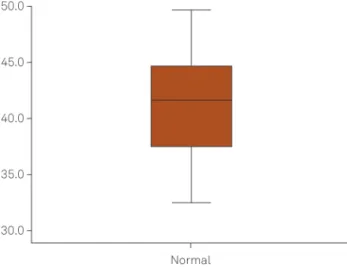
In the normal group (N=53), the age group varied from 7 to 76 years (mean 43.13 and standard deviation (SD) 16.46), 32 subjects were female and 21 were male. Global mean
value of mean PtcCO2was 41,325 (confidence interval 95%
per mean, varying from 40,122 to 42,527). Standard deviation
was 4,363 and 2swas used for calculation of standard
devi-ation, considering as normality interval values .33.0 and
#50.0 mmHg (Table and Figure 2).
Global mean values of mean PtcCO2of normal patients
presented a behavior with Gaussian distribution. Variability
of PtcCO2during the exam presented a linear pattern,
allow-ing an estimation of the behavioral tendency of
transcuta-neous CO2 during PSG in normal patients. Based on this
tendency, it was possible to establish normative values of
PtcCO2for the normal patients group.
Due to technical difficulties, the capillary blood sample was carried out in only 23 patients; however, the variation
curve of PtcCO2values was similar to that of patients with
a validated transcutaneous technique. Such similarity of behavior was confirmed through ANOVA (sigma between groups 0.615 and F 0.256).
DISCUSSION
The study did not attempt to assess or even correct the
existence of“drift”, since the focus of analysis was the mean
PtcCO2 and not PtcCO2 in punctual analysis during the
night.
These results allow us to conclude that transcutaneous capnography is a noninvasive and totally reliable method. Zavorsky and Yildizdas et all demonstrated that there is no significant variation regarding capillary and arterial
PaCO2, when the capillary blood sample is properly
arteria-lized12. The behavioral similarity between capillary
gasome-try and transcutaneous capnography in normal individuals leads us to discard the need to perform capillary gasometry as validation method of transcutaneous capnography.
Further studies in patient with respiratory sleep disorders such as apnea and hypoventilation (obesity/hypoventilation/ neuromuscular diseases syndrome) may be carried out with
the objective of identifying mean PtcCO2 abnormality
pat-terns during polysomnographic recording13,14.
Acknowledgement
The authors are indebted to Sandro Barbosa de Oliveira for your untiring assistance in the preparation of this manuscript as a statistician.
Figure 1.Normal distribution values for global mean transcu-taneous carbon dioxide pressure (PtcCO2) in the normal group. Standard deviation of ±2s.
Figure 2.Global mean transcutaneous carbon dioxide pressure (PtcCO2)distribution in the normal group. Values ranging from 33.1 to 50.0 mmHg.
References
1. Storre JH, Magnet FS, Dreher M, Windisch W. Transcutaneous monitoring as a replacement for arterial PCO2 monitoring during
nocturnal non-invasive ventilation. Respir Med. 2011;105(1):143-50. http://dx.doi.org/10.1016/j.rmed.2010.10.007
2. Hazenberg A, Zijlstra JG, Kertjens HAM, Wijkstra PJ. Validation of a transcutaneous CO2monitor in adult patients with chronic respiratory
failure. Respiration. 2011;81(3):242-6. http://dx.doi.org/10.1159/ 000323074
3. Bland JM, Altman DG. Statistical methods for assessing agree-ment between two methods of clinical measureagree-ment. Lancet. 1986;327(8476):307-10. http://dx.doi.org/10.1016/S0140-6736(86) 90837-8
4. Zavorsky GS, Cao J, Mayo NE, Gabbay R, Murias JM. Arterial versus capillary blood gases: a meta-analysis. Respir Physiol Neurobiol. 2007;155(3):268-79. http://dx.doi.org/10.1016/j.resp.2006.07.002
5. Herrejón A, Inchaurraga I, Palop J, Ponce S, Peris R, Terrádez M et al. Usefulness of transcutaneous carbon dioxide pressure monitoring to measure blood gases in adults hospitalized for respiratory disease. Arch Broncopneumol. 2006;42(5):225-9. http://dx.doi.org/10.1016/ S1579-2129(06)60450-3
6. Berlowitz DJ, Song J, O’Donoghue FJ, Pierce RJ, Brown DJ, Campbell DA et al. Transcutaneous measurement of carbon dioxide tension during extended monitoring: evaluation of accuracy and stability and an algorithm for correcting calibration drift. Respiratory Care. 2011;56(4):242-6. http://dx.doi.org/10.4187/respcare.00454
7. Janssens JP, Perrin E, Bennani I, Muralt B, Titelion V, Picaud C. Is continuous transcutaneous monitoring ofPCO2(TcPCO2) over 8 h
reliable in adults? Respir Med. 2001;95(5):331-5. http://dx.doi.org/ 10.1053/rmed.2001.1045
8. Bollinger D, Steiner LA, Kasper J, Aziz OA, Filipovic M, Seeberger MD. The accuracy of non-invasive carbon dioxide monitoring: a clinical evalua-tion of two transcutaneous systems. Anesthesia. 2007;62(4):394-9. http://dx.doi.org/10.1111/j.1365-2044.2007.04987.x
9. Bendjelid K, Schüts N, Stotz M, Gerard I, Suter PM, Romand J-A. Transcutaneous Pco2 monitoring in critically ill adults: clinical evaluation of a new sensor. Crit Care Med. 2005;33(10):2203-6. http://dx.doi.org/10.1097/01.CCM.0000181734.26070.26
10. Rodriguez P, Lellouche F, Aboab J, Boisson CB, Brochard L. Transcutaneous arterial carbon dioxide pressure monitoring in critically ill adult patients. Intens Care Med. 2006;32(2):309-12. http://dx.doi.org/10.1007/s00134-005-0006-4
11. American Academy of Sleep Medicine. International classification of sleep disorders: diagnostic & coding manual. 2nd ed. Westchester: American Academy of Sleep Medicine; 2005.
12. Yildizdas D, Yapicioglu H, Yilmaz H, Sertdemir Y. Correlation of simultaneously obtained capillary, venous and arterial blood gases of patients in a paediatric intensive care unit. Arch Dis Child. 2004;89(2):176-80. 10.1136/adc.2002.016261
13. Maniscalpo M, Zedda A, Faraone S, Carratù P, Sofia M. Evaluation of a transcutaneous carbon dioxide monitor in severe obesity. Intensive Care Med. 2008;34(7):1340-4. http://dx.doi.org/10.1007/s00134-008-1078-8
14. Midgren B, Hansson L. Changes in transcutaneous PCO2 with sleep in normal subjects and in patients with chronic respiratory diseases. Eur J Respir Dis. 1987;71(5):388-94.